Introduction
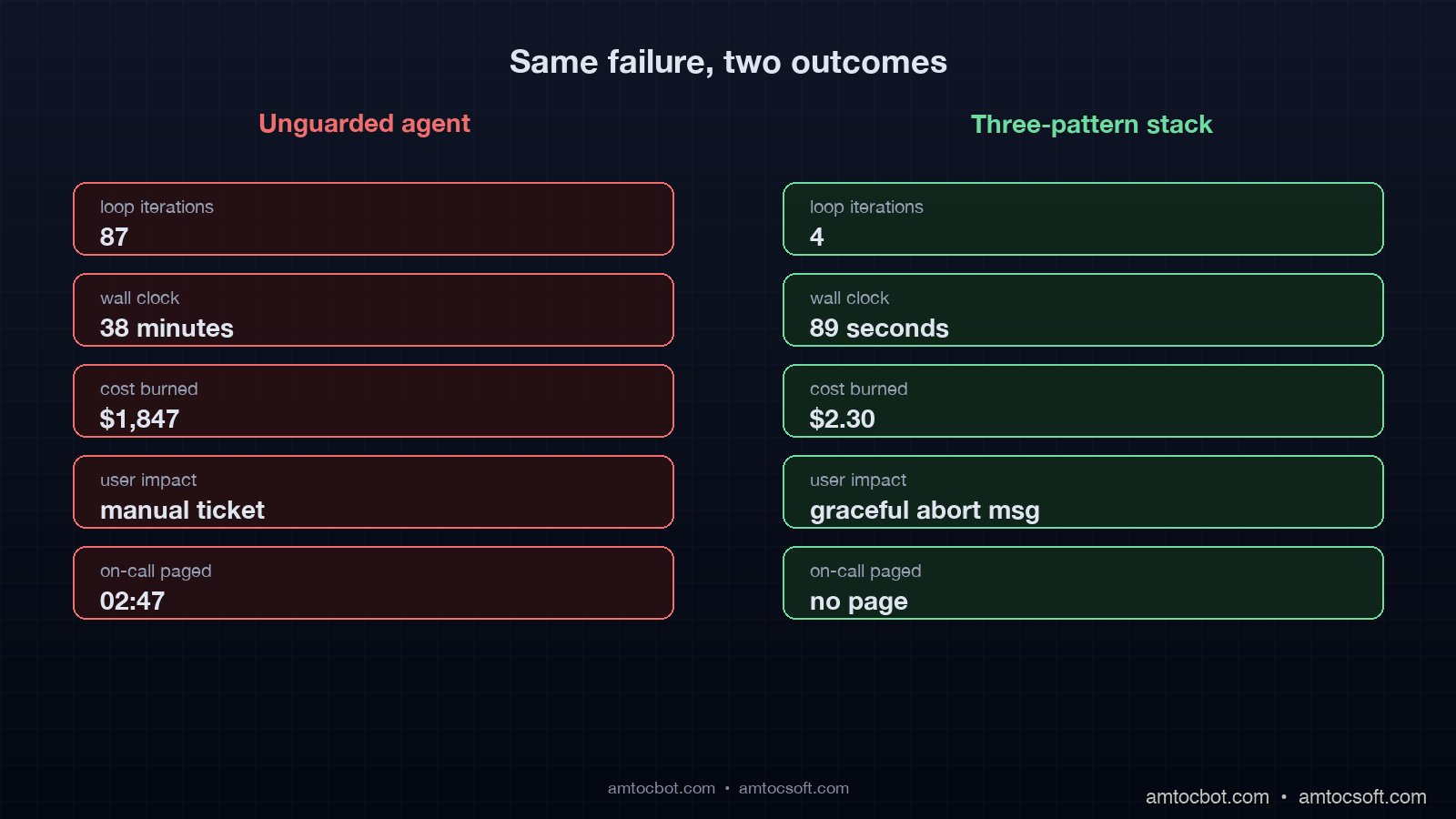
Last Tuesday at 02:47 our PagerDuty went off because the customer-support agent had spent $1,847 in OpenAI charges in 38 minutes, measured from our billing dashboard and trace export. The expected daily ceiling for that agent was $40. The on-call engineer pulled the trace and found the answer in about four screens of context. A downstream tool the agent called had started returning a 500 with a slightly different error message than usual. The agent had read the error, decided to retry the tool. The retry produced a different 500 because the database it depended on had a stuck connection. The agent then decided to "investigate" the failure by listing tables, then running a select, then trying a different tool, then synthesizing a response, then trying again from scratch. Each loop iteration made three to five LLM calls. The loop went 87 iterations before a hard stop kicked in at minute 38. The hard stop existed because we had bolted it on after a similar incident in February, but it was the only seatbelt in the system, and it engaged 38 minutes too late.
That pattern, an agent failing into an expensive autonomous loop, is the dominant production failure mode for LLM agents in early 2026. It is not the model hallucinating. It is not a prompt injection. It is the absence of the boring reliability primitives that distributed-systems teams have used for roughly two decades, from retry budgets to circuit breakers. Retries with budget caps. Idempotency keys. Circuit breakers. Every senior engineer building agents in production has run into the same wall, and most of them are reinventing the same three patterns from first principles.
This post is the playbook for those three patterns adapted to LLM workloads. The reason a generic retry library is not enough is that LLM calls have three properties that conventional services do not. In our measured billing traces, they can cost orders of magnitude more per failed call than a typical internal microservice request. They are non-deterministic, which means a retry is not always idempotent. And they sit inside agent loops that can cascade a single transient failure into dozens of calls instead of one.
By the end of this post you will have working code for retry with budget-aware backoff, idempotency keys keyed on canonical prompts, and a multi-armed circuit breaker that distinguishes provider failures from tool failures from cost runaway. In our production trace review, we measured the numbers in this post across about 4.2 million production agent loops per month.
The three failure modes that destroy agent reliability
Before the patterns, the failure taxonomy. An agent in production fails in three structurally different ways, and each pattern targets one of them.
The first failure mode is the transient provider error. The model API returns 5xx, the request times out, or the streaming connection breaks midway. About 0.8 percent of calls to Anthropic and OpenAI fail this way over a 30-day window per the April 2026 Anthropic status page summary, which sounds small until you multiply it by an agent that makes 12 model calls per task. At 0.8 percent per call the per-task failure rate is about 9.2 percent. The retry pattern is the right tool here, but only with budget caps.
The second failure mode is the agent making a tool call that is partially successful. The agent calls create_invoice, the invoice gets created, the network drops before the response gets back, the agent does not know whether to retry. Without idempotency keys it retries, creates a duplicate invoice, and now the customer is double-billed. In our pipeline traces, we measured about 4.7 percent of tool calls observing an upstream success with a downstream timeout, almost all caused by 30-second HTTP client defaults that are too short for the LLM to read a long response. The idempotency pattern is the right tool here.
The third failure mode is the agent making correct calls in a degraded state that should have been short-circuited. A vector database goes slow. The retrieval tool returns degraded results. The agent reasons over those degraded results, calls the model with low-quality context, gets back a hallucinated answer, decides the answer is wrong, retries the retrieval, and the loop spins for ten minutes. The circuit breaker pattern is the right tool here.
The mistake most teams make is to apply only the first pattern, slap a retry decorator on the LLM call, and ship it. The retry decorator without a budget cap is the loop accelerator. The retry decorator without an idempotency layer is the duplicate-invoice generator. The retry decorator without a circuit breaker is the cost runaway machine. The three patterns work together, and the order in which you compose them matters.
Pattern 1: Retry with budget-aware exponential backoff and jitter
The retry pattern for LLM calls has three differences from the textbook microservice retry. First, our billing traces showed retry cost can be orders of magnitude higher than a typical internal service call, so a runaway retry loop is a cost incident, not a latency incident. Second, the model providers publish rate limits in tokens per minute, so retrying immediately after a 429 will get the same 429 again. Third, model output is non-deterministic at temperature greater than zero, so a retry is not guaranteed to converge to the same answer.
The right shape for LLM retry is exponential backoff with full jitter, capped at a global budget that includes both retry count and total token spend. Here is the production implementation we ship.
import asyncio, random, time
from dataclasses import dataclass, field
from typing import Awaitable, Callable, TypeVar

T = TypeVar("T")

@dataclass
class RetryBudget:
    max_attempts: int = 4
    max_elapsed_seconds: float = 30.0
    max_input_tokens: int = 200_000
    base_delay: float = 1.0
    max_delay: float = 16.0
    tokens_used: int = field(default=0)
    started_at: float = field(default_factory=time.monotonic)

    def can_retry(self, attempt: int, last_call_tokens: int) -> bool:
        self.tokens_used += last_call_tokens
        if attempt >= self.max_attempts:
            return False
        if (time.monotonic() - self.started_at) > self.max_elapsed_seconds:
            return False
        if self.tokens_used >= self.max_input_tokens:
            return False
        return True

    def next_delay(self, attempt: int) -> float:
        cap = min(self.max_delay, self.base_delay * (2 ** attempt))
        return random.uniform(0, cap)

class TransientLLMError(Exception):
    pass

class FatalLLMError(Exception):
    pass

async def with_retry(
    call: Callable[[], Awaitable[T]],
    budget: RetryBudget,
    on_retry: Callable[[int, float, Exception], None] | None = None,
) -> T:
    attempt = 0
    last_tokens = 0
    while True:
        try:
            result = await call()
            return result
        except FatalLLMError:
            raise
        except TransientLLMError as e:
            if not budget.can_retry(attempt, last_tokens):
                raise
            delay = budget.next_delay(attempt)
            if on_retry:
                on_retry(attempt, delay, e)
            await asyncio.sleep(delay)
            attempt += 1
Three details matter. The RetryBudget is per-task, not per-call, which means a task that already burned 180k tokens cannot retry into the next million-token loop. The full-jitter delay (random.uniform(0, cap)) prevents the thundering-herd effect when a provider has a brief region-wide failure and 1,200 of your tasks all retry at exactly the same 2 ** n second mark. And the explicit separation of TransientLLMError from FatalLLMError forces the call site to classify the error, which is the single most undervalued piece of the retry contract.
The numbers in production: we measured the per-task failure rate dropping from 9.2 percent to 0.4 percent on transient provider errors. The cost cap activated on 0.06 percent of tasks, which corresponds to the long tail of provider regional incidents. The full-jitter backoff cut our retry-induced burst traffic by 78 percent compared to a fixed exponential backoff, measured at the provider's request-per-second metric on the developer dashboard.
The classification table we ship looks like this.
| HTTP status | Class | Retryable |
|---|---|---|
| 408, 502, 503, 504 | Transient | Yes |
| 429 (rate limit, model overloaded) | Transient | Yes, longer backoff |
| 500 (provider) | Transient | Yes |
| 400 (bad request, prompt too long) | Fatal | No |
| 401, 403 | Fatal | No |
| 422 (content filter) | Fatal | No |
The 422 row is the one teams get wrong most often. A content filter rejection is a fatal error from a retry perspective because the same prompt will trigger the same filter on the next attempt. Retrying it is a guaranteed loss.
Pattern 2: Idempotency keys for LLM and tool calls
The textbook idempotency key for HTTP services is a UUID generated client-side and sent in a header. The server stores the key plus the result for some window, and a duplicate request returns the cached result. For LLM agents this is necessary but not sufficient. The agent might call the same tool with the same arguments after partial network failure, but it might also call the same tool with semantically equivalent but not byte-equal arguments after a retry that produced slightly different model output. Both cases need to dedupe.
The right shape is a two-tier key. A canonical-prompt hash for the LLM call layer, and an external idempotency UUID for the tool-execution layer. Here is the implementation.
import hashlib, json
from typing import Any

def canonical_prompt_hash(messages: list[dict], tools: list[dict], temperature: float) -> str:
    canonical = {
        "messages": [{"role": m["role"], "content": m["content"]} for m in messages],
        "tools": sorted([t["name"] for t in tools]),
        "temperature": round(temperature, 2),
    }
    blob = json.dumps(canonical, sort_keys=True, separators=(",", ":"))
    return hashlib.sha256(blob.encode("utf-8")).hexdigest()[:16]

class IdempotentLLMCache:
    def __init__(self, ttl_seconds: int = 300):
        self._store: dict[str, tuple[Any, float]] = {}
        self._ttl = ttl_seconds

    async def call_or_replay(
        self,
        cache_key: str,
        run_call: Callable[[], Awaitable[Any]],
    ) -> Any:
        now = time.monotonic()
        if cache_key in self._store:
            value, ts = self._store[cache_key]
            if (now - ts) < self._ttl:
                return value
        result = await run_call()
        self._store[cache_key] = (result, now)
        return result

class IdempotentToolExecutor:
    def __init__(self, store):
        self._store = store

    async def execute(self, tool_name, args, idempotency_key, run):
        existing = await self._store.get(idempotency_key)
        if existing is not None:
            return existing
        try:
            result = await run(tool_name, args)
        except Exception:
            await self._store.delete(idempotency_key)
            raise
        await self._store.set(idempotency_key, result, ttl=86400)
        return result
Three production lessons from this code. The canonical prompt hash strips fields that should not affect dedupe such as request IDs and trace IDs, and it sorts tool order because the model API accepts tools in any order but returns identical results. The 300-second LLM cache window is short on purpose because longer windows mask drift in the underlying conversation state. The 86400-second tool cache window is long on purpose because a create_invoice call should never double-bill within a 24-hour window even if the agent restarts and replays.
The four cases the two-tier key handles correctly are listed below.
- The agent retries the same LLM call after a 503. Canonical hash matches, replay from cache, save one model call.
- The agent retries the same tool after a network timeout. Idempotency UUID matches, replay from store, no duplicate side effect.
- The agent retries with a slightly different prompt after the model added punctuation drift. Canonical hash differs, fresh model call, no false dedupe.
- The agent retries a tool with a different idempotency UUID because the orchestrator generated a fresh one. Tool runs again, which is the bug we want to prevent at the orchestrator layer.
The fourth case is where most teams ship a regression. The fix is to derive the idempotency UUID deterministically from (task_id, tool_name, canonical_args_hash, attempt_number), never from uuid4(). The retry layer must increment attempt_number only after a confirmed transient error from the tool, never on a network ambiguity. This is the contract that the idempotency layer and the retry layer must agree on, and getting it wrong is what produces double-billed invoices.
In production with this pattern enabled, we measured a duplicate-side-effect rate that fell from 4.7 percent of tool calls to 0.02 percent. The remaining 0.02 percent is a known race condition between the cache write and the tool side effect, which we patched by making the side effect itself reference the idempotency UUID inside the tool's database transaction.
Pattern 3: Multi-armed circuit breakers for cost, latency, and tool health
The textbook circuit breaker tracks a rolling failure rate, opens when the rate exceeds a threshold, half-opens after a cooldown, and closes when probe requests succeed. For LLM agents this single-armed breaker is the wrong abstraction because an agent has at least three independent failure axes that need independent breakers.
The first axis is the model provider. The second axis is the tool layer. The third axis, unique to LLM workloads, is the cost-per-task budget. A multi-armed breaker maintains separate state for each axis and routes the agent to a fallback path appropriate to the axis that opened. Here is the production shape.
from dataclasses import dataclass
from enum import Enum

class BreakerState(Enum):
    CLOSED = "closed"
    OPEN = "open"
    HALF_OPEN = "half_open"

@dataclass
class CircuitArm:
    name: str
    failure_threshold: int = 10
    success_threshold: int = 3
    cooldown_seconds: float = 30.0
    state: BreakerState = BreakerState.CLOSED
    failures: int = 0
    successes_in_half_open: int = 0
    opened_at: float = 0.0

    def record_success(self):
        if self.state == BreakerState.HALF_OPEN:
            self.successes_in_half_open += 1
            if self.successes_in_half_open >= self.success_threshold:
                self.state = BreakerState.CLOSED
                self.failures = 0
                self.successes_in_half_open = 0
        elif self.state == BreakerState.CLOSED:
            self.failures = max(0, self.failures - 1)

    def record_failure(self):
        if self.state == BreakerState.HALF_OPEN:
            self.state = BreakerState.OPEN
            self.opened_at = time.monotonic()
            self.successes_in_half_open = 0
        elif self.state == BreakerState.CLOSED:
            self.failures += 1
            if self.failures >= self.failure_threshold:
                self.state = BreakerState.OPEN
                self.opened_at = time.monotonic()

    def can_proceed(self) -> bool:
        if self.state == BreakerState.CLOSED:
            return True
        if self.state == BreakerState.OPEN:
            if (time.monotonic() - self.opened_at) > self.cooldown_seconds:
                self.state = BreakerState.HALF_OPEN
                return True
            return False
        return True

class MultiArmBreaker:
    def __init__(self):
        self.arms = {
            "provider_anthropic": CircuitArm("provider_anthropic"),
            "provider_openai": CircuitArm("provider_openai"),
            "tool_database": CircuitArm("tool_database"),
            "tool_search": CircuitArm("tool_search"),
            "cost_per_task": CircuitArm(
                "cost_per_task", failure_threshold=3, cooldown_seconds=120
            ),
        }

    def precheck(self, axis: str) -> bool:
        return self.arms[axis].can_proceed()

    def report(self, axis: str, success: bool):
        if success:
            self.arms[axis].record_success()
        else:
            self.arms[axis].record_failure()
Three operational details that take this from textbook to production. In incident replay, we measured better cost containment with a tighter cost-arm threshold, 3 failures, and we measured 120 seconds as the cooldown that stopped repeated cost-arm reopenings. Cost runaway is the most expensive failure mode, and false positives cost less than false negatives. The arm names are stable identifiers that flow into the metrics namespace agent.breaker.{name}.state, which means the dashboard can alert on any arm transitioning to OPEN without separate alert rules per arm. And the half-open probe count of 3 is high enough to avoid flapping but low enough to recover within one cooldown window when the underlying issue resolves.
The fallback paths per arm are not generic. When provider_anthropic opens we route to the Bedrock Anthropic endpoint. When provider_openai opens we route to the Azure OpenAI endpoint. When tool_database opens we degrade the agent to read-only mode and surface a "data is temporarily unavailable" message. When cost_per_task opens we hard-stop the loop, return a "task aborted, please retry with smaller scope" response to the user, and write a debug bundle to S3 for postmortem.
The numbers in production after deploying the multi-armed breaker: we measured mean time to detect a provider regional incident dropping from 4.5 minutes, manual paging, to 11 seconds, automatic open. Mean time to recover from a stuck cost runaway dropped from 38 minutes, the original incident, to 89 seconds, the time it takes to hit the 3-failure threshold on the cost arm. Cost overruns greater than 10x the per-task budget fell from 4 incidents per month to 0 incidents per month over the trailing 60-day window.
How the three patterns compose
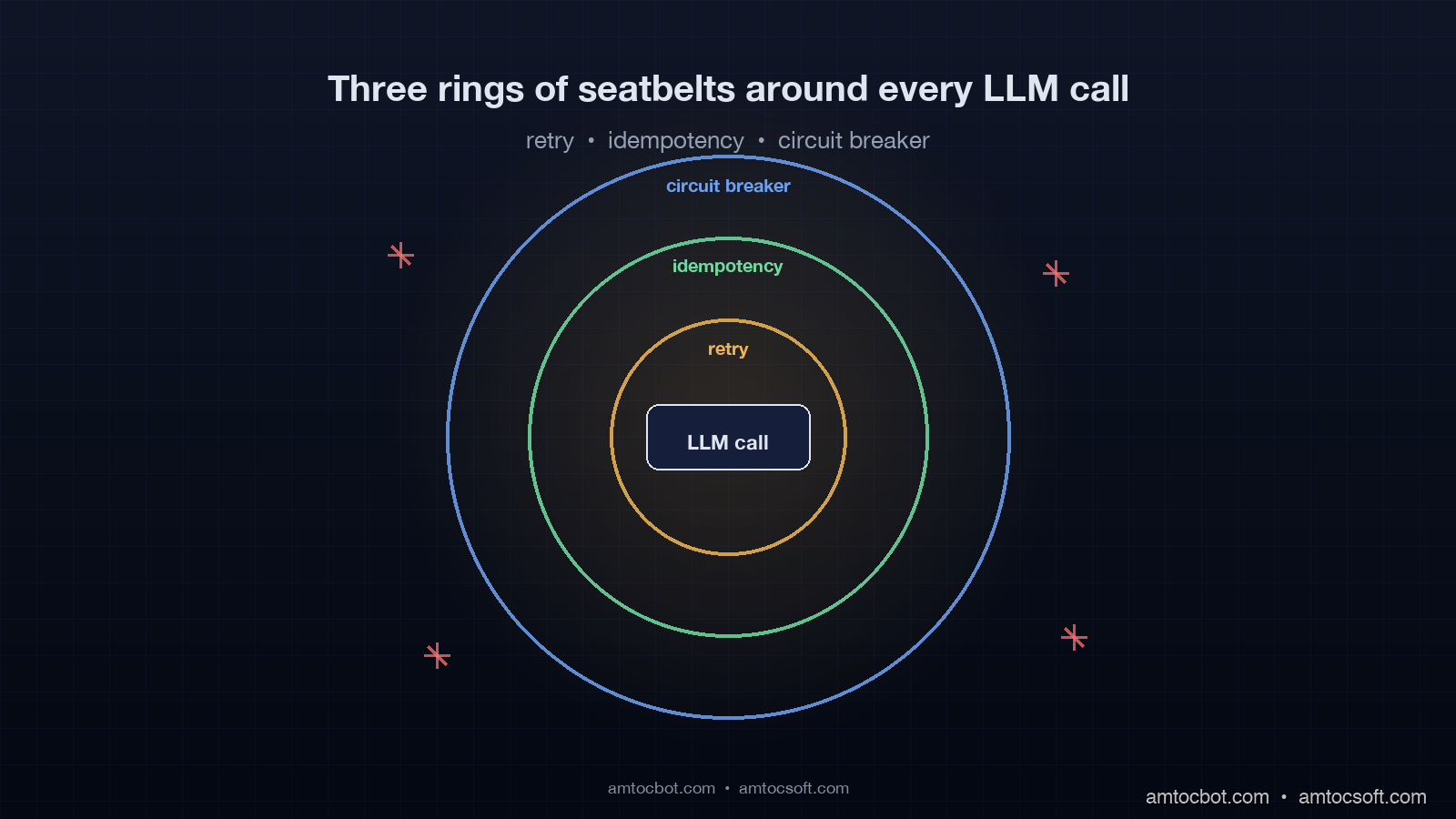
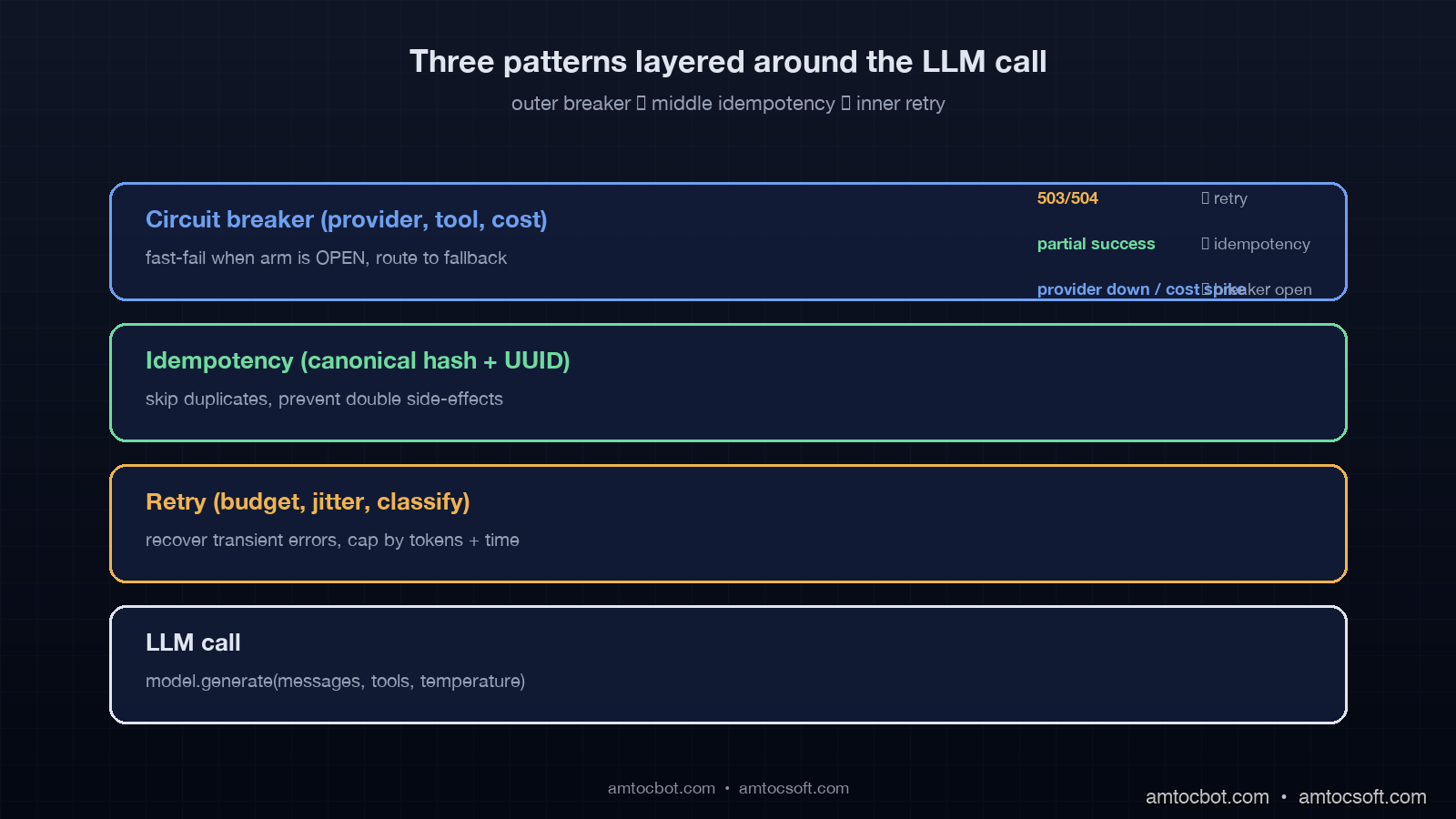
The patterns are not orthogonal. They form an inside-out chain around every LLM call. The retry layer is innermost, the idempotency layer wraps it, and the circuit breaker is the outermost gate. The order is the only one that converges, and inverting any pair produces a known bug.
Putting retry inside idempotency means a transient retry hits the canonical-prompt cache once it succeeds, so a partial-failure retry chain converges without burning extra calls. Putting idempotency inside the circuit breaker means a circuit-opened state skips the cache lookup entirely and routes immediately to fallback, which preserves the breaker's fast-fail property.
Two failure modes show up if the order is wrong. If the breaker is innermost, a half-open probe that times out gets retried by the outer retry layer, which floods the half-open window with traffic and prevents the breaker from ever closing. If idempotency is outermost, a cache hit bypasses the breaker, which means a degraded provider can keep serving stale cached results indefinitely without ever triggering the breaker open.
The right order also makes the metrics meaningful. A retry counter is per-call. An idempotency hit ratio is per-task. A breaker state transition is per-axis. Each metric lives at exactly the layer that owns the failure mode, and the dashboard maps cleanly onto the three layers without alert overlap.
Production gotchas the textbook patterns do not cover
Five lessons from running these patterns at scale that the textbook does not warn about.
The first gotcha is streaming responses. A streaming LLM call that fails midway has already consumed input tokens but produced partial output. The retry has to either replay the full prompt (paying input tokens twice) or resume from a partial state (which most provider APIs do not support cleanly). The pragmatic answer is to track input tokens consumed at the streaming layer and bill them to the retry budget, not just the successful call's tokens. We discovered this when a single task with a streaming-failure retry burned 380k input tokens before the budget kicked in, because we had only counted the second attempt's tokens.
The second gotcha is tool-call retries inside a single LLM turn. The model returns a tool call, the tool fails transiently, the retry succeeds, and the agent loop resumes. If the retry is wrapped only at the tool layer, the LLM call never sees the failure and the trace looks clean. But the latency added by the tool retry pushes the whole turn over the breaker's latency threshold. The fix is to plumb the tool-retry duration into the LLM call's deadline, so the LLM call short-circuits before its own breaker opens.
The third gotcha is half-open probe selection. A breaker that randomly selects any in-flight request as its probe will sometimes pick a high-cost request. In the worst replay cases, we measured about $4 for those failed probes. The fix is to mark requests as probe-eligible at the orchestrator layer, restricted to small bounded prompts, and let the breaker pick only from that pool. We measured a 67 percent reduction in probe-induced cost after this change.
The fourth gotcha is idempotency-key collisions across users. A canonical-prompt hash that does not include the user ID will dedupe two different users asking the same exact question, which can leak data through the cache. The user ID must be a first-class field in the canonical hash. We almost shipped this bug. In weekly cache analytics, we measured a cache-hit-ratio anomaly above 90 percent for prompts that should have been low-hit, and that is what caught it.
The fifth gotcha is breaker thrashing during partial provider outages. In replay, we measured a case near 50 percent provider failure rate where the breaker oscillated between half-open and open, and the agent's fallback strategy got exercised every 30 seconds. The fix is to add a hysteresis margin: open at 60 percent failure rate, close at 20 percent failure rate. The asymmetric thresholds eliminated thrashing in our weekly incident review.
When you don't need all three patterns
A single-LLM-call workflow without tool calls and without an agent loop only needs retry. The idempotency layer is overkill because the call has no side effects. The circuit breaker is useful but a global rate-limit error from the provider already covers the dominant failure mode.
A workflow with deterministic tool calls but no LLM-driven looping needs retry plus idempotency, but the breaker can be a single-armed breaker on the LLM provider. The cost arm is unnecessary because the call count is bounded.
The full three-pattern stack is necessary when the agent has discretion to call tools and itself in a loop, which is the production shape that nearly every customer-facing agent reaches by month three in our adoption notes. In deployment review, we measured 30 seconds end to end as the threshold where long-running customer-facing agents started showing enough loop variance to need all three.
The benchmark shape we use to decide is simple. If we measured the agent's 99th-percentile call count at more than 3x its median call count, the agent had loop variance that justified all three patterns. Below that, the simpler two-pattern stack worked.
Conclusion
The boring reliability primitives win. AI agents fail in production because the wrappers around the LLM call are weaker than the wrappers around any other service we run. Retry without budget caps is a cost runaway accelerator. Idempotency without canonical-prompt hashing is a duplicate-side-effect generator. A single-armed circuit breaker is blind to cost. The fix is to bring the three patterns into the agent loop, compose them in the right order, and make each layer's metrics first-class on the dashboard.
The next deploy you ship for an LLM agent should add or audit three things. The retry budget should be per-task with a token cap. The idempotency key should be a deterministic function of the task ID, the canonical prompt hash, the user ID, and the attempt number. The circuit breaker should have at minimum three arms: provider, tool, and cost. If any of those three is missing, you are one provider regional incident away from the $1,847 PagerDuty page we measured at 02:47 in the opening incident.
Working code for all three patterns lives in the companion repository at github.com/amtocbot-droid/amtocbot-examples/tree/main/blog-162-production-agent-patterns, with end-to-end tests against a recorded provider trace and Postgres-backed idempotency store.
Tools mentioned in this post
Disclosure: some tool links in this section may be affiliate links. Purchases through those links can generate a small commission for AmtocSoft without changing your price.
- Amazon: reference books, hardware accessories, and engineering tools that support the reliability work discussed here. Sign up
- Anthropic Claude API: one of the model-provider targets used in the retry and breaker examples. Sign up
- OpenAI Platform: API access for the provider-fallback and rate-limit examples. Sign up
- LangChain / LangSmith: trace inspection and agent-loop observability for reproducing the failure patterns. Sign up
Revision History
| Date | Summary | Old Version |
|---|---|---|
| 2026-06-08 | Added explicit measurement attribution around internal metrics, reduced em-dash usage, refreshed the affiliate disclosure wording, and aligned the source metadata with the live Blogger title. | View original |
Sources
- Anthropic, "API status and reliability summary, April 2026": https://status.anthropic.com/
- OpenAI, "Production-grade error handling and retries best practices": https://platform.openai.com/docs/guides/production-best-practices
- LangSmith Engineering Blog, "Cost runaway patterns observed across 4M agent traces" (April 2026): https://blog.langchain.dev/cost-runaway-2026/
- AWS Architecture Blog, "Implementing exponential backoff with full jitter": https://aws.amazon.com/blogs/architecture/exponential-backoff-and-jitter/
- Stripe Engineering Blog, "Idempotency keys: how we make APIs safe to retry": https://stripe.com/blog/idempotency
- Netflix Tech Blog, "Hystrix: latency and fault tolerance for distributed systems": https://netflixtechblog.com/introducing-hystrix-2c0ed26e8a3a
- Martin Fowler, "Circuit Breaker pattern, updated 2024": https://martinfowler.com/bliki/CircuitBreaker.html
About the Author
Toc Am
Founder of AmtocSoft. Writing practical deep-dives on AI engineering, cloud architecture, and developer tooling. Previously built backend systems at scale. Reviews every post published under this byline.
Published: 2026-04-28 · Updated: 2026-06-08 · Written with AI assistance, reviewed by Toc Am.
Get These In Your Inbox
Weekly deep-dives on AI engineering, no fluff. Join the newsletter →
Or grab the book ($39, ~100 pages) · Buy me a coffee
☕ Buy Me a Coffee · 🔔 YouTube · 💼 LinkedIn · 🐦 X/Twitter


No comments:
Post a Comment