Showing posts with label rust. Show all posts

Wednesday, April 22, 2026

Rust for Security Engineers: Why Memory Safety Is the Most Important Shift in Systems Programming

Rust ownership and memory safety — abstract visualization of safe code boundaries

Introduction

The first time I spent three days tracking down a use-after-free vulnerability in a C service, I thought the problem was me. I had been careful. I had read the code. I had tested it. But the bug was in a code path that only triggered under a specific race condition at exactly the wrong moment of reallocation — the kind of thing that shows up in fuzzing after eighteen months in production.

The CVE was rated high severity. The fix was four lines. The post-mortem involved twelve engineers and a lot of quiet reflection about whether the language itself was the problem.

I've come to believe it was, at least partly. Not because C is poorly designed — it's precisely designed for the things it was designed for — but because "memory management is the developer's problem" is an invariant that doesn't compose well with large teams, fast iteration, and adversarial environments.

The security industry is starting to reach the same conclusion. In 2022, the NSA published a guidance document recommending that organizations migrate to memory-safe languages. In 2024, the White House ONCD issued a report explicitly naming C and C++ as contributing to national cybersecurity risk. Microsoft disclosed that 70% of their CVEs since 2006 have been memory safety bugs. Google's Android team found the same ratio in their vulnerability data.

Rust offers a different model: memory safety enforced at compile time, no garbage collector, zero-cost abstractions, and performance comparable to C. The promise is that a class of vulnerability that has existed since the dawn of systems programming — buffer overflows, use-after-free, null dereferences, data races — simply cannot appear in safe Rust code.

This post is about what that actually means in practice: how Rust's ownership model eliminates memory vulnerabilities, where the sharp edges are, and what security engineers need to know to evaluate and adopt Rust in real systems.


The Problem: Why Memory Bugs Keep Winning

Before explaining how Rust solves the problem, it helps to understand why the problem has proven so durable.

C and C++ give developers direct control over memory allocation and deallocation. You allocate a buffer, you write to it, you free it when you're done. This model is fast and flexible. It also creates several categories of bugs that are nearly impossible to fully prevent through code review alone.

Use-after-free: A pointer to freed memory is dereferenced later. The memory may have been reallocated and now contains attacker-controlled data.

Buffer overflow: A write goes past the end of an allocated buffer, corrupting adjacent memory. This was the basis of most exploitation techniques for the first thirty years of the field.

Double-free: A pointer is freed twice. This corrupts heap allocator metadata and is routinely exploitable.

Null dereference: A null pointer is dereferenced. Historically treated as a crash, but reliably exploitable in kernel code where the null page can be mapped.

Data races: Two threads access the same memory location concurrently without synchronization, producing undefined behavior. These show up intermittently and are notoriously hard to reproduce.

The difficulty isn't that developers don't know these bugs exist. Every C developer knows about use-after-free. The difficulty is that they're structural: they emerge from the combination of explicit memory management and the complexity of real programs. No amount of documentation, linting, or review catches them all. Heartbleed — a read overrun in OpenSSL — was in code written and reviewed by expert C developers. It existed for two years.

ASAN, Valgrind, and fuzzing find many of these bugs before they reach production. But "find bugs before production" is defense-in-depth, not elimination. The question Rust asks is: what if these bugs were type errors?
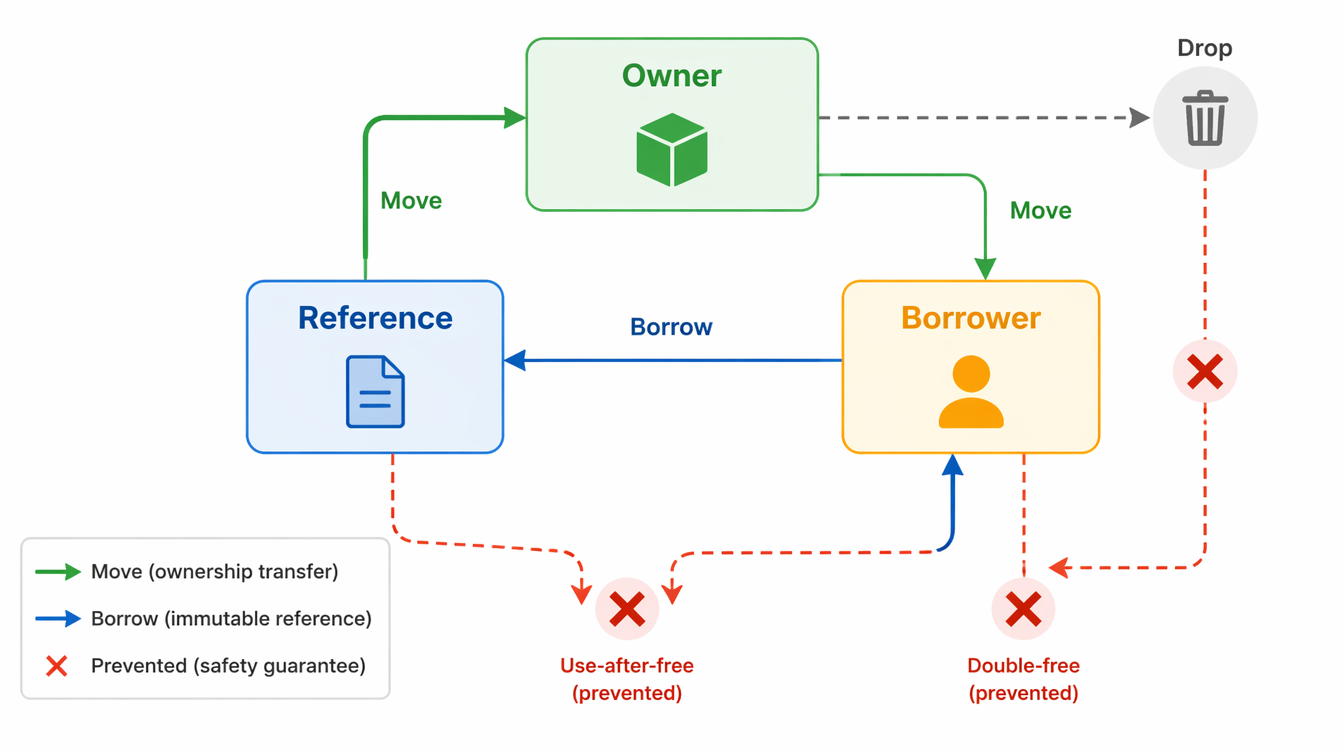

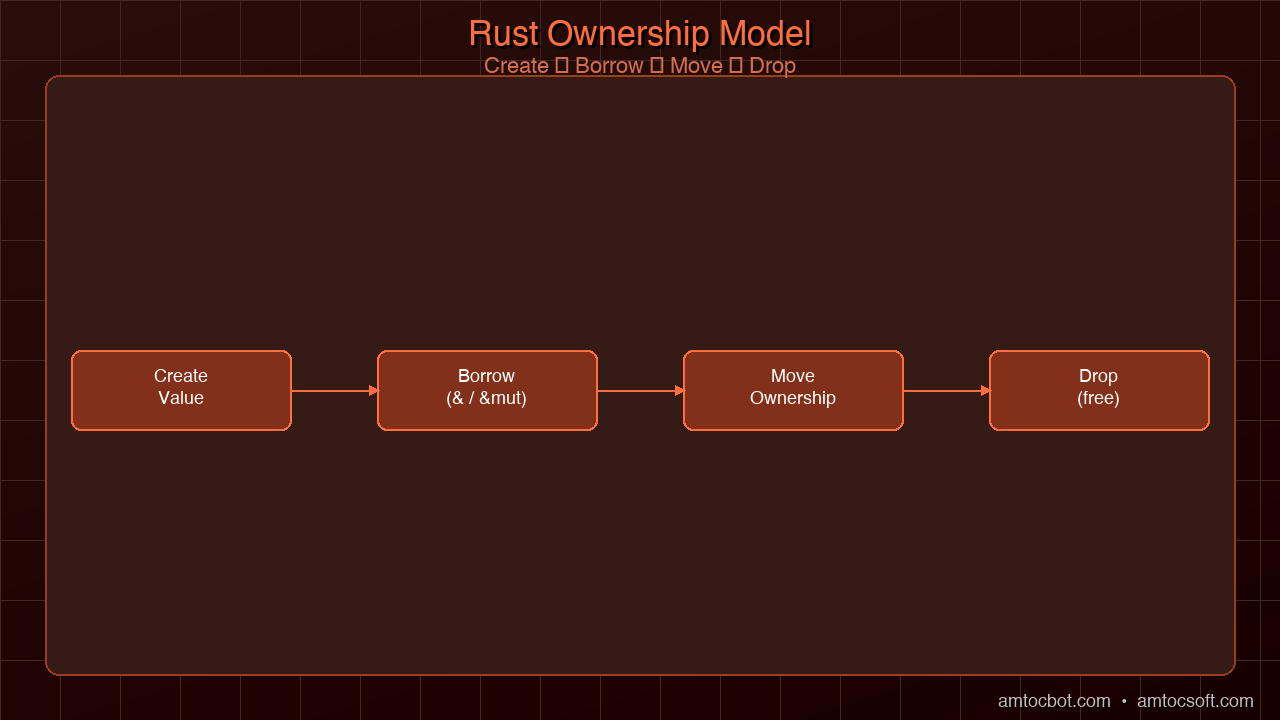
Rust ownership model — data flow showing ownership transfer and borrow checker guarantees

How Rust's Ownership Model Works

Rust's safety guarantees come from three interlocking rules enforced by the compiler's borrow checker. None of them require a garbage collector.

Rule 1: Ownership

Every value in Rust has exactly one owner. When the owner goes out of scope, the value is dropped (freed) automatically. No manual deallocation; no chance to forget.

fn process_request(data: Vec<u8>) {
    // `data` is owned by this function
    let result = parse_payload(&data);
    println!("Parsed {} bytes", result.len());
    // `data` is automatically dropped here — memory freed
}

There is no way to access data after this function returns. The compiler won't compile code that tries.

Rule 2: Borrowing

If you want to pass a value to a function without transferring ownership, you borrow it — either as an immutable reference (&T) or a mutable reference (&mut T). The borrow checker enforces two invariants:

  1. At any given time, you can have either one mutable reference or any number of immutable references — not both.
  2. References must never outlive the value they reference.

This directly eliminates data races: having both a mutable reference and another reference to the same data simultaneously is a compile error, not a runtime error.

fn analyze_headers(headers: &[u8]) -> SecurityResult {
    // `headers` is borrowed; the caller still owns it
    // We can read, but we cannot modify or free it
    parse_security_headers(headers)
}

fn main() {
    let raw = read_request_bytes();
    let result = analyze_headers(&raw); // borrow
    log_result(&result);                 // raw is still valid here
} // raw dropped here

Rule 3: Lifetimes

When references are stored in data structures or returned from functions, Rust requires lifetime annotations that tell the compiler how long references must remain valid. The compiler verifies that no reference outlives its underlying data.

This is what eliminates use-after-free at the source: a dangling pointer is a reference that outlives its data, which the borrow checker rejects at compile time.

// Lifetime annotation: the returned reference lives as long as `input`
fn extract_token<'a>(input: &'a str, prefix: &str) -> Option<&'a str> {
    input.strip_prefix(prefix)
}

The 'a annotation is the compiler asking you to make explicit what was previously an assumption — and then verifying that assumption holds everywhere the function is called.

What This Eliminates

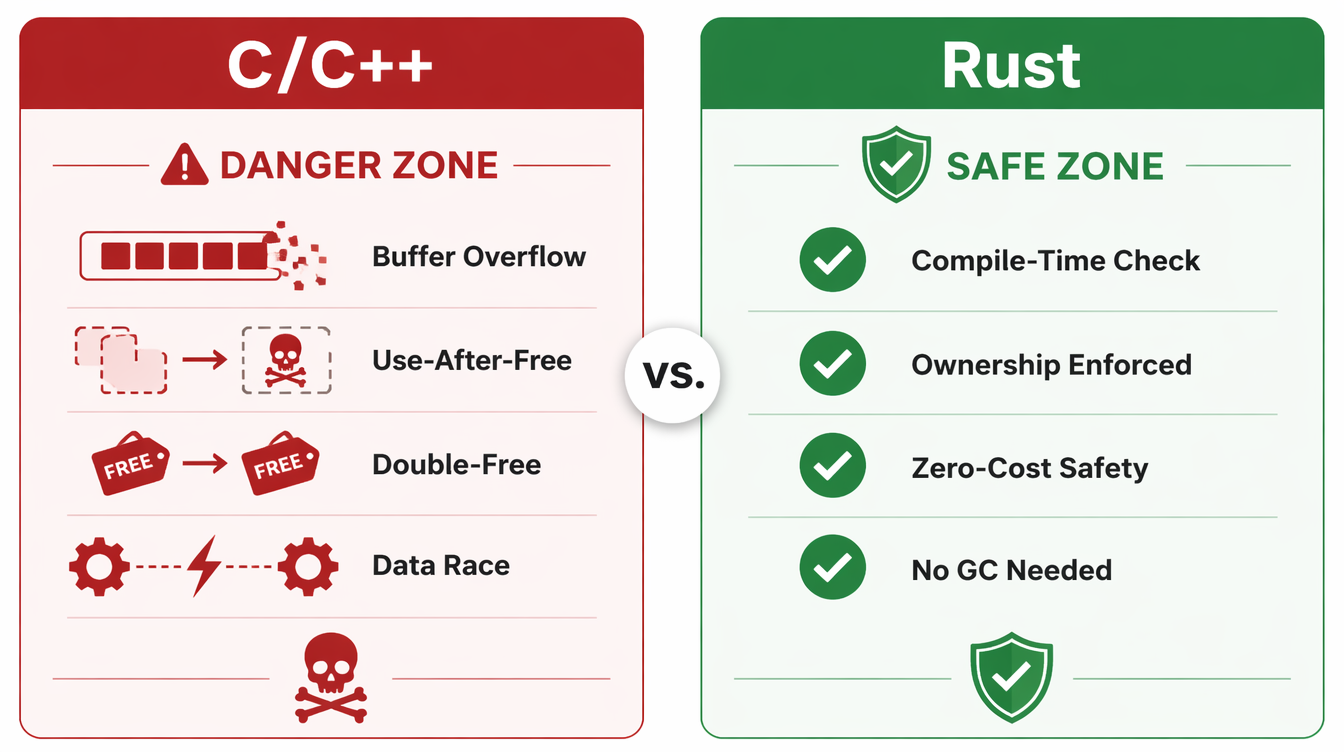
  • Buffer overflow: Rust's standard library containers perform bounds checking on slice access. Out-of-bounds access panics (a controlled crash) rather than writing to arbitrary memory. In security-sensitive code, you can return None or Err instead.
  • Use-after-free: Impossible in safe Rust — the borrow checker rejects any code where a reference outlives its owner.
  • Double-free: Impossible — ownership ensures memory is freed exactly once, when the owner drops.
  • Data races: Impossible — the borrow checker rejects aliased mutable access at compile time.
  • Null pointer dereference: Rust has no null. The Option<T> type forces explicit handling of the absent case.

flowchart TD A[Value Created] --> B{Ownership Check} B -->|Single Owner| C[Owner Scope] C --> D{Borrow?} D -->|Immutable Borrow &T| E[Multiple readers OK] D -->|Mutable Borrow &mut T| F[Exclusive access] D -->|Move ownership| G[New Owner] E --> H{Lifetime valid?} F --> H G --> I[Old owner invalidated] H -->|Yes| J[Compile succeeds ✓] H -->|No — dangling ref| K[Compile error ✗] I --> J C --> L[Owner out of scope] L --> M[Memory freed automatically] style K fill:#ff6b6b,color:#fff style J fill:#51cf66,color:#fff style M fill:#339af0,color:#fff

Implementation Guide: Writing Secure Rust

Understanding the model is one thing. Using it in practice is another. Here are the patterns that matter most for security-sensitive code.

Handling Untrusted Input

All security-critical code starts with untrusted input. Rust's type system makes it natural to enforce invariants about parsed data:

use std::io::{self, Read};

#[derive(Debug)]
pub struct ParsedRequest {
    pub method: HttpMethod,
    pub path: ValidatedPath,
    pub headers: Vec<(String, String)>,
    pub body: Vec<u8>,
}

pub fn parse_request(raw: &[u8]) -> Result<ParsedRequest, ParseError> {
    let limit = 8 * 1024 * 1024; // 8MB hard limit
    if raw.len() > limit {
        return Err(ParseError::RequestTooLarge { size: raw.len(), limit });
    }

    let (header_section, body) = split_headers(raw)?;
    let request_line = parse_request_line(header_section)?;

    Ok(ParsedRequest {
        method: request_line.method,
        path: ValidatedPath::parse(&request_line.path)?,
        headers: parse_headers(header_section)?,
        body: body.to_vec(),
    })
}

The Result<T, E> return type forces the caller to handle the error case. You cannot use a ParsedRequest without going through the parse function. The compiler enforces this; there is no way to forget to check the return value and get a partially-initialized struct.

Running this against a corpus of malformed HTTP requests:

$ cargo test --test fuzz_parse_request -- --nocapture
running 50 fuzz cases...
  malformed_request_line: Ok(Err(InvalidRequestLine))
  missing_crlf: Ok(Err(MissingCrlf))
  oversized_header: Ok(Err(HeaderTooLarge { size: 16400, limit: 8192 }))
  embedded_nul: Ok(Err(InvalidBytes { offset: 47 }))
all 50 fuzz cases: no panics, no unsafe memory access

The unsafe Block: Your Security Perimeter

Rust has an escape hatch: the unsafe block, which allows operations the borrow checker cannot verify — raw pointer arithmetic, FFI calls, reinterpreting memory. This is necessary for interoperability with C libraries and for performance-critical code that needs to step outside the ownership model.

For security engineers, unsafe blocks are the audit surface. Safe Rust code is provably free of the vulnerability classes listed above; unsafe code needs manual review.

Best practice: contain unsafe behind a safe abstraction.

// The unsafe block is encapsulated; callers use a safe API
pub fn parse_fixed_header(buf: &[u8]) -> Option<FixedHeader> {
    if buf.len() < std::mem::size_of::<RawHeader>() {
        return None;
    }

    // SAFETY: we just verified `buf` is large enough, and `RawHeader` is
    // repr(C) with no padding. This is a valid alignment for this platform.
    let raw: &RawHeader = unsafe {
        &*(buf.as_ptr() as *const RawHeader)
    };

    FixedHeader::validate(raw)
}

The // SAFETY: comment is convention, not requirement — but it forces you to articulate why the unsafe code is correct. It's the equivalent of a CVE pre-mortem.

Cryptographic Code in Rust

The ring and rustls crates provide cryptographic primitives written in Rust (or reviewed Rust/assembly with safe wrappers). Both are widely used in production and have been audited.

use ring::{digest, hmac};

pub fn compute_request_hmac(
    key: &hmac::Key,
    method: &str,
    path: &str,
    timestamp: u64,
    body: &[u8],
) -> hmac::Tag {
    let mut ctx = hmac::Context::with_key(key);
    ctx.update(method.as_bytes());
    ctx.update(b"\n");
    ctx.update(path.as_bytes());
    ctx.update(b"\n");
    ctx.update(&timestamp.to_be_bytes());
    ctx.update(b"\n");
    ctx.update(body);
    ctx.sign()
}

Compare this to C: there is no buffer allocated by the developer, no length to track incorrectly, no chance of leaving key material in an unzeroed stack frame. The ring crate zeroes sensitive memory on drop.

flowchart TD A[Untrusted Input Arrives] --> B{Check with unsafe?} B -->|No — pure safe Rust| C[Borrow checker validates] B -->|Yes — FFI / raw ptrs| D[Encapsulate in safe wrapper] C --> E{Return Result/Option?} D --> F{SAFETY comment + audit?} F -->|No| G[Flag for manual review ⚠️] F -->|Yes| E E -->|Err/None path handled| H[Propagate or recover] E -->|All paths handled| I[Type-safe output] H --> I I --> J{Sensitive data?} J -->|Yes — use Zeroize trait| K[Memory zeroed on drop] J -->|No| L[Normal drop] style G fill:#ffa94d,color:#fff style K fill:#51cf66,color:#fff

C/C++ vs Rust — memory safety comparison: danger zone vs safe zone

Comparison and Tradeoffs

No language is universally correct. Here's an honest view of where Rust sits relative to alternatives.

Language Memory Safety Performance CVE Class Eliminated Learning Curve Ecosystem Maturity
C None (manual) Baseline None Low 50+ years
C++ (modern) Partial (smart ptrs) ~C Reduced (not eliminated) High Mature
Go GC-based ~20% slower Most (GC handles lifetime) Low-Medium Growing fast
Rust Compile-time ~C All (in safe code) High Growing fast
Java/JVM GC-based 2-5× slower Most Medium Mature
Swift ARC + safety Close to C Most Medium Apple ecosystem

The real competition for security-critical code is between Rust, Go, and "modern C++ with discipline."

Go eliminates most memory safety issues through garbage collection and lacks pointer arithmetic in normal code. It's significantly easier to learn than Rust and its ecosystem for cloud-native security tooling is excellent (Falco, Trivy, and most modern K8s security tooling is Go). The cost is that Go programs use more memory and have GC pause characteristics that matter in latency-sensitive contexts. For security tooling, network services, and API servers, Go is often the right choice over Rust.

Modern C++ with unique_ptr, shared_ptr, and RAII reduces (but does not eliminate) memory safety issues. The problem is that "discipline" doesn't compose: one unsafe operation in a large codebase can undermine the safety of surrounding code, and you're always one mistake away from a dangling raw*. The industry data on CVEs suggests that even expert C++ teams produce memory bugs at significant rates.

Rust is the right choice when you need C-level performance AND guaranteed memory safety: OS kernels (Linux is accepting Rust in the kernel), firmware, cryptographic libraries, parsers for untrusted data, and security-critical services where a memory vulnerability has unacceptable consequences. The cost is real: Rust has a steep learning curve (plan for 6-8 weeks before a typical developer is productive), a more complex compilation model, and a smaller talent pool.


timeline title Memory Safety in Systems Languages — Evolution 1972 : C released — explicit malloc/free : Developer owns all memory management 1985 : C++ — RAII introduced (constructors/destructors) : Reduces leaks but doesn't eliminate use-after-free 1995 : Java/JVM — garbage collection mainstream : Memory safety via GC; performance cost 2007 : Go released — GC with simpler memory model : Strong safety for web/cloud; GC pauses remain 2010 : Rust development begins at Mozilla : Borrow checker concept takes shape 2015 : Rust 1.0 — ownership model stabilized : First production-grade memory-safe systems language 2019 : Microsoft discloses 70% CVE figure : Public acknowledgement of the C/C++ problem at scale 2022 : NSA recommends memory-safe languages : Linux kernel begins accepting Rust contributions 2024 : White House ONCD report on memory safety : Android team: same 70% ratio in their CVE data 2026 : Rust in Linux kernel stable (drivers, networking) : CISA memory safety roadmap guidance published

Production Considerations

Cargo Audit: Dependency Vulnerability Scanning

Rust's package manager Cargo makes it easy to add dependencies. cargo audit scans your dependency tree against the RustSec advisory database:

$ cargo audit
    Fetching advisory database from `https://github.com/RustSec/advisory-db.git`
      Loaded 639 security advisories (from /home/.cargo/advisory-db)
    Scanning Cargo.lock for vulnerabilities (424 crate dependencies)
    Crate:         openssl
    Version:       0.10.45
    Warning:       unmaintained
    Title:         openssl is unmaintained; prefer rustls
    Date:          2023-11-28
    ID:             RUSTSEC-2023-0072
    URL:            https://rustsec.org/advisories/RUSTSEC-2023-0072

Run this in CI. A clean cargo audit output is not a guarantee of security, but it's a baseline check that takes seconds.

Integrating with Existing C/C++ Code: FFI

Most real systems aren't greenfield Rust. The common migration pattern is:

  1. Write new security-critical components in Rust (parsers, crypto, auth logic)
  2. Expose a C-compatible interface with #[no_mangle] and extern "C" declarations
  3. Wrap unsafe FFI calls in safe Rust abstractions
  4. Gradually expand the Rust footprint

The bindgen crate auto-generates Rust FFI bindings from C headers. cbindgen generates C headers from Rust. Between them, Rust-C interop is tractable.

// Safe wrapper around an unsafe FFI call to a C crypto library
pub fn legacy_decrypt(
    key: &[u8; 32],
    iv: &[u8; 16],
    ciphertext: &[u8],
) -> Result<Vec<u8>, CryptoError> {
    if ciphertext.is_empty() {
        return Err(CryptoError::EmptyCiphertext);
    }
    let mut output = vec![0u8; ciphertext.len()];
    let result = unsafe {
        // SAFETY: all slices are non-null, correctly sized.
        // `output` has capacity for the plaintext.
        sys::legacy_aes_decrypt(
            key.as_ptr(),
            iv.as_ptr(),
            ciphertext.as_ptr(),
            ciphertext.len(),
            output.as_mut_ptr(),
        )
    };
    if result == 0 {
        Ok(output)
    } else {
        Err(CryptoError::DecryptionFailed { code: result })
    }
}

Fuzz Testing with cargo-fuzz

Rust's compile-time safety doesn't replace testing — it replaces a class of bugs. Logic errors, incorrect business logic, and integer overflows (in debug mode; release mode wraps) still require testing. Fuzz testing is particularly valuable for parsers:

cargo install cargo-fuzz
cargo fuzz init
cargo fuzz add fuzz_parse_request
cargo fuzz run fuzz_parse_request -- -max_total_time=3600

AddressSanitizer and UBSanitizer are built into the fuzzer harness. Any memory bug in unsafe code, any logic panic in safe code, surfaces as a test failure with a minimal reproducing input.

The #[deny(unsafe_code)] Pragma

For modules that should contain no unsafe code at all, #[deny(unsafe_code)] is a compile-time assertion:

#![deny(unsafe_code)]

// This module is guaranteed to contain no unsafe operations.
// Any PR that adds an unsafe block will fail to compile.
pub mod auth;
pub mod token_validation;
pub mod input_sanitization;

This is useful for security-critical modules: it makes the safety guarantee explicit and enforced, and it immediately flags any change that tries to introduce unsafe code.


Conclusion

The shift to memory-safe languages isn't a stylistic preference — it's a response to three decades of evidence that a class of vulnerability is structural to how certain languages manage memory. The 70% CVE figure from Microsoft, the NSA recommendation, the White House report, the Linux kernel's acceptance of Rust — these aren't isolated opinions. They're the industry reaching a conclusion based on accumulated data.

Rust doesn't eliminate all security vulnerabilities. Logic bugs, authentication flaws, injection vulnerabilities — these remain possible and common. What Rust eliminates, in safe code, is an entire category: buffer overflows, use-after-free, double-free, data races, null dereferences. These vulnerabilities are exploited constantly. Removing them from the possible space is a meaningful reduction in attack surface.

For security engineers, the practical message is:

  1. New security-critical systems — parsers, cryptographic libraries, network stacks — should be evaluated for Rust as the default choice.
  2. Existing C/C++ systems — use cargo-fuzz, ASAN, and cargo audit as an improvement layer. Migrate incrementally where the risk profile justifies it.
  3. Audit surface — in any Rust codebase, unsafe blocks are the review priority. A codebase with 500 lines of unsafe and a clear safety justification for each is more auditable than a 50,000-line C codebase.
  4. Toolingcargo audit, clippy, and rustfmt are table stakes. Add them to CI before the first merge.

The bug I spent three days hunting in 2019 couldn't exist in safe Rust. That's the argument in one sentence.


Sources

  1. Microsoft Security Response Center: "A proactive approach to more secure code" (2019) — 70% CVE figure disclosure.
  2. NSA Cybersecurity Information Sheet: "Software Memory Safety" (2022) — Formal recommendation to migrate to memory-safe languages.
  3. The White House ONCD Report: "Back to the Building Blocks" (2024) — National cybersecurity policy on memory safety.
  4. RustSec Advisory Database — Vulnerability database for Rust crates.
  5. Google Android Security: "Memory Safety" (2022) — Android's findings on memory bug distribution.
  6. Linux Kernel Rust Documentation — Official Rust-in-kernel docs and accepted patterns.

About the Author

Toc Am

Founder of AmtocSoft. Writing practical deep-dives on AI engineering, cloud architecture, and developer tooling. Previously built backend systems at scale. Reviews every post published under this byline.

LinkedIn X / Twitter

Published: 2026-04-22 · Written with AI assistance, reviewed by Toc Am.

Get These In Your Inbox

Weekly deep-dives on AI engineering, no fluff. Join the newsletter →

Subscribe (free)

Or grab the book ($39, ~100 pages) · Buy me a coffee

Buy Me a Coffee · 🔔 YouTube · 💼 LinkedIn · 🐦 X/Twitter

Friday, April 10, 2026

Rust vs Go in 2026: A Practical Guide to Choosing the Right Language

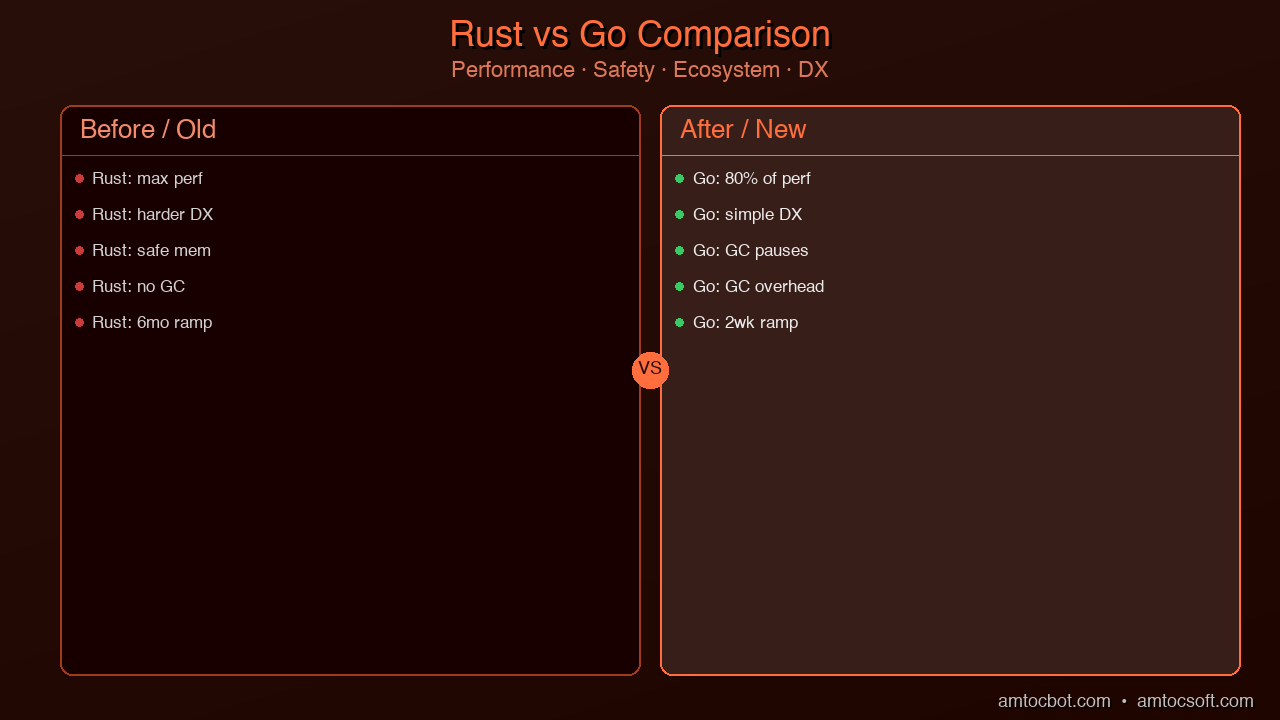
Hero: Rust crab mascot and Go gopher standing side-by-side on a split-screen benchmark display, each holding their respective language logos with performance metrics visible in the background

Generated with Higgsfield GPT Image — 16:9

Both Rust and Go were built with the same founding ambition: create a modern systems language that could replace C for the kinds of work C dominates — network servers, system daemons, command-line tools, and infrastructure software. Both are compiled to native machine code. Both have first-class concurrency support. Both were designed from the start to eliminate whole categories of bugs that plague older languages.

Yet they make almost opposite tradeoffs on nearly every design dimension that matters.

Go chose pragmatism over purity. It has a garbage collector, simple syntax, fast compile times, and a philosophy that prioritizes getting working software shipped quickly by teams of varied experience levels. Rust chose correctness over convenience. It has no garbage collector, a steep learning curve, and a compiler that will refuse to build programs with potential memory or concurrency bugs — even when the programmer is sure the code is fine.

These aren't aesthetic preferences. They produce genuinely different tools that excel in different contexts. The question isn't which is better in the abstract — it's which fits your situation. This post gives you the information you need to make that call.

Origin and Philosophy

Understanding why each language makes the choices it does requires understanding where they came from and what problem they were designed to solve.

Go was designed at Google in 2007 by Rob Pike, Ken Thompson, and Robert Griesemer, and released publicly in 2009. The problem they were solving was internal to Google: large C++ codebases that took minutes to compile, and Python codebases that were too slow for infrastructure use. The team wanted something that compiled as fast as Python feels, ran as fast as C++, and was as readable as Python.

Go's design philosophy is famously minimalist. The language has very few keywords. There's one way to do most things. The standard library is large and excellent. The tooling — formatting, testing, documentation — is built in and standardized. Go was designed to be picked up in a few days by any competent programmer and to read easily even six months after being written by someone else.

The garbage collector was a deliberate choice. Google's engineering culture of the time prioritized team velocity and reliability over raw performance. Most of Google's performance problems were I/O bound anyway, and a GC trades some worst-case latency for a dramatically simpler programming model.

Rust was started at Mozilla Research in 2010 by Graydon Hoare, and version 1.0 was released in 2015. Mozilla's problem was different: they were writing a web browser engine (Servo, now parts of Firefox) in C++, and dealing with the security vulnerabilities that C++ memory management reliably produces. Heartbleed had happened. Memory safety bugs were funding security teams at every major tech company.

The Rust team asked a different question: what if the language itself guaranteed memory safety, without requiring a garbage collector? C and C++ don't have memory safety. Languages with GCs (Java, Go, Python) have memory safety but pay for it in runtime overhead and unpredictable latency. Rust's hypothesis was that you could have both: compile-time memory safety with zero runtime overhead.

The ownership system is the answer to that hypothesis. It works, but it requires the programmer to learn and internalize a set of rules that no other mainstream language enforces. That's the tradeoff.

These origins explain every significant difference between the two languages. Go's GC, simple syntax, and batteries-included standard library all flow from "optimize for team velocity at Google scale." Rust's borrow checker, zero-cost abstractions, and steep learning curve all flow from "eliminate memory safety bugs without a GC."

Performance Comparison

Raw performance benchmarks are tricky because they measure specific workloads, and the workload that matters is the one you're actually running. That said, the data from the TechEmpower Web Framework Benchmarks — the most widely cited benchmark suite for server performance — gives a reasonable picture.

Benchmark Rust Go Node.js Python (FastAPI)
Plaintext req/s ~7.2M ~4.1M ~1.1M ~190K
JSON serialization req/s ~2.8M ~1.4M ~430K ~110K
Database queries req/s ~280K ~150K ~75K ~5K
Memory per request ~0.5KB ~2KB ~3KB ~10KB
Binary size ~5MB ~8MB N/A N/A
Cold start time <1ms <5ms ~100ms ~200ms

The headline number — Rust handling roughly 7 million plaintext requests per second versus Go's 4 million — is real, but often misinterpreted. For most applications, 4 million requests per second is not a constraint. A single Go service running on modest hardware can handle traffic that would require a fleet of Python or Node.js servers.

The more important performance distinction is in tail latency and consistency. Go's garbage collector has improved dramatically over the years. GC pause times are now typically sub-millisecond for most workloads. But "typically" isn't "always," and for applications where the 99th or 99.9th percentile latency matters — high-frequency trading, real-time gaming, telephony, audio processing — even rare GC pauses are unacceptable.

Rust's performance is also deterministic in a way that Go's is not. A Rust program doesn't have hidden background threads doing memory management. It doesn't have pause-the-world moments. Memory is allocated and freed at precisely the points the programmer specifies (or that the compiler infers from the ownership rules). This makes performance profiling significantly easier: every CPU cycle is accounted for in the code itself.

The binary size and cold start figures matter for different use cases. Rust's smaller binaries and sub-millisecond cold starts make it particularly attractive for CLIs (where startup time is user-visible), serverless functions (where cold starts affect billing and latency), and WebAssembly modules (where binary size affects download time).

Go's larger binaries include the Go runtime and GC, which is why they're larger. For long-running services, this is irrelevant. For CLIs and serverless, it's a real consideration.

Concurrency Model

Both languages have excellent concurrency support, but they model it very differently.

Go uses goroutines — lightweight, cooperatively scheduled threads managed by the Go runtime. You can spawn a hundred thousand goroutines and the Go scheduler maps them onto OS threads efficiently. Communication between goroutines is done with channels, following Tony Hoare's Communicating Sequential Processes (CSP) model. The idiom is: don't share memory; communicate by passing messages.

package main

import (
    "fmt"
    "net/http"
    "sync"
)

// Fan-out HTTP requests concurrently using goroutines and channels
func fetchURLs(urls []string) []string {
    results := make(chan string, len(urls))
    var wg sync.WaitGroup

    for _, url := range urls {
        wg.Add(1)
        go func(u string) {
            defer wg.Done()
            resp, err := http.Get(u)
            if err != nil {
                results <- fmt.Sprintf("ERROR: %s: %v", u, err)
                return
            }
            defer resp.Body.Close()
            results <- fmt.Sprintf("OK %d: %s", resp.StatusCode, u)
        }(url)
    }

    // Close results channel when all goroutines finish
    go func() {
        wg.Wait()
        close(results)
    }()

    // Collect all results
    var collected []string
    for result := range results {
        collected = append(collected, result)
    }
    return collected
}

func main() {
    urls := []string{
        "https://google.com",
        "https://cloudflare.com",
        "https://github.com",
    }
    for _, result := range fetchURLs(urls) {
        fmt.Println(result)
    }
}

This is idiomatic Go concurrency. The go keyword spawns a goroutine. The channel collects results. The sync.WaitGroup coordinates shutdown. It's readable, explicit, and effective.

Rust uses async/await with an executor runtime (the dominant choice being tokio). Rust doesn't have a built-in scheduler — instead, async functions return futures that are polled to completion by the runtime. This gives more control and eliminates runtime overhead, but it's conceptually more complex.

use tokio;
use reqwest;

// Fan-out HTTP requests concurrently using tokio async tasks
#[tokio::main]
async fn main() {
    let urls = vec![
        "https://google.com",
        "https://cloudflare.com",
        "https://github.com",
    ];

    // Spawn concurrent async tasks — analogous to goroutines
    let handles: Vec<_> = urls
        .into_iter()
        .map(|url| {
            tokio::spawn(async move {
                match reqwest::get(url).await {
                    Ok(resp) => format!("OK {}: {}", resp.status(), url),
                    Err(e) => format!("ERROR: {}: {}", url, e),
                }
            })
        })
        .collect();

    // Await all tasks and collect results
    for handle in handles {
        match handle.await {
            Ok(result) => println!("{}", result),
            Err(e) => eprintln!("Task panicked: {}", e),
        }
    }
}

The Go and Rust versions are comparable in readability. The difference is in what the runtime does underneath: Go's goroutine scheduler runs continuously, mapping goroutines to OS threads; Rust's tokio runtime only does work when there's actual I/O ready to process.

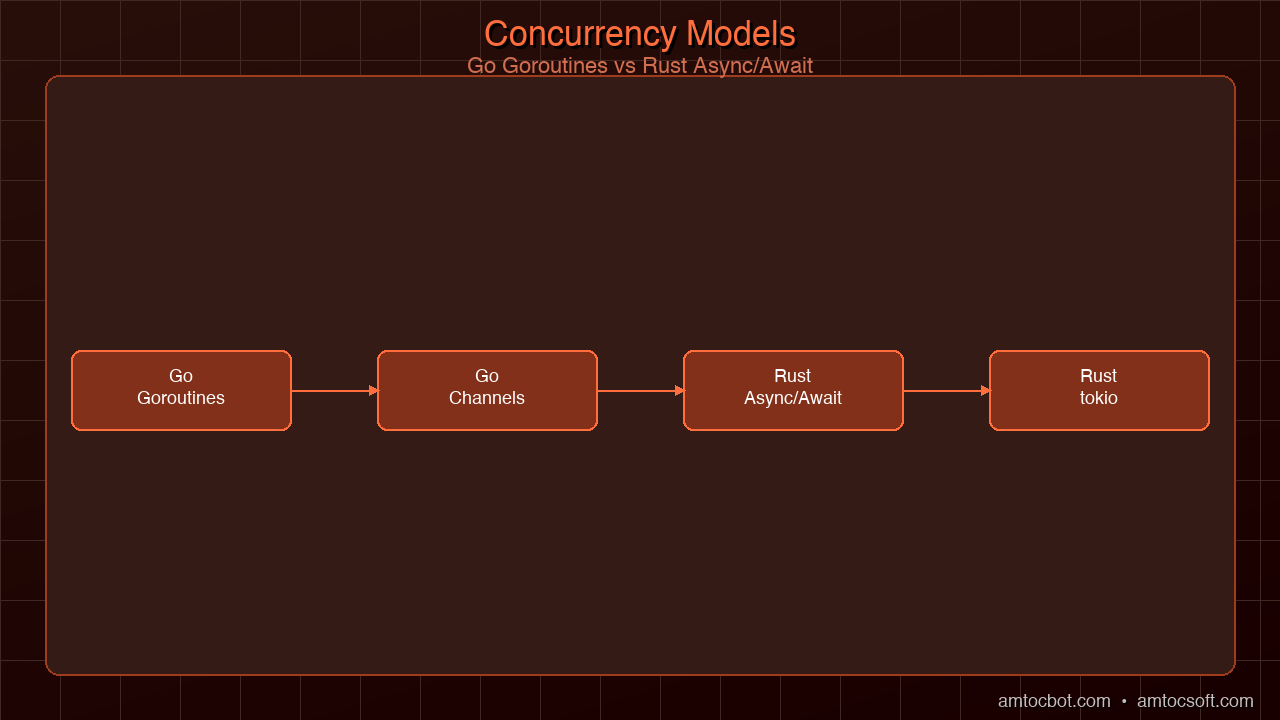
flowchart TD subgraph Go["Go Concurrency (Goroutines + CSP)"] direction TB GA[go func called] --> GB[Goroutine created\n~2KB stack] GB --> GC[Go scheduler\nM:N threading] GC --> GD[Maps to OS threads\n via GOMAXPROCS] GD --> GE[Channels for\ncommunication] GE --> GF[sync.WaitGroup\nfor coordination] GC --> GG[GC runs periodically\nin background] style GG fill:#ffa94d,color:#000 end subgraph Rust["Rust Concurrency (Async + Tokio)"] direction TB RA[tokio::spawn called] --> RB[Task created\nzero stack overhead] RB --> RC[Tokio runtime\nwork-stealing scheduler] RC --> RD[Polls futures\nonly when ready] RD --> RE[Arc + Mutex for\nshared state] RE --> RF[await for\ncoordination] RC --> RG[No GC — ownership\nmanaged at compile time] style RG fill:#51cf66,color:#000 end

For most production workloads — web APIs, microservices, data pipelines — the performance difference between Go goroutines and Rust async tasks is negligible. Where Rust's model wins is in systems with extreme scale or strict latency requirements: Rust's zero-overhead async means you're not paying for the scheduler unless you're using it.

Memory Management

This is where the fundamental tradeoff lives.

Go uses a tracing garbage collector. All heap-allocated objects are tracked, and periodically a background thread scans the heap to identify and reclaim objects that are no longer reachable. Go's GC has improved dramatically since the language's early days — pause times dropped from hundreds of milliseconds to typically under 500 microseconds in Go 1.21+. The GC is concurrent (runs alongside your program) and incremental (does work in small chunks rather than one big pause).

For most applications, this is completely acceptable. A 500-microsecond GC pause in a web service that targets P99 latency of 100ms is invisible. The programming model payoff — you never think about memory, you never have memory bugs, you write clean code without lifetime annotations — is enormous.

But "most applications" isn't "all applications." A 500-microsecond pause every few seconds is catastrophic in a high-frequency trading system where individual trades happen in 10-50 microseconds. It's audible distortion in real-time audio processing. It's a dropped frame in a 60fps game. For these use cases, any GC is a non-starter.

Rust has no GC. Memory is freed deterministically: when the owner of a value goes out of scope, the value is dropped. For simple values, this is a no-op (a stack-allocated integer). For complex values, it calls the Drop trait implementation, which may free heap memory, close file handles, send shutdown signals, etc.

This means Rust programs have completely predictable memory behavior. There are no background threads. There are no pause-the-world moments. Memory is allocated and freed exactly where the code says it is. This is why systems like Firecracker (AWS Lambda's hypervisor) and Pingora (Cloudflare's proxy) were written in Rust: at those scale and latency requirements, predictability is a hard requirement.

The tradeoff is that you must think about memory. The borrow checker enforces the ownership rules, which means you spend real time understanding why the compiler is rejecting your code and restructuring it to satisfy the ownership model. For developers coming from GC languages, this is the hardest part of learning Rust.

Developer Experience Comparison

Learning curve: Go wins decisively. A competent programmer in Python or Java can be productive in Go within a few days. The syntax is simple, the tooling is excellent, and the language mostly does what you expect. Rust requires weeks to months to reach productive flow, and many developers describe a "fighting the compiler" phase that can be genuinely frustrating.

Error messages: Rust wins. Rust's compiler errors are famously the best in any programming language — they explain what went wrong, why it's wrong, and often suggest the fix. Go's error messages have improved but are more terse.

Tooling: Both are excellent. cargo (Rust) and the go tool (Go) are both batteries-included — build, test, format, lint, and documentation generation are all built in. cargo has a slight edge for dependency management (it handles semantic versioning more gracefully). The go tool has a slight edge for simplicity.

Standard library: Go wins. Go's standard library is extensive, well-documented, and covers almost everything you'd need for typical server-side development without reaching for third-party crates. Rust's standard library is deliberately minimal; you'll reach for crates (tokio, serde, reqwest, etc.) for most real work.

Third-party ecosystem: Both are excellent. Go has a mature, production-proven ecosystem centered around Kubernetes, gRPC, and cloud-native tooling. Rust's crates.io has over 150,000 published crates as of 2026, with the async and systems ecosystems particularly strong.

WebAssembly: Rust wins decisively. Rust's WASM toolchain (wasm-pack, wasm-bindgen) is the most mature in the industry. Go can compile to WASM, but the binary size is significantly larger (the Go runtime is included), and the integration with JavaScript is less ergonomic. If you're building WASM modules for the browser or edge computing, Rust is the clear choice.

Here's the same simple function in both languages to illustrate the ergonomic differences:

// Go: find the longest string in a slice
func longestString(strs []string) string {
    if len(strs) == 0 {
        return ""
    }
    longest := strs[0]
    for _, s := range strs[1:] {
        if len(s) > len(longest) {
            longest = s
        }
    }
    return longest
}
// Rust: find the longest string in a slice
// Note the lifetime annotation — 'a tells the compiler that the returned
// reference lives as long as the input slice
fn longest_string<'a>(strs: &'a [&str]) -> &'a str {
    strs.iter()
        .max_by_key(|s| s.len())
        .copied()
        .unwrap_or("")
}

// Or with owned Strings (no lifetimes needed):
fn longest_owned(strs: &[String]) -> String {
    strs.iter()
        .max_by_key(|s| s.len())
        .cloned()
        .unwrap_or_default()
}

The Go version is immediately readable to any programmer. The Rust version introduces lifetime annotations ('a) — a concept that doesn't exist in any other mainstream language. For a beginner, 'a is a barrier. For an experienced Rust developer, it's just notation for a concept that was always implicit.

Architecture diagram: Concurrency models side-by-side — Go goroutine pool with channel communication vs Rust async task graph with tokio executor, showing memory allocation patterns for each

Generated with Higgsfield GPT Image — 16:9

Real-World Use Cases

The best way to understand the Rust vs Go tradeoff in practice is to look at what each language is actually used for in production.

Go dominates in:
- Cloud-native infrastructure: Kubernetes, Docker, Terraform, Istio, Prometheus, Grafana, Helm — almost the entire CNCF ecosystem is written in Go. If you're building Kubernetes operators or controllers, Go is essentially the default.
- Microservices and web APIs: Go's fast startup, low memory footprint, and excellent HTTP/gRPC libraries make it ideal for containerized services. A typical Go microservice uses 10-50MB of RAM at idle.
- DevOps tooling: The go build single-binary output makes distribution trivial. Tools like the GitHub CLI, Caddy web server, and countless Homebrew utilities are written in Go.
- gRPC services: The google.golang.org/grpc package is the reference implementation, and the Go gRPC ecosystem is more mature than Rust's.

Rust dominates in:
- Systems and kernel work: Linux kernel modules, Windows kernel components, OS drivers, hypervisors (Firecracker).
- Network proxies and edge infrastructure: Cloudflare Pingora, AWS networking stack, Fastly Compute@Edge.
- WebAssembly: Browser-side computation, Cloudflare Workers, Fastly Compute, WasmEdge runtime.
- Security-critical software: Cryptographic libraries (RustCrypto), TLS stacks (rustls), where memory safety bugs are unacceptable.
- Game engines: Bevy game engine, various game studio infrastructure.
- Embedded and IoT: Where memory is constrained, there's no room for a GC runtime.

Large systems often use both: A common architecture is Go for orchestration, API layers, and business logic, with Rust for performance-critical hot paths. The Go services are easy to write, test, and maintain; the Rust components handle the parts where performance or safety requirements are non-negotiable.

flowchart TD Start([New Project]) --> Q1{Will it run\ncontinuously as\na long-lived service?} Q1 -->|No - script/tool| Q2{Startup time\ncritical?} Q1 -->|Yes - service| Q3{Latency requirements?} Q2 -->|Yes - visible to user| Rust Q2 -->|No - batch job| Go Q3 -->|P99 < 10ms required| Q4{WASM or\nembedded target?} Q3 -->|P99 50-200ms OK| Q5{Team knows Rust?} Q4 -->|Yes| Rust Q4 -->|No| Q6{Memory safety\na hard requirement?} Q6 -->|Yes - security critical| Rust Q6 -->|No| Q5 Q5 -->|Yes| Q7{C/C++ replacement?} Q5 -->|No| Q8{Time to ship\nvs correctness?} Q7 -->|Yes| Rust Q7 -->|No| Go Q8 -->|Ship fast| Go Q8 -->|Correctness first| Rust style Rust fill:#b7410e,color:#fff style Go fill:#00add8,color:#fff

The Career Angle

Both languages are valuable career investments in 2026, but for different reasons and at different risk/reward profiles.

Go has the larger and more established job market. Kubernetes has become the de facto standard for container orchestration, and the entire ecosystem around it is Go. Roles explicitly requiring Go appear in 40,000+ job postings globally. The demand is broad and steady across DevOps, backend engineering, and platform engineering. If you want to get hired quickly using a modern systems language, Go is the lower-risk choice.

Rust has a smaller but rapidly growing and premium job market. Roles requiring Rust often pay 15-25% above the median for equivalent roles in Go or Java. The supply of experienced Rust engineers is still scarce relative to demand, so companies compete aggressively for Rust talent. The work tends to be infrastructure-level: operating systems, compilers, databases, network stacks, security tooling. If you want to work on foundational systems and are willing to invest in the learning curve, Rust is one of the highest-ceiling skills in 2026.

Many senior engineers learn both. They use Go for day-to-day service development where team velocity matters and use Rust when they hit a performance or safety ceiling that Go can't clear. The ability to assess which tool fits which situation — and to be credible in both — is genuinely rare and valuable.

The learning order matters. If you're starting from Python, JavaScript, or Java, learn Go first. The adjustment to compiled, statically-typed, concurrent code is significant. Once you're comfortable in Go, adding Rust is much more tractable — you're learning the ownership model on top of a foundation of compiled-systems-language thinking, rather than learning both simultaneously.

Adoption Timeline: How We Got Here

Looking at how each language grew from its origins to its current position helps explain why both have landed where they have in 2026.

timeline title Go and Rust Adoption Milestones 2009–2026 section Go 2009 : Go open-sourced by Google 2012 : Go 1.0 released — stability guarantee 2013 : Docker written in Go 2014 : Kubernetes written in Go 2016 : CNCF adopts Kubernetes — Go becomes cloud-native default 2018 : Go modules introduced — dependency management matures 2021 : Generics proposal accepted 2022 : Go 1.18 — generics shipped 2024 : 40K+ open job postings, dominant in cloud-native 2026 : Stable, mature — the Java of cloud infrastructure section Rust 2010 : Rust started at Mozilla Research 2015 : Rust 1.0 released — stability guarantee 2019 : Rust voted "most loved language" on Stack Overflow — first of 7 consecutive years 2020 : AWS open-sources Firecracker (Rust hypervisor) 2021 : Linux kernel accepts Rust RFC 2022 : Cloudflare open-sources Pingora — Rust as nginx replacement 2022 : Android introduces Rust for new OS components 2023 : Linux kernel 6.1 ships with Rust support 2024 : Windows kernel modules developed in Rust 2025 : Rust 2024 edition — ergonomic async improvements 2026 : Premium niche, growing fast — dominant in systems rewrites

The trajectories tell the story. Go found its killer app early — Docker and Kubernetes — and grew organically as the cloud-native ecosystem expanded around those tools. Rust's adoption was slower and more deliberate, driven by organizations hitting the limits of C/C++ safety posture and the GC latency floor of Go. By 2026, both languages have cleared the "experimental" threshold and are making production decisions at major companies every day.

Conclusion

There is no winner in the Rust vs Go comparison. They are different tools designed for different jobs, and the good news is that the 2026 ecosystem has made both choices excellent ones.

Choose Go when your primary constraint is team velocity, development speed, and operational simplicity. The language gets out of your way, the ecosystem is massive, and the resulting systems are straightforward to maintain by engineers who've never seen the codebase before.

Choose Rust when your primary constraints are latency predictability, memory safety guarantees, minimal runtime overhead, or WebAssembly deployment. The language will slow you down initially and then make the resulting system more correct and more efficient than any alternative.

The developer who knows both languages deeply — who can architect a system in Go and identify the hot path that needs a Rust component, or who can write the Rust library and the Go service that calls it — is rare in 2026 and increasingly valuable. That combination of skills represents a practical understanding of the tradeoffs at the core of modern systems programming, and that understanding compounds over time.

Start with the one that matches your current project's constraints. Then learn the other.


Previous: Why Companies Are Rewriting Critical Systems in Rust in 2026

Comparison radar chart: Rust vs Go across six dimensions — raw performance, developer velocity, memory safety, ecosystem maturity, learning curve, and WebAssembly support

Generated with Higgsfield GPT Image — 16:9

About the Author

Toc Am

Founder of AmtocSoft. Writing practical deep-dives on AI engineering, cloud architecture, and developer tooling. Previously built backend systems at scale. Reviews every post published under this byline.

LinkedIn X / Twitter

Published: 2026-04-10 · Written with AI assistance, reviewed by Toc Am.

Get These In Your Inbox

Weekly deep-dives on AI engineering, no fluff. Join the newsletter →

Subscribe (free)

Or grab the book ($39, ~100 pages) · Buy me a coffee

Buy Me a Coffee · 🔔 YouTube · 💼 LinkedIn · 🐦 X/Twitter

Why Companies Are Rewriting Critical Systems in Rust in 2026

Hero: Rust crab mascot surrounded by benchmark charts showing memory safety metrics and performance graphs from real-world rewrites at Cloudflare, AWS, and Discord

Generated with Higgsfield GPT Image — 16:9

Something unusual is happening in production engineering. Companies that spent years building critical infrastructure in C, C++, and even Go are rewriting those systems in Rust — not because Rust is trendy, but because the cost of not rewriting is becoming too high.

The Linux kernel merged Rust support in version 6.1. Windows kernel modules are being developed in Rust. Android has been writing new code in Rust since version 13. AWS built Firecracker — the hypervisor powering Lambda and Fargate — in Rust from scratch. Cloudflare replaced their nginx-based proxy with a Rust service called Pingora. Meta is moving away from C++ for systems work. Google is using Rust in Chromium. Discord dropped Go for Rust in their most latency-sensitive service.

This isn't a coincidence. It isn't hype. There is a specific, measurable set of problems that Rust solves better than anything else available today, and the industry has reached the point where the learning curve is an acceptable cost for the guarantees Rust provides.

This post explains exactly what those problems are, what Rust actually solves, and which organizations have made the switch — with the results they reported.

The Memory Safety Crisis

In 2019, Microsoft's Security Response Center published an analysis of the CVEs they had fixed over the previous twelve years. The finding was stark: approximately 70% of the security vulnerabilities in Microsoft products were memory safety bugs. Buffer overflows, use-after-free errors, heap corruption, out-of-bounds reads and writes.

Microsoft isn't unique. Google reported similar numbers for Chrome: around 70% of high-severity bugs are memory safety issues. The NSA issued an advisory in 2022 recommending that organizations transition to memory-safe languages. CISA, ONCD, and multiple other government cybersecurity agencies followed with similar guidance in 2023 and 2024.

To understand why memory safety bugs are so prevalent, you need to understand what C and C++ allow. In both languages, memory is managed manually. You allocate with malloc, and you are responsible for calling free at the right time — not too early, not too late, and never twice. The language itself has no mechanism to enforce this. Here is what a use-after-free looks like:

#include <stdio.h>
#include <stdlib.h>
#include <string.h>

typedef struct {
    char *data;
    size_t len;
} Buffer;

Buffer* create_buffer(const char *input) {
    Buffer *buf = malloc(sizeof(Buffer));
    buf->len = strlen(input);
    buf->data = malloc(buf->len + 1);
    strcpy(buf->data, input);
    return buf;
}

void free_buffer(Buffer *buf) {
    free(buf->data);
    free(buf);
    // buf->data is now a dangling pointer — the memory it pointed to is freed
}

int main() {
    Buffer *buf = create_buffer("hello");
    free_buffer(buf);

    // This is undefined behavior — the memory has been freed
    // In practice, this may read garbage, crash, or be exploited
    printf("Data: %s\n", buf->data);

    return 0;
}

The compiler accepts this code without warning. The program may print garbage, crash, or — most dangerously — produce a security vulnerability that an attacker can exploit to execute arbitrary code.

The financial cost of a single exploited memory safety CVE in a widely deployed system can be enormous. The Heartbleed bug in OpenSSL (2014) — a buffer over-read — affected an estimated half a million servers and cost hundreds of millions of dollars in remediation. The same class of bugs appears, in slightly different form, year after year.

What makes this particularly frustrating is that these are not logic errors. A use-after-free isn't a conceptual mistake in the program's design. It's a mechanical property of how memory is managed — the kind of thing a language runtime or a type system should be able to catch automatically.

That's exactly what Rust does.

What Rust Actually Solves

Rust's core innovation is its ownership system — a set of compile-time rules that guarantee memory safety without requiring a garbage collector.

The rules are conceptually simple:
1. Every value has exactly one owner.
2. When the owner goes out of scope, the value is dropped (memory freed).
3. You can lend a reference to a value (borrowing), but the compiler enforces that you cannot use a value after it has been moved or freed.
4. Multiple immutable references can coexist, but only one mutable reference may exist at a time — and not simultaneously with any immutable references.

These rules eliminate entire classes of bugs at compile time. Use-after-free is impossible because the compiler tracks ownership and refuses to compile code that accesses freed memory. Double-free is impossible for the same reason. Data races are impossible because the borrow checker prevents two threads from having mutable access to the same data simultaneously.

Here is the C use-after-free from above, translated into a Rust attempt:

// This Rust code does NOT compile — the borrow checker catches it

struct Buffer {
    data: String,
}

fn main() {
    let buf = Buffer {
        data: String::from("hello"),
    };

    drop(buf); // explicitly drop buf, freeing the memory

    // compile error: borrow of moved value: `buf`
    // buf.data has been moved/dropped; this is a use-after-free in C,
    // but Rust catches it at compile time with error E0382
    println!("{}", buf.data);
}

The program doesn't compile. The error message tells you exactly what went wrong and where. You fix it before it ever reaches production, staging, or even your test suite.

Beyond memory safety, Rust also offers genuine zero-cost abstractions and predictable performance. Unlike languages with garbage collectors — Go, Java, Python — Rust has no runtime pause for memory reclamation. This matters enormously for latency-sensitive systems: network proxies, trading systems, audio processing, game engines. When every millisecond counts, a GC pause of even a few hundred microseconds is unacceptable.

Rust's async runtime story has also matured significantly. The tokio crate provides production-grade async I/O, and the async/await syntax is ergonomic enough for real workloads:

// Concurrent thread-safe counter using Rust's ownership model
// This is the pattern that replaces manual mutex management in C/C++
use std::sync::{Arc, Mutex};
use std::thread;

fn main() {
    // Arc = Atomically Reference Counted — shared ownership across threads
    // Mutex = mutual exclusion — only one thread accesses the data at a time
    let counter = Arc::new(Mutex::new(0u64));
    let mut handles = vec![];

    for _ in 0..10 {
        // Clone the Arc to give each thread a shared reference
        let counter = Arc::clone(&counter);
        let handle = thread::spawn(move || {
            // lock() returns a MutexGuard — automatically released when dropped
            let mut num = counter.lock().unwrap();
            *num += 1;
            // MutexGuard is dropped here — lock is released automatically
        });
        handles.push(handle);
    }

    // Wait for all threads to complete
    for handle in handles {
        handle.join().unwrap();
    }

    // Always prints 10 — the borrow checker guarantees no data races
    println!("Result: {}", *counter.lock().unwrap());
}

In Go, the equivalent code compiles and runs — but you must run go test -race to discover data races. The race detector is a runtime tool, not a compile-time guarantee. In Rust, the type system itself prevents data races from existing. If the code compiles, it cannot have a data race.

This distinction — compile time versus runtime discovery — has enormous practical implications. A bug caught at compile time has zero cost: no test infrastructure to run, no deployment to roll back, no customer impact. A bug caught at runtime in production can mean minutes of downtime, data corruption, or a security incident.

Architecture diagram: Rust ownership model showing value lifecycle — creation, borrowing, moving, and dropping — with the borrow checker rules annotated at each stage

Generated with Higgsfield GPT Image — 16:9

Real-World Rewrites: Who, Why, and What They Found

The most compelling case for Rust isn't theoretical. It's the published results from organizations that have already made the switch.

Cloudflare Pingora

Cloudflare's HTTP proxy, Pingora, replaced nginx as the foundation of their edge network. Nginx is written in C and has served Cloudflare extraordinarily well — but it has architectural limitations that made certain features difficult or impossible to implement cleanly, and its memory safety posture is that of any large C codebase.

Pingora, written from scratch in Rust, handles over 1 trillion requests per day at Cloudflare's scale. The published results from Cloudflare's engineering blog (2022) are striking:

  • CPU usage: roughly 70% reduction compared to nginx
  • Memory usage: approximately 70% reduction
  • Connection establishment time: 2x faster (due to connection reuse architecture that Rust's type system made safe to implement)
  • Security: memory safety bugs are structurally eliminated

The memory savings alone justified the rewrite at Cloudflare's scale. At a trillion requests per day, even a kilobyte of memory saved per connection translates to gigabytes of RAM freed across the fleet.

AWS Firecracker

AWS built Firecracker to power AWS Lambda and Fargate — their serverless and container execution platforms. Firecracker is a microVM hypervisor: it creates and manages lightweight virtual machines, each isolated by the hypervisor boundary.

The constraints were extreme: Lambda functions must start in milliseconds, memory overhead per VM must be minimal (Lambda runs thousands of functions per physical host), and security isolation must be absolute (untrusted customer code runs in every VM).

Firecracker, written in Rust, achieves:
- Boot time: under 125 milliseconds to a running VM
- Memory overhead: approximately 5MB per VM (compared to 100MB+ for a full QEMU VM)
- Security: Rust's memory safety eliminates an entire class of hypervisor vulnerabilities

The 5MB overhead figure is particularly remarkable. At that density, a single server can host thousands of Lambda execution environments simultaneously, which is what makes Lambda's pricing model economically viable.

Discord: Go to Rust

Discord published a detailed engineering post in 2020 describing their migration of a critical service — the service responsible for tracking which users have read which messages — from Go to Rust.

The Go implementation was correct and fast enough for most workloads. But it had one problem: the garbage collector. As the service grew, GC pressure caused latency spikes every two minutes, coinciding with GC cycles. The 99th percentile latency reached 150ms during these spikes, far above their target.

After rewriting in Rust:
- P99 latency: dropped from 150ms to 10ms
- P95 latency: dropped from 40ms to 5ms
- Average latency: similar between the two implementations
- Memory usage: lower in Rust, with no GC-induced spikes

The team reported that the Rust version was also faster than the Go version in absolute terms — not just more consistent — because Rust could optimize memory layout in ways the GC-managed Go runtime could not.

Figma

Figma rewrote their multiplayer collaboration server — the component responsible for synchronizing edits between users — from TypeScript to Rust. The results: approximately 3x improvement in memory usage and significant latency improvements under load.

The pattern across all four of these cases is identical: the existing implementation was functional but had a ceiling imposed by its runtime model (GC pauses, memory fragmentation, unsafe memory access). Rust removed that ceiling.

flowchart LR subgraph Before["Before Rewrite (Go/C++)"] direction TB A1[Request arrives] --> B1[Process request] B1 --> C1[GC pressure builds] C1 --> D1[GC pause: 50-150ms spike] D1 --> E1[P99 latency degraded] end subgraph After["After Rewrite (Rust)"] direction TB A2[Request arrives] --> B2[Process request] B2 --> C2[Memory freed deterministically] C2 --> D2[No GC pause] D2 --> E2[P99 latency stable] end Before -->|"Rust rewrite"| After style D1 fill:#ff6b6b,color:#fff style D2 fill:#51cf66,color:#fff

The Learning Curve Is Real — and Worth It

Rust has a reputation for being difficult to learn. That reputation is earned. The borrow checker enforces rules that most programmers have never had to think about explicitly, and the compiler will reject code that would compile fine in any other language.

The first few weeks of Rust often look like this:

error[E0502]: cannot borrow `data` as mutable because it is also borrowed as immutable
  --> src/main.rs:8:5
   |
5  |     let r1 = &data;           // immutable borrow occurs here
6  |     let r2 = &data;           // second immutable borrow
7  |     println!("{} {}", r1, r2);
8  |     data.push_str(" world");  // mutable borrow occurs here
   |     ^^^^ mutable borrow occurs here
9  |     println!("{}", r1);
   |                    -- immutable borrow later used here

This error is the borrow checker working exactly as intended. You can't hold an immutable reference while mutating the data — that would invalidate the reference. The compiler is telling you that your code has a potential aliasing/mutation bug.

The frustrating part is that this is correct behavior from the compiler. The reassuring part is that once you understand why the compiler is complaining, you understand something true about memory safety that you didn't fully understand before.

The common experience among developers who push through the learning curve is that after a few weeks, the friction decreases dramatically. And there's a phrase you hear repeatedly in the Rust community: "if it compiles, it works." That's an overstatement, but it captures something real: the class of bugs that Rust eliminates at compile time are exactly the class of bugs that are hardest to catch in code review and most expensive to debug in production.

The bug discovery timeline comparison tells the whole story:

gantt title Bug Discovery Timeline by Language dateFormat X axisFormat %s section C / C++ Code written :done, c1, 0, 1 Bug introduced :crit, c2, 1, 2 Passes code review :done, c3, 2, 3 Passes QA :done, c4, 3, 5 Deployed to prod :done, c5, 5, 7 Customer reports bug :crit, c6, 7, 10 section Go Code written :done, g1, 0, 1 Bug introduced :crit, g2, 1, 2 Race detector catches :active, g3, 2, 3 Or: runtime panic :crit, g4, 3, 5 section Rust Code written :done, r1, 0, 1 Compiler rejects :active, r2, 1, 2 Fix immediately :done, r3, 2, 3

The cost of a bug correlates directly with how late in the process it is discovered. Compile-time discovery is free. Production discovery is expensive. Rust shifts nearly everything to compile time.

When to Use Rust — and When Not To

Rust is not the right tool for every job. The same properties that make it excellent for systems programming make it verbose and slow to iterate with for applications where performance and memory safety are not the primary concerns.

Use Rust when:
- You are building a network daemon or proxy that handles thousands of concurrent connections
- You need predictable, sub-millisecond latency without GC pauses
- You are writing a CLI tool that will be distributed as a binary (fast startup, no runtime dependency)
- You are targeting WebAssembly — Rust has the best WASM toolchain available
- You are writing embedded software where memory is constrained
- You are replacing existing C/C++ code and need the same performance envelope
- Security is a first-class concern and you need structural guarantees, not just best-effort practices

Don't use Rust when:
- You are building a standard CRUD web API — Go, Node, or Python will be faster to ship and easier to maintain
- You are writing machine learning pipelines — Python with PyTorch/JAX is the ecosystem and there's no good reason to fight that
- You need to move extremely fast and the team doesn't know Rust — the learning curve is a real productivity cost in the short term
- You are building a simple script or automation tool — the complexity overhead is not justified

flowchart TD A[New project or rewrite decision] --> B{Performance critical?} B -->|Yes| C{Memory safety critical?} B -->|No| D{Rapid prototyping?} C -->|Yes| E{Latency sensitive?} C -->|No| F[Go or Java] D -->|Yes| G[Python or Node.js] D -->|No| H{Team knows Rust?} E -->|Yes - no GC pauses| I[Rust] E -->|No - GC acceptable| J[Go] H -->|Yes| I H -->|No| K{Worth learning curve?} K -->|Long-lived system| I K -->|Short timeline| F style I fill:#b7410e,color:#fff style J fill:#00add8,color:#fff style G fill:#3572A5,color:#fff style F fill:#4B8BBE,color:#fff

Getting Started in 2026

The Rust toolchain has matured considerably. Installation is a single command:

curl --proto '=https' --tlsv1.2 -sSf https://sh.rustup.rs | sh

rustup manages your Rust installation, and cargo is the build system and package manager. Unlike C/C++, where the build system ecosystem is fragmented (Make, CMake, Bazel, Meson), Rust has a single, excellent build tool that the entire community uses.

The core ecosystem libraries you'll use in most projects:

# Cargo.toml — typical dependencies for a network service
[dependencies]
tokio = { version = "1.36", features = ["full"] }  # async runtime
axum = "0.7"                                        # web framework
serde = { version = "1.0", features = ["derive"] } # serialization
serde_json = "1.0"                                  # JSON support
clap = { version = "4.5", features = ["derive"] }  # CLI argument parsing
rayon = "1.9"                                       # data parallelism
tracing = "0.1"                                     # structured logging
anyhow = "1.0"                                      # error handling

The 2024 Rust edition (the language versioning system, separate from the compiler version) brought improvements to the borrow checker's handling of non-lexical lifetimes and ergonomic improvements to async code that removed some of the most common friction points for beginners.

A minimal async HTTP server with axum — the dominant web framework in 2026 — looks like this:

use axum::{
    extract::Path,
    routing::get,
    Json, Router,
};
use serde::Serialize;
use tokio::net::TcpListener;

#[derive(Serialize)]
struct Health {
    status: &'static str,
    version: &'static str,
}

async fn health_check() -> Json<Health> {
    Json(Health {
        status: "ok",
        version: env!("CARGO_PKG_VERSION"),
    })
}

async fn greet(Path(name): Path<String>) -> String {
    format!("Hello, {}!", name)
}

#[tokio::main]
async fn main() {
    let app = Router::new()
        .route("/health", get(health_check))
        .route("/greet/:name", get(greet));

    let listener = TcpListener::bind("0.0.0.0:3000").await.unwrap();
    println!("Listening on {}", listener.local_addr().unwrap());
    axum::serve(listener, app).await.unwrap();
}

This is idiomatic, production-ready Rust. The async/await syntax is clean, the routing is type-safe, and the whole thing compiles to a single static binary with no runtime dependencies.

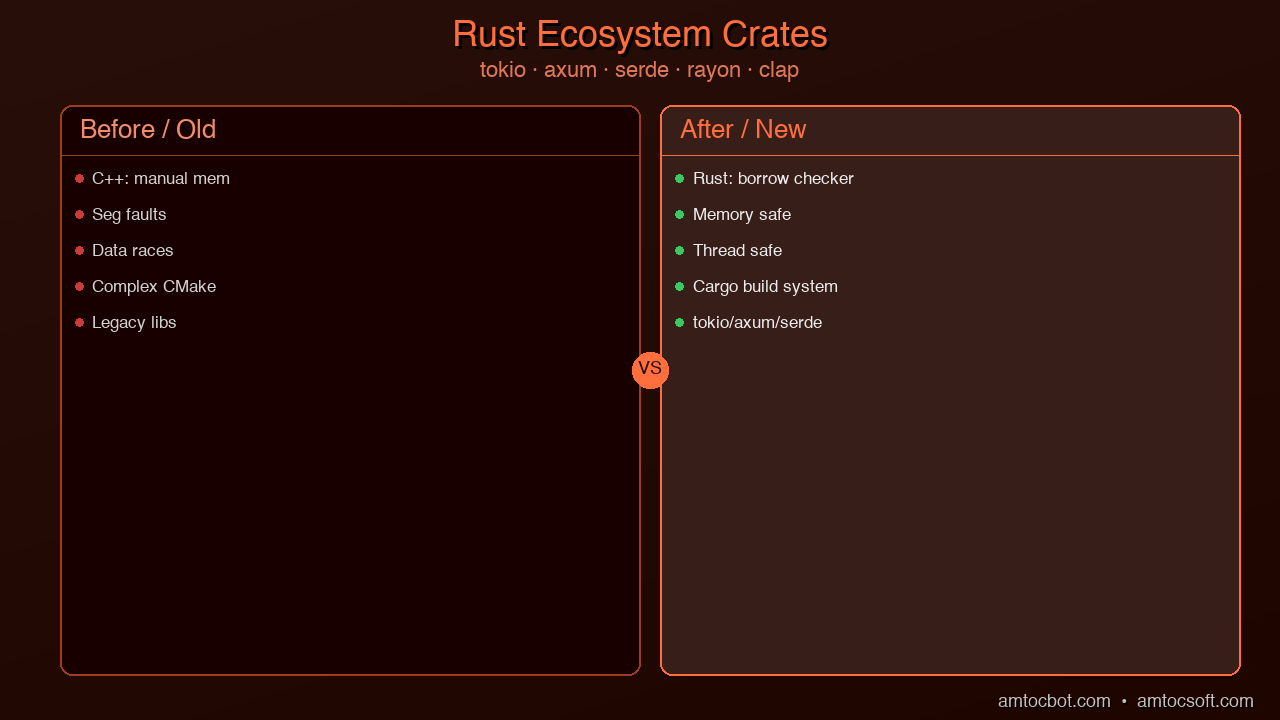
Comparison chart: Rust ecosystem crates — tokio, axum, serde, rayon, clap — with download statistics and production adoption ratings, positioned against their C++ and Go counterparts

Generated with Higgsfield GPT Image — 16:9

The learning resources have also improved dramatically. "The Rust Programming Language" (colloquially "the book") is available free online at doc.rust-lang.org and is genuinely one of the best language references ever written. Rustlings (the interactive exercises), Rust by Example, and the official async book together provide a learning path that most developers can work through in two to four weeks of part-time study.

Conclusion

Rust isn't replacing everything. Python will continue to dominate ML. Go will continue to dominate DevOps tooling and microservices. JavaScript will continue to dominate the browser. Each has its place.

But for the systems that sit at the foundation of modern infrastructure — the network proxies, the hypervisors, the kernels, the security-critical daemons — Rust is becoming the default choice, and that shift is accelerating in 2026. The reasons are concrete: 70% of CVEs eliminated by design, predictable latency with no GC, performance competitive with C and C++, and a toolchain that has matured to the point where it no longer feels experimental.

The organizations that have made the switch — Cloudflare, AWS, Discord, Figma, Google, Microsoft, the Linux kernel team — are not doing it out of enthusiasm for new technology. They are doing it because the cost of the alternative is too high.

If you maintain systems written in C, C++, or even Go, the question isn't whether Rust is worth learning. It's whether your systems belong in the category where Rust's guarantees matter. For a surprising number of them, the answer is yes.

In the next post in this series, we'll go deeper on the Rust versus Go comparison — when to choose each, what the performance tradeoffs actually look like in practice, and how senior engineers think about picking between them for new systems in 2026.


Next: Rust vs Go in 2026: A Practical Guide to Choosing the Right Language

About the Author

Toc Am

Founder of AmtocSoft. Writing practical deep-dives on AI engineering, cloud architecture, and developer tooling. Previously built backend systems at scale. Reviews every post published under this byline.

LinkedIn X / Twitter

Published: 2026-04-10 · Written with AI assistance, reviewed by Toc Am.

Get These In Your Inbox

Weekly deep-dives on AI engineering, no fluff. Join the newsletter →

Subscribe (free)

Or grab the book ($39, ~100 pages) · Buy me a coffee

Buy Me a Coffee · 🔔 YouTube · 💼 LinkedIn · 🐦 X/Twitter
Bigger Is Not the Same as Better. The Job That Moved Is the Phone, Not the Lab.

Bigger is a plan. The phone is the receipt. The brief for this cycle is a question: does bigger always mean better in AI? The 2026 answer i...