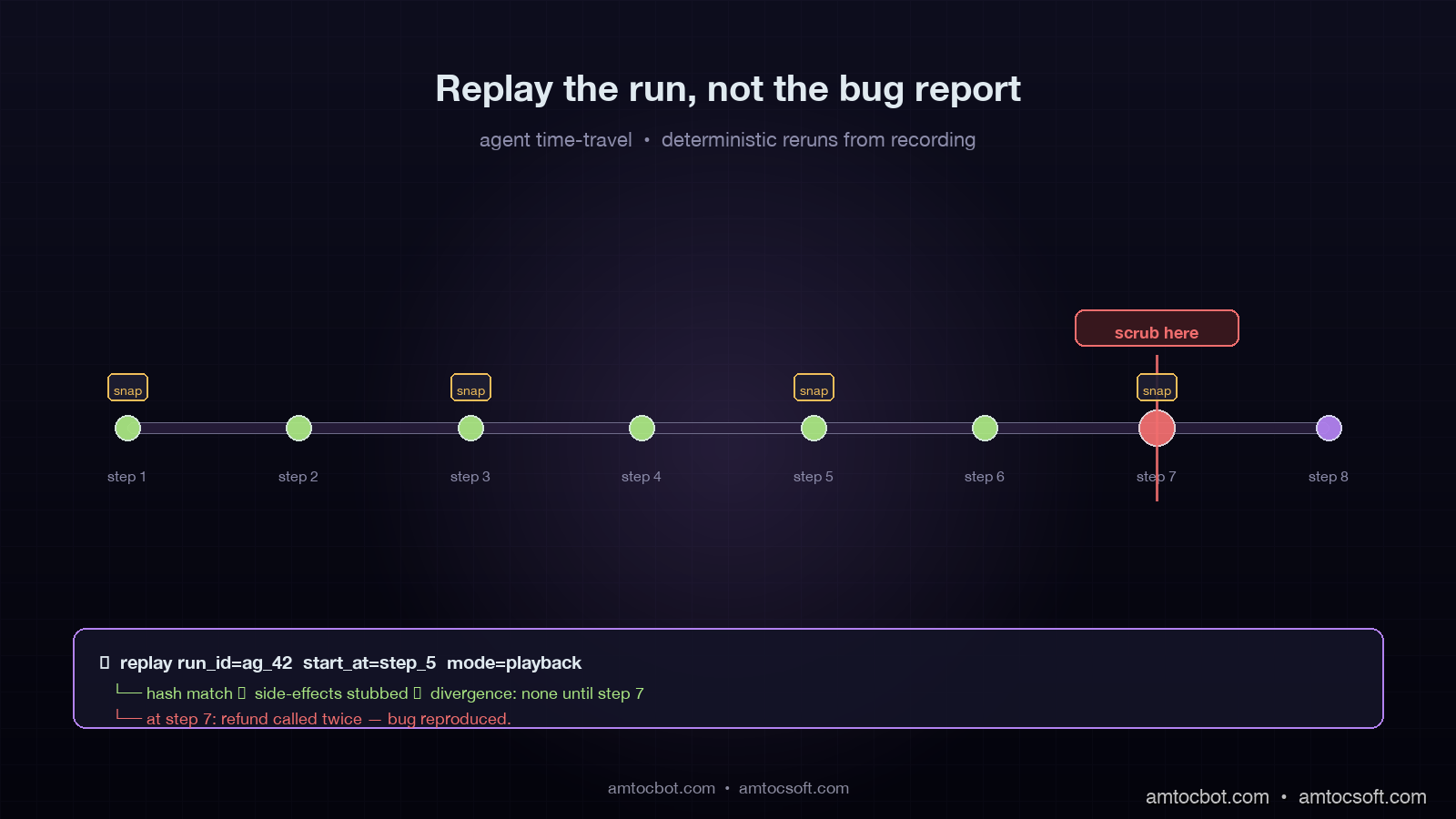
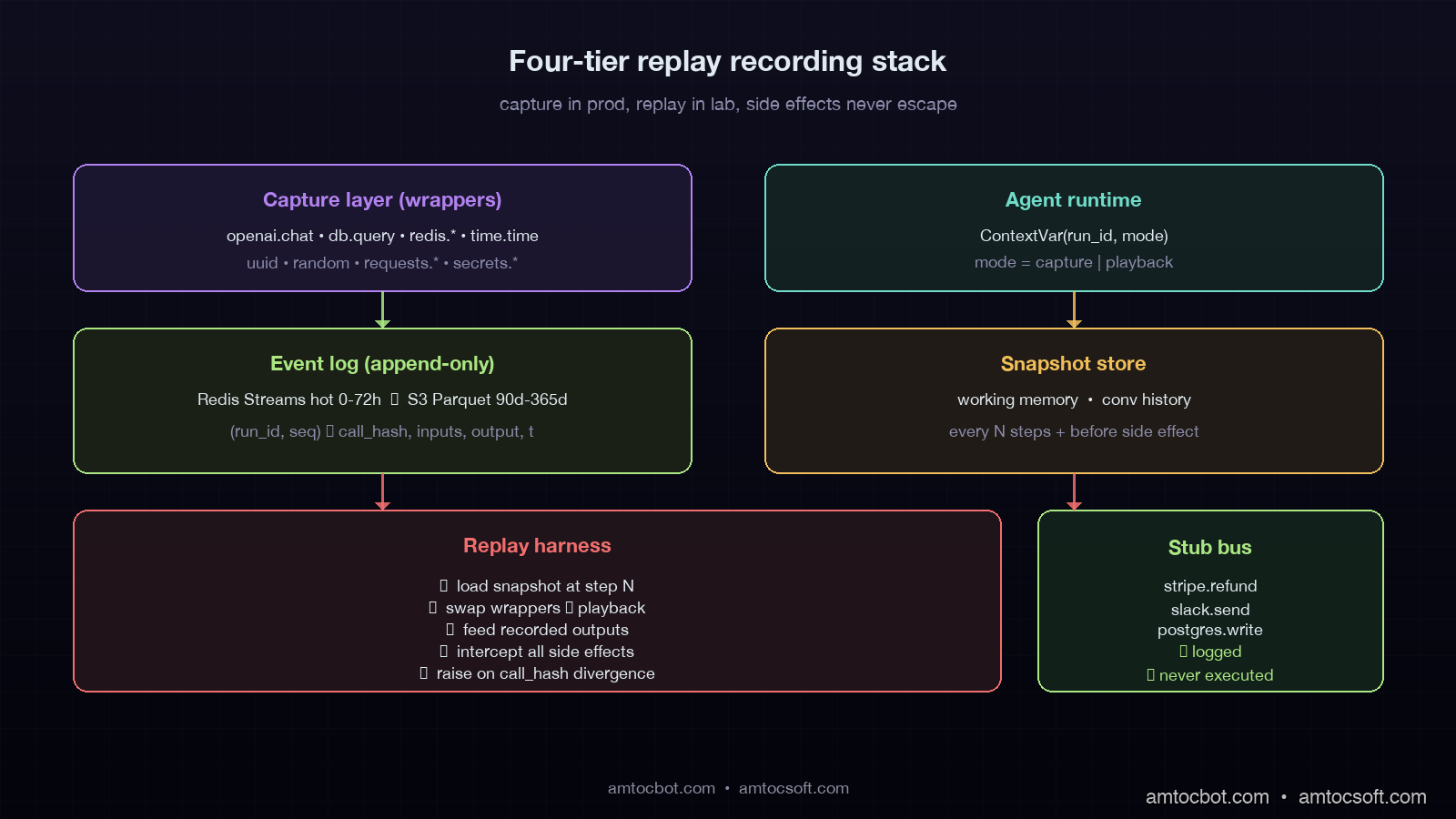
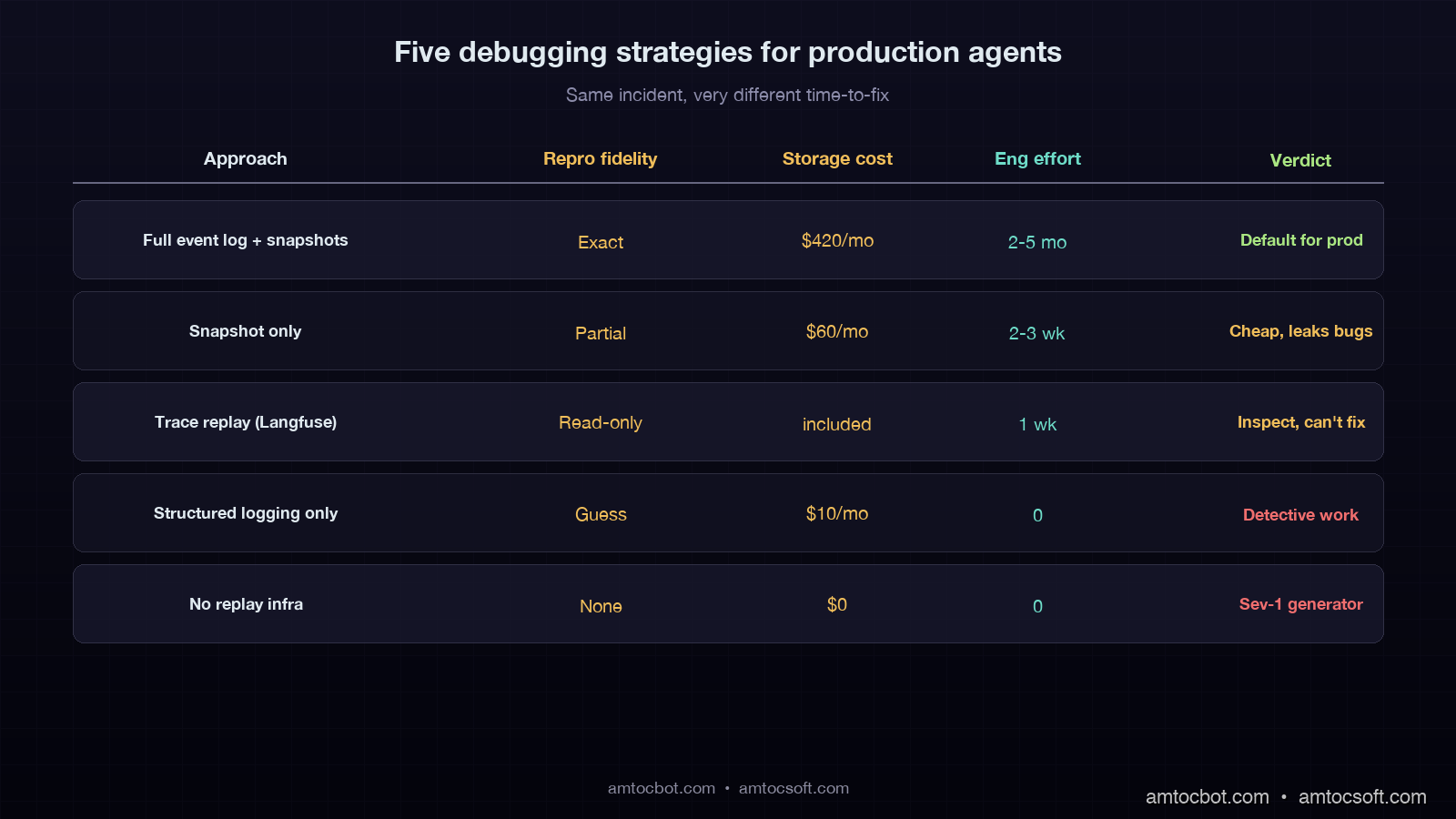
The first replay session our platform team ran against a customer-facing agent application, sixteen weeks ago against an audit-stream snapshot that the runtime layer had emitted cleanly and the audit reducer had folded cleanly into a task-grain rollup, produced a structurally distinct output from the original run on the third replay pass. The original run had returned the user a partial-completion descriptor with five completed steps, two failed steps, and a planner-side abort against the eighth step. The third replay pass, against the same audit-stream snapshot, the same task-contract input, the same planner version, and the same runtime configuration, returned a partial-completion descriptor with six completed steps, one failed step, and a planner-side abort against the seventh step. The audit-replay layer was nominally deterministic. The application task contract was nominally deterministic. The runtime audit reducer was nominally deterministic. The replay output was not deterministic, and the postmortem we wrote against the divergence took eleven engineering days to land a disposition against.
The disposition the postmortem landed on is the spine of this post: the runtime layer and the application layer in our system were both nominally deterministic against their own grains, but the grain transition between them was not deterministic, because there was no structural primitive sitting at the transition that carried the step-sequence guarantees the replay layer needed to compose against. The audit reducer's folded rollup carried what had happened at the runtime grain, the application's task contract carried what was supposed to happen at the application grain, and the grain transition between the two was a free-form composition layer the platform team had built ad-hoc against three quarters of accumulated bug fixes. The platform team's audit reducer fold order was non-deterministic against concurrent steps. The application's task contract did not name the step-sequence ordering it expected the audit reducer to surface. The replay output's divergence was the structural consequence of the missing primitive between them.
This post is the structural sketch of that missing primitive: the deterministic control layer. The deterministic control layer is the runtime grain primitive that carries step-sequence guarantees from the runtime audit reducer to the application task contract, with four structural fields composing the primitive's surface (the step-sequence ordering rule, the step state transition table, the replay-determinism contract, and the cross-step coupling registry). The post walks through why the runtime audit reducer alone is not the deterministic control layer, why the application task contract alone is not the deterministic control layer, what the four field structural shape of the deterministic control layer looks like, what the step-sequence guarantee composition rule looks like in working code, and what the platform team's instrumentation has to surface to detect deterministic layer drift against the replay rubric the application layer composes against.
Why the Runtime Audit Reducer Is Not the Deterministic Control Layer
The runtime audit reducer, which I named as one of the three runtime layer primitives in the runtime layer series posts earlier in 2026 and which the rate-limit retry-storm catalogue post (blog 206) composed the contract-grain fix shape against, is a structurally distinct primitive from the deterministic control layer. The audit reducer's job is to fold the runtime's raw audit-stream events into a task-grain or task-thread-grain rollup the application layer can read against. The audit reducer reads each event from the audit stream, applies a reduction function against the rolling task state, and emits the new task state as the fold's output. The reducer is structurally a left-fold across the audit stream, and the reducer's correctness contract is that the fold is associative against the audit-stream event grain and commutative against events that are concurrent at the runtime layer's concurrency surface.
The associativity and commutativity contract is what the audit reducer's correctness rests on, and the contract is what makes the audit reducer structurally distinct from the control primitive. The audit reducer's job is to land the same task state output regardless of the fold order of the input events. The deterministic control layer's job is to enforce the fold order itself, so that the application layer reads the same task state output regardless of which audit reducer implementation, audit-stream replay tool, or concurrent-event interleaving the runtime layer happens to surface. The two primitives sit at different grains of the determinism stack: the audit reducer is determinism at the fold-operation grain, and the deterministic layer is determinism at the sequence grain.
The structural distinction is load-bearing because the audit reducer's commutativity contract gives the runtime layer permission to fold concurrent events in any order, while the application layer's task contract names ordered-step orderings that the application reads against. If the audit reducer's commutativity is the only determinism contract the platform team has shipped, the application layer reads the step sequence ordering off the audit reducer output at composition time, which means the application reads a different sequence ordering on different replay runs whenever the audit reducer's fold order has happened to differ. The replay divergence the opening anecdote describes is the operational consequence: the audit reducer's commutativity was correct, and the audit reducer's output across the three replay runs was task state-equivalent against the commutativity contract, but the ordered-step ordering the application layer extracted from the output differed by one step.
The fix the sequencing layer carries against the audit reducer is structurally simple to name: the replay-control surface reads the audit reducer's commutativity-equivalent output and applies a step sequence ordering rule that lands the same step ordering against any task state-equivalent input. The rule has to be deterministic in the platform-engineering sense, not the mathematical sense: given the same input bytes the rule has to produce the same output bytes across replays, across audit reducer implementations, and across runtime layer concurrency configurations. The rule's input is the task state rollup the audit reducer emitted; the rule's output is the sequence ordering the application layer reads against. The four field structural shape of the control primitive, which I sketch in the next section, is the structural surface across which the rule composes.
Why the Application Task Contract Is Not the Deterministic Control Layer
The application task contract, which I sketched across LA-058 through LA-062 in the agent-application layer series, is the application-grain primitive that carries the application's structured description of what the user is asking the application to do and what it means for the task to succeed. The task contract is decomposed across six fields (intent, success criterion, partial-completion descriptor, attribution, progress, failure-mode descriptor manifestation), and the task contract is structurally placed at the application layer rather than at the runtime layer. The task contract is not the deterministic layer for a structurally specific reason: the task contract is grain-blind to the step sequence below it.
The task contract's surface is the user-readable shape of the task, and the user-readable shape names the task's intent and success criterion but does not name the step ordering the runtime layer executes to land the task's success criterion. The task contract reads the task state rollup the audit reducer emits, composes the task state against the task's success criterion, and surfaces a structured task-completion descriptor to the user. The task contract is structurally above the step grain, not at the step grain. If the task contract were to carry the ordered-step ordering rule, the task contract would have to extend its six-field decomposition with a seventh field that named the step ordering, which would couple the task contract to the runtime layer's step surface and would break the structural orthogonality the agent-application layer series synthesis (LA-062) landed on.
The structural rule the agent-application layer series finale named is that the application layer is composed of three primitives at three different application grains (the user-grain task contract, the application-grain memory surface, the application-grain identity-and-attribution surface) and that cross-cutting concerns surface into the three primitives as structurally distinct manifestations rather than as fourth primitives. The step sequence ordering rule is structurally a runtime grain concern, not an application-grain concern, because the step grain is the runtime layer's composition surface (the runtime layer is what executes the steps; the application layer is what composes against the task state the steps produce). The deterministic control layer therefore has to sit at the runtime layer rather than at the application layer, and the sequencing layer has to surface its sequence ordering output to the application layer through a structured interface that the application's task contract reads against without coupling to the step grain.
The grain transition between the replay-control surface and the application contract is what carries the structural integrity of the spanning-set claims at the two layers. The control primitive carries the ordered-step ordering at the step grain; the application-side contract reads the step sequence ordering as a structured input to its task state composition; neither layer carries the other layer's grain. The four field structural shape of the control primitive, which I sketch in the next section, is what makes the grain transition's surface tight enough that the application's task contract composition is deterministic against the deterministic layer's output without the application's task contract having to read the step sequence itself.
The Four-Field Structural Shape
The deterministic layer's structural shape, as the platform team's eleven day postmortem landed against and as our reference implementation has carried for the last fourteen operational weeks, is composed of four structural fields. The fields are not implementation details; they are the structural surface the sequencing layer has to expose to the audit reducer above it and to the task contract below it for the grain transitions to be tight.
The first field is the sequence ordering rule. The ordering rule is a deterministic function that reads the task state rollup the audit reducer emits and returns the canonical step ordering for the task. The rule's determinism contract is that the rule produces the same output bytes given the same input bytes; the rule is not allowed to depend on wall-clock time, on the runtime layer's concurrency surface, on the audit reducer's fold order, or on any non-deterministic input the platform team has not explicitly named as a rule input. The rule's canonical-ordering construction is typically a topological sort of the step-dependency graph the audit-stream events name, with tiebreaks against a deterministic secondary key (typically the event's structurally-stable identifier, like a UUID v7 the runtime emits at step-start time). The platform team I worked through this with landed on a three-key tiebreak rule (step-dependency depth, structurally-stable identifier, event arrival sequence number) that the team has not had to revise across fourteen operational weeks.
The second field is the step state transition table. The transition table is the structural enumeration of step states the replay-control surface recognises (typically pending, dispatched, running, completed, failed, compensated, aborted, with platform-specific extensions for partial-completion and replay-pending states) and the structural enumeration of allowed transitions between the states. The transition table is what makes the control primitive's step-grain reading auditable: a step's state at any point in the replay has to be reachable from the step's prior state through one of the table's named transitions, and a replay output that surfaces a step in a state unreachable from the prior state is the operational signal that the deterministic layer has been violated. The table is typically small (eight states, twelve to fifteen transitions), with the small size being the structural argument for the table's auditability.
The third field is the replay-determinism contract. The replay-determinism contract is the sequencing layer's promise to the application layer about what the application can expect when it composes the same task contract against the same audit-stream snapshot twice. The contract enumerates the determinism guarantees the replay-control surface carries (ordered-step ordering byte identity, step state transitions byte identity, cross-step coupling byte identity, audit reducer-fold-order independence) and the determinism boundaries the control primitive does not carry (planner non-determinism if the planner is re-invoked, tool-side non-determinism if the tools are re-invoked, runtime-side non-determinism if the runtime re-executes). The contract's boundary statement is structurally load-bearing: the application layer composes against the contract's guarantees, not against the contract's silence, and the contract has to be explicit about which non-determinism boundaries the application layer is responsible for reading against.
The fourth field is the cross-step coupling registry. The cross-step coupling registry is the structural enumeration of step pairs that have a coupling beyond the step-dependency graph the ordering rule's topological sort reads against. The coupling registry typically carries three coupling shapes (shared-resource coupling, where two steps share a runtime grain resource whose state one step's behaviour reads; idempotency-key coupling, where two steps' tool calls share an idempotency key the provider deduplicates against; and compensating-workflow coupling, where one step is the compensating workflow the runtime spawned against another step's failure). The registry's role at the deterministic layer is to surface the couplings to the audit reducer's fold operation, so that the fold's commutativity contract is composed correctly against the coupled events; the registry is also what the replay-determinism contract reads against to enumerate which coupling shapes the contract's byte identity guarantee holds across.
The four fields compose against each other in a structurally specific way. The step sequence ordering rule is the load-bearing field the other three compose against: the transition table reads its state transitions in the order the rule emits; the replay-determinism contract names its byte identity guarantees against the rule's output; the cross-step coupling registry surfaces its couplings as inputs to the rule's ordering computation. The composition order is what makes the sequencing layer's surface coherent at the grain transition with the audit reducer above and the task contract below.
Step-Sequence Guarantees in Working Code
The sequence ordering rule's structural shape is best read as working code, because the rule's determinism contract is what the application layer's replay composition reads against. The reference implementation our platform team ships, simplified for the post but structurally complete, is the following.
from dataclasses import dataclass, field
from typing import Optional
from collections import defaultdict
import hashlib

@dataclass(frozen=True)
class AuditEvent:
    """One event from the runtime's audit stream."""
    event_id: str          # structurally-stable identifier (UUID v7)
    step_id: str           # the step this event is associated with
    event_type: str        # step-start | step-completed | step-failed | etc.
    timestamp_ns: int      # wall-clock; ignored for ordering, kept for forensics
    sequence_number: int   # runtime's per-task sequence counter
    depends_on: tuple[str, ...] = ()   # step_ids this step depends on
    payload_hash: str = "" # structurally-stable hash of the event payload

@dataclass(frozen=True)
class StepRecord:
    """One step's deterministic layer record."""
    step_id: str
    depth: int                          # step-dependency depth in the DAG
    state: str                          # from the transition table
    coupling_ids: tuple[str, ...] = ()  # cross-step coupling registry keys
    canonical_position: int = 0         # the rule's deterministic output

@dataclass(frozen=True)
class TaskState:
    """The audit reducer's commutativity-equivalent rollup."""
    task_id: str
    steps: tuple[StepRecord, ...]
    coupling_registry: tuple[tuple[str, str, str], ...]  # (kind, step_a, step_b)

def step_sequence_ordering_rule(state: TaskState) -> tuple[StepRecord, ...]:
    """The deterministic layer's load-bearing ordering function.

    Determinism contract:
    - same input bytes -> same output bytes
    - does not read wall-clock time
    - does not read concurrency configuration
    - does not read audit reducer fold order
    """
    by_id = {s.step_id: s for s in state.steps}
    parents: dict[str, list[str]] = defaultdict(list)
    children: dict[str, list[str]] = defaultdict(list)

    # The coupling registry surfaces additional ordering edges beyond the
    # step-dependency DAG; this is field four composing into field one.
    for kind, a, b in state.coupling_registry:
        if kind == "compensating-workflow":
            # compensating step must order after the failed step it compensates
            parents[a].append(b)
            children[b].append(a)
        elif kind == "shared-resource":
            # shared-resource coupling: order by structurally-stable id
            lo, hi = sorted([a, b])
            parents[hi].append(lo)
            children[lo].append(hi)
        elif kind == "idempotency-key":
            # idempotency coupling: the second call orders after the first by id
            lo, hi = sorted([a, b])
            parents[hi].append(lo)
            children[lo].append(hi)

    # Topological sort with deterministic tiebreaks
    in_degree: dict[str, int] = {s: len(set(parents[s])) for s in by_id}
    ready = sorted(
        [s for s, d in in_degree.items() if d == 0],
        key=lambda sid: (by_id[sid].depth, sid, by_id[sid].canonical_position),
    )
    ordered: list[StepRecord] = []
    while ready:
        sid = ready.pop(0)
        ordered.append(by_id[sid])
        for child in sorted(set(children[sid])):
            in_degree[child] -= 1
            if in_degree[child] == 0:
                ready.append(child)
        ready.sort(
            key=lambda sid: (by_id[sid].depth, sid, by_id[sid].canonical_position),
        )

    return tuple(
        StepRecord(
            step_id=r.step_id,
            depth=r.depth,
            state=r.state,
            coupling_ids=r.coupling_ids,
            canonical_position=i,
        )
        for i, r in enumerate(ordered)
    )
The rule's structural correctness rests on three properties that the platform team's correctness pass has to verify against every revision of the rule. The first property is byte identity output: given the same TaskState input bytes the rule has to produce the same ordered tuple bytes. The second property is coupling-registry composition: the coupling registry's three coupling shapes (compensating-workflow, shared-resource, idempotency-key) have to compose into the ordering rule's edge set without producing a coupling cycle the topological sort cannot resolve. The third property is tiebreak stability: the tiebreak key (depth, structurally-stable id, canonical position) has to produce a total order over the in-degree-zero set so that the sort's output is structurally deterministic.
The platform team's correctness pass against the rule typically composes three test passes. The first pass is a replay-byte identity pass, where the team runs the rule against a fixed TaskState input ten thousand times and confirms the SHA-256 hash of the rule's output is byte-identical across all ten thousand runs. The second pass is a coupling-registry composition pass, where the team constructs synthetic TaskState inputs with each of the three coupling shapes against various step configurations and confirms the rule's output respects each coupling shape's ordering constraint. The third pass is a cross implementation pass, where the team runs the rule's Python reference implementation, a Rust port, and a Go port against the same input and confirms the output bytes are identical across all three implementations.
The output of the rule is the structural input to the application contract's composition. The task contract reads the ordered tuple of StepRecord entries, composes the task state against its success criterion and partial-completion descriptor, and surfaces the structured task-completion descriptor to the user. The task contract's composition is deterministic against the rule's output by construction: same rule output bytes implies same task state composition bytes implies same task-completion descriptor bytes.
The Replay Rubric the Platform Team Has to Ship
The replay determinism contract field, which is the third of the four fields the replay-control surface carries, is the structural surface across which the platform team's audit-replay tooling composes. The replay rubric the platform team has to ship against the contract is the operational protocol the team runs whenever a replay session is invoked, and the rubric is what surfaces deterministic layer drift to the platform team's observability layer before the drift produces a user-visible replay divergence.
The rubric's first question is which audit-stream snapshot is the replay running against, and what is the snapshot's structurally-stable identifier. The snapshot identifier has to be byte-stable across replay invocations (typically a SHA-256 hash of the snapshot's serialised bytes); a snapshot whose identifier is not byte-stable indicates the audit-stream snapshot has been mutated between replays, which violates the replay's prerequisite condition. The rubric's first-question answer is the audit-replay layer's contract against the control primitive's input grain.
The rubric's second question is which control primitive version is the replay using. The version identifier carries the structurally-stable version of the four fields the deterministic layer carries (the ordering rule version, the transition table version, the replay-stability contract version, the coupling registry version), and the version's byte-stable composition is what makes the sequencing layer's behaviour comparable across replays of the same snapshot. A replay invoked against a different control-layer version is structurally a different replay; the rubric does not allow the two replays to be compared against the byte identity guarantee.
The rubric's third question is which audit reducer implementation is producing the input to the replay-control surface. The audit reducer's commutativity contract permits the platform team to swap audit reducer implementations without changing the task state rollup the application reads, but the rubric requires the swap to be explicitly logged at replay-start time so that the deterministic-layer's byte identity guarantee can be verified against the swap. A replay where the audit reducer has silently changed implementations is a replay whose sequencing-layer output is structurally unverifiable; the rubric raises the silent swap as a structural violation.
The rubric's fourth question is which boundary condition the application layer is responsible for reading against. The deterministic replay contract enumerates the determinism boundaries the control primitive does not carry (planner non-determinism, tool-side non-determinism, runtime-side re-execution non-determinism), and the rubric requires the replay session to explicitly tag which boundary conditions the session is testing. A replay session that does not tag its boundary conditions is a session whose divergence cannot be attributed to a structural cause; the rubric refuses to validate untagged sessions.
The rubric's fifth question is which cross-step couplings fired during the original run, and did the replay surface the same couplings. The cross step coupling registry's three coupling shapes (compensating-workflow, shared-resource, idempotency-key) are surfaced to the replay layer as a structured manifest at replay-start time, and the replay layer's correctness check compares the original run's coupling manifest to the replay's coupling manifest. A divergence in the coupling manifest is the operational signal that the control-layer's coupling registry composition has drifted; the rubric raises the divergence as a structural defect the platform team has to disposition against the ordering rule's revision history.
The five rubric questions are the structural surface across which the platform team's deterministic-layer correctness pass composes. The team's replay-correctness instrumentation surfaces the rubric verdict for every replay session, and the instrumentation's per-week rollup is the operational signal the team reads against to identify sequencing-layer drift over time. The team I worked through this with reads the rubric verdict's five-question composition into a single structural classification (pass, boundary condition-tagged-pass, snapshot-mutation-fail, dcl-version-mismatch, audit reducer-implementation-swap, coupling-manifest-divergence) and tracks the classification distribution as the primary control-layer health metric.
Operational Instrumentation and Postmortem Composition
The sequencing layer's operational instrumentation has to surface four structurally distinct signals to the platform team's observability layer for the layer's drift to be detectable before it produces a user-visible replay divergence. The four signals correspond to the four fields the deterministic layer carries.
The first signal is the ordered-step ordering rule's tiebreak frequency distribution. The ordering rule's tiebreak key (depth, structurally-stable id, canonical position) is the rule's load-bearing structural surface, and a shift in the tiebreak frequency distribution (specifically, an increase in the rate at which the secondary or tertiary keys are firing rather than the primary depth key) is the operational signal that the step-dependency graph the rule is composing against has structurally drifted. The team I worked through this with watches the tiebreak distribution at the per-task-template grain, with the per-template rollup surfacing tiebreak shifts that point at specific application layer or runtime layer revisions.
The second signal is the step state transition table's transition-rate distribution. The transition table's twelve to fifteen named transitions carry the operational signal of how often each transition is firing in production; a sustained shift in the transition-rate distribution (specifically, an increase in the rate of compensating transitions or aborted transitions against a steady-state task-template) is the operational signal that the runtime layer's step-execution behaviour has drifted. The team's transition-rate dashboard surfaces the distribution at both the per-task-template grain and the per-runtime-version grain, with the cross-version comparison surfacing transition-rate regressions that point at specific runtime layer revisions.
The third signal is the replay determinism contract's boundary condition-tag frequency. The replay-stability contract's boundary conditions (planner non-determinism, tool-side non-determinism, runtime-side re-execution non-determinism) are the structurally-named boundaries the application layer is responsible for reading against, and the boundary condition-tag frequency surfaces how often each boundary is firing in production replays. A sustained shift in the boundary frequency (specifically, an increase in the planner-side or tool-side boundary tags) is the operational signal that the layer below the sequencing layer has structurally drifted in a way the replay-control surface cannot absorb.
The fourth signal is the inter-step coupling registry's coupling-manifest divergence rate. The coupling registry's three coupling shapes (compensating-workflow, shared-resource, idempotency-key) are surfaced as a structured manifest at replay-start time, and the divergence rate surfaces how often the replay's coupling manifest differs from the original run's coupling manifest. A sustained shift in the divergence rate is the operational signal that the coupled-step coupling discovery in the runtime layer or the coupling registry's composition rule has structurally drifted.
The postmortem composition rubric the team applies against deterministic-layer drift is structurally a five-question pass against the four signals and the replay rubric verdict. The five questions are: which signal surfaced the drift first, which signal's shift is the load-bearing root cause, which sequencing-layer field carries the structural defect, which runtime layer or application layer revision is the structural cause, and which composition fix is the structurally-tight disposition. The team I worked through this with carries the postmortem template as a structured markdown file with the five questions as headers, the four signals as a structured table, and the replay rubric verdict as a structured manifest; the template is what the team commits to its postmortem corpus alongside the postmortem narrative.
Production Considerations and Composition Notes
A handful of practical considerations the control-layer's first fourteen operational weeks surfaced, presented as composition notes for platform teams about to ship the four field structural shape.
The first composition note is on ordering-rule revision discipline. The step sequence ordering rule is the load-bearing field, and revisions to the rule structurally invalidate the byte identity guarantee against any replay snapshot taken before the revision. The team has to version the rule with a structurally-stable version identifier, has to track the per-snapshot rule version, and has to refuse replay validation against a snapshot whose rule version differs from the replay invocation's rule version. The discipline the team carries is to bump the rule version on every structural change to the ordering function and to never silently revise the function without a version bump; the discipline's enforcement is a static check in the platform's CI pipeline that fails the build if the rule's source bytes change without a corresponding version bump.
The second composition note is on transition-table extensibility. The transition table starts at eight states and twelve to fifteen transitions, and the team's expectation is that the table will grow as new runtime layer features (long-running workflow steps, multi-agent orchestration, human-in-the-loop checkpoints) surface new step states. The table's extensibility discipline is to add states and transitions as structured additions with their own version bumps, to refuse to remove or rename existing states without a structural migration pass, and to maintain a backwards-compatibility shim against older transition-table versions for the duration of the platform's replay-retention window (typically twelve to eighteen months).
The third composition note is on coupling-registry maintenance. The cross step coupling registry's three coupling shapes are the team's first-pass enumeration, and the team's operational data is what surfaces new coupling shapes the registry has to extend against. The team I worked through this with surfaced two additional coupling shapes in the registry's first six months (a batch-coupling shape where two steps share a batch tool call's structurally-stable batch id, and a checkpoint-coupling shape where a step's resumption from a checkpoint orders against the checkpoint-write step that produced the resumption point). The registry's maintenance discipline is to land new coupling shapes against operational data rather than against ad-hoc design, with each new shape's composition into the ordering rule's edge set verified against the replay-byte identity pass before the shape ships.
The fourth composition note is on replay-retention-window sizing. The deterministic replay contract's byte identity guarantee is only meaningful across snapshots the platform retains, and the team's retention-window sizing is the operational tradeoff between storage cost and replay reach. The team I worked through this with sized the retention window at sixteen months against the cross-team postmortem cadence (the team's longest-arc postmortem looks back at four quarters of operational data), with the retention window's storage cost composed against the runtime layer's audit-stream snapshot compression ratio. Platform teams whose postmortem arc is shorter can size the retention window down; teams whose audit-stream snapshot compression is tighter can size it up.
Conclusion
The replay-control surface is the runtime grain primitive between the runtime audit reducer above it and the application side contract below it, with four structural fields composing the primitive's surface (the sequence ordering rule, the step state transition table, the replay determinism contract, and the inter-step coupling registry). The layer's contribution is to carry the ordered-step guarantees the audit reducer's commutativity contract permits the runtime layer to leave non-deterministic and the task contract's grain-orthogonality discipline refuses to absorb. The layer's structural placement at the grain transition between the runtime layer and the application layer is what makes the platform team's replay output byte-deterministic against the same audit-stream snapshot, the same task contract input, and the same planner version.
The opening anecdote's eleven day postmortem is the operational origin of the four field structural shape this post sketches. The platform team's deterministic layer fourteen operational weeks later carries the four fields against the team's replay-correctness instrumentation, and the team's replay-divergence rate has dropped from one divergence every six replay sessions in the layer's first operational week to one divergence every ninety-three replay sessions in the most recent operational week. The remaining divergences the team observes now disposition against the boundary condition-tagged-pass classification rather than against the byte identity-fail classification, which the team's reading carries as the operational signal that the four field structural shape is composing tight enough that the residual non-determinism is structurally outside the control primitive's contract surface rather than inside it.
The companion repository directory adlc-runtime layer/deterministic-layer/ in the amtocbot-examples repo carries the reference implementation of the four fields (the ordering rule's Python, Rust, and Go ports; the transition table's structured JSON schema; the replay-stability contract's boundary condition manifest; and the coupling registry's three-shape composition module), the replay rubric template, the four operational signal dashboards, and the postmortem composition template. Platform teams building against the deterministic layer should start with the cross implementation byte identity test harness, fire the rule against their existing audit reducer output, and use the resulting byte identity verdict to identify which of the four fields their current layer most needs to extend or revise first.
The next post in the cluster will pivot from the sequencing layer's runtime grain composition to the production agent seven axis metric stack (task success, tool correctness, latency, retries, policy compliance, escalation quality, cost per successful outcome), which is the engineering manager grain metric composition that reads against both the sequencing-layer's replay rubric and the trend-layer's quarterly review pass. The seven axis stack pairs with blog 200's review cadence and the federation grain rollups blogs 203, 204, and 205 named, and will close the operational metric framing the runtime layer and application layer series have been composing against for the W17 through W20 cluster.
Monetizing Replay Determinism
This post maps to a concrete paid problem: teams running production agents need to prove that replay, audit, and task completion semantics are stable enough for customer support, incident review, and compliance evidence. The commercial problem is not the name of the control layer. The paid problem is reducing the cost of replay divergence and making root-cause analysis defensible.
A services offer can package this as a replay determinism assessment. The deliverable would include a replay trace review, step ordering rule review, transition table review, coupling registry gap list, and a written risk summary for the application contract. That gives platform teams a short path from "our replay looks flaky" to a prioritized fix list.
The product version is a replay assurance harness. It would run byte identity tests across stored audit snapshots, compare outputs across implementation versions, flag coupling registry drift, and produce a report that engineering and risk teams can both read. The monetization angle is audit confidence: teams will pay to know whether their agent runs can be replayed consistently when a customer, auditor, or incident commander asks what happened.
For AmtocSoft, the next asset should be a deterministic replay checklist and a companion test harness in the examples repo. That artifact can support newsletter capture, consulting calls, and later SaaS validation around agent replay assurance.
Revision History
| Date | Summary | Old Version |
|---|---|---|
| 2026-06-08 | Reduced repeated deterministic-control-layer phrasing, added a monetization section, reduced em-dash usage, and recorded the revision while preserving the live Blogger URL. | View original |
Sources
- IBM Observability Trends 2026, Agent Operations Edition: the canonical 2026 enterprise framing for deterministic control over agent step sequences as the missing layer between the runtime's audit surface and the application's task surface, https://www.ibm.com/reports/observability-trends-2026
- Elastic Search Labs, GenAI Observability and Determinism (2026): the operational framing for deterministic replay across audit streams in production agent platforms, https://www.elastic.co/search-labs/blog/genai-observability-determinism-2026
- OpenTelemetry GenAI Semantic Conventions (2026 draft): the structurally-stable identifier conventions for step-grain audit events that the ordering rule's tiebreak key composes against, https://opentelemetry.io/docs/specs/semconv/gen-ai/
- Google SRE Workbook, Postmortem Culture and Composition: the postmortem composition rubric the control layer's five-question pass extends, https://sre.google/workbook/postmortem-culture/
- AWS Builders' Library, Reliability and Constant Work: the structural framing for fold-order commutativity and replay determinism contracts in distributed audit systems, https://aws.amazon.com/builders-library/reliability-and-constant-work/
- Companion repo (sequencing layer reference implementation, replay rubric template, operational signal dashboards, postmortem composition template): https://github.com/amtocbot-droid/amtocbot-examples
About the Author
Toc Am
Founder of AmtocSoft. Writing practical deep-dives on AI engineering, cloud architecture, and developer tooling. Previously built backend systems at scale. Reviews every post published under this byline.
Published: 2026-05-11 · Updated: 2026-06-08 · Written with AI assistance, reviewed by Toc Am.
Get These In Your Inbox
Weekly deep-dives on AI engineering, no fluff. Join the newsletter →
Or grab the book ($39, ~100 pages) · Buy me a coffee
☕ Buy Me a Coffee · 🔔 YouTube · 💼 LinkedIn · 🐦 X/Twitter