Showing posts with label rest. Show all posts

Friday, April 17, 2026

API Design in 2026: REST, Versioning, Pagination, and Rate Limiting Patterns

Hero image

Introduction

Most API design mistakes are invisible until scale exposes them. Offset-based pagination seems fine at 10,000 records; it returns wrong results and causes full-table scans at 10 million. A single versioning strategy that works for your first three clients fails when a fourth client needs a breaking change. The patterns that seemed like over-engineering at launch become the foundation you're glad you built when client count reaches double digits. Rate limiting by IP address seems obvious until you have enterprise customers behind corporate NAT proxies sharing a single IP — you'll rate-limit an entire company because one employee hit a burst.

This post covers the API design patterns that hold up at scale: URL structure and resource modeling, versioning strategies with their trade-offs, cursor-based pagination for large datasets, rate limiting by identity not IP, idempotency keys for safe retries, and the OpenAPI specification workflow that makes API changes manageable across teams.

URL Design and Resource Modeling

RESTful URL design expresses resources (nouns) and uses HTTP methods (verbs) to express operations. The conventions that experienced API designers follow:

# Resources: plural nouns
GET    /api/v1/orders           # list
POST   /api/v1/orders           # create
GET    /api/v1/orders/{id}      # retrieve
PATCH  /api/v1/orders/{id}      # partial update
PUT    /api/v1/orders/{id}      # full replacement
DELETE /api/v1/orders/{id}      # delete

# Nested resources: relationships
GET    /api/v1/orders/{id}/items          # order's line items
POST   /api/v1/orders/{id}/items          # add item to order
DELETE /api/v1/orders/{id}/items/{itemId} # remove item

# Actions that don't map cleanly to CRUD: use sub-resources as verbs
POST /api/v1/orders/{id}/cancel    # cancel an order
POST /api/v1/orders/{id}/refund    # refund an order
POST /api/v1/users/{id}/verify     # verify email

# Query parameters: filtering, sorting, pagination — not resource addressing
GET /api/v1/orders?status=pending&sort=-created_at&limit=20&cursor=abc123

The rule for when to use nested resources vs query parameters: if the relationship is hierarchical (an item belongs to an order), use nested URLs. If you're filtering or searching across resources, use query parameters.

HTTP status codes communicate response semantics:

from fastapi import FastAPI, HTTPException, status
from fastapi.responses import JSONResponse

app = FastAPI()

@app.post("/api/v1/orders", status_code=status.HTTP_201_CREATED)
async def create_order(body: CreateOrderRequest, user=Depends(get_current_user)):
    # 201 Created: resource created, Location header points to new resource
    order = await order_service.create(body, user.id)
    return JSONResponse(
        status_code=201,
        content=order.dict(),
        headers={"Location": f"/api/v1/orders/{order.id}"}
    )

@app.get("/api/v1/orders/{order_id}")
async def get_order(order_id: str, user=Depends(get_current_user)):
    order = await order_service.get(order_id)
    if not order:
        raise HTTPException(
            status_code=404,
            detail={"error": "not_found", "message": f"Order {order_id} not found"}
        )
    if order.user_id != user.id:
        raise HTTPException(
            status_code=403,
            detail={"error": "forbidden", "message": "You cannot access this order"}
        )
    return order

# Status codes to use correctly:
# 200 OK: success with body
# 201 Created: resource created (POST)
# 204 No Content: success with no body (DELETE, action endpoints)
# 400 Bad Request: client sent invalid data (validation error)
# 401 Unauthorized: not authenticated
# 403 Forbidden: authenticated but not authorized
# 404 Not Found: resource doesn't exist
# 409 Conflict: resource already exists or state conflict
# 422 Unprocessable Entity: semantically invalid (invalid field value)
# 429 Too Many Requests: rate limit exceeded
# 500 Internal Server Error: unexpected server error
Architecture diagram

Versioning Strategies

Breaking API changes break clients. The versioning strategies and their trade-offs:

URL versioning (/api/v1/, /api/v2/): explicit, cacheable, easy to route. Clients must explicitly migrate. The most common and pragmatic choice.

Header versioning (Accept: application/vnd.myapi.v2+json): cleaner URLs, harder to test (can't just open in browser). Popular in enterprise APIs.

Query parameter (?version=2): easy to add, but pollutes every URL and is easily forgotten in documentation.

# URL versioning implementation in FastAPI
from fastapi import FastAPI, APIRouter

app = FastAPI()

# v1 router: keep forever for backward compatibility
v1_router = APIRouter(prefix="/api/v1")

@v1_router.get("/orders/{id}")
async def get_order_v1(id: str):
    order = await get_order(id)
    # v1 format: amount as decimal string
    return {
        "id": order.id,
        "amount": f"{order.total_cents / 100:.2f}",  # "49.99"
        "status": order.status,
    }

# v2 router: new format
v2_router = APIRouter(prefix="/api/v2")

@v2_router.get("/orders/{id}")
async def get_order_v2(id: str):
    order = await get_order(id)
    # v2 format: amount as integer cents (breaking change from v1)
    return {
        "id": order.id,
        "amount_cents": order.total_cents,     # breaking: renamed + type change
        "currency": order.currency,            # new field
        "status": order.status,
        "created_at": order.created_at.isoformat(),
    }

app.include_router(v1_router)
app.include_router(v2_router)

Version sunset policy: announce deprecation 12+ months ahead, add Sunset and Deprecation headers to v1 responses, monitor v1 traffic, contact active clients. Only sunset when v1 traffic reaches zero or after the sunset date.

# Add deprecation headers to old versions
@v1_router.middleware("http")
async def add_deprecation_headers(request, call_next):
    response = await call_next(request)
    response.headers["Deprecation"] = "true"
    response.headers["Sunset"] = "Sat, 01 Jan 2027 00:00:00 GMT"
    response.headers["Link"] = '</api/v2/orders>; rel="successor-version"'
    return response

Cursor-Based Pagination

Offset-based pagination (LIMIT 20 OFFSET 1000) has two production problems: it causes full-table scans at high offsets (PostgreSQL counts and skips 1,000 rows before returning 20), and it produces inconsistent results when records are inserted or deleted between pages (page 2 might return records already shown on page 1).

Cursor-based pagination uses an opaque cursor (typically an encoded primary key or timestamp) to mark position — O(1) regardless of offset depth.

from base64 import b64encode, b64decode
import json
from datetime import datetime

def encode_cursor(order_id: str, created_at: datetime) -> str:
    """Encode pagination cursor — opaque to clients."""
    data = {"id": order_id, "created_at": created_at.isoformat()}
    return b64encode(json.dumps(data).encode()).decode()

def decode_cursor(cursor: str) -> tuple[str, datetime]:
    """Decode pagination cursor."""
    data = json.loads(b64decode(cursor.encode()).decode())
    return data["id"], datetime.fromisoformat(data["created_at"])

@app.get("/api/v2/orders")
async def list_orders(
    limit: int = Query(default=20, ge=1, le=100),
    cursor: str | None = None,
    status: str | None = None,
    user=Depends(get_current_user)
):
    query = """
        SELECT id, total_cents, status, created_at
        FROM orders
        WHERE user_id = $1
        {status_filter}
        {cursor_filter}
        ORDER BY created_at DESC, id DESC  -- deterministic ordering
        LIMIT $2
    """

    params = [user.id, limit + 1]  # fetch one extra to detect "has more"

    if status:
        query = query.format(
            status_filter="AND status = $3",
            cursor_filter="" if not cursor else "AND (created_at, id) < ($4, $5)"
        )
        params.append(status)

    if cursor:
        cursor_id, cursor_created_at = decode_cursor(cursor)
        params.extend([cursor_created_at, cursor_id])

    orders = await db.fetch(query.format(
        status_filter=f"AND status = ${len(params)-1}" if status else "",
        cursor_filter=f"AND (created_at, id) < (${len(params)-1}, ${len(params)})" if cursor else ""
    ), *params)

    has_more = len(orders) > limit
    orders = orders[:limit]  # trim the extra

    next_cursor = None
    if has_more and orders:
        last = orders[-1]
        next_cursor = encode_cursor(last['id'], last['created_at'])

    return {
        "data": orders,
        "pagination": {
            "has_more": has_more,
            "next_cursor": next_cursor,
            "limit": limit,
        }
    }

The client receives next_cursor and passes it as ?cursor= in the next request. Each page query is O(log n) (index seek) regardless of how deep into the dataset you are.

Comparison visual

Rate Limiting by Identity

Rate limiting by IP address fails in two scenarios: enterprise customers behind corporate NAT share one IP (you rate-limit the entire company when one employee is over the limit), and attackers with multiple IPs or rotating proxies bypass per-IP limits.

Production rate limiting is by API key or user ID, using a sliding window algorithm:

import redis.asyncio as redis
import time
from fastapi import HTTPException, Depends, Header

r = redis.from_url("redis://redis:6379")

async def rate_limit(
    api_key: str = Header(alias="X-API-Key"),
    limit: int = 1000,       # 1000 requests per window
    window_seconds: int = 3600  # per hour
) -> None:
    """Sliding window rate limiter using Redis sorted sets."""
    key = f"rate_limit:{api_key}"
    now = time.time()
    window_start = now - window_seconds

    pipe = r.pipeline()
    # Remove entries outside the window
    pipe.zremrangebyscore(key, 0, window_start)
    # Count requests in current window
    pipe.zcard(key)
    # Add current request (score=timestamp, member=unique ID)
    pipe.zadd(key, {f"{now}:{id(object())}": now})
    # Set TTL to prevent memory leak
    pipe.expire(key, window_seconds)
    _, count, _, _ = await pipe.execute()

    if count >= limit:
        # Include retry information
        oldest = await r.zrange(key, 0, 0, withscores=True)
        retry_after = int(oldest[0][1] + window_seconds - now) if oldest else window_seconds
        raise HTTPException(
            status_code=429,
            detail={
                "error": "rate_limit_exceeded",
                "limit": limit,
                "window_seconds": window_seconds,
                "retry_after": retry_after,
            },
            headers={
                "Retry-After": str(retry_after),
                "X-RateLimit-Limit": str(limit),
                "X-RateLimit-Remaining": "0",
                "X-RateLimit-Reset": str(int(now + retry_after)),
            }
        )

# Add rate limit headers to successful responses too
@app.middleware("http")
async def add_rate_limit_headers(request, call_next):
    response = await call_next(request)
    # Attach rate limit info from request state (set by rate_limit dependency)
    if hasattr(request.state, 'rate_limit_info'):
        info = request.state.rate_limit_info
        response.headers["X-RateLimit-Limit"] = str(info['limit'])
        response.headers["X-RateLimit-Remaining"] = str(info['remaining'])
        response.headers["X-RateLimit-Reset"] = str(info['reset'])
    return response

Rate limit tiers by customer type (tiered limits):

RATE_LIMIT_TIERS = {
    'free':       {'limit': 100,   'window': 3600},
    'starter':    {'limit': 1000,  'window': 3600},
    'growth':     {'limit': 10000, 'window': 3600},
    'enterprise': {'limit': 100000,'window': 3600},
}

async def get_rate_limit_for_key(api_key: str) -> dict:
    key_info = await db.api_keys.get(api_key)
    tier = key_info.tier if key_info else 'free'
    return RATE_LIMIT_TIERS[tier]

Idempotency Keys for Safe Retries

Network requests fail. Clients retry. Without idempotency, a retry might create duplicate orders, double charges, or duplicate emails. The idempotency key pattern makes any non-idempotent operation safe to retry.

import hashlib

@app.post("/api/v2/orders")
async def create_order(
    body: CreateOrderRequest,
    idempotency_key: str = Header(alias="Idempotency-Key"),
    user=Depends(get_current_user)
):
    """Create an order. Safe to retry with the same Idempotency-Key."""
    cache_key = f"idempotency:{user.id}:{idempotency_key}"

    # Check if we've seen this key before
    cached = await r.get(cache_key)
    if cached:
        # Return the exact same response as the original request
        return JSONResponse(
            content=json.loads(cached),
            headers={"Idempotent-Replayed": "true"}
        )

    # Process the request
    order = await order_service.create(body, user.id)
    response_body = order.dict()

    # Cache the response for 24 hours
    await r.setex(cache_key, 86400, json.dumps(response_body))

    return JSONResponse(
        status_code=201,
        content=response_body,
        headers={"Location": f"/api/v2/orders/{order.id}"}
    )

The client generates a unique idempotency key per logical operation (a UUID v4 works well) and includes it in the Idempotency-Key header. If the request times out, the client retries with the same key. If the server processed it already, it returns the cached response. If not, it processes normally. The client always gets a result, and the server processes the operation exactly once.

Webhook Design: Event-Driven API Integrations

Webhooks push events to clients rather than requiring polling. The design decisions that determine whether your webhook implementation is reliable or frustrating:

import hmac
import hashlib
import json
from datetime import datetime

# Webhook payload: include event type, timestamp, and idempotency ID
def build_webhook_payload(event_type: str, data: dict) -> dict:
    return {
        "id": f"evt_{uuid4().hex}",    # unique event ID — clients can deduplicate
        "type": event_type,            # e.g., "order.created", "payment.failed"
        "created": int(datetime.utcnow().timestamp()),
        "data": data,
        "api_version": "2026-06-01",   # schema version of the payload
    }

# Signature verification: HMAC-SHA256 of the raw body
def sign_webhook(payload: str, secret: str) -> str:
    """Sign webhook payload with HMAC-SHA256."""
    timestamp = int(time.time())
    signed_payload = f"{timestamp}.{payload}"
    signature = hmac.new(
        secret.encode(), signed_payload.encode(), hashlib.sha256
    ).hexdigest()
    return f"t={timestamp},v1={signature}"

# Delivery with retry
async def deliver_webhook(endpoint_url: str, payload: dict, secret: str) -> bool:
    body = json.dumps(payload)
    signature = sign_webhook(body, secret)

    for attempt in range(5):  # retry up to 5 times
        try:
            async with httpx.AsyncClient(timeout=30.0) as client:
                response = await client.post(
                    endpoint_url,
                    content=body,
                    headers={
                        "Content-Type": "application/json",
                        "X-Webhook-Signature": signature,
                        "X-Webhook-Attempt": str(attempt + 1),
                    }
                )
                if response.status_code < 400:
                    return True
                # 4xx: don't retry (bad endpoint config, not transient)
                if response.status_code < 500:
                    return False
        except httpx.TimeoutException:
            pass  # retry on timeout

        # Exponential backoff: 1s, 2s, 4s, 8s, 16s
        await asyncio.sleep(2 ** attempt)

    return False  # all retries exhausted

Clients verify the webhook signature before processing:

def verify_webhook(payload: str, signature_header: str, secret: str) -> bool:
    """Verify HMAC-SHA256 webhook signature. Reject if >300 seconds old."""
    parts = dict(item.split("=") for item in signature_header.split(","))
    timestamp = int(parts.get("t", 0))
    received_sig = parts.get("v1", "")

    # Replay attack prevention: reject webhooks older than 5 minutes
    if abs(time.time() - timestamp) > 300:
        return False

    signed_payload = f"{timestamp}.{payload}"
    expected_sig = hmac.new(
        secret.encode(), signed_payload.encode(), hashlib.sha256
    ).hexdigest()

    return hmac.compare_digest(expected_sig, received_sig)

HTTP Caching: ETags and Conditional Requests

Properly implemented HTTP caching reduces server load and improves client performance for resources that don't change frequently.

import hashlib
from datetime import datetime, timedelta

@app.get("/api/v2/orders/{order_id}")
async def get_order(
    order_id: str,
    request: Request,
    user=Depends(get_current_user)
):
    order = await order_service.get(order_id, user.id)
    if not order:
        raise HTTPException(404)

    # ETag: hash of the resource content
    etag = f'"{hashlib.md5(order.json().encode()).hexdigest()}"'

    # 304 Not Modified: if client has current version
    if request.headers.get("If-None-Match") == etag:
        return Response(status_code=304, headers={"ETag": etag})

    # Last-Modified: for time-based conditional requests
    last_modified = order.updated_at.strftime("%a, %d %b %Y %H:%M:%S GMT")
    if_modified_since = request.headers.get("If-Modified-Since")
    if if_modified_since:
        ims_date = datetime.strptime(if_modified_since, "%a, %d %b %Y %H:%M:%S GMT")
        if order.updated_at <= ims_date.replace(tzinfo=None):
            return Response(status_code=304)

    return JSONResponse(
        content=order.dict(),
        headers={
            "ETag": etag,
            "Last-Modified": last_modified,
            "Cache-Control": "private, max-age=60",  # cache for 60s client-side
        }
    )

For list endpoints, avoid client-side caching (lists change frequently). For individual resources, ETags enable the client to request "give me the order only if it changed since I last fetched it" — reducing response body size to zero bytes for unchanged resources.

OpenAPI and API-First Design

OpenAPI (Swagger) specification defines your API as a YAML/JSON document that can generate documentation, client SDKs, mock servers, and test stubs. The API-first workflow: write the spec before writing code.

# FastAPI generates OpenAPI automatically from type annotations
from pydantic import BaseModel, field_validator
from typing import Annotated

class CreateOrderRequest(BaseModel):
    items: Annotated[list[OrderItem], Field(min_length=1, max_length=50)]
    currency: Literal['USD', 'EUR', 'GBP']
    shipping_address: ShippingAddress
    coupon_code: str | None = None

    model_config = {
        "json_schema_extra": {
            "example": {
                "items": [{"product_id": "prod_123", "quantity": 2}],
                "currency": "USD",
                "shipping_address": {"street": "123 Main St", ...}
            }
        }
    }

# FastAPI exposes: GET /openapi.json, GET /docs (Swagger UI), GET /redoc
# Generate client SDK: openapi-generator-cli generate -i openapi.json -g typescript-fetch

# Validate requests against schema automatically
# All validation errors → 422 with field-level details

Breaking vs non-breaking changes:
- Non-breaking (safe): add optional fields, add new endpoints, add new enum values to responses
- Breaking (requires version bump): remove fields, rename fields, change field types, change required/optional status, remove enum values

API Authentication Patterns

Two patterns dominate production APIs:

API keys (machine-to-machine): simple, long-lived, easy to rotate. Best for server-to-server integrations.

async def validate_api_key(
    x_api_key: str = Header(alias="X-API-Key"),
) -> ApiKey:
    # Timing-safe comparison prevents timing attacks
    key_hash = hashlib.sha256(x_api_key.encode()).hexdigest()
    key_record = await db.api_keys.find_by_hash(key_hash)

    if not key_record or key_record.revoked:
        raise HTTPException(401, detail={"error": "invalid_api_key"})

    # Track last used — helps customers audit key usage
    await db.api_keys.update(key_record.id, {"last_used_at": datetime.utcnow()})
    return key_record

# Key format: prefix_randomhex (e.g., "sk_live_abc123...")
# Prefix identifies key type (test vs live), makes them greppable in logs
# Never log the full key — log only key_id (database row ID)

JWT Bearer tokens (user-facing APIs): short-lived, self-contained claims, no database lookup per request. Best for user authentication flows.

import jwt
from datetime import datetime, timedelta

SECRET_KEY = os.environ["JWT_SECRET"]
ALGORITHM = "HS256"
ACCESS_TOKEN_EXPIRE_MINUTES = 15    # short-lived
REFRESH_TOKEN_EXPIRE_DAYS = 30

def create_access_token(user_id: str, scope: list[str]) -> str:
    payload = {
        "sub": user_id,
        "scope": scope,
        "iat": datetime.utcnow(),
        "exp": datetime.utcnow() + timedelta(minutes=ACCESS_TOKEN_EXPIRE_MINUTES),
        "type": "access",
    }
    return jwt.encode(payload, SECRET_KEY, algorithm=ALGORITHM)

async def get_current_user(
    authorization: str = Header(),
) -> dict:
    try:
        token = authorization.removeprefix("Bearer ")
        payload = jwt.decode(token, SECRET_KEY, algorithms=[ALGORITHM])
        if payload.get("type") != "access":
            raise ValueError("Not an access token")
        return payload
    except jwt.ExpiredSignatureError:
        raise HTTPException(401, detail={"error": "token_expired"})
    except (jwt.InvalidTokenError, ValueError):
        raise HTTPException(401, detail={"error": "invalid_token"})

The combination: API keys for server-to-server, JWT for browser/mobile clients. Both patterns include the error field with a machine-readable code so clients can handle specific error types programmatically.

Error Response Design

Consistent error responses make debugging and client error handling tractable:

from pydantic import BaseModel

class ErrorDetail(BaseModel):
    field: str | None = None
    message: str
    code: str  # machine-readable error code

class ErrorResponse(BaseModel):
    error: str           # top-level error type: "validation_error", "not_found"
    message: str         # human-readable description
    request_id: str      # for support — correlates with server logs
    details: list[ErrorDetail] = []  # field-level errors for 400/422

# 400 Bad Request: validation error with field details
{
    "error": "validation_error",
    "message": "Request validation failed",
    "request_id": "req_abc123",
    "details": [
        {"field": "items.0.quantity", "message": "Must be between 1 and 100", "code": "range_error"},
        {"field": "currency", "message": "Must be one of: USD, EUR, GBP", "code": "invalid_enum"}
    ]
}

# 404 Not Found: no details needed
{
    "error": "not_found",
    "message": "Order ord_abc123 not found",
    "request_id": "req_def456"
}

# 500 Internal Server Error: never expose internals
{
    "error": "internal_error",
    "message": "An unexpected error occurred",
    "request_id": "req_ghi789"
    # No stack trace, no database error message
}

CORS and Security Headers

Browser clients require CORS headers for cross-origin API requests. The minimal correct configuration:

from fastapi.middleware.cors import CORSMiddleware

app.add_middleware(
    CORSMiddleware,
    allow_origins=["https://app.example.com"],  # specific origins, never "*" in production
    allow_credentials=True,    # allows cookies and auth headers
    allow_methods=["GET", "POST", "PUT", "PATCH", "DELETE", "OPTIONS"],
    allow_headers=["Authorization", "Content-Type", "X-API-Key", "Idempotency-Key"],
    max_age=86400,             # browser caches preflight for 24 hours
)

# Additional security headers middleware
@app.middleware("http")
async def add_security_headers(request, call_next):
    response = await call_next(request)
    response.headers["X-Content-Type-Options"] = "nosniff"
    response.headers["X-Frame-Options"] = "DENY"
    response.headers["Referrer-Policy"] = "strict-origin-when-cross-origin"
    # Note: don't add CSP headers to API responses — CSP is for HTML responses
    return response

Never use allow_origins=["*"] with allow_credentials=True — this is a browser security error and indicates a misconfigured CORS policy. Enumerate specific allowed origins.

Conclusion

API design decisions compound. A URL structure chosen in year one, an offset-based pagination scheme that "works for now," a rate limiter that counts IPs — these choices persist because changing them is a breaking change. The patterns in this post are the ones that hold up: cursor pagination scales to billions of rows, identity-based rate limiting handles enterprise customers, idempotency keys make payment APIs safe to retry, and URL versioning gives you a clear path for breaking changes.

The OpenAPI-first workflow ties everything together — a spec that documents, validates, and generates clients from a single source of truth. In 2026, APIs that aren't documented in OpenAPI are APIs that are hard to integrate with. The spec is the contract; the implementation proves the contract.

Good API design is also the foundation of developer experience. Consistent error codes, predictable pagination, documented idempotency, clear versioning timelines — these are what distinguish an API that developers trust from one they route around. The best API is the one that surprises clients least: predictable, consistent, and explicit about what happens when things go wrong. Get these foundations right early, and the API becomes a stable platform that many clients depend on. Get them wrong, and every breaking change becomes a negotiation.

Sources

About the Author

Toc Am

Founder of AmtocSoft. Writing practical deep-dives on AI engineering, cloud architecture, and developer tooling. Previously built backend systems at scale. Reviews every post published under this byline.

LinkedIn X / Twitter

Published: 2026-06-03 · Written with AI assistance, reviewed by Toc Am.

Get These In Your Inbox

Weekly deep-dives on AI engineering, no fluff. Join the newsletter →

Subscribe (free)

Or grab the book ($39, ~100 pages) · Buy me a coffee

Buy Me a Coffee · 🔔 YouTube · 💼 LinkedIn · 🐦 X/Twitter

Sunday, April 12, 2026

GraphQL vs REST vs gRPC in 2026: Which API Style Should You Choose?

API Styles Comparison

Introduction

Every engineering team building distributed systems eventually hits the same wall: the API design conversation. REST has been the industry default for over two decades. GraphQL emerged in 2015 from Facebook's internal frustrations with REST's rigidity. gRPC, born inside Google, became the backbone of most large-scale microservice meshes. By 2026, all three are mature, battle-tested, and still actively competing for the same mindshare.

The problem is that the debate never really ended — it just got noisier. You'll find passionate engineers on all sides, each armed with benchmarks and horror stories. REST veterans warn you about GraphQL's N+1 query problem. GraphQL advocates complain about REST's over-fetching on mobile. gRPC proponents will tell you protobuf is the only sane serialization format worth considering at scale.

This post cuts through the tribal loyalty and gives you a practical, technical comparison you can use to make the right call for your specific system. We'll look at real implementation patterns, performance characteristics, versioning strategies, and a use-case decision matrix so you can stop debating and start building.

Whether you're designing a public API consumed by third-party developers, building an internal service mesh, or shipping a mobile app that needs to squeeze every millisecond of latency out of its backend — this guide has a concrete answer for you.


The Problem: Why One Size Doesn't Fit All

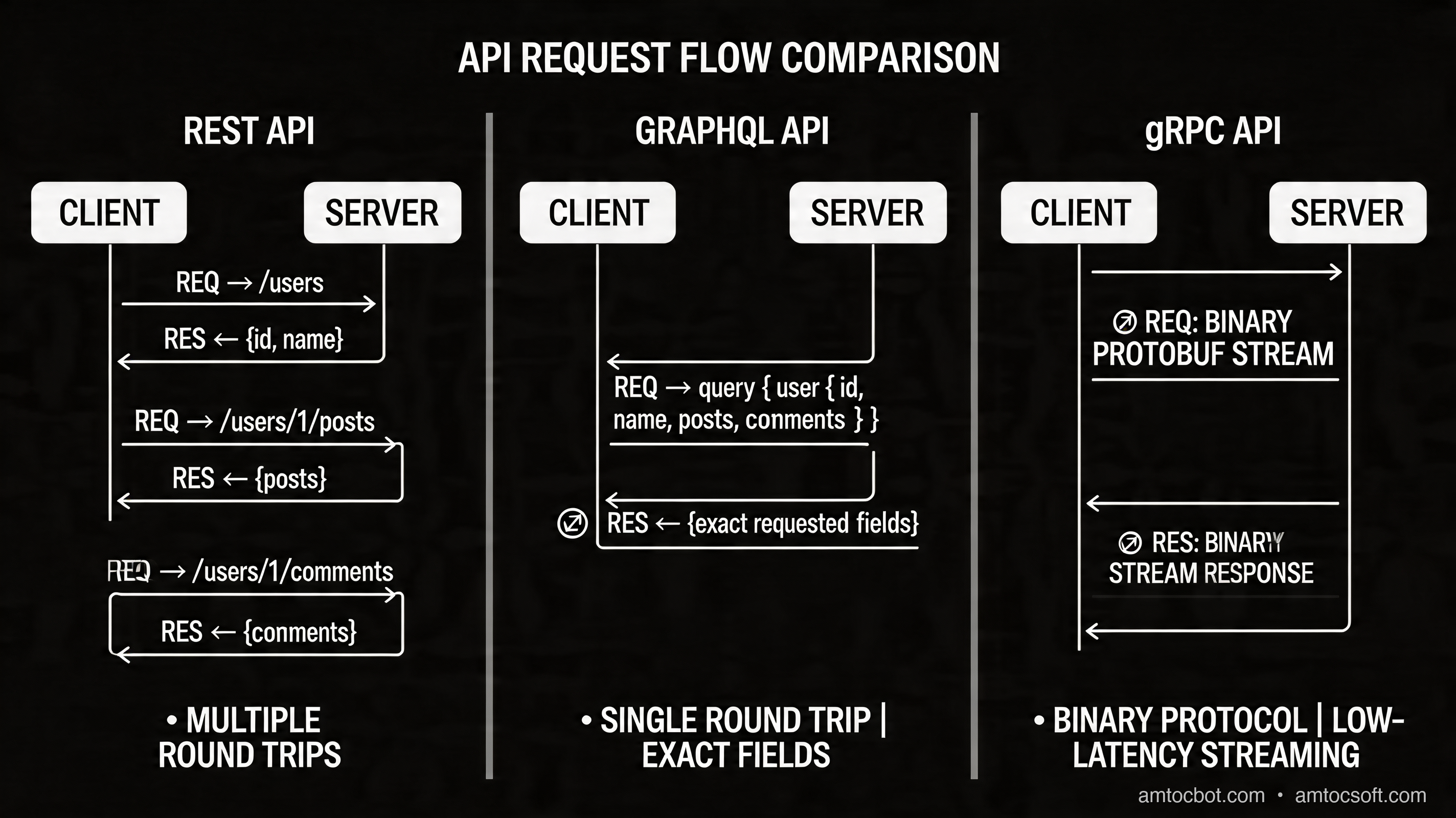
REST was designed around the concept of resources and uniform interfaces. It maps beautifully to CRUD operations and HTTP semantics. But real applications don't always model cleanly onto resources. A dashboard that needs user data, recent orders, notification counts, and product recommendations in a single render cycle is asking REST to do something it was never designed for elegantly — and the result is either massive over-fetching (returning too much data) or multiple round trips (under-fetching).

GraphQL solved those problems but introduced new ones. A flexible query language means clients can request arbitrary shapes of data, which is powerful — until a malicious or poorly written client sends a deeply nested query that hammers your database for minutes. The N+1 query problem, where each item in a list triggers a separate database lookup, has burned teams who didn't build DataLoader patterns from day one.

gRPC sidesteps much of this by using strongly typed contracts (Protocol Buffers) and HTTP/2's multiplexing. It's extremely fast for internal service-to-service calls. But it's nearly useless for browser-native consumption without additional tooling (grpc-web or Connect), and protobuf schemas have a learning curve that slows down exploratory API development.

The real problem engineers face in 2026 is not choosing the "best" API style — it's choosing the right one for the right context, and potentially using all three in the same system.

Request Flow Comparison

How It Works: Technical Deep Dive

REST: Resources, Verbs, and Stateless Contracts

REST (Representational State Transfer) operates on six architectural constraints: statelessness, client-server separation, cacheability, layered system, uniform interface, and optionally code on demand. In practice, REST APIs are defined by their resource URLs and HTTP verbs.

GET    /users/42           → Fetch user 42
POST   /users              → Create a new user
PUT    /users/42           → Replace user 42
PATCH  /users/42           → Partially update user 42
DELETE /users/42           → Delete user 42

The power of REST is that HTTP infrastructure already understands it. CDNs can cache GET responses. Load balancers route by path. API gateways apply rate limits per route. Every HTTP client in every language can speak it without special libraries.

A well-designed REST response for a user resource might look like this:

GET /users/42
{
  "id": 42,
  "name": "Alice Chen",
  "email": "alice@example.com",
  "role": "admin",
  "created_at": "2024-01-15T09:00:00Z",
  "organization_id": 7,
  "avatar_url": "https://cdn.example.com/avatars/42.png",
  "preferences": {
    "theme": "dark",
    "notifications": true
  }
}

The catch: if your mobile client only needs name and avatar_url, you've transmitted six unnecessary fields on every request. Multiply that across millions of calls and it's wasted bandwidth and parsing cost.

REST versioning is another pain point. The common approaches are URL versioning (/v1/users, /v2/users), header versioning (Accept: application/vnd.api+json;version=2), or query parameter versioning (/users?version=2). Each has tradeoffs. URL versioning duplicates routing logic. Header versioning is less visible. None of them prevent the proliferation of parallel API versions that all need to be maintained.

GraphQL: Schema-First, Client-Driven Queries

GraphQL flips the model. Instead of the server defining what data is available at which endpoint, the server defines a typed schema and the client asks for exactly what it needs.

# Schema definition (server-side)
type User {
  id: ID!
  name: String!
  email: String!
  orders(limit: Int, status: OrderStatus): [Order!]!
  organization: Organization!
}

type Order {
  id: ID!
  total: Float!
  status: OrderStatus!
  items: [OrderItem!]!
  createdAt: DateTime!
}

type Query {
  user(id: ID!): User
  users(role: String, limit: Int): [User!]!
}

type Mutation {
  updateUser(id: ID!, input: UpdateUserInput!): User!
  createOrder(input: CreateOrderInput!): Order!
}

The client now sends a single query that specifies exactly the shape it wants:

query GetDashboardData {
  user(id: "42") {
    name
    avatarUrl
    orders(limit: 5, status: PENDING) {
      id
      total
      status
      createdAt
    }
    organization {
      name
      plan
    }
  }
}

One HTTP request. One response. No over-fetching, no multiple round trips. The client gets a dashboard's worth of data in a single call.

The N+1 Problem and DataLoader

The dangerous failure mode in GraphQL is the N+1 query. If you resolve a list of 100 orders and each Order.user field triggers a separate database query, you've issued 101 queries where one would do. The solution is DataLoader — a batching and caching utility that collects all the individual lookup requests within a single execution tick and issues one batched query.

// Without DataLoader — N+1 problem
const resolvers = {
  Order: {
    user: async (order) => {
      // Called once per order — 100 queries for 100 orders!
      return db.users.findById(order.userId);
    }
  }
};

// With DataLoader — batched, one query
import DataLoader from 'dataloader';

const userLoader = new DataLoader(async (userIds) => {
  // Called ONCE with all userIds collected this tick
  const users = await db.users.findByIds(userIds);
  return userIds.map(id => users.find(u => u.id === id));
});

const resolvers = {
  Order: {
    user: async (order) => {
      return userLoader.load(order.userId); // batched automatically
    }
  }
};

GraphQL versioning is simpler than REST because you evolve the schema rather than creating new endpoints. Fields are deprecated with @deprecated(reason: "Use newField instead") and remain available until all clients migrate. This allows gradual evolution without breaking consumers.

graph TD Client["🖥️ GraphQL Client"] GW["API Gateway / GraphQL Server"] QP["Query Parser & Validator"] RE["Resolver Engine"] DL["DataLoader Batch Collector"] DB_Users["Users DB"] DB_Orders["Orders DB"] DB_Orgs["Organizations DB"] Cache["Response Cache"] Client -->|"POST /graphql\n{ query, variables }"| GW GW --> QP QP -->|"Validated AST"| RE RE -->|"user(id: 42)"| DL RE -->|"orders(userId: 42)"| DL RE -->|"organization(id: 7)"| DL DL -->|"Batch: SELECT * FROM users WHERE id IN (...)"| DB_Users DL -->|"Batch: SELECT * FROM orders WHERE user_id IN (...)"| DB_Orders DL -->|"Batch: SELECT * FROM orgs WHERE id IN (...)"| DB_Orgs DB_Users -->|"User rows"| DL DB_Orders -->|"Order rows"| DL DB_Orgs -->|"Org rows"| DL DL -->|"Resolved fields"| RE RE -->|"Assembled JSON"| Cache Cache -->|"{ data: {...} }"| Client

gRPC: Contracts, Protobuf, and HTTP/2 Streaming

gRPC uses Protocol Buffers (protobuf) as its interface definition language and serialization format, and runs over HTTP/2. The schema is defined in .proto files, and client/server code is generated from those definitions.

// user.proto
syntax = "proto3";

package users.v1;

service UserService {
  rpc GetUser (GetUserRequest) returns (User);
  rpc ListUsers (ListUsersRequest) returns (stream User);
  rpc UpdateUser (UpdateUserRequest) returns (User);
  rpc StreamUserActivity (GetUserRequest) returns (stream ActivityEvent);
}

message GetUserRequest {
  string user_id = 1;
}

message User {
  string id = 1;
  string name = 2;
  string email = 3;
  string role = 4;
  int64 created_at = 5;
  string organization_id = 6;
}

message ListUsersRequest {
  string role = 1;
  int32 limit = 2;
  string cursor = 3;
}

message ActivityEvent {
  string event_type = 1;
  int64 timestamp = 2;
  map<string, string> metadata = 3;
}

From this .proto file, protoc generates strongly typed client and server code in Go, Python, TypeScript, Java, Rust, and a dozen other languages. The generated client looks like a regular function call:

// Generated Go client usage
conn, err := grpc.Dial("user-service:50051", grpc.WithTransportCredentials(creds))
client := usersv1.NewUserServiceClient(conn)

// Unary call — just like a function
user, err := client.GetUser(ctx, &usersv1.GetUserRequest{
    UserId: "42",
})
fmt.Printf("Name: %s\n", user.Name)

// Server-side streaming — get users as they arrive
stream, err := client.ListUsers(ctx, &usersv1.ListUsersRequest{
    Role:  "admin",
    Limit: 100,
})
for {
    user, err := stream.Recv()
    if err == io.EOF {
        break
    }
    process(user)
}

// Bidirectional streaming — real-time activity feed
actStream, err := client.StreamUserActivity(ctx, &usersv1.GetUserRequest{UserId: "42"})
for {
    event, err := actStream.Recv()
    if err != nil { break }
    handleEvent(event)
}

Protobuf's binary encoding is roughly 3-10x smaller than equivalent JSON, and serialization/deserialization is significantly faster. For high-throughput internal services exchanging millions of messages per second, this is a meaningful advantage.

HTTP/2 multiplexing means multiple streams can share a single TCP connection without head-of-line blocking, and gRPC supports four call patterns: unary (one request, one response), server streaming, client streaming, and bidirectional streaming. This makes gRPC the natural choice for real-time event feeds, large file uploads, and long-lived connections.


Implementation Guide

REST: A Production-Ready Node.js Endpoint

// routes/users.js — Express + Zod validation
import express from 'express';
import { z } from 'zod';
import { db } from '../db/index.js';
import { cache } from '../cache/redis.js';
import { requireAuth, requireRole } from '../middleware/auth.js';

const router = express.Router();

const UpdateUserSchema = z.object({
  name: z.string().min(1).max(100).optional(),
  email: z.string().email().optional(),
  role: z.enum(['admin', 'member', 'viewer']).optional(),
});

// GET /v1/users/:id
// Cache-Control: max-age=60, stale-while-revalidate=300
router.get('/:id', requireAuth, async (req, res) => {
  const { id } = req.params;
  const cacheKey = `user:${id}`;

  const cached = await cache.get(cacheKey);
  if (cached) {
    res.set('X-Cache', 'HIT');
    return res.json(JSON.parse(cached));
  }

  const user = await db.users.findById(id);
  if (!user) {
    return res.status(404).json({
      error: 'NOT_FOUND',
      message: `User ${id} not found`,
    });
  }

  const response = {
    id: user.id,
    name: user.name,
    email: user.email,
    role: user.role,
    created_at: user.createdAt.toISOString(),
    organization_id: user.organizationId,
    _links: {
      self: { href: `/v1/users/${user.id}` },
      organization: { href: `/v1/organizations/${user.organizationId}` },
      orders: { href: `/v1/users/${user.id}/orders` },
    },
  };

  await cache.setex(cacheKey, 60, JSON.stringify(response));
  res.set('Cache-Control', 'max-age=60, stale-while-revalidate=300');
  res.set('X-Cache', 'MISS');
  res.json(response);
});

// PATCH /v1/users/:id
router.patch('/:id', requireAuth, requireRole('admin'), async (req, res) => {
  const { id } = req.params;
  const parsed = UpdateUserSchema.safeParse(req.body);

  if (!parsed.success) {
    return res.status(400).json({
      error: 'VALIDATION_ERROR',
      details: parsed.error.flatten(),
    });
  }

  const updated = await db.users.update(id, parsed.data);
  await cache.del(`user:${id}`); // Invalidate cache

  res.json(updated);
});

export default router;

GraphQL: Apollo Server with DataLoader and Auth

// graphql/resolvers/user.js
import DataLoader from 'dataloader';
import { AuthenticationError, ForbiddenError } from 'apollo-server-errors';
import { db } from '../../db/index.js';

// Create loaders per-request (not global — prevents cross-request cache pollution)
export function createLoaders() {
  return {
    userById: new DataLoader(async (ids) => {
      const users = await db.users.findByIds(ids);
      const map = new Map(users.map(u => [u.id, u]));
      return ids.map(id => map.get(id) ?? new Error(`User ${id} not found`));
    }),
    ordersByUserId: new DataLoader(async (userIds) => {
      const orders = await db.orders.findByUserIds(userIds);
      const grouped = new Map();
      for (const order of orders) {
        if (!grouped.has(order.userId)) grouped.set(order.userId, []);
        grouped.get(order.userId).push(order);
      }
      return userIds.map(id => grouped.get(id) ?? []);
    }),
  };
}

// typeDefs (schema)
export const typeDefs = `#graphql
  type User {
    id: ID!
    name: String!
    email: String!
    role: UserRole!
    createdAt: DateTime!
    organization: Organization!
    orders(limit: Int = 10, status: OrderStatus): [Order!]!
  }

  enum UserRole { ADMIN MEMBER VIEWER }
  enum OrderStatus { PENDING PROCESSING SHIPPED DELIVERED CANCELLED }

  type Query {
    user(id: ID!): User
    me: User!
  }

  type Mutation {
    updateUser(id: ID!, input: UpdateUserInput!): User!
  }

  input UpdateUserInput {
    name: String
    email: String
    role: UserRole
  }
`;

export const resolvers = {
  Query: {
    user: async (_, { id }, { user, loaders }) => {
      if (!user) throw new AuthenticationError('Not authenticated');
      return loaders.userById.load(id);
    },
    me: async (_, __, { user }) => {
      if (!user) throw new AuthenticationError('Not authenticated');
      return user;
    },
  },
  Mutation: {
    updateUser: async (_, { id, input }, { user, loaders }) => {
      if (!user) throw new AuthenticationError('Not authenticated');
      if (user.role !== 'ADMIN' && user.id !== id) {
        throw new ForbiddenError('Cannot update other users');
      }
      const updated = await db.users.update(id, input);
      loaders.userById.clear(id); // Clear specific loader cache
      return updated;
    },
  },
  User: {
    organization: (user, _, { loaders }) => {
      return loaders.organizationById.load(user.organizationId);
    },
    orders: async (user, { limit, status }, { loaders }) => {
      const orders = await loaders.ordersByUserId.load(user.id);
      const filtered = status ? orders.filter(o => o.status === status) : orders;
      return filtered.slice(0, limit);
    },
  },
};

gRPC: Go Server Implementation

// server/user_service.go
package server

import (
    "context"
    "database/sql"
    "time"

    "google.golang.org/grpc/codes"
    "google.golang.org/grpc/status"

    usersv1 "github.com/example/api/gen/users/v1"
)

type UserServiceServer struct {
    usersv1.UnimplementedUserServiceServer
    db    *sql.DB
    cache Cache
}

func NewUserServiceServer(db *sql.DB, cache Cache) *UserServiceServer {
    return &UserServiceServer{db: db, cache: cache}
}

// Unary RPC — GetUser
func (s *UserServiceServer) GetUser(
    ctx context.Context,
    req *usersv1.GetUserRequest,
) (*usersv1.User, error) {
    if req.UserId == "" {
        return nil, status.Error(codes.InvalidArgument, "user_id is required")
    }

    // Check cache
    if cached, ok := s.cache.Get(ctx, "user:"+req.UserId); ok {
        return cached.(*usersv1.User), nil
    }

    var user usersv1.User
    var createdAt time.Time

    err := s.db.QueryRowContext(ctx,
        `SELECT id, name, email, role, created_at, organization_id
         FROM users WHERE id = $1 AND deleted_at IS NULL`,
        req.UserId,
    ).Scan(&user.Id, &user.Name, &user.Email, &user.Role, &createdAt, &user.OrganizationId)

    if err == sql.ErrNoRows {
        return nil, status.Errorf(codes.NotFound, "user %s not found", req.UserId)
    }
    if err != nil {
        return nil, status.Errorf(codes.Internal, "database error: %v", err)
    }

    user.CreatedAt = createdAt.Unix()
    s.cache.Set(ctx, "user:"+req.UserId, &user, 60*time.Second)
    return &user, nil
}

// Server streaming RPC — ListUsers
func (s *UserServiceServer) ListUsers(
    req *usersv1.ListUsersRequest,
    stream usersv1.UserService_ListUsersServer,
) error {
    query := `SELECT id, name, email, role, created_at, organization_id
              FROM users WHERE deleted_at IS NULL`
    args := []any{}

    if req.Role != "" {
        query += " AND role = $1"
        args = append(args, req.Role)
    }
    if req.Limit > 0 {
        query += " LIMIT $2"
        args = append(args, req.Limit)
    }

    rows, err := s.db.QueryContext(stream.Context(), query, args...)
    if err != nil {
        return status.Errorf(codes.Internal, "query error: %v", err)
    }
    defer rows.Close()

    for rows.Next() {
        var user usersv1.User
        var createdAt time.Time

        if err := rows.Scan(
            &user.Id, &user.Name, &user.Email,
            &user.Role, &createdAt, &user.OrganizationId,
        ); err != nil {
            return status.Errorf(codes.Internal, "scan error: %v", err)
        }
        user.CreatedAt = createdAt.Unix()

        // Send each user as it's scanned — true streaming
        if err := stream.Send(&user); err != nil {
            return err // Client disconnected
        }
    }

    return rows.Err()
}
flowchart TD Start(["Start: API Design Decision"]) Q1{"Public API?\n(Third-party devs)"} Q2{"Mobile-heavy\nclient?"} Q3{"Real-time or\nstreaming needed?"} Q4{"Internal service\nto service?"} Q5{"Strict schema\ncontract needed?"} REST["✅ Use REST\n\n• Familiar to all HTTP clients\n• CDN caching works natively\n• Easy to document with OpenAPI\n• Wide tooling ecosystem"] GraphQL["✅ Use GraphQL\n\n• Client-driven queries\n• One endpoint, flexible shape\n• Solves over/under-fetching\n• Schema introspection built in"] gRPC_Stream["✅ Use gRPC\n(with streaming)\n\n• Bidirectional streaming\n• Low latency, binary protocol\n• HTTP/2 multiplexing\n• Ideal for real-time feeds"] gRPC_Internal["✅ Use gRPC\n(internal services)\n\n• Generated typed clients\n• ~3-10x faster than JSON/REST\n• Enforced contract via protobuf\n• Service mesh friendly"] Hybrid["⚡ Consider Hybrid\n\nREST for public\ngRPC internally\nGraphQL for BFF layer"] Start --> Q1 Q1 -->|Yes| REST Q1 -->|No| Q2 Q2 -->|Yes, complex data needs| GraphQL Q2 -->|No| Q3 Q3 -->|Yes, bidirectional| gRPC_Stream Q3 -->|No| Q4 Q4 -->|Yes| Q5 Q5 -->|Yes, high performance| gRPC_Internal Q5 -->|No, flexible iteration| GraphQL Q4 -->|No, mixed concerns| Hybrid

Comparison and Tradeoffs

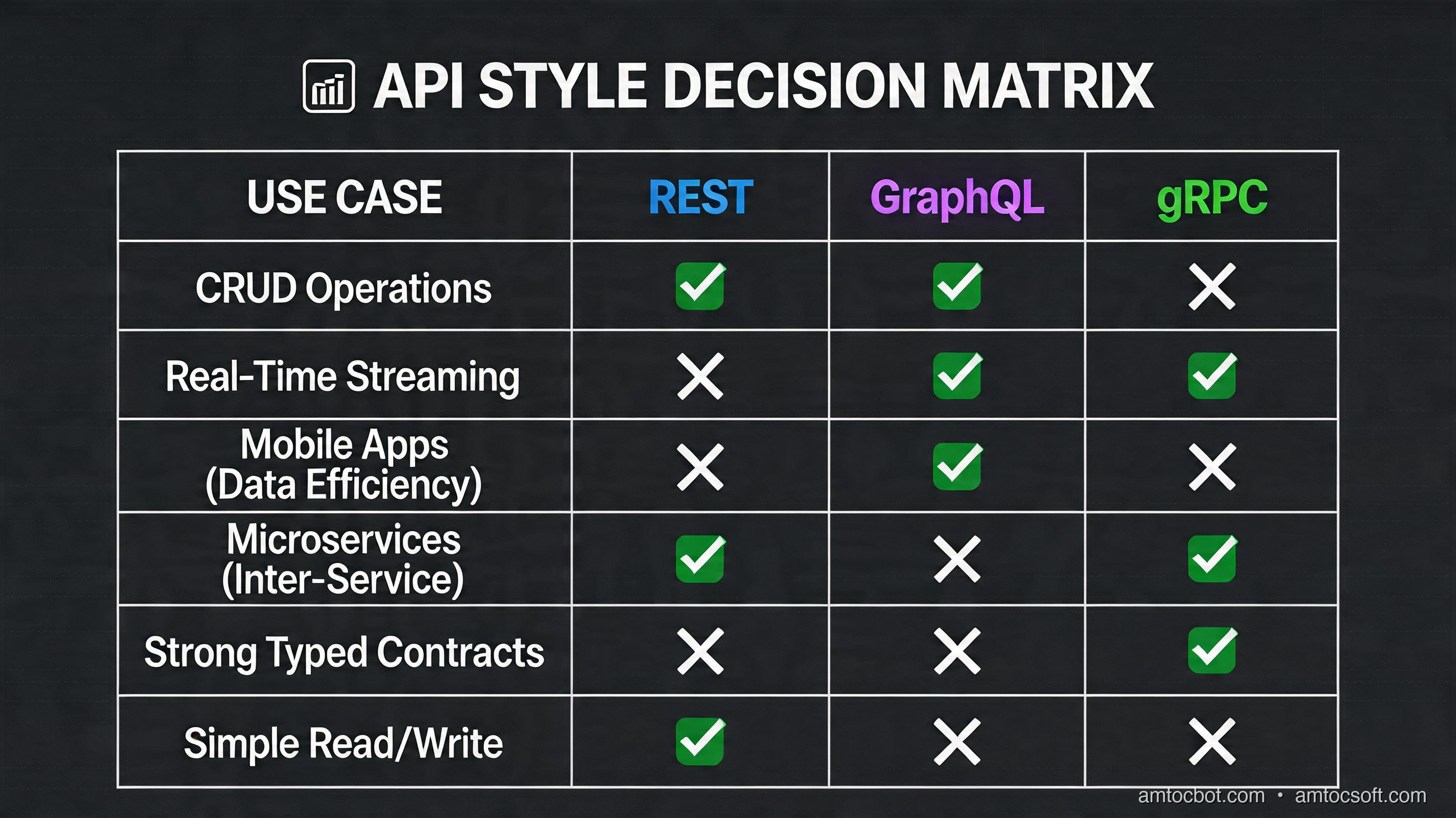
GraphQL vs REST vs gRPC Decision Matrix

The following table consolidates the major engineering tradeoffs across all three styles.

Dimension REST GraphQL gRPC
Protocol HTTP/1.1 + 2 HTTP/1.1 + 2 HTTP/2 only
Payload format JSON (typically) JSON Protobuf (binary)
Schema OpenAPI (optional) Mandatory SDL Mandatory .proto
Browser support Native Native Needs grpc-web/Connect
Streaming SSE / WebSocket (workaround) Subscriptions Native (4 modes)
Caching HTTP cache (CDN-friendly) Complex (POST by default) Not HTTP-cache-friendly
Versioning URL/Header-based Schema evolution + deprecation Package versioning in proto
Code generation Optional (OpenAPI gen) Optional (codegen tools) Required (protoc)
Learning curve Low Medium High
Over-fetching Common problem Eliminated Not applicable
N+1 problem Not applicable Real risk (DataLoader required) Not applicable
Tooling maturity Excellent Very good Good
Type safety Optional Schema-enforced Enforced via protobuf
Throughput Baseline ~5-15% overhead vs REST 2-10x faster than REST
Best for Public APIs, CRUD Mobile, BFF, complex graphs Internal services, streaming

Performance in Numbers (2026 Benchmarks)

In synthetic benchmarks on equivalent hardware (4-core, 16GB, 10Gbps network):

  • Simple GET (single resource, small payload):
  • REST/JSON: ~12,000 req/s
  • GraphQL: ~10,500 req/s (schema parsing overhead)
  • gRPC/protobuf: ~45,000 req/s

  • Complex query (5 related entities, large payload):

  • REST (5 round trips): ~1,800 req/s effective throughput
  • GraphQL (1 request): ~9,800 req/s
  • gRPC (streaming): ~38,000 msg/s

GraphQL's overhead on simple queries is real but small. Its advantage on complex, multi-entity queries is dramatic. gRPC wins on raw throughput in every scenario where it applies.

sequenceDiagram participant C as Client participant REST as REST API participant GQL as GraphQL API participant GRPC as gRPC Service participant DB as Database Note over C,DB: Same operation: fetch user + last 5 orders + organization rect rgb(255, 240, 240) Note over C,REST: REST — 3 round trips C->>REST: GET /v1/users/42 REST->>DB: SELECT * FROM users WHERE id=42 DB-->>REST: user row REST-->>C: { user object } C->>REST: GET /v1/users/42/orders?limit=5 REST->>DB: SELECT * FROM orders WHERE user_id=42 LIMIT 5 DB-->>REST: 5 order rows REST-->>C: [order array] C->>REST: GET /v1/organizations/7 REST->>DB: SELECT * FROM organizations WHERE id=7 DB-->>REST: org row REST-->>C: { org object } Note over C: 3 requests, 3 round trips, 3x latency end rect rgb(240, 255, 240) Note over C,GQL: GraphQL — 1 request, batched queries C->>GQL: POST /graphql { user(id:42) { name orders { ... } organization { ... } } } GQL->>DB: SELECT FROM users WHERE id=42 GQL->>DB: SELECT FROM orders WHERE user_id=42 LIMIT 5 (DataLoader batch) GQL->>DB: SELECT FROM organizations WHERE id=7 (DataLoader batch) DB-->>GQL: all results GQL-->>C: { data: { user: { name, orders, organization } } } Note over C: 1 request, parallel DB queries, minimal latency end rect rgb(240, 240, 255) Note over C,GRPC: gRPC — binary, multiplexed C->>GRPC: GetUserWithRelations(user_id: "42") [protobuf, HTTP/2 stream 1] GRPC->>DB: Batched JOIN query DB-->>GRPC: Binary result set GRPC-->>C: UserWithRelations message [protobuf, ~3x smaller than JSON] Note over C: 1 request, binary protocol, HTTP/2 multiplexing end

Versioning Strategy Deep Dive

REST versioning creates parallel codebases. /v1/ and /v2/ must both be maintained until all clients migrate. This is operationally expensive — every bug fix or security patch must be applied to every active version.

GraphQL versioning is fundamentally different. You never create /v2/graphql. Instead, you add fields, deprecate old ones, and remove them only after usage drops to zero (visible via field-level usage metrics). This allows continuous evolution without breaking existing clients.

type User {
  id: ID!
  name: String!
  # Deprecated — use `avatarUrl` instead
  avatar: String @deprecated(reason: "Use avatarUrl for CDN-optimized images")
  avatarUrl: String!
  # New field — clients opt in
  profileCompleteness: Int!
}

gRPC uses protobuf's field numbering rules for backward compatibility. You never remove or renumber fields; you only add new ones. Clients compiled against old .proto files ignore unknown fields. This allows independent deployment of services and clients, which is critical in a microservice mesh where you can't coordinate releases.

message User {
  string id = 1;
  string name = 2;
  string email = 3;
  // Field 4 was deprecated and removed — number 4 is reserved forever
  reserved 4;
  reserved "old_avatar_url";
  // New fields added safely — old clients ignore these
  string avatar_url = 5;
  int32 profile_completeness = 6;
}

Production Considerations

gRPC in Production

gRPC's main production challenge is observability. Protobuf binary payloads can't be read in standard network tools. Invest in proper tracing (OpenTelemetry, Jaeger) from day one. Envoy proxy with gRPC-JSON transcoding lets you expose gRPC services as REST endpoints for debugging and for clients that can't speak gRPC natively.

Health checking requires gRPC's own health protocol (grpc.health.v1.Health) — Kubernetes readiness probes need to be configured with grpc probe type (available since Kubernetes 1.24) or a sidecar.

# Kubernetes liveness probe for gRPC service
livenessProbe:
  grpc:
    port: 50051
  initialDelaySeconds: 10
  periodSeconds: 15

GraphQL in Production

Depth limiting and complexity analysis are non-negotiable in any GraphQL API exposed to the public or to third-party clients. A query like { users { orders { user { orders { user { ... } } } } } } can recurse infinitely.

import depthLimit from 'graphql-depth-limit';
import { createComplexityRule } from 'graphql-query-complexity';

const server = new ApolloServer({
  typeDefs,
  resolvers,
  validationRules: [
    depthLimit(7),  // Max query depth
    createComplexityRule({
      maximumComplexity: 1000,
      estimators: [
        fieldExtensionsEstimator(),
        simpleEstimator({ defaultComplexity: 1 }),
      ],
    }),
  ],
  plugins: [
    ApolloServerPluginLandingPageDisabledPlugin(), // Disable in prod
  ],
});

Persisted queries (storing query hashes server-side and having clients send only the hash) eliminate the attack surface of arbitrary query execution entirely and dramatically improve caching.

REST in Production

REST's production story is the most mature of the three. API gateways (Kong, AWS API Gateway, Cloudflare API Shield) understand HTTP semantics natively. Rate limiting by IP, user, or API key is built-in. CDN caching for GET endpoints is trivially enabled.

The main REST production pitfall is inconsistent error shapes. Define a standard error envelope and enforce it across all services:

{
  "error": {
    "code": "VALIDATION_ERROR",
    "message": "Request validation failed",
    "details": [
      { "field": "email", "message": "Must be a valid email address" }
    ],
    "request_id": "req_01HX7M3K2NQVP9WFZYX4B6R8C",
    "timestamp": "2026-04-15T10:30:00Z"
  }
}

Use OpenAPI 3.1 specifications as the source of truth for all REST APIs. Generate server stubs, client SDKs, and documentation from the spec rather than writing them separately. Tools like Speakeasy, OpenAPI Generator, and Redocly make this straightforward in 2026.

Choosing a Hybrid Architecture

The pragmatic answer for most production systems in 2026 is a hybrid. A common pattern:

  • Public API: REST (OpenAPI 3.1, versioned, CDN-cached)
  • BFF (Backend for Frontend): GraphQL (per-client schemas for web, iOS, Android)
  • Internal service mesh: gRPC (typed contracts, binary protocol, service discovery via Consul or Kubernetes)

This pattern lets each communication style do what it's best at. REST gives you a stable, well-understood public surface. GraphQL lets your frontend teams move fast without waiting for backend endpoint changes. gRPC keeps your internal services fast and contract-safe.


Conclusion

There is no universally correct answer to the GraphQL vs REST vs gRPC question in 2026 — but there are clearly correct answers for each context.

Choose REST when you're building a public API that needs to be usable by any HTTP client, when CDN caching is important, or when your team is small and tooling simplicity matters. It's not exciting, but it's proven, well-understood, and has the widest ecosystem support.

Choose GraphQL when your client teams (especially mobile) have complex, variable data needs. When over-fetching is hurting performance or developer productivity. When you have a graph-shaped data model. Budget time to implement DataLoader patterns correctly and add query complexity limits before going to production.

Choose gRPC for internal service-to-service communication where performance, streaming, and strict contracts matter more than browser compatibility. It's the right call for high-throughput pipelines, real-time event streams, and service meshes where the 3-10x performance advantage over JSON/REST pays for the protobuf learning curve many times over.

The most sophisticated systems — the ones at Google, Netflix, Shopify, and other high-scale organizations — use all three. REST faces the world. gRPC moves data internally. GraphQL sits at the boundary, composing internal data into exactly what each client needs.

Start with the one that fits your current constraints. Design your boundaries so switching or adding another style later is possible. The API layer is one of the few architectural decisions that's genuinely hard to reverse — get the fundamentals right from the start.


Tags: graphql, rest, grpc, api-design, microservices, software-engineering


Sources

About the Author

Toc Am

Founder of AmtocSoft. Writing practical deep-dives on AI engineering, cloud architecture, and developer tooling. Previously built backend systems at scale. Reviews every post published under this byline.

LinkedIn X / Twitter

Published: 2026-04-15 · Written with AI assistance, reviewed by Toc Am.

Get These In Your Inbox

Weekly deep-dives on AI engineering, no fluff. Join the newsletter →

Subscribe (free)

Or grab the book ($39, ~100 pages) · Buy me a coffee

Buy Me a Coffee · 🔔 YouTube · 💼 LinkedIn · 🐦 X/Twitter

Bigger Is Not the Same as Better. The Job That Moved Is the Phone, Not the Lab.

Bigger is a plan. The phone is the receipt. The brief for this cycle is a question: does bigger always mean better in AI? The 2026 answer i...