Showing posts with label ai-security. Show all posts

Sunday, April 12, 2026

Deepfake Phishing: How AI-Generated Attacks Are Targeting Your Organization in 2026

Hero image: A split-screen showing a realistic video call on one side and a glitch-revealed AI face on the other, with red alert overlays and a corporate office background

Introduction

In early 2024, a finance employee at a multinational firm in Hong Kong joined what appeared to be a routine video conference. The call included his CFO and several other senior colleagues — familiar faces, familiar voices. By the end of the meeting, he had authorized transfers totaling $25 million USD. Every person on that call except him was a deepfake. The attackers had trained AI models on publicly available footage of the real employees, generated convincing video and audio in real time, and walked away with one of the largest social engineering payouts in history.

This is not a future-state scenario. It happened, and the techniques used are now cheaper, faster, and more accessible than they were when that attack took place.

Traditional phishing relied on volume. Attackers sent millions of generic emails and hoped a small percentage of recipients would click a malicious link or hand over credentials. Defense was also volume-based: spam filters, blacklists, user awareness training built around the classic "Nigerian prince" email. The model held for decades because attackers couldn't afford to personalize at scale.

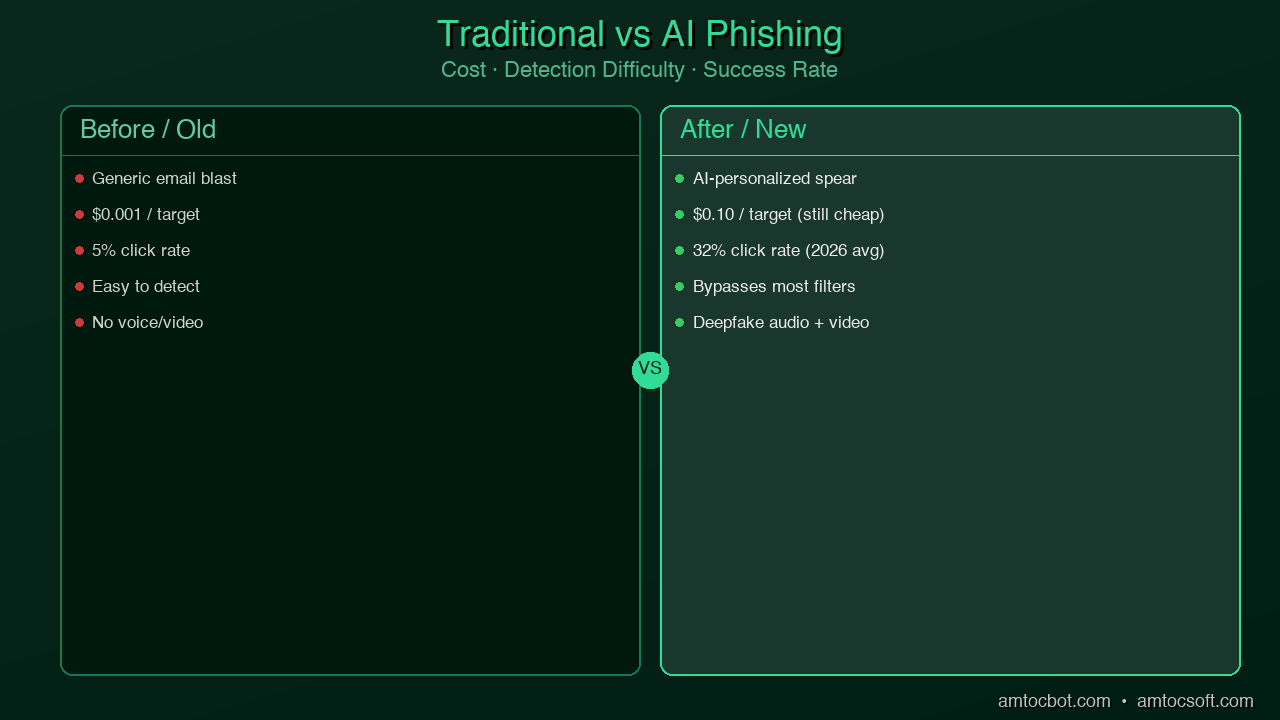
AI broke that equation. Voice cloning services can replicate a person's voice from less than 30 seconds of audio. Open-source face-swap models run on consumer GPUs. Large language models can draft perfectly grammatical, contextually accurate spear-phishing emails by scraping a target's LinkedIn profile, blog posts, and public communications in minutes. The cost of a targeted, personalized attack has collapsed from thousands of dollars and weeks of human labor to a few dollars and a few hours of compute.

For security-aware developers, tech leads, and DevSecOps engineers, this shift demands a different mental model. The question is no longer "does this email look like phishing?" It's "do I have a verified, out-of-band reason to trust this request?" This post breaks down how these attacks work, what the real-world incidents look like, and — most importantly — what technical and process controls you can implement today to harden your organization against them.


The New Attack Surface

To understand why deepfake phishing is different, you need to understand what changed in the cost structure of attacks.

The Economics of Old Phishing

Classic phishing was a numbers game. An attacker might pay a few hundred dollars for a phishing kit, blast millions of emails using a botnet, and convert a fraction of a percent into credential theft or malware installs. Spear phishing — targeted attacks against specific individuals — required real human research time and skilled social engineers. A sophisticated Business Email Compromise (BEC) attack targeting a CFO might take a team of attackers weeks of reconnaissance and impersonation effort. The return had to justify the investment, which limited targeting to high-value organizations.

What AI Changed

The AI toolchain for a modern deepfake attack is disturbingly accessible:

Voice cloning: Services like ElevenLabs allow voice cloning from as little as a 30-second sample. A YouTube earnings call, a LinkedIn video post, a podcast appearance, or a TED talk provides more than enough source material for most executives. The resulting clone can speak any script with convincing prosody and emotional variation. Cost: free tier available, professional tiers starting at $5/month.

Video deepfakes: Open-source projects like DeepFaceLab and commercial tools allow real-time face-swapping during live video calls. While high-fidelity real-time deepfakes still require meaningful GPU resources, the barrier is a $500 gaming PC — not a nation-state budget. Latency and quality continue to improve with each model generation.

LLM-written spear phishing: GPT-4-class models can ingest a target's public digital footprint — LinkedIn connections, GitHub commits, conference talks, published papers — and generate highly personalized phishing emails that reference real projects, real colleagues, and real internal vocabulary. These emails pass traditional spam filters and fool users trained to spot generic phishing cues.

OSINT automation: Tools like Maltego, SpiderFoot, and purpose-built scraping scripts can aggregate a target's digital footprint in minutes, feeding it directly into attack pipeline prompts.

Cost Comparison

Attack Type Old Cost (2018) New Cost (2026)
Generic phishing email $0.001/email $0.001/email
Spear phishing email $500–2,000 (human time) $2–10 (LLM + OSINT)
Voice clone of executive $50,000+ (actor/studio) $5–20 (ElevenLabs + sample)
Video deepfake (pre-recorded) $100,000+ (studio) $50–200 (GPU rental)
Real-time video deepfake Nation-state level $500–2,000 (consumer GPU)

The cost curve has a direct implication: attacks that previously targeted only Fortune 500 companies with multi-million dollar fraud potential are now economically viable against mid-market companies, municipal governments, hospitals, and law firms.
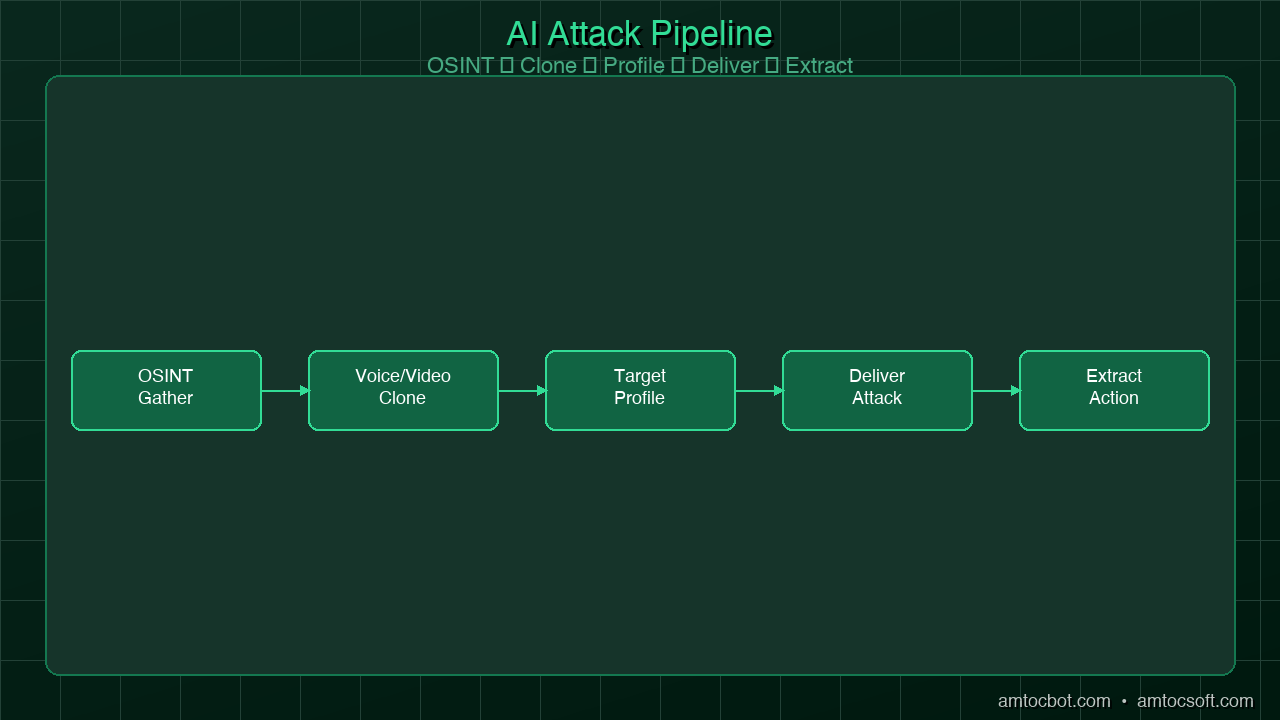
Architecture diagram: AI-powered phishing attack pipeline showing OSINT ingestion, model training, target profiling, and delivery vectors feeding into action extraction

How Deepfake Attacks Work

Understanding the anatomy of an attack is the first step to building effective defenses. Modern deepfake phishing follows a consistent kill chain, whether the goal is wire fraud, credential theft, or malware installation.

Step 1: OSINT Gathering

Before any AI model is trained, attackers build a comprehensive intelligence profile. Publicly available sources are shockingly rich:

  • LinkedIn: Job titles, reporting structures, internal project names, company vocabulary, and employee connections reveal organizational hierarchy. An attacker can identify the CFO, their direct reports, and which assistant handles calendar requests.
  • YouTube and conference recordings: Earnings calls, investor presentations, and conference talks provide hours of high-quality audio and video of executives — exactly the training data needed for voice clones and deepfake models.
  • GitHub: Public repositories reveal internal tooling names, infrastructure patterns, and sometimes email addresses and internal domain structures.
  • Press releases and news: Merger announcements, funding rounds, and personnel changes create time-sensitive pretexts ("I need this wire transfer completed before the acquisition closes tomorrow").
  • Job postings: Reveal internal systems in use (Salesforce, Workday, specific cloud providers), which helps attackers craft believable system-level pretexts.

OSINT phase for a mid-sized target can be completed in 2–4 hours with automated tooling. For high-value targets like public company executives, the data is already pre-aggregated across dozens of data broker databases.

Step 2: Voice and Video Model Training

With source material in hand, attackers train or fine-tune models:

  • Voice cloning: 30 seconds to 3 minutes of clean audio is sufficient for services like ElevenLabs. The resulting model captures prosody, accent, speech patterns, and emotional register. Longer samples produce more convincing results with more flexibility for novel scripts.
  • Video deepfake: Tools like DeepFaceLab require more source data — typically 300–500 photos or a few minutes of video — to produce stable face-swaps. Real-time face-swap for live calls requires a GPU with enough VRAM to run inference at video frame rates, typically an RTX 3080 or better.
  • LLM context priming: The attacker creates a system prompt for an LLM that includes the target's writing style, known projects, colleagues' names, and organizational vocabulary. The LLM then generates emails, chat messages, or call scripts that sound internally authentic.

Step 3: Target Profiling

Not everyone in the organization is the final target. Attackers map the authorization chain:

  • Who can authorize wire transfers? (CFO, Controller, Treasury Manager)
  • Who has admin access to identity systems? (IT helpdesk, Active Directory admins)
  • Who onboards new vendors? (AP team, Procurement)
  • Who can reset MFA for executives? (IT helpdesk — often the weakest link)

The deepfake is of a trusted authority figure (CEO, CFO, board member, IT director). The target is whoever has the ability to execute the requested action and is most likely to defer to that authority figure under time pressure.

Step 4: Delivery Vector

The attack reaches the target through whatever channel establishes the most trust with the least friction:

  • Fake video conference call: The most sophisticated vector. Attacker creates a meeting invite from a spoofed or compromised email account, joins with deepfake video and cloned voice. The Hong Kong $25M attack used this method.
  • Voice message / voicemail: Simpler to execute, no real-time GPU required. A pre-generated voice message from "the CEO" asking for an urgent action.
  • Teams or Slack DM: Attackers compromise or spoof an account and send a direct message with a link or credential request. LLM-generated text matches the executive's writing style.
  • Email: Still the dominant vector for volume attacks. LLM-generated spear phishing with convincing personalization.

Step 5: Action Extraction

The final step is converting trust into a concrete action:

  • Wire transfer: "We need to move funds for the acquisition before end of day. I'll explain in the all-hands next week — keep this quiet for now."
  • Credential handover: "IT is doing emergency maintenance on your account — what's your current password / can you approve this MFA push?"
  • Malware install: "I'm sending you a contract to review — click the link to download."
  • Vendor account creation: "We're onboarding a new vendor urgently — can you process this invoice/banking details?"

The time pressure and authority combination are intentional. Attackers want the target to act before they have time to verify.

graph TD A[OSINT Gathering\nLinkedIn, YouTube, GitHub, Press] --> B[Model Training\nVoice Clone + Video Deepfake + LLM Priming] B --> C[Target Profiling\nIdentify Authorization Holders] C --> D{Delivery Vector} D --> E[Live Video Call\nReal-time Deepfake] D --> F[Voice Message\nPre-generated Clone] D --> G[Chat / Email\nLLM-generated Text] E --> H[Action Extraction] F --> H G --> H H --> I[Wire Transfer\nor Credential Theft\nor Malware Install] style I fill:#c0392b,color:#fff style A fill:#2c3e50,color:#fff style B fill:#2c3e50,color:#fff

Real-World Incidents

The threat is not theoretical. The incidents below represent documented cases with verified financial losses.

The $25 Million Hong Kong Deepfake Call (2024)

In February 2024, Hong Kong police confirmed that a finance worker at an unidentified multinational corporation was defrauded of HKD 200 million (approximately $25.6 million USD) after attending a multi-person video conference where every other participant was a deepfake. The attacker had used publicly available video of the real employees to create convincing real-time deepfakes. The finance worker initially suspected a phishing email but was reassured when the video call appeared to show familiar faces and voices.

This case is significant because it demonstrated that deepfake video calls in a business context were no longer theoretical — they were operationally deployed against a real organization at scale.

Energy Company CEO Voice Clone ($243,000)

In 2019 — years before the current generation of voice AI tools was available — attackers used AI-generated audio to impersonate the CEO of a UK-based energy company. The fake CEO called the company's German subsidiary and instructed the manager to wire €220,000 (approximately $243,000) to a Hungarian supplier. The manager complied, believing he was speaking to his actual CEO. The attackers called back requesting a second transfer, but the manager grew suspicious and verified with the real CEO. This incident occurred with voice AI tools that were primitive by 2026 standards.

LLM-Powered Spear Phishing Campaigns (2024–2025)

Security researchers at multiple firms documented a significant uptick in LLM-generated spear phishing campaigns targeting enterprise employees. Unlike previous generations of phishing emails — which were detectable by grammar errors, generic salutations, or implausible scenarios — these emails referenced real internal projects by name, used correct organizational terminology, and adopted the writing style of known internal communicators. Defenders reported that standard phishing awareness training was largely ineffective because the emails no longer had the traditional visual tells.

According to IBM's 2024 Cost of a Data Breach Report, the average cost of a data breach reached $4.88 million, with social engineering remaining one of the leading initial attack vectors. Gartner projected that by 2026, more than 80% of enterprises will have encountered AI-generated attack content.

What These Incidents Have in Common

All of these attacks shared a common structure: they exploited the human tendency to trust familiar identities, combined with time pressure that discouraged verification. The technology was the enabler, but the attack surface was process and psychology — not software vulnerabilities.

graph TD A[Unexpected Request Arrives] --> B{Is the sender identity verified\nthrough a channel you initiated?} B -- Yes --> C[Proceed with normal authorization] B -- No --> D{Does it involve money, credentials,\nor system access?} D -- No --> E[Proceed with standard caution] D -- Yes --> F[STOP — Verify out-of-band] F --> G[Call known number from directory\nNOT from the message] G --> H{Identity confirmed\nvia separate channel?} H -- Yes --> I[Proceed — document verification] H -- No --> J[Escalate to security team immediately] style J fill:#c0392b,color:#fff style F fill:#e67e22,color:#fff style I fill:#27ae60,color:#fff

Detection and Defense

The good news: while attackers are using AI to scale attacks, defenders have both technical and procedural tools available. The key insight is that no single control is sufficient — defense requires layering.

Technical Controls

Out-of-Band Verification

The single most effective control against deepfake fraud is a mandatory out-of-band verification protocol for any request involving financial transactions or credential changes. The rule is simple: if a request for a wire transfer, credential handover, or system access change arrives via any digital channel — email, chat, video call, voice message — it must be verified by calling a phone number from your organization's internal directory or a previously stored known-good contact. Not the number provided in the message. Not by replying to the email.

This control is low-tech and highly effective because it bypasses the deepfake entirely. The attacker cannot intercept a call to a number they don't control.

AI Deepfake Detection Tools

Several technical tools exist to detect AI-generated content at the signal level:

  • Intel FakeCatcher: Uses photoplethysmography (blood flow patterns visible in facial skin pixels) to distinguish real human faces from synthetic video. Real faces show subtle pulse-driven color changes; deepfakes typically do not replicate these at the pixel level. FakeCatcher has been demonstrated with real-time detection capabilities.
  • Microsoft's deepfake detection research: Microsoft has published detection models as part of its Responsible AI initiative that analyze temporal inconsistencies and frequency-domain artifacts common in face-swap models.
  • Voice liveness detection: Dedicated services and APIs analyze audio for artifacts of synthesis — phase inconsistencies, spectral smoothing, unnatural pitch transitions. These are increasingly integrated into fraud detection platforms used by financial institutions.

Email Analysis for LLM-Generated Text

LLM-generated phishing emails can be detected with statistical text analysis tools. One approach is perplexity scoring — LLMs tend to produce text with lower perplexity (more predictable token sequences) than human writers in many contexts. While this is not foolproof, it can be used as a risk signal in email security tooling.

import math
import re
import statistics

def estimate_llm_likelihood(text: str) -> dict:
    """
    Heuristic estimate of LLM-generated text likelihood.
    Uses sentence-level variance and vocabulary richness as signals.
    Higher uniformity score = more likely LLM-generated.

    NOTE: This is a simplified heuristic for illustration.
    Production use should call a dedicated LLM-detection API 
    (e.g., Originality.ai, GPTZero API, or fine-tuned classifier).
    """
    # Split into sentences
    sentences = re.split(r'[.!?]+', text.strip())
    sentences = [s.strip() for s in sentences if len(s.strip()) > 10]

    if len(sentences) < 3:
        return {"score": 0.0, "confidence": "insufficient_data"}

    # Feature 1: Sentence length variance
    # LLMs tend toward uniform sentence lengths; humans vary more
    lengths = [len(s.split()) for s in sentences]
    length_stdev = statistics.stdev(lengths) if len(lengths) > 1 else 0
    length_mean = statistics.mean(lengths)
    coefficient_of_variation = length_stdev / length_mean if length_mean > 0 else 0

    # Feature 2: Vocabulary richness (Type-Token Ratio)
    # LLMs sometimes produce lower TTR on formal text
    words = text.lower().split()
    ttr = len(set(words)) / len(words) if words else 0

    # Feature 3: Filler phrase density
    # LLMs overuse certain transitional phrases
    llm_fillers = [
        "it is important to note", "in conclusion", "furthermore",
        "it is worth mentioning", "as mentioned above", "in summary",
        "to summarize", "needless to say", "it goes without saying"
    ]
    text_lower = text.lower()
    filler_count = sum(1 for phrase in llm_fillers if phrase in text_lower)
    filler_density = filler_count / len(sentences)

    # Composite heuristic score (0 = likely human, 1 = likely LLM)
    # Low CV + high filler density → LLM signal
    uniformity_signal = max(0, 1 - coefficient_of_variation)
    llm_score = (uniformity_signal * 0.4) + (filler_density * 0.4) + (max(0, 0.6 - ttr) * 0.2)
    llm_score = min(1.0, llm_score)

    confidence = "high" if len(sentences) >= 8 else "medium"

    return {
        "score": round(llm_score, 3),
        "confidence": confidence,
        "signals": {
            "sentence_length_cv": round(coefficient_of_variation, 3),
            "vocabulary_richness_ttr": round(ttr, 3),
            "filler_phrase_density": round(filler_density, 3)
        },
        "interpretation": "Possible LLM-generated text" if llm_score > 0.6 else "Likely human-written"
    }


# Example usage
sample_email = """
Dear John, I hope this message finds you well. 
I wanted to reach out regarding an urgent matter that requires your immediate attention.
It is important to note that we need to process a wire transfer before end of business today.
In conclusion, please confirm your availability to discuss this matter at your earliest convenience.
Furthermore, the details of the transfer will be provided upon confirmation.
"""

result = estimate_llm_likelihood(sample_email)
print(f"LLM likelihood score: {result['score']}")
print(f"Interpretation: {result['interpretation']}")
print(f"Signals: {result['signals']}")

Domain and Sender Threat Intelligence

For email-based attacks, automated checks against threat intelligence feeds can catch newly registered lookalike domains before they reach inboxes.

#!/bin/bash
# check-domain-threat-intel.sh
# Check a domain against VirusTotal and WHOIS for phishing signals
# Requires: VIRUSTOTAL_API_KEY environment variable

DOMAIN="${1:?Usage: $0 <domain>}"
VT_API_KEY="${VIRUSTOTAL_API_KEY:?Set VIRUSTOTAL_API_KEY env variable}"

echo "=== Threat Intel Check: $DOMAIN ==="

# VirusTotal domain report
echo ""
echo "[VirusTotal] Checking domain reputation..."
VT_RESPONSE=$(curl -s --request GET \
  --url "https://www.virustotal.com/api/v3/domains/${DOMAIN}" \
  --header "x-apikey: ${VT_API_KEY}")

# Parse malicious vote count and registration date
MALICIOUS=$(echo "$VT_RESPONSE" | python3 -c "
import sys, json
data = json.load(sys.stdin)
stats = data.get('data', {}).get('attributes', {}).get('last_analysis_stats', {})
print(f'Malicious detections: {stats.get(\"malicious\", 0)}/{sum(stats.values()) if stats else 0}')
creation_date = data.get('data', {}).get('attributes', {}).get('creation_date', 'Unknown')
import datetime
if isinstance(creation_date, int):
    creation_date = datetime.datetime.fromtimestamp(creation_date).strftime('%Y-%m-%d')
print(f'Domain created: {creation_date}')
" 2>/dev/null || echo "Parse error — check raw response")

echo "$MALICIOUS"

# WHOIS age check (new domains = higher risk)
echo ""
echo "[WHOIS] Checking domain age..."
whois "$DOMAIN" 2>/dev/null | grep -iE "creation|registered|created" | head -3

# DNS anomaly check — does it look like a lookalike?
echo ""
echo "[DNS] Resolving domain..."
dig +short "$DOMAIN" A | head -3

echo ""
echo "=== Manual review recommended if: domain < 30 days old, >"
echo "    0 malicious detections, or MX records point to free email providers ==="

Zero-Trust for Financial and Credential Requests

Zero-trust architecture principles apply directly to this threat: never trust a request based on identity alone. Every request for sensitive action should be treated as potentially compromised regardless of how convincing the requester appears. This means:

  • No wire transfers authorized via email, chat, or voice message alone — period.
  • MFA resets require a secondary approval from a supervisor through a separate channel.
  • New vendor banking details changes require a documented callback to the vendor's known phone number.
  • Privileged access requests are logged, reviewed, and require multi-party authorization above defined thresholds.

Process Controls

The Call-Back Rule: For any wire transfer above a defined threshold (suggested: $10,000 or whatever is meaningful for your organization), a mandatory callback to a known phone number in the internal directory is required before authorization. This should be policy, not suggestion — written into financial controls with the same weight as dual-signature requirements.

Multi-Person Authorization Thresholds: Define dollar thresholds above which no single person can authorize a transfer. This is standard financial control practice, but many organizations have informal exceptions. Those exceptions are the attack surface.

AI-Generated Phishing Simulations: Security awareness training built on old-style phishing examples is insufficient. Run simulations using LLM-generated spear phishing emails that reference real projects, real colleagues, and real company vocabulary. Users need to develop instincts calibrated to the current threat, not the 2015 threat.

Incident Response Playbook for Deepfake Attempts: Define a clear escalation path when an employee suspects a deepfake call or message. The playbook should include: hang up immediately, do not continue the call, report to security team, do not transfer funds or provide credentials pending verification, preserve call recordings and message artifacts.
graph LR A[Request Received] --> B[Email / Message] A --> C[Voice Call] A --> D[Video Call] B --> E[Technical Layer\nEmail Authentication\nSPF/DKIM/DMARC\nLLM Detection Scoring\nDomain Age Check] C --> F[Technical Layer\nVoice Liveness Detection\nCaller ID Verification\nAudio Artifact Analysis] D --> G[Technical Layer\nDeepfake Detection\nFakeCatcher / Frame Analysis\nLatency Anomaly Detection] E --> H[Process Layer\nOut-of-Band Verification\nCallback to Known Number\nDo NOT use contact info from message] F --> H G --> H H --> I[Authorization Layer\nDual Approval for Transfers\nZero-Trust Policy\nAudit Logging] I --> J{Action Type} J -- Financial Transfer --> K[Multi-Person Approval\n+ Documented Callback] J -- Credential Change --> L[IT Security Review\n+ Supervisor Sign-off] J -- System Access --> M[Privileged Access Workflow\n+ Time-limited Grants] style K fill:#27ae60,color:#fff style L fill:#27ae60,color:#fff style M fill:#27ae60,color:#fff style E fill:#2980b9,color:#fff style F fill:#2980b9,color:#fff style G fill:#2980b9,color:#fff
Comparison: Traditional phishing vs AI-personalized deepfake attacks — side by side showing detection difficulty, cost to attacker, and success rate

Building a Deepfake-Resistant Culture

Technical controls are necessary but not sufficient. The most sophisticated detection system in the world fails if the person on the video call can be pressured into bypassing it "just this once" under time pressure from an apparent authority figure.

Establish Out-of-Band Codewords

Some organizations — particularly those that have already encountered or seriously modeled this threat — establish shared codewords for executives making unusual requests. The codeword system works like this: any unusual financial or access request from an executive must include a pre-agreed rotating codeword that was established in person or through a verified channel. No codeword, no action. This is simple, low-tech, and difficult for an attacker to compromise without already having physical access to internal communications.

Adopt an Assume-Breach Mindset

Security culture often defaults to assuming that systems and identities are legitimate unless proven otherwise. The deepfake threat inverts this: treat any unexpected request involving money, credentials, or privileged access as suspicious by default, regardless of who appears to be making it. This is not paranoia — it is calibrated skepticism in an environment where identity can be convincingly fabricated.

The practical implication: employees at all levels need psychological permission to say "I need to verify this before I act" even when facing apparent authority pressure. An executive who creates a culture where requests can be questioned without consequence is actively reducing organizational risk.

Red Team Exercises with AI-Generated Attacks

If your security team is not already running red team exercises using AI-generated deepfake content, begin planning them now. This means:

  • Sending LLM-generated spear phishing emails that reference real internal projects and colleagues (with appropriate ethical guardrails and employee notification)
  • Running simulated fake video calls with AI voice to test finance team response
  • Testing whether IT helpdesk staff appropriately escalate requests for MFA resets or password changes that come from convincing but unverified voices

The goal of these exercises is not to catch employees failing — it is to build calibrated intuition for what these attacks feel like in practice, so that the psychological response ("this feels urgent and authoritative, I should comply") is replaced with a trained response ("this is exactly what a deepfake attack is supposed to feel like").

Structured Skepticism as Organizational Norm

Build formal skepticism into authorization workflows. A finance employee who says "I need to call back before I process this" should be executing policy, not being obstructionist. The callback requirement should be so routine that bypassing it feels as unusual as skipping a dual-signature on a large check.

The organizational norm shift required is: verification is not an insult to the requester's authority. It is the policy. The real CEO does not ask employees to skip verification. If someone is pressuring an employee to skip verification because "there's no time," that pressure itself is a red flag worth escalating.


Conclusion

The $25 million Hong Kong deepfake case was not an isolated anomaly. It was a preview. The AI capabilities that made that attack possible have become cheaper, faster, and more accessible with every quarter since. By the time you read this in 2026, the toolchain required to execute a convincing deepfake attack on a mid-market organization is within reach of moderately resourced criminal groups, not just nation-states.

The core insight for developers and security engineers is this: the attack surface has shifted from software vulnerabilities to process vulnerabilities. No amount of endpoint detection or email filtering addresses a threat that succeeds because a human trusted a familiar face and voice. The defenses that work are the ones that make identity verification mandatory before consequential action — regardless of how convincing the requester appears.

The layered approach outlined here — technical detection, out-of-band verification, zero-trust authorization policy, and culture-level skepticism training — is not a checklist to complete and file away. It is an ongoing posture that needs to evolve as attacker capabilities evolve. The AI arms race in security is real, and it is accelerating.

For broader context on the AI security landscape, see our companion posts: Post 059: Platform Engineering and Security Automation, Post 060: Internal Developer Platforms, and Post 061: AI-Powered Cybersecurity. Each covers a different dimension of how AI is reshaping both the attack and defense surfaces for modern organizations.

The organizations that will weather this transition are not necessarily those with the largest security budgets. They are the ones that have built verification into muscle memory — where "let me call you back on a known number" is a reflex, not an afterthought.


Published by AmtocSoft Tech Insights | amtocsoft.blogspot.com

About the Author

Toc Am

Founder of AmtocSoft. Writing practical deep-dives on AI engineering, cloud architecture, and developer tooling. Previously built backend systems at scale. Reviews every post published under this byline.

LinkedIn X / Twitter

Published: 2026-04-12 · Written with AI assistance, reviewed by Toc Am.

Get These In Your Inbox

Weekly deep-dives on AI engineering, no fluff. Join the newsletter →

Subscribe (free)

Or grab the book ($39, ~100 pages) · Buy me a coffee

Buy Me a Coffee · 🔔 YouTube · 💼 LinkedIn · 🐦 X/Twitter

AI-Powered Cybersecurity: From Reactive SIEM to Preemptive Threat Intelligence

AI-powered cybersecurity — neural threat detection visualization across a global network

Generated with Higgsfield GPT Image — 16:9

Introduction

On March 14, 2024, a single malicious actor compromised a critical open-source dependency used by millions of Linux systems worldwide. The XZ Utils backdoor — embedded over two years of patient, methodical social engineering — was only discovered by accident when a Microsoft engineer noticed an unexpected performance regression in SSH logins. The backdoor had likely been in production SSH deployments for weeks before detection.

This is the threat landscape in 2026. Attacks are slower, more patient, more sophisticated, and more automated than ever before. The old mental model — attackers move fast, defenders need to move faster — no longer holds. The new model is: attackers move slowly and systematically, defenders need to watch everything, all the time, at scale.

AI is the only force multiplier that makes that equation work for defenders. A human SOC analyst can meaningfully process roughly 100-200 security alerts per shift. Modern enterprise environments generate tens of thousands. The math does not work without automation.

But the arms race cuts both ways. The same AI capabilities that enable defenders to detect threats faster enable attackers to discover vulnerabilities, craft phishing campaigns, and probe defenses at machine speed. In 2026, the cybersecurity contest is no longer human versus human — it is AI versus AI, with human judgment as the final arbiter.

This post covers how AI is reshaping every layer of cybersecurity: threat detection, vulnerability management, attack surface reduction, and incident response. It also covers how organizations can integrate AI security capabilities into their development pipelines today — and what to watch out for when the AI in your pipeline is also a potential attack vector.


Traditional Security is Losing

The numbers are brutal. Despite record investment in cybersecurity tools and talent, the defender side of the ledger shows consistent underperformance against a threat environment that keeps accelerating.

Alert fatigue has reached crisis levels. The average SOC analyst handles over 1,000 security alerts per day. Studies consistently find that 90% or more of these alerts are false positives — benign activity that pattern-matched a rule written years ago. Analysts develop alert blindness: they start processing alerts mechanically, approving dismissals at high speed to keep the queue manageable. The result is that genuine threats hide in the noise. When IBM's 2024 Cost of a Data Breach report found the average mean time to detect a breach had fallen to 194 days, it was tracking progress — but 194 days is still six months of an attacker living inside your environment.

Signature-based detection misses modern attacks. Traditional antivirus and intrusion detection systems work by matching against known-bad signatures: file hashes, domain names, IP addresses, known malware patterns. This approach is fundamentally reactive. It only catches attacks that have already been catalogued. Zero-day exploits, novel malware, and living-off-the-land attacks (where attackers use legitimate system tools like PowerShell or WMI) routinely evade signature-based defenses entirely.

The analyst shortage compounds everything. The global shortfall of cybersecurity professionals stood at 3.5 million unfilled roles in 2024. This number has barely moved in three years. Organizations cannot hire their way out of the detection problem. The tools must become smarter, not the teams bigger.

Compliance theater versus actual security. Many organizations have optimized their security programs for passing audits rather than resisting attacks. Ticking boxes on SOC 2 Type II does not protect against a sophisticated threat actor who has been patiently mapping your environment for six months. The compliance-first mindset creates a false sense of security precisely when the threat is most novel.


AI for Threat Detection

The most mature and impactful application of AI in cybersecurity today is behavioral threat detection — using machine learning to identify anomalous activity patterns that signature-based systems would miss entirely.

User and Entity Behavior Analytics (UEBA)

UEBA platforms establish baseline behavioral profiles for every user and system entity in an environment. What time does this user normally log in? From which IP ranges? How many files do they access per hour? Which systems do they authenticate to? When activity deviates significantly from baseline, the system flags it for investigation — not because it matched a known-bad signature, but because it is unusual for that specific entity.

This approach catches insider threats (where the attacker IS a legitimate user), compromised credential abuse (where an attacker authenticates with stolen credentials but behaves differently from the legitimate owner), and lateral movement (where an attacker who has compromised one system begins exploring others).

LLM-Assisted Log Analysis

The more recent development is using large language models to correlate and reason about security events across systems. Traditional SIEM correlation rules are brittle: they require human analysts to anticipate attack patterns in advance and encode them as queries. LLM-assisted analysis can read raw log data across multiple systems and identify narrative patterns — this user authenticated to the VPN from an unusual location, then immediately accessed the HR database, then exported a large CSV — that no single correlation rule would catch.

Microsoft Sentinel Copilot, CrowdStrike Charlotte AI, and SentinelOne Purple AI are the leading implementations of this approach in 2026. Each takes a slightly different form — some prioritize natural language querying of security data, others focus on automated investigation and playbook execution — but all share the core capability of helping analysts process more data, faster.

The Impact: MTTD Before and After AI

One of the most concrete measures of AI's impact in security is mean time to detect (MTTD). Traditional signature-based and manual approaches face an inherent bottleneck: alert volume grows faster than analyst capacity. AI-augmented detection inverts this relationship.

timeline title Mean Time to Detect (MTTD) — Evolution of Security Detection 2018 : Signature-based SIEM only : MTTD ~280 days : High false positive rate (~95%) 2020 : UEBA added to SIEM stack : MTTD ~220 days : Behavioral baselines established 2022 : First-gen ML anomaly detection : MTTD ~194 days (IBM Cost of Breach average) : Automated triage for low-complexity alerts 2024 : LLM-assisted correlation + CrowdStrike Charlotte AI : MTTD ~48 hours for well-instrumented orgs : 70% reduction in analyst alert queue 2026 : AI-native SIEM + preemptive threat intel : MTTD < 4 hours (elite orgs) : Predictive attack path identification

A Practical Anomaly Detection Example

Here is a working Python implementation of login anomaly detection using Isolation Forest — the same general approach used in production UEBA systems, simplified for illustration:

from sklearn.ensemble import IsolationForest
from sklearn.preprocessing import StandardScaler
import pandas as pd
import numpy as np
from datetime import datetime
from typing import Tuple

def engineer_login_features(df: pd.DataFrame) -> pd.DataFrame:
    """
    Transform raw login event data into ML-ready features.

    Expected columns in df:
        - timestamp: datetime of login attempt
        - user_id: identifier of the user
        - source_ip: IP address used
        - success: bool, whether login succeeded
        - failed_attempts_before: int, consecutive failures before this event
        - is_new_ip: bool, IP not seen for this user in last 30 days
        - geo_distance_km: float, km from user's most common login location
        - device_fingerprint: string, hashed browser/device fingerprint
    """
    df = df.copy()

    # Extract time-based features
    df['hour'] = pd.to_datetime(df['timestamp']).dt.hour
    df['day_of_week'] = pd.to_datetime(df['timestamp']).dt.dayofweek
    df['is_weekend'] = (df['day_of_week'] >= 5).astype(int)
    df['is_off_hours'] = ((df['hour'] < 7) | (df['hour'] > 20)).astype(int)

    # Binary flags to numeric
    df['new_ip'] = df['is_new_ip'].astype(int)
    df['new_device'] = (df['device_fingerprint'] == 'unknown').astype(int)

    return df


def detect_anomalous_logins(
    login_events: pd.DataFrame,
    contamination: float = 0.05,
    threshold_score: float = -0.3
) -> Tuple[pd.DataFrame, pd.DataFrame]:
    """
    Flag anomalous login patterns using Isolation Forest.

    Isolation Forest works by randomly partitioning the feature space.
    Anomalous points — those that are isolated quickly by random splits —
    receive lower (more negative) anomaly scores.

    Args:
        login_events: DataFrame of login events with engineered features
        contamination: Expected proportion of anomalies (0.05 = 5%)
        threshold_score: Score cutoff for flagging (lower = more anomalous)

    Returns:
        Tuple of (all_events_with_scores, flagged_anomalies)
    """
    df = engineer_login_features(login_events)

    feature_cols = [
        'hour', 'is_off_hours', 'is_weekend',
        'failed_attempts_before', 'new_ip', 'new_device',
        'geo_distance_km'
    ]

    # Normalize features to equal scale
    scaler = StandardScaler()
    X = scaler.fit_transform(df[feature_cols].fillna(0))

    # Train Isolation Forest
    model = IsolationForest(
        n_estimators=200,
        contamination=contamination,
        max_samples='auto',
        random_state=42,
        n_jobs=-1
    )

    # score_samples returns negative scores: closer to 0 = more normal
    df['raw_anomaly_score'] = model.fit_predict(X)
    df['anomaly_score'] = model.score_samples(X)
    df['is_anomaly'] = (df['raw_anomaly_score'] == -1)

    # Calculate risk level for flagged events
    flagged = df[df['is_anomaly']].copy()
    flagged['risk_level'] = pd.cut(
        flagged['anomaly_score'],
        bins=[-np.inf, -0.6, -0.45, -0.3, 0],
        labels=['critical', 'high', 'medium', 'low']
    )

    # Sort by anomaly score (most anomalous first)
    flagged = flagged.sort_values('anomaly_score')

    return df, flagged


def summarize_anomalies(flagged: pd.DataFrame) -> dict:
    """Generate a summary report of detected anomalies for SOC analyst review."""
    if flagged.empty:
        return {"total_flagged": 0, "risk_breakdown": {}, "top_users": []}

    return {
        "total_flagged": len(flagged),
        "risk_breakdown": flagged['risk_level'].value_counts().to_dict(),
        "top_affected_users": (
            flagged.groupby('user_id')
            .size()
            .sort_values(ascending=False)
            .head(10)
            .to_dict()
        ),
        "off_hours_percentage": (
            flagged['is_off_hours'].sum() / len(flagged) * 100
        ),
        "new_ip_percentage": (
            flagged['new_ip'].sum() / len(flagged) * 100
        ),
    }

Production UEBA systems apply this same principle across billions of events per day, with continuous model retraining to adapt to legitimate behavioral drift (a developer who moves to a new city, a sales rep who starts traveling internationally). The key advantage over rule-based detection: the model finds anomalies the analyst never anticipated.


AI for Vulnerability Management

The second major frontier for AI in security is vulnerability discovery and remediation. The traditional vulnerability management lifecycle — scan, triage, prioritize, patch, verify — is slow, manual-intensive, and inherently reactive. AI is accelerating every stage.

AI-Powered Static Analysis

AI-enhanced SAST tools go far beyond pattern matching on known vulnerability signatures. Tools like Snyk DeepCode AI, GitHub Copilot Autofix, and Semgrep Assistant use large language models to understand code semantics — what a function actually does, how data flows through a codebase, whether user input can reach a dangerous sink — rather than matching surface-level patterns.

The practical result: significantly lower false positive rates and the ability to detect vulnerability classes that require multi-step reasoning to identify. A SQL injection via a chain of three function calls, where none of the individual calls looks suspicious, is difficult for pattern-based tools but tractable for semantic analysis.

GitHub Copilot Autofix goes one step further: when it identifies a vulnerability, it generates a fix and opens a pull request. The developer reviews and approves; the machine does the mechanical repair work. For high-volume, well-understood vulnerabilities (dependency version bumps, known SQL injection patterns, XSS in template rendering), autofix is ready for production use. For novel or business-logic vulnerabilities, it still requires human review — and that is appropriate.

AI-Assisted CVE Understanding

The National Vulnerability Database logs thousands of CVEs per year. Security teams cannot read and manually triage all of them. AI tools that translate CVE descriptions from technical jargon into plain-English impact assessments — "this vulnerability lets an unauthenticated attacker execute arbitrary code on your Redis instance if it is exposed to the internet" — dramatically accelerate triage.

Automatic Patch Generation

Research teams at Google (Project Zero), Microsoft, and several universities have demonstrated LLMs generating patches for known CVEs with high accuracy for narrow vulnerability classes. This capability is not yet production-standard for arbitrary vulnerabilities, but for well-understood classes (buffer overflows in C, prototype pollution in JavaScript, SSRF via unvalidated URLs), patch-generation AI is becoming a practical tool.

The key risk to understand: over-relying on AI for security code review creates a false sense of coverage. AI tools miss vulnerabilities — especially novel ones, business-logic flaws, and subtle authentication bypass issues. They should augment human review, never replace it.


The Attacker's AI Toolkit

Understanding AI-powered defense requires understanding AI-powered offense. The same capabilities that accelerate threat detection also accelerate threat creation.

FraudGPT and WormGPT — jailbroken or fine-tuned LLMs sold on dark web forums — lower the skill floor for social engineering attacks. A beginner phisher can now generate grammatically perfect, psychologically tailored spear-phishing emails at scale. The era of "just look for bad grammar in phishing emails" is definitively over.

AI-accelerated vulnerability scanning means that the window between a CVE being published and active exploitation has collapsed from weeks to hours or days. Automated systems continuously scrape vulnerability databases, map CVEs to production systems via internet scanning (using tools like Shodan and Censys as inputs), and generate working exploits. Organizations that patch on a monthly cycle are now perpetually behind.

Deepfake audio and video have matured to the point where voice cloning from a 15-second sample is commercially available. Business email compromise attacks, already the highest-dollar-value category of cybercrime, are evolving into business voice compromise — attackers calling employees and impersonating executives or vendors with cloned voices.

AI-assisted zero-day discovery is perhaps the most concerning long-term development. LLMs combined with fuzzing frameworks can automate the process of exploring codebases for novel vulnerability classes. The economics of zero-day discovery, historically a domain of well-funded nation-states, are becoming more accessible.

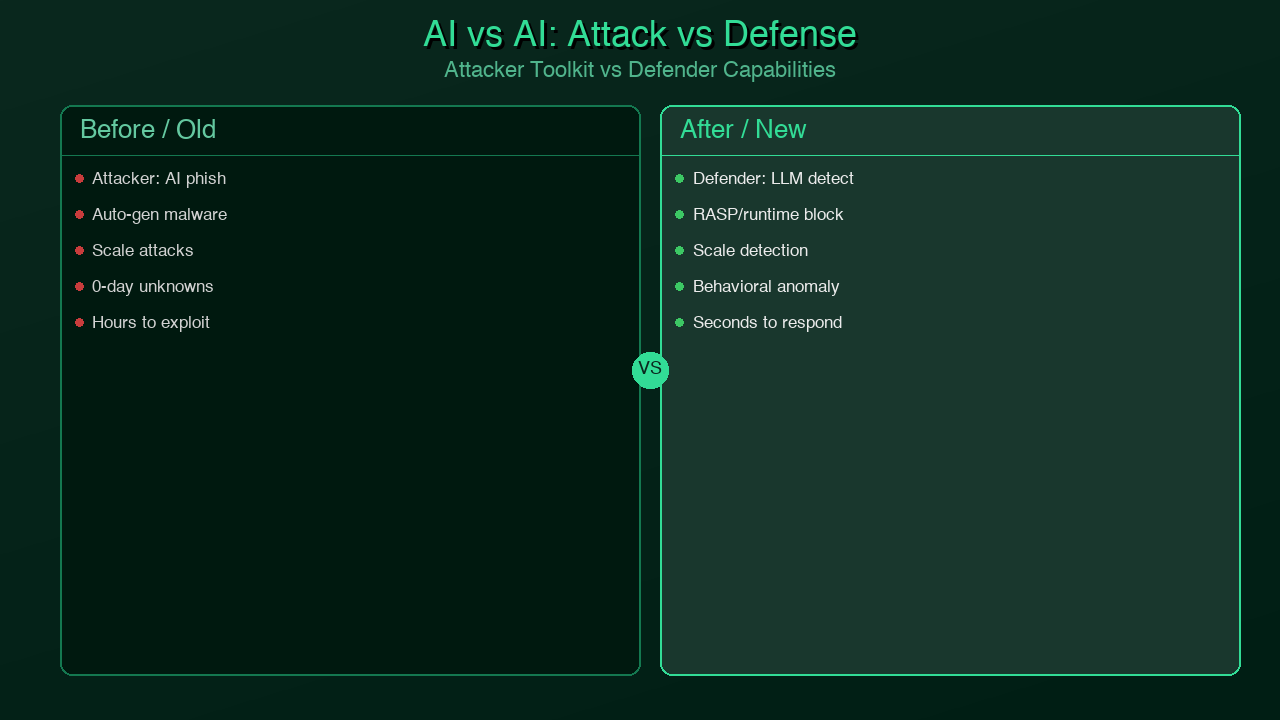
Defenders cannot prevent attackers from having these tools. What they can do is ensure their defenses are equally AI-augmented — responding at machine speed, with AI-assisted analysis, rather than human speed with manual triage.

The current AI capability gap between attackers and defenders varies significantly by capability area:

quadrantChart title AI Capability Maturity — Attackers vs Defenders (2026) x-axis Attacker Maturity --> Defender Maturity y-axis Low Impact --> High Impact Spear Phishing Generation: [0.85, 0.75] Vulnerability Scanning: [0.90, 0.70] Zero-Day Discovery: [0.65, 0.30] Deepfake Social Engineering: [0.80, 0.25] Malware Obfuscation: [0.75, 0.60] Behavioral Anomaly Detection: [0.40, 0.85] Automated Patch Generation: [0.55, 0.70] Incident Correlation: [0.50, 0.80] Threat Intelligence: [0.60, 0.75] Code Vulnerability Analysis: [0.70, 0.78]
AI threat detection comparison — attacker AI toolkit versus defender AI capabilities

Generated with Higgsfield GPT Image — 16:9


Building AI-Augmented Security Pipelines

The most actionable thing a software organization can do right now is integrate AI security scanning throughout the development lifecycle, not just at the perimeter. This is the shift-left security model, accelerated by AI.

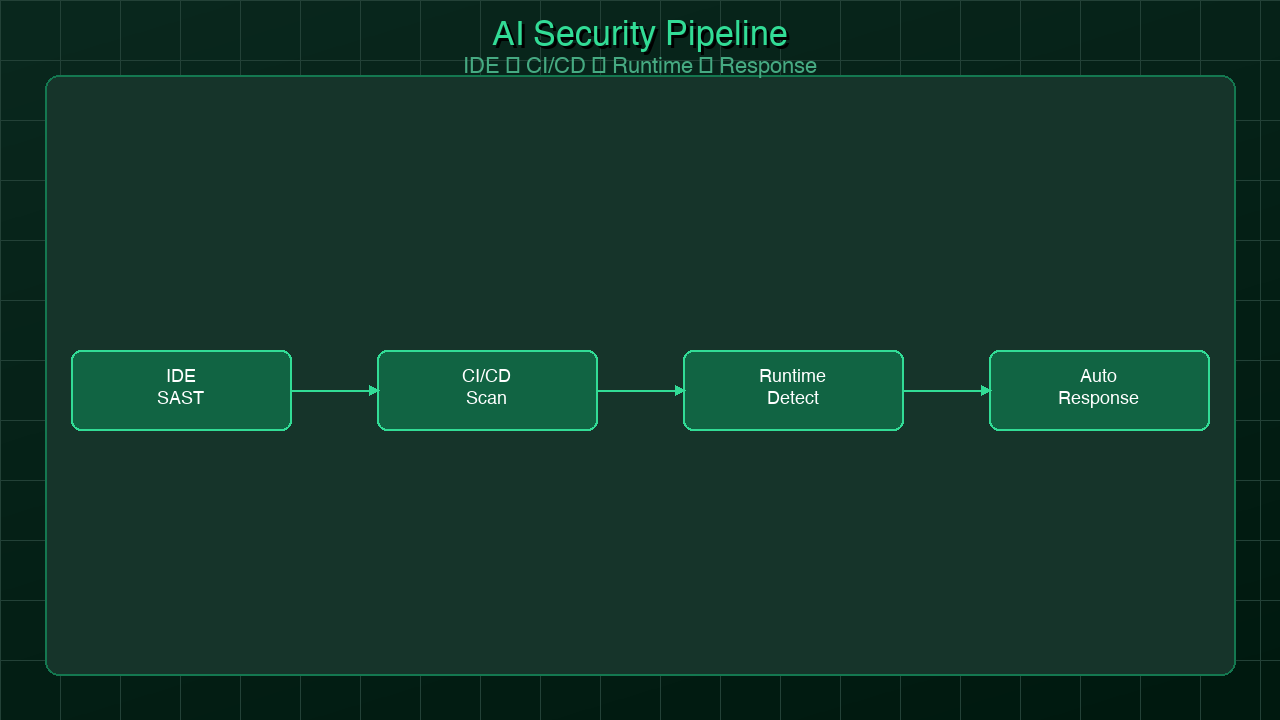
Security pipeline diagram — AI-augmented defense from IDE to production runtime

Generated with Higgsfield GPT Image — 16:9

flowchart LR subgraph DEV["Developer Environment"] IDE[IDE\nReal-time AI SAST\nCopilot Autofix\nSnyk IDE plugin] end subgraph PR["Pull Request / CI Gate"] SAST[AI SAST Scan\nSemgrep / CodeQL\nDeepCode AI] SCA[SCA Scan\nDependency vulns\nSnyk / Dependabot] SECRETS[Secrets Detection\nGitGuardian / TruffleHog] CONTAINER[Container Scan\nTrivy / Grype] GATE{Severity Gate\nBlock on Critical/High?} SAST --> GATE SCA --> GATE SECRETS --> GATE CONTAINER --> GATE end subgraph DEPLOY["Deployment"] DAST[AI DAST\nBurp Suite / OWASP ZAP\nagainst staging env] IAC[IaC Scan\nCheckov / Terrascan\nTerraform misconfigs] end subgraph RUNTIME["Production Runtime"] RASP[RASP / WAF\nRuntime protection\nCloudflare / AWS WAF] UEBA[AI Anomaly Detection\nUser behavior analysis\nNetwork flow anomalies] SIEM[AI-Augmented SIEM\nMicrosoft Sentinel\nCrowdStrike / Splunk AI] end subgraph RESPONSE["Incident Response"] AUTO[Automated Playbooks\nAI-assisted triage\nAuto-quarantine] ANALYST[Human Analyst\nAI-summarized context\nDecision support] end DEV -->|Code pushed| PR GATE -->|Pass| DEPLOY GATE -->|Fail - block PR| DEV DEPLOY -->|Deployed| RUNTIME RUNTIME -->|Alerts| RESPONSE RESPONSE -->|Lessons learned| DEV style DEV fill:#e8f5e9,stroke:#2e7d32 style PR fill:#fff3e0,stroke:#f57c00 style DEPLOY fill:#e3f2fd,stroke:#1565c0 style RUNTIME fill:#fce4ec,stroke:#c62828 style RESPONSE fill:#f3e5f5,stroke:#6a1b9a

Stage 1: IDE (Shift Left)

AI security scanning starts in the developer's editor. Snyk's IDE plugin, GitHub Advanced Security, and SonarLint with AI explanation all provide real-time feedback as code is written. When a developer introduces a SQL query that concatenates user input, they see the warning immediately — not after a CI scan 20 minutes later.

This stage catches the highest-value issues: vulnerabilities introduced by the developer in the current working session, before they are even committed.

Stage 2: Pull Request Gate

Every pull request should run a battery of automated security checks before merge. The AI-augmented stack includes:

  • SAST (Static Analysis): CodeQL, Semgrep, or Snyk Code scan the diff for vulnerability patterns, with AI-generated explanations of findings
  • SCA (Software Composition Analysis): Snyk, Dependabot, or OWASP Dependency Check scan for known vulnerable dependencies
  • Secret Detection: GitGuardian or TruffleHog scan for accidentally committed API keys, passwords, or certificates
  • Container Scanning: Trivy or Grype scan the container image produced by the PR build

The gate decision — block the PR or warn — should be calibrated to your organization's risk tolerance. Critical severity findings should typically block; medium and low can be warnings with required acknowledgment.

Stage 3: Dynamic Testing in Staging

DAST tools test running applications for vulnerabilities that static analysis cannot find: authentication bypasses, business logic flaws, API access control issues, and XSS in rendered HTML. Modern DAST tools like Burp Suite Enterprise and OWASP ZAP with ML extensions are beginning to use AI to intelligently guide test cases rather than brute-forcing all inputs.

Stage 4: Runtime Protection and Monitoring

The production runtime layer combines several capabilities:
- WAF/RASP: Block known attack patterns at the edge (Cloudflare WAF, AWS WAF) and within the application runtime
- UEBA: AI behavioral analysis of user and system activity (as described in the threat detection section above)
- AI-augmented SIEM: Microsoft Sentinel Copilot, CrowdStrike Charlotte AI, or Splunk AI for correlated analysis of security events across all systems

Stage 5: AI-Assisted Incident Response

When an alert fires, the AI's job is to give the analyst everything they need to make a decision — fast. AI-assisted response tools automatically gather context (what other events correlate with this alert? what is the blast radius if this is real?), generate natural language incident summaries, and execute pre-approved playbooks (isolate the affected endpoint, revoke the compromised credential, notify the owner team) without requiring manual steps for low-risk, high-confidence responses.


LLM-Specific Security Risks

As AI systems become part of production software infrastructure, they introduce a new category of security risks that traditional security frameworks were not designed to handle.

Prompt Injection is the LLM equivalent of SQL injection. An attacker embeds malicious instructions in data that the LLM processes — a document, an email, a web page, a user-supplied field — and the LLM executes those instructions rather than its legitimate task. A customer service LLM that summarizes incoming emails can be hijacked to exfiltrate customer data, send unauthorized messages, or escalate its own permissions if the system does not properly separate trusted instructions from untrusted content.

Training Data Poisoning targets LLMs during training. By injecting malicious examples into training data — a possibility whenever models are fine-tuned on web-scraped or user-generated content — attackers can create backdoors that activate on specific trigger phrases or cause systematic biases in model behavior.

Model Exfiltration involves reconstructing training data or model weights through carefully crafted queries. Proprietary models trained on internal data can leak sensitive information through their outputs.

OWASP Top 10 for LLMs (2025 edition) provides the most comprehensive framework for these risks. The top categories are: prompt injection, insecure output handling, training data poisoning, model denial of service, supply chain vulnerabilities, sensitive information disclosure, insecure plugin design, excessive agency, overreliance, and model theft.

Defense patterns for LLM systems include:
- Input sanitization: Validate and sanitize all user inputs before passing to the LLM. Define what the model is allowed to do and enforce it structurally
- Output validation: Treat LLM output as untrusted data. Validate, sanitize, and constrain it before acting on it
- Sandboxing: Give LLM agents the minimum permissions needed. Do not give an LLM that summarizes documents the ability to send emails
- Human-in-the-loop: For high-stakes decisions, require human approval even when the LLM is confident
- Audit logging: Log all LLM inputs and outputs for forensic analysis


What Security Teams Should Do Now

The AI security landscape is moving fast. Organizations that wait for the technology to stabilize before acting will be meaningfully behind in both tooling and defensive capability. These are the concrete steps security teams should take in the next 90 days.

Evaluate one AI-powered security tool. Pick the layer where your team feels the most pain — SIEM alert overload, vulnerability triage, code review burden — and evaluate one AI-augmented product in that space. CrowdStrike Falcon with Charlotte AI, Wiz for cloud security posture, Snyk Code for developer security, and Microsoft Sentinel Copilot are all production-ready. Most offer a trial period. Run a 30-day evaluation with real data and measure impact.

Train your analysts on prompt engineering for security queries. The ability to query your SIEM or EDR using natural language — "show me all events where a user authenticated from a new country and then accessed a sensitive database within 30 minutes" — is powerful. But it requires knowing how to ask. Prompt engineering is a skill, and security analysts who develop it will be 2-3x more effective with AI-augmented tools.

Run a purple team exercise with AI tools on both sides. Use AI-assisted attack simulation (tools like AttackIQ, Vectra, or a GPT-assisted red team) to probe your defenses while your defenders use AI-augmented detection to find the activity. The exercise will reveal detection gaps and help your team understand how AI changes the attack-defense calculus in your specific environment.

Build AI security scanning into your CI/CD pipeline. If you only do one thing, do this: add Snyk, Semgrep, or CodeQL to every pull request. Configure it to block on critical-severity findings. The investment is a few hours of setup; the payoff is catching high-severity vulnerabilities before they reach production.

Do not replace humans — augment them. The consistent finding from organizations that have deployed AI security tools is that the technology raises the floor of defensive capability and frees human analysts for the work that actually requires judgment. The human security analyst is not being replaced; they are being equipped with tools that make them dramatically more effective. The organizations that treat AI as a replacement for human security expertise will discover that AI tools, like all tools, have failure modes that only humans can catch.


Conclusion

The cybersecurity contest of 2026 is an AI arms race. Attackers have AI tools that automate vulnerability discovery, craft targeted phishing at scale, and probe defenses continuously. Defenders have AI tools that correlate security events across millions of data points, detect behavioral anomalies that humans would miss, and explain complex security situations in plain language.

The key insight is that AI does not resolve the fundamental asymmetry between attackers and defenders — attackers only need to succeed once, defenders need to succeed every time. What AI does is change the economics of defense. A well-instrumented, AI-augmented security program can achieve coverage that previously required teams ten times larger. For organizations that cannot hire enough security engineers, that is transformative.

The pipeline model described in this post — AI security scanning from IDE to production runtime — is achievable for any software organization with existing DevOps practices. Start with CI integration. Add runtime behavioral monitoring. Build towards AI-assisted incident response. Each layer compounds the defensive capability of the previous one.

The organizations that will be best positioned in three years are not those who wait for a single AI security product to solve everything. They are the ones building security deeply into their development culture — treating security as an engineering problem, using AI to scale their defenses, and keeping humans in the loop where judgment matters.

The attack surface will keep growing. The AI capabilities on both sides will keep improving. The only sustainable advantage is building security into everything, from the first line of code to the last production event.


Related reading: Platform Engineering and Developer Security — how platform teams build security into the golden path by default.

About the Author

Toc Am

Founder of AmtocSoft. Writing practical deep-dives on AI engineering, cloud architecture, and developer tooling. Previously built backend systems at scale. Reviews every post published under this byline.

LinkedIn X / Twitter

Published: 2026-04-12 · Written with AI assistance, reviewed by Toc Am.

Get These In Your Inbox

Weekly deep-dives on AI engineering, no fluff. Join the newsletter →

Subscribe (free)

Or grab the book ($39, ~100 pages) · Buy me a coffee

Buy Me a Coffee · 🔔 YouTube · 💼 LinkedIn · 🐦 X/Twitter
Bigger Is Not the Same as Better. The Job That Moved Is the Phone, Not the Lab.

Bigger is a plan. The phone is the receipt. The brief for this cycle is a question: does bigger always mean better in AI? The 2026 answer i...