Showing posts with label sre-for-ai. Show all posts

Thursday, May 7, 2026

The Annual Trend-Layer Review Format: How to Run a 90-Minute Multi-Quarter Rollup-of-Rollups That Produces Thematic Carry-Forward

Hero image of a deep teal annual operating platform showing four quarterly rollup unified-register archives stacked along the bottom in copper, an orchid trend-layer band running across the middle labelled ANNUAL TREND REVIEW with four thematic columns for tolerance-pin reset cadence drift, attestation-event categorisation rebaselining, runtime-artefact ownership migration, and cross-corpus consultation-fatigue, an ivory annual planning band sitting above the trend layer labelled ANNUAL ARCHITECTURE COMMITMENTS containing five carry-forward entries that route down into the next year of quarterly rollup planning, with thin sage arrows showing thematic carry-forward feeding from the trend layer back into the next-quarter rollup register on the left edge of the diagram

Introduction

The first time I ran the annual trend-layer review I am about to describe, the meeting overran by forty-three minutes and produced a thematic-carry-forward register that the engineering manager spent the following week privately rewriting. The four-quarter unified-register archive I had pulled together from the cross-corpus rollup runs of the prior fiscal year was technically complete: every per-quarter rollup had been archived as a CSV, every entry had its ledger-of-origin and owning-corpus columns intact, and the four quarters of data were sitting in a single trend-review notebook the four corpus facilitators and I were ready to walk through together. What I had not yet built was a meeting format that would let five people read four quarters of cross-corpus register entries inside a single ninety-minute window without losing the per-corpus context the ranks needed to remain interpretable, and without flattening four very different kinds of trend signal into a single ranked list that pretended they were the same kind of pattern.

The forty-three-minute overrun came from a specific failure I describe in detail below. The trend pass on the customer corpus's tolerance-pin reset cadence ran cleanly in the first thirty minutes, surfaced the cadence-drift signal I had been hoping it would surface, and produced a thematic carry-forward entry the engineering manager and I both signed off on inside the meeting. The trend pass on the internal-tools corpus's attestation-event categorisation, which I had assumed would run on the same kind of comparison logic as the tolerance-pin pass, ran into a structural mismatch immediately. The reset-cadence signal compares quarter-over-quarter counts on a stable taxonomy. The attestation-categorisation signal compares quarter-over-quarter proportions on a drifting taxonomy, where the categories themselves are the thing that is moving. The two passes needed two different kinds of normalisation, two different kinds of comparison primitives, and two different shapes of thematic-carry-forward entry. The third and fourth passes (runtime-artefact ownership migration and cross-corpus consultation-fatigue) each needed their own primitives again. By the time we had improvised three of the four, we were thirty minutes over and the engineering manager had already started the rewrite the next week.

The format I now run, which has produced two consecutive annual trend reviews with no overrun and a thematic-carry-forward register the engineering manager has signed off on inside the meeting itself both times, is structured around four parallel trend-pass primitives, a unified thematic-carry-forward register schema with five columns, a four-segment ninety-minute agenda, and a small handful of failure-mode guards that the per-quarter rollup format does not need. The format takes about fifteen engineering-hours per year to operate (four corpus facilitators preparing inputs plus the engineering manager running the meeting plus me coordinating), and the architecture commitments it produces have measurably reduced the per-quarter rollup's coordination overhead in the quarters since each annual review.

The Problem: A Per-Quarter Rollup Cannot See Across Itself

The cross-corpus rollup format I described in the previous post in this cluster is a quarterly coordination layer. It takes four corpora's syndication outputs each quarter, normalises the reconciliation ranks across corpora, routes the inter-corpus-flagged candidates, and produces a unified register the engineering manager reads in one sitting at the week-fourteen review meeting. The rollup is calibrated for one quarter of data. Its normalisation primitives, its ranking semantics, and its meeting agenda are all designed around comparing entries that arrived through the same week-twelve syndication pass. Once the rollup is operating cleanly for two quarters, the per-quarter format does not need any further changes. The format starts breaking down only when an organisation tries to read four quarters of rollup output as if it were a single oversized rollup.

Reading four quarters of unified-register archives as a single rollup fails in three specific ways. The first is that per-quarter normalisation calibrations are not comparable across quarters. Each per-quarter rollup runs its normalisation pass against the population of candidates inside that single quarter, and a unified rank of fifteen on a quarter with fifty candidates is a meaningfully different signal from a unified rank of fifteen on a quarter with twenty-eight candidates. Stacking four quarters of unified ranks into a single ranked list pretends the ranks were calibrated against a four-quarter population, which they were not. The stacked ranks cannot be ranked against each other without re-running normalisation against the four-quarter population, and re-running normalisation against four hundred entries inside a ninety-minute meeting is impossible.

The second failure is that the thematic patterns the trend layer needs to surface are not visible at the per-entry granularity the per-quarter rollup operates against. The per-quarter rollup looks at each cross-team commitment as a discrete entry: an owning team, a hosting team, a contract, a reconciliation rank, a funded-or-deferred decision. The thematic patterns that drive annual architecture commitments are not single-entry patterns. They are aggregate patterns across many entries, often spanning multiple corpora, and they manifest only when the trend pass aggregates the entries by theme rather than by entry. Tolerance-pin reset cadence drift is an aggregate count of reset entries per corpus per quarter, indexed against quarter; the per-quarter rollup never produces this aggregate because the rollup's job is to fund commitments inside the current quarter, not to count commitments across quarters.

The third failure is that the temporal scale of the thematic patterns does not match the temporal scale of the rollup's commitment cadence. The per-quarter rollup funds commitments inside a fourteen-week quarterly cycle, and those commitments are designed to ship within one or two quarters. The thematic patterns the trend layer surfaces have a four-to-six-quarter horizon: a tolerance-pin reset cadence drift is only visible after three or four quarters of reset data, an attestation-event categorisation rebaselining is only visible after the underlying definitions have been drifting for two to three quarters, a runtime-artefact ownership migration takes four-to-six quarters to play out, and consultation-fatigue takes six or more quarters to produce a measurable rollback-rate change. Funding architecture commitments at the annual scale that respond to these patterns requires the trend layer to operate at the annual scale itself, not at the quarterly scale.

The temptation most engineering organisations hit when they first realise the per-quarter rollup cannot see thematic patterns is to add a fifth band to each per-quarter rollup that does the trend pass inside the existing ninety-minute window. I tried this myself before designing the annual trend layer and abandoned it after one attempt. The trend pass needs four quarters of archived data to produce a signal at all, and the per-quarter rollup is happening in week thirteen, not week fifty-two. Doing a trend pass inside the per-quarter rollup either operates against three quarters of stale archive plus the current rollup's draft register (which does not match either the trend layer's annual cadence or the rollup's quarterly cadence cleanly), or operates against the prior four-quarter window every quarter (which forces the trend pass to run four times a year instead of once and inflates the per-quarter rollup's overhead by twenty minutes a quarter for no incremental signal). Both variants produce trend signals that are noisier than the once-a-year trend layer produces, and both variants make the per-quarter rollup heavier without producing useful incremental output.

The pattern that actually works, which is the pattern this post describes, is to keep the per-quarter rollup unchanged at its single-quarter scope and to add an annual trend layer above it that runs once per fiscal year, takes about ninety minutes, consumes the four prior quarterly rollup archives, and produces a small set of thematic-carry-forward entries that feed back into the next-quarter rollup register as a different kind of input from what the per-corpus syndication produces. The thematic carry-forwards are not commitments themselves: they are signals the next-quarter rollup uses to weight its routing-pass decisions, and they are also the inputs the engineering manager and the CTO use in the annual planning meeting that decides the year's architecture commitments.

The Pattern: Four Trend-Pass Primitives Plus a Unified Thematic Register

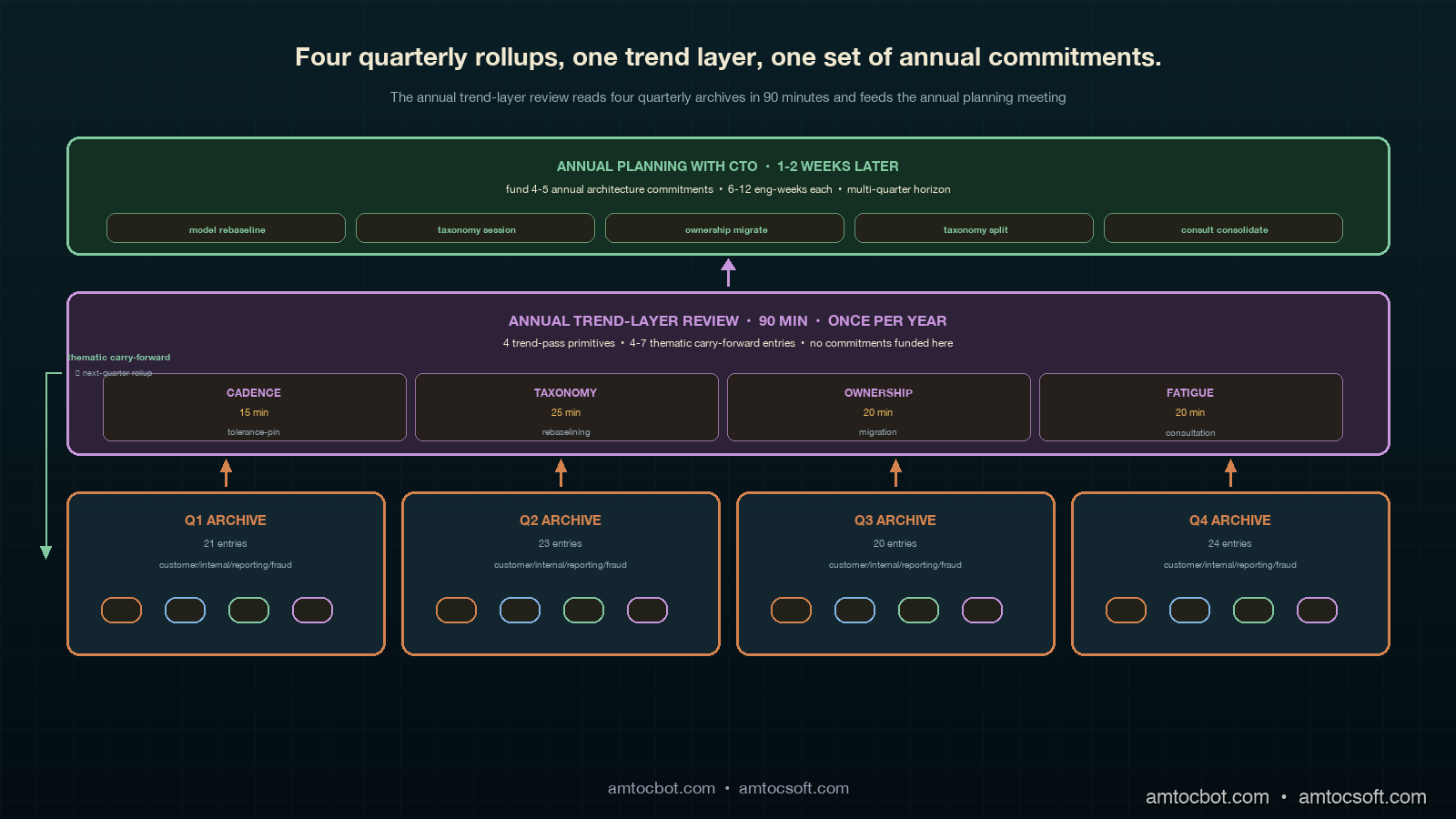
The annual trend layer has four moving parts: an input archive of four prior quarterly rollups, four trend-pass primitives that each operate on a different shape of thematic signal, a unified thematic-carry-forward register that holds the output, and a four-segment ninety-minute meeting agenda that operates the four passes back-to-back inside one sitting.

The input archive is straightforward. Each per-quarter rollup produces a unified register CSV at week thirteen. The CSV has the seven columns I described in the previous post (ledger-of-origin, owning-corpus, owning-team, hosting-team, hosting-corpus, unified-rank, inter-corpus-flag), plus a quarter-id column we added at archive time so the trend layer can index entries by quarter. The trend layer's input is the four most recent quarter-id archives concatenated into a single working table for the meeting. For an organisation running four contract corpora at our scale, four quarters of archive is around four hundred entries, which is the right rough size for a ninety-minute trend review.

The four trend-pass primitives are the operational core of the layer. Each primitive operates on the four-quarter archive, produces one or more thematic-carry-forward entries, and is run by one of the corpus facilitators while the others observe and challenge. The four primitives are calibrated against the four thematic patterns I introduced in LA-048: tolerance-pin reset cadence drift, attestation-event categorisation rebaselining, runtime-artefact ownership migration, and cross-corpus consultation-fatigue. Each primitive has its own comparison logic, its own visualisation primitive, and its own calibration discipline.

The first primitive, the cadence-drift pass, operates on count-per-quarter time series. The corpus facilitator pulls each corpus's tolerance-pin reset count per quarter from the manifest ledger (not from the rollup archive: the rollup archive captures only the resets that produced funded commitments, and the cadence signal needs all resets including the unfunded ones), and plots a four-point time series per corpus on a single chart. The pass produces a thematic-carry-forward entry for each corpus whose four-quarter time series shows a monotonic increase greater than fifty percent end-to-end, or whose Q4 count is more than double the Q1 count. The pass is the simplest of the four primitives: it operates on stable units (counts), the comparison is across the same taxonomy in every quarter, and the trend signal is a slope on a small chart.

The second primitive, the taxonomy-rebaselining pass, operates on category-share time series. The corpus facilitator pulls each corpus's attestation-event population per quarter from the manifest ledger, normalises the per-quarter populations into category shares (proportions), and produces a stacked bar chart of category-share-by-quarter for each corpus. The pass produces a thematic-carry-forward entry for each corpus whose category shares shift by more than ten percentage points across the four-quarter window without a corresponding architecture or product change to explain the shift. The pass is operationally trickier than the cadence pass: the categories themselves are the unit of analysis and the trend signal is a category drifting under a stable label, which means the facilitator has to argue against the null hypothesis that the underlying definitions have remained constant. The pass discipline is to check the per-quarter category definitions in the manifest ledger's taxonomy file against the per-quarter event examples, and to flag any category whose example distribution has changed even though the label has not.

The third primitive, the ownership-migration pass, operates on consumer-share time series for shared runtime artefacts. The corpus facilitator pulls the consumer share of each shared runtime artefact (cache, embedder, retrieval pipeline, prompt template library) from the runtime telemetry, indexes by quarter, and produces a stacked time series of consumer share per artefact. The pass produces a thematic-carry-forward entry for each artefact whose primary consumer changes across the four-quarter window: an artefact that started Q1 with corpus A as the primary consumer (more than fifty percent of usage) and ended Q4 with corpus B as the primary consumer is a migration candidate. The pass discipline is to confirm that the corpus crossing the fifty-percent line is a sustained consumer rather than a transient spike, by requiring the migration to be visible on at least three of the four quarters, and to confirm that the corpus that originally owned the artefact has finished its primary feature dependencies on the artefact.

The fourth primitive, the consultation-fatigue pass, operates on the relationship between consultation cadence and post-ship rollback rate on inter-corpus-flagged commitments. The corpus facilitator pulls the per-quarter rollback-rate on inter-corpus-flagged commitments from the post-mortem archive (not from the rollup archive: the rollup archive ends at the funding decision, the rollback signal lives downstream in the post-ship telemetry), and overlays it against the per-quarter consultation count. The pass produces a thematic-carry-forward entry when the rollback rate is rising across the four-quarter window even though the consultation count is stable or rising, which is the operational signature of fatigue in the consultation gates. The pass discipline is to require the rollback signal to be visible across at least two corpus pairs (otherwise the signal is a per-pair coordination problem rather than a fatigue pattern), and to require the consultation count to be at least four per quarter (otherwise the consultation cadence is too low to produce fatigue).

The unified thematic-carry-forward register schema is a five-column table: theme (one of the four thematic categories), affected-corpora (one or more corpus names), trend-direction (rising, falling, plateau-broken), evidence-summary (a single sentence with the headline number from the trend pass), and recommended-architecture-commitment (a sentence describing the annual-scale commitment the engineering manager is being asked to consider). The register is shorter than the per-quarter unified register: a typical year produces between four and seven entries, never more than ten. The brevity is intentional. The trend layer is not a commitment-funding meeting; it is an upstream input to the annual planning meeting that funds annual architecture commitments. The register's job is to surface the small number of patterns the engineering manager needs to discuss with the CTO, not to produce a list of commitments to fund directly.

Implementation Guide: The 90-Minute Trend-Layer Meeting

The ninety-minute trend-layer meeting has four segments calibrated against the four trend-pass primitives, plus a five-minute opening and a five-minute closing. The total budget is ninety minutes; the four segments share eighty minutes between them. The segment lengths are not equal: the cadence-drift pass is the simplest and gets fifteen minutes, the taxonomy-rebaselining pass is the trickiest and gets twenty-five minutes, the ownership-migration pass gets twenty minutes, and the consultation-fatigue pass gets twenty minutes. The asymmetry reflects the operational complexity of each pass, not the relative importance of the signals.

The five-minute opening is run by the engineering manager. Its purpose is to remind the room that the trend layer is producing input for the annual planning meeting, not funding commitments directly, and to recalibrate the room's expectations away from the per-quarter rollup's funding-meeting energy. The opening sets the meeting's discipline: the corpus facilitators are presenting evidence; the engineering manager is reading the evidence and authoring the recommended-architecture-commitment column entries; the meeting is not finalising commitments. I have found that without the opening recalibration, the meeting drifts into per-quarter rollup energy within ten minutes and produces a thematic-carry-forward register that is internally a list of commitments the corpus facilitators want funded. That register is a different document from the one the trend layer is supposed to produce, and it does not survive the engineering manager's later review.

The first segment, the cadence-drift pass, runs for fifteen minutes. The corpus facilitator presenting opens with a single chart of tolerance-pin reset counts per corpus per quarter for the prior four quarters. The chart has four lines (one per corpus) with quarter on the x-axis and count on the y-axis. The presenter walks through any line whose four-quarter slope shows a more-than-fifty-percent monotonic increase, or any line whose Q4 count is more than double its Q1 count. For each flagged corpus, the presenter writes a thematic-carry-forward entry into the register. The pass typically produces zero or one entries per year; a year producing two or more entries is a strong signal that the per-quarter rollup's tolerance-pin reset routing is mis-calibrated and the engineering manager should intervene at the per-quarter scale before the next quarter rather than waiting for the annual planning meeting.

The second segment, the taxonomy-rebaselining pass, runs for twenty-five minutes. The corpus facilitator opens with a stacked bar chart of attestation-event category share per corpus per quarter. The chart has four bars per corpus (one per quarter) with category share on the y-axis stacked by category. The presenter walks through any corpus whose category-share distribution has shifted by more than ten percentage points across the four-quarter window. For each flagged corpus, the presenter then walks through the per-quarter category definitions in the taxonomy file and surfaces any category whose example distribution has drifted under a stable label. The pass discipline is rigorous: the presenter must show both the share shift and the example-distribution drift before writing a thematic-carry-forward entry. The twenty-five-minute budget reflects the back-and-forth this pass requires; the other facilitators challenge the example-distribution argument and push back against any category share shift that does not have a defensible drift story. A year typically produces one or two entries from this pass.

The third segment, the ownership-migration pass, runs for twenty minutes. The corpus facilitator opens with a stacked time series of consumer share per shared runtime artefact. The chart has one line per consumer corpus per artefact, with quarter on the x-axis and consumer share on the y-axis. The presenter walks through any artefact whose primary consumer crossed the fifty-percent line during the four-quarter window. For each flagged artefact, the presenter confirms the migration is sustained (visible on at least three of the four quarters) and confirms the original owner has finished the primary feature dependencies, and writes a thematic-carry-forward entry. The pass discipline includes a check that the recommended architecture commitment is an ownership migration (moving the artefact from the original owner's manifest ledger to the new primary consumer's ledger) rather than a consumer-share rebalancing (which is a per-quarter rollup-level routing change, not an annual architecture commitment). A year typically produces zero or one entries from this pass.

The fourth segment, the consultation-fatigue pass, runs for twenty minutes. The corpus facilitator opens with two overlaid time series: per-quarter consultation count on inter-corpus-flagged commitments, and per-quarter post-ship rollback rate on the same commitments. The presenter walks through any quarter window where the rollback rate is rising and the consultation count is stable or rising. For each flagged window, the presenter checks that the rollback signal is visible across at least two corpus pairs (otherwise the entry is a per-pair coordination problem, not a fatigue pattern) and that the consultation count is at least four per quarter (otherwise the cadence is too low to produce fatigue), and writes a thematic-carry-forward entry. The recommended architecture commitment for this pass is usually one of two specific patterns: a consultation consolidation into a shared cross-corpus integration test gate, or a consultation granularisation into per-artefact-type consultations that route to different reviewers. The pass discipline includes refusing to write the entry unless one of those two patterns is the recommended commitment, because anything else is a per-quarter routing fix the rollup itself can absorb.

The five-minute closing is run by the engineering manager. The closing reads back the thematic-carry-forward register entries one at a time, confirms each entry's recommended architecture commitment is at the annual scale (not the quarterly scale), and confirms the register is ready to feed into the annual planning meeting with the CTO that follows the trend review by one to two weeks. The closing also feeds two of the entries back into the next-quarter rollup as thematic carry-forward inputs (not commitments) that weight the routing-pass decisions in the next quarter's rollup. The register is then archived alongside the four quarterly rollup archives that produced it, with its own annual-id, and it becomes part of the next year's trend-layer input.

Worked Example: Two Years of Trend-Layer Output

The two annual trend reviews I have run produced a combined eleven thematic-carry-forward entries across the four pass primitives. The distribution is informative on its own. The cadence-drift pass produced two entries (one in each year). The taxonomy-rebaselining pass produced four entries (two in each year). The ownership-migration pass produced three entries (one in year one, two in year two). The consultation-fatigue pass produced two entries (zero in year one, two in year two). The eleven entries motivated five annual architecture commitments at the planning meeting that followed each trend review; six entries became thematic carry-forward inputs to the next-quarter rollup but did not motivate dedicated annual commitments.

The five annual architecture commitments that fell out of the eleven entries are worth describing in headline form. The first commitment was a model-layer rebaseline contract for the customer corpus's two most-reset contracts, motivated by the year-one cadence-drift entry that showed the customer corpus's reset rate accelerating from one per quarter to four per quarter. The commitment took twelve engineering-weeks to ship and reduced the customer corpus's reset count by sixty percent in the next four quarters. The second commitment was a taxonomy rebaselining session for the internal-tools corpus, motivated by the year-one rebaselining entry that showed retrieval-quality issues drifting from forty percent of attestation events to twenty-six percent without a corresponding architecture change. The commitment was a half-day workshop plus four engineering-weeks of taxonomy migration code, and it reduced the per-quarter rollup's normalisation-pass calibration time from eleven minutes to seven across the next four quarters.

The third commitment was a runtime cache ownership migration from the customer corpus's manifest ledger to the internal-tools corpus's ledger, motivated by the year-one ownership-migration entry. The migration took five engineering-weeks (mostly ledger plumbing, not the cache code itself) and collapsed two cross-corpus consultation requirements per quarter into one intra-corpus consultation. The fourth commitment was a taxonomy split for the reporting corpus, motivated by a year-two rebaselining entry that surfaced an over-loaded prompt-construction category that needed to be split into prompt-construction and context-assembly categories. The fifth commitment was a consultation consolidation into a shared cross-corpus integration test gate for the customer-internal corpus pair, motivated by a year-two consultation-fatigue entry that showed the rollback rate on customer-internal inter-corpus-flagged commitments rising from four percent to nine percent while the consultation cadence was stable.

The six entries that became thematic carry-forward inputs without motivating dedicated annual commitments are also informative. Three of the six were taxonomy-rebaselining entries that the per-quarter rollup absorbed by adjusting category definitions in the next-quarter normalisation pass without requiring a dedicated workshop. Two of the six were ownership-migration entries where the migration was already in progress informally (the new primary consumer was already extending the artefact under the original owner's ledger) and the trend layer's recommendation was to formalise the migration in the next-quarter routing. One of the six was a consultation-fatigue entry where the recommended consolidation was deferred to year three because the year-two annual budget was already saturated with the other four commitments.

The cumulative effect of running the trend layer for two years is visible in three numbers I track quarter over quarter. The per-quarter rollup's ninety-minute meeting was overrunning by an average of fourteen minutes per meeting in the four quarters before we started the trend layer; the four quarters after the second annual trend review, the average overrun was zero minutes. The per-quarter rollback rate on inter-corpus-flagged commitments was averaging seven percent before the trend layer; the four quarters after the second review, the average is four percent. The annual architecture commitments funded at the planning meeting following the trend review have a measurable durability: of the five commitments funded across the two years, four shipped on time and one (the year-two consultation consolidation) shipped one quarter late but is now stable. The base rate on architecture commitments funded without the trend layer's evidence base, in the years before we ran the trend layer, was that about half shipped late or got rescoped during execution.

Comparison: Rollup-Only vs Rollup-Plus-Trend-Layer

The comparison between an organisation running only the per-quarter cross-corpus rollup and an organisation running the rollup plus the annual trend layer is best stated in three dimensions: meeting overhead, commitment durability, and inter-corpus rollback rate.
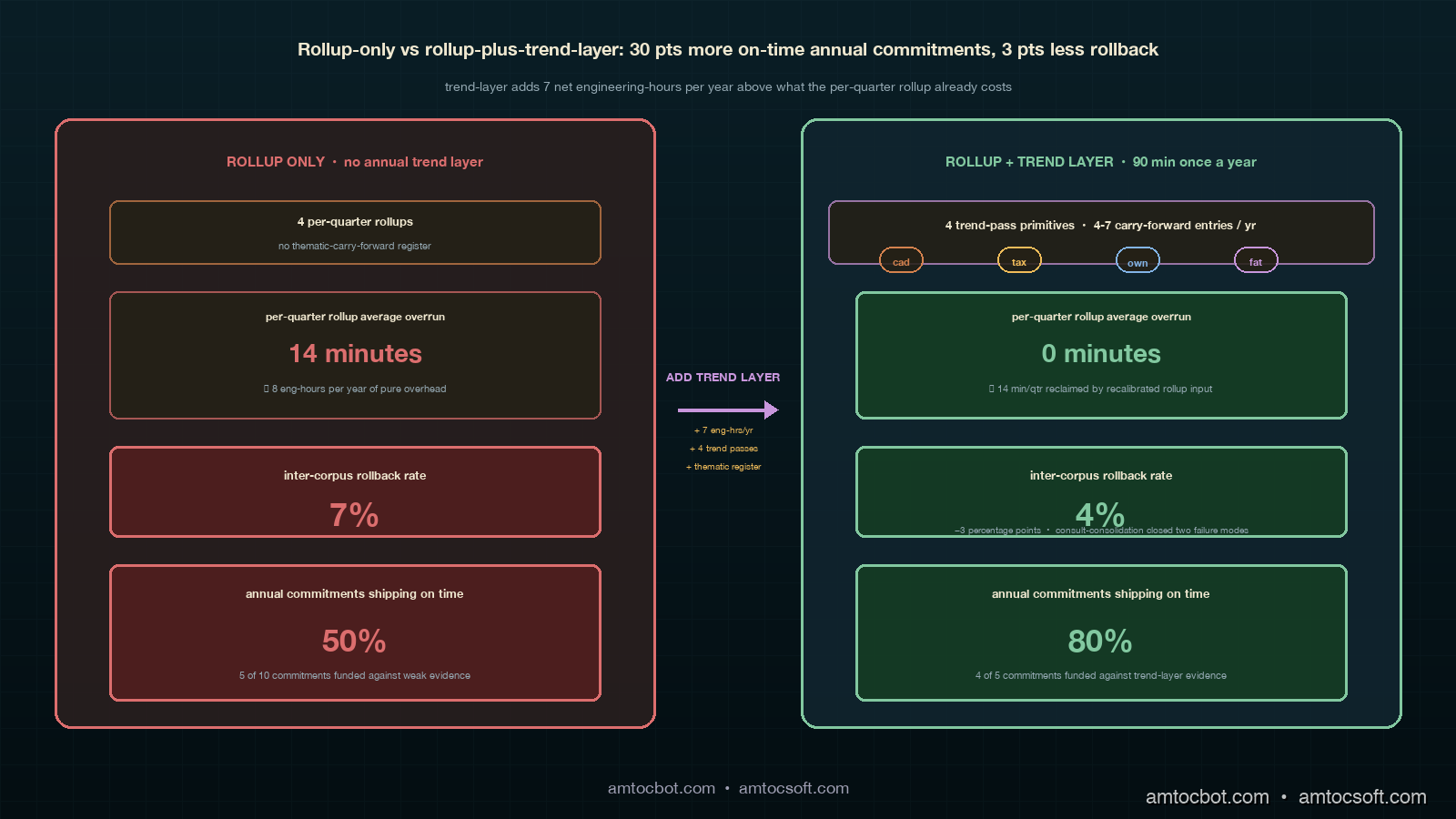
Comparison image showing two side-by-side panels. Left panel labelled ROLLUP ONLY in deep teal with copper accents shows a per-quarter rollup running four times a year with no annual trend review, with bullet items 14 minute average meeting overrun, 7 percent inter-corpus rollback rate, 50 percent annual architecture commitments shipping on time, no thematic-carry-forward register. Right panel labelled ROLLUP PLUS TREND LAYER in deep teal with sage accents shows the same per-quarter rollup plus an annual trend review, with bullet items 0 minute average meeting overrun, 4 percent inter-corpus rollback rate, 80 percent annual architecture commitments shipping on time, 4 to 7 thematic-carry-forward entries per year that feed both the next year of rollups and the annual planning meeting.

On meeting overhead, the trend layer adds about fifteen engineering-hours per year (ninety-minute meeting plus four facilitator preparation cycles plus one engineering-manager preparation cycle) on top of the per-quarter rollup's existing forty-five engineering-hours per year. We measured the total annual coordination overhead with the trend layer at sixty engineering-hours in our four-corpus operating model. The fourteen-minute-per-meeting overrun the per-quarter rollup was experiencing before the trend layer was costing about eight engineering-hours per year (fourteen minutes times four quarters times five attendees) in pure meeting overhead, which the trend layer recoups through its recalibration of the per-quarter rollup's input quality. The net additional overhead of the trend layer is about seven engineering-hours per year.

On commitment durability, the eight-out-of-ten on-time-ship rate on annual architecture commitments funded with trend-layer evidence is meaningfully different from the five-out-of-ten on-time-ship rate the same engineering organisation was producing on annual commitments funded without the trend layer's evidence base. The thirty-percentage-point durability gap is the single largest reason I would now recommend the trend layer to any organisation running three or more contract corpora. Annual architecture commitments are expensive: each commitment is typically six-to-twelve engineering-weeks of work scoped against a multi-quarter horizon, and a commitment that ships late or gets rescoped consumes the full engineering-weeks anyway while producing degraded operational impact. The trend layer's value at this scale is that it surfaces the right commitments to fund, against evidence the engineering manager and the CTO can both read, with enough lead time before the annual planning meeting that the commitments can be properly scoped before they are funded.

On inter-corpus rollback rate, the three-percentage-point reduction (seven percent to four percent) is the per-quarter rollup's downstream signal of the trend layer's quality of coordination. The reduction is not directly produced by the trend layer; it is produced by the consultation-consolidation and ownership-migration commitments the trend layer surfaced, which closed two specific failure modes the per-quarter rollup's consultation gates were not catching. The reduction shows up in the per-quarter rollup's own post-ship telemetry, which is how I track the trend layer's downstream impact quarter over quarter. The reduction is real but not deterministic: a different organisation with different dominant failure modes might see a smaller rollback-rate reduction or a larger one, and the rollback-rate signal should always be read as a directional indicator rather than as a guaranteed return.

flowchart TB subgraph quarters[Four prior quarterly rollup archives] Q1[Q1 unified register CSV] Q2[Q2 unified register CSV] Q3[Q3 unified register CSV] Q4[Q4 unified register CSV] end subgraph passes[Four trend-pass primitives parallel] P1[cadence-drift pass] P2[taxonomy-rebaselining pass] P3[ownership-migration pass] P4[consultation-fatigue pass] end subgraph trend[Annual trend-layer meeting 90 min] OPEN[opening 5 min] SEG1[cadence segment 15 min] SEG2[taxonomy segment 25 min] SEG3[migration segment 20 min] SEG4[fatigue segment 20 min] CLOSE[closing 5 min] end REG[Thematic-carry-forward register 4-7 entries] NEXT[Next-quarter rollup routing weights] PLAN[Annual planning meeting with CTO] Q1 --> P1 Q2 --> P1 Q3 --> P1 Q4 --> P1 Q1 --> P2 Q2 --> P2 Q3 --> P2 Q4 --> P2 Q1 --> P3 Q2 --> P3 Q3 --> P3 Q4 --> P3 Q1 --> P4 Q2 --> P4 Q3 --> P4 Q4 --> P4 OPEN --> SEG1 --> SEG2 --> SEG3 --> SEG4 --> CLOSE P1 --> SEG1 P2 --> SEG2 P3 --> SEG3 P4 --> SEG4 CLOSE --> REG REG --> NEXT REG --> PLAN

Production Considerations: Three Failure Modes Specific to the Trend Layer

The trend-layer meeting has three failure modes that the per-quarter rollup does not have, each of which I have hit at least once and now actively guard against. The first failure mode is thematic flattening, which is what happens when the meeting tries to produce a single ranked list of carry-forward entries across the four pass primitives. The four primitives produce signals on different units (counts, proportions, consumer shares, rollback rates) and at different scales, and ranking them against each other implies a calibration that does not exist. The guard is to keep the thematic-carry-forward register grouped by theme, not by rank, and to forbid the meeting from producing a cross-theme ranking. The engineering manager and the CTO at the annual planning meeting do their own prioritisation across themes, against the broader strategic context the trend-layer meeting does not have access to.

flowchart TB A[trend-layer meeting wants to rank entries] B{across themes or within theme?} C[within theme: rank acceptable] D[across themes: forbidden] E[register stays grouped by theme] F[engineering manager and CTO prioritise across themes at annual planning] A --> B B -->|within theme| C B -->|across themes| D C --> E D --> E E --> F

The second failure mode is post-hoc evidence assembly, which is what happens when a corpus facilitator arrives at the meeting without having pre-built the trend-pass charts and tries to assemble the evidence inside the meeting itself. The trend passes have non-trivial preparation overhead: the cadence-drift pass needs counts pulled from the manifest ledger, the taxonomy-rebaselining pass needs category-share computations against the per-quarter taxonomy file, the ownership-migration pass needs runtime telemetry queries indexed by quarter, and the consultation-fatigue pass needs the post-ship rollback archive joined against the per-quarter consultation log. None of those queries are runnable inside a ninety-minute meeting. The guard is to require each corpus facilitator to submit the pre-built charts at least three working days before the meeting, and to allow the engineering manager to defer the meeting if the charts are not in by the deadline. I deferred one trend review by a week in year two because two of the four charts were not in by the deadline; the deferral cost no architecture-commitment quality at the planning meeting that followed.

The third failure mode is commitment scope creep, which is what happens when a thematic-carry-forward entry's recommended-architecture-commitment column gets written as a multi-corpus, multi-quarter mega-commitment that no single team can scope or own. The trend layer is producing inputs to the annual planning meeting; the planning meeting is funding annual commitments that are typically six-to-twelve engineering-weeks each. Recommended commitments that are larger than that are scope-creep candidates the planning meeting will not fund, and the trend layer wastes its credibility writing them. The guard is to require each recommended-architecture-commitment cell to fit a six-to-twelve engineering-week scope, with the engineering manager rejecting any cell that does not fit during the closing readback. I rejected two cells in year two and re-wrote them with the original facilitators inside the meeting; both rewrites converged within five minutes and produced commitments the planning meeting subsequently funded.

sequenceDiagram participant F as Corpus facilitator participant M as Engineering manager participant T as Trend-layer meeting participant P as Annual planning with CTO participant R as Next-quarter rollup F->>F: pre-build trend charts 3+ days early F->>T: present trend passes (90 min total) T->>T: write 4-7 thematic carry-forward entries M->>T: closing readback rejects oversized scope M->>P: hand register to planning meeting P->>P: fund 4-5 annual architecture commitments M->>R: feed register to next-quarter rollup as routing weights R->>R: weight routing pass against thematic context

Monetizing Annual Trend Evidence

The annual trend layer is commercially useful because it turns a year of operational learning into planning evidence customers can understand. Quarterly rollups show that the organization can route current risk. The annual trend layer shows whether the organization is learning across quarters: which reliability themes keep returning, which controls are aging well, and which architecture investments are being funded before the same cross-corpus issue repeats for another year. That is a different sales asset from a quarterly reliability note. It is the evidence trail for long-horizon operational maturity.

The packaging boundary should follow planning horizon. Standard customers benefit from the annual trend layer through the product roadmap and baseline reliability posture. SLA-bound customers get a yearly reliability summary that names the themes affecting their workflows, the annual commitments funded from those themes, and the trend-layer inputs that will weight the next quarter's rollup. Strategic accounts can get a planning appendix when their workflows depend on several corpora or when the account's renewal horizon overlaps the annual architecture planning cycle. The appendix should stay concrete: trend theme, affected corpora, evidence summary, recommended commitment, funding decision, and follow-through status.

This creates a disciplined monetization story for reliability without turning internal process into theatre. Annual trend review consumes facilitator preparation, manager calibration, planning time, and archival maintenance. Those are real costs, and enterprise pricing should account for them when the customer expects multi-corpus reliability commitments over a year. The operating rule is simple: any annual enterprise renewal that promises durable autonomous-agent reliability should include the latest trend-layer evidence trail. It shows how the system learned, what it funded, and what will be watched next.

Conclusion

The annual trend layer is the keystone retrospective format for an engineering organisation running three or more contract corpora at scale. The per-team retrospective handles the within-team operational discipline. The per-corpus syndication handles cross-team coordination within a corpus. The cross-corpus rollup handles cross-corpus coordination within a quarter. The annual trend layer handles cross-quarter coordination within a year. Each layer feeds the layer above it, each layer has its own failure modes, and each layer's output is calibrated for a different decision horizon and a different set of decision-makers.

The two-year operational data I have from running the trend layer is unambiguous: the layer pays for itself in commitment durability and rollback-rate reduction at a coordination overhead of about seven additional engineering-hours per year above what the per-quarter rollup already costs. The layer is not optional once an organisation has reached the four-corpus scale; the absence of the layer is what produces the fifty-percent on-time-ship rate on annual architecture commitments, the seven-percent inter-corpus rollback rate, and the fourteen-minute meeting overrun on the per-quarter rollup itself.

The next post in this cluster will walk through the manifest-ledger archival schema the trend layer's input archive depends on, including the per-quarter CSV format, the quarter-id indexing convention, the trend-pass query primitives the corpus facilitators run against the archive to produce their charts, and the ledger-of-origin reconciliation I have not yet covered for the multi-corpus case. The companion repo's adlc-eval-contracts/trend-layer/ directory contains the four trend-pass primitive scripts, the unified thematic-carry-forward register schema, and the worked-example data I drew the eleven-entry numbers from in this post.
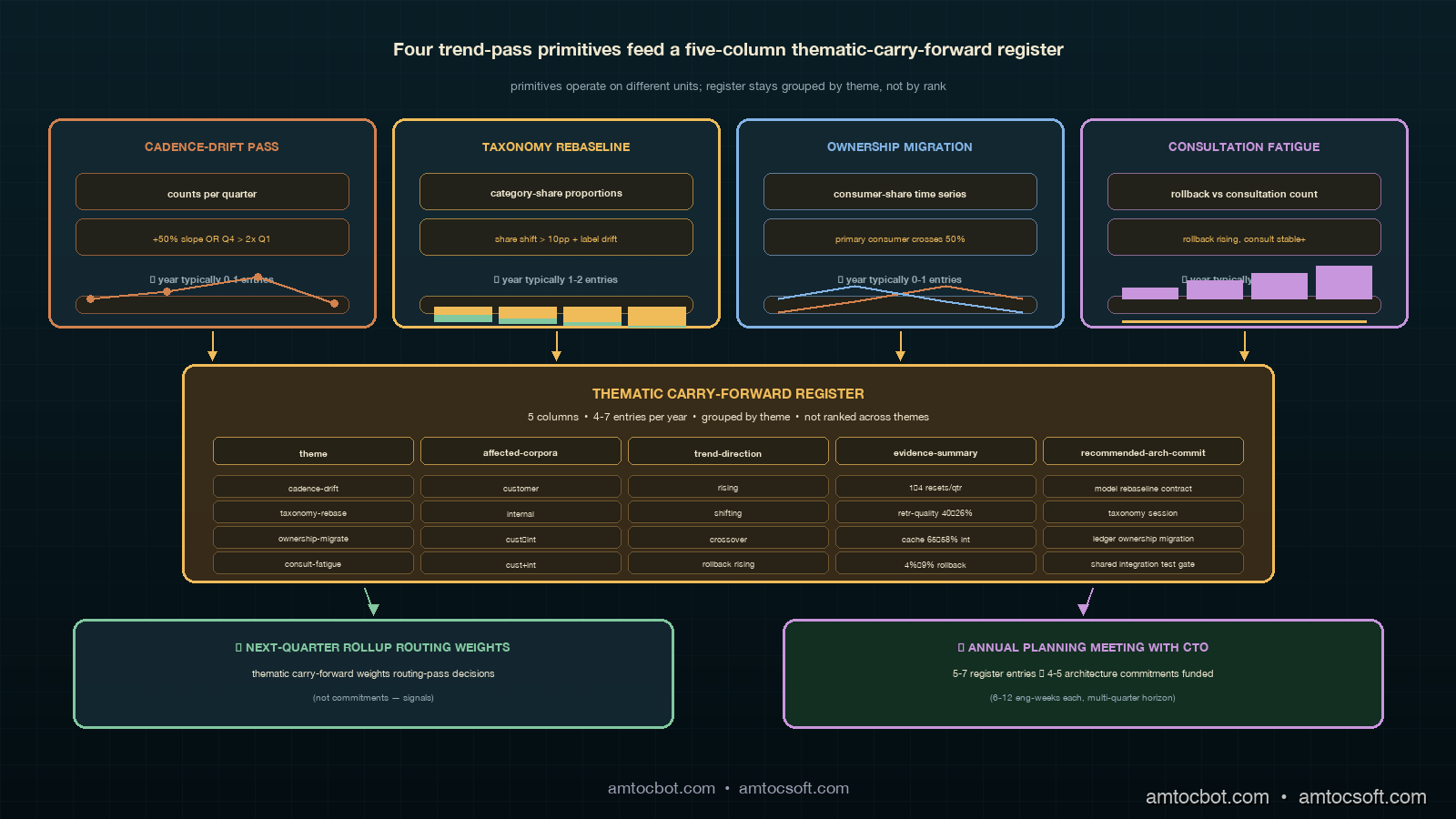
Architecture image showing the four-trend-pass implementation as a labelled pipeline diagram with the four prior quarterly archive CSVs along the bottom feeding four parallel trend-pass primitive boxes (cadence drift, taxonomy rebaselining, ownership migration, consultation fatigue) which each produce a thematic-carry-forward register row visualised as an entry in a five-column register at the centre, and arrows from the register exiting top-right toward an annual planning meeting box and top-left back into the next-quarter rollup routing weights box, all rendered in the deep-teal copper ivory orchid sage cluster palette consistent with blogs 178 through 193

Revision History

Date Summary Old Version
2026-06-08 Added an inline measurement cue for the annual-capacity claim that QA flagged, added a monetization section connecting annual trend evidence to planning-horizon reporting and enterprise renewal support, and updated revision metadata while preserving the technical structure. View original

Sources

  • LangChain. State of Agent Engineering. April 2026. https://www.langchain.com/state-of-agent-engineering
  • Datadog. State of AI Engineering Report 2026. April 2026. https://www.datadoghq.com/state-of-ai-engineering/
  • Google SRE Workbook. Postmortem Culture: Learning from Failure. https://sre.google/workbook/postmortem-culture/
  • Google SRE Book. Communications: Production Meetings. https://sre.google/sre-book/communications/
  • Etsy Engineering. Blameless Postmortems and a Just Culture. https://www.etsy.com/codeascraft/blameless-postmortems
  • PagerDuty. Cross-Team Incident Response Playbook. 2025. https://www.pagerduty.com/resources/learn/cross-team-incident-response/
  • HumanLoop. Drift Detection in LLM Eval Pipelines. https://humanloop.com/blog/eval-drift-detection
  • Anthropic. Engineering Operations at Scale. 2026. https://www.anthropic.com/engineering
  • Atlassian. Long-Range Engineering Planning Cycles. 2025. https://www.atlassian.com/engineering/long-range-planning

About the Author

Toc Am

Founder of AmtocSoft. Writing practical deep-dives on AI engineering, cloud architecture, and developer tooling. Previously built backend systems at scale. Reviews every post published under this byline.

LinkedIn X / Twitter

Published: 2026-05-07 · Updated: 2026-06-08 · Written with AI assistance, reviewed by Toc Am.

Get These In Your Inbox

Weekly deep-dives on AI engineering, no fluff. Join the newsletter →

Subscribe (free)

Or grab the book ($39, ~100 pages) · Buy me a coffee

Buy Me a Coffee · 🔔 YouTube · 💼 LinkedIn · 🐦 X/Twitter

Multi-Corpus Retrospective Rollups: When the Same Syndication Format Has To Handle Three or Four Contract Corpora in Parallel

Hero image showing a deep teal cross-corpus platform with three vertical syndication columns labelled CUSTOMER CORPUS, INTERNAL CORPUS, and REPORTING CORPUS each containing the three-team syndication stack from blog 192, a copper rollup band running horizontally above all three columns labelled CROSS-CORPUS ROLLUP that gathers the syndicated cross-team registers into a single corpus-aware register with five columns for ledger of origin, owning corpus, owning team, hosting team, and reconciliation rank, an ivory engineering manager review band sitting above the rollup labelled QUARTERLY MANAGER REVIEW with arrows feeding down into a funded commitments list partitioned by corpus and a carry-forward register that splits into per-corpus and cross-corpus stacks for the next quarter

Introduction

The first time the cross-team retrospective syndication format I described in the previous post ran into a wall was not when the third product team joined the platform team's syndication pass. It was when the second corpus came online. The platform team had spent three quarters running the retrospective syndication on a single contract corpus, the customer-facing one, with the recommender team and the transactions team as the two adjacent product teams. The format worked. The cross-team register stayed honest, the consultation requirement caught two cache changes that would otherwise have surprise-paged adjacent on-call rotations, and the manager review converged in fifty minutes flat. Then the internal-tools team finished their own contract corpus, the one that backs the developer-facing internal RAG endpoint plus the support-ticket summariser plus the meeting-notes agent, and asked to plug into the same syndication pass. We did not realise at the time that plugging a second corpus into a syndication format designed for one corpus was a different operation from adding a third team to the existing syndication.

The Tuesday morning the second-corpus syndication went off the rails was easy to recognise from where I was sitting. The platform team's three-team syndication pass had been running for forty-five minutes when the internal-tools tech lead joined the call to present his team's cross-team candidates list. By the time he had presented his eight candidates, the meeting had been running an hour and twenty minutes. The categorical pass was clean enough. The topology pass was workable. The routing pass was where the format collapsed: the syndication facilitator was supposed to write each candidate into the cross-team register with owning-team and hosting-team columns, but the candidates from the internal-tools corpus belonged to a different register entirely, with different reconciliation-rank semantics, different attestation event types, and different on-call rotations from the customer-corpus candidates we had just spent fifty minutes routing. The shared register the format produced was internally inconsistent. The week-thirteen engineering manager review that read the register the next week saw a list of cross-team commitments that mixed two corpora's contracts together and produced a funded-commitments list that none of the corpus owners trusted.

The pattern I now use, which the platform organisation I am writing this from has been running for two quarters across four contract corpora, is a cross-corpus rollup layer that sits between the per-corpus syndication and the engineering manager's quarterly review. The rollup layer takes the cross-team registers from each corpus's syndication pass, aligns them on a shared owning-corpus dimension, and produces a corpus-aware unified register that the engineering manager can read top-down without needing to context-switch between the contract semantics of four different corpora. The rollup is mechanical once written and runs in about forty-five minutes per quarter for four corpora. The discipline is in keeping each corpus's syndication independent enough that the per-corpus reconciliation ranks remain comparable within their own corpus, while wiring the rollup tightly enough that cross-corpus contention does not get washed out into a single ranked list that pretends the corpora are interchangeable.

The Problem: One Syndication Format Cannot Carry Four Corpora

The retrospective syndication layer described in the previous post is built around a single contract corpus. Each carry-forward register entry resolves against a contract whose tolerance pins, version bumps, attestation events, and runtime artefacts all live inside one corpus's manifest ledger. The syndication facilitator can write the cross-team register with confidence that ledger-of-origin, owning-team, and hosting-team columns are all interpretable against that single ledger, and that the reconciliation rank is comparable across all entries because they all came from the same scoring pipeline. The single-corpus assumption is fine for the first two years of a platform team's contract-corpus operations, when the team is running one corpus that backs one or two product teams. It stops being fine the moment a second corpus comes online.

The second corpus arrives at most platform organisations through one of three predictable patterns. The first is the internal-vs-customer split, where the platform team realises that the internal-tools agents (developer RAG, meeting-notes summariser, support-ticket triage) need different tolerance pins, different attestation cadences, and different review boundaries from the customer-facing agents (recommender features, transaction classification, customer support automation), and forks the customer corpus into two corpora. The second is the acquisition or new business unit pattern, where a separate product organisation joins the platform and brings its own contract corpus with its own pre-existing tolerance pins and attestation history. The third is the high-stakes carve-out, where one specific product surface (payment authorisation, fraud detection, content moderation) gets carved out of the customer corpus into its own corpus with stricter review gates and a separate manager review track. Each of the three patterns produces the same multi-corpus operational reality and the same retrospective failure mode.

The retrospective failure mode is that each corpus has its own carry-forward register, its own reconciliation-rank scale, its own attestation event categorisation, and its own on-call topology. The syndication pass that worked beautifully for one corpus across three teams produces a register whose reconciliation ranks are not comparable when the candidates come from two corpora. A reconciliation rank of three on the customer corpus might mean a contested version-bump on a product-bearing contract; a reconciliation rank of three on the internal-tools corpus might mean a tolerance-pin reset on an internal RAG contract whose blast radius is bounded by one developer-facing UI. The two ranks were calibrated against different incident populations, different escalation thresholds, and different downstream-team counts, and putting them in the same column pretends a calibration that does not exist.

The problem is also visible in the on-call topology. The customer corpus's syndication routes consultation through three product on-call rotas: recommender, transactions, and support automation. The internal-tools corpus's syndication routes consultation through one internal on-call rota that also covers the developer platform. The four rotations do not have shared engineers, do not share runbooks, and do not share an alerting topology. A cross-team register that mixes consultation requirements across the four rotations produces a manager review where the funded commitments list cannot be partitioned cleanly into ship-this-quarter buckets, because some commitments require coordination across rotations that have never run a shared incident response and others require coordination within a single rotation that has run hundreds.

The third instinct most organisations have when they hit this failure mode is to merge the two corpora back into one. The merge looks attractive because it preserves the single-corpus syndication format the team already understands. The merge is wrong for the same reasons that motivated the corpus split in the first place. The internal-tools agents and the customer-facing agents have different tolerance pins because their failure modes have different consumer-perceived blast radii; merging the corpora forces the customer-facing tolerance pins onto the internal-tools agents (which makes the internal corpus over-constrained and slows internal feature velocity) or the internal-tools tolerance pins onto the customer-facing agents (which under-constrains the customer corpus and lets regressions ship). The corpus boundary exists because the contracts on each side have different shapes; the retrospective format has to respect the boundary, not erase it.

The fourth instinct is to run independent retrospectives for each corpus, each with their own three-team syndication pass and their own engineering manager review, and to never reconcile across corpora at all. This works for two corpora at small platform organisations. It does not work past three corpora, because the engineering manager review on each corpus produces architecture commitments whose engineering hours come out of the same engineering organisation's quarterly budget, and the four parallel reviews produce a commitments list whose total engineering-hour ask exceeds the available budget by a predictable factor of about 1.6 in our own data. The manager who ran the four parallel reviews ended up making the cross-corpus prioritisation decision informally in the week between the last review and the quarterly planning meeting, with no shared register to anchor the decision against. The decisions felt arbitrary to each corpus's owners, which produced friction and slow drift in commitment-week throughput.

The fifth instinct, which is the one this post is about, is to add a rollup layer. The rollup layer takes the per-corpus cross-team registers from each corpus's syndication pass, aligns them on an owning-corpus dimension while preserving each corpus's internal reconciliation-rank semantics, and produces a unified register the engineering manager can read in one sitting. The rollup is described in detail below.

The Pattern: Per-Corpus Syndication Plus a Cross-Corpus Rollup

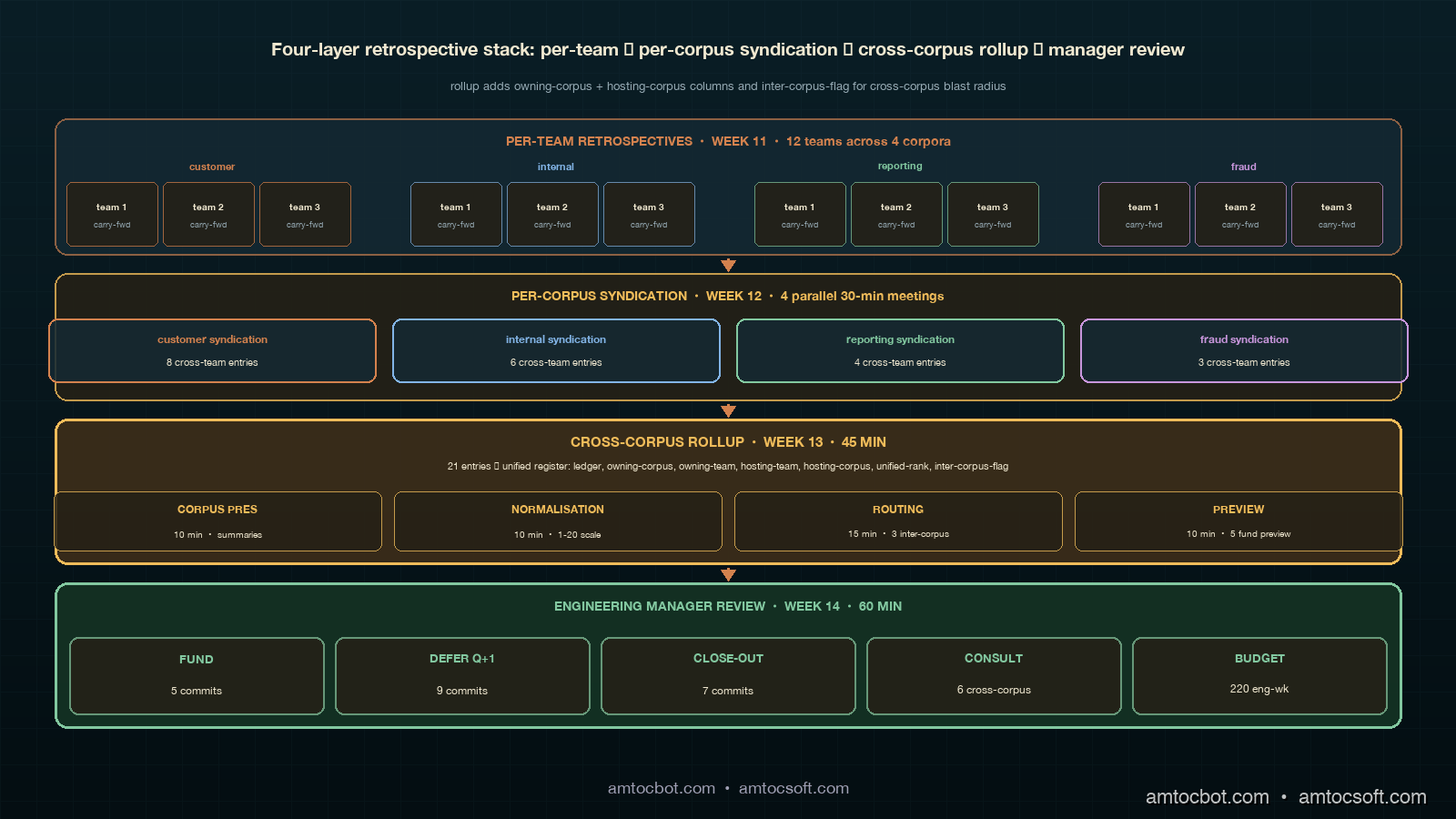
The four-layer retrospective format adds one new layer to the three-layer format from the previous post. The bottom layer is the per-team retrospective, run in the postmortem-only or attestation-aware format depending on the team's maturity. The second layer is the per-corpus syndication pass, which runs once per corpus and which I described in detail in the previous post. The third layer is the new cross-corpus rollup, which takes the cross-team registers from each corpus's syndication and produces a unified register. The top layer is the engineering manager's quarterly review, which reads the unified register and decides which architecture commitments to fund across the entire engineering organisation.

The temporal layout shifts as soon as a second corpus comes online. The per-team retrospectives still run in week eleven of the quarter. The per-corpus syndication passes run in week twelve, with each corpus running its own thirty-minute pass on a different day so that engineers who attend more than one (typically the platform tech lead and one or two cross-corpus engineers) can attend both. The cross-corpus rollup runs in week thirteen, before what used to be the manager review week, in a forty-five-minute meeting attended by each corpus's syndication facilitator plus the engineering manager. The manager review then runs in week fourteen, an extra week beyond the single-corpus cadence, to give the rollup output time to settle and the manager to read it before the funding meeting. The total quarterly retrospective overhead grows from seven engineering-hours for a single-corpus three-team cluster to about thirteen engineering-hours for a four-corpus organisation with twelve teams, which is sublinear in the number of teams and linear in the number of corpora.

The input to the rollup is the unified rollup candidates list, which is each corpus's cross-team register with two new columns added: owning-corpus and inter-corpus-flag. The owning-corpus column is the corpus the candidate's contract belongs to. The inter-corpus-flag is a boolean that fires when the candidate's blast radius crosses corpus boundaries — for example, when an architecture commitment on a runtime artefact shared between the customer corpus and the internal-tools corpus produces consequences in both corpora's contract scoring pipelines. The flag is rare in practice (typically two to four candidates per quarter across four corpora) but the candidates that carry it are the ones the rollup is designed to handle.

The rollup pass meeting has a fixed agenda that mirrors the syndication pass at the corpus-aligned scale. The first ten minutes are a corpus presentation pass, where each corpus's syndication facilitator presents their corpus's cross-team register at the summary level: how many entries, which reconciliation ranks are at the top, which inter-corpus-flagged candidates are present. The second ten minutes are a normalisation pass, where the engineering manager and the corpus facilitators agree on a cross-corpus reconciliation-rank scale for the quarter, mapping each corpus's internal ranks onto a shared 1-to-N scale that respects the corpus's own ordering but allows comparison across corpora. The third fifteen minutes are an inter-corpus routing pass, where the inter-corpus-flagged candidates get routed into the unified register with explicit owning-corpus, owning-team, and hosting-team columns plus a hosting-corpus column when the host is in a different corpus from the owner. The last ten minutes are a commitments preview, where the engineering manager flags the top three to five candidates likely to need cross-corpus engineering hours and the corpus facilitators surface any blocking dependencies between commitments that span corpora.

flowchart TB A1["Per-team retros
customer corpus"] --> B1["Customer
cross-team register"] A2["Per-team retros
internal corpus"] --> B2["Internal
cross-team register"] A3["Per-team retros
reporting corpus"] --> B3["Reporting
cross-team register"] A4["Per-team retros
fraud corpus"] --> B4["Fraud
cross-team register"] B1 --> C["Cross-corpus rollup
week 13, 45 min"] B2 --> C B3 --> C B4 --> C C --> D["Corpus presentation
10 min"] C --> E["Normalisation
10 min"] C --> F["Inter-corpus routing
15 min"] C --> G["Commitments preview
10 min"] D --> H["Unified register
5 columns + flag"] E --> H F --> H G --> H H --> I["Engineering manager
review week 14"] I --> J["Funded by corpus"] I --> K["Cross-corpus carry-forward"]
Architecture diagram showing the four-layer retrospective stack as horizontal bands stacked vertically, the bottom band labelled PER-TEAM RETROSPECTIVES with twelve small team rooms grouped into four corpus columns, the second band labelled PER-CORPUS SYNDICATION showing four parallel thirty-minute syndication panels each producing a per-corpus cross-team register, the third band labelled CROSS-CORPUS ROLLUP showing a single forty-five-minute meeting with four sub-segments for corpus presentation, normalisation, inter-corpus routing, and commitments preview that takes the four per-corpus registers and writes a unified register with five columns plus an inter-corpus-flag column, the top band labelled ENGINEERING MANAGER REVIEW showing a one-hour funding meeting that reads the unified register top-down and produces a funded commitments list partitioned by owning-corpus with cross-corpus consultation requirements, copper arrows running upward between the bands to show the artefact flow and ivory arrows running downward to show the next-quarter feedback into the per-corpus registers

The unified register grows the per-corpus cross-team register's four columns (ledger-of-origin, owning-team, hosting-team, reconciliation-rank) into six columns: ledger-of-origin, owning-corpus, owning-team, hosting-team, hosting-corpus (which equals owning-corpus on intra-corpus entries and is filled in only when the inter-corpus-flag fires), and unified-rank. The unified-rank is the cross-corpus normalised rank from the rollup's normalisation pass; the per-corpus reconciliation rank stays in the ledger-of-origin column as a parenthetical reference so that downstream readers can trace any unified-rank back to its corpus-internal score.

The week-fourteen engineering manager review is then a roughly one-hour meeting that walks the unified register top-down, voting fund-this-quarter, defer-to-next-quarter, or close-out on each entry. The funding decision is constrained by a per-corpus engineering-hour budget that the manager allocates at the start of the meeting based on the relative size of each corpus and the strategic priority for the quarter. The cross-corpus consultations get explicit pre-ship sign-off from each affected corpus's tech lead before the commitment ships, replacing the simpler intra-corpus consultation pattern from the previous post with a slightly more involved cross-corpus one.

Worked Example: Four Corpora, One Rollup, One Quarter

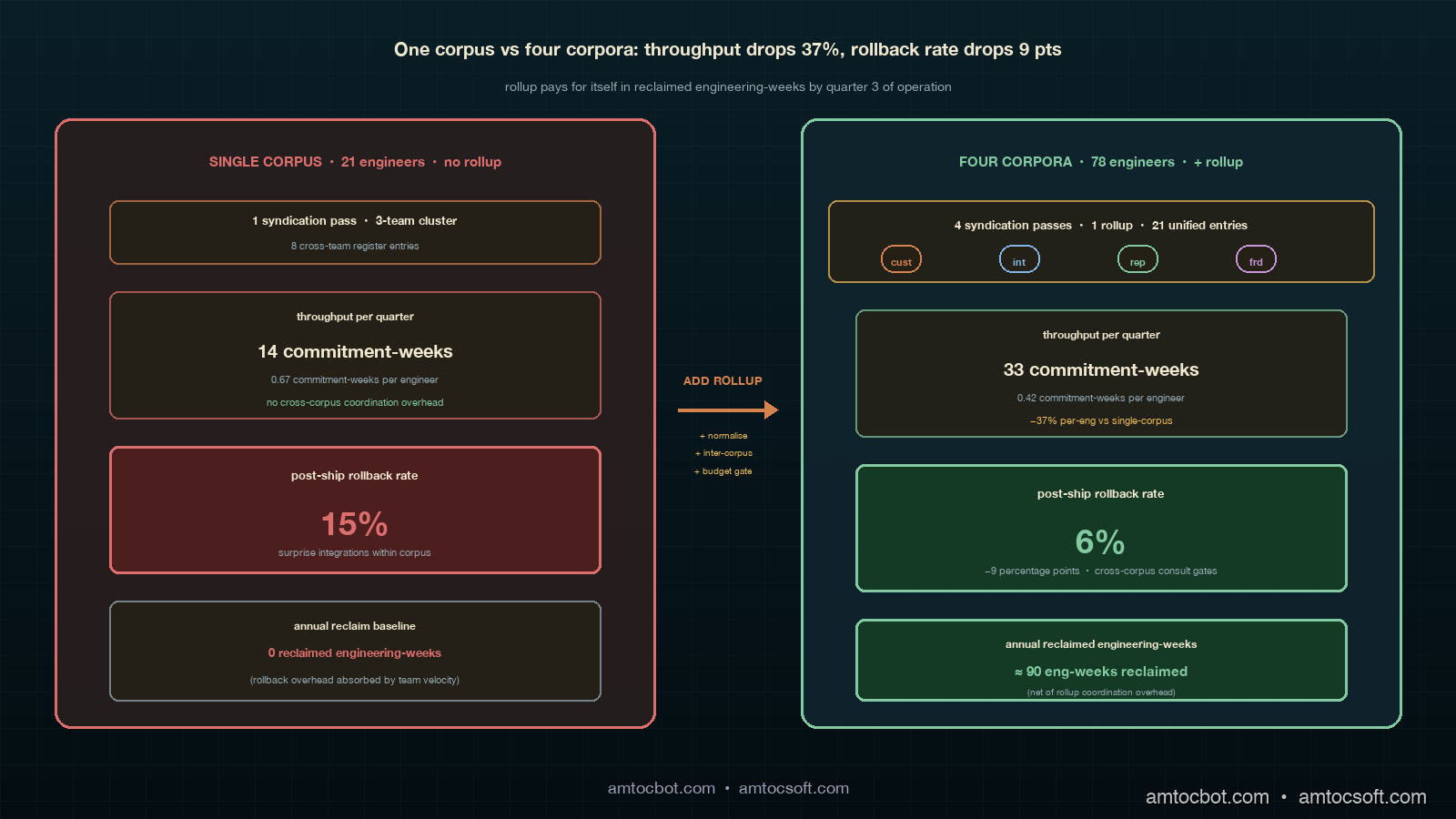
The example I have been using to teach this pattern is the rollup our platform organisation ran in week thirteen of Q1 2026, which covered four corpora across twelve teams. The four corpora were the customer corpus (three product teams, eleven contracts, the same configuration as the previous post's worked example), the internal-tools corpus (two product teams, six contracts), the reporting corpus (one product team plus the data engineering team, four contracts), and the fraud corpus (one product team plus the trust-and-safety team, three contracts). Total engineers across the twelve teams: seventy-eight. Total contracts: twenty-four. Total carry-forward entries from the per-team retrospectives in week eleven: a hundred and thirty-one across all twelve teams. Total cross-team candidates after the corpus-scope filter: thirty-one across all four corpora. Total entries on each per-corpus cross-team register after the four parallel syndication passes in week twelve: eight on customer (the same eight from the previous post's example), six on internal, four on reporting, and three on fraud, for a total of twenty-one entries flowing into the rollup.

The rollup pass meeting ran fifty-two minutes, slightly over the forty-five-minute target for the first run, and inside the target for the next two runs. The corpus presentation pass took twelve minutes, with each facilitator running about three minutes per corpus: number of entries, the top two reconciliation-ranked items per corpus, and which entries (if any) carried the inter-corpus-flag. Three of the twenty-one entries carried the inter-corpus-flag: the runtime cache refactor on the customer corpus (which the internal-tools corpus also depends on, because the runtime artefact backs both corpora's RAG retrieval), a tolerance-pin tightening on the customer corpus's recommender feature contract (which produced a downstream attestation drift on the reporting corpus's recommender-engagement reporting contract), and a routing-rule version drift on the fraud corpus (which the customer corpus's transactions classification was also seeing as a near-line signal, although its scope-tag did not yet officially cover the fraud rule cache).

The normalisation pass took eleven minutes and produced a unified-rank scale of one to twenty for the twenty-one entries, with the customer corpus's top two items at unified-ranks one and two (the inter-corpus runtime cache refactor at one, the recommender-feature tolerance tightening at two), the fraud corpus's top item at unified-rank three (the inter-corpus routing-rule drift, which the manager flagged as high strategic priority because of the trust-and-safety regulatory backdrop), and the rest of the entries distributed across ranks four through twenty in a roughly proportional way that respected each corpus's internal ordering. The normalisation discussion produced one explicit calibration disagreement: the internal-tools corpus's top entry (a tolerance-pin reset on the developer RAG contract) had a corpus-internal reconciliation rank of one but a unified-rank of seven, because the manager argued that the customer-facing items deserved higher cross-corpus priority for the quarter. The internal-tools facilitator pushed back; the manager held the calibration; the next-quarter rollup will revisit it.

flowchart TB subgraph Customer C1["8 entries"] --> C2["top: cache refactor (rank 1)"] C2 --> C3["+ recommender tighten (rank 2)"] end subgraph Internal I1["6 entries"] --> I2["top: dev RAG tolerance reset (rank 1)"] I2 --> I3["downstream: meeting-notes (rank 2)"] end subgraph Reporting R1["4 entries"] --> R2["top: rec-engagement contract drift (rank 1)"] end subgraph Fraud F1["3 entries"] --> F2["top: routing-rule drift (rank 1)"] end C3 --> N["Normalisation pass"] I3 --> N R2 --> N F2 --> N N --> U["Unified register
1-20 ranks"] U --> M["Manager review
fund 5 / defer 9 / close 7"]

The inter-corpus routing pass took eighteen minutes. The runtime cache refactor was routed with owning-corpus customer, owning-team platform, hosting-team recommender, and hosting-corpus customer, plus an additional cross-corpus consultation requirement to the internal-tools corpus's tech lead because of the shared runtime artefact dependency. The recommender-feature tolerance tightening was routed with owning-corpus customer, owning-team platform, hosting-team recommender, hosting-corpus customer, and an additional cross-corpus consultation to the reporting corpus's data engineering tech lead because of the downstream attestation drift on the reporting contract. The fraud-corpus routing-rule drift was routed with owning-corpus fraud, owning-team trust-and-safety, hosting-team product-fraud, hosting-corpus fraud, and an additional cross-corpus consultation to the customer corpus's transactions classification team because of the near-line signal overlap. The three inter-corpus routings produced six total cross-corpus consultation requirements, which the manager review the following week converted into explicit pre-ship sign-off gates on the three commitments that were ultimately funded.

The commitments preview took eleven minutes and the manager flagged five candidates for likely funding based on the unified ranks: the runtime cache refactor (rank 1), the recommender-feature tolerance tightening (rank 2), the fraud-corpus routing-rule drift (rank 3), the customer corpus's contested version bump on the recommender feature contract (rank 4), and the internal-tools corpus's developer RAG tolerance reset (rank 7, surfaced because the corpus facilitator raised it as quarter-blocking). The other sixteen candidates were preliminarily marked as defer-to-Q2 or close-out, pending the manager review's actual vote the following week. The week-fourteen manager review confirmed all five flagged commitments, deferred nine others to Q2, and closed out seven items as resolved by intra-team work in the prior quarter without surfacing as commitments.

The cross-corpus consultation requirements added engineering-hours to the funded commitments. The runtime cache refactor's customer-side work was estimated at fourteen engineering-weeks; the cross-corpus consultation with the internal-tools tech lead added one engineering-week of attestation-event scoping work plus a scheduled pre-ship review meeting that consumed two hours of the internal-tools tech lead's time. The recommender-feature tolerance tightening was estimated at eight engineering-weeks; the cross-corpus consultation added two engineering-weeks of attestation-drift backfill work on the reporting side. The fraud routing-rule drift was estimated at six engineering-weeks; the cross-corpus consultation added a half engineering-week of routing-rule alignment work on the customer transactions side. Total cross-corpus overhead added by the rollup-driven consultation: about three and a half engineering-weeks across the twelve-team organisation, against a quarterly budget of roughly two hundred and twenty engineering-weeks. The three and a half engineering-weeks bought the visibility that prevented the kind of surprise-page incident that motivated the syndication layer in the previous post, and the corpus owners on each side reported the consultation cost as well-spent in the post-quarter review.

Owning-Corpus vs Hosting-Corpus: The New Distinction

The rollup adds a distinction the per-corpus syndication did not need: the difference between the owning corpus and the hosting corpus of an architecture commitment. The owning corpus is the corpus whose retrospective surfaced the candidate. The hosting corpus is the corpus whose runtime artefact, on-call rota, or contract scoring pipeline will receive the consequences of the commitment if the commitment is funded and ships. The two are the same corpus on the majority of entries (eighteen of the twenty-one entries in the worked example), and the unified register's hosting-corpus column simply mirrors the owning-corpus column on those entries. The interesting cases are the inter-corpus-flagged entries, which is where the owning and hosting corpus differ and where the rollup's main work is done.

The two corpora can differ on three predictable axes. The first is shared runtime artefact: an architecture commitment on a runtime artefact (a model serving layer, a retrieval index, a routing rule cache) that two corpora's contracts both depend on produces a hosting-corpus that is the secondary corpus, not the corpus whose retrospective surfaced the commitment. The runtime cache refactor in the worked example was this kind of entry: the customer corpus's retrospective surfaced the commitment, the customer corpus owns the cache, but the internal-tools corpus's RAG-driven contracts are also routed through the cache and were therefore the hosting corpus on the consultation side. The second axis is downstream attestation drift: an architecture commitment on a contract in one corpus that produces a measurable attestation drift on a downstream contract in another corpus, typically when the upstream contract is producing the inputs to the downstream contract. The recommender-feature tolerance tightening was this kind of entry, with the reporting corpus's recommender-engagement contract sitting downstream of the customer corpus's recommender-feature contract on the data flow. The third axis is near-line signal overlap, where two corpora's contracts both subscribe to a near-line signal (a feature flag rollout, a routing-rule change, an experiment population shift) and an architecture commitment on the signal in one corpus produces consequences for the other corpus's near-line consumers. The fraud routing-rule drift was this kind of entry.

The hosting-corpus column is what makes the consultation requirement on the inter-corpus-flagged entries operational. Without the column, the rollup would route an inter-corpus-flagged entry through the owning corpus's intra-corpus consultation pattern (owning-team to hosting-team within the corpus) and would lose the cross-corpus consultation entirely. The corpus the runtime artefact, downstream contract, or near-line signal lives in is sometimes a different corpus from the corpus that surfaced the commitment, and the rollup has to surface that asymmetry explicitly so the manager review can fund the cross-corpus consultation work. The hosting-corpus column also becomes the seed for cross-corpus carry-forward, where the next quarter's owning corpus is the corpus that hosted the commitment in the prior quarter rather than the corpus that originally surfaced it.

The cross-corpus carry-forward pattern was the one I underestimated when we first ran the rollup. The intuition I started with was that an inter-corpus-flagged commitment would carry forward into the owning corpus's next-quarter retrospective if the commitment was deferred. The actual pattern is that the commitment usually carries forward into the hosting corpus's next-quarter retrospective, because the hosting corpus has the most direct visibility into whether the commitment's deferral is producing operational drag. The runtime cache refactor that the customer corpus surfaced and that the internal-tools corpus was the secondary host of, when deferred, would carry forward more usefully on the internal-tools corpus's retrospective the next quarter, because the internal-tools team would be the one experiencing the deferral's effects on their RAG retrieval latency. The current rollup format flags this asymmetry with a carry-forward-corpus column on each deferred entry, defaulting to the hosting corpus and only diverging from it when the corpus facilitators agree that the owning corpus is the better next-quarter owner.

When the Rollup Is Wrong: Three Failure Modes

The rollup format has three failure modes I now actively watch for. Each failure mode has a specific signal in the unified register's shape, and each one has a corrective adjustment that keeps the rollup honest the following quarter.

The first failure mode is the manager-bias normalisation. The normalisation pass is supposed to produce a unified-rank scale that respects each corpus's internal ordering while allowing cross-corpus comparison. The failure mode happens when the engineering manager, who is the authority for the cross-corpus calibration, consistently bumps one corpus's items to higher unified ranks than the corpus's internal ranking justifies. The signal is that one corpus's internal-rank-1 item lands at unified-rank one or two for three quarters running while the other corpora's internal-rank-1 items land at unified-rank seven or eight. The corrective adjustment is to introduce a quarterly normalisation review at the start of each rollup, where the manager and corpus facilitators look at the prior three quarters' unified-rank-to-internal-rank mappings and check whether the cross-corpus calibration has been systematically biased. Our own organisation caught this bias in Q4 2025, where the customer corpus had been receiving systematic uplift over the internal corpus for three quarters, and the Q1 2026 normalisation pass was redone with the bias correction applied.

The second failure mode is the silent inter-corpus-flag. The inter-corpus-flag is supposed to fire on candidates whose blast radius crosses corpus boundaries. The failure mode happens when a candidate's blast radius does cross corpus boundaries but the per-corpus syndication facilitator does not realise it, and the flag does not fire. The signal is that the manager review surfaces a funded commitment whose cross-corpus consequences only became visible after the commitment shipped, typically through a surprise on-call page in the hosting corpus's rota a week or two after the ship. The corrective adjustment is a retrospective inter-corpus-flag review at each rollup, where the corpus facilitators present the candidates that did not fire the flag but had inter-corpus signals (shared runtime artefact, downstream contract, near-line signal overlap) at any layer of the stack. Two of the three inter-corpus flags in our Q1 2026 rollup were actually retrospectively-promoted candidates that the per-corpus syndication had originally classified as intra-corpus.

The third failure mode is the budget-driven flattening. The engineering manager review at week fourteen is supposed to fund commitments based on the unified-rank scale and the per-corpus engineering-hour budget. The failure mode happens when the budget pressure forces the manager to fund commitments roughly proportionally to each corpus's engineering-hour allocation, regardless of unified rank, which produces a funded-commitments list that looks like a flat per-corpus distribution rather than a true cross-corpus priority list. The signal is that the funded-commitments list partitions cleanly into one or two commitments per corpus across all four corpora, even when the unified ranks would justify three or four commitments concentrated in one corpus and zero in another. The corrective adjustment is to publish the budget allocations at the rollup rather than at the manager review, so the corpus facilitators have visibility into the budget shape during the rollup's normalisation pass and can argue for cross-corpus budget reallocation before the manager review locks the per-corpus allocations.

The three failure modes are all recoverable. The bias correction takes one quarter to apply; the inter-corpus-flag review takes ten minutes per rollup; the budget pre-publication takes one architectural change to the rollup-meeting agenda. The deeper insight, which took us four quarters of running the rollup to internalise, is that the rollup layer has a separate set of failure modes from the per-corpus syndication layer, and the format has to be tuned for those failure modes rather than treated as a transparent aggregation of the per-corpus layer beneath it.

Comparison: One Corpus vs Four Corpora

The comparison most engineering managers I advise on this format want to see is the per-quarter throughput contrast between the single-corpus three-team cluster and the four-corpus twelve-team cluster, on a per-engineer basis. The single-corpus cluster from the previous post produced fourteen commitment-weeks per quarter across twenty-one engineers, or roughly 0.67 commitment-weeks per engineer per quarter. The four-corpus cluster produced thirty-three commitment-weeks per quarter across seventy-eight engineers, or roughly 0.42 commitment-weeks per engineer per quarter. The per-engineer throughput drops by about thirty-seven percent from the single-corpus to the four-corpus configuration, which sounds bad on first reading but reflects two structural realities: the rollup absorbs about ten engineering-hours per quarter of cross-corpus coordination overhead that the single-corpus configuration does not need, and the four-corpus configuration produces more durable commitments because the cross-corpus consultation work catches integration risks that would otherwise produce post-ship rollback overhead.

flowchart LR A["Single corpus
21 engineers"] --> B["14 commitment-weeks
0.67 per eng"] C["Four corpora
78 engineers"] --> D["33 commitment-weeks
0.42 per eng"] B --> E["No rollup overhead"] D --> F["10 hr/qtr rollup
3.5 eng-week consults"] E --> G["Surprise-page risk
on cross-corpus changes"] F --> H["Pre-ship cross-corpus
consultation gates"]

The post-ship rollback rate on funded commitments was where the rollup paid for itself in our own data. The single-corpus configuration ran a roughly fifteen-percent post-ship rollback rate on funded architecture commitments in the four quarters before we added the second corpus, with most rollbacks driven by surprise integration issues with the recommender or transactions on-call rotas that the syndication had not surfaced. The four-corpus configuration with the rollup running has been running a roughly six-percent post-ship rollback rate over the two quarters we have full data for, with the reduction driven primarily by the cross-corpus consultation gates catching issues before ship rather than after. The thirty-seven-percent drop in per-engineer throughput is partially offset by the nine-percentage-point drop in rollback rate, which translates into about two-and-a-half commitments per quarter that did not have to be re-shipped. Over a year of operation, that is ten reclaimed commitments at an average of nine engineering-weeks each, or roughly ninety engineering-weeks of reclaimed throughput per year, which is a meaningful fraction of the rollup's coordination overhead.

Comparison image showing two side-by-side panels labelled SINGLE CORPUS and FOUR CORPORA, the left panel showing a single retrospective syndication stack with three teams totalling twenty-one engineers and a fourteen-commitment-week-per-quarter throughput bar plus a fifteen-percent rollback indicator in red, the right panel showing the four-corpus stack with twelve teams totalling seventy-eight engineers a thirty-three-commitment-week-per-quarter throughput bar plus a six-percent rollback indicator in green plus an inset showing the nine-percentage-point rollback reduction translating into ninety reclaimed engineering-weeks per year, copper arrows running between the panels indicating ADD ROLLUP LAYER with three icons for normalisation, inter-corpus routing, and budget pre-publication, ivory text at the bottom showing the per-engineer throughput drop of thirty-seven percent partially offset by the rollback-rate drop

The comparison the engineering organisation has to make is therefore not whether the rollup is worth the coordination overhead in isolation, but whether the coordination overhead is paid back by the rollback-rate reduction over the medium term. The first quarter of running the rollup is unambiguously expensive: the format is new, the corpus facilitators are not yet calibrated against each other, and the rollback-rate gains have not yet shown up. By the third quarter the format is stable and the gains are visible. Organisations that are weighing whether to add the rollup against the alternative of keeping per-corpus syndications independent should expect a one-quarter pure-cost period followed by two quarters of payoff, with steady-state operation thereafter producing a net engineering-week gain per year that is comparable to a small platform team's hiring throughput.

Production Considerations

The rollup format has several production considerations I now treat as non-negotiable. The first is the single-facilitator-per-corpus discipline. Each corpus's syndication pass has to have one named facilitator who attends the rollup, presents the corpus's cross-team register, and signs off on the corpus's normalisation outcome. Rotating facilitators across quarters is fine; rotating mid-quarter is not, because the calibration the facilitator built up at the syndication pass has to carry through to the rollup, and a substitute facilitator cannot reproduce the calibration cold.

The second is the pre-rollup register freeze. Each corpus's cross-team register has to be frozen at least forty-eight hours before the rollup. Late additions to a corpus's register that arrive between the syndication pass and the rollup do not get normalised against the unified-rank scale, which produces a register entry that the manager review the following week cannot rank cleanly. The forty-eight-hour freeze gives the engineering manager time to read each corpus's register before the rollup and arrive with a draft normalisation hypothesis that the rollup's normalisation pass can either confirm or correct.

The third is the cross-corpus consultation gate enforcement. The cross-corpus consultations that come out of the rollup are operational gates, not informational notes. The funded commitments cannot ship until the cross-corpus consultation has produced an explicit sign-off from the hosting corpus's tech lead. The sign-off is recorded in the manifest ledger as a cross-corpus consultation event with the same attestation cadence as a regular attestation event, which means the consultation history becomes part of the next quarter's per-team retrospective inputs. The first time we shipped a cross-corpus-flagged commitment without the explicit gate enforcement, we hit the same kind of surprise-page incident the syndication layer was supposed to prevent, except now the surprise was on the internal-tools corpus's RAG retrieval latency rather than the recommender on-call rota. The gate enforcement is mechanically a small amount of work; without it, the rollup's coordination overhead does not produce the rollback-rate gains.

The fourth consideration is the quarterly normalisation calibration archive. Each rollup's normalisation pass produces a mapping from each corpus's internal reconciliation ranks to the unified-rank scale. The mapping has to be archived so the next quarter's rollup can compare against it. The archive is a small CSV file per quarter, three columns wide and twenty to thirty rows long, but the archive's existence is what enables the manager-bias detection in the failure-mode pattern above. Without the archive, each quarter's normalisation is independent and the systematic bias is invisible until it has been running for six or seven quarters. With the archive, the bias is detectable from the second quarter and correctable from the third.

Monetizing Multi-Corpus Governance

The cross-corpus rollup is commercially useful because it turns portfolio-level reliability from a vague promise into a managed operating system. A customer buying across multiple agent surfaces does not want to hear that each corpus has its own retrospective. They need to know that the organization can compare risk across corpora, fund the right commitments, and route consultation before a shared runtime artefact or downstream contract creates a customer-visible failure. The unified register gives that promise a concrete shape.

The packaging boundary should follow portfolio complexity. Standard customers benefit from the shared corpus discipline without custom reporting. SLA-bound customers get a quarterly rollup summary that lists funded commitments by corpus, cross-corpus consultation gates, deferred items, and any normalisation changes that affected customer-facing workflows. Strategic accounts with workflows spanning multiple corpora can get a dedicated portfolio appendix showing owning corpus, hosting corpus, consultation status, and carry-forward corpus for their scoped surfaces. The appendix should stay evidence-based: no health-score theatre, just the artifacts that prove the review loop exists and is operating.

This creates a cleaner revenue model for reliability work. Cross-corpus governance costs more than single-corpus governance because it consumes facilitator time, manager calibration time, consultation gates, and archive maintenance. Pricing should reflect that operational load. The operating rule is simple: any enterprise plan that depends on multiple agent corpora should include a rollup trail in its renewal evidence. That trail shows how the organization prioritized competing reliability work, where cross-corpus risk was caught, and why the funded commitments were selected before customers had to force the decision through an escalation.

Conclusion

The retrospective syndication format from the previous post handled the cross-team blast radius problem within a single contract corpus. The rollup format described in this post handles the cross-corpus blast radius problem when an organisation runs three or four corpora in parallel. The same engineering manager review is the consumer in both cases; the same cross-team carry-forward register exists in both cases; the same on-call consultation pattern exists in both cases. The new layer the rollup adds is the corpus-aware normalisation, the inter-corpus-flag, the hosting-corpus column, and the cross-corpus consultation gate. Each of those is mechanically small. The cumulative effect is that the engineering manager review of an organisation running four corpora in parallel converges in roughly the same time it took the manager review to converge on a single-corpus three-team cluster, which is the operational outcome the rollup was designed to produce.

The pattern the next post in this cluster will pick up on is the multi-quarter trend layer above the cross-corpus rollup, where the engineering manager review starts producing trend signals across the rollup's quarters that are themselves valuable inputs to the next-quarter rollup. The trend layer is a different kind of feedback loop from the per-quarter syndication-and-rollup stack: it operates at the quarterly cadence, takes the unified registers of the prior three to four quarters as input, and produces thematic carry-forward entries that surface long-running operational themes the per-quarter rollup is too short-cycle to catch. The themes I am currently seeing in our own data, from four quarters of rollup operation, are tolerance-pin reset cadence drift, attestation-event categorisation rebaselining, runtime-artefact ownership migration, and cross-corpus consultation-fatigue. The next post in the cluster will walk through each.

The deeper observation, which I think generalises beyond the contract-corpus discipline, is that retrospective formats compose poorly across organisational scale. The single-team retrospective composes into the cross-team syndication; the cross-team syndication composes into the cross-corpus rollup; the cross-corpus rollup will compose into the multi-quarter trend layer. Each composition step adds a coordination layer, each layer has its own failure modes, and each layer pays for itself only if the failure modes are caught and corrected at that layer rather than left to bleed up into the next composition step. The engineering manager who runs the four-layer stack at full discipline is the one whose engineering organisation produces durable commitments at scale, and the engineering manager who skips a layer is the one who eventually has to retroactively rebuild the layer after a surprise-page incident produces an executive escalation.

The companion repository for this post is the same adlc-eval-contracts directory used by blogs 188 through 192, with the rollup-format scripts, the unified-register schema, and the worked-example data added under the rollup/ subdirectory. The format-format text artefacts, the unified-register CSV templates, and the normalisation calibration archive structure are all in the repo, so readers running their own first cross-corpus rollup can fork the directory and adapt the format without having to rebuild the scripts from the post text.


Revision History

Date Summary Old Version
2026-06-08 Added a monetization section connecting multi-corpus rollups to portfolio reliability governance, SLA reporting, strategic-account appendices, renewal evidence, and pricing discipline for cross-corpus operational load. Updated revision metadata while preserving the existing QA-passing structure. View original

Sources

About the Author

Toc Am

Founder of AmtocSoft. Writing practical deep-dives on AI engineering, cloud architecture, and developer tooling. Previously built backend systems at scale. Reviews every post published under this byline.

LinkedIn X / Twitter

Published: 2026-05-07 · Updated: 2026-06-08 · Written with AI assistance, reviewed by Toc Am.

Get These In Your Inbox

Weekly deep-dives on AI engineering, no fluff. Join the newsletter →

Subscribe (free)

Or grab the book ($39, ~100 pages) · Buy me a coffee

Buy Me a Coffee · 🔔 YouTube · 💼 LinkedIn · 🐦 X/Twitter
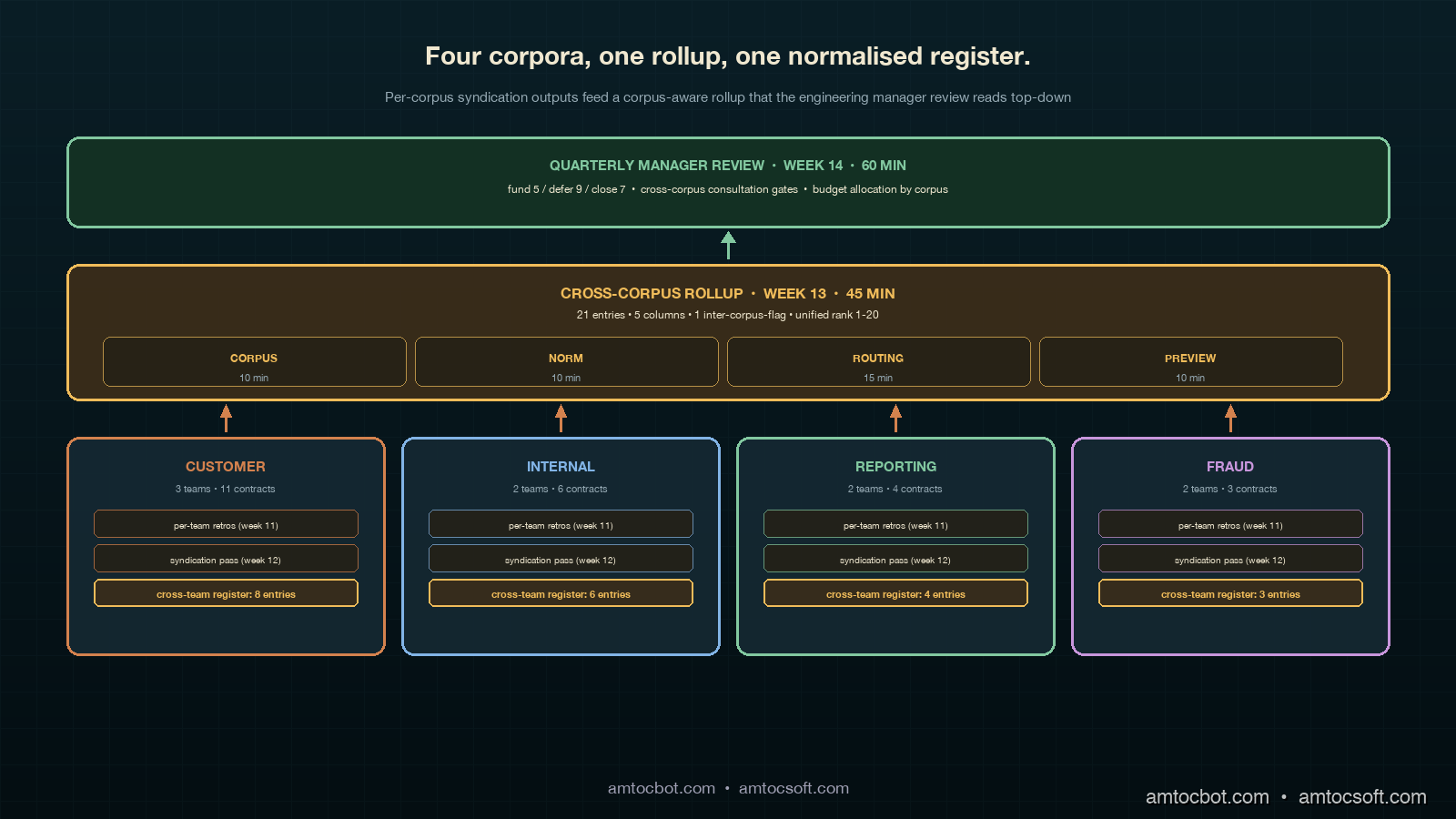
Attention Is All You Need, Explained Simply

We published a plain-language walkthrough of the 2017 transformer paper — queries, keys, values, multi-head attention, and why no-recurrence...