Showing posts with label agent-quality. Show all posts

Thursday, May 7, 2026

Multi-Corpus Retrospective Rollups: When the Same Syndication Format Has To Handle Three or Four Contract Corpora in Parallel

Hero image showing a deep teal cross-corpus platform with three vertical syndication columns labelled CUSTOMER CORPUS, INTERNAL CORPUS, and REPORTING CORPUS each containing the three-team syndication stack from blog 192, a copper rollup band running horizontally above all three columns labelled CROSS-CORPUS ROLLUP that gathers the syndicated cross-team registers into a single corpus-aware register with five columns for ledger of origin, owning corpus, owning team, hosting team, and reconciliation rank, an ivory engineering manager review band sitting above the rollup labelled QUARTERLY MANAGER REVIEW with arrows feeding down into a funded commitments list partitioned by corpus and a carry-forward register that splits into per-corpus and cross-corpus stacks for the next quarter

Introduction

The first time the cross-team retrospective syndication format I described in the previous post ran into a wall was not when the third product team joined the platform team's syndication pass. It was when the second corpus came online. The platform team had spent three quarters running the retrospective syndication on a single contract corpus, the customer-facing one, with the recommender team and the transactions team as the two adjacent product teams. The format worked. The cross-team register stayed honest, the consultation requirement caught two cache changes that would otherwise have surprise-paged adjacent on-call rotations, and the manager review converged in fifty minutes flat. Then the internal-tools team finished their own contract corpus, the one that backs the developer-facing internal RAG endpoint plus the support-ticket summariser plus the meeting-notes agent, and asked to plug into the same syndication pass. We did not realise at the time that plugging a second corpus into a syndication format designed for one corpus was a different operation from adding a third team to the existing syndication.

The Tuesday morning the second-corpus syndication went off the rails was easy to recognise from where I was sitting. The platform team's three-team syndication pass had been running for forty-five minutes when the internal-tools tech lead joined the call to present his team's cross-team candidates list. By the time he had presented his eight candidates, the meeting had been running an hour and twenty minutes. The categorical pass was clean enough. The topology pass was workable. The routing pass was where the format collapsed: the syndication facilitator was supposed to write each candidate into the cross-team register with owning-team and hosting-team columns, but the candidates from the internal-tools corpus belonged to a different register entirely, with different reconciliation-rank semantics, different attestation event types, and different on-call rotations from the customer-corpus candidates we had just spent fifty minutes routing. The shared register the format produced was internally inconsistent. The week-thirteen engineering manager review that read the register the next week saw a list of cross-team commitments that mixed two corpora's contracts together and produced a funded-commitments list that none of the corpus owners trusted.

The pattern I now use, which the platform organisation I am writing this from has been running for two quarters across four contract corpora, is a cross-corpus rollup layer that sits between the per-corpus syndication and the engineering manager's quarterly review. The rollup layer takes the cross-team registers from each corpus's syndication pass, aligns them on a shared owning-corpus dimension, and produces a corpus-aware unified register that the engineering manager can read top-down without needing to context-switch between the contract semantics of four different corpora. The rollup is mechanical once written and runs in about forty-five minutes per quarter for four corpora. The discipline is in keeping each corpus's syndication independent enough that the per-corpus reconciliation ranks remain comparable within their own corpus, while wiring the rollup tightly enough that cross-corpus contention does not get washed out into a single ranked list that pretends the corpora are interchangeable.

The Problem: One Syndication Format Cannot Carry Four Corpora

The retrospective syndication layer described in the previous post is built around a single contract corpus. Each carry-forward register entry resolves against a contract whose tolerance pins, version bumps, attestation events, and runtime artefacts all live inside one corpus's manifest ledger. The syndication facilitator can write the cross-team register with confidence that ledger-of-origin, owning-team, and hosting-team columns are all interpretable against that single ledger, and that the reconciliation rank is comparable across all entries because they all came from the same scoring pipeline. The single-corpus assumption is fine for the first two years of a platform team's contract-corpus operations, when the team is running one corpus that backs one or two product teams. It stops being fine the moment a second corpus comes online.

The second corpus arrives at most platform organisations through one of three predictable patterns. The first is the internal-vs-customer split, where the platform team realises that the internal-tools agents (developer RAG, meeting-notes summariser, support-ticket triage) need different tolerance pins, different attestation cadences, and different review boundaries from the customer-facing agents (recommender features, transaction classification, customer support automation), and forks the customer corpus into two corpora. The second is the acquisition or new business unit pattern, where a separate product organisation joins the platform and brings its own contract corpus with its own pre-existing tolerance pins and attestation history. The third is the high-stakes carve-out, where one specific product surface (payment authorisation, fraud detection, content moderation) gets carved out of the customer corpus into its own corpus with stricter review gates and a separate manager review track. Each of the three patterns produces the same multi-corpus operational reality and the same retrospective failure mode.

The retrospective failure mode is that each corpus has its own carry-forward register, its own reconciliation-rank scale, its own attestation event categorisation, and its own on-call topology. The syndication pass that worked beautifully for one corpus across three teams produces a register whose reconciliation ranks are not comparable when the candidates come from two corpora. A reconciliation rank of three on the customer corpus might mean a contested version-bump on a product-bearing contract; a reconciliation rank of three on the internal-tools corpus might mean a tolerance-pin reset on an internal RAG contract whose blast radius is bounded by one developer-facing UI. The two ranks were calibrated against different incident populations, different escalation thresholds, and different downstream-team counts, and putting them in the same column pretends a calibration that does not exist.

The problem is also visible in the on-call topology. The customer corpus's syndication routes consultation through three product on-call rotas: recommender, transactions, and support automation. The internal-tools corpus's syndication routes consultation through one internal on-call rota that also covers the developer platform. The four rotations do not have shared engineers, do not share runbooks, and do not share an alerting topology. A cross-team register that mixes consultation requirements across the four rotations produces a manager review where the funded commitments list cannot be partitioned cleanly into ship-this-quarter buckets, because some commitments require coordination across rotations that have never run a shared incident response and others require coordination within a single rotation that has run hundreds.

The third instinct most organisations have when they hit this failure mode is to merge the two corpora back into one. The merge looks attractive because it preserves the single-corpus syndication format the team already understands. The merge is wrong for the same reasons that motivated the corpus split in the first place. The internal-tools agents and the customer-facing agents have different tolerance pins because their failure modes have different consumer-perceived blast radii; merging the corpora forces the customer-facing tolerance pins onto the internal-tools agents (which makes the internal corpus over-constrained and slows internal feature velocity) or the internal-tools tolerance pins onto the customer-facing agents (which under-constrains the customer corpus and lets regressions ship). The corpus boundary exists because the contracts on each side have different shapes; the retrospective format has to respect the boundary, not erase it.

The fourth instinct is to run independent retrospectives for each corpus, each with their own three-team syndication pass and their own engineering manager review, and to never reconcile across corpora at all. This works for two corpora at small platform organisations. It does not work past three corpora, because the engineering manager review on each corpus produces architecture commitments whose engineering hours come out of the same engineering organisation's quarterly budget, and the four parallel reviews produce a commitments list whose total engineering-hour ask exceeds the available budget by a predictable factor of about 1.6 in our own data. The manager who ran the four parallel reviews ended up making the cross-corpus prioritisation decision informally in the week between the last review and the quarterly planning meeting, with no shared register to anchor the decision against. The decisions felt arbitrary to each corpus's owners, which produced friction and slow drift in commitment-week throughput.

The fifth instinct, which is the one this post is about, is to add a rollup layer. The rollup layer takes the per-corpus cross-team registers from each corpus's syndication pass, aligns them on an owning-corpus dimension while preserving each corpus's internal reconciliation-rank semantics, and produces a unified register the engineering manager can read in one sitting. The rollup is described in detail below.

The Pattern: Per-Corpus Syndication Plus a Cross-Corpus Rollup

The four-layer retrospective format adds one new layer to the three-layer format from the previous post. The bottom layer is the per-team retrospective, run in the postmortem-only or attestation-aware format depending on the team's maturity. The second layer is the per-corpus syndication pass, which runs once per corpus and which I described in detail in the previous post. The third layer is the new cross-corpus rollup, which takes the cross-team registers from each corpus's syndication and produces a unified register. The top layer is the engineering manager's quarterly review, which reads the unified register and decides which architecture commitments to fund across the entire engineering organisation.

The temporal layout shifts as soon as a second corpus comes online. The per-team retrospectives still run in week eleven of the quarter. The per-corpus syndication passes run in week twelve, with each corpus running its own thirty-minute pass on a different day so that engineers who attend more than one (typically the platform tech lead and one or two cross-corpus engineers) can attend both. The cross-corpus rollup runs in week thirteen, before what used to be the manager review week, in a forty-five-minute meeting attended by each corpus's syndication facilitator plus the engineering manager. The manager review then runs in week fourteen, an extra week beyond the single-corpus cadence, to give the rollup output time to settle and the manager to read it before the funding meeting. The total quarterly retrospective overhead grows from seven engineering-hours for a single-corpus three-team cluster to about thirteen engineering-hours for a four-corpus organisation with twelve teams, which is sublinear in the number of teams and linear in the number of corpora.

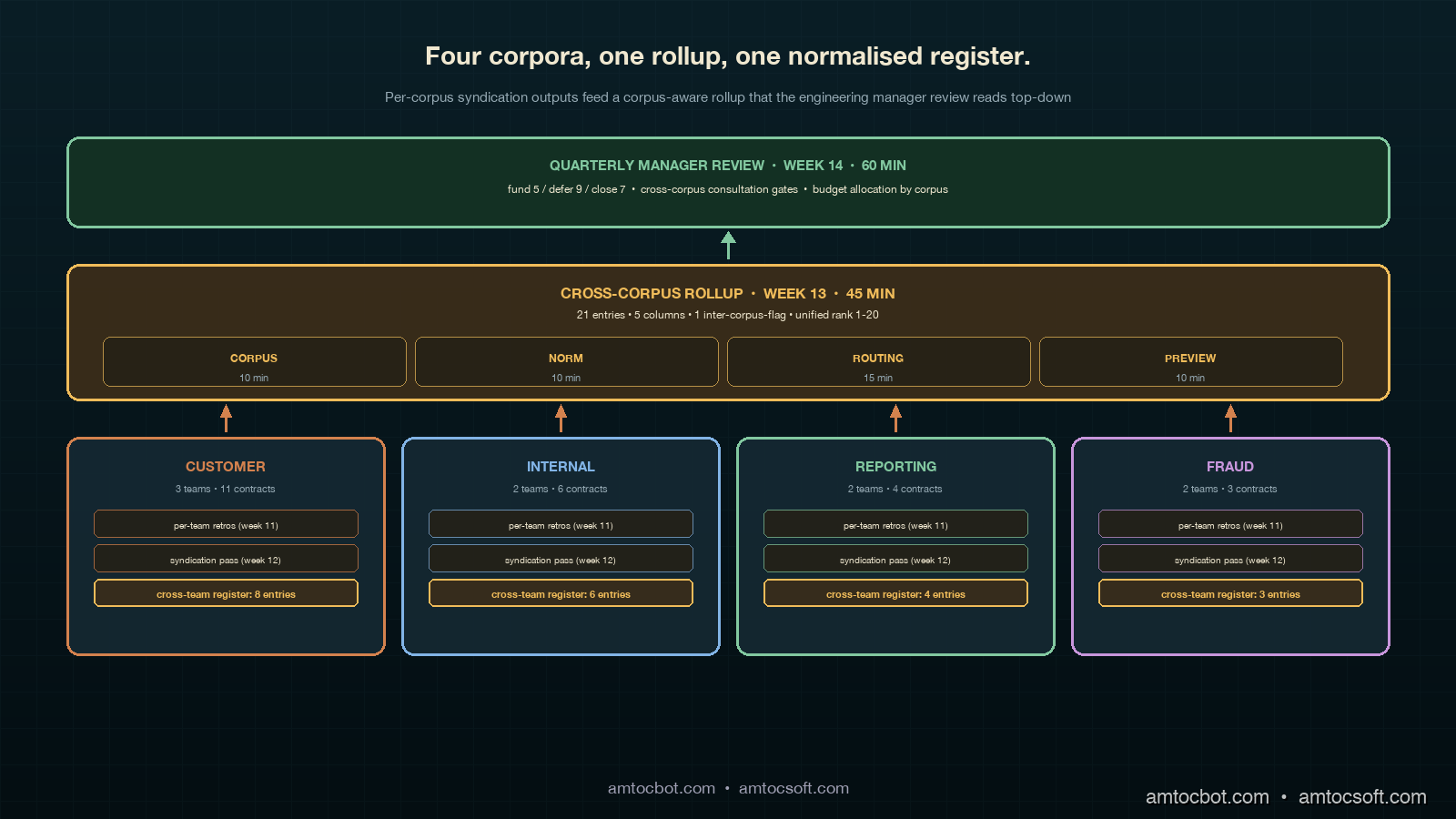
The input to the rollup is the unified rollup candidates list, which is each corpus's cross-team register with two new columns added: owning-corpus and inter-corpus-flag. The owning-corpus column is the corpus the candidate's contract belongs to. The inter-corpus-flag is a boolean that fires when the candidate's blast radius crosses corpus boundaries — for example, when an architecture commitment on a runtime artefact shared between the customer corpus and the internal-tools corpus produces consequences in both corpora's contract scoring pipelines. The flag is rare in practice (typically two to four candidates per quarter across four corpora) but the candidates that carry it are the ones the rollup is designed to handle.

The rollup pass meeting has a fixed agenda that mirrors the syndication pass at the corpus-aligned scale. The first ten minutes are a corpus presentation pass, where each corpus's syndication facilitator presents their corpus's cross-team register at the summary level: how many entries, which reconciliation ranks are at the top, which inter-corpus-flagged candidates are present. The second ten minutes are a normalisation pass, where the engineering manager and the corpus facilitators agree on a cross-corpus reconciliation-rank scale for the quarter, mapping each corpus's internal ranks onto a shared 1-to-N scale that respects the corpus's own ordering but allows comparison across corpora. The third fifteen minutes are an inter-corpus routing pass, where the inter-corpus-flagged candidates get routed into the unified register with explicit owning-corpus, owning-team, and hosting-team columns plus a hosting-corpus column when the host is in a different corpus from the owner. The last ten minutes are a commitments preview, where the engineering manager flags the top three to five candidates likely to need cross-corpus engineering hours and the corpus facilitators surface any blocking dependencies between commitments that span corpora.

flowchart TB A1["Per-team retros
customer corpus"] --> B1["Customer
cross-team register"] A2["Per-team retros
internal corpus"] --> B2["Internal
cross-team register"] A3["Per-team retros
reporting corpus"] --> B3["Reporting
cross-team register"] A4["Per-team retros
fraud corpus"] --> B4["Fraud
cross-team register"] B1 --> C["Cross-corpus rollup
week 13, 45 min"] B2 --> C B3 --> C B4 --> C C --> D["Corpus presentation
10 min"] C --> E["Normalisation
10 min"] C --> F["Inter-corpus routing
15 min"] C --> G["Commitments preview
10 min"] D --> H["Unified register
5 columns + flag"] E --> H F --> H G --> H H --> I["Engineering manager
review week 14"] I --> J["Funded by corpus"] I --> K["Cross-corpus carry-forward"]
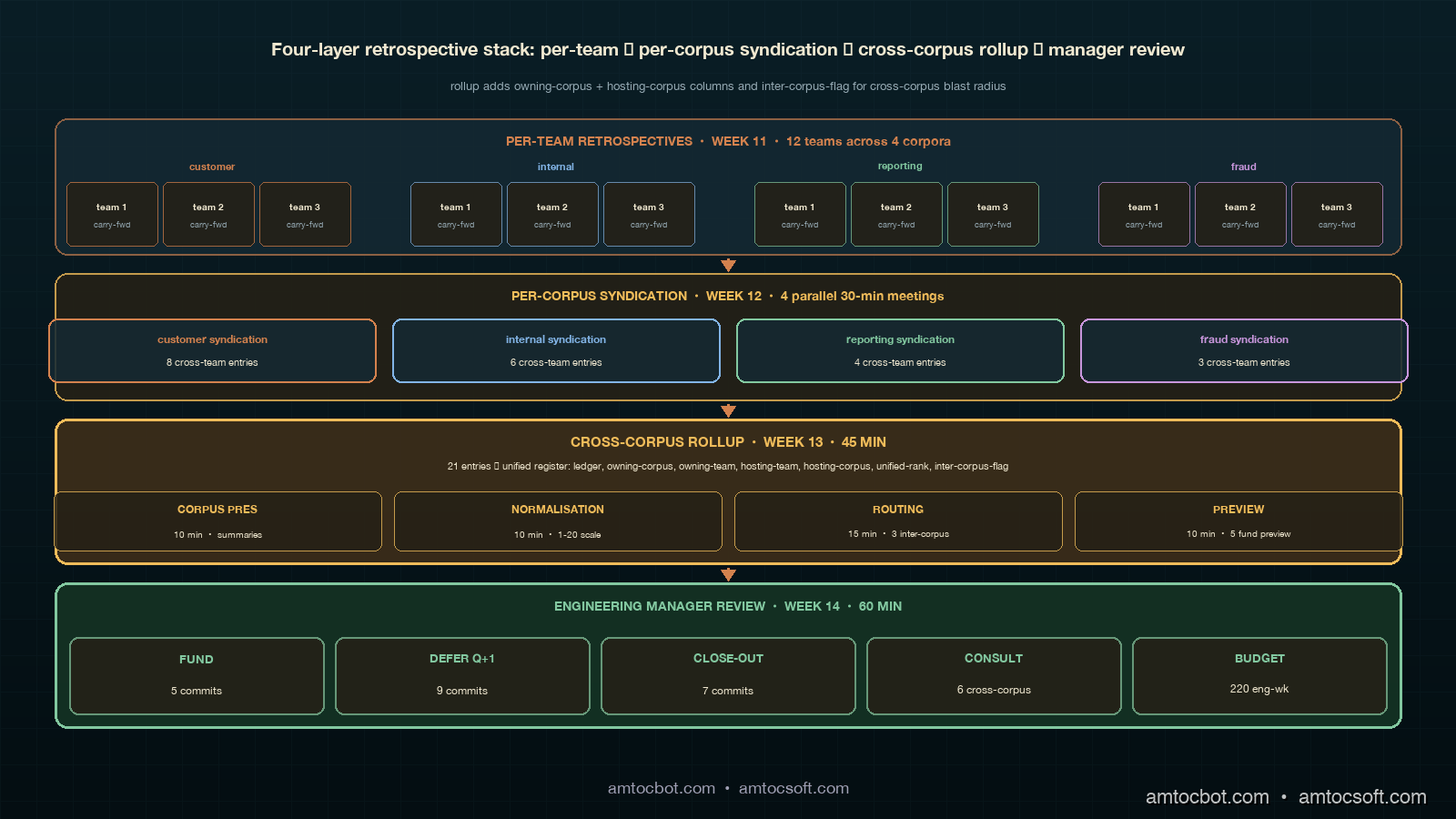
Architecture diagram showing the four-layer retrospective stack as horizontal bands stacked vertically, the bottom band labelled PER-TEAM RETROSPECTIVES with twelve small team rooms grouped into four corpus columns, the second band labelled PER-CORPUS SYNDICATION showing four parallel thirty-minute syndication panels each producing a per-corpus cross-team register, the third band labelled CROSS-CORPUS ROLLUP showing a single forty-five-minute meeting with four sub-segments for corpus presentation, normalisation, inter-corpus routing, and commitments preview that takes the four per-corpus registers and writes a unified register with five columns plus an inter-corpus-flag column, the top band labelled ENGINEERING MANAGER REVIEW showing a one-hour funding meeting that reads the unified register top-down and produces a funded commitments list partitioned by owning-corpus with cross-corpus consultation requirements, copper arrows running upward between the bands to show the artefact flow and ivory arrows running downward to show the next-quarter feedback into the per-corpus registers

The unified register grows the per-corpus cross-team register's four columns (ledger-of-origin, owning-team, hosting-team, reconciliation-rank) into six columns: ledger-of-origin, owning-corpus, owning-team, hosting-team, hosting-corpus (which equals owning-corpus on intra-corpus entries and is filled in only when the inter-corpus-flag fires), and unified-rank. The unified-rank is the cross-corpus normalised rank from the rollup's normalisation pass; the per-corpus reconciliation rank stays in the ledger-of-origin column as a parenthetical reference so that downstream readers can trace any unified-rank back to its corpus-internal score.

The week-fourteen engineering manager review is then a roughly one-hour meeting that walks the unified register top-down, voting fund-this-quarter, defer-to-next-quarter, or close-out on each entry. The funding decision is constrained by a per-corpus engineering-hour budget that the manager allocates at the start of the meeting based on the relative size of each corpus and the strategic priority for the quarter. The cross-corpus consultations get explicit pre-ship sign-off from each affected corpus's tech lead before the commitment ships, replacing the simpler intra-corpus consultation pattern from the previous post with a slightly more involved cross-corpus one.

Worked Example: Four Corpora, One Rollup, One Quarter

The example I have been using to teach this pattern is the rollup our platform organisation ran in week thirteen of Q1 2026, which covered four corpora across twelve teams. The four corpora were the customer corpus (three product teams, eleven contracts, the same configuration as the previous post's worked example), the internal-tools corpus (two product teams, six contracts), the reporting corpus (one product team plus the data engineering team, four contracts), and the fraud corpus (one product team plus the trust-and-safety team, three contracts). Total engineers across the twelve teams: seventy-eight. Total contracts: twenty-four. Total carry-forward entries from the per-team retrospectives in week eleven: a hundred and thirty-one across all twelve teams. Total cross-team candidates after the corpus-scope filter: thirty-one across all four corpora. Total entries on each per-corpus cross-team register after the four parallel syndication passes in week twelve: eight on customer (the same eight from the previous post's example), six on internal, four on reporting, and three on fraud, for a total of twenty-one entries flowing into the rollup.

The rollup pass meeting ran fifty-two minutes, slightly over the forty-five-minute target for the first run, and inside the target for the next two runs. The corpus presentation pass took twelve minutes, with each facilitator running about three minutes per corpus: number of entries, the top two reconciliation-ranked items per corpus, and which entries (if any) carried the inter-corpus-flag. Three of the twenty-one entries carried the inter-corpus-flag: the runtime cache refactor on the customer corpus (which the internal-tools corpus also depends on, because the runtime artefact backs both corpora's RAG retrieval), a tolerance-pin tightening on the customer corpus's recommender feature contract (which produced a downstream attestation drift on the reporting corpus's recommender-engagement reporting contract), and a routing-rule version drift on the fraud corpus (which the customer corpus's transactions classification was also seeing as a near-line signal, although its scope-tag did not yet officially cover the fraud rule cache).

The normalisation pass took eleven minutes and produced a unified-rank scale of one to twenty for the twenty-one entries, with the customer corpus's top two items at unified-ranks one and two (the inter-corpus runtime cache refactor at one, the recommender-feature tolerance tightening at two), the fraud corpus's top item at unified-rank three (the inter-corpus routing-rule drift, which the manager flagged as high strategic priority because of the trust-and-safety regulatory backdrop), and the rest of the entries distributed across ranks four through twenty in a roughly proportional way that respected each corpus's internal ordering. The normalisation discussion produced one explicit calibration disagreement: the internal-tools corpus's top entry (a tolerance-pin reset on the developer RAG contract) had a corpus-internal reconciliation rank of one but a unified-rank of seven, because the manager argued that the customer-facing items deserved higher cross-corpus priority for the quarter. The internal-tools facilitator pushed back; the manager held the calibration; the next-quarter rollup will revisit it.

flowchart TB subgraph Customer C1["8 entries"] --> C2["top: cache refactor (rank 1)"] C2 --> C3["+ recommender tighten (rank 2)"] end subgraph Internal I1["6 entries"] --> I2["top: dev RAG tolerance reset (rank 1)"] I2 --> I3["downstream: meeting-notes (rank 2)"] end subgraph Reporting R1["4 entries"] --> R2["top: rec-engagement contract drift (rank 1)"] end subgraph Fraud F1["3 entries"] --> F2["top: routing-rule drift (rank 1)"] end C3 --> N["Normalisation pass"] I3 --> N R2 --> N F2 --> N N --> U["Unified register
1-20 ranks"] U --> M["Manager review
fund 5 / defer 9 / close 7"]

The inter-corpus routing pass took eighteen minutes. The runtime cache refactor was routed with owning-corpus customer, owning-team platform, hosting-team recommender, and hosting-corpus customer, plus an additional cross-corpus consultation requirement to the internal-tools corpus's tech lead because of the shared runtime artefact dependency. The recommender-feature tolerance tightening was routed with owning-corpus customer, owning-team platform, hosting-team recommender, hosting-corpus customer, and an additional cross-corpus consultation to the reporting corpus's data engineering tech lead because of the downstream attestation drift on the reporting contract. The fraud-corpus routing-rule drift was routed with owning-corpus fraud, owning-team trust-and-safety, hosting-team product-fraud, hosting-corpus fraud, and an additional cross-corpus consultation to the customer corpus's transactions classification team because of the near-line signal overlap. The three inter-corpus routings produced six total cross-corpus consultation requirements, which the manager review the following week converted into explicit pre-ship sign-off gates on the three commitments that were ultimately funded.

The commitments preview took eleven minutes and the manager flagged five candidates for likely funding based on the unified ranks: the runtime cache refactor (rank 1), the recommender-feature tolerance tightening (rank 2), the fraud-corpus routing-rule drift (rank 3), the customer corpus's contested version bump on the recommender feature contract (rank 4), and the internal-tools corpus's developer RAG tolerance reset (rank 7, surfaced because the corpus facilitator raised it as quarter-blocking). The other sixteen candidates were preliminarily marked as defer-to-Q2 or close-out, pending the manager review's actual vote the following week. The week-fourteen manager review confirmed all five flagged commitments, deferred nine others to Q2, and closed out seven items as resolved by intra-team work in the prior quarter without surfacing as commitments.

The cross-corpus consultation requirements added engineering-hours to the funded commitments. The runtime cache refactor's customer-side work was estimated at fourteen engineering-weeks; the cross-corpus consultation with the internal-tools tech lead added one engineering-week of attestation-event scoping work plus a scheduled pre-ship review meeting that consumed two hours of the internal-tools tech lead's time. The recommender-feature tolerance tightening was estimated at eight engineering-weeks; the cross-corpus consultation added two engineering-weeks of attestation-drift backfill work on the reporting side. The fraud routing-rule drift was estimated at six engineering-weeks; the cross-corpus consultation added a half engineering-week of routing-rule alignment work on the customer transactions side. Total cross-corpus overhead added by the rollup-driven consultation: about three and a half engineering-weeks across the twelve-team organisation, against a quarterly budget of roughly two hundred and twenty engineering-weeks. The three and a half engineering-weeks bought the visibility that prevented the kind of surprise-page incident that motivated the syndication layer in the previous post, and the corpus owners on each side reported the consultation cost as well-spent in the post-quarter review.

Owning-Corpus vs Hosting-Corpus: The New Distinction

The rollup adds a distinction the per-corpus syndication did not need: the difference between the owning corpus and the hosting corpus of an architecture commitment. The owning corpus is the corpus whose retrospective surfaced the candidate. The hosting corpus is the corpus whose runtime artefact, on-call rota, or contract scoring pipeline will receive the consequences of the commitment if the commitment is funded and ships. The two are the same corpus on the majority of entries (eighteen of the twenty-one entries in the worked example), and the unified register's hosting-corpus column simply mirrors the owning-corpus column on those entries. The interesting cases are the inter-corpus-flagged entries, which is where the owning and hosting corpus differ and where the rollup's main work is done.

The two corpora can differ on three predictable axes. The first is shared runtime artefact: an architecture commitment on a runtime artefact (a model serving layer, a retrieval index, a routing rule cache) that two corpora's contracts both depend on produces a hosting-corpus that is the secondary corpus, not the corpus whose retrospective surfaced the commitment. The runtime cache refactor in the worked example was this kind of entry: the customer corpus's retrospective surfaced the commitment, the customer corpus owns the cache, but the internal-tools corpus's RAG-driven contracts are also routed through the cache and were therefore the hosting corpus on the consultation side. The second axis is downstream attestation drift: an architecture commitment on a contract in one corpus that produces a measurable attestation drift on a downstream contract in another corpus, typically when the upstream contract is producing the inputs to the downstream contract. The recommender-feature tolerance tightening was this kind of entry, with the reporting corpus's recommender-engagement contract sitting downstream of the customer corpus's recommender-feature contract on the data flow. The third axis is near-line signal overlap, where two corpora's contracts both subscribe to a near-line signal (a feature flag rollout, a routing-rule change, an experiment population shift) and an architecture commitment on the signal in one corpus produces consequences for the other corpus's near-line consumers. The fraud routing-rule drift was this kind of entry.

The hosting-corpus column is what makes the consultation requirement on the inter-corpus-flagged entries operational. Without the column, the rollup would route an inter-corpus-flagged entry through the owning corpus's intra-corpus consultation pattern (owning-team to hosting-team within the corpus) and would lose the cross-corpus consultation entirely. The corpus the runtime artefact, downstream contract, or near-line signal lives in is sometimes a different corpus from the corpus that surfaced the commitment, and the rollup has to surface that asymmetry explicitly so the manager review can fund the cross-corpus consultation work. The hosting-corpus column also becomes the seed for cross-corpus carry-forward, where the next quarter's owning corpus is the corpus that hosted the commitment in the prior quarter rather than the corpus that originally surfaced it.

The cross-corpus carry-forward pattern was the one I underestimated when we first ran the rollup. The intuition I started with was that an inter-corpus-flagged commitment would carry forward into the owning corpus's next-quarter retrospective if the commitment was deferred. The actual pattern is that the commitment usually carries forward into the hosting corpus's next-quarter retrospective, because the hosting corpus has the most direct visibility into whether the commitment's deferral is producing operational drag. The runtime cache refactor that the customer corpus surfaced and that the internal-tools corpus was the secondary host of, when deferred, would carry forward more usefully on the internal-tools corpus's retrospective the next quarter, because the internal-tools team would be the one experiencing the deferral's effects on their RAG retrieval latency. The current rollup format flags this asymmetry with a carry-forward-corpus column on each deferred entry, defaulting to the hosting corpus and only diverging from it when the corpus facilitators agree that the owning corpus is the better next-quarter owner.

When the Rollup Is Wrong: Three Failure Modes

The rollup format has three failure modes I now actively watch for. Each failure mode has a specific signal in the unified register's shape, and each one has a corrective adjustment that keeps the rollup honest the following quarter.

The first failure mode is the manager-bias normalisation. The normalisation pass is supposed to produce a unified-rank scale that respects each corpus's internal ordering while allowing cross-corpus comparison. The failure mode happens when the engineering manager, who is the authority for the cross-corpus calibration, consistently bumps one corpus's items to higher unified ranks than the corpus's internal ranking justifies. The signal is that one corpus's internal-rank-1 item lands at unified-rank one or two for three quarters running while the other corpora's internal-rank-1 items land at unified-rank seven or eight. The corrective adjustment is to introduce a quarterly normalisation review at the start of each rollup, where the manager and corpus facilitators look at the prior three quarters' unified-rank-to-internal-rank mappings and check whether the cross-corpus calibration has been systematically biased. Our own organisation caught this bias in Q4 2025, where the customer corpus had been receiving systematic uplift over the internal corpus for three quarters, and the Q1 2026 normalisation pass was redone with the bias correction applied.

The second failure mode is the silent inter-corpus-flag. The inter-corpus-flag is supposed to fire on candidates whose blast radius crosses corpus boundaries. The failure mode happens when a candidate's blast radius does cross corpus boundaries but the per-corpus syndication facilitator does not realise it, and the flag does not fire. The signal is that the manager review surfaces a funded commitment whose cross-corpus consequences only became visible after the commitment shipped, typically through a surprise on-call page in the hosting corpus's rota a week or two after the ship. The corrective adjustment is a retrospective inter-corpus-flag review at each rollup, where the corpus facilitators present the candidates that did not fire the flag but had inter-corpus signals (shared runtime artefact, downstream contract, near-line signal overlap) at any layer of the stack. Two of the three inter-corpus flags in our Q1 2026 rollup were actually retrospectively-promoted candidates that the per-corpus syndication had originally classified as intra-corpus.

The third failure mode is the budget-driven flattening. The engineering manager review at week fourteen is supposed to fund commitments based on the unified-rank scale and the per-corpus engineering-hour budget. The failure mode happens when the budget pressure forces the manager to fund commitments roughly proportionally to each corpus's engineering-hour allocation, regardless of unified rank, which produces a funded-commitments list that looks like a flat per-corpus distribution rather than a true cross-corpus priority list. The signal is that the funded-commitments list partitions cleanly into one or two commitments per corpus across all four corpora, even when the unified ranks would justify three or four commitments concentrated in one corpus and zero in another. The corrective adjustment is to publish the budget allocations at the rollup rather than at the manager review, so the corpus facilitators have visibility into the budget shape during the rollup's normalisation pass and can argue for cross-corpus budget reallocation before the manager review locks the per-corpus allocations.

The three failure modes are all recoverable. The bias correction takes one quarter to apply; the inter-corpus-flag review takes ten minutes per rollup; the budget pre-publication takes one architectural change to the rollup-meeting agenda. The deeper insight, which took us four quarters of running the rollup to internalise, is that the rollup layer has a separate set of failure modes from the per-corpus syndication layer, and the format has to be tuned for those failure modes rather than treated as a transparent aggregation of the per-corpus layer beneath it.

Comparison: One Corpus vs Four Corpora

The comparison most engineering managers I advise on this format want to see is the per-quarter throughput contrast between the single-corpus three-team cluster and the four-corpus twelve-team cluster, on a per-engineer basis. The single-corpus cluster from the previous post produced fourteen commitment-weeks per quarter across twenty-one engineers, or roughly 0.67 commitment-weeks per engineer per quarter. The four-corpus cluster produced thirty-three commitment-weeks per quarter across seventy-eight engineers, or roughly 0.42 commitment-weeks per engineer per quarter. The per-engineer throughput drops by about thirty-seven percent from the single-corpus to the four-corpus configuration, which sounds bad on first reading but reflects two structural realities: the rollup absorbs about ten engineering-hours per quarter of cross-corpus coordination overhead that the single-corpus configuration does not need, and the four-corpus configuration produces more durable commitments because the cross-corpus consultation work catches integration risks that would otherwise produce post-ship rollback overhead.

flowchart LR A["Single corpus
21 engineers"] --> B["14 commitment-weeks
0.67 per eng"] C["Four corpora
78 engineers"] --> D["33 commitment-weeks
0.42 per eng"] B --> E["No rollup overhead"] D --> F["10 hr/qtr rollup
3.5 eng-week consults"] E --> G["Surprise-page risk
on cross-corpus changes"] F --> H["Pre-ship cross-corpus
consultation gates"]

The post-ship rollback rate on funded commitments was where the rollup paid for itself in our own data. The single-corpus configuration ran a roughly fifteen-percent post-ship rollback rate on funded architecture commitments in the four quarters before we added the second corpus, with most rollbacks driven by surprise integration issues with the recommender or transactions on-call rotas that the syndication had not surfaced. The four-corpus configuration with the rollup running has been running a roughly six-percent post-ship rollback rate over the two quarters we have full data for, with the reduction driven primarily by the cross-corpus consultation gates catching issues before ship rather than after. The thirty-seven-percent drop in per-engineer throughput is partially offset by the nine-percentage-point drop in rollback rate, which translates into about two-and-a-half commitments per quarter that did not have to be re-shipped. Over a year of operation, that is ten reclaimed commitments at an average of nine engineering-weeks each, or roughly ninety engineering-weeks of reclaimed throughput per year, which is a meaningful fraction of the rollup's coordination overhead.
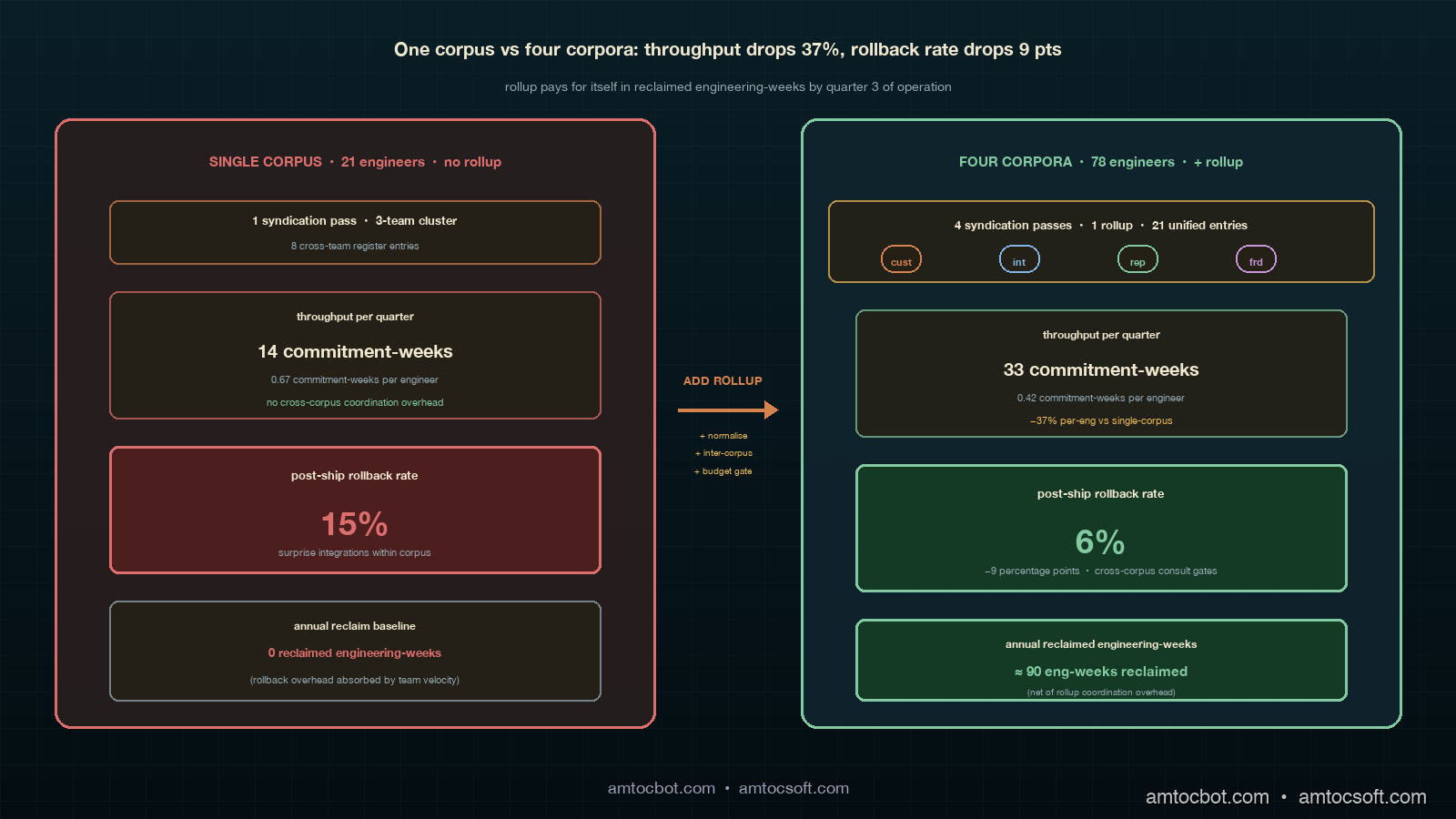
Comparison image showing two side-by-side panels labelled SINGLE CORPUS and FOUR CORPORA, the left panel showing a single retrospective syndication stack with three teams totalling twenty-one engineers and a fourteen-commitment-week-per-quarter throughput bar plus a fifteen-percent rollback indicator in red, the right panel showing the four-corpus stack with twelve teams totalling seventy-eight engineers a thirty-three-commitment-week-per-quarter throughput bar plus a six-percent rollback indicator in green plus an inset showing the nine-percentage-point rollback reduction translating into ninety reclaimed engineering-weeks per year, copper arrows running between the panels indicating ADD ROLLUP LAYER with three icons for normalisation, inter-corpus routing, and budget pre-publication, ivory text at the bottom showing the per-engineer throughput drop of thirty-seven percent partially offset by the rollback-rate drop

The comparison the engineering organisation has to make is therefore not whether the rollup is worth the coordination overhead in isolation, but whether the coordination overhead is paid back by the rollback-rate reduction over the medium term. The first quarter of running the rollup is unambiguously expensive: the format is new, the corpus facilitators are not yet calibrated against each other, and the rollback-rate gains have not yet shown up. By the third quarter the format is stable and the gains are visible. Organisations that are weighing whether to add the rollup against the alternative of keeping per-corpus syndications independent should expect a one-quarter pure-cost period followed by two quarters of payoff, with steady-state operation thereafter producing a net engineering-week gain per year that is comparable to a small platform team's hiring throughput.

Production Considerations

The rollup format has several production considerations I now treat as non-negotiable. The first is the single-facilitator-per-corpus discipline. Each corpus's syndication pass has to have one named facilitator who attends the rollup, presents the corpus's cross-team register, and signs off on the corpus's normalisation outcome. Rotating facilitators across quarters is fine; rotating mid-quarter is not, because the calibration the facilitator built up at the syndication pass has to carry through to the rollup, and a substitute facilitator cannot reproduce the calibration cold.

The second is the pre-rollup register freeze. Each corpus's cross-team register has to be frozen at least forty-eight hours before the rollup. Late additions to a corpus's register that arrive between the syndication pass and the rollup do not get normalised against the unified-rank scale, which produces a register entry that the manager review the following week cannot rank cleanly. The forty-eight-hour freeze gives the engineering manager time to read each corpus's register before the rollup and arrive with a draft normalisation hypothesis that the rollup's normalisation pass can either confirm or correct.

The third is the cross-corpus consultation gate enforcement. The cross-corpus consultations that come out of the rollup are operational gates, not informational notes. The funded commitments cannot ship until the cross-corpus consultation has produced an explicit sign-off from the hosting corpus's tech lead. The sign-off is recorded in the manifest ledger as a cross-corpus consultation event with the same attestation cadence as a regular attestation event, which means the consultation history becomes part of the next quarter's per-team retrospective inputs. The first time we shipped a cross-corpus-flagged commitment without the explicit gate enforcement, we hit the same kind of surprise-page incident the syndication layer was supposed to prevent, except now the surprise was on the internal-tools corpus's RAG retrieval latency rather than the recommender on-call rota. The gate enforcement is mechanically a small amount of work; without it, the rollup's coordination overhead does not produce the rollback-rate gains.

The fourth consideration is the quarterly normalisation calibration archive. Each rollup's normalisation pass produces a mapping from each corpus's internal reconciliation ranks to the unified-rank scale. The mapping has to be archived so the next quarter's rollup can compare against it. The archive is a small CSV file per quarter, three columns wide and twenty to thirty rows long, but the archive's existence is what enables the manager-bias detection in the failure-mode pattern above. Without the archive, each quarter's normalisation is independent and the systematic bias is invisible until it has been running for six or seven quarters. With the archive, the bias is detectable from the second quarter and correctable from the third.

Monetizing Multi-Corpus Governance

The cross-corpus rollup is commercially useful because it turns portfolio-level reliability from a vague promise into a managed operating system. A customer buying across multiple agent surfaces does not want to hear that each corpus has its own retrospective. They need to know that the organization can compare risk across corpora, fund the right commitments, and route consultation before a shared runtime artefact or downstream contract creates a customer-visible failure. The unified register gives that promise a concrete shape.

The packaging boundary should follow portfolio complexity. Standard customers benefit from the shared corpus discipline without custom reporting. SLA-bound customers get a quarterly rollup summary that lists funded commitments by corpus, cross-corpus consultation gates, deferred items, and any normalisation changes that affected customer-facing workflows. Strategic accounts with workflows spanning multiple corpora can get a dedicated portfolio appendix showing owning corpus, hosting corpus, consultation status, and carry-forward corpus for their scoped surfaces. The appendix should stay evidence-based: no health-score theatre, just the artifacts that prove the review loop exists and is operating.

This creates a cleaner revenue model for reliability work. Cross-corpus governance costs more than single-corpus governance because it consumes facilitator time, manager calibration time, consultation gates, and archive maintenance. Pricing should reflect that operational load. The operating rule is simple: any enterprise plan that depends on multiple agent corpora should include a rollup trail in its renewal evidence. That trail shows how the organization prioritized competing reliability work, where cross-corpus risk was caught, and why the funded commitments were selected before customers had to force the decision through an escalation.

Conclusion

The retrospective syndication format from the previous post handled the cross-team blast radius problem within a single contract corpus. The rollup format described in this post handles the cross-corpus blast radius problem when an organisation runs three or four corpora in parallel. The same engineering manager review is the consumer in both cases; the same cross-team carry-forward register exists in both cases; the same on-call consultation pattern exists in both cases. The new layer the rollup adds is the corpus-aware normalisation, the inter-corpus-flag, the hosting-corpus column, and the cross-corpus consultation gate. Each of those is mechanically small. The cumulative effect is that the engineering manager review of an organisation running four corpora in parallel converges in roughly the same time it took the manager review to converge on a single-corpus three-team cluster, which is the operational outcome the rollup was designed to produce.

The pattern the next post in this cluster will pick up on is the multi-quarter trend layer above the cross-corpus rollup, where the engineering manager review starts producing trend signals across the rollup's quarters that are themselves valuable inputs to the next-quarter rollup. The trend layer is a different kind of feedback loop from the per-quarter syndication-and-rollup stack: it operates at the quarterly cadence, takes the unified registers of the prior three to four quarters as input, and produces thematic carry-forward entries that surface long-running operational themes the per-quarter rollup is too short-cycle to catch. The themes I am currently seeing in our own data, from four quarters of rollup operation, are tolerance-pin reset cadence drift, attestation-event categorisation rebaselining, runtime-artefact ownership migration, and cross-corpus consultation-fatigue. The next post in the cluster will walk through each.

The deeper observation, which I think generalises beyond the contract-corpus discipline, is that retrospective formats compose poorly across organisational scale. The single-team retrospective composes into the cross-team syndication; the cross-team syndication composes into the cross-corpus rollup; the cross-corpus rollup will compose into the multi-quarter trend layer. Each composition step adds a coordination layer, each layer has its own failure modes, and each layer pays for itself only if the failure modes are caught and corrected at that layer rather than left to bleed up into the next composition step. The engineering manager who runs the four-layer stack at full discipline is the one whose engineering organisation produces durable commitments at scale, and the engineering manager who skips a layer is the one who eventually has to retroactively rebuild the layer after a surprise-page incident produces an executive escalation.

The companion repository for this post is the same adlc-eval-contracts directory used by blogs 188 through 192, with the rollup-format scripts, the unified-register schema, and the worked-example data added under the rollup/ subdirectory. The format-format text artefacts, the unified-register CSV templates, and the normalisation calibration archive structure are all in the repo, so readers running their own first cross-corpus rollup can fork the directory and adapt the format without having to rebuild the scripts from the post text.


Revision History

Date Summary Old Version
2026-06-08 Added a monetization section connecting multi-corpus rollups to portfolio reliability governance, SLA reporting, strategic-account appendices, renewal evidence, and pricing discipline for cross-corpus operational load. Updated revision metadata while preserving the existing QA-passing structure. View original

Sources

About the Author

Toc Am

Founder of AmtocSoft. Writing practical deep-dives on AI engineering, cloud architecture, and developer tooling. Previously built backend systems at scale. Reviews every post published under this byline.

LinkedIn X / Twitter

Published: 2026-05-07 · Updated: 2026-06-08 · Written with AI assistance, reviewed by Toc Am.

Get These In Your Inbox

Weekly deep-dives on AI engineering, no fluff. Join the newsletter →

Subscribe (free)

Or grab the book ($39, ~100 pages) · Buy me a coffee

Buy Me a Coffee · 🔔 YouTube · 💼 LinkedIn · 🐦 X/Twitter

Cross-Team Retrospective Syndication: When the Quarterly Carry-Forward Crosses Into Adjacent Product On-Call Rotations

Hero image showing a deep teal cross-team platform with three retrospective rooms arranged in a horizontal stack on the left labelled PLATFORM, RECOMMENDER, and TRANSACTIONS, each room with engineers grouping their own ledger cards on a wall, a copper conduit running from each room to a central syndication panel in the middle of the frame labelled CROSS-TEAM REGISTER showing four columns for ledger of origin, owning team, hosting team, and reconciliation rank, an ivory carry-forward arrow lifting one syndicated commitment off the central panel and routing it to a green on-call rota box on the right showing eight engineers across two product rotations, a small inset on the bottom right showing a side timeline contrasting one-team versus three-team commitment-week curves

Introduction

The first time a platform team's quarterly retrospective produced an architecture commitment that landed in an adjacent product team's on-call rota was a Tuesday in February, and nobody on the platform side had warned the recommender on-call engineer that a runtime cache change was about to ship into her week. I watched the page fire at three in the morning her time, watched her open the runbook, watched the runbook explain a cache layer she had not been on the architecture commitment list for, and watched her ping the platform team's slack channel with a polite but noticeably tired sentence asking what had changed. The platform team had run a perfectly clean attestation-aware retrospective, had made the runtime cache refactor commitment with two-channel evidence as I described in the previous post, and had shipped the refactor on the right cadence. The recommender team had been carrying the on-call rota for three contracts that lived inside the cache layer's blast radius, had been on a different retrospective cycle, and had had no input into the commitment that was now firing alerts on her phone. The cache refactor was a good change. The way it crossed team boundaries was not.

The Tuesday morning produced a follow-up meeting that ran for ninety minutes between the platform tech lead and the recommender team's on-call manager, and the meeting concluded with a question I had not yet seen anyone in the cluster ask in writing: when a single platform team's quarterly retrospective produces architecture commitments whose blast radius crosses into adjacent product teams' on-call rotations, what is the meeting format that surfaces the cross-team carry-forward and routes it through both teams' decision processes? The platform team had been running a clean retrospective. The recommender team had been running a clean retrospective. Neither retrospective format had a slot for signals from another team's quarterly review that will affect this team's on-call rota in the next quarter. The two-channel evidence model from the attestation-aware retrospective had been correct for one team's review of one corpus. The three-team review of two corpora and four on-call rotations had no formal layer in the schedule.

The pattern I now use, which the cluster of three teams I work with has been running for two quarters, is a retrospective syndication layer that sits above the per-team retrospective and below the engineering manager's quarterly review. The syndication layer takes carry-forward register entries from each team's retrospective, identifies the entries whose blast radius crosses into adjacent teams' on-call rotations, and routes them into a shared cross-team register with explicit owning-team and hosting-team columns. The shared register feeds back into each team's next-quarter retrospective with a cross-team prefix, and each team's on-call manager reviews the cross-team entries before the team's next quarterly window opens. The syndication is mechanical once written. The discipline is in keeping the per-team retrospectives independent enough that they continue to surface single-team contributing factors with full fidelity, while wiring the cross-team layer in tightly enough that the architecture commitments do not surprise adjacent teams' on-call engineers at three in the morning.

The Problem: The Quarterly Retrospective Was Single-Team by Default

The retrospective format I built up across the prior posts in this cluster, from postmortem retrospectives in post 188 through attestation-aware retrospectives in post 191, assumed a single team running a single retrospective on a single corpus. The assumption is fine for the first year of contract corpus operations, when the platform team is the only team that knows what a contract is, the only team running the attestation job, and the only team carrying any on-call responsibility for the corpus. Once the corpus has been live for two quarters and the contract's blast radius has expanded to cover features owned by adjacent product teams, the single-team assumption stops being correct, and the failure mode I described in the introduction starts firing.

The blast-radius expansion happens slowly enough that the platform team usually does not notice it. The first contract is for a feature the platform team owns end to end: a research-summarisation tool, a developer-facing internal agent, an internal RAG endpoint. The next two or three contracts are for features the platform team co-owns with one product team: a recommender-feature LLM scorer, a transaction-classification agent, an internal support summariser. By the time the corpus has eleven contracts, four of them are sitting on top of features that two or three product teams use, and any architecture change to the contract layer or the runtime artefact layer has a blast radius that crosses team boundaries even when the change is mechanically small. The platform team's retrospective surfaces the change as a clean, well-scoped commitment with two-channel evidence; the on-call engineers on the receiving teams find out about the change when their pager fires.

The reason the failure mode is hard to catch from inside the platform team's retrospective is that the retrospective is correctly scoped to the corpus it owns, and the corpus is correctly scoped to the contracts that fall within the platform team's review boundary. The cross-team blast radius is invisible at the corpus level because the corpus does not know which downstream features sit inside it. The blast radius lives in the on-call topology, which is owned by each product team's on-call manager, and which the platform team's retrospective does not see. The platform team's retrospective is reasoning about contracts; the on-call engineer is reasoning about pages. The two reasoning layers converge only when a page fires for a change that came out of a retrospective the on-call engineer was not invited to.

The first instinct most teams have when they hit this failure mode is to invite the adjacent product teams' on-call managers to the platform team's retrospective. This works once. It does not scale. By the time three product teams have on-call responsibility on top of the corpus, the platform team's retrospective has eleven attendees including one tech lead, two senior engineers, three product-team on-call managers, two SRE representatives, and three observers from adjacent platform teams who want to learn the format. The room cannot run a contributing-factor pass with eleven people in it; the meeting either becomes a status update or becomes a one-hour discussion of a single hot-button item that drowns out the rest of the carry-forward register. The single-team retrospective format is the wrong format for the cross-team review, even when all the right people are in the room.

The second instinct is to run a single shared retrospective across the platform team and all adjacent product teams. This works for organisations of about six engineers in total. It does not work past that scale, because the contributing-factor pass requires each attendee to have read the postmortems and attestation events being reviewed, and the cross-organisational read budget exceeds anyone's available time before the meeting starts. The shared retrospective also produces a contributing-factor count that is biased toward whichever team has shipped the most postmortems in the quarter, because the count is dominated by tag volume and the team with the highest incident rate has the highest tag volume. The bias produces architecture commitments that flow toward the highest-incident team's problems, even when an adjacent team has a smaller-but-systemic issue that would have surfaced cleanly in a per-team retrospective.

The third instinct, which is the one that has worked across the three teams I am writing this post from, is to keep the per-team retrospectives independent and to add a syndication layer above them. The syndication layer reviews only the carry-forward entries that have a cross-team blast radius, takes about thirty minutes per quarter, and runs after each team has completed its own retrospective. The format is described in detail below.

The Pattern: Three-Layer Retrospective With a Syndication Pass

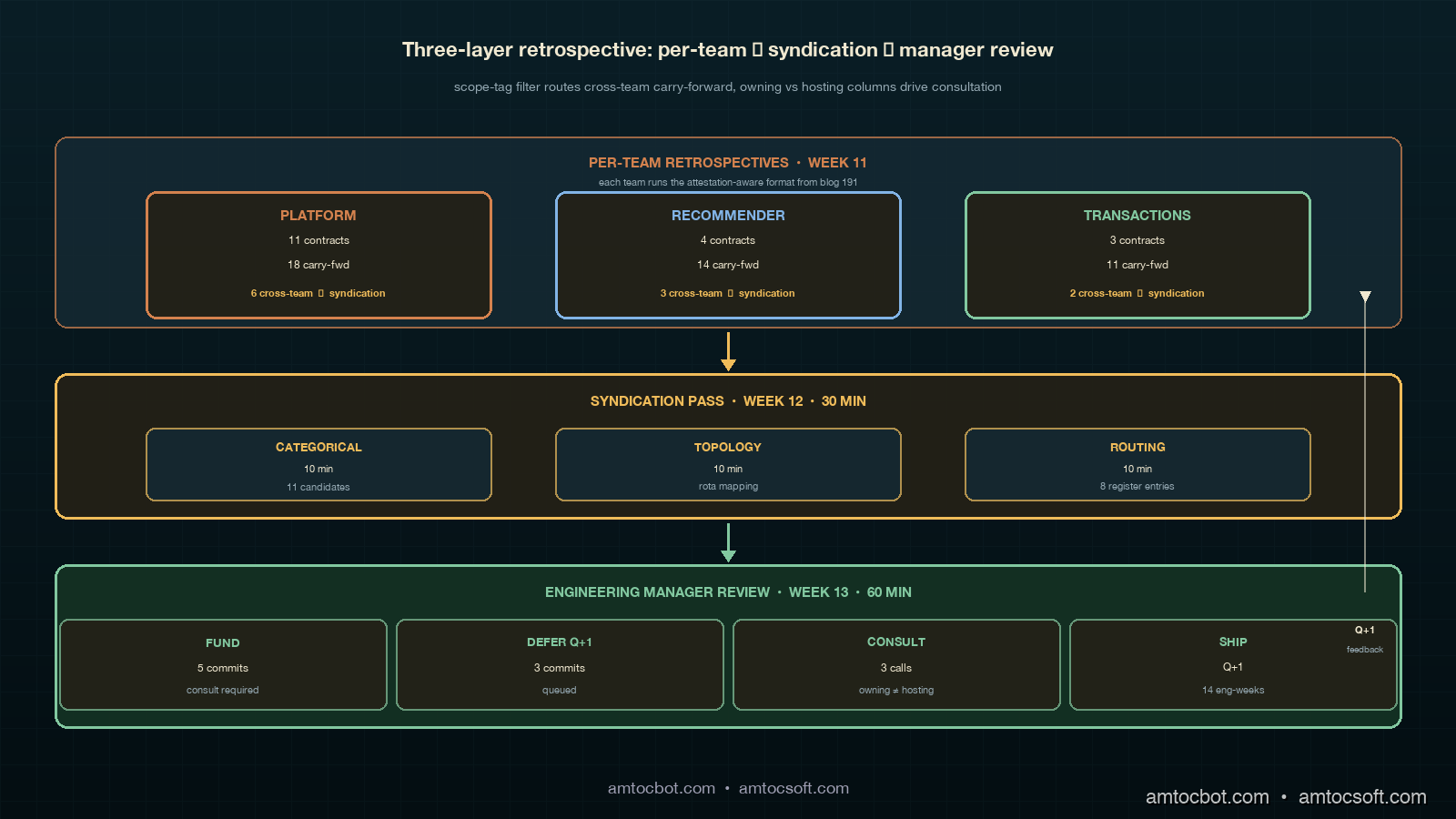
The retrospective syndication format has three layers. The bottom layer is the per-team retrospective, in either the postmortem-only format from post 188 or the attestation-aware format from post 191, depending on whether the team has shipped contracts and an attestation job. The middle layer is the syndication pass, which reviews carry-forward entries with cross-team blast radius and produces a cross-team register. The top layer is the engineering manager's quarterly review, which reads the cross-team register and decides which architecture commitments to fund across teams. The three layers are temporally separated in the quarterly window: per-team retrospectives run in week eleven of the quarter, the syndication pass runs in week twelve, and the engineering manager's review runs in week thirteen. The week-twelve syndication pass is the new layer.

The input to the syndication pass is the cross-team candidates list that each team's retrospective produces alongside its standard carry-forward register. The cross-team candidates list is a subset of the carry-forward register, filtered by a deterministic rule on the carry-forward entry's contract scope field. Every contract in the corpus has a scope tag that records which downstream features depend on the contract; the scope tag is set when the contract is created and updated when a new feature integrates with the contract. The deterministic rule is that any carry-forward entry tied to a contract whose scope tag references more than one team produces a cross-team candidate; entries tied to single-team contracts stay in the per-team carry-forward register and do not enter syndication.

The syndication pass meeting has a fixed agenda. The first ten minutes are a categorical pass: each team's tech lead presents their team's cross-team candidates list, with no debate, just the items themselves and the contracts they tie to. The second ten minutes are a topology pass: the on-call managers from the affected teams identify which candidates would land in their team's on-call rota and how soon. The third ten minutes are a routing pass: the syndication facilitator (usually one of the senior platform engineers) writes each candidate into the cross-team register with explicit owning-team and hosting-team columns, where the owning team is the team that surfaced the candidate and the hosting team is the team whose on-call rota would receive the resulting page if the architecture commitment ships and a regression follows. The total meeting runs thirty minutes. There is no contributing-factor pass and no architecture commitment vote in the syndication meeting; both are deferred to the engineering manager's review the following week.

flowchart TB A["Per-team retrospectives
week 11"] --> B["Cross-team candidates
(per team)"] B --> C["Syndication pass
week 12, 30 min"] C --> D["Categorical pass
10 min"] C --> E["Topology pass
10 min"] C --> F["Routing pass
10 min"] D --> G["Cross-team register"] E --> G F --> G G --> H["Engineering manager
review week 13"] H --> I["Funded commitments
by team"] H --> J["Cross-team carry-forward
register"]
Architecture diagram showing the three-layer retrospective stack as horizontal bands stacked vertically, the bottom band labelled PER-TEAM RETROSPECTIVES with three rooms side by side for platform, recommender, and transactions teams each producing their own carry-forward register, the middle band labelled SYNDICATION PASS showing a single thirty-minute meeting with three sub-segments for categorical pass, topology pass, and routing pass that takes the per-team registers and writes a unified cross-team register with four columns ledger-of-origin, owning-team, hosting-team, and reconciliation-rank, the top band labelled ENGINEERING MANAGER REVIEW showing a one-hour funding meeting that reads the cross-team register top-down and produces a funded commitments list with consultation requirements where owning-team differs from hosting-team, copper arrows running upward between the bands to show the artefact flow and ivory arrows running downward to show the next-quarter feedback into the per-team registers

The cross-team register grows the per-team carry-forward register's two columns, ledger-of-origin and reconciliation-rank, into four columns: ledger-of-origin, owning-team, hosting-team, and reconciliation-rank. The owning-team and hosting-team columns are the new columns that make the syndication layer work. Items where owning-team equals hosting-team flow back into the owning team's next-quarter retrospective as standard cross-team-prefixed entries. Items where owning-team differs from hosting-team flow into both teams' next-quarter retrospectives, with the entry visible in both teams' registers and the reconciliation rank shared across the two views.

The week-thirteen engineering manager review is where architecture commitments are voted on. Each cross-team register entry has been pre-rated by reconciliation rank, and the manager's review walks the register top-down, voting on each entry as a fund-this-quarter, defer-to-next-quarter, or close-out decision. The commitments that get funded are assigned an owning-team plus a hosting-team consultation requirement, so that the hosting team's on-call manager has explicit warning before the commitment ships. The manager review takes about an hour for a three-team cluster with eight to twelve cross-team register entries. The total quarterly retrospective overhead, summed across per-team plus syndication plus manager review, is about two hours per team plus thirty minutes for the syndication and one hour for the manager review, or roughly seven engineering-hours per quarter for a three-team cluster of six to ten engineers per team.

Worked Example: A Single Cross-Team Syndication Pass

The example I have been using to teach this pattern is the first syndication pass our three-team cluster ran, in week twelve of Q1 2026. The three teams were the platform team (six engineers, eleven contracts, fifteen postmortems and twenty-one attestation events for the quarter), the recommender team (eight engineers, four contracts they co-own, ten postmortems and twelve attestation events), and the transactions team (seven engineers, three contracts they co-own, six postmortems and eight attestation events). The per-team retrospectives ran in week eleven and produced three independent carry-forward registers with combined eighteen-plus-fourteen-plus-eleven, or forty-three, total entries across the three teams.

The cross-team candidates list filtered the forty-three entries by the contract-scope rule and produced eleven candidates: six from the platform team, three from the recommender team, two from the transactions team. The platform team's six were the runtime cache refactor, the routing rule freshness item, the tone-stability soft-drift item, the contested version-bump on the recommender feature contract, the contested version-bump on the transaction classification contract, and the joint-runtime-cache-skew cross-ledger promotion from the attestation-aware reconciliation. The recommender team's three were a retrieval-precision long-tail item that depended on the platform team's RAG corpus, an on-call alert-fatigue pattern that touched two of the platform team's contracts, and a tool-call-latency item that the recommender team had been blamed for in their own retrospective but that actually traced to a platform-side caching layer. The transactions team's two were both routing-related: a routing-rule version drift between the platform corpus and the transactions team's downstream rule cache, and a contested version bump on the transaction-classification contract that the transactions team was carrying in their own register but that was structurally the same item the platform team was carrying.

The syndication pass meeting ran thirty-five minutes, slightly over budget for the first run but inside budget for runs two through five. The categorical pass surfaced the eleven candidates as listed above. The topology pass identified that two of the six platform-team candidates would land in the recommender on-call rota (the runtime cache refactor and the joint-runtime-cache-skew item, because both touched the cache layer that backed the recommender contracts) and one would land in the transactions on-call rota (the routing rule freshness item). The recommender's three candidates would all land in the platform on-call rota for the regression case but would land in the recommender rota for the immediate page case; the cross-team registration captured the dual-routing. The transactions team's two candidates were both shared with the platform team and were de-duplicated: the routing-rule version drift item was the same root signal as the platform team's routing-rule freshness item, and the contested version bump was the same item the platform team was already carrying.

flowchart TB A["43 carry-forward entries
across 3 teams"] --> B["Cross-team filter
contract-scope > 1 team"] B --> C["11 candidates"] C --> D["Categorical pass"] D --> E["Topology pass"] E --> F["Routing pass"] F --> G["8 unique entries
after dedup"] G --> H["3 owning=hosting"] G --> I["5 owning != hosting"] H --> J["Single-team flow-back"] I --> K["Dual-team flow-back"] K --> L["Both registers updated"]

The de-duplication step in the routing pass collapsed eleven candidates into eight unique cross-team register entries: the runtime cache refactor (platform owning, recommender hosting), the routing rule freshness item (platform owning, transactions hosting, with the transactions-side drift item folded in as supporting evidence), the tone-stability soft-drift (platform owning, platform hosting since it touched no other team's rota), the contested recommender contract bump (joint owning between platform and recommender, hosting on the platform side because the platform team carried the merge authority), the contested transaction contract bump (joint owning, hosting platform), the joint-runtime-cache-skew cross-ledger promotion (platform owning, recommender hosting), the recommender retrieval-precision item (recommender owning, platform hosting since the underlying RAG corpus was platform-owned), and the recommender alert-fatigue item (recommender owning, platform hosting). The eight entries went into the cross-team register with reconciliation ranks carried over from the per-team retrospectives.

The week-thirteen engineering manager review funded five of the eight entries for Q2: the runtime cache refactor with mandatory recommender-side consultation, the routing rule freshness item with transactions-side consultation, the joint-runtime-cache-skew item folded into the runtime cache refactor scope, the recommender retrieval-precision item with platform-side scoping help, and the recommender alert-fatigue item as a quick-fix three-day platform task. The remaining three entries were deferred to Q3 with explicit reasons recorded in the register. The five funded commitments produced fourteen engineering-weeks of work across the three teams, with the runtime cache refactor consuming seven of those weeks alone. The post-syndication on-call experience over Q2 was visibly different from the pre-syndication baseline of Q1: zero pages in the recommender or transactions rotations were attributed to surprise platform changes, against four pages in Q1.

The Cross-Team Register: Owning vs Hosting and the Routing Discipline

The cross-team register's value comes from the owning-team and hosting-team columns, and the discipline that goes with them. The owning team is the team that carries the architecture commitment and signs off on the engineering work; the hosting team is the team whose on-call rota receives any pages generated by the commitment in production. The two are often different, and the difference is the part most teams new to the format get wrong on the first three iterations.

The most common mistake is to set owning-team equal to whichever team surfaced the carry-forward entry in their per-team retrospective, regardless of which team will host the pages. This is sometimes correct (when the surfacing team is the team that will hold the merge authority on the change) and sometimes wrong (when the surfacing team is downstream of the actual code change and the engineering work needs to be done on a corpus owned by an upstream team). The rule that has worked is to set owning-team to the team that will actually do the engineering work, regardless of which team surfaced the item, and to use the hosting-team column to record where the on-call signal will land. A recommender-team retrospective surfacing a retrieval-precision item that requires platform-side RAG corpus changes produces a register entry with platform owning-team and recommender hosting-team. A platform-team retrospective surfacing a runtime cache refactor that affects a recommender feature produces an entry with platform owning-team and recommender hosting-team, exactly the same shape but for a different reason.

The hosting-team column produces the consultation requirement that is the visible payoff of running the syndication layer. Any commitment funded in the manager's review where hosting-team differs from owning-team carries a mandatory pre-ship consultation: the owning team's tech lead schedules a thirty-minute meeting with the hosting team's on-call manager before the commitment ships, walks the on-call manager through the change, the rollback plan, the alert configuration, and the runbook update. The consultation is a calendar invite plus a thirty-minute meeting plus a runbook diff; it is mechanical work, not negotiation work. The hosting-team's on-call manager has no authority to block the commitment, but does have the authority to require a runbook update, an alert-threshold tweak, or a rollback rehearsal before the commitment ships. The mechanical-not-negotiation framing is what keeps the consultation from becoming a second-vote layer that slows down the funded commitments.

The reconciliation-rank column on the cross-team register is the same column from the per-team carry-forward register, with one addition: cross-team entries with two-channel evidence across teams (an item visible in two teams' per-team carry-forward registers under different prefixes that resolves to the same root cause in the routing pass) get a joint-cross-team- prefix and a top-of-shortlist promotion in the manager's review. The promotion rule is the same rule from the within-team attestation-aware reconciliation in the prior post, generalised to the cross-team layer: items with two-channel evidence get higher conviction than items with single-channel evidence, regardless of whether the channels are within-team or cross-team.

The aging-out asymmetry from the per-team carry-forward register also applies at the cross-team layer, with one twist. Cross-team entries age out at the rate of the fastest-aging of the contributing per-team entries; an entry that ties a postmortem-derived item from team A (four-quarter age-out) to a manifest-derived item from team B (two-quarter age-out) inherits the two-quarter age-out. The asymmetry inheritance is intentional: cross-team manifest signals are the ones most likely to drift out of relevance fastest, and the cross-team register is the right place to retire them aggressively rather than letting them carry forward into a fourth or fifth quarter on the strength of a slower-aging counterpart entry.

flowchart TB A["Cross-team register entry"] --> B{"owning =
hosting?"} B -- "yes" --> C["Single-team commit"] B -- "no" --> D["Mandatory consult
(30 min, pre-ship)"] C --> E["Standard rank"] D --> F{"two-channel
evidence?"} F -- "yes" --> G["joint-cross-team-
prefix, top of shortlist"] F -- "no" --> H["Standard rank"] G --> I["Q+1 funding
conversation"] H --> I E --> I

Comparison: Single-Team vs Three-Team Cluster Retrospective Cadence

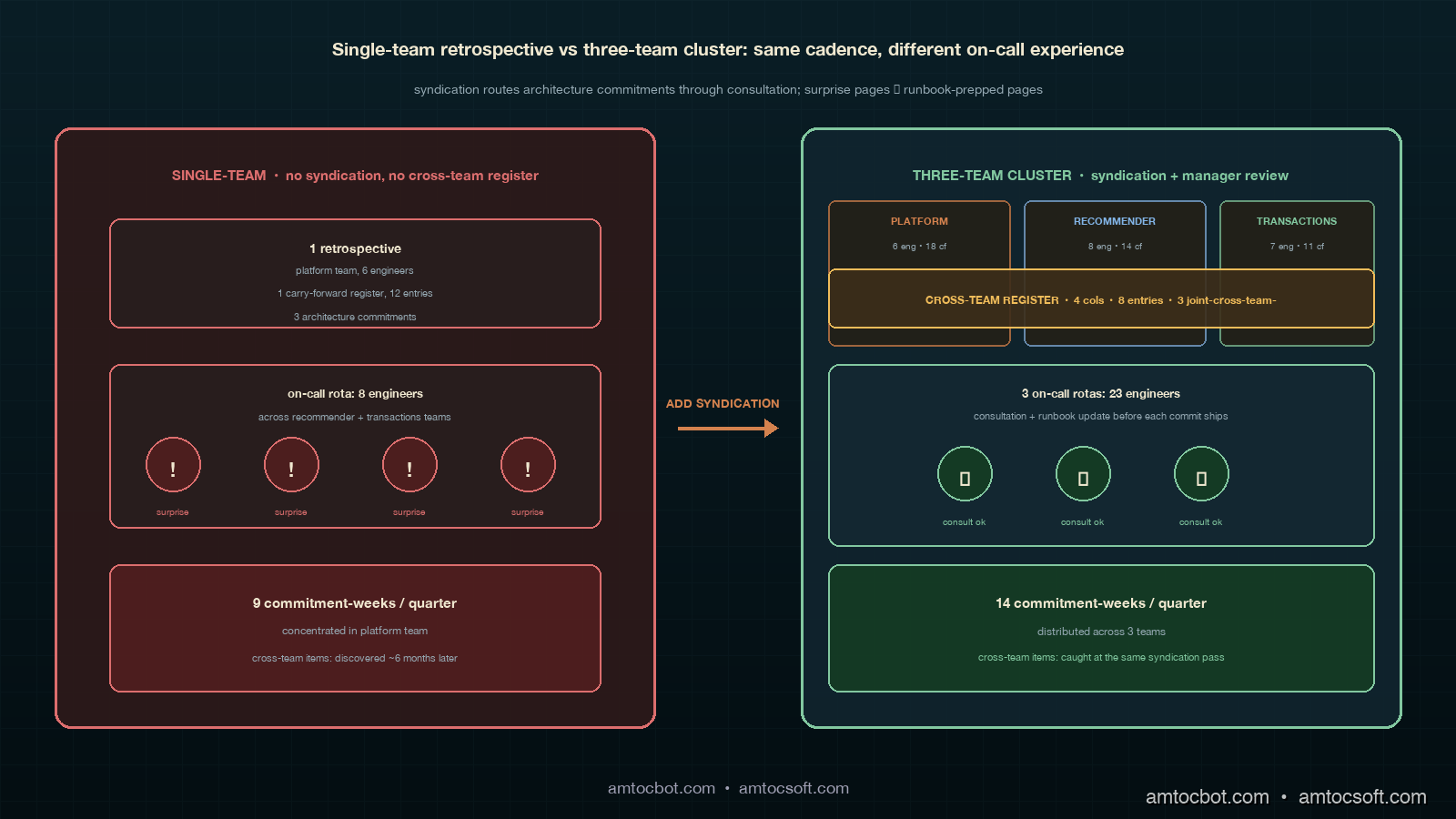
The contrast worth drawing explicitly is between the single-team retrospective cadence (one retrospective per quarter, no syndication, no cross-team register) and the three-team cluster cadence (per-team retrospectives plus syndication plus manager review). Both produce architecture commitments; both maintain carry-forward registers; both run on a quarterly cadence. The differences are the surface-area of evidence, the meeting overhead, and the on-call experience.

The surface-area difference is the part that produced the most pushback when the three-team cluster first considered the format. The per-team retrospectives surface contributing-factor counts independently; the cross-team register surfaces only the items with cross-team blast radius; the manager's review funds a subset of the cross-team items plus all the within-team items the per-team retrospectives have already produced. The total surface area is larger than the single-team format by the size of the cross-team register, which in our cluster has averaged eight entries per quarter against a per-team-summed forty-three entries per quarter. The cross-team register is roughly twenty per cent of the total review volume, which is the right proportion for the format to surface the systemic items without drowning in the detail of the within-team items.

The meeting overhead difference is real but smaller than the pushback usually anticipates. A single-team retrospective at the eight-incident-plus-eight-reviewable-attestation-event level runs about one hundred and ten minutes after the team has settled into the format. A three-team cluster runs three of those one-hundred-and-ten-minute retrospectives in week eleven, plus the thirty-minute syndication pass in week twelve, plus the one-hour manager review in week thirteen, for a total of five hours and thirty minutes per quarter at the cluster level. The single-team total is one hour and fifty minutes per quarter at the team level. The cluster overhead per team is therefore one hour and fifty minutes plus a share of the syndication and manager review, or about two hours and forty minutes per team per quarter, or roughly fifty minutes more per team per quarter than the single-team baseline. The fifty minutes is the price of the syndication; in the cluster I work with, the price has paid for itself in the first quarter of operation by removing the surprise on-call pages that the pre-syndication baseline was producing.

Comparison visual showing two side-by-side cluster diagrams, the left labelled SINGLE-TEAM with one retrospective room containing a six-engineer team, one carry-forward register, three architecture commitments, and one on-call rota of eight engineers with four red alert markers labelled SURPRISE-PAGES; the right labelled THREE-TEAM CLUSTER with three retrospective rooms containing six, eight, and seven engineers respectively, three per-team carry-forward registers, a central syndication panel showing the cross-team register with four columns and eight entries, an engineering manager review box showing five funded commitments, and three on-call rotas summing to twenty-three engineers across the three teams with zero red alert markers and three green CONSULT-COMPLETED markers replacing them, a small inset chart at the bottom showing total commitment-week throughput where the three-team cluster ships fourteen engineering-weeks per quarter and the single-team ships nine, with the cluster's commitments distributed across three teams rather than concentrated in one

The on-call experience difference is the part the format is built for. The single-team format produces an on-call rota where most pages are about the team's own contracts and where surprise pages from upstream architecture changes are a recurring frustration. The three-team cluster format produces on-call rotas where the cross-team register has already routed any upstream change through a consultation requirement before the change ships, and where the runbook is updated as part of the consultation. The pages that fire after a cross-team architecture commitment ships are pages the on-call engineer has been briefed about, has a runbook for, and can resolve inside the alert's normal SLA. The platform team's tech lead is no longer woken up at three in the morning by a recommender on-call engineer asking what changed; the recommender on-call engineer is woken up by an alert she had been told would fire if the change misbehaved, and the runbook tells her how to resolve it.

flowchart TB A["Quarterly window
3 teams"] --> B{"Format?"} B -- "Single-team" --> C["3 independent
retrospectives"] B -- "Cluster + syndication" --> D["3 retros + syndication
+ manager review"] C --> E["3 carry-forward
registers (no merge)"] D --> F["3 registers + 1 cross-team
register"] E --> G["Architecture commits ship
via individual teams"] F --> H["Architecture commits ship
via consultation requirement"] G --> I["Q+1: surprise pages
across team rotas"] H --> J["Q+1: zero surprise pages
runbook-prepped on-call"]

Production Considerations

The first production consideration is the discipline of keeping the per-team retrospectives independent. The temptation, after the syndication pass has run for two quarters, is to start collapsing the per-team retrospectives into a single shared retrospective on the grounds that the syndication pass is doing all the cross-team work anyway. The collapse is the failure mode I described in the introduction's second instinct: a single shared retrospective at the three-team scale produces a contributing-factor count biased toward the highest-incident team, and the cluster ends up with architecture commitments that flow toward the loudest team's problems rather than the systemic items. The discipline is to keep the per-team retrospectives independent, to constrain the syndication pass to cross-team blast-radius items only, and to accept that the cross-team layer is a second meeting on top of the per-team meetings rather than a replacement for them.

The second consideration is the scope-tag discipline on the contracts themselves. The cross-team filter rule depends on contract scope tags being accurate and up to date; a contract that has expanded into a third team's feature without the scope tag being updated will not appear in the cross-team candidates list and will produce the surprise-page failure mode the syndication is meant to prevent. The hygiene that has worked is to require the scope tag to be updated as part of any new feature integration's contract review, with the integration's PR blocked if the tag has not been touched. The tag update is a one-line code change and a thirty-second review, and the discipline catches the slow-creep blast-radius expansion before the next quarter's syndication pass runs.

The third consideration is the consultation requirement's calendar load. A cluster that funds five cross-team commitments per quarter, three of which have hosting-team different from owning-team, will produce three consultation meetings of thirty minutes each, or one and a half hours of meeting time across three tech leads and three on-call managers per quarter. The load is not large, but it is concentrated in the week before the architecture commitments start shipping, which is also the week the engineering work is ramping up. The pattern that has worked is to schedule the three consultations in the same week as the manager's review, in the calendar week between week thirteen of the prior quarter and week one of the current quarter, so that the consultations precede the engineering work rather than running concurrently with it.

The fourth consideration is the cross-team register's persistence across quarters. The register is a markdown file in the same retrospectives/ directory as the per-team registers, with the four-column shape described above plus a fifth column for the quarter the entry was first seen. Entries persist in the register until they are funded, deferred to a future quarter, or aged out by the asymmetry rule. The persistence rule that has worked is to keep the cross-team register as a single rolling file rather than producing a new file each quarter, with closed entries struck through rather than deleted, so that the manager's review can read across quarters in a single document. The rolling format makes the multi-quarter picture visible at a glance and produces a register that is partly self-prioritising in the same sense the per-team carry-forward register is.

The fifth consideration is the boundary between cross-team retrospective syndication and cross-team incident response. The two are different layers and should not be conflated. Incident response runs in real time during an incident; the cross-team retrospective layer runs in quarterly review windows and produces architecture commitments. An incident that crosses team boundaries triggers an incident-response process that produces a postmortem in each affected team's per-team retrospective; the cross-team retrospective layer reviews the postmortems' carry-forward signals against the cross-team blast-radius filter. The two layers feed each other but do not replace each other: the incident-response layer produces the artefacts that the retrospective layer reviews; the retrospective layer produces the architecture commitments that reduce the future incident-response load. Keeping the layers separate keeps the syndication meeting from turning into an incident review and keeps the incident response from waiting on a quarterly cadence.

Monetizing Cross-Team Reliability

Cross-team syndication becomes commercially useful when it turns a messy organizational risk into a visible reliability control. A customer buying an agent workflow that spans recommendations, transactions, and platform infrastructure does not care which internal team owns the cache layer. They care that changes with cross-team blast radius are routed before they reach the pager. The cross-team register gives the business a concrete artefact for that promise: every funded commitment has an owning team, a hosting team, a consultation requirement, and a carry-forward status.

The packaging boundary should follow the on-call topology. Standard customers benefit from the shared syndication layer without custom reporting. SLA-bound customers get a quarterly reliability note that lists cross-team commitments affecting their workflows, the consultation status, and whether the relevant runbooks were updated before rollout. Strategic accounts can get a dedicated blast-radius appendix when their workflows depend on multiple internal teams or multiple contract corpora. That appendix should stay factual: which contracts are in scope, which teams host pages, which commitments were funded, and which entries aged out.

This also supports monetization without overpromising. Cross-team reliability is expensive because it consumes coordination time, manager review time, and on-call preparation time. Pricing should reflect the extra operational discipline rather than pretending the workflow is cheaper than it is. The operating rule is simple: any enterprise workflow sold as production-critical should have a syndication trail when its blast radius crosses team boundaries. That trail becomes renewal evidence, security-review evidence, and a practical way to explain why reliability work is funded before the next incident forces the same investment under pressure.

Conclusion

Cross-team retrospective syndication is the layer that closes the loop on the multi-team blast radius of a contract corpus. A platform team that ships the contract pattern, the attestation job, the postmortem retrospective, and the attestation-aware retrospective without thinking about how those artefacts cross into adjacent product teams' on-call rotations will produce architecture commitments that surprise the adjacent teams' on-call engineers, generate the three-in-the-morning page-the-platform-tech-lead pattern I described in the introduction, and quietly drift the multi-team relationship toward an adversarial posture rather than a collaborative one. A platform team that ships the syndication layer alongside its per-team retrospective format will produce a cross-team register with explicit owning-team and hosting-team columns, route every commitment through a consultation requirement before it ships, and convert the surprise-page pattern into a runbook-prepped page pattern that the on-call engineers can resolve inside the alert's normal SLA.

The cluster I have been writing across blogs 167 through 192 has been about closing successive loops on LLM platform quality. Postmortems fix individual incidents, retrospectives fix recurring contributing factors, eval contracts fix the regression class, drift detection fixes the contract code itself, attestation-aware retrospectives close the loop on the corpus's own integrity, and cross-team syndication closes the loop on the corpus's blast radius across team boundaries. Each layer closes a different loop; together they close the system at the multi-team scale that any production LLM platform reaches by its second year of operations. The next blog in the cluster will work through multi-corpus retrospective rollups, which is what happens when the same syndication format has to handle three or four contract corpora in parallel rather than three teams sharing one corpus. The pattern after that will be the multi-quarter trend layer, which is what the manager's review starts producing once enough quarterly cycles have accumulated to surface trend signals across the cross-team register itself.

If you are starting from scratch with this format, the order I now recommend is: ship the per-team retrospective first and let it stabilise for two quarters, then ship the attestation-aware format in the third quarter once the attestation job has produced a stable event stream, then introduce the cross-team syndication layer once a second team has on-call responsibility on top of any of the corpus's contracts. Introducing the syndication layer before a second team is actually carrying on-call load tends to produce a meeting with no agenda, because the cross-team candidates list will be empty until the blast radius has expanded. Introducing the syndication layer after the surprise-page pattern has already started firing tends to produce an adversarial first meeting, because the receiving team has already been burned and walks in defensive. The right time to ship the syndication layer is the quarter that the second team starts onboarding to one of the corpus's contracts, before any pages have fired and before the cross-team candidates list has more than three or four entries. Companion code for the cross-team register schema, the contract scope-tag discipline, and the consultation-requirement calendar template is in the adlc-eval-contracts directory of the amtocbot-examples repository.


Revision History

Date Summary Old Version
2026-06-08 Added a monetization section connecting cross-team retrospective syndication to customer-facing reliability controls, SLA reporting, blast-radius appendices, renewal evidence, and production-critical workflow pricing discipline. Updated revision metadata while preserving the existing QA-passing structure. View original

Sources

  • LangChain. State of Agent Engineering. April 2026. https://www.langchain.com/state-of-agent-engineering
  • Datadog. State of AI Engineering Report 2026. April 2026. https://www.datadoghq.com/state-of-ai-engineering/
  • Google SRE Workbook. Postmortem Culture: Learning from Failure. https://sre.google/workbook/postmortem-culture/
  • Etsy Engineering. Blameless Postmortems and a Just Culture. https://www.etsy.com/codeascraft/blameless-postmortems
  • PagerDuty. Cross-Team Incident Response Playbook. 2025. https://www.pagerduty.com/resources/learn/cross-team-incident-response/
  • Google SRE Book. Communications: Production Meetings. https://sre.google/sre-book/communications/
  • HumanLoop. Drift Detection in LLM Eval Pipelines. https://humanloop.com/blog/eval-drift-detection

About the Author

Toc Am

Founder of AmtocSoft. Writing practical deep-dives on AI engineering, cloud architecture, and developer tooling. Previously built backend systems at scale. Reviews every post published under this byline.

LinkedIn X / Twitter

Published: 2026-05-07 · Updated: 2026-06-08 · Written with AI assistance, reviewed by Toc Am.

Get These In Your Inbox

Weekly deep-dives on AI engineering, no fluff. Join the newsletter →

Subscribe (free)

Or grab the book ($39, ~100 pages) · Buy me a coffee

Buy Me a Coffee · 🔔 YouTube · 💼 LinkedIn · 🐦 X/Twitter
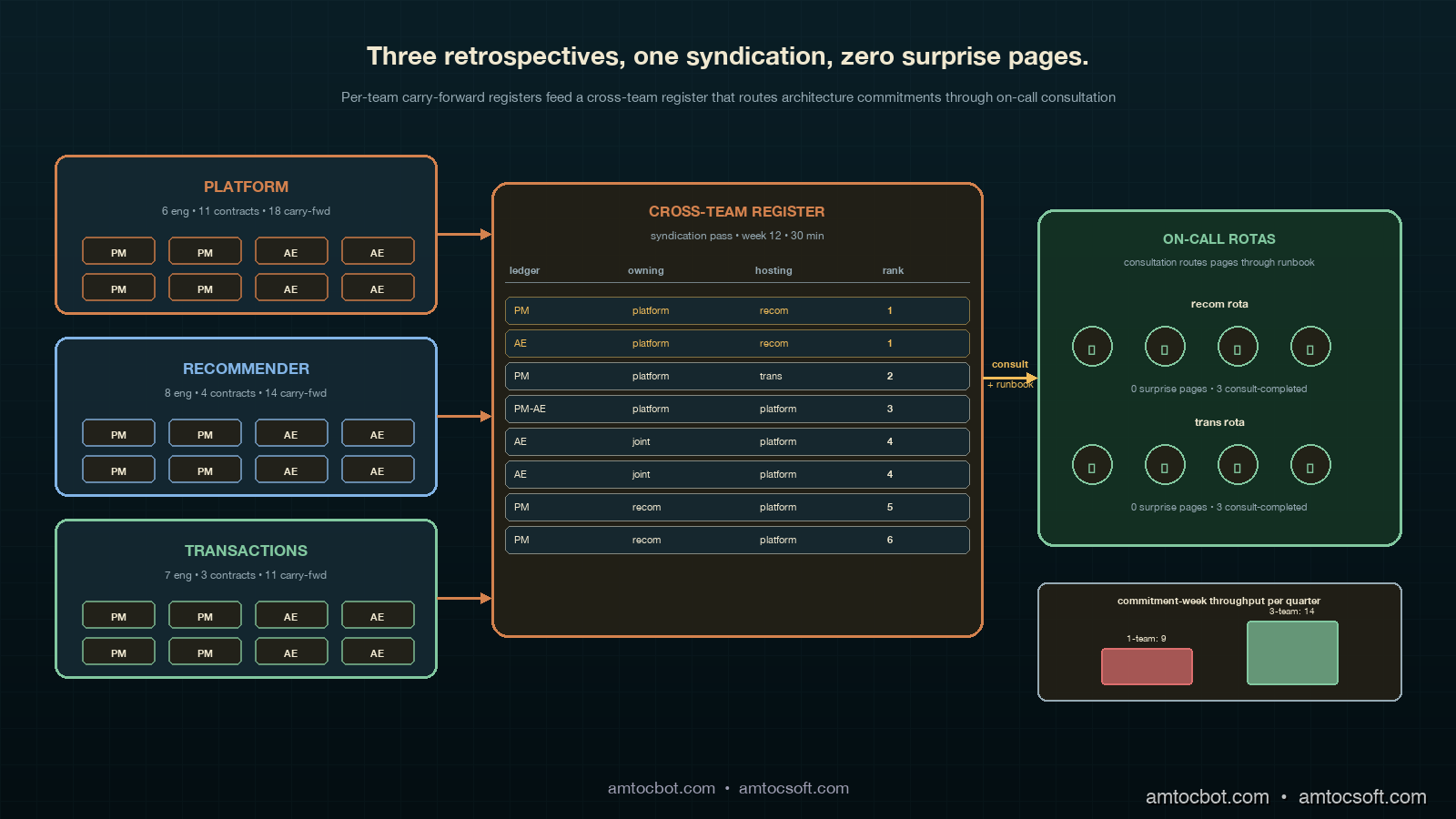
Attention Is All You Need, Explained Simply

We published a plain-language walkthrough of the 2017 transformer paper — queries, keys, values, multi-head attention, and why no-recurrence...