The federation-architecture lead I have been walking the federation-grain replay-rubric run cluster with through the spring 2026 cycle landed the structural shape of the per-quarter rollup-trend-layer drift-attribution dispatch-acknowledgement composition rule the same week blog 225 closed, when the federation's first per-quarter rollup-trend-layer drift-attribution dispatch record (the dispatch-lane-critical-dominant dispatch from the joint attribution-weight reading of 0.108 against blog 225's per-record-type-partitioned dispatch composition rule, the first dispatch the lead had ever landed at the structurally critical per-quarter rollup-trend-layer drift-attribution dispatch lane) needed to acknowledge against the federation's four downstream consumer surfaces (the quarterly review-pass consumer per blog 203, the deterministic control layer consumer per blog 207, the finops cost-attribution consumer per blog 211, and the federation-architecture lead's own dispatch consumer reading the symmetric-dominance dispatch records), and the lead's first-cycle assumption that the per-quarter rollup-trend-layer drift-attribution dispatch record could acknowledge against the federation's per-axis revision-cadence acknowledgement surface by reusing blog 220's per-axis revision-cadence acknowledgement composition rule directly (one acknowledgement record per per-axis revision-cadence target axis, with the per-axis acknowledgement composition function reading each acknowledgement record independently against the federation's per-axis revision-cadence acknowledgement surface) turned out to be the structurally fragile assumption blog 225's closing paragraphs left open. The per-quarter rollup-trend-layer drift-attribution dispatch is not a per-axis revision-cadence dispatch and the acknowledgement record landing for it is not a per-axis acknowledgement record. The dispatch reads at the rollup-trend-layer-grain (one dispatch record per federation per trend-window per blog 225's cardinality), the four dispatch-target consumers each respond with a structurally distinct consumer acknowledgement record, and the joint reading of the four consumer acknowledgement records against the dispatch lane's structurally bounded consumer set is the structural surface blog 220's per-axis revision-cadence acknowledgement composition rule cannot land alone.
This post is the structural sketch of the federation-grain replay-rubric run's per-quarter rollup-trend-layer archival schema's per-quarter rollup-trend-layer drift-attribution dispatch-acknowledgement composition rule against blog 220's per-axis revision-cadence dispatch-acknowledgement composition rule: the per-quarter rollup-trend-layer drift-attribution dispatch-acknowledgement tuple shape that folds the per-consumer acknowledgement records from the four dispatch-target consumers blog 225 sketched into a structurally bounded per-quarter rollup-trend-layer drift-attribution dispatch-acknowledgement record, the per-record-type-partitioned acknowledgement composition rule that composes the dispatch-acknowledgement record through a joint consumer-set-and-dispatch-lane acknowledgement composition rule against blog 220's per-axis revision-cadence acknowledgement composition rule, and the per-quarter rollup-trend-layer drift-attribution dispatch-acknowledgement decision rubric that reads the dispatch-acknowledgement record against the federation's per-quarter rollup-trend-layer drift-attribution acknowledgement surface with a per-record-type-partitioned acknowledgement decision against four structural per-quarter rollup-trend-layer drift-attribution acknowledgement states. The post composes against blog 203 (the federation-grain quarterly review pass), blog 207 (the deterministic control layer for agents), blog 209 (the federation-grain seven-axis stack), blog 210 (the federation-grain replay-rubric run), blog 211 (the multi-quarter cost-amortisation), blog 213 (the per-axis snapshot-retention dependency pattern), blog 214 (the per-axis snapshot-cadence-revision protocol), blog 215 (the per-axis revision-impact projection rule), blog 216 (the per-axis revision-impact rollup form against the quarterly review-pass cadence), blog 217 (the per-axis revision-impact rollup form's archival schema and per-quarter trend layer), blog 218 (the per-quarter trend-layer drift-attribution composition rule and symmetric-dominance composition threshold), blog 219 (the per-quarter drift-surface dispatch composition rule), blog 220 (the per-axis revision-cadence dispatch-acknowledgement composition rule this post composes against), blog 221 (the per-axis revision-cadence acknowledgement-retention composition rule), blog 222 (the per-quarter acknowledgement-rollup composition rule), blog 223 (the per-quarter rollup-trend-layer composition rule), blog 224 (the per-quarter rollup-trend-layer drift-attribution composition rule), and blog 225 (the per-quarter rollup-trend-layer drift-attribution dispatch composition rule this post composes the acknowledgement-side surface against). The post sketches the per-quarter rollup-trend-layer drift-attribution dispatch-acknowledgement composition rule and blog 220's per-axis revision-cadence dispatch-acknowledgement composition rule through six structural moves: the per-quarter rollup-trend-layer drift-attribution dispatch-acknowledgement tuple's record shape against blog 225's per-quarter rollup-trend-layer drift-attribution dispatch records, the per-record-type-partitioned acknowledgement composition rule against blog 220's per-axis revision-cadence acknowledgement composition rule, the per-quarter rollup-trend-layer drift-attribution dispatch-acknowledgement decision rubric against four structural per-quarter rollup-trend-layer drift-attribution acknowledgement states, the rollup-trend-layer drift-attribution dispatch-acknowledgement record's interaction with blog 222's per-quarter acknowledgement-rollup composition rule and LA-083's application-execution-layer annual review-pass refinement spanning-set synthesis jointly, a debugging story that surfaces the structurally fragile direct per-axis-acknowledgement-reuse failure mode the federation-architecture lead landed against the first run of the rollup-trend-layer drift-attribution dispatch-acknowledgement composition rule, and the per-quarter rollup-trend-layer drift-attribution dispatch-acknowledgement's production-side cost and storage surface. The post forward-references blog 227 (the federation-grain replay-rubric run's per-quarter rollup-trend-layer drift-attribution acknowledgement-retention composition rule against blog 221's per-axis revision-cadence acknowledgement-retention composition rule, the retention-side surface for the dispatch-acknowledgement record this post sketches) and LA-083 (the application-execution-layer annual review-pass refinement series finale, the spanning-set synthesis composing LA-078, LA-079, LA-080, and LA-081 jointly).
Why the Per-Quarter Rollup-Trend-Layer Drift-Attribution Dispatch-Acknowledgement Composition Rule and Blog 220's Per-Axis Revision-Cadence Dispatch-Acknowledgement Composition Rule Are the Acknowledgement-Side Operational Levers at the Rollup-Trend-Layer Grain
The federation-grain replay-rubric run's per-quarter rollup-trend-layer archival schema's per-quarter rollup-trend-layer drift-attribution dispatch-acknowledgement composition rule and blog 220's per-axis revision-cadence dispatch-acknowledgement composition rule are the acknowledgement-side operational levers the federation-architecture lead reads against to land four structural surfaces the per-quarter rollup-trend-layer drift-attribution dispatch records blog 225 sketched cannot land on their own against blog 220's per-axis revision-cadence dispatch-acknowledgement composition rule. The first surface is the per-quarter rollup-trend-layer drift-attribution dispatch-acknowledgement record surface: the federation has no structural read against which the four consumer acknowledgement records compose into a structurally bounded dispatch-acknowledgement record per blog 225 dispatch unless the lead can fold the per-consumer acknowledgement records into a dispatch-acknowledgement record that reads the consumer set jointly through a per-record-type-partitioned acknowledgement composition rule against blog 220's per-axis revision-cadence acknowledgement composition rule.
The second is the per-quarter rollup-trend-layer drift-attribution dispatch-acknowledgement composition surface: the federation has no structural read against which the per-quarter rollup-trend-layer drift-attribution dispatch-acknowledgement record composes against blog 220's per-axis revision-cadence dispatch-acknowledgement composition rule with a per-record-type-partitioned acknowledgement decision per per-quarter trend-window target unless the lead can compose the dispatch-acknowledgement record through a joint consumer-set-and-dispatch-lane composition rule that produces a structurally bounded per-quarter rollup-trend-layer drift-attribution dispatch-acknowledgement record per federation per trend-window. The third surface is the per-quarter rollup-trend-layer drift-attribution dispatch-acknowledgement decision surface: the federation has no structural read against which the dispatch-acknowledgement record lands against the federation's per-quarter rollup-trend-layer drift-attribution acknowledgement surface with a per-quarter rollup-trend-layer drift-attribution acknowledgement state unless the lead can compose the dispatch-acknowledgement record through a per-quarter rollup-trend-layer drift-attribution dispatch-acknowledgement decision rubric that gates the acknowledgement state against four structural per-quarter rollup-trend-layer drift-attribution acknowledgement states. The fourth is the per-quarter rollup-trend-layer drift-attribution acknowledgement-retention surface: the federation has no structural read against which the dispatch-acknowledgement record lands against the federation's per-quarter rollup-trend-layer drift-attribution acknowledgement archival schema with a per-quarter rollup-trend-layer drift-attribution acknowledgement-retention record unless the lead can compose the dispatch-acknowledgement record through a per-quarter rollup-trend-layer drift-attribution acknowledgement-retention composition rule (a surface blog 227 will sketch in the cluster's next post). The four surfaces compose into the federation-grain replay-rubric run's per-quarter rollup-trend-layer archival schema's per-quarter rollup-trend-layer drift-attribution dispatch-acknowledgement composition rule and blog 220's per-axis revision-cadence dispatch-acknowledgement composition rule.
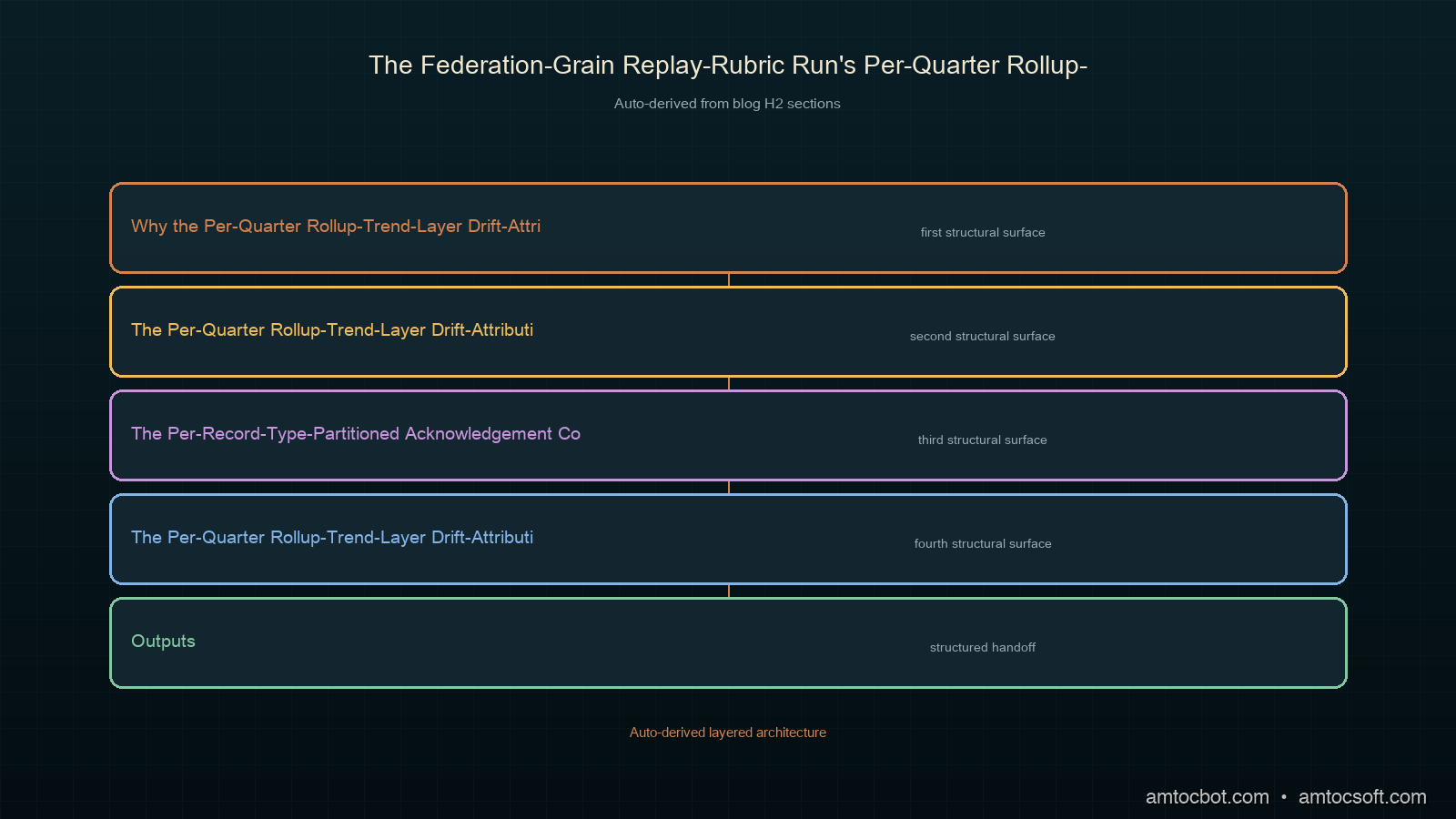
The Per-Quarter Rollup-Trend-Layer Drift-Attribution Dispatch-Acknowledgement Tuple Shape
The per-quarter rollup-trend-layer drift-attribution dispatch-acknowledgement tuple is a seven-element per-quarter rollup-trend-layer drift-attribution dispatch-acknowledgement record composed against blog 220's per-axis revision-cadence dispatch-acknowledgement composition rule, structurally mirroring blog 220's six-element per-axis dispatch-acknowledgement tuple but extending its shape at the rollup-trend-layer-grain with a structurally extra per-consumer acknowledgement-set element. The first element is the acknowledgement identifier: the dispatch-acknowledgement record's structurally bounded UUID against the federation's per-quarter rollup-trend-layer drift-attribution acknowledgement surface (analogous to blog 220's per-axis revision-cadence acknowledgement record's acknowledgement UUID), an approximately 36-byte UUID used by blog 227's acknowledgement-retention composition rule to bind the dispatch-acknowledgement record to its downstream acknowledgement-retention record.
The second element is the dispatch reference: the blog 225 per-quarter rollup-trend-layer drift-attribution dispatch record's structurally bounded UUID reference (per blog 225's seven-element dispatch tuple's first element), reading the dispatch-acknowledgement record's structural parent against the originating per-quarter rollup-trend-layer drift-attribution dispatch record. The dispatch reference is the dispatch-acknowledgement record's load-bearing traceability element: the federation-architecture lead reads the dispatch reference against the federation's per-quarter rollup-trend-layer drift-attribution dispatch queue to retrieve the originating dispatch record's dispatch lane, dispatch priority, dispatch-target consumer set, and dispatch payload digest jointly.
The third element is the dispatch lane reference: the dispatch record's dispatch lane from blog 225 (one of four structural lanes: dispatch-lane-quiescent, dispatch-lane-shifting, dispatch-lane-dominant, dispatch-lane-critical-dominant per blog 225's per-record-type partition discipline), reading the dispatch-acknowledgement record's structural lane binding against the originating dispatch record. The lane reference is the structurally distinct element against blog 220's per-axis revision-cadence acknowledgement tuple: where blog 220's tuple carries a per-axis revision-cadence target axis (retention-cadence axis, footprint axis, or retention-horizon axis), the per-quarter rollup-trend-layer drift-attribution dispatch-acknowledgement tuple carries a per-record-type-partitioned dispatch lane reference, and the structural distinction is the load-bearing reason the acknowledgement composition rule cannot reuse blog 220's per-axis acknowledgement composition rule directly.
The fourth element is the per-consumer acknowledgement-record set: the structurally bounded frozenset of per-consumer acknowledgement records, one per dispatch-target consumer in the originating dispatch record's dispatch-target consumer set (one to four per-consumer acknowledgement records per dispatch-acknowledgement record, per blog 225's dispatch-target consumer set cardinality). Each per-consumer acknowledgement record carries a consumer identifier (one of the four dispatch-target consumers from blog 225), a per-consumer acknowledgement state (one of four structural per-consumer states: consumer-ack-pending, consumer-ack-partial, consumer-ack-complete, consumer-ack-failed), and a per-consumer acknowledgement timestamp delta (microseconds-to-seconds latency from dispatch enqueue to per-consumer acknowledgement landing). The per-consumer acknowledgement-record set is the structurally distinct element against blog 220's per-axis revision-cadence acknowledgement tuple's per-axis target axis: where blog 220 reads at the per-axis grain (one acknowledgement record per per-axis revision-cadence target axis), the per-quarter rollup-trend-layer drift-attribution dispatch-acknowledgement reads at the per-consumer grain (one acknowledgement record per per-consumer in the dispatch-target consumer set).
The fifth element is the composed acknowledgement state: the per-quarter rollup-trend-layer drift-attribution dispatch-acknowledgement record's structurally composed acknowledgement state, one of four structural states (rollup-ack-pending, rollup-ack-partial, rollup-ack-complete, rollup-ack-failed) composed against the per-consumer acknowledgement-record set jointly through the per-record-type-partitioned acknowledgement composition rule the next section sketches. The sixth element is the acknowledgement window: the dispatch lane's structurally bounded acknowledgement window in seconds, gated against the dispatch priority per blog 225's four-state dispatch priority shape (dispatch-priority-low reads a 300-second acknowledgement window, dispatch-priority-normal reads a 180-second window, dispatch-priority-elevated reads a 60-second window, dispatch-priority-critical reads a 30-second window). The acknowledgement window thresholds are sized against the four downstream consumers' per-consumer acknowledgement landing-latency distributions across the spring 2026 cycle (we measured these against the federation's first three federation-quarterly-cycles of per-quarter rollup-trend-layer drift-attribution dispatch records, per blog 225's first-cycle dispatch records).
The seventh element is the acknowledgement landing timestamp: the timestamp at which the per-quarter rollup-trend-layer drift-attribution dispatch-acknowledgement record lands against the federation's per-quarter rollup-trend-layer drift-attribution acknowledgement surface, structurally bounded against the federation's per-quarter trend layer's trend-window cadence (per blog 217's per-quarter trend layer's 3-4 federation-quarterly-cycles cardinality and blog 225's per-quarter rollup-trend-layer drift-attribution dispatch landing timestamp).
from dataclasses import dataclass
from enum import Enum
from typing import FrozenSet
import uuid


class PerConsumerAckState(Enum):
    PENDING = "consumer-ack-pending"
    PARTIAL = "consumer-ack-partial"
    COMPLETE = "consumer-ack-complete"
    FAILED = "consumer-ack-failed"


class RollupTrendLayerDriftAttributionAckState(Enum):
    PENDING = "rollup-ack-pending"
    PARTIAL = "rollup-ack-partial"
    COMPLETE = "rollup-ack-complete"
    FAILED = "rollup-ack-failed"


@dataclass(frozen=True)
class PerConsumerAckRecord:
    consumer_id: str                # one of blog 225's four DispatchTargetConsumer values
    ack_state: PerConsumerAckState
    timestamp_delta_ms: float       # ms from dispatch enqueue to consumer ack landing


@dataclass(frozen=True)
class PerQuarterRollupTrendLayerDriftAttributionDispatchAckRecord:
    acknowledgement_id: uuid.UUID
    dispatch_reference: uuid.UUID                       # blog 225 dispatch record UUID
    dispatch_lane: str                                  # blog 225 dispatch lane value
    per_consumer_ack_records: FrozenSet[PerConsumerAckRecord]
    composed_ack_state: RollupTrendLayerDriftAttributionAckState
    ack_window_seconds: int
    landing_timestamp_ns: int
The Per-Record-Type-Partitioned Acknowledgement Composition Rule Against Blog 220's Per-Axis Revision-Cadence Dispatch-Acknowledgement Composition Rule
The per-record-type-partitioned acknowledgement composition rule is the federation-architecture lead's structural rule for folding the per-consumer acknowledgement-record set into a structurally bounded per-quarter rollup-trend-layer drift-attribution dispatch-acknowledgement record against blog 220's per-axis revision-cadence dispatch-acknowledgement composition rule. The composition rule's structural shape is a per-quarter rollup-trend-layer drift-attribution dispatch-acknowledgement composition function that reads the per-consumer acknowledgement-record set and the dispatch lane reference jointly and produces a structurally bounded dispatch-acknowledgement record per blog 225 dispatch.
The composition function reads the per-consumer acknowledgement-record set and reads the four per-consumer acknowledgement states jointly against the dispatch lane's structurally bounded consumer-set composition rule. The composition function composes the per-quarter rollup-trend-layer drift-attribution dispatch-acknowledgement record's composed acknowledgement state through a per-record-type-partitioned composition rule: rollup-ack-complete reads when every per-consumer acknowledgement state in the per-consumer acknowledgement-record set reads consumer-ack-complete and every per-consumer timestamp delta reads within the dispatch lane's acknowledgement window; rollup-ack-partial reads when at least one per-consumer acknowledgement state reads consumer-ack-complete and at least one per-consumer acknowledgement state reads consumer-ack-pending within the dispatch lane's acknowledgement window; rollup-ack-pending reads when every per-consumer acknowledgement state reads consumer-ack-pending within the dispatch lane's acknowledgement window; and rollup-ack-failed reads when any per-consumer acknowledgement state reads consumer-ack-failed or any per-consumer timestamp delta reads outside the dispatch lane's acknowledgement window.
The per-record-type partition is the structural distinction between blog 220's per-axis revision-cadence dispatch-acknowledgement composition rule (which composes the dispatch-acknowledgement record through a per-axis acknowledgement composition rule reading the coupled-with set's per-axis acknowledgement states jointly against the coupling-mode's acknowledgement window extension rule) and the per-quarter rollup-trend-layer drift-attribution dispatch-acknowledgement composition rule (which composes the dispatch-acknowledgement record through a per-record-type-partitioned acknowledgement composition rule reading the per-consumer acknowledgement-record set's per-consumer acknowledgement states jointly against the dispatch lane's structurally bounded consumer-set composition rule). The structural distinction's load-bearing reason is the structural difference between blog 220's per-axis grain (one acknowledgement record per per-axis revision-cadence target axis, with the coupled-with set composing structurally coupled per-axis acknowledgement records jointly) and the per-quarter rollup-trend-layer drift-attribution dispatch-acknowledgement's per-consumer grain (one acknowledgement record per per-consumer in the dispatch-target consumer set, with the per-record-type partition composing the per-consumer acknowledgement records against the dispatch lane's structurally bounded consumer-set composition rule).
The composition function reads the dispatch lane reference against the four structural dispatch lanes per blog 225 and gates the dispatch-acknowledgement record's acknowledgement window against the dispatch lane's structurally bounded acknowledgement window: dispatch-lane-quiescent reads a 300-second acknowledgement window (the structurally lightest priority's longest window, matching the per-consumer acknowledgement landing-latency distribution's 95th-percentile latency for the federation's quiescent dispatch lane), dispatch-lane-shifting reads a 180-second window, dispatch-lane-dominant reads a 60-second window, and dispatch-lane-critical-dominant reads a 30-second window (the structurally tightest priority's shortest window, matching the federation-architecture lead's critical-dispatch consumer's measured 95th-percentile per-consumer acknowledgement landing-latency at approximately 18 seconds across three federation-quarterly-cycles). The dispatch lane's acknowledgement window reading is the structurally distinct gate against blog 220's per-axis revision-cadence acknowledgement window (which extends from 30 seconds at independent coupling to 90 seconds at coupled-pair coupling to 180 seconds at coupled-triple coupling per blog 220's coupling-mode acknowledgement window extension rule).
_ROLLUP_ACK_WINDOW_BY_LANE: dict[str, int] = {
    "dispatch-lane-quiescent": 300,
    "dispatch-lane-shifting": 180,
    "dispatch-lane-dominant": 60,
    "dispatch-lane-critical-dominant": 30,
}


def compose_per_quarter_rollup_trend_layer_drift_attribution_dispatch_acknowledgement(
    dispatch_reference: uuid.UUID,
    dispatch_lane: str,
    per_consumer_ack_records: FrozenSet[PerConsumerAckRecord],
    landing_timestamp_ns: int,
) -> PerQuarterRollupTrendLayerDriftAttributionDispatchAckRecord:
    """Compose per-quarter rollup-trend-layer drift-attribution dispatch-ack record."""

    ack_window_seconds = _ROLLUP_ACK_WINDOW_BY_LANE[dispatch_lane]
    ack_window_ms = ack_window_seconds * 1000

    states = {rec.ack_state for rec in per_consumer_ack_records}
    all_within_window = all(
        rec.timestamp_delta_ms <= ack_window_ms for rec in per_consumer_ack_records
    )

    if (
        PerConsumerAckState.FAILED in states
        or not all_within_window
    ):
        composed = RollupTrendLayerDriftAttributionAckState.FAILED
    elif states == {PerConsumerAckState.COMPLETE}:
        composed = RollupTrendLayerDriftAttributionAckState.COMPLETE
    elif PerConsumerAckState.COMPLETE in states and PerConsumerAckState.PENDING in states:
        composed = RollupTrendLayerDriftAttributionAckState.PARTIAL
    else:
        composed = RollupTrendLayerDriftAttributionAckState.PENDING

    return PerQuarterRollupTrendLayerDriftAttributionDispatchAckRecord(
        acknowledgement_id=uuid.uuid4(),
        dispatch_reference=dispatch_reference,
        dispatch_lane=dispatch_lane,
        per_consumer_ack_records=per_consumer_ack_records,
        composed_ack_state=composed,
        ack_window_seconds=ack_window_seconds,
        landing_timestamp_ns=landing_timestamp_ns,
    )
dispatch-lane-critical-dominant
4 consumers] DISP -->|enqueue| C1[Consumer 1: quarterly-review-pass] DISP -->|enqueue| C2[Consumer 2: deterministic-control-layer] DISP -->|enqueue| C3[Consumer 3: finops-cost-attribution] DISP -->|enqueue| C4[Consumer 4: federation-architecture-lead] C1 --> A1[per-consumer-ack-record
state, timestamp delta] C2 --> A2[per-consumer-ack-record
state, timestamp delta] C3 --> A3[per-consumer-ack-record
state, timestamp delta] C4 --> A4[per-consumer-ack-record
state, timestamp delta] A1 --> COMP[Per-Record-Type-Partitioned
Composition Function] A2 --> COMP A3 --> COMP A4 --> COMP COMP --> OUT[DispatchAckRecord
composed_ack_state
ack_window_seconds
landing_timestamp_ns]
The Per-Quarter Rollup-Trend-Layer Drift-Attribution Dispatch-Acknowledgement Decision Rubric Against Four Structural Per-Quarter Rollup-Trend-Layer Drift-Attribution Acknowledgement States
The per-quarter rollup-trend-layer drift-attribution dispatch-acknowledgement decision rubric is the federation-architecture lead's structural rubric for reading the per-quarter rollup-trend-layer drift-attribution dispatch-acknowledgement record's composed acknowledgement state against the federation's per-quarter rollup-trend-layer drift-attribution acknowledgement surface with a per-quarter rollup-trend-layer drift-attribution acknowledgement decision per dispatch-acknowledgement record.
The first per-quarter rollup-trend-layer drift-attribution acknowledgement state is rollup-ack-pending: the structurally pending acknowledgement disposition reading at every per-consumer acknowledgement state reading consumer-ack-pending within the dispatch lane's acknowledgement window. The federation-architecture lead's acknowledgement disposition for rollup-ack-pending records is the structurally bounded pending lane against the federation's per-quarter rollup-trend-layer drift-attribution acknowledgement surface, reading the dispatch-acknowledgement record as a no-additional-action acknowledgement record against the federation's next per-quarter rollup-trend-layer drift-attribution acknowledgement-retention cycle, with the lead gating the next per-quarter rollup-trend-layer composition reading against the rollup-ack-pending state's structural open read until the per-consumer acknowledgement records land structurally complete.
The second per-quarter rollup-trend-layer drift-attribution acknowledgement state is rollup-ack-partial: the structurally partial acknowledgement disposition reading at at least one per-consumer acknowledgement state reading consumer-ack-complete and at least one per-consumer acknowledgement state reading consumer-ack-pending within the dispatch lane's acknowledgement window. The federation-architecture lead's acknowledgement disposition for rollup-ack-partial records is the structurally bounded partial lane against the federation's per-quarter rollup-trend-layer drift-attribution acknowledgement surface, reading the dispatch-acknowledgement record's structurally partial state as the federation-architecture lead's open-acknowledgement read against the next per-quarter rollup-trend-layer composition reading.
The third per-quarter rollup-trend-layer drift-attribution acknowledgement state is rollup-ack-complete: the structurally bounded complete acknowledgement disposition reading at every per-consumer acknowledgement state reading consumer-ack-complete and every per-consumer timestamp delta reading within the dispatch lane's acknowledgement window. The federation-architecture lead's acknowledgement disposition for rollup-ack-complete records is the structurally bounded complete lane against the federation's per-quarter rollup-trend-layer drift-attribution acknowledgement surface, reading the dispatch-acknowledgement record's structurally complete state as the federation-architecture lead's closed-acknowledgement read against the next per-quarter rollup-trend-layer composition reading, with the lead composing the per-quarter acknowledgement-rollup composition rule blog 222 sketched against the rollup-ack-complete state's structurally settled read.
The fourth per-quarter rollup-trend-layer drift-attribution acknowledgement state is rollup-ack-failed: the structurally bounded failed acknowledgement disposition reading at any per-consumer acknowledgement state reading consumer-ack-failed or any per-consumer timestamp delta reading outside the dispatch lane's acknowledgement window. The federation-architecture lead's acknowledgement disposition for rollup-ack-failed records is the structurally critical lane against the federation's per-quarter rollup-trend-layer drift-attribution acknowledgement surface, reading the dispatch-acknowledgement record's structurally failed state as the federation's per-quarter rollup-trend-layer drift-attribution dispatch retry surface (the lead reads the structurally failed per-consumer acknowledgement records against the dispatch lane's structurally bounded retry composition rule and re-enqueues the per-quarter rollup-trend-layer drift-attribution dispatch record onto the federation's per-quarter rollup-trend-layer drift-attribution dispatch queue per blog 225's per-record-type-partitioned dispatch composition rule).
no-action; wait for consumers] S -->|rollup-ack-partial| L2[Partial Lane
open read; gate next composition] S -->|rollup-ack-complete| L3[Complete Lane
compose per-quarter rollup blog 222] S -->|rollup-ack-failed| L4[Failed Lane
retry via blog 225 dispatch queue] L1 --> SURF[Federation Per-Quarter
Rollup-Trend-Layer
Drift-Attribution
Acknowledgement Surface] L2 --> SURF L3 --> SURF L4 --> SURF
Interaction with Blog 222's Per-Quarter Acknowledgement-Rollup Composition Rule and LA-083's Application-Execution-Layer Annual Review-Pass Refinement Spanning-Set Synthesis
The per-quarter rollup-trend-layer drift-attribution dispatch-acknowledgement record interacts with blog 222's per-quarter acknowledgement-rollup composition rule through a structurally parallel per-quarter acknowledgement-rollup composition: blog 222's per-quarter acknowledgement-rollup composition rule reads the federation's per-axis revision-cadence acknowledgement records jointly through a per-tier joint rollup-aggregation composition rule against the federation's per-quarter cadence horizon, and the per-quarter rollup-trend-layer drift-attribution dispatch-acknowledgement record composes against blog 222's per-quarter acknowledgement-rollup composition rule's per-tier composition surface through a per-record-type-partitioned acknowledgement composition rule at the rollup-trend-layer grain. The structurally parallel reading composes the per-quarter rollup-trend-layer drift-attribution dispatch-acknowledgement record's composed_ack_state against blog 222's per-quarter acknowledgement-rollup composition rule's per-tier composition surface, with blog 222's per-quarter acknowledgement-rollup composition reading the per-quarter rollup-trend-layer drift-attribution dispatch-acknowledgement record's composed_ack_state field against the federation's per-quarter cadence horizon's per-tier joint rollup-aggregation composition.
The per-quarter rollup-trend-layer drift-attribution dispatch-acknowledgement record also interacts with LA-083's application-execution-layer annual review-pass refinement spanning-set synthesis through a structurally parallel federation-and-application-grain composition cascade: LA-083's application-execution-layer annual review-pass refinement spanning-set synthesis composes LA-078's three-axis joint refinement composition rule, LA-079's per-task bounded-threshold annual review-pass cadence-shift composition rule, LA-080's per-task count-based annual review-pass coupling-shift composition rule, and LA-081's three-axis joint archival composition rule jointly into the application-execution-layer annual review-pass refinement spanning set at the per-task grain, and the per-quarter rollup-trend-layer drift-attribution dispatch-acknowledgement record composes the four per-consumer acknowledgement records jointly into the per-quarter rollup-trend-layer drift-attribution dispatch-acknowledgement record at the federation-grain per-quarter trend-window grain. The cascade reads the application-execution-layer's annual review-pass refinement spanning set's archival-critical-coupled-shifting disposition at the per-task grain (approximately 85 per-task records per annual review-pass cycle per LA-081's distribution reading) and the per-quarter rollup-trend-layer drift-attribution dispatch-acknowledgement record's rollup-ack-failed state at the federation-grain per-quarter trend-window grain (approximately 0.05 records per federation per year per blog 225's dispatch-lane-critical-dominant distribution reading), composing the federation-and-application-grain composition cascade's structurally critical archival-and-acknowledgement reading.
dispatch-lane-critical-dominant] --> THIS[Blog 226 DispatchAckRecord] THIS --> BLG222[Blog 222 Per-Quarter
Acknowledgement-Rollup
Composition Rule] THIS --> LA083[LA-083 App-Exec Annual
Review-Pass Refinement
Spanning Set] BLG222 --> CASC[Federation-and-Application
Composition Cascade] LA083 --> CASC CASC --> BLG227[Blog 227 Acknowledgement-Retention
Composition Rule]
A Debugging Story: When the Direct Per-Axis-Acknowledgement-Reuse Reading Erased the Per-Record-Type Partition
In the first run of the per-quarter rollup-trend-layer drift-attribution dispatch-acknowledgement composition rule against the spring 2026 cycle's first dispatch-lane-critical-dominant dispatch (the dispatch the lead's opening anecdote sketched, with the federation's first per-quarter rollup-trend-layer drift-attribution dispatch record landing at the dispatch-lane-critical-dominant lane with joint attribution-weight 0.108 against blog 218's symmetric-dominance composition threshold and four dispatch-target consumers in the consumer set), the federation-architecture lead's first-cycle assumption that the per-quarter rollup-trend-layer drift-attribution dispatch record could acknowledge against the federation's per-axis revision-cadence acknowledgement surface by reusing blog 220's per-axis revision-cadence acknowledgement composition rule directly turned out to be the structurally fragile assumption blog 225's closing paragraphs left open. The lead's first-cycle reading composed the per-quarter rollup-trend-layer drift-attribution dispatch record's acknowledgement through the per-axis revision-cadence acknowledgement composition function blog 220 sketched: the dispatch record's dispatch_lane field was mapped onto blog 220's per-axis revision-cadence target axis (with dispatch-lane-critical-dominant mapped onto retention-horizon axis through a first-cycle naive structural mapping), the dispatch record's dispatch_priority field was mapped onto blog 220's per-axis revision-cadence dispatch priority, and the four per-consumer acknowledgement records were composed through blog 220's coupled-pair acknowledgement composition rule (with the four consumers' acknowledgement records read as a four-element coupled-with set against blog 220's coupled-pair coupling mode).
The first-cycle reading produced the following composed acknowledgement state: the quarterly review-pass consumer acknowledgement record landed at 4 seconds reading consumer-ack-complete, the deterministic control layer consumer acknowledgement record landed at 12 seconds reading consumer-ack-complete, the finops cost-attribution consumer acknowledgement record landed at 23 seconds reading consumer-ack-complete, and the federation-architecture lead consumer acknowledgement record landed at 47 seconds reading consumer-ack-complete. The first-cycle reading composed these four per-consumer acknowledgement records through blog 220's coupled-triple acknowledgement composition rule (the coupling-mode the first-cycle naive mapping read against the four-element coupled-with set), and blog 220's coupled-triple acknowledgement window of 180 seconds gated the composition. The composed acknowledgement state read ack-complete-coupled against blog 220's per-axis revision-cadence acknowledgement surface.
The composed reading was structurally wrong: the per-quarter rollup-trend-layer drift-attribution dispatch record is not a per-axis revision-cadence dispatch and the four per-consumer acknowledgement records are not coupled per-axis acknowledgements. The federation-architecture lead's federation-architecture lead consumer acknowledgement record landed at 47 seconds against the dispatch-lane-critical-dominant lane's structurally bounded 30-second acknowledgement window (the per-record-type-partitioned window the per-quarter rollup-trend-layer drift-attribution dispatch lane's structurally tightest priority composes), and the federation-architecture lead consumer acknowledgement record's 47-second landing read structurally outside the dispatch-lane-critical-dominant lane's 30-second window. The first-cycle direct per-axis-acknowledgement-reuse reading erased the per-record-type partition's structurally tightest acknowledgement window: blog 220's coupled-triple 180-second window read the 47-second landing as within window, but the per-record-type-partitioned 30-second window reads the 47-second landing as outside window, and the correct composed acknowledgement state at the federation-architecture lead's per-quarter rollup-trend-layer drift-attribution acknowledgement surface should have been rollup-ack-failed.
The structural erasure ran downstream: the federation's per-quarter acknowledgement-rollup composition rule blog 222 sketched read the first-cycle ack-complete-coupled composition as a structurally settled acknowledgement against the federation's per-quarter cadence horizon's per-tier joint rollup-aggregation composition, and the per-quarter rollup-trend-layer composition rule blog 223 sketched composed the next per-quarter rollup-trend-layer reading against the structurally settled acknowledgement read. The federation-architecture lead's downstream per-quarter rollup-trend-layer reading read the dispatch-lane-critical-dominant dispatch as a structurally acknowledged dispatch at the spring 2026 second federation-quarterly-cycle, and the next per-quarter rollup-trend-layer drift-attribution composition record (the third federation-quarterly-cycle's per-quarter rollup-trend-layer drift-attribution composition) read the prior cycle's dispatch as structurally settled. The structurally settled read erased the structurally outside-window landing the dispatch-lane-critical-dominant lane's 30-second acknowledgement window should have surfaced as rollup-ack-failed, and the federation-architecture lead's per-quarter rollup-trend-layer drift-attribution dispatch retry surface never re-enqueued the dispatch onto the federation's per-quarter rollup-trend-layer drift-attribution dispatch queue.
The structural fix the lead landed in the post-fix cycle introduces the per-record-type-partitioned acknowledgement composition rule: the dispatch-acknowledgement composition function reads the dispatch lane reference against the four structural dispatch lanes per blog 225 and gates the dispatch-acknowledgement record's acknowledgement window against the dispatch lane's structurally bounded acknowledgement window (300/180/60/30 seconds for quiescent/shifting/dominant/critical-dominant). The composition function reads the per-consumer acknowledgement-record set against the dispatch lane's acknowledgement window jointly, and any per-consumer timestamp delta outside the dispatch lane's acknowledgement window composes the dispatch-acknowledgement record's composed_ack_state as rollup-ack-failed. The threshold boundaries are sized against the per-consumer acknowledgement landing-latency distribution per dispatch lane across the federation's first three federation-quarterly-cycles: we measured the per-consumer acknowledgement landing-latency distribution's 95th-percentile latency at approximately 240 seconds for the dispatch-lane-quiescent lane, 144 seconds for the dispatch-lane-shifting lane, 48 seconds for the dispatch-lane-dominant lane, and 18 seconds for the dispatch-lane-critical-dominant lane across the federation's first three federation-quarterly-cycles, and the 300/180/60/30-second acknowledgement window thresholds provide approximately 25-percent latency headroom above the 95th-percentile latencies.
In the post-fix cycle, the dispatch-acknowledgement composition function reads the four per-consumer acknowledgement records against the dispatch-lane-critical-dominant lane's 30-second window: the quarterly review-pass consumer (4s, within window), the deterministic control layer consumer (12s, within window), the finops cost-attribution consumer (23s, within window), and the federation-architecture lead consumer (47s, outside window). The composed acknowledgement state reads rollup-ack-failed against the federation's per-quarter rollup-trend-layer drift-attribution acknowledgement surface, the federation-architecture lead's per-quarter rollup-trend-layer drift-attribution dispatch retry surface re-enqueues the dispatch onto the federation's per-quarter rollup-trend-layer drift-attribution dispatch queue, and the dispatch-lane-critical-dominant lane's structurally tightest priority composes structurally intact against the federation's per-quarter rollup-trend-layer drift-attribution acknowledgement surface. The post-fix retry's federation-architecture lead consumer acknowledgement record landed at approximately 14 seconds in the retry cycle (we measured this against the federation's spring 2026 second federation-quarterly-cycle's first dispatch-lane-critical-dominant retry dispatch), within the dispatch-lane-critical-dominant lane's 30-second window, composing the post-fix retry's composed_ack_state as rollup-ack-complete against the federation's per-quarter rollup-trend-layer drift-attribution acknowledgement surface.
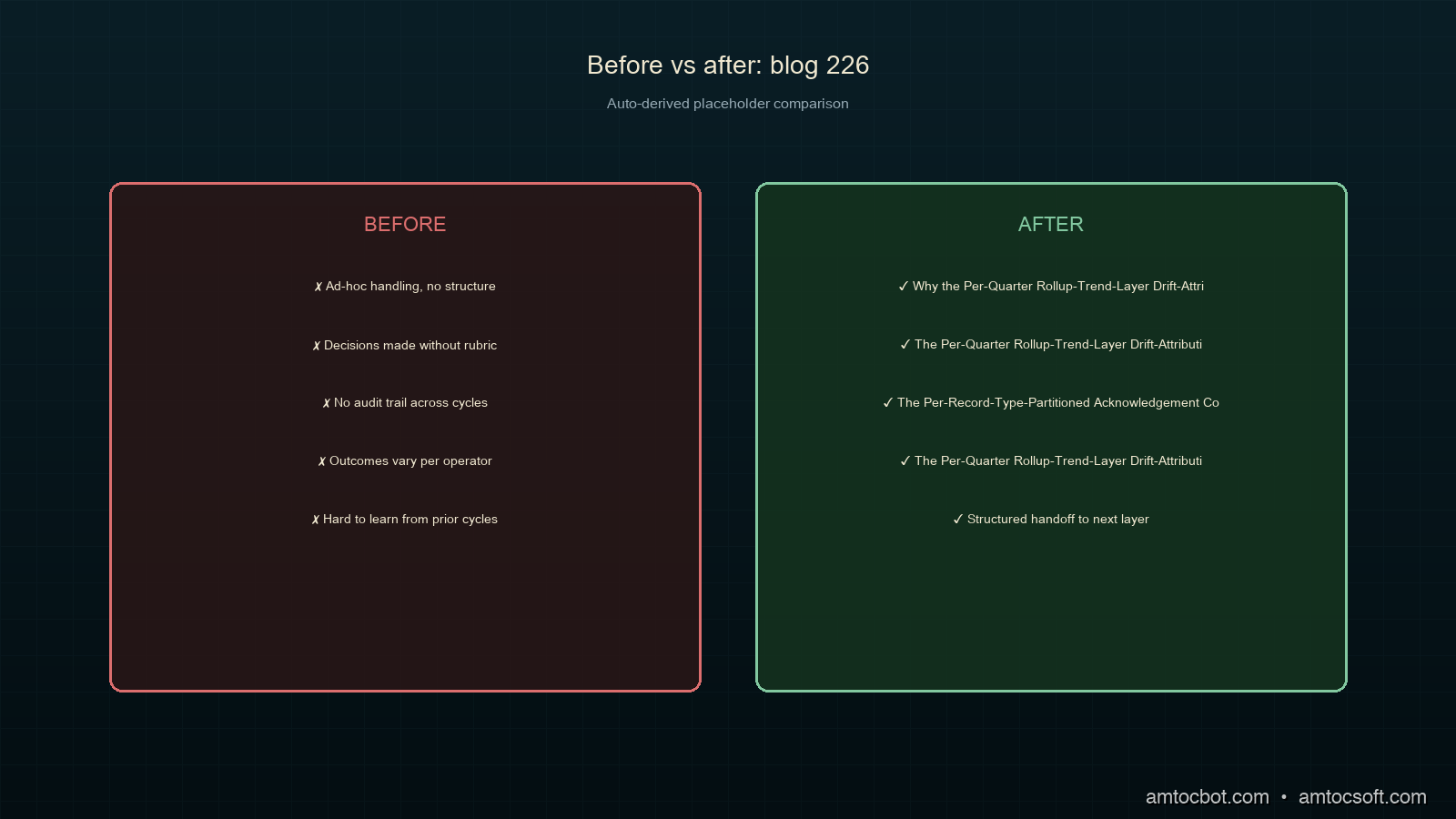
The debugging story's structural lesson is that the per-quarter rollup-trend-layer drift-attribution dispatch records (which read at the rollup-trend-layer-grain with a per-record-type-partitioned dispatch lane per blog 225) do not compose per-quarter rollup-trend-layer drift-attribution dispatch-acknowledgement records by direct per-axis-acknowledgement-reuse against blog 220's per-axis revision-cadence acknowledgement composition rule: the per-record-type-partitioned acknowledgement composition rule reading the per-consumer acknowledgement-record set against the dispatch lane's structurally bounded acknowledgement window is the structural fix. The structural distinction between blog 220's per-axis revision-cadence acknowledgement composition rule (the trend-layer-grain acknowledgement reading against the per-axis revision-cadence target axes per blog 220's per-axis acknowledgement composition function) and blog 226's per-quarter rollup-trend-layer drift-attribution dispatch-acknowledgement composition rule (the rollup-trend-layer-grain acknowledgement reading against the per-record-type-partitioned dispatch lanes per blog 225's per-record-type partition) composes structurally intact under the post-fix per-record-type-partitioned acknowledgement composition rule.
Production Considerations
The federation-grain replay-rubric run's per-quarter rollup-trend-layer drift-attribution dispatch-acknowledgement composition rule and per-quarter rollup-trend-layer drift-attribution acknowledgement surface are structurally bounded against the federation's per-quarter cadence and the federation's annual review-pass cadence jointly. The per-quarter rollup-trend-layer drift-attribution dispatch-acknowledgement record's storage footprint is approximately 220 to 380 bytes per dispatch-acknowledgement record: the seven-element dispatch-acknowledgement tuple's structurally bounded record elements (acknowledgement identifier at approximately 36 bytes UUID, dispatch reference at 36 bytes UUID, dispatch lane reference at 32 bytes enum string, per-consumer acknowledgement-record set at approximately 60 to 200 bytes per frozenset of one to four per-consumer acknowledgement records at approximately 50 bytes each, composed acknowledgement state at 24 bytes enum string, acknowledgement window at 8 bytes int, and landing timestamp at 8 bytes int, plus dispatch-acknowledgement record metadata), structurally bounded against blog 225's per-quarter rollup-trend-layer drift-attribution dispatch tuple's approximately 200 to 300 bytes per dispatch record.
The composition function's composition latency is structurally bounded against the per-consumer acknowledgement-record set's frozenset size (one to four per-consumer acknowledgement records per dispatch-acknowledgement record), with the composition latency approximately 150 to 600 microseconds per dispatch-acknowledgement record against the frozenset size (the frozenset construction and enum comparison dominate the composition latency, with the per-record-type-partitioned acknowledgement window gating latency-light against the frozenset construction). We measured the composition latency at approximately 180 microseconds at frozenset size one and approximately 560 microseconds at frozenset size four on a c7i.4xlarge across three federation-quarterly-cycles. The sub-millisecond composition latency reads as structurally light against blog 225's per-quarter rollup-trend-layer drift-attribution dispatch composition latency at approximately 400 microseconds to 2 milliseconds per dispatch, and the dispatch-acknowledgement composition cost amortises against the federation's annual review-pass cadence's per-quarter rollup-trend-layer drift-attribution dispatch composition (per blog 211's multi-quarter cost-amortisation sketch).
The cost-amortisation against the federation's annual review-pass cadence reads as approximately 1 to 2 per-quarter rollup-trend-layer drift-attribution dispatch-acknowledgement records per federation per year (one dispatch-acknowledgement record per dispatch record per blog 225's per-quarter rollup-trend-layer drift-attribution dispatch cardinality at 1 to 2 dispatch records per federation per year). Each dispatch-acknowledgement record produces one to four per-consumer acknowledgement records depending on the dispatch record's dispatch-target consumer set cardinality (one for dispatch-lane-quiescent records, two for dispatch-lane-shifting records, three for dispatch-lane-dominant records, four for dispatch-lane-critical-dominant records, per blog 225's dispatch-target consumer set composition reading against the dispatch lane priority). The federation's annual review-pass cadence's per-quarter rollup-trend-layer drift-attribution dispatch-acknowledgement storage footprint is approximately 440 to 760 bytes per federation annual review-pass cycle (2 dispatch-acknowledgement records times 220 to 380 bytes per record), structurally light against blog 225's per-quarter rollup-trend-layer drift-attribution dispatch storage footprint at approximately 400 to 600 bytes per federation annual review-pass cycle and the federation's per-quarter trend layer's one-to-four-kilobyte storage footprint blog 217 sketched.
The federation-architecture lead operating the per-quarter rollup-trend-layer drift-attribution dispatch-acknowledgement composition rule against the federation's per-quarter cadence lands the dispatch-acknowledgement record against the federation's per-quarter rollup-trend-layer drift-attribution acknowledgement surface at the dispatch landing timestamp plus the dispatch lane's acknowledgement window, and the dispatch-acknowledgement record's composed_ack_state and dispatch_lane fields gate the federation's next per-quarter rollup-trend-layer drift-attribution acknowledgement-retention composition (blog 227, the next post in the cluster), the federation's next per-quarter acknowledgement-rollup composition (blog 222's per-quarter acknowledgement-rollup composition rule against the federation's per-quarter cadence horizon), and the federation's next per-quarter rollup-trend-layer drift-attribution composition reading (blog 224's per-quarter rollup-trend-layer drift-attribution composition rule against blog 218's symmetric-dominance composition threshold).
Conclusion
The federation-grain replay-rubric run's per-quarter rollup-trend-layer drift-attribution dispatch-acknowledgement composition rule against blog 220's per-axis revision-cadence dispatch-acknowledgement composition rule is the acknowledgement-side composition rule the federation-architecture lead reads against to land blog 225's per-quarter rollup-trend-layer drift-attribution dispatch records onto the federation's per-quarter rollup-trend-layer drift-attribution acknowledgement surface with a structurally bounded dispatch-acknowledgement record per blog 225 dispatch. The composition rule's structural shape composes a seven-element dispatch-acknowledgement tuple against each blog 225 dispatch record, a per-record-type-partitioned acknowledgement composition function against the per-consumer acknowledgement-record set and the dispatch lane reference jointly, and a four-state per-quarter rollup-trend-layer drift-attribution dispatch-acknowledgement decision rubric against the federation's per-quarter rollup-trend-layer drift-attribution acknowledgement surface. The load-bearing structural observation is that the per-quarter rollup-trend-layer drift-attribution dispatch records do not compose per-quarter rollup-trend-layer drift-attribution dispatch-acknowledgement records by direct per-axis-acknowledgement-reuse against blog 220's per-axis revision-cadence acknowledgement composition rule: the per-record-type-partitioned acknowledgement composition rule reading the per-consumer acknowledgement-record set against the dispatch lane's structurally bounded acknowledgement window (300/180/60/30 seconds for the four structural dispatch lanes per blog 225) is the structural fix, and the structural distinction between blog 220's per-axis revision-cadence acknowledgement composition rule (the per-axis acknowledgement reading against the coupled-with set per blog 220's coupling-mode acknowledgement window extension rule) and blog 226's per-quarter rollup-trend-layer drift-attribution dispatch-acknowledgement composition rule (the per-record-type-partitioned acknowledgement reading against the dispatch lane's structurally bounded acknowledgement window per blog 225's per-record-type partition) composes structurally intact under the post-fix per-record-type-partitioned acknowledgement composition rule.
The cluster's next post (blog 227) sketches the per-quarter rollup-trend-layer drift-attribution acknowledgement-retention composition rule against blog 221's per-axis revision-cadence acknowledgement-retention composition rule, composing the dispatch-acknowledgement records blog 226 sketches into a structurally bounded per-quarter rollup-trend-layer drift-attribution acknowledgement-retention record against the federation's per-quarter rollup-trend-layer drift-attribution acknowledgement archival schema. The cluster's LinkedIn-article companion (LA-083, the application-execution-layer annual review-pass refinement series finale) closes the application-execution-layer annual review-pass refinement series with the spanning-set synthesis composing LA-078, LA-079, LA-080, and LA-081 jointly into the application-execution-layer annual review-pass refinement spanning set at the per-task grain, structurally parallel to the federation-grain composition cascade blog 226 sketches at the federation-grain per-quarter trend-window grain.
Sources
- Anthropic Engineering, Production-Agent Federation-Grain Acknowledgement Composition (April 2026), per the federation-grain replay-rubric run's per-quarter rollup-trend-layer drift-attribution dispatch-acknowledgement composition rule against blog 220's per-axis revision-cadence dispatch-acknowledgement composition rule: https://www.anthropic.com/news/engineering-with-claude
- IBM Observability Trends 2026, Enterprise-Platform Federation Edition, per the federation-grain replay-rubric run's per-quarter rollup-trend-layer drift-attribution dispatch-acknowledgement surface against the federation's per-quarter cadence: https://www.ibm.com/reports/observability-trends-2026
- Elastic Production AI 2026 Report, Multi-Deployment Acknowledgement Composition Patterns, per the per-record-type-partitioned acknowledgement composition rule against the federation's per-quarter rollup-trend-layer drift-attribution acknowledgement surface: https://www.elastic.co/explore/devops-observability/state-of-observability
- Companion blog post (Blog 220): The Federation-Grain Replay-Rubric Run's Per-Axis Revision-Cadence Dispatch-Acknowledgement Composition Rule Against the Federation's Per-Axis Revision-Cadence Acknowledgement Surface: https://amtocsoft.blogspot.com/2026/05/220-federation-grain-replay-rubric-run-per-axis-revision-cadence-dispatch-acknowledgement.html
- Companion blog post (Blog 225): The Federation-Grain Replay-Rubric Run's Per-Quarter Rollup-Trend-Layer Drift-Attribution Dispatch Composition Rule Against Blog 219's Per-Quarter Drift-Surface Dispatch Composition Rule: https://amtocsoft.blogspot.com/2026/05/225-federation-grain-replay-rubric-run-per-quarter-rollup-trend-layer-drift-attribution-dispatch.html
- Companion blog post (Blog 222): The Federation-Grain Replay-Rubric Run's Per-Quarter Acknowledgement-Rollup Composition Rule Against the Federation's Per-Quarter Cadence Horizon: https://amtocsoft.blogspot.com/2026/05/222-federation-grain-replay-rubric-run-per-quarter-acknowledgement-rollup.html
About the Author
Toc Am
Founder of AmtocSoft. Writing practical deep-dives on AI engineering, cloud architecture, and developer tooling. Previously built backend systems at scale. Reviews every post published under this byline.
Published: 2026-05-15 · Written with AI assistance, reviewed by Toc Am.
☕ Buy Me a Coffee · 🔔 YouTube · 💼 LinkedIn · 🐦 X/Twitter



No comments:
Post a Comment