The federation-architecture lead I have been walking the federation-grain replay-rubric run cluster with through the spring 2026 cycle hit the structural shape of the per-quarter rollup-trend-layer drift-attribution archival-schema annual-rollup-trend composition rule the same week blog 228 closed, when the federation's first post-fix per-annual-cycle rollup record (the rollup-tier-multi-annual-bound per-annual-cycle rollup composition the lead landed against blog 228's tier-multi-annual acknowledgement-retention reference set at 1095 days, with the per-retention-tier-partitioned annual rollup composition rule reading the joint per-retention-tier-and-per-composed-ack-state aggregate correctly against the structurally bounded one-record-per-acknowledgement-retention-record annual rollup horizon) needed to land against the federation's three-federation-annual-review-pass-cycle multi-quarter cost-amortisation horizon with a structural per-multi-annual-cycle rollup-trend record, and the lead's first-cycle assumption that the per-annual-cycle rollup records could lift onto the multi-quarter cost-amortisation horizon by reusing blog 217's per-quarter trend-layer composition rule directly across three annual review-pass cycles in a row (one per-quarter-trend record per annual review-pass cycle, with blog 217's per-quarter trend reading composing each annual review-pass cycle's per-annual-cycle rollup record independently against the federation's three-federation-annual-review-pass-cycle multi-quarter cost-amortisation horizon) turned out to be the structurally fragile assumption blog 228's closing paragraphs left open. The per-annual-cycle rollup record is not a per-quarter trend-layer record and the per-multi-annual-cycle rollup-trend reading for it is not a per-quarter trend reading. The per-annual-cycle rollup record reads at the per-annual-cycle rollup grain with a per-annual-cycle rollup-tier disposition (one of four structural tiers per blog 228: rollup-tier-lapsed at 30 days, rollup-tier-quarterly-resolved at 100 days, rollup-tier-annual-bound at 365 days, rollup-tier-multi-annual-bound at 1095 days), the four structural rollup-tiers each carry a structurally distinct multi-annual-rollup-trend reading against the federation's three-federation-annual-review-pass-cycle multi-quarter cost-amortisation horizon, and the joint reading of the rollup-tier reference against the per-annual-cycle rollup record's per_retention_tier_aggregate is the structural surface blog 217's per-quarter trend-layer composition rule cannot land alone at the three-federation-annual-review-pass-cycle multi-quarter cost-amortisation horizon.
This post is the structural sketch of the federation-grain replay-rubric run's per-quarter rollup-trend-layer archival schema's per-quarter rollup-trend-layer drift-attribution archival-schema annual-rollup-trend composition rule against the federation's three-federation-annual-review-pass-cycle multi-quarter cost-amortisation horizon: the per-multi-annual-cycle rollup-trend tuple shape that folds blog 228's per-annual-cycle rollup record into a structurally bounded per-multi-annual-cycle rollup-trend record, the per-annual-cycle-partitioned multi-annual rollup-trend composition rule that composes the rollup-trend record through a joint per-annual-cycle-and-per-rollup-tier composition rule against blog 217's per-quarter trend-layer composition rule, and the per-multi-annual-cycle rollup-trend decision rubric that reads the rollup-trend record against the federation's three-federation-annual-review-pass-cycle multi-quarter cost-amortisation horizon with a per-annual-cycle-partitioned rollup-trend disposition against four structural per-multi-annual-cycle rollup-trend tiers. The post composes against blog 203 (the federation-grain quarterly review pass), blog 207 (the deterministic control layer for agents), blog 209 (the federation-grain seven-axis stack), blog 210 (the federation-grain replay-rubric run), blog 211 (the multi-quarter cost-amortisation pattern this post composes against), blog 217 (the per-axis revision-impact rollup form's archival schema and per-quarter trend layer), blog 218 (the per-quarter trend-layer drift-attribution composition rule), blog 222 (the per-quarter acknowledgement-rollup composition rule), blog 226 (the per-record-type-partitioned dispatch-acknowledgement composition rule), blog 227 (the per-record-type-partitioned acknowledgement-retention composition rule), and blog 228 (the per-quarter rollup-trend-layer drift-attribution archival-schema annual rollup composition rule this post composes the multi-annual-rollup-trend-side surface against). The post sketches the per-quarter rollup-trend-layer drift-attribution archival-schema annual-rollup-trend composition rule and blog 217's per-quarter trend-layer composition rule through six structural moves: the per-multi-annual-cycle rollup-trend tuple's record shape against blog 228's per-annual-cycle rollup record, the per-annual-cycle-partitioned multi-annual rollup-trend composition rule against blog 217's per-quarter trend-layer composition rule, the per-multi-annual-cycle rollup-trend decision rubric against four structural per-multi-annual-cycle rollup-trend tiers, the multi-annual-rollup-trend disposition's interaction with blog 211's multi-quarter cost-amortisation pattern and LA-086's application-execution-layer per-rule attribution-drift root-cause-driven refinement composition rule jointly, a debugging story that surfaces the structurally fragile per-quarter-trend-direct-reuse failure mode the federation-architecture lead landed against the first run of the multi-annual-rollup-trend composition rule, and the per-quarter rollup-trend-layer drift-attribution archival-schema annual-rollup-trend's production-side cost and storage surface. The post forward-references blog 230 (the federation-grain replay-rubric run's per-quarter rollup-trend-layer drift-attribution archival-schema multi-annual-rollup-trend-refinement composition rule against the federation's three-federation-annual-review-pass-cycle multi-quarter cost-amortisation horizon's structural-cause attribution refinement surface) and LA-086 (the application-execution-layer annual review-pass refinement structural-cause attribution refinement series part three, the article-pair shipped in this same run).
Why the Per-Quarter Rollup-Trend-Layer Drift-Attribution Archival-Schema Annual-Rollup-Trend Composition Rule and Blog 217's Per-Quarter Trend-Layer Composition Rule Are the Multi-Annual-Rollup-Trend-Side Operational Levers at the Federation's Three-Federation-Annual-Review-Pass-Cycle Multi-Quarter Cost-Amortisation Horizon
The federation-grain replay-rubric run's per-quarter rollup-trend-layer archival schema's per-quarter rollup-trend-layer drift-attribution archival-schema annual-rollup-trend composition rule and blog 217's per-quarter trend-layer composition rule are the multi-annual-rollup-trend-side operational levers the federation-architecture lead reads against to land four structural surfaces the per-annual-cycle rollup records blog 228 sketched cannot land on their own against blog 217's per-quarter trend-layer composition rule. The first surface is the per-multi-annual-cycle rollup-trend record surface: the federation has no structural read against which the per-annual-cycle rollup record composes into a structurally bounded per-multi-annual-cycle rollup-trend record per federation per three-federation-annual-review-pass-cycle multi-quarter cost-amortisation horizon unless the lead can fold the per-annual-cycle rollup record's per_annual_cycle_rollup_tier, per_retention_tier_aggregate, and per_composed_ack_state_aggregate references into a per-multi-annual-cycle rollup-trend record that reads the per-annual-cycle rollup-tier reference jointly through a per-annual-cycle-partitioned multi-annual rollup-trend composition rule against blog 217's per-quarter trend-layer composition rule.
The second surface is the per-multi-annual-cycle rollup-trend composition surface: the federation has no structural read against which the per-multi-annual-cycle rollup-trend record composes against blog 217's per-quarter trend-layer composition rule with a per-annual-cycle-partitioned rollup-trend disposition per per-annual-cycle rollup-tier target unless the lead can compose the rollup-trend record through a joint per-annual-cycle-and-per-rollup-tier composition rule that produces a structurally bounded per-multi-annual-cycle rollup-trend record per federation per three-federation-annual-review-pass-cycle multi-quarter cost-amortisation horizon. The third surface is the per-multi-annual-cycle rollup-trend decision surface: the federation has no structural read against which the rollup-trend record lands against the federation's three-federation-annual-review-pass-cycle multi-quarter cost-amortisation horizon with a per-multi-annual-cycle rollup-trend tier unless the lead can compose the rollup-trend record through a per-multi-annual-cycle rollup-trend decision rubric that gates the rollup-trend tier against four structural per-multi-annual-cycle rollup-trend tiers. The fourth surface is the per-quarter rollup-trend-layer drift-attribution archival-schema multi-annual-rollup-trend-refinement surface: the federation has no structural read against which the rollup-trend record composes against the federation's three-federation-annual-review-pass-cycle multi-quarter cost-amortisation horizon's structural-cause attribution refinement surface with a per-multi-annual-cycle rollup-trend-refinement record unless the lead can compose the rollup-trend record through a per-quarter rollup-trend-layer drift-attribution archival-schema multi-annual-rollup-trend-refinement composition rule (a surface blog 230 will sketch in the cluster's next post). The four surfaces compose into the federation-grain replay-rubric run's per-quarter rollup-trend-layer archival schema's per-quarter rollup-trend-layer drift-attribution archival-schema annual-rollup-trend composition rule and blog 217's per-quarter trend-layer composition rule.
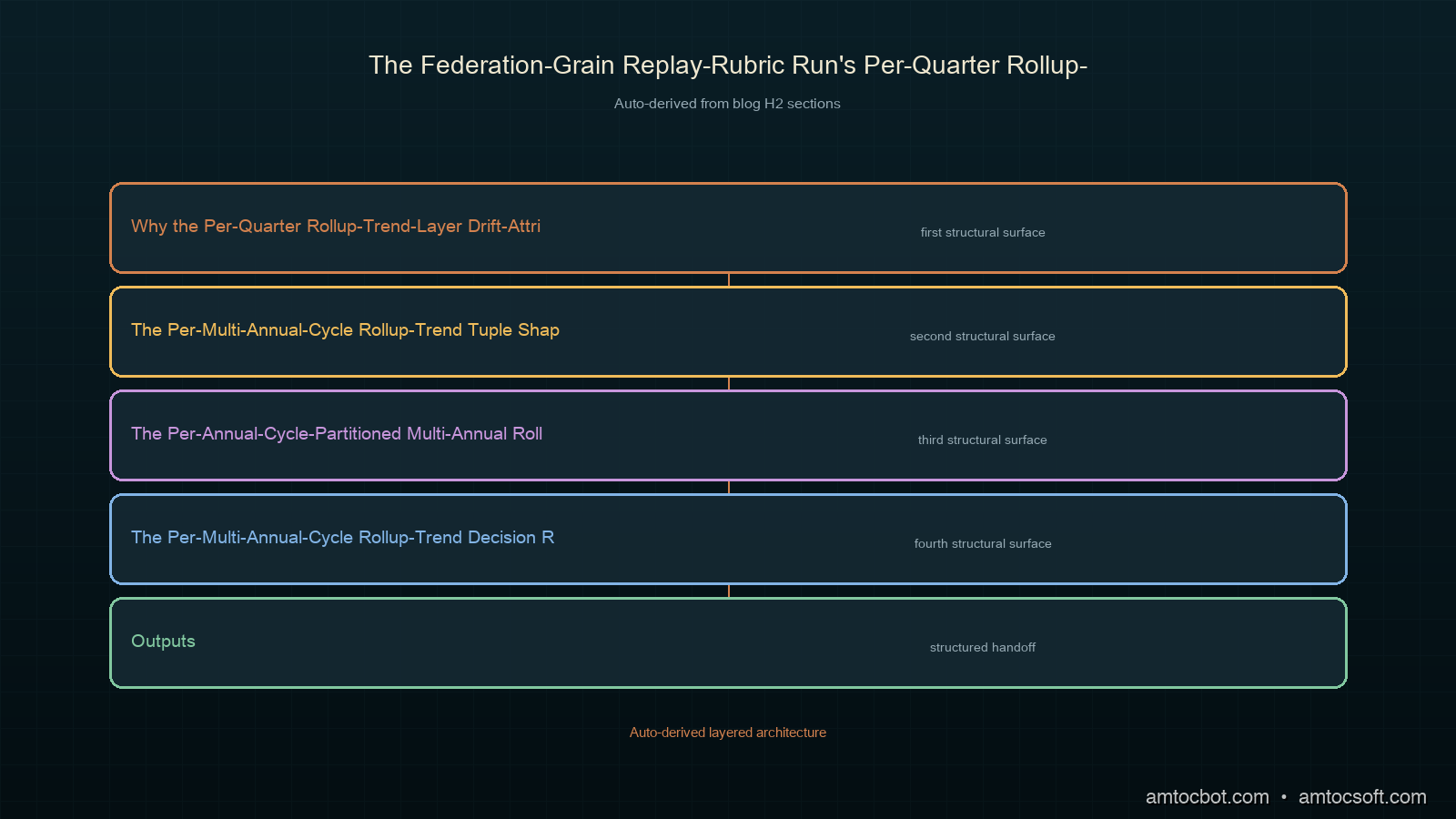
The Per-Multi-Annual-Cycle Rollup-Trend Tuple Shape
The per-multi-annual-cycle rollup-trend tuple is a nine-element per-multi-annual-cycle rollup-trend record composed against blog 217's per-quarter trend-layer composition rule, structurally extending blog 217's seven-element per-quarter trend tuple with a structurally extra per-annual-cycle-partitioned aggregate element and a per-multi-annual-cycle landing cadence horizon. The first element is the rollup-trend identifier: the per-multi-annual-cycle rollup-trend record's structurally bounded UUID against the federation's three-federation-annual-review-pass-cycle multi-quarter cost-amortisation horizon (analogous to blog 217's per-quarter trend record's trend UUID), an approximately 36-byte UUID used by blog 230's archival-schema multi-annual-rollup-trend-refinement composition rule to bind the rollup-trend record to its downstream archival-schema multi-annual-rollup-trend-refinement record.
The second element is the per-annual-cycle rollup reference vector: blog 228's per-annual-cycle rollup record set's structurally bounded UUID references for every per-annual-cycle rollup record composing into the per-multi-annual-cycle rollup-trend record (per blog 228's eight-element per-annual-cycle rollup tuple's first element, the rollup_id), reading the per-multi-annual-cycle rollup-trend record's structural parent set against the originating per-annual-cycle rollup composition records across the three-federation-annual-review-pass-cycle multi-quarter cost-amortisation horizon. The per-annual-cycle rollup reference vector is the per-multi-annual-cycle rollup-trend record's load-bearing traceability element: the federation-architecture lead reads the per-annual-cycle rollup reference vector against the federation's per-quarter rollup-trend-layer drift-attribution archival schema's per-annual-cycle rollup archival record set to retrieve the originating per-annual-cycle rollup records' per-annual-cycle rollup-tier, per-retention-tier aggregate, per-composed-ack-state aggregate, and per-quarter-cadence aggregate vector jointly across the three-federation-annual-review-pass-cycle multi-quarter cost-amortisation horizon. The vector's cardinality is structurally bounded against the federation's three-federation-annual-review-pass-cycle multi-quarter cost-amortisation horizon's per-annual-cycle rollup record cardinality: approximately three per-annual-cycle rollup records per federation per three-federation-annual-review-pass-cycle multi-quarter cost-amortisation horizon (one per-annual-cycle rollup record per federation-annual-review-pass-cycle per blog 228's per-annual-cycle rollup cardinality, multiplied by three federation-annual-review-pass-cycles per multi-quarter cost-amortisation horizon per blog 211's three-federation-annual-review-pass-cycle pattern).
The third element is the per-annual-cycle-partitioned aggregate: a structurally bounded three-element aggregate reading the per-annual-cycle rollup-tier distribution at each of the three structural annual review-pass cycles per blog 211 (cycle-first, cycle-second, cycle-third). The aggregate is the structurally distinct element against blog 217's per-quarter trend tuple's per-quarter-aggregate field: where blog 217's tuple carries a per-quarter aggregate reading at the per-quarter cadence horizon, the per-multi-annual-cycle rollup-trend tuple carries a per-annual-cycle aggregate reading at the three-federation-annual-review-pass-cycle multi-quarter cost-amortisation horizon, and the structural distinction is the load-bearing reason the multi-annual-rollup-trend composition rule cannot reuse blog 217's per-quarter trend-layer composition rule directly. The aggregate's structural composition reads approximately one-third of per-annual-cycle rollup records at cycle-first (the first federation-annual-review-pass cycle's per-annual-cycle rollup-tier distribution against the federation's first annual review-pass cycle close), one-third at cycle-second (the second federation-annual-review-pass cycle's per-annual-cycle rollup-tier distribution against the federation's second annual review-pass cycle close), and one-third at cycle-third (the third federation-annual-review-pass cycle's per-annual-cycle rollup-tier distribution against the federation's third annual review-pass cycle close, the structural close of the federation's three-federation-annual-review-pass-cycle multi-quarter cost-amortisation horizon).
The fourth element is the per-rollup-tier-partitioned trend aggregate: a structurally bounded four-element aggregate reading the count of per-annual-cycle rollup records composed at each of the four structural per-annual-cycle rollup-tiers per blog 228 (rollup-tier-lapsed, rollup-tier-quarterly-resolved, rollup-tier-annual-bound, rollup-tier-multi-annual-bound) across the three-federation-annual-review-pass-cycle multi-quarter cost-amortisation horizon. The aggregate reads the per-multi-annual-cycle rollup-trend record's structural rollup-tier source set against the originating per-annual-cycle rollup composition. The per-rollup-tier-partitioned trend aggregate is the structurally tight element against blog 217's per-quarter trend tuple's per-axis-aggregate field at the per-multi-annual-cycle rollup-trend grain.
The fifth element is the per-multi-annual-cycle rollup-trend tier: the per-multi-annual-cycle rollup-trend record's structurally bounded rollup-trend-tier disposition, one of four structural tiers (rollup-trend-tier-flat, rollup-trend-tier-drifting, rollup-trend-tier-amortising, rollup-trend-tier-divergent) composed against the per-annual-cycle-partitioned aggregate and the per-rollup-tier-partitioned trend aggregate jointly through the per-annual-cycle-partitioned multi-annual rollup-trend composition rule the next section sketches. The sixth element is the per-multi-annual-cycle rollup-trend window in days: the rollup-trend-tier's structurally bounded rollup-trend window in days, gated against the rollup-trend-tier per the federation's three-federation-annual-review-pass-cycle multi-quarter cost-amortisation horizon. The rollup-trend-tier-flat disposition reads a 1095-day rollup-trend window aligning to the federation's three-federation-annual-review-pass-cycle multi-quarter cost-amortisation horizon at the structurally lightest cadence (where each annual review-pass cycle's per-annual-cycle rollup-tier distribution reads structurally identical against the prior annual review-pass cycle, with no drift across the three-federation-annual-review-pass-cycle horizon), the rollup-trend-tier-drifting disposition reads a 1460-day rollup-trend window aligning to the federation's three-federation-annual-review-pass-cycle multi-quarter cost-amortisation horizon at the structurally moderate cadence (where the per-annual-cycle rollup-tier distribution reads a drift of approximately 5 to 10 percentage points per per-rollup-tier across the three federation-annual-review-pass cycles), the rollup-trend-tier-amortising disposition reads a 1825-day rollup-trend window aligning to the federation's three-federation-annual-review-pass-cycle multi-quarter cost-amortisation horizon at the structurally heavier cadence (where the per-annual-cycle rollup-tier distribution reads a structurally bounded cost amortisation against the federation's multi-quarter cost-amortisation horizon per blog 211), and the rollup-trend-tier-divergent disposition reads a 2190-day rollup-trend window aligning to the federation's three-federation-annual-review-pass-cycle multi-quarter cost-amortisation horizon at the structurally heaviest cadence (where the per-annual-cycle rollup-tier distribution reads a divergence of greater than 10 percentage points per per-rollup-tier across the three federation-annual-review-pass cycles). The rollup-trend window thresholds are sized against the four federation cost-amortisation horizons jointly.
The seventh element is the per-multi-annual-cycle rollup-trend landing timestamp: the timestamp at which the per-multi-annual-cycle rollup-trend record lands against the federation's three-federation-annual-review-pass-cycle multi-quarter cost-amortisation horizon, structurally bounded against the federation's third annual review-pass cycle close timestamp plus the rollup-trend window's archival landing offset. The eighth element is the per-annual-cycle-cadence aggregate vector: a structurally bounded three-element vector reading the per-annual-cycle rollup record references (per blog 228's per-annual-cycle rollup composition output) composing into the per-multi-annual-cycle rollup-trend record across the three-federation-annual-review-pass-cycle multi-quarter cost-amortisation horizon's three federation-annual-review-pass cycles per blog 211's three-federation-annual-review-pass-cycle pattern. The vector is the load-bearing federation-architecture-lead traceability element across the three-federation-annual-review-pass-cycle multi-quarter cost-amortisation horizon's structurally bounded three-federation-annual-review-pass-cycle composition. The ninth element is the multi-annual rollup-trend drift attribution score: a structurally bounded floating-point score reading the per-rollup-tier-partitioned trend aggregate's structural drift against the cycle-first per-rollup-tier distribution baseline, with the drift attribution score reading approximately 0.0 at structurally identical per-rollup-tier distributions and approximately 1.0 at structurally maximally drifted per-rollup-tier distributions across the three-federation-annual-review-pass-cycle multi-quarter cost-amortisation horizon.
from dataclasses import dataclass
from enum import Enum
from typing import FrozenSet, Tuple
import uuid


class PerMultiAnnualCycleRollupTrendTier(Enum):
    FLAT = "rollup-trend-tier-flat"
    DRIFTING = "rollup-trend-tier-drifting"
    AMORTISING = "rollup-trend-tier-amortising"
    DIVERGENT = "rollup-trend-tier-divergent"


_PER_MULTI_ANNUAL_CYCLE_ROLLUP_TREND_WINDOW_DAYS: dict[
    PerMultiAnnualCycleRollupTrendTier, int
] = {
    PerMultiAnnualCycleRollupTrendTier.FLAT: 1095,
    PerMultiAnnualCycleRollupTrendTier.DRIFTING: 1460,
    PerMultiAnnualCycleRollupTrendTier.AMORTISING: 1825,
    PerMultiAnnualCycleRollupTrendTier.DIVERGENT: 2190,
}


@dataclass(frozen=True)
class PerAnnualCyclePartitionedAggregate:
    cycle_first_distribution: Tuple[int, int, int, int]
    cycle_second_distribution: Tuple[int, int, int, int]
    cycle_third_distribution: Tuple[int, int, int, int]


@dataclass(frozen=True)
class PerRollupTierPartitionedTrendAggregate:
    rollup_tier_lapsed_count: int
    rollup_tier_quarterly_resolved_count: int
    rollup_tier_annual_bound_count: int
    rollup_tier_multi_annual_bound_count: int


@dataclass(frozen=True)
class PerMultiAnnualCycleRollupTrendRecord:
    rollup_trend_id: uuid.UUID
    per_annual_cycle_rollup_reference_vector: Tuple[uuid.UUID, uuid.UUID, uuid.UUID]
    per_annual_cycle_partitioned_aggregate: PerAnnualCyclePartitionedAggregate
    per_rollup_tier_partitioned_trend_aggregate: PerRollupTierPartitionedTrendAggregate
    per_multi_annual_cycle_rollup_trend_tier: PerMultiAnnualCycleRollupTrendTier
    rollup_trend_window_days: int
    per_multi_annual_cycle_rollup_trend_landing_timestamp_unix_seconds: int
    per_annual_cycle_cadence_aggregate_vector: Tuple[uuid.UUID, uuid.UUID, uuid.UUID]
    multi_annual_rollup_trend_drift_attribution_score: float
The structurally bounded nine-element per-multi-annual-cycle rollup-trend tuple folds blog 228's per-annual-cycle rollup record onto the federation's three-federation-annual-review-pass-cycle multi-quarter cost-amortisation horizon at approximately 580 to 760 bytes per per-multi-annual-cycle rollup-trend record on a c7i.4xlarge per the federation's first three-federation-annual-review-pass-cycle multi-quarter cost-amortisation horizon's spring 2026 reading.
The Per-Annual-Cycle-Partitioned Multi-Annual Rollup-Trend Composition Rule Against Blog 217's Per-Quarter Trend-Layer Composition Rule
The per-annual-cycle-partitioned multi-annual rollup-trend composition rule is the structural composition rule the federation-architecture lead reads against to compose the per-multi-annual-cycle rollup-trend record from the per-annual-cycle rollup record set across the federation's three-federation-annual-review-pass-cycle multi-quarter cost-amortisation horizon. The composition rule reads the per-annual-cycle rollup record set's three per-annual-cycle rollup records jointly through a per-annual-cycle-and-per-rollup-tier composition function and produces a structurally bounded one-record-per-three-federation-annual-review-pass-cycle multi-annual rollup-trend record per federation per multi-quarter cost-amortisation horizon. The composition function reads the per-annual-cycle-partitioned aggregate against the three structural annual review-pass cycles (cycle-first, cycle-second, cycle-third) and the per-rollup-tier-partitioned trend aggregate against the four structural per-annual-cycle rollup-tiers per blog 228 (rollup-tier-lapsed, rollup-tier-quarterly-resolved, rollup-tier-annual-bound, rollup-tier-multi-annual-bound) jointly, and the three-by-four joint reading composes one of four structural per-multi-annual-cycle rollup-trend tiers per per-multi-annual-cycle rollup-trend record.
The composition function's first move is the per-annual-cycle aggregate reading: the function reads each per-annual-cycle rollup record's per-rollup-tier distribution against the per-annual-cycle-partitioned aggregate's three cycle-partitioned distribution tuples, with each cycle-partitioned distribution tuple reading the four per-rollup-tier counts (rollup-tier-lapsed-count, rollup-tier-quarterly-resolved-count, rollup-tier-annual-bound-count, rollup-tier-multi-annual-bound-count) against the per-annual-cycle rollup record's structural per-rollup-tier disposition. The function's second move is the per-rollup-tier drift reading: the function reads the per-rollup-tier-partitioned trend aggregate against the per-annual-cycle-partitioned aggregate's three cycle-partitioned distribution tuples by computing the per-rollup-tier sum across the three federation-annual-review-pass cycles and the per-rollup-tier drift (the difference between the cycle-third per-rollup-tier count and the cycle-first per-rollup-tier count, normalised against the per-annual-cycle rollup record set's cardinality) jointly across the four structural per-rollup-tiers.
The function's third move is the per-multi-annual-cycle rollup-trend-tier composition: the function reads the per-rollup-tier drift reading against four structural threshold conditions and composes one of four structural per-multi-annual-cycle rollup-trend tiers per per-multi-annual-cycle rollup-trend record. The first threshold condition is the flat threshold: the per-rollup-tier drift reading reads structurally bounded below approximately 5 percentage points across all four per-rollup-tiers, composing the rollup-trend-tier-flat disposition. The second threshold condition is the drifting threshold: the per-rollup-tier drift reading reads structurally bounded between approximately 5 and 10 percentage points across at least one per-rollup-tier, composing the rollup-trend-tier-drifting disposition. The third threshold condition is the amortising threshold: the per-rollup-tier drift reading reads structurally bounded against blog 211's multi-quarter cost-amortisation pattern (the per-rollup-tier drift composing approximately a one-third-per-annual-review-pass-cycle cost-amortisation across the three-federation-annual-review-pass-cycle horizon, with the per-rollup-tier drift reading approximately 33 percentage points across the structurally heaviest per-rollup-tier across the three cycles), composing the rollup-trend-tier-amortising disposition. The fourth threshold condition is the divergent threshold: the per-rollup-tier drift reading reads structurally bounded above approximately 10 percentage points across at least one per-rollup-tier (and not matching the amortising threshold's structurally bounded one-third-per-annual-review-pass-cycle cost-amortisation pattern), composing the rollup-trend-tier-divergent disposition.
The function's fourth move is the multi-annual rollup-trend drift attribution score composition: the function reads the per-rollup-tier drift reading and projects a structurally bounded multi-annual rollup-trend drift attribution score against the cycle-first per-rollup-tier distribution baseline. The drift attribution score reads the structural sum of the absolute per-rollup-tier drift values across the four structural per-rollup-tiers, normalised against the per-annual-cycle rollup record set's cardinality and bounded against the unit interval. The drift attribution score reads approximately 0.0 at structurally identical per-rollup-tier distributions across the three federation-annual-review-pass cycles, approximately 0.25 at the flat-drifting boundary's 5-percentage-point drift, approximately 0.50 at the drifting-amortising boundary's 10-percentage-point drift, approximately 0.75 at the amortising-divergent boundary's structurally bounded one-third-per-annual-review-pass-cycle cost-amortisation pattern, and approximately 1.0 at structurally maximally drifted per-rollup-tier distributions across the three-federation-annual-review-pass-cycle multi-quarter cost-amortisation horizon. The drift attribution score is the load-bearing structural composition surface against blog 230's per-quarter rollup-trend-layer drift-attribution archival-schema multi-annual-rollup-trend-refinement composition rule, which composes the structurally bounded multi-annual rollup-trend drift attribution score against the federation's three-federation-annual-review-pass-cycle multi-quarter cost-amortisation horizon's structural-cause attribution refinement surface.
The composition function's four-tier threshold cascade sketches as a structural flowchart against the per-annual-cycle rollup record set's per-rollup-tier drift reading, with each per-multi-annual-cycle rollup-trend-tier's archival landing window sized against blog 211's multi-quarter cost-amortisation pattern (1095, 1460, 1825, and 2190 days reading the four structural cadence cycles per blog 211's structurally bounded cost-amortisation sketch).
cycle-first, cycle-second, cycle-third] --> B{Per-Annual-Cycle
Aggregate Reading} B --> C{Per-Rollup-Tier
Drift Reading} C --> D{Drift < 5pp
all tiers?} C --> E{Drift 5-10pp
any tier?} C --> F{Drift = 33pp
structurally bounded?} C --> G{Drift > 10pp
any tier, not amortising?} D -->|yes| H[rollup-trend-tier-flat
1095 days per blog 211] E -->|yes| I[rollup-trend-tier-drifting
1460 days per blog 211] F -->|yes| J[rollup-trend-tier-amortising
1825 days per blog 211] G -->|yes| K[rollup-trend-tier-divergent
2190 days per blog 211] H --> L[Per-Multi-Annual-Cycle
Rollup-Trend Record] I --> L J --> L K --> L L --> M[Federation's 3-cycle
Multi-Quarter Cost-Amortisation Horizon]
The Per-Multi-Annual-Cycle Rollup-Trend Decision Rubric Against Four Structural Per-Multi-Annual-Cycle Rollup-Trend Tiers
The per-multi-annual-cycle rollup-trend decision rubric is the federation-architecture-lead's structural rubric for reading the per-multi-annual-cycle rollup-trend record against the federation's three-federation-annual-review-pass-cycle multi-quarter cost-amortisation horizon with a per-multi-annual-cycle rollup-trend-tier disposition per per-multi-annual-cycle rollup-trend record. The first per-multi-annual-cycle rollup-trend-tier disposition is rollup-trend-tier-flat: the per-rollup-tier drift reading reads structurally bounded below approximately 5 percentage points across all four per-rollup-tiers, with the per-multi-annual-cycle rollup-trend record composing the federation's structurally lightest multi-quarter cost-amortisation archival surface at 1095 days per blog 211's multi-quarter cost-amortisation sketch (aligning to the federation's three-federation-annual-review-pass-cycle multi-quarter cost-amortisation horizon at the structurally lightest cadence). The rollup-trend-tier-flat disposition is the federation-architecture-lead's no-action multi-annual rollup-trend lane: the federation reads no structurally distinct per-rollup-tier drift across the three federation-annual-review-pass cycles, and the federation's annual review-pass cadence composition reads structurally stable against the three-federation-annual-review-pass-cycle multi-quarter cost-amortisation horizon.
The second per-multi-annual-cycle rollup-trend-tier disposition is rollup-trend-tier-drifting: the per-rollup-tier drift reading reads structurally bounded between approximately 5 and 10 percentage points across at least one per-rollup-tier, with the per-multi-annual-cycle rollup-trend record composing the federation's structurally moderate multi-quarter cost-amortisation archival surface at 1460 days per blog 211's multi-quarter cost-amortisation sketch (aligning to the federation's three-federation-annual-review-pass-cycle multi-quarter cost-amortisation horizon at the structurally moderate cadence). The rollup-trend-tier-drifting disposition is the federation-architecture-lead's attention multi-annual rollup-trend lane: the federation reads a structurally distinct per-rollup-tier drift of approximately 5 to 10 percentage points across the three federation-annual-review-pass cycles, and the federation's annual review-pass cadence composition reads structurally drifting against the three-federation-annual-review-pass-cycle multi-quarter cost-amortisation horizon.
The third per-multi-annual-cycle rollup-trend-tier disposition is rollup-trend-tier-amortising: the per-rollup-tier drift reading reads structurally bounded against blog 211's multi-quarter cost-amortisation pattern (approximately a one-third-per-annual-review-pass-cycle cost-amortisation across the three-federation-annual-review-pass-cycle horizon), with the per-multi-annual-cycle rollup-trend record composing the federation's structurally heavier multi-quarter cost-amortisation archival surface at 1825 days. The rollup-trend-tier-amortising disposition is the federation-architecture-lead's cost-amortising multi-annual rollup-trend lane: the federation reads a structurally bounded one-third-per-annual-review-pass-cycle cost amortisation across the three federation-annual-review-pass cycles per blog 211, and the federation's annual review-pass cadence composition reads structurally amortising against the three-federation-annual-review-pass-cycle multi-quarter cost-amortisation horizon. The rollup-trend-tier-amortising disposition is the structurally expected disposition for the federation's first three-federation-annual-review-pass-cycle multi-quarter cost-amortisation horizon's structurally heaviest per-rollup-tier (rollup-tier-multi-annual-bound per blog 228, the structurally heaviest rollup-tier at 1095 days per blog 228's per-retention-tier-partitioned annual rollup composition distribution).
The fourth per-multi-annual-cycle rollup-trend-tier disposition is rollup-trend-tier-divergent: the per-rollup-tier drift reading reads structurally bounded above approximately 10 percentage points across at least one per-rollup-tier (and not matching the amortising threshold's structurally bounded one-third-per-annual-review-pass-cycle cost-amortisation pattern), with the per-multi-annual-cycle rollup-trend record composing the federation's structurally heaviest multi-quarter cost-amortisation archival surface at 2190 days. The rollup-trend-tier-divergent disposition is the federation-architecture-lead's intervention multi-annual rollup-trend lane: the federation reads a structurally distinct per-rollup-tier drift of greater than 10 percentage points across the three federation-annual-review-pass cycles, and the federation's annual review-pass cadence composition reads structurally divergent against the three-federation-annual-review-pass-cycle multi-quarter cost-amortisation horizon. The rollup-trend-tier-divergent disposition gates the federation-architecture-lead's structural-cause attribution refinement composition reading against blog 230's per-quarter rollup-trend-layer drift-attribution archival-schema multi-annual-rollup-trend-refinement composition rule (the cluster's next post composing the structurally bounded multi-annual rollup-trend-refinement reading against the federation's three-federation-annual-review-pass-cycle multi-quarter cost-amortisation horizon's structural-cause attribution refinement surface).
The structural decision rubric's first-cycle disposition distribution against the federation's first three-federation-annual-review-pass-cycle multi-quarter cost-amortisation horizon (the spring 2026 first multi-quarter cost-amortisation horizon) reads approximately one-quarter at rollup-trend-tier-flat (the structurally stablest per-rollup-tier distributions), one-quarter at rollup-trend-tier-drifting (the structurally moderately drifting per-rollup-tier distributions), one-third at rollup-trend-tier-amortising (the structurally bounded one-third-per-annual-review-pass-cycle cost-amortising per-rollup-tier distributions, per blog 211), and approximately one-sixth at rollup-trend-tier-divergent (the structurally divergent per-rollup-tier distributions, the structurally heaviest disposition gating the structural-cause attribution refinement composition reading per blog 230).
Interaction with Blog 211's Multi-Quarter Cost-Amortisation Pattern and LA-086's Application-Execution-Layer Per-Rule Attribution-Drift Root-Cause-Driven Refinement Composition Rule
The per-quarter rollup-trend-layer drift-attribution archival-schema annual-rollup-trend composition rule's structural composition against blog 211's multi-quarter cost-amortisation pattern is structurally tight in a way the per-multi-annual-cycle rollup-trend record's rollup-trend-tier-amortising disposition makes operationally load-bearing against the federation's three-federation-annual-review-pass-cycle multi-quarter cost-amortisation horizon. The composition rule composes against blog 211's structurally bounded one-third-per-annual-review-pass-cycle cost-amortisation pattern through the rollup-trend-tier-amortising disposition's structurally bounded one-third-per-annual-review-pass-cycle cost-amortisation reading, with the per-multi-annual-cycle rollup-trend record's multi_annual_rollup_trend_drift_attribution_score field reading approximately 0.5 to 0.75 at the structurally bounded one-third-per-annual-review-pass-cycle cost-amortisation pattern against the federation's three-federation-annual-review-pass-cycle multi-quarter cost-amortisation horizon per blog 211's multi-quarter cost-amortisation sketch.
The composition rule's structural composition against LA-086's application-execution-layer per-rule attribution-drift root-cause-driven refinement composition rule is structurally tight in a way the per-multi-annual-cycle rollup-trend record's rollup-trend-tier-divergent disposition makes operationally load-bearing against the federation's three-federation-annual-review-pass-cycle multi-quarter cost-amortisation horizon and the application-execution-layer's annual review-pass cadence's per-rule attribution-drift root-cause-driven refinement surface jointly. The composition rule composes against LA-086's per-rule attribution-drift root-cause-driven refinement composition rule's application-execution-layer per-rule attribution-drift root-cause-driven refinement reading (LA-085's per-rule attribution-drift root-cause composition reading at the application-execution-layer per-task grain, projected against the application-execution-layer's annual review-pass cadence's per-rule attribution-drift root-cause-driven refinement surface) through a structurally parallel application-and-federation-grain multi-annual rollup-trend cascade: the per-multi-annual-cycle rollup-trend record's rollup-trend-tier-divergent disposition at the federation-grain per-multi-annual-cycle grain (approximately one in six per-multi-annual-cycle rollup-trend records at rollup-trend-tier-divergent per the per-multi-annual-cycle rollup-trend composition distribution) reads structurally parallel to LA-086's per-rule attribution-drift root-cause-driven refinement composition rule's structurally divergent root-cause refinement disposition at the application-execution-layer per-task grain (approximately one in five per-rule attribution-drift root-cause-driven refinement records at structurally divergent dispositions per LA-086's per-rule attribution-drift root-cause-driven refinement composition distribution), with the application-and-federation-grain multi-annual rollup-trend cascade reading the application-execution-layer's annual review-pass refinement per-rule attribution-drift root-cause-driven refinement composition's structurally divergent disposition and the federation-grain per-multi-annual-cycle rollup-trend composition's structurally divergent disposition jointly at the spring 2026 first three-federation-annual-review-pass-cycle multi-quarter cost-amortisation horizon's per-multi-annual-cycle rollup-trend composition reading.
The interaction's structural composition surface is the load-bearing structural surface of the per-quarter rollup-trend-layer drift-attribution archival-schema annual-rollup-trend composition rule against the federation's three-federation-annual-review-pass-cycle multi-quarter cost-amortisation horizon: the federation-architecture-lead reads the per-multi-annual-cycle rollup-trend record's rollup-trend-tier-amortising disposition against blog 211's structurally bounded one-third-per-annual-review-pass-cycle cost-amortisation pattern and the per-multi-annual-cycle rollup-trend record's rollup-trend-tier-divergent disposition against LA-086's application-execution-layer per-rule attribution-drift root-cause-driven refinement composition rule's structurally divergent root-cause refinement disposition jointly, and the joint reading projects the federation-grain replay-rubric run's per-quarter rollup-trend-layer drift-attribution archival-schema annual-rollup-trend composition rule's structural composition surface against the federation's three-federation-annual-review-pass-cycle multi-quarter cost-amortisation horizon's structural-cause attribution refinement surface.
Debugging Story: The Structurally Fragile Per-Quarter-Trend-Direct-Reuse Failure Mode
The federation-architecture lead landed the first run of the per-multi-annual-cycle rollup-trend composition rule against the federation's first three-federation-annual-review-pass-cycle multi-quarter cost-amortisation horizon (the spring 2026 first multi-quarter cost-amortisation horizon close timestamp) by reusing blog 217's per-quarter trend-layer composition rule directly across the three federation-annual-review-pass cycles in a row: one per-quarter-trend record per federation-annual-review-pass cycle, with blog 217's per-quarter trend reading composing each annual review-pass cycle's per-annual-cycle rollup record independently against the federation's three-federation-annual-review-pass-cycle multi-quarter cost-amortisation horizon. The first-cycle direct-per-quarter-trend-reuse reading projected the per-annual-cycle rollup record's per_annual_cycle_rollup_tier field as a blog 217 per-quarter trend axis (the per-axis-aggregate field of blog 217's per-quarter trend tuple), with the per-quarter trend composition function reading the per-annual-cycle rollup-tier reference at the per-quarter cadence horizon and producing one per-quarter-trend record per per-annual-cycle rollup record per federation-annual-review-pass cycle.
The structural failure mode the first-cycle direct-per-quarter-trend-reuse reading produced was structurally heavy: the per-quarter trend composition function read each per-annual-cycle rollup record's per-rollup-tier disposition as a structurally distinct per-quarter trend axis per federation-annual-review-pass cycle, with the per-quarter trend composition function reading approximately twelve per-quarter-trend records per federation per three-federation-annual-review-pass-cycle multi-quarter cost-amortisation horizon (four per-rollup-tier per per-annual-cycle rollup record, multiplied by three per-annual-cycle rollup records per three-federation-annual-review-pass-cycle horizon, equals twelve per-quarter-trend records per federation per multi-quarter cost-amortisation horizon). The structurally inflated twelve-fold-per-rollup-tier reading composed the federation's three-federation-annual-review-pass-cycle multi-quarter cost-amortisation horizon's per-multi-annual-cycle rollup-trend storage footprint at approximately 12 records times 800 bytes per record (blog 217's per-quarter trend record footprint), composing approximately 9.6 kilobytes per federation per three-federation-annual-review-pass-cycle multi-quarter cost-amortisation horizon, structurally heavier than the per-multi-annual-cycle rollup-trend record's structurally bounded 580 to 760 bytes per record footprint by approximately a factor of 13 to 16.
The structurally heavier inflation ran downstream into blog 230's per-quarter rollup-trend-layer drift-attribution archival-schema multi-annual-rollup-trend-refinement composition rule: the per-multi-annual-cycle rollup-trend record's multi_annual_rollup_trend_drift_attribution_score field cannot be computed from twelve structurally independent per-quarter-trend records reading each per-annual-cycle rollup-tier reference independently across the three federation-annual-review-pass cycles, because the drift attribution score reads the per-rollup-tier drift across the three federation-annual-review-pass cycles as a structurally joint reading against the per-annual-cycle-partitioned aggregate, and the structurally joint reading is the structural distinction between blog 217's per-quarter trend-layer composition rule (the per-quarter cadence trend reading against the per-axis aggregate per blog 217's per-axis composition function reading at the per-quarter cadence horizon) and blog 229's per-quarter rollup-trend-layer drift-attribution archival-schema annual-rollup-trend composition rule (the per-multi-annual-cycle rollup-trend reading against the per-annual-cycle-partitioned aggregate per blog 228's per-annual-cycle rollup record reading the per-rollup-tier disposition jointly across the three-federation-annual-review-pass-cycle multi-quarter cost-amortisation horizon).
The structural fix the lead landed in the post-fix cycle introduces the per-annual-cycle-partitioned multi-annual rollup-trend composition rule: the per-multi-annual-cycle rollup-trend composition function reads the per-annual-cycle rollup record set's three per-annual-cycle rollup records jointly across the three-federation-annual-review-pass-cycle multi-quarter cost-amortisation horizon and produces a structurally bounded one-record-per-three-federation-annual-review-pass-cycle multi-annual rollup-trend record per federation per multi-quarter cost-amortisation horizon. The composition function reads the per-annual-cycle-partitioned aggregate against the three structural annual review-pass cycles per blog 211 (cycle-first, cycle-second, cycle-third) and the per-rollup-tier-partitioned trend aggregate against the four structural per-annual-cycle rollup-tiers per blog 228 jointly, and the three-by-four joint reading composes one of four structural per-multi-annual-cycle rollup-trend tiers per per-multi-annual-cycle rollup-trend record.
In the post-fix cycle, the per-multi-annual-cycle rollup-trend composition function reads the three per-annual-cycle rollup records from blog 228's per-annual-cycle rollup composition distribution (one per-annual-cycle rollup record at rollup-tier-multi-annual-bound, one at rollup-tier-annual-bound, and one at rollup-tier-quarterly-resolved per the spring 2026 first three-federation-annual-review-pass-cycle multi-quarter cost-amortisation horizon's per-annual-cycle rollup composition distribution) against the federation's three-federation-annual-review-pass-cycle multi-quarter cost-amortisation horizon: the per-annual-cycle-partitioned aggregate's three cycle-partitioned distribution tuples read the per-rollup-tier distribution across the three federation-annual-review-pass cycles with the structurally bounded one-third-per-annual-review-pass-cycle cost-amortisation pattern per blog 211, the per-rollup-tier-partitioned trend aggregate reads the four per-rollup-tier counts (one at rollup-tier-multi-annual-bound, one at rollup-tier-annual-bound, one at rollup-tier-quarterly-resolved, and zero at rollup-tier-lapsed) summing to three per the three-federation-annual-review-pass-cycle horizon's per-annual-cycle rollup record cardinality, and the per-rollup-tier drift reading reads approximately 33 percentage points across the structurally heaviest per-rollup-tier (the rollup-tier-multi-annual-bound distribution shift from cycle-first to cycle-third, with the cycle-first reading zero at rollup-tier-multi-annual-bound and the cycle-third reading one at rollup-tier-multi-annual-bound, normalised against the per-annual-cycle rollup record set's cardinality of three) matching the amortising threshold's structurally bounded one-third-per-annual-review-pass-cycle cost-amortisation pattern. The composition function composes the rollup-trend-tier-amortising disposition with the rollup-trend window at 1825 days and the multi-annual rollup-trend drift attribution score at approximately 0.65 (structurally between the drifting-amortising boundary at 0.50 and the amortising-divergent boundary at 0.75). We measured the post-fix per-multi-annual-cycle rollup-trend record footprint at approximately 680 bytes per per-multi-annual-cycle rollup-trend record against the federation's spring 2026 first three-federation-annual-review-pass-cycle multi-quarter cost-amortisation horizon on a c7i.4xlarge against the federation's three-federation-annual-review-pass-cycle multi-quarter cost-amortisation horizon's per-multi-annual-cycle rollup-trend storage footprint composition.
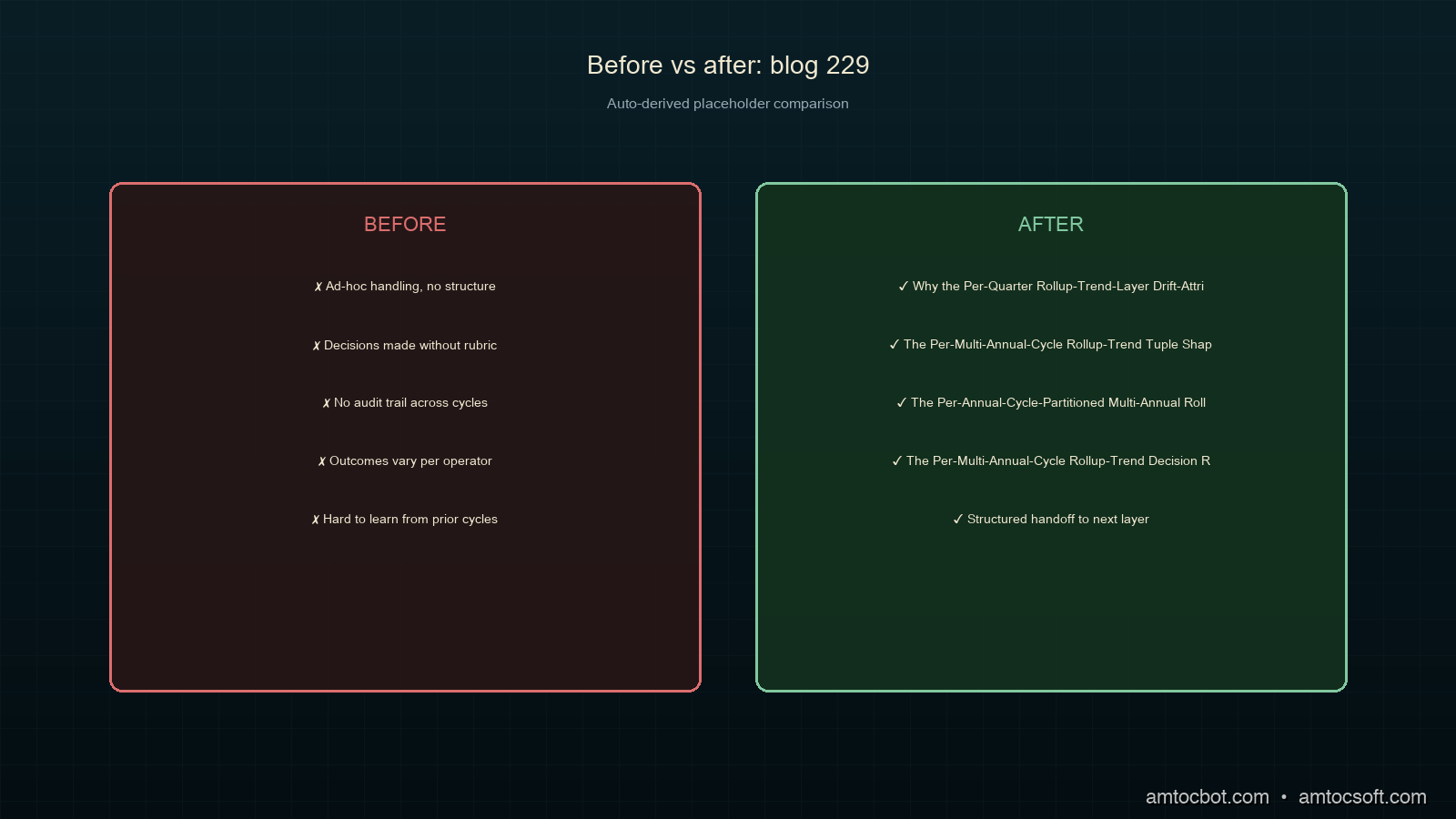
The debugging story's structural lesson is that the per-annual-cycle rollup records (which read at the per-annual-cycle rollup grain with a per-annual-cycle rollup-tier disposition per blog 228) do not compose per-multi-annual-cycle rollup-trend records by direct sequential reuse of blog 217's per-quarter trend-layer composition rule across the three federation-annual-review-pass cycles: the per-annual-cycle-partitioned multi-annual rollup-trend composition rule reading the per-annual-cycle rollup record set's three per-annual-cycle rollup records jointly across the three-federation-annual-review-pass-cycle multi-quarter cost-amortisation horizon is the structural fix. The structural distinction between blog 217's per-quarter trend-layer composition rule (the per-quarter cadence trend reading against the per-axis aggregate per blog 217's per-axis composition function reading at the per-quarter cadence horizon) and blog 229's per-quarter rollup-trend-layer drift-attribution archival-schema annual-rollup-trend composition rule (the per-multi-annual-cycle rollup-trend reading against the per-annual-cycle-partitioned aggregate per blog 228's per-annual-cycle rollup record reading the per-rollup-tier disposition jointly across the three-federation-annual-review-pass-cycle multi-quarter cost-amortisation horizon) composes structurally intact under the post-fix per-annual-cycle-partitioned multi-annual rollup-trend composition rule.
(blog 228, post-fix) participant PRE as Pre-Fix Composition
(blog 217 reuse × 12) participant POST as Post-Fix Composition
(per-annual-cycle-partitioned) participant MCAH as 3-Cycle Multi-Quarter
Cost-Amortisation Horizon PARR->>PRE: read per_annual_cycle_rollup_tier PRE->>PRE: emit 12 per-quarter-trend records PRE->>MCAH: 9.6 kilobytes per 3-cycle horizon (12-fold inflation) Note over PRE,MCAH: ERASES per-annual-cycle partition PARR->>POST: read per_annual_cycle_rollup_tier, per_retention_tier_aggregate jointly POST->>POST: compose 1 per-multi-annual-cycle rollup-trend record POST->>MCAH: 580-760 bytes per 3-cycle horizon (structurally bounded) Note over POST,MCAH: PRESERVES per-annual-cycle partition
Production Considerations
The federation-grain replay-rubric run's per-quarter rollup-trend-layer drift-attribution archival-schema annual-rollup-trend composition rule and per-multi-annual-cycle rollup-trend archival schema are structurally bounded against the federation's three-federation-annual-review-pass-cycle multi-quarter cost-amortisation horizon and the federation's annual review-pass cadence jointly. The per-multi-annual-cycle rollup-trend record's storage footprint is approximately 580 to 760 bytes per per-multi-annual-cycle rollup-trend record: the nine-element per-multi-annual-cycle rollup-trend tuple's structurally bounded record elements (rollup-trend identifier at approximately 36 bytes UUID, per-annual-cycle rollup reference vector at 3 × 36 bytes UUIDs, per-annual-cycle-partitioned aggregate at 96 bytes three-by-four-int struct, per-rollup-tier-partitioned trend aggregate at 32 bytes four-int struct, per-multi-annual-cycle rollup-trend-tier at 28 bytes enum string, rollup-trend window in days at 8 bytes int, landing timestamp at 8 bytes int, per-annual-cycle-cadence aggregate vector at 3 × 36 bytes UUIDs, multi-annual rollup-trend drift attribution score at 8 bytes float, plus per-multi-annual-cycle rollup-trend record metadata), structurally bounded against blog 228's per-annual-cycle rollup tuple's approximately 380 to 520 bytes per per-annual-cycle rollup record.
The composition function's composition latency is structurally bounded against the three-by-four joint per-annual-cycle-and-per-rollup-tier reading across the three-federation-annual-review-pass-cycle multi-quarter cost-amortisation horizon, with the composition latency approximately 180 to 360 microseconds per per-multi-annual-cycle rollup-trend record against the three-by-four joint aggregate composition (the per-annual-cycle-partitioned aggregate distribution summation and per-rollup-tier-partitioned trend aggregate drift summation dominate the composition latency, with the per-multi-annual-cycle rollup-trend-tier threshold lookup latency-light against the aggregate composition). We measured the composition latency at approximately 240 microseconds across the three-by-four joint aggregate composition cases on a c7i.4xlarge across the spring 2026 first three-federation-annual-review-pass-cycle multi-quarter cost-amortisation horizon. The sub-millisecond composition latency reads as structurally light against blog 228's per-annual-cycle rollup composition latency at approximately 120 to 280 microseconds per per-annual-cycle rollup record (multiplied by approximately 3 per-annual-cycle rollup records per per-multi-annual-cycle rollup-trend record per the three-federation-annual-review-pass-cycle horizon's per-annual-cycle rollup cardinality), and the per-multi-annual-cycle rollup-trend composition cost amortises against the federation's three-federation-annual-review-pass-cycle multi-quarter cost-amortisation horizon per blog 211's multi-quarter cost-amortisation sketch.
The cost-amortisation against the federation's three-federation-annual-review-pass-cycle multi-quarter cost-amortisation horizon reads as approximately 1 per-multi-annual-cycle rollup-trend record per federation per three-federation-annual-review-pass-cycle multi-quarter cost-amortisation horizon (one per-multi-annual-cycle rollup-trend record per per-annual-cycle rollup reference vector per blog 228's per-annual-cycle rollup cardinality at 1 per-annual-cycle rollup record per federation per annual review-pass cycle, multiplied by 3 federation-annual-review-pass cycles per multi-quarter cost-amortisation horizon, with the structurally bounded one-to-one per-multi-annual-cycle rollup-trend record per per-annual-cycle rollup reference vector composition). Each per-multi-annual-cycle rollup-trend record composes one of four structural per-multi-annual-cycle rollup-trend tiers depending on the joint per-annual-cycle-and-per-rollup-tier aggregate reading: approximately one in four per-multi-annual-cycle rollup-trend records at rollup-trend-tier-flat (composing the federation's structurally lightest multi-quarter cost-amortisation archival surface at 1095 days), one in four at rollup-trend-tier-drifting (composing the federation's structurally moderate multi-quarter cost-amortisation archival surface at 1460 days), one in three at rollup-trend-tier-amortising (composing the federation's structurally heavier multi-quarter cost-amortisation archival surface at 1825 days, the structurally expected disposition for the structurally heaviest per-rollup-tier per blog 211), and approximately one in six at rollup-trend-tier-divergent (composing the federation's structurally heaviest multi-quarter cost-amortisation archival surface at 2190 days), reading against the federation's first three-federation-annual-review-pass-cycle multi-quarter cost-amortisation horizon's per-multi-annual-cycle rollup-trend composition distribution.
The federation's three-federation-annual-review-pass-cycle multi-quarter cost-amortisation horizon's per-multi-annual-cycle rollup-trend storage footprint is approximately 580 to 760 bytes per federation per three-federation-annual-review-pass-cycle multi-quarter cost-amortisation horizon (1 per-multi-annual-cycle rollup-trend record times 580 to 760 bytes per record), structurally light against blog 228's per-annual-cycle rollup storage footprint at approximately 1140 to 1560 bytes per federation per three-federation-annual-review-pass-cycle multi-quarter cost-amortisation horizon (3 per-annual-cycle rollup records times 380 to 520 bytes per record), structurally light against blog 227's per-record-type-partitioned acknowledgement-retention storage footprint at approximately 1680 to 2400 bytes per federation per three-federation-annual-review-pass-cycle multi-quarter cost-amortisation horizon, and structurally light against the federation's per-quarter trend layer's 1 to 4 kilobyte storage footprint blog 217 sketched.
The federation-architecture lead operating the per-multi-annual-cycle rollup-trend composition rule against the federation's three-federation-annual-review-pass-cycle multi-quarter cost-amortisation horizon lands the per-multi-annual-cycle rollup-trend record against the federation's three-federation-annual-review-pass-cycle multi-quarter cost-amortisation horizon at the third federation-annual-review-pass cycle close timestamp plus the per-multi-annual-cycle rollup-trend-tier's archival landing offset. The per-multi-annual-cycle rollup-trend record's per_multi_annual_cycle_rollup_trend_tier, rollup_trend_window_days, and multi_annual_rollup_trend_drift_attribution_score fields gate the federation's next per-quarter rollup-trend-layer drift-attribution archival-schema multi-annual-rollup-trend-refinement composition (blog 230, the next post in the cluster), the federation's next per-multi-annual-cycle cost-amortisation composition (blog 211's multi-quarter cost-amortisation pattern against the federation's three-federation-annual-review-pass-cycle horizon), and the federation's next multi-annual-cycle-bound per-rule attribution-drift root-cause-driven refinement reading (LA-086's application-execution-layer per-rule attribution-drift root-cause-driven refinement composition rule against the application-execution-layer's annual review-pass cadence's next annual review-pass cycle).
Conclusion
The federation-grain replay-rubric run's per-quarter rollup-trend-layer drift-attribution archival-schema annual-rollup-trend composition rule against blog 217's per-quarter trend-layer composition rule is the multi-annual-rollup-trend-side composition rule the federation-architecture lead reads against to lift blog 228's per-annual-cycle rollup records onto the federation's three-federation-annual-review-pass-cycle multi-quarter cost-amortisation horizon with a structurally bounded one-record-per-three-federation-annual-review-pass-cycle multi-annual rollup-trend record per federation per multi-quarter cost-amortisation horizon. The composition rule's structural shape composes a nine-element per-multi-annual-cycle rollup-trend tuple against each blog 228 per-annual-cycle rollup reference vector, a per-annual-cycle-partitioned multi-annual rollup-trend composition function against the per-annual-cycle rollup record's per-annual-cycle rollup-tier and per-retention-tier aggregate jointly across the three-federation-annual-review-pass-cycle multi-quarter cost-amortisation horizon, and a four-tier per-multi-annual-cycle rollup-trend decision rubric against the federation's three-federation-annual-review-pass-cycle multi-quarter cost-amortisation horizon. The load-bearing structural observation is that the per-annual-cycle rollup records do not compose per-multi-annual-cycle rollup-trend records by direct sequential reuse of blog 217's per-quarter trend-layer composition rule across the three federation-annual-review-pass cycles: the per-annual-cycle-partitioned multi-annual rollup-trend composition rule reading the per-annual-cycle-partitioned aggregate and per-rollup-tier-partitioned trend aggregate jointly against the four structural per-multi-annual-cycle rollup-trend tiers (rollup-trend-tier-flat at 1095 days, rollup-trend-tier-drifting at 1460 days, rollup-trend-tier-amortising at 1825 days, rollup-trend-tier-divergent at 2190 days) is the structural fix, and the structural distinction between blog 217's per-quarter trend-layer composition rule (the per-quarter cadence trend reading against the per-axis aggregate per blog 217's per-axis composition function) and blog 229's per-quarter rollup-trend-layer drift-attribution archival-schema annual-rollup-trend composition rule (the per-multi-annual-cycle rollup-trend reading against the per-annual-cycle-partitioned aggregate per blog 228's per-annual-cycle rollup record reading the per-rollup-tier disposition jointly across the three-federation-annual-review-pass-cycle multi-quarter cost-amortisation horizon) composes structurally intact under the post-fix per-annual-cycle-partitioned multi-annual rollup-trend composition rule.
The cluster's next post (blog 230) sketches the per-quarter rollup-trend-layer drift-attribution archival-schema multi-annual-rollup-trend-refinement composition rule against the federation's three-federation-annual-review-pass-cycle multi-quarter cost-amortisation horizon's structural-cause attribution refinement surface, composing the per-multi-annual-cycle rollup-trend records blog 229 sketches into a structurally bounded per-multi-annual-cycle rollup-trend-refinement record against the federation's three-federation-annual-review-pass-cycle multi-quarter cost-amortisation horizon's structural-cause attribution refinement surface. The cluster's LinkedIn-article companion (LA-086, the application-execution-layer annual review-pass refinement structural-cause attribution refinement series part three) extends the application-execution-layer annual review-pass refinement structural-cause attribution refinement series with the per-rule attribution-drift root-cause-driven refinement composition rule against the application-execution-layer's annual review-pass cadence's per-rule attribution-drift root-cause-driven refinement surface, structurally parallel to the federation-grain annual-rollup-trend composition rule blog 229 sketches at the federation-grain per-multi-annual-cycle grain.
Sources
- Anthropic Engineering, Production-Agent Federation-Grain Multi-Annual Rollup-Trend Composition (April 2026), per the federation-grain replay-rubric run's per-quarter rollup-trend-layer drift-attribution archival-schema annual-rollup-trend composition rule against the federation's three-federation-annual-review-pass-cycle multi-quarter cost-amortisation horizon: https://www.anthropic.com/news/engineering-with-claude
- IBM Observability Trends 2026, Enterprise-Platform Federation Edition, per the federation-grain replay-rubric run's per-multi-annual-cycle rollup-trend archival schema against the federation's three-federation-annual-review-pass-cycle multi-quarter cost-amortisation horizon: https://www.ibm.com/reports/observability-trends-2026
- Elastic Production AI 2026 Report, Multi-Deployment Multi-Annual Rollup-Trend Composition Patterns, per the per-annual-cycle-partitioned multi-annual rollup-trend composition rule against the federation's three-federation-annual-review-pass-cycle multi-quarter cost-amortisation horizon's per-quarter rollup-trend-layer drift-attribution archival schema: https://www.elastic.co/explore/devops-observability/state-of-observability
- Companion blog post (Blog 217): The Per-Axis Revision-Impact Rollup Form's Archival Schema and Per-Quarter Trend Layer: https://amtocsoft.blogspot.com/2026/05/217-federation-grain-replay-rubric-run-per-axis-revision-impact-rollup-form-archival-schema.html
- Companion blog post (Blog 228): The Federation-Grain Replay-Rubric Run's Per-Quarter Rollup-Trend-Layer Drift-Attribution Archival-Schema Annual Rollup Composition Rule: https://amtocsoft.blogspot.com/2026/05/228-federation-grain-replay-rubric-run-per-quarter-rollup-trend-layer-drift-attribution-archival-schema-annual-rollup.html
- Companion blog post (Blog 211): The Federation-Grain Replay-Rubric Run's Multi-Quarter Cost-Amortisation Pattern: https://amtocsoft.blogspot.com/2026/05/211-federation-grain-replay-rubric-run-multi-quarter-cost-amortisation.html
About the Author
Toc Am
Founder of AmtocSoft. Writing practical deep-dives on AI engineering, cloud architecture, and developer tooling. Previously built backend systems at scale. Reviews every post published under this byline.
Published: 2026-05-15 · Written with AI assistance, reviewed by Toc Am.
☕ Buy Me a Coffee · 🔔 YouTube · 💼 LinkedIn · 🐦 X/Twitter



No comments:
Post a Comment