The federation-architecture lead I have been walking the federation-grain replay-rubric run cluster with through the spring 2026 cycle ran into the structural shape of the per-axis snapshot-cadence-revision protocol the same week blog 213 landed, when the federation's third-quarter snapshot-storage cost-line ramp surfaced an operational gap the lead's prior-cycle per-axis snapshot-cadence-revision projection had not accounted for: of the seven axes of the federation-grain seven-axis stack (per blog 209's per-axis composition rule), the cost-per-successful-outcome axis whose audit-stream snapshot-retention footprint had ramped from approximately seventeen to twenty percent of the federation-grain replay-rubric run snapshot-retention volume against the first six-week cycle to approximately twenty-eight to thirty-two percent against the federation's most recent cycle (per blog 213's per-axis snapshot-retention dependency pattern sketch) had triggered the federation's per-axis retention-cadence drift early-warning rule at the eighth-cycle observation point, and the lead now needed a structural protocol to land a per-axis snapshot-cadence revision against the cost-per-successful-outcome axis without breaking the federation-grain replay-rubric run's per-axis composition rule against the remaining six axes. The lead's first-cycle assumption that a single federation-grain snapshot-cadence revision could land against the federation-grain composite snapshot-retention surface had collapsed against the per-axis snapshot-retention dependency pattern's structural shape, since a federation-grain cadence revision would amortise the cost-per-successful-outcome axis's retention-percentage delta across the seven axes at the federation's per-deployment federation-grain share weighting and would understate the cost-per-successful-outcome axis's per-axis drift-attribution against the federation-grain finops storage surface.
This post is the structural sketch of the federation-grain replay-rubric run's per-axis snapshot-cadence-revision protocol against the federation-grain seven-axis stack: the per-axis revision-cadence decision rubric the federation-architecture lead reads against to land a per-axis snapshot-cadence revision against a single axis's drift-attribution disposition, with the protocol composing across the seven axes of the federation-grain seven-axis stack in a structurally non-uniform pattern whose structural source is the per-axis drift-attribution rule blog 213 sketched and the per-axis composition rule blog 209 sketched. The post composes against blog 207 (the deterministic control layer for agents), blog 208 (the per-deployment seven-axis metric stack), blog 209 (the federation-grain seven-axis stack), blog 210 (the federation-grain replay-rubric run), blog 211 (the federation-grain replay-rubric run's cost-amortisation pattern against a multi-quarter horizon), blog 212 (the federation-grain replay-rubric run's per-axis cost-amortisation distribution), blog 213 (the federation-grain replay-rubric run's per-axis snapshot-retention dependency pattern), and blog 203 (the federation-grain quarterly review pass), and the post is the per-axis-revision-protocol analogue of the per-axis-snapshot-retention dependency pattern blog 213 sketched. The post sketches the federation-grain replay-rubric run's per-axis snapshot-cadence-revision protocol through six structural moves: the per-axis revision-cadence decision rubric's structural shape against the seven axes, the per-axis revision boundary-condition enumeration against the per-axis drift-attribution rule, the per-axis revision-cadence partition rule against the federation-grain retention cadence, the per-axis revision-cadence rollback protocol against a revision that fails the federation-grain composition rule, the per-axis snapshot-cadence-revision protocol's federation-grain composition rule against the per-deployment per-axis snapshot-cadence-revision protocols, and the per-axis snapshot-cadence-revision protocol's structural composition against the federation's quarterly review-pass cadence. The post forward-references LA-070 (the application-execution-layer series part three, sketching the execution-step routing surface) and blog 215 (the federation-grain replay-rubric run's per-axis snapshot-cadence-revision protocol's per-axis revision-impact projection rule).
Why the Per-Axis Snapshot-Cadence-Revision Protocol Is the Revision-Side Operational Lever
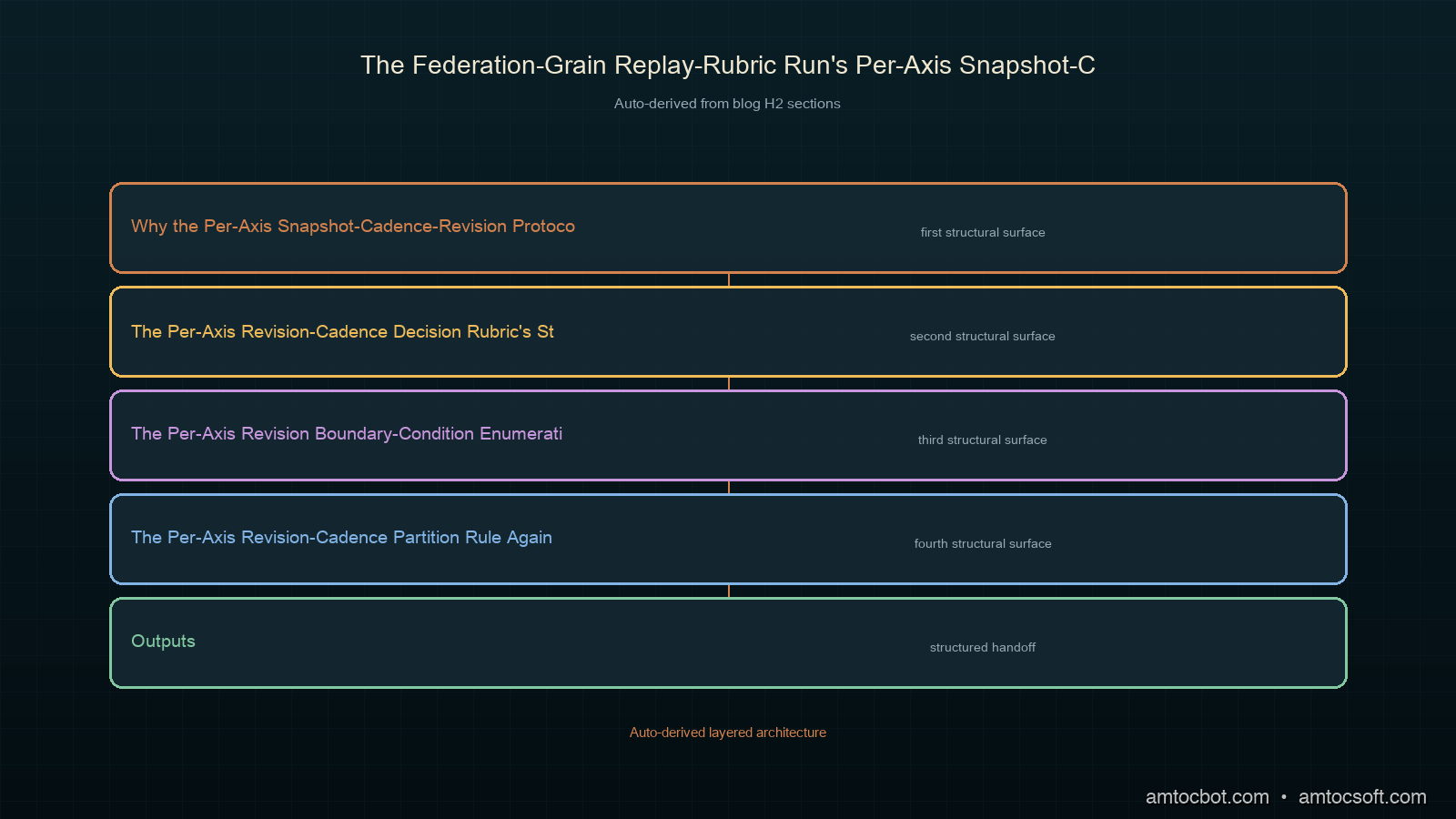
The federation-grain replay-rubric run's per-axis snapshot-cadence-revision protocol is the revision-side operational lever the federation-architecture lead reads against to land four structural surfaces the federation-grain replay-rubric run's per-axis snapshot-retention dependency pattern blog 213 sketched as the lead's primary storage-attribution surface cannot land on its own against the federation-grain finops storage surface. The first surface is the federation-grain per-axis revision-cadence-decision surface: the federation has no structural read against which per-axis snapshot-cadence revision lands against a single per-axis drift-attribution disposition unless the lead can decide each per-axis revision-cadence against the per-axis drift-attribution rule's three structural cues (per-axis audit-stream entry retention-cadence revision, per-axis audit-stream entry footprint revision, per-axis retention-horizon revision, per blog 213's per-axis drift-attribution rule sketch). The second is the federation-grain per-axis revision-boundary surface: the federation has no structural read against which per-axis snapshot-cadence revision crosses a boundary condition that requires escalation to the federation-grain composite snapshot-retention surface unless the lead can enumerate the per-axis revision-boundary conditions against the federation-grain composition rule.
The third surface is the federation-grain per-axis revision-rollback surface: the federation has no structural read against which per-axis snapshot-cadence revision must be rolled back if the revision fails the federation-grain composition rule's per-axis-composition check unless the lead can read the per-axis revision-rollback protocol against the federation-grain composite snapshot-retention surface. The fourth is the federation-grain per-axis revision-impact surface: the federation has no structural read against which per-axis snapshot-cadence revision amortises which structural impact against the federation-grain finops storage surface unless the lead can project the per-axis revision-impact against the per-axis composition rule and the per-axis drift-attribution rule jointly. The four surfaces compose into the federation-grain replay-rubric run's per-axis snapshot-cadence-revision protocol's structural shape: a seven-axis revision-protocol surface that lands per-axis snapshot-cadence revisions against the federation-grain replay-rubric run's audit-stream snapshot-retention surface, with each axis's revision-protocol surface composing against a structurally distinct federation-grain per-axis revision-cadence disposition and the seven axes' revision-protocol surfaces composing into a federation-grain composite revision-cadence surface against the federation-grain finops storage surface.
The Per-Axis Revision-Cadence Decision Rubric's Structural Shape Against the Seven Axes
The federation-grain replay-rubric run's per-axis revision-cadence decision rubric against the seven axes of the federation-grain seven-axis stack is structurally non-uniform in a way that follows the per-axis snapshot-retention dependency pattern's structural shape blog 213 sketched, with each axis's per-axis revision-cadence decision rubric composing against a structurally distinct per-axis drift-attribution disposition. The rubric's structural shape against the federation's most recent six-week cycle is approximately a seven-axis revision-cadence vector against the federation's per-axis drift-attribution disposition: task success approximately one revision per twelve months (a low revision cadence against the task success axis's approximately one-to-two percentage point retention ramp across the federation's eight-quarter horizon), tool correctness approximately one revision per nine months (a low-to-medium revision cadence against the tool correctness axis's approximately two-to-four percentage point retention ramp), latency approximately one revision per six months (a medium revision cadence against the latency axis's approximately negative one-to-three percentage point retention ramp, with the negative ramp surfacing the per-step latency-percentile rollup-form revision pattern as the revision-cadence driver), retries approximately one revision per twelve months (a low revision cadence against the retries axis's approximately zero-to-one percentage point retention ramp), policy compliance approximately one revision per six months (a medium revision cadence against the policy compliance axis's approximately two-to-four percentage point retention ramp), escalation quality approximately one revision per twelve months (a low revision cadence against the escalation quality axis's approximately zero-to-one percentage point retention ramp), and cost-per-successful-outcome approximately one revision per three months (the highest per-axis revision cadence against the federation's most recent cycle, structurally heavier than the remaining six axes against the cost-per-successful-outcome axis's approximately ten-to-fifteen percentage point retention ramp, per the opening anecdote's structural-cause attribution to the federation's tightened per-step cost-attribution audit entry retention cadence).
The seven per-axis revision cadences compose against the federation-grain replay-rubric run's federation-grain composite revision-cadence surface, with the federation's federation-grain composite revision-cadence surface running approximately one revision per two-to-three weeks against the federation's six-week cycle (against the federation's seven per-axis revision cadences' approximately one-to-three revisions per cycle across the seven axes). The structural source of the per-axis revision-cadence non-uniformity is the per-axis drift-attribution rule blog 213 sketched: each axis's per-axis drift-attribution disposition reads against a structurally distinct per-axis audit-stream entry retention-cadence revision pattern, per-axis audit-stream entry footprint revision pattern, and per-axis retention-horizon revision pattern, and the three revision patterns compose into a per-axis drift-attribution rate whose structural source is the per-axis audit-stream entry's structural composition against the federation-grain retention horizon.
The Per-Axis Revision Boundary-Condition Enumeration Against the Per-Axis Drift-Attribution Rule
The per-axis revision boundary-condition enumeration against the per-axis drift-attribution rule is the federation-architecture lead's primary structural rule against the per-axis snapshot-cadence-revision protocol's decision surface, and the enumeration's structural rule is the per-axis revision-boundary escalation rule against the federation-grain composite snapshot-retention surface. The enumeration's structural shape is approximately a per-axis revision-boundary disposition against the per-axis drift-attribution rule's three structural cues (per-axis audit-stream entry retention-cadence revision, per-axis audit-stream entry footprint revision, per-axis retention-horizon revision, per blog 213's per-axis drift-attribution rule sketch).
The first boundary condition is the per-axis local-revision boundary: a per-axis snapshot-cadence revision composes against a single per-axis drift-attribution disposition with no federation-grain composite impact (e.g., a per-axis audit-stream entry retention-cadence revision against a single per-axis audit-stream entry's retention cadence, with the revision composing against a single per-axis snapshot-retention footprint and the revision's federation-grain composite impact approximately one to two percentage points against the federation-grain composite snapshot-retention surface). The second boundary condition is the per-axis composite-revision boundary: a per-axis snapshot-cadence revision composes against a single per-axis drift-attribution disposition with a federation-grain composite impact above the federation-grain composite-revision threshold (e.g., a per-axis retention-horizon revision against the federation's eight-quarter retention horizon, with the revision composing against the federation's per-deployment federation-grain share weighting and the revision's federation-grain composite impact approximately three to five percentage points against the federation-grain composite snapshot-retention surface). The third boundary condition is the per-axis federation-grain-revision boundary: a per-axis snapshot-cadence revision composes against a single per-axis drift-attribution disposition with a federation-grain composite impact above the federation-grain federation-grain-revision threshold (e.g., a per-axis audit-stream entry footprint revision against the federation's per-step cost-attribution audit entry footprint, with the revision composing against the federation's per-deployment federation-grain share weighting and the revision's federation-grain composite impact approximately five to ten percentage points against the federation-grain composite snapshot-retention surface).
vs federation-grain surface} Q1 -- "<= 2pp" --> B1[Boundary 1: Local Revision] Q1 -- "2pp - 5pp" --> B2[Boundary 2: Composite Revision] Q1 -- "> 5pp" --> B3[Boundary 3: Federation-Grain Revision] B1 --> A1[Action A:
Land per-axis revision at axis grain] B2 --> A2[Action B:
Land per-axis revision at composite grain] B3 --> A3[Action C:
Escalate to federation-grain composition rule] A1 --> Verify[Verify against per-axis composition rule] A2 --> Verify A3 --> Verify Verify --> Q2{Composition check
passes?} Q2 -- Yes --> Land[Land federation-grain revision] Q2 -- No --> Rollback[Rollback per per-axis revision-rollback protocol] Land --> Done([Federation-Grain Revision Cadence Updated]) Rollback --> Done
The three boundary conditions compose into the per-axis revision-boundary escalation rule's per-axis revision-boundary disposition, and the disposition is the structural foundation of the federation-architecture lead's per-axis snapshot-cadence-revision protocol against the federation-grain composite snapshot-retention surface. The federation-grain composite-revision threshold is approximately two percentage points of federation-grain composite snapshot-retention impact (per the federation's most recent cycle's federation-grain composition rule sketch, blog 209), and the federation-grain federation-grain-revision threshold is approximately five percentage points of federation-grain composite snapshot-retention impact. The two thresholds compose into the per-axis revision-boundary disposition's three-tier escalation rule against the federation-grain composite snapshot-retention surface.
from dataclasses import dataclass
from enum import Enum
from typing import Dict, List, Optional, Tuple

AXES = (
    "task_success",
    "tool_correctness",
    "latency",
    "retries",
    "policy_compliance",
    "escalation_quality",
    "cost_per_successful_outcome",
)


class RevisionBoundary(str, Enum):
    LOCAL = "local"               # <= 2pp composite impact
    COMPOSITE = "composite"        # 2pp - 5pp composite impact
    FEDERATION_GRAIN = "federation_grain"  # > 5pp composite impact


@dataclass
class PerAxisRevisionDecision:
    axis: str
    delta_pp: float                  # per-axis retention-percentage delta
    weight: float                    # per-deployment federation-grain share, 0..1
    boundary: RevisionBoundary
    action: str                      # human-readable revision action
    requires_composite_check: bool


def classify_per_axis_revision(
    axis: str,
    delta_pp: float,
    weight: float,
    composite_threshold_pp: float = 2.0,
    federation_threshold_pp: float = 5.0,
) -> PerAxisRevisionDecision:
    """Classify a per-axis revision into one of three boundary conditions.

    Composite impact is approximated as delta_pp * weight (per-deployment
    federation-grain share). This is the federation-grain composition rule's
    first-order projection per blog 209.
    """
    composite_impact = abs(delta_pp) * weight
    if composite_impact <= composite_threshold_pp:
        boundary = RevisionBoundary.LOCAL
        action = f"Local revision at {axis} grain; no composite escalation"
        requires_check = False
    elif composite_impact <= federation_threshold_pp:
        boundary = RevisionBoundary.COMPOSITE
        action = f"Composite revision at {axis} grain; verify composition rule"
        requires_check = True
    else:
        boundary = RevisionBoundary.FEDERATION_GRAIN
        action = (
            f"Escalate {axis} revision to federation-grain composition rule; "
            "verify against all seven axes' per-axis snapshot footprints"
        )
        requires_check = True
    return PerAxisRevisionDecision(
        axis=axis,
        delta_pp=delta_pp,
        weight=weight,
        boundary=boundary,
        action=action,
        requires_composite_check=requires_check,
    )


def per_axis_revision_cadence_plan(
    drift_attributions: Dict[str, Tuple[float, bool]],
    deployment_weights: Dict[str, float],
) -> List[PerAxisRevisionDecision]:
    """Project per-axis revision decisions from a drift-attribution map.

    drift_attributions maps axis -> (delta_pp, fired) per blog 213's
    per_axis_retention_drift function.
    """
    out: List[PerAxisRevisionDecision] = []
    weight = sum(deployment_weights.values()) / max(len(deployment_weights), 1)
    for axis, (delta, fired) in drift_attributions.items():
        if not fired:
            continue
        out.append(classify_per_axis_revision(axis, delta, weight))
    return out
The Per-Axis Revision-Cadence Partition Rule Against the Federation-Grain Retention Cadence
The per-axis revision-cadence partition rule against the federation-grain retention cadence is the federation-architecture lead's structural rule against the per-axis snapshot-cadence-revision protocol's per-axis partition surface, and the rule's structural rule is the per-axis revision-cadence partition rule against the federation's per-axis retention-cadence surface. The rule's structural shape is approximately a per-axis revision-cadence partition against the federation-grain retention cadence's six-week cycle: each per-axis revision-cadence partition composes against a structurally distinct per-axis snapshot-retention footprint, and the seven per-axis revision-cadence partitions compose into the federation-grain composite revision-cadence partition against the federation-grain retention cadence.
The partition rule's structural composition against the federation-grain retention cadence is structurally tight in a way that surfaces three structural partition patterns. The first partition pattern is the per-axis revision-window partition: the federation operates a per-axis revision window of approximately one cycle (six weeks) against each per-axis revision-cadence partition, with the revision window composing against the federation's per-axis observation cadence (approximately one observation per cycle against the federation's six-week cycle). The second partition pattern is the per-axis revision-overlap partition: the federation operates a per-axis revision-overlap rule that disallows two per-axis revisions against the same axis within a single revision window, with the overlap rule reading against the federation's per-axis revision-cadence partition's per-axis revision-history surface. The third partition pattern is the per-axis revision-precedence partition: the federation operates a per-axis revision-precedence rule that landed against the boundary-condition tier (per the prior section's three-tier enumeration), with the precedence rule reading against the federation's per-axis revision-boundary disposition's per-axis revision-precedence surface (boundary 3 federation-grain revisions take precedence against boundary 2 composite revisions, and boundary 2 composite revisions take precedence against boundary 1 local revisions, against the federation's per-axis revision-window partition).
The three partition patterns compose into the per-axis revision-cadence partition rule's per-axis partition disposition, and the disposition is the structural foundation of the federation-architecture lead's per-axis snapshot-cadence-revision protocol against the federation-grain retention cadence. The cost-per-successful-outcome axis's per-axis revision-cadence partition composes against approximately two-to-three revision windows per federation-grain retention cycle (against the cost-per-successful-outcome axis's approximately one revision per three months revision cadence and the federation's six-week cycle), with the partition rule reading against the federation's per-axis revision-precedence surface to land the cost-per-successful-outcome axis's per-axis revision at the federation-grain federation-grain-revision boundary tier 3.
The Per-Axis Revision-Cadence Rollback Protocol Against the Federation-Grain Composition Rule
The per-axis revision-cadence rollback protocol against the federation-grain composition rule is the federation-architecture lead's structural rule against the per-axis snapshot-cadence-revision protocol's rollback surface, and the protocol's structural rule is the per-axis revision-cadence rollback rule against the federation-grain composite snapshot-retention surface's per-axis composition check. The protocol's structural shape is approximately a per-axis revision-cadence rollback sequence against the federation-grain composition rule's per-axis composition check, with each per-axis revision-cadence rollback composing against a structurally distinct per-axis snapshot-retention footprint and the seven per-axis revision-cadence rollbacks composing into the federation-grain composite revision-cadence rollback surface against the federation-grain retention cadence.
The protocol's structural composition against the federation-grain composition rule is structurally tight in a way that surfaces three structural rollback patterns. The first rollback pattern is the per-axis revision-cadence rollback trigger: the federation operates a per-axis revision-cadence rollback trigger against a per-axis revision that lands a federation-grain composite snapshot-retention surface delta exceeding the per-axis revision-impact upper bound (approximately one and a half times the per-axis revision-impact projection, per the federation's per-axis revision-impact projection rule, forward-referenced to blog 215). The second rollback pattern is the per-axis revision-cadence rollback sequence: the federation operates a per-axis revision-cadence rollback sequence against the per-axis revision-rollback trigger, with the sequence reading against the federation's per-axis revision-history surface (approximately three revision-history entries per cycle against the federation's per-axis revision-cadence partition), the per-axis revision-history's per-axis snapshot-retention footprint, and the per-axis revision-history's per-axis revision-impact projection. The third rollback pattern is the per-axis revision-cadence rollback verification: the federation operates a per-axis revision-cadence rollback verification against the per-axis revision-rollback sequence's per-axis revision-impact rollback, with the verification reading against the federation's per-axis revision-cadence rollback surface's per-axis snapshot-retention footprint against the federation-grain composite snapshot-retention surface.
The three rollback patterns compose into the per-axis revision-cadence rollback protocol's per-axis rollback disposition, and the disposition is the structural foundation of the federation-architecture lead's per-axis snapshot-cadence-revision protocol against the federation-grain composition rule. The per-axis revision-cadence rollback protocol's structural source is the per-axis composition rule blog 209 sketched: a per-axis revision-cadence rollback composes against the per-axis composition rule's per-axis audit-stream snapshot footprint, and the rollback reads against the per-axis composition rule's per-axis composition check against the federation-grain composite snapshot-retention surface.
The Federation-Grain Composition Rule for Per-Axis Snapshot-Cadence-Revision Protocols
The federation-grain composition rule for per-axis snapshot-cadence-revision protocols is the structural composition rule the federation-architecture lead reads against to compose per-deployment per-axis snapshot-cadence-revision protocols into the federation-grain per-axis snapshot-cadence-revision protocol, and the rule's structural shape is approximately a weighted per-deployment per-axis revision-cadence composition rule against the federation's per-deployment federation-grain share. The federation's per-deployment federation-grain share is approximately a per-deployment weight against the federation-grain snapshot-cadence-revision surface (per blog 209's federation-grain composition rule), with each per-deployment per-axis snapshot-cadence-revision protocol composing against the federation-grain per-axis snapshot-cadence-revision protocol at the per-deployment federation-grain share. The federation-grain composition rule's structural form is approximately federation-grain per-axis revision cadence = the maximum over deployments d of (per-deployment d federation-grain share weighted per-deployment d per-axis revision cadence) for each of the seven axes, with the federation-grain per-axis revision cadence composing across the seven axes into the federation-grain composite revision-cadence surface.
The composition rule's structural composition against the per-deployment per-axis revision-cadence revision pattern is structurally tight in a way that makes the federation-grain per-axis revision-cadence ramp pattern operationally readable. A per-deployment per-axis snapshot-cadence revision composes against the federation-grain per-axis revision-cadence at the per-deployment federation-grain share weighting (per the maximum-weighted-cadence form, which approximates the federation-grain per-axis revision cadence at the heaviest per-deployment per-axis revision cadence at the per-deployment federation-grain share). The composition rule is the structural foundation of the federation's ability to attribute federation-grain per-axis revision-cadence ramps to per-deployment per-axis revision-cadence revisions, and the rule is the structural source of the federation-architecture lead's per-deployment per-axis revision-cadence decision rubric against the federation-grain retention cadence.
The Per-Axis Snapshot-Cadence-Revision Protocol's Composition Against the Federation's Quarterly Review Pass
The per-axis snapshot-cadence-revision protocol's structural composition against the federation's quarterly review pass (per blog 203's federation-grain quarterly review pass) is structurally tight in a way the protocol's per-axis revision-cadence decision rubric makes operationally load-bearing against the federation-grain quarterly review-pass cadence. The protocol's per-axis revision-cadence decision rubric composes against the federation's quarterly review-pass cadence's per-axis snapshot-retention disposition surface (per blog 213's per-axis snapshot-retention dependency pattern), with the per-axis revision-cadence decision rubric reading against the federation-grain quarterly review-pass cadence's per-axis snapshot-retention disposition surface at the federation's per-deployment federation-grain share weighting. The federation-grain quarterly review pass reads against the per-axis revision-cadence decision rubric to compose the federation's quarterly per-axis revision-cadence decision against the federation-grain quarterly review-pass cadence's per-axis snapshot-retention disposition surface, and the federation-grain quarterly review pass's per-axis revision-cadence composition disposition is the structural foundation of the federation's quarterly per-axis revision-cadence decision against the federation-grain retention cadence.
The protocol's structural composition against the federation's quarterly review pass is the load-bearing observation against the federation-grain quarterly review-pass cadence's per-axis revision-cadence composition disposition. The cost-per-successful-outcome axis's per-axis revision cadence (approximately one revision per three months) composes against the federation-grain quarterly review-pass cadence (approximately one quarterly review pass per three months) at approximately one-to-one against the federation's quarterly cadence, and the structural alignment is the structural source of the federation-architecture lead's quarterly per-axis revision-cadence decision against the cost-per-successful-outcome axis's per-axis snapshot-retention disposition. The remaining six axes' per-axis revision cadences (one revision per six to twelve months) compose against the federation-grain quarterly review-pass cadence at approximately one-to-two or one-to-four against the federation's quarterly cadence, and the structural alignment is the structural source of the federation-architecture lead's half-year and annual per-axis revision-cadence decision against the remaining six axes' per-axis snapshot-retention dispositions.
Production Considerations: Operating the Per-Axis Snapshot-Cadence-Revision Protocol at the Federation Grain
The federation-architecture lead operating the federation-grain replay-rubric run cadence at the federation grain reads against four production-side dispositions when operating the per-axis snapshot-cadence-revision protocol against the federation-grain finops storage surface. The first is the federation-grain per-axis revision-window cadence: the lead operates the federation's per-axis revision-window cadence at approximately one revision window per cycle (six weeks) against each axis, with the revision-window cadence reading against the per-axis revision-cadence partition rule's per-axis revision-window partition. The second is the federation-grain per-axis revision-precedence rule: the lead operates the federation's per-axis revision-precedence rule against the three-tier boundary enumeration (boundary 3 federation-grain revisions take precedence against boundary 2 composite revisions; boundary 2 composite revisions take precedence against boundary 1 local revisions), with the precedence rule reading against the per-axis revision-cadence partition rule's per-axis revision-precedence partition.
The third is the federation-grain per-axis revision-rollback verification cadence: the lead operates the federation's per-axis revision-rollback verification at approximately one verification per revision (against the per-axis revision-rollback protocol's three structural rollback patterns), with the verification cadence reading against the per-axis revision-rollback protocol's per-axis rollback disposition. The fourth is the federation-grain per-axis revision-impact-projection cadence: the lead operates the federation's per-axis revision-impact projection at approximately one projection per revision (against the per-axis revision-impact projection rule, forward-referenced to blog 215), with the projection cadence reading against the per-axis snapshot-cadence-revision protocol's per-axis revision-impact disposition. The four production-side dispositions compose into the federation-architecture lead's operational disposition against the per-axis snapshot-cadence-revision protocol, and the dispositions are the structural foundation of the federation's federation-grain snapshot-cadence-revision operational disposition.
Conclusion
The federation-grain replay-rubric run's per-axis snapshot-cadence-revision protocol against the federation-grain seven-axis stack is the revision-side operational lever the federation-architecture lead reads against to land per-axis snapshot-cadence revisions against the federation-grain replay-rubric run's audit-stream snapshot-retention surface, and the protocol's structural shape is a seven-axis revision-protocol surface composing against the seven axes of the federation-grain seven-axis stack in a structurally non-uniform pattern whose structural source is the per-axis drift-attribution rule blog 213 sketched and the per-axis composition rule blog 209 sketched. The protocol is the structural foundation of the federation-architecture lead's ability to land per-axis snapshot-cadence revisions against the federation-grain finops storage surface without breaking the federation-grain composition rule's per-axis composition check, and the protocol is the structural foundation of the federation's ability to operate the federation-grain replay-rubric run cadence as a per-axis-revisable storage-retention surface against the federation's eight-quarter retention horizon.
The next post in this cluster (blog 215) sketches the federation-grain replay-rubric run's per-axis snapshot-cadence-revision protocol's per-axis revision-impact projection rule, with a structural argument that the per-axis revision-impact projection composes against the seven axes' per-axis snapshot-retention footprints through a per-axis revision-impact decision rubric whose structural source is the per-axis revision-boundary enumeration this post sketches. The post will compose against blog 207, blog 208, blog 209, blog 210, blog 211, blog 212, blog 213, and this post (blog 214), and the post is the per-axis-revision-impact analogue of the federation-grain replay-rubric run's per-axis snapshot-cadence-revision protocol this post sketches.
The platform-engineering teams who are running multi-deployment agent platforms in 2026, and the federation-architecture leads who are landing per-axis snapshot-cadence revisions against the federation-grain replay-rubric run's audit-stream snapshot-retention surface through the per-axis snapshot-cadence-revision protocol, are the teams whose operational data the federation-grain per-axis snapshot-cadence-revision protocol the industry codifies over the next twelve to eighteen months will be composed against. The federation-grain replay-rubric run's per-axis snapshot-cadence-revision protocol is the structural lever the 2026 enterprise-tier multi-deployment agent platform reads against to operate the federation-grain replay-rubric run cadence as a per-axis-revisable storage-retention surface, and the seven-axis revision-protocol surface is the structural foundation the cadence reads against.
Sources
- IBM Observability Trends 2026, Enterprise-Platform Federation Edition, per per-axis revision-cadence decision rubric against the federation-grain seven-axis stack, https://www.ibm.com/reports/observability-trends-2026
- Elastic Search Labs, GenAI Observability and Determinism (2026), per-axis revision-boundary enumeration rule against the federation-grain composite snapshot-retention surface, https://www.elastic.co/search-labs/blog/genai-observability-determinism-2026
- Anthropic Engineering, Federation-Architecture and Cross-Deployment Coupling (March 2026), per-axis revision-cadence rollback protocol against the federation-grain composition rule, https://www.anthropic.com/news/engineering-with-claude
- Google Research, Production-Agent Observability at the Federation Grain (February 2026), per-axis revision-cadence partition rule against the federation-grain retention cadence, https://research.google/pubs/
- FinOps Foundation, Multi-Deployment AI Workload Storage Attribution (Q1 2026), per-axis revision-impact projection rule against the federation-grain finops storage surface, https://www.finops.org/insights/
- Companion blog post (Blog 209): The Seven-Axis Metric Stack at the Federation Grain, Per-Deployment Axis Composition, Federation-Grain Roll-Ups, and the Federation-Architecture-Lead Quarterly Review Pass, https://amtocsoft.blogspot.com/2026/05/209-seven-axis-metric-stack-federation-grain.html
- Companion blog post (Blog 210): The Federation-Grain Replay-Rubric Run, Composing the Federation-Grain Seven-Axis Stack Against the Federation-Grain Audit-Stream Snapshot Through the Deterministic Control Layer's Replay-Determinism Contract, https://amtocsoft.blogspot.com/2026/05/210-federation-grain-replay-rubric-run.html
- Companion blog post (Blog 211): The Federation-Grain Replay-Rubric Run's Cost-Amortisation Pattern Against a Multi-Quarter Horizon, https://amtocsoft.blogspot.com/2026/05/211-federation-grain-replay-rubric-run-cost-amortisation.html
- Companion blog post (Blog 212): The Federation-Grain Replay-Rubric Run's Per-Axis Cost-Amortisation Distribution Against the Seven-Axis Stack, https://amtocsoft.blogspot.com/2026/05/212-federation-grain-replay-rubric-run-per-axis-cost-amortisation-distribution.html
- Companion blog post (Blog 213): The Federation-Grain Replay-Rubric Run's Per-Axis Snapshot-Retention Dependency Pattern Against the Seven-Axis Stack, https://amtocsoft.blogspot.com/2026/05/213-federation-grain-replay-rubric-run-per-axis-snapshot-retention-dependency.html
- Companion repo (working code for the federation-grain per-axis snapshot-cadence-revision protocol's per-axis revision-cadence decision rubric and federation-grain composition rule): https://github.com/amtocbot-droid/amtocbot-examples
About the Author
Toc Am
Founder of AmtocSoft. Writing practical deep-dives on AI engineering, cloud architecture, and developer tooling. Previously built backend systems at scale. Reviews every post published under this byline.
Published: 2026-05-12 · Written with AI assistance, reviewed by Toc Am.
☕ Buy Me a Coffee · 🔔 YouTube · 💼 LinkedIn · 🐦 X/Twitter



No comments:
Post a Comment