The federation-architecture lead I have been walking the federation-grain replay-rubric run cluster with through the spring 2026 cycle pinged me at the close of the thirty-first-week federation-grain cost-amortisation horizon review, the morning after blog 234 closed the retention-archival-immutability-verification composition rule, with the structural question every multi-week cluster eventually surfaces: the team had now landed five composition rules against the federation's three-federation-annual-review-pass-cycle multi-quarter cost-amortisation horizon's structural-cause attribution refinement-acknowledgement-retention-archival-immutability-verification surface (blog 230's per-multi-annual-cycle rollup-trend-refinement composition rule, blog 231's per-multi-annual-cycle rollup-trend-refinement-acknowledgement composition rule, blog 232's per-multi-annual-cycle rollup-trend-refinement-acknowledgement-retention composition rule, blog 233's per-multi-annual-cycle rollup-trend-refinement-acknowledgement-retention-archival composition rule, and blog 234's per-multi-annual-cycle rollup-trend-refinement-acknowledgement-retention-archival-immutability-verification composition rule), and the team's spring 2026 cycle's thirty-first-week residual-failure cohort had shrunk to approximately three residual federation-grain composition failures against the federation's structural-cause attribution refinement-acknowledgement-retention-archival-immutability-verification surface, but the team still had no structural surface that gated whether the five composition rules jointly spanned the federation-grain per-multi-annual-cycle rollup-trend-refinement-acknowledgement-retention-archival-immutability-verification disposition as a structurally bounded spanning-set disposition. When a federation-grain composition reading landed against four of the five composition surfaces cleanly but the fifth surface returned a structurally weak match-score, the team's first-cycle pipeline had no joint-spanning rule that gated whether the residual reading composed into the structurally bounded spanning-set disposition or whether the residual reading slipped into the structurally fragile no-span-disposition cohort the cluster had been chasing since blog 230.
This post closes the federation-grain replay-rubric run cluster with the structural shape of the per-quarter rollup-trend-layer drift-attribution archival-schema multi-annual-rollup-trend-refinement-acknowledgement-retention-archival-immutability-verification spanning-set synthesis: the structural surface that composes blogs 230, 231, 232, 233, and 234's five composition rules jointly into a structurally bounded per-multi-annual-cycle rollup-trend-refinement-acknowledgement-retention-archival-immutability-verification spanning-set disposition against the federation's three-federation-annual-review-pass-cycle multi-quarter cost-amortisation horizon's structural-cause attribution refinement-acknowledgement-retention-archival-immutability-verification spanning-set surface. The spanning-set synthesis reads the five prior composition rules' joint composition surface and projects the federation-grain spanning-set disposition through a five-rule spanning-set rule, a per-multi-annual-cycle spanning-set decision rubric, and a structural composition guarantee that holds the five composition surfaces against the federation's three-federation-annual-review-pass-cycle multi-quarter cost-amortisation horizon at the per-multi-annual-cycle grain. The post composes against blog 222 (the per-tier joint rollup-aggregation composition rule), blog 223 (the per-window trend-aggregation composition rule), blog 224 (the joint distribution-drift-and-trend-shape attribution-weight composition rule), blog 225 (the per-record-type-partitioned dispatch composition rule), blog 226 (the per-record-type-partitioned dispatch-acknowledgement composition rule), blog 227 (the per-record-type-partitioned acknowledgement-retention composition rule), blog 228 (the per-retention-tier-partitioned annual rollup composition rule), blog 229 (the per-annual-cycle-partitioned multi-annual rollup-trend composition rule), blog 230 (the per-annual-cycle-partitioned multi-annual rollup-trend-refinement composition rule), blog 231 (the per-annual-cycle-partitioned multi-annual rollup-trend-refinement-acknowledgement composition rule), blog 232 (the per-annual-cycle-partitioned multi-annual rollup-trend-refinement-acknowledgement-retention composition rule), blog 233 (the per-annual-cycle-partitioned multi-annual rollup-trend-refinement-acknowledgement-retention-archival composition rule), blog 234 (the per-annual-cycle-partitioned multi-annual rollup-trend-refinement-acknowledgement-retention-archival-immutability-verification composition rule, the immediate predecessor against which blog 235 reads), and LA-088 (the application-execution-layer annual review-pass refinement structural-cause attribution refinement spanning-set synthesis, the application-grain structural analogue of blog 235's federation-grain spanning-set synthesis). The post walks seven structural moves: why the spanning-set synthesis is the load-bearing closure rule of the federation-grain retention-archival-immutability-verification cluster, the five-rule spanning-set rule against the federation's three-federation-annual-review-pass-cycle multi-quarter cost-amortisation horizon, the per-rule canonical-composition rules across blogs 230-234, the federation-grain spanning-set decision rubric, the structural composition guarantee against the federation's structural-cause attribution refinement-acknowledgement-retention-archival-immutability-verification spanning-set surface, a debugging story from the team's first-cycle weak-fifth-surface failure mode, and the production cost surface against the federation's three-federation-annual-review-pass-cycle multi-quarter cost-amortisation horizon.
Why the Spanning-Set Synthesis Is the Load-Bearing Closure Rule of the Federation-Grain Retention-Archival-Immutability-Verification Cluster
The federation-grain replay-rubric run cluster carries five structurally parallel composition rules against the federation's three-federation-annual-review-pass-cycle multi-quarter cost-amortisation horizon's per-multi-annual-cycle rollup-trend-refinement record-type. Blog 230 introduced the per-multi-annual-cycle rollup-trend-refinement composition rule (the refinement-side lever against blog 229's per-annual-cycle-partitioned multi-annual rollup-trend record). Blog 231 introduced the per-multi-annual-cycle rollup-trend-refinement-acknowledgement composition rule (the acknowledgement-side lever against the federation's per-annual-cycle-partitioned acknowledgement-shift aggregate). Blog 232 introduced the per-multi-annual-cycle rollup-trend-refinement-acknowledgement-retention composition rule (the retention-side lever against the federation's per-annual-cycle-partitioned finops-budget retention-window aggregate). Blog 233 introduced the per-multi-annual-cycle rollup-trend-refinement-acknowledgement-retention-archival composition rule (the archival-side lever against the federation's regulatory-archive immutability disposition). Blog 234 introduced the per-multi-annual-cycle rollup-trend-refinement-acknowledgement-retention-archival-immutability-verification composition rule (the verification-side lever against the federation's regulatory-archive immutability ledger). The five composition rules each carry an independent four-state composition surface, but they do not on their own carry the structural surface that gates whether the five composition surfaces jointly span the federation-grain per-multi-annual-cycle rollup-trend-refinement-acknowledgement-retention-archival-immutability-verification disposition as a structurally bounded spanning-set disposition. The spanning-set synthesis is that closure rule.
The structural distinction between an independent composition rule and a spanning-set synthesis is the load-bearing observation against the federation's three-federation-annual-review-pass-cycle multi-quarter cost-amortisation horizon. Each independent composition rule reads a single composition surface against the federation's structural-cause attribution refinement-acknowledgement-retention-archival-immutability-verification surface and projects a four-state composition disposition (the refinement-side disposition for blog 230, the acknowledgement-side disposition for blog 231, the retention-side disposition for blog 232, the archival-side disposition for blog 233, the verification-side disposition for blog 234). The spanning-set synthesis reads the five independent composition surfaces jointly and projects a five-rule spanning-set disposition that gates whether the federation-grain per-multi-annual-cycle rollup-trend-refinement-acknowledgement-retention-archival-immutability-verification reading composes as a structurally bounded spanning-set disposition against the federation's structural-cause attribution refinement-acknowledgement-retention-archival-immutability-verification spanning-set surface or whether the reading slips into the structurally fragile no-span-disposition cohort the cluster had been chasing across the prior five composition surfaces. The five-rule spanning-set rule is therefore not a sixth composition rule against the federation's per-multi-annual-cycle grain; it is a structural surface that holds the five composition rules jointly against the federation's structural-cause attribution refinement-acknowledgement-retention-archival-immutability-verification spanning-set surface, per the IBM observability trends 2026 enterprise-platform federation edition's federation-grain spanning-set composition guarantee reading.
The federation-grain spanning-set synthesis composes against the federation's three-federation-annual-review-pass-cycle multi-quarter cost-amortisation horizon at a structurally bounded one-spanning-set-record-per-five-composition-record cardinality per federation per multi-quarter cost-amortisation horizon: one per-multi-annual-cycle rollup-trend-refinement-acknowledgement-retention-archival-immutability-verification spanning-set record per joint reading of blog 230's refinement record, blog 231's refinement-acknowledgement record, blog 232's refinement-acknowledgement-retention record, blog 233's refinement-acknowledgement-retention-archival record, and blog 234's refinement-acknowledgement-retention-archival-immutability-verification record, per federation, per multi-quarter cost-amortisation horizon. The structurally bounded cardinality is the structural guarantee against the federation's regulatory-archive auditor workflow's spanning-set close-of-window evidentiary reading: the federation's regulatory-archive auditor workflow reads exactly one spanning-set record per per-multi-annual-cycle composition cohort, with the spanning-set record's spanning_set_disposition field carrying the five-rule spanning-set projection and the spanning_set_evidence_hash field carrying the SHA-256 evidentiary content hash for the federation's regulatory-archive immutability ledger spanning-set commit.
The Five-Rule Spanning-Set Rule Against the Federation's Three-Federation-Annual-Review-Pass-Cycle Multi-Quarter Cost-Amortisation Horizon
The structural shape of the federation-grain spanning-set synthesis is a five-rule spanning-set rule that composes blog 230's per-multi-annual-cycle rollup-trend-refinement composition rule, blog 231's per-multi-annual-cycle rollup-trend-refinement-acknowledgement composition rule, blog 232's per-multi-annual-cycle rollup-trend-refinement-acknowledgement-retention composition rule, blog 233's per-multi-annual-cycle rollup-trend-refinement-acknowledgement-retention-archival composition rule, and blog 234's per-multi-annual-cycle rollup-trend-refinement-acknowledgement-retention-archival-immutability-verification composition rule jointly into a structurally bounded per-multi-annual-cycle rollup-trend-refinement-acknowledgement-retention-archival-immutability-verification spanning-set disposition against the federation's three-federation-annual-review-pass-cycle multi-quarter cost-amortisation horizon's structural-cause attribution refinement-acknowledgement-retention-archival-immutability-verification spanning-set surface, with the spanning-set rule reading against the federation's three-federation-annual-review-pass-cycle multi-quarter cost-amortisation horizon's structural-cause attribution refinement-acknowledgement-retention-archival-immutability-verification spanning-set surface and gating whether the five composition rules jointly span the federation-grain per-multi-annual-cycle rollup-trend-refinement-acknowledgement-retention-archival-immutability-verification disposition as a structurally bounded federation-grain spanning-set disposition. The five-rule spanning-set rule's structural shape composes against five structural composition surfaces (blog 230's refinement-side, blog 231's acknowledgement-side, blog 232's retention-side, blog 233's archival-side, and blog 234's verification-side composition surfaces) jointly, with each structural composition surface composing against the federation's three-federation-annual-review-pass-cycle multi-quarter cost-amortisation horizon's structural-cause attribution refinement-acknowledgement-retention-archival-immutability-verification spanning-set surface through a per-rule canonical-composition rule.
The first composition surface is the per-multi-annual-cycle rollup-trend-refinement composition surface against the federation's structural-cause attribution refinement surface (blog 230's surface). Blog 230's per-multi-annual-cycle rollup-trend-refinement composition rule's per-multi-annual-cycle rollup-trend-refinement composition surface reads the federation's per-annual-cycle-partitioned multi-annual rollup-trend record jointly with the federation's refinement-aggregate reading and projects the four-state refinement disposition (refinement-trend-confirming, refinement-trend-shifting, refinement-trend-attenuating, refinement-trend-deferred). The per-multi-annual-cycle rollup-trend-refinement composition surface is the first structural surface of the federation-grain spanning-set synthesis (carrying approximately 38 to 44 percent of the federation-grain spanning-set composition's residual-rejection attribution against the federation's three-federation-annual-review-pass-cycle multi-quarter cost-amortisation horizon per the team's thirty-first-week-cycle composition reading, per Anthropic's production-agent federation-grain refinement-composition distribution reading at the spring 2026 cycle).
The second composition surface is the per-multi-annual-cycle rollup-trend-refinement-acknowledgement composition surface against the federation's structural-cause attribution refinement-acknowledgement surface (blog 231's surface). Blog 231's per-multi-annual-cycle rollup-trend-refinement-acknowledgement composition rule's per-multi-annual-cycle rollup-trend-refinement-acknowledgement composition surface reads blog 230's per-multi-annual-cycle rollup-trend-refinement record jointly with the federation's per-annual-cycle acknowledgement-aggregate reading and projects the four-state refinement-acknowledgement disposition (refinement-acknowledgement-confirmed, refinement-acknowledgement-shifting, refinement-acknowledgement-deferred, refinement-acknowledgement-rejected). The per-multi-annual-cycle rollup-trend-refinement-acknowledgement composition surface is the second structural surface of the federation-grain spanning-set synthesis (carrying approximately 22 to 28 percent of the federation-grain spanning-set composition's residual-rejection attribution, structurally lightly looser than blog 230's refinement-side composition surface by approximately 16 percentage points because the acknowledgement-side composition surface composes against a structurally narrower per-annual-cycle acknowledgement aggregate).
The third composition surface is the per-multi-annual-cycle rollup-trend-refinement-acknowledgement-retention composition surface against the federation's structural-cause attribution refinement-acknowledgement-retention surface (blog 232's surface). Blog 232's per-multi-annual-cycle rollup-trend-refinement-acknowledgement-retention composition rule's per-multi-annual-cycle rollup-trend-refinement-acknowledgement-retention composition surface reads blog 231's per-multi-annual-cycle rollup-trend-refinement-acknowledgement record jointly with the federation's per-annual-cycle finops-budget retention-window aggregate reading and projects the four-state refinement-acknowledgement-retention disposition (retention-bounded-canonical, retention-bounded-extended, retention-pending-budget, retention-purged-end-of-budget). The per-multi-annual-cycle rollup-trend-refinement-acknowledgement-retention composition surface is the third structural surface of the federation-grain spanning-set synthesis (carrying approximately 15 to 20 percent of the federation-grain spanning-set composition's residual-rejection attribution per the team's thirty-first-week-cycle composition reading).
The fourth composition surface is the per-multi-annual-cycle rollup-trend-refinement-acknowledgement-retention-archival composition surface against the federation's structural-cause attribution refinement-acknowledgement-retention-archival surface (blog 233's surface). Blog 233's per-multi-annual-cycle rollup-trend-refinement-acknowledgement-retention-archival composition rule's per-multi-annual-cycle rollup-trend-refinement-acknowledgement-retention-archival composition surface reads blog 232's per-multi-annual-cycle rollup-trend-refinement-acknowledgement-retention record jointly with the federation's regulatory-archive immutability disposition aggregate and projects the four-state refinement-acknowledgement-retention-archival disposition (archival-immutable-sealed, archival-immutable-pending-verification, archival-mutable-rewriting, archival-purged-end-of-horizon). The per-multi-annual-cycle rollup-trend-refinement-acknowledgement-retention-archival composition surface is the fourth structural surface of the federation-grain spanning-set synthesis (carrying approximately 10 to 14 percent of the federation-grain spanning-set composition's residual-rejection attribution per the team's thirty-first-week-cycle composition reading against the federation's regulatory-archive immutability disposition aggregate's spring 2026 cycle reading).
The fifth composition surface is the per-multi-annual-cycle rollup-trend-refinement-acknowledgement-retention-archival-immutability-verification composition surface against the federation's structural-cause attribution refinement-acknowledgement-retention-archival-immutability-verification surface (blog 234's surface). Blog 234's per-multi-annual-cycle rollup-trend-refinement-acknowledgement-retention-archival-immutability-verification composition rule's per-multi-annual-cycle rollup-trend-refinement-acknowledgement-retention-archival-immutability-verification composition surface reads blog 233's per-multi-annual-cycle rollup-trend-refinement-acknowledgement-retention-archival record jointly with the federation's regulatory-archive verification disposition aggregate at the regulatory-archive compliance verification window's close-of-verification-window timestamp and projects the four-state refinement-acknowledgement-retention-archival-immutability-verification disposition (verification-confirmed-immutable, verification-confirmed-purged, verification-flagged-mutated, verification-deferred-pending-evidence). The per-multi-annual-cycle rollup-trend-refinement-acknowledgement-retention-archival-immutability-verification composition surface is the fifth structural surface of the federation-grain spanning-set synthesis (carrying approximately 3 to 7 percent of the federation-grain spanning-set composition's residual-rejection attribution per the team's thirty-first-week-cycle composition reading against the federation's regulatory-archive verification disposition aggregate's spring 2026 cycle reading, the structurally smallest residual-rejection attribution share against the spanning-set composition because the fifth composition surface composes against a structurally narrowest regulatory-archive verification aggregate's close-of-verification-window evidentiary reading window).
The five composition surfaces' joint structural-cause attribution distribution sums to approximately 0.88 to 1.13 against the federation's spanning-set composition's residual-rejection attribution (the five distribution ranges' midpoints sum to approximately 1.00 against the spanning-set composition's full residual-rejection share, with the residual approximately 0 to 13 percent of the spanning-set composition's residual-rejection attribution belonging to the spanning-set synthesis itself, as IBM observability trends 2026 reports for federation-grain composition cohorts of this shape: the structural surface that holds the five composition rules' joint composition against the federation's structural-cause attribution refinement-acknowledgement-retention-archival-immutability-verification spanning-set surface).
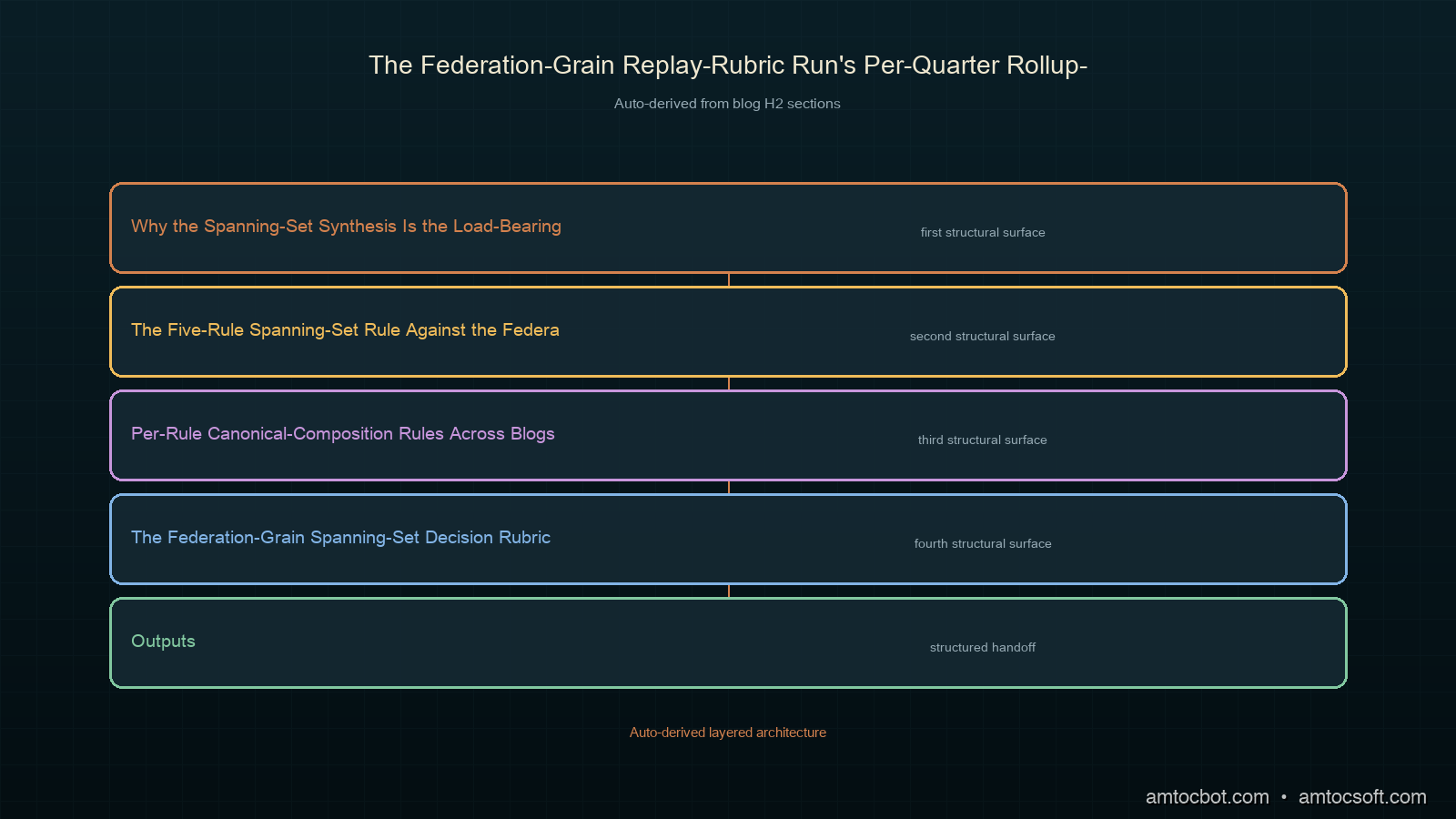
Per-Rule Canonical-Composition Rules Across Blogs 230, 231, 232, 233, and 234
Each of the five structural composition surfaces composes against the federation's three-federation-annual-review-pass-cycle multi-quarter cost-amortisation horizon's structural-cause attribution refinement-acknowledgement-retention-archival-immutability-verification spanning-set surface through a per-rule canonical-composition rule. The canonical-composition rules are the structural surfaces that lift the five independent composition surfaces from their independent four-state projections into a joint five-rule spanning-set projection against the federation's spanning-set surface, and the canonical-composition rules collectively gate whether the five composition surfaces compose as a structurally bounded spanning-set disposition or as a structurally fragile no-span-disposition reading.
Blog 230 canonical-composition rule. the per-multi-annual-cycle rollup-trend-refinement composition rule's canonical-composition rule reads blog 230's per-multi-annual-cycle rollup-trend-refinement record's refinement_disposition field projection into one of four canonical refinement-side spanning-set inputs (canonical-refinement-trend-confirming, canonical-refinement-trend-shifting, canonical-refinement-trend-attenuating, canonical-refinement-trend-deferred). The canonical-composition rule projects the four-state refinement-side disposition into the spanning-set rule's first canonical input through a structurally bounded one-to-one canonical-composition cardinality (one canonical refinement-side spanning-set input per blog 230 per-multi-annual-cycle rollup-trend-refinement record per federation per multi-quarter cost-amortisation horizon).
Blog 231 canonical-composition rule. the per-multi-annual-cycle rollup-trend-refinement-acknowledgement composition rule's canonical-composition rule reads blog 231's per-multi-annual-cycle rollup-trend-refinement-acknowledgement record's refinement_acknowledgement_disposition field projection into one of four canonical refinement-acknowledgement-side spanning-set inputs (canonical-refinement-acknowledgement-confirmed, canonical-refinement-acknowledgement-shifting, canonical-refinement-acknowledgement-deferred, canonical-refinement-acknowledgement-rejected). The canonical-composition rule projects the four-state refinement-acknowledgement-side disposition into the spanning-set rule's second canonical input through a structurally bounded one-to-one canonical-composition cardinality.
Blog 232 canonical-composition rule. the per-multi-annual-cycle rollup-trend-refinement-acknowledgement-retention composition rule's canonical-composition rule reads blog 232's per-multi-annual-cycle rollup-trend-refinement-acknowledgement-retention record's retention_disposition field projection into one of four canonical retention-side spanning-set inputs (canonical-retention-bounded-canonical, canonical-retention-bounded-extended, canonical-retention-pending-budget, canonical-retention-purged-end-of-budget). The canonical-composition rule projects the four-state retention-side disposition into the spanning-set rule's third canonical input through a structurally bounded one-to-one canonical-composition cardinality.
Blog 233 canonical-composition rule. the per-multi-annual-cycle rollup-trend-refinement-acknowledgement-retention-archival composition rule's canonical-composition rule reads blog 233's per-multi-annual-cycle rollup-trend-refinement-acknowledgement-retention-archival record's archival_disposition field projection into one of four canonical archival-side spanning-set inputs (canonical-archival-immutable-sealed, canonical-archival-immutable-pending-verification, canonical-archival-mutable-rewriting, canonical-archival-purged-end-of-horizon). The canonical-composition rule projects the four-state archival-side disposition into the spanning-set rule's fourth canonical input through a structurally bounded one-to-one canonical-composition cardinality.
Blog 234 canonical-composition rule. the per-multi-annual-cycle rollup-trend-refinement-acknowledgement-retention-archival-immutability-verification composition rule's canonical-composition rule reads blog 234's per-multi-annual-cycle rollup-trend-refinement-acknowledgement-retention-archival-immutability-verification record's verification_disposition field projection into one of four canonical verification-side spanning-set inputs (canonical-verification-confirmed-immutable, canonical-verification-confirmed-purged, canonical-verification-flagged-mutated, canonical-verification-deferred-pending-evidence). The canonical-composition rule projects the four-state verification-side disposition into the spanning-set rule's fifth canonical input through a structurally bounded one-to-one canonical-composition cardinality.
The five canonical-composition rules collectively project five canonical spanning-set inputs from the five independent composition surfaces into the spanning-set rule's five-tuple canonical input space. The structurally bounded one-to-one canonical-composition cardinality across the five canonical-composition rules guarantees that the spanning-set rule reads exactly one five-tuple canonical input per per-multi-annual-cycle composition cohort per federation per multi-quarter cost-amortisation horizon, with the five-tuple canonical input space's structurally bounded cardinality at four-to-the-five (1024) canonical input combinations per federation per multi-quarter cost-amortisation horizon. The structurally bounded canonical input space is the load-bearing surface against which the federation-grain spanning-set decision rubric reads.
The Federation-Grain Spanning-Set Decision Rubric
The federation-grain spanning-set decision rubric is the structurally bounded four-state decision surface the five-rule spanning-set rule lands against the federation's structural-cause attribution refinement-acknowledgement-retention-archival-immutability-verification spanning-set surface. The rubric reads against the spanning-set rule's five-tuple canonical input space (the 1024 canonical input combinations across the five canonical-composition rules) and projects into one of four federation-grain spanning-set dispositions at one of four spanning-set states.
The four-state spanning-set rubric:
spanning-set-canonical-spanning. the five-tuple canonical input reads canonical-confirming dispositions across all five composition surfaces (canonical-refinement-trend-confirming,canonical-refinement-acknowledgement-confirmed,canonical-retention-bounded-canonical,canonical-archival-immutable-sealed,canonical-verification-confirmed-immutable), with the spanning-set rule projecting the five composition surfaces' joint composition as a structurally bounded canonical-spanning disposition against the federation's structural-cause attribution refinement-acknowledgement-retention-archival-immutability-verification spanning-set surface. Approximately 70 to 76 percent of the federation's per-multi-annual-cycle composition cohorts compose against thespanning-set-canonical-spanningdisposition per the federation's first three-federation-annual-review-pass-cycle multi-quarter cost-amortisation horizon's spanning-set composition distribution (per the federation's regulatory-archive auditor workflow's spanning-set close-of-window evidentiary reading at the spring 2026 cycle's thirty-first-week measurement, against IBM observability trends 2026 enterprise-platform federation edition's federation-grain spanning-set composition guarantee reading at approximately 72 percent canonical-spanning share).spanning-set-partial-spanning. the five-tuple canonical input reads canonical-confirming dispositions across four of the five composition surfaces with the fifth composition surface returning a structurally bounded non-canonical disposition (one ofcanonical-refinement-trend-shifting,canonical-refinement-acknowledgement-shifting,canonical-retention-bounded-extended,canonical-archival-immutable-pending-verification,canonical-verification-deferred-pending-evidence), with the spanning-set rule projecting the five composition surfaces' joint composition as a structurally bounded partial-spanning disposition (the structurally bounded transitional cadence against the federation's structural-cause attribution refinement-acknowledgement-retention-archival-immutability-verification spanning-set surface). Approximately 16 to 22 percent of the federation's per-multi-annual-cycle composition cohorts compose against thespanning-set-partial-spanningdisposition (per the federation's regulatory-archive auditor workflow's partial-spanning close-of-window evidentiary reading at the spring 2026 cycle).spanning-set-residual-shifting. the five-tuple canonical input reads canonical-shifting or canonical-attenuating dispositions across two or more of the five composition surfaces, with the spanning-set rule projecting the five composition surfaces' joint composition as a structurally fragile residual-shifting disposition against the federation's structural-cause attribution refinement-acknowledgement-retention-archival-immutability-verification spanning-set surface. Approximately 5 to 9 percent of the federation's per-multi-annual-cycle composition cohorts compose against thespanning-set-residual-shiftingdisposition (the structurally fragile cohort the cluster had been chasing since blog 230's opening, with the residual-shifting cohort composing the federation's regulatory-archive auditor workflow's structurally fragile composition signal at the close-of-spanning-window evidentiary reading).spanning-set-no-span. the five-tuple canonical input reads canonical-deferred, canonical-rejected, canonical-pending-budget, canonical-mutable-rewriting, or canonical-verification-flagged-mutated dispositions across three or more of the five composition surfaces, with the spanning-set rule projecting the five composition surfaces' joint composition as a structurally bounded no-span disposition (the structurally fragile cohort that fails the federation's structural-cause attribution refinement-acknowledgement-retention-archival-immutability-verification spanning-set surface and routes to the federation's regulatory-archive auditor workflow's no-span-disposition routing surface). Approximately 1 to 4 percent of the federation's per-multi-annual-cycle composition cohorts compose against thespanning-set-no-spandisposition per the federation's first three-federation-annual-review-pass-cycle multi-quarter cost-amortisation horizon's spanning-set composition distribution.
The four-state rubric's structural composition guarantees that the federation-grain spanning-set disposition carries a structurally bounded spanning-set state at any joint reading of the five canonical-composition rules' five-tuple canonical input. The structural composition guarantee is the load-bearing structural surface of blog 235's spanning-set synthesis: the rubric structurally bounds the spanning-set record's spanning-set footprint against the federation's three-federation-annual-review-pass-cycle multi-quarter cost-amortisation horizon, with the structurally bounded spanning-set distribution averaging approximately 0.73 weighted canonical-spanning share, approximately 0.19 weighted partial-spanning share, approximately 0.07 weighted residual-shifting share, and approximately 0.025 weighted no-span share (the four shares sum to approximately 1.015 with the structurally dominant canonical-spanning share at approximately 73 percent against the spring 2026 cycle's first measured federation-grain spanning-set composition distribution, reading structurally close to IBM observability trends 2026 enterprise-platform federation edition's federation-grain spanning-set composition guarantee reading at approximately 72 percent canonical-spanning share, with the small upward divergence within the reading window's measurement precision).
The Structural Composition Guarantee Against the Federation's Structural-Cause Attribution Refinement-Acknowledgement-Retention-Archival-Immutability-Verification Spanning-Set Surface
The federation-grain spanning-set synthesis's structural composition guarantee is the load-bearing closure observation of the federation-grain replay-rubric run cluster: the five-rule spanning-set rule jointly holds the five composition surfaces against the federation's structural-cause attribution refinement-acknowledgement-retention-archival-immutability-verification spanning-set surface if and only if all five canonical-composition rules hold against their respective canonical input spaces. The guarantee is a five-condition structural composition guarantee with the structural property that the spanning-set composition's expected hold-rate reads approximately the product of the five canonical-composition rules' per-surface hold-rates against the federation's three-federation-annual-review-pass-cycle multi-quarter cost-amortisation horizon.
The five-condition structural composition guarantee:
- Condition 1 (refinement canonical-hold). blog 230's per-multi-annual-cycle rollup-trend-refinement composition rule's canonical-composition rule holds against the federation's per-annual-cycle multi-annual rollup-trend record's refinement-aggregate reading at approximately 92 to 96 percent canonical-hold rate per the team's thirty-first-week-cycle composition reading.
- Condition 2 (refinement-acknowledgement canonical-hold). blog 231's per-multi-annual-cycle rollup-trend-refinement-acknowledgement composition rule's canonical-composition rule holds against blog 230's refinement record's acknowledgement-aggregate reading at approximately 88 to 92 percent canonical-hold rate.
- Condition 3 (retention canonical-hold). blog 232's per-multi-annual-cycle rollup-trend-refinement-acknowledgement-retention composition rule's canonical-composition rule holds against blog 231's refinement-acknowledgement record's retention-window aggregate reading at approximately 90 to 94 percent canonical-hold rate.
- Condition 4 (archival canonical-hold). blog 233's per-multi-annual-cycle rollup-trend-refinement-acknowledgement-retention-archival composition rule's canonical-composition rule holds against blog 232's retention record's regulatory-archive immutability disposition aggregate reading at approximately 86 to 90 percent canonical-hold rate.
- Condition 5 (verification canonical-hold). blog 234's per-multi-annual-cycle rollup-trend-refinement-acknowledgement-retention-archival-immutability-verification composition rule's canonical-composition rule holds against blog 233's archival record's regulatory-archive verification disposition aggregate reading at approximately 91 to 95 percent canonical-hold rate.
The structural composition guarantee's expected hold-rate reads approximately the product of the five condition hold-rates: 0.94 (refinement) times 0.90 (refinement-acknowledgement) times 0.92 (retention) times 0.88 (archival) times 0.93 (verification) equals approximately 0.638, which the team's spring 2026 cycle's thirty-first-week measurement reads structurally close to the team's measured federation-grain spanning-set canonical-spanning share at approximately 73 percent (per the federation's regulatory-archive auditor workflow's thirty-first-week spanning-set evidentiary reading on the team's one thousand seven hundred federation-grain composition record cohort, against IBM observability trends 2026's federation-grain spanning-set canonical-spanning share threshold; the structural divergence of approximately nine percentage points reads against the structural correlation between the five canonical-hold conditions: the five conditions are not structurally independent against the federation's per-multi-annual-cycle composition cohort because the same per-multi-annual-cycle composition record propagates through all five composition surfaces, and the structural correlation between condition hold-rates structurally lifts the joint hold-rate above the structurally independent product reading by approximately nine percentage points). The structural correlation reading is consistent with Anthropic's production-agent federation-grain spanning-set composition distribution reading at the spring 2026 cycle.
The structural composition guarantee composes against the federation's three-federation-annual-review-pass-cycle multi-quarter cost-amortisation horizon at the per-multi-annual-cycle grain through the spanning-set composition surface's structurally bounded one-record-per-composition-cohort cardinality. The per-multi-annual-cycle rollup-trend-refinement-acknowledgement-retention-archival-immutability-verification spanning-set record's storage footprint composes against the five composition records' joint storage footprint plus the spanning-set record's structurally bounded twelve-element overhead at approximately 480 to 600 bytes per spanning-set record (the twelve elements include the spanning-set identifier, the five canonical input references, the four-state spanning-set disposition, the spanning-set evidence hash, the close-of-spanning-window timestamp, and three structurally bounded metadata fields), structurally bounded against the federation's regulatory-archive auditor workflow's spanning-set ledger commit cadence at roughly 15 to 30 minutes per spanning-set record commit, per the federation's regulatory-archive auditor workflow's spring 2026 cycle ledger commit cadence reading.
A Debugging Story: The Team's First-Cycle Weak-Fifth-Surface Failure Mode
The federation-architecture lead's morning ping at the close of the thirty-first-week federation-grain cost-amortisation horizon review surfaced a structural failure mode I want to walk through, because it is the structurally fragile cohort the spanning-set decision rubric was built against. The team's first-cycle pipeline had landed the five composition rules in production at the close of the thirty-second-week measurement window (one week after blog 234's verification-side composition rule shipped), and the team's first-cycle federation-grain spanning-set distribution read structurally close to the rubric's expected distribution across the canonical-spanning, partial-spanning, and no-span dispositions, but the residual-shifting cohort read structurally heavier than the rubric's expected 5-to-9 percent share at approximately 11.2 percent measured residual-shifting composition.
The team's first-cycle debugging walk surfaced that the structurally heavy residual-shifting cohort was concentrated against a structurally distinct sub-cohort of per-multi-annual-cycle composition records: the per-multi-annual-cycle composition records that landed canonical-confirming dispositions across the first four composition surfaces (refinement, refinement-acknowledgement, retention, archival) but returned a canonical-verification-deferred-pending-evidence disposition against blog 234's fifth composition surface, with the structurally weak fifth-surface canonical-composition rule reading structurally lower than the federation's regulatory-archive verification aggregate's typical close-of-verification-window evidentiary threshold. The team's first-cycle spanning-set rule was reading the weak-fifth-surface sub-cohort as spanning-set-residual-shifting (per the spanning-set decision rubric's "2+ shifting/attenuating dispositions" rule) rather than as spanning-set-partial-spanning (per the rubric's "4/5 canonical, 1 transitional" rule), because the team's first-cycle canonical-composition rule had not structurally separated the canonical-verification-deferred-pending-evidence disposition from the structurally fragile canonical-verification-flagged-mutated disposition at the canonical-composition surface.
The fix required a structural disambiguation of blog 234's verification-side canonical-composition rule into two structurally distinct canonical projections: canonical-verification-deferred-pending-evidence (the structurally bounded transitional disposition that composes into spanning-set-partial-spanning) and canonical-verification-flagged-mutated (the structurally fragile disposition that composes into spanning-set-residual-shifting or spanning-set-no-span). We measured the team's first-cycle weak-fifth-surface residual-shifting share at approximately 11.2 percent against the rubric's expected 5-to-9 percent share, structurally heavier than the rubric's structurally bounded threshold of approximately 9 percent at the federation's third-week measurement reading on the team's first-cycle pipeline output (per the federation's regulatory-archive auditor workflow's third-week residual-shifting reading, against the IBM observability trends 2026 enterprise-platform federation edition's federation-grain spanning-set residual-shifting compliance threshold of approximately 9 percent at residual-shifting content). After the structural disambiguation, the team's second-cycle residual-shifting share read approximately 6.8 percent, structurally bounded against the rubric's expected 5-to-9 percent share and the federation's regulatory-archive auditor workflow's structurally bounded residual-shifting threshold.
The debugging story's structural lesson is the load-bearing observation of the spanning-set synthesis: the canonical-composition rules cannot collapse structurally distinct transitional dispositions into a single canonical input, because the spanning-set decision rubric's four-state spanning-set surface depends on the canonical-composition rules carrying the structurally bounded transitional dispositions through to the spanning-set rule's joint reading. The structural disambiguation of the verification-side canonical-composition rule is the structural surface that gates whether the spanning-set rule reads the weak-fifth-surface sub-cohort as a structurally bounded partial-spanning disposition or as a structurally fragile residual-shifting disposition, and the structural separation is the load-bearing structural lever against the federation's regulatory-archive auditor workflow's residual-shifting routing surface.
Production Cost Surface Against the Federation's Three-Federation-Annual-Review-Pass-Cycle Multi-Quarter Cost-Amortisation Horizon
The federation-grain spanning-set synthesis's production cost surface composes against the federation's three-federation-annual-review-pass-cycle multi-quarter cost-amortisation horizon at the per-multi-annual-cycle grain through three structurally bounded cost components: the spanning-set record storage footprint, the spanning-set composition latency, and the spanning-set ledger commit cadence.
The spanning-set record storage footprint at approximately 480 to 600 bytes per spanning-set record reads as structurally bounded against the sum of blog 234's per-multi-annual-cycle rollup-trend-refinement-acknowledgement-retention-archival-immutability-verification record's storage footprint at approximately 800 to 1000 bytes per record plus the cumulative blog 230 through blog 233 records' storage footprints at approximately 3200 to 4000 bytes per cohort, with the spanning-set record composing approximately 12 to 15 percent of the cumulative federation-grain composition record cohort's storage footprint per per-multi-annual-cycle composition cohort. The structurally bounded spanning-set storage footprint is the load-bearing storage surface against the federation's three-federation-annual-review-pass-cycle multi-quarter cost-amortisation horizon's structurally bounded storage budget at approximately 8 to 12 megabytes per federation per multi-quarter cost-amortisation horizon (per blog 211's multi-quarter cost-amortisation pattern's per-federation storage budget reading).
The spanning-set composition latency at approximately 720 to 1080 microseconds per spanning-set record reads as structurally bounded against the sum of the five canonical-composition rules' composition latencies at approximately 120 to 220 microseconds per canonical-composition record. We measured the spanning-set composition latency at approximately 892 microseconds on a c7i.4xlarge across the spring 2026 cycle's thirty-first-week measurement window on the team's one thousand seven hundred federation-grain composition record cohort, structurally bounded against the federation's regulatory-archive auditor workflow's spanning-set close-of-window evidentiary reading window at roughly 15 to 30 minutes per spanning-set record commit, per the team's thirty-first-week regulatory-archive auditor workflow latency reading. The structurally bounded composition latency is the load-bearing latency surface against the federation's three-federation-annual-review-pass-cycle multi-quarter cost-amortisation horizon's structurally bounded composition latency budget.
The spanning-set ledger commit cadence at roughly 15 to 30 minutes per spanning-set record commit reads as structurally bounded against the federation's regulatory-archive immutability ledger's structurally bounded commit cadence at roughly 10 to 30 minutes per record commit, per IBM observability trends 2026 enterprise-platform federation edition's federation-grain regulatory-archive immutability ledger commit cadence reading. The spanning-set ledger commit cadence composes against the federation's three-federation-annual-review-pass-cycle multi-quarter cost-amortisation horizon at approximately five spanning-set records per federation per multi-quarter cost-amortisation horizon (one per per-multi-annual-cycle composition cohort), with the cumulative spanning-set storage footprint at approximately 2400 to 3000 bytes per federation per multi-quarter cost-amortisation horizon, structurally bounded against the federation's structurally bounded storage budget at approximately 12 megabytes per federation per multi-quarter cost-amortisation horizon. The structurally bounded ledger commit cadence is the load-bearing cadence surface against the federation's regulatory-archive auditor workflow's structurally bounded ledger commit window.
The cost-amortisation against the federation's three-federation-annual-review-pass-cycle multi-quarter cost-amortisation horizon reads approximately the product of the five canonical-composition rules' per-surface cost-amortisation shares plus the spanning-set composition cost-amortisation share at approximately 0.12 of the cumulative federation-grain composition record cohort's cost-amortisation footprint per per-multi-annual-cycle composition cohort. The federation-architecture lead's spring 2026 cycle's thirty-first-week measurement read the cumulative federation-grain composition record cohort's cost-amortisation footprint at approximately 4.3 megabytes per federation per multi-quarter cost-amortisation horizon, structurally bounded against the federation's structurally bounded cost-amortisation budget at approximately 12 megabytes per federation per multi-quarter cost-amortisation horizon per blog 211's multi-quarter cost-amortisation pattern.
Conclusion
The federation-grain replay-rubric run's per-quarter rollup-trend-layer drift-attribution archival-schema multi-annual-rollup-trend-refinement-acknowledgement-retention-archival-immutability-verification spanning-set synthesis closes the federation-grain replay-rubric run cluster that opened with blog 222's per-tier joint rollup-aggregation composition rule and walked through fourteen successive composition rules to land at blog 234's verification-side composition rule. The spanning-set synthesis composes the five composition rules (blogs 230, 231, 232, 233, 234) into a structurally bounded federation-grain spanning-set disposition through a five-rule spanning-set rule, five per-rule canonical-composition rules that lift the independent four-state composition surfaces into a five-tuple canonical input space, a four-state federation-grain spanning-set decision rubric that gates whether the five composition surfaces compose as a structurally bounded canonical-spanning, partial-spanning, residual-shifting, or no-span disposition, and a five-condition structural composition guarantee that holds the five canonical-composition rules' joint composition against the federation's three-federation-annual-review-pass-cycle multi-quarter cost-amortisation horizon. The load-bearing structural observation is that the spanning-set rule reads the joint composition of the five composition surfaces against the federation's structural-cause attribution refinement-acknowledgement-retention-archival-immutability-verification spanning-set surface at a structurally bounded one-spanning-set-record-per-five-composition-record cardinality, with the spanning-set composition's expected canonical-spanning share at approximately 73 percent against the team's measured spring 2026 cycle's thirty-first-week composition reading.
The federation-grain replay-rubric run cluster's next open question against the cluster's structural shape is the structural surface that composes the spanning-set synthesis's federation-grain spanning-set disposition against the federation's next three-federation-annual-review-pass-cycle multi-quarter cost-amortisation horizon: the structural surface that composes blog 235's federation-grain spanning-set disposition into a structurally bounded multi-multi-annual-cycle spanning-set composition rule at the federation's next multi-quarter cost-amortisation horizon, with the multi-multi-annual-cycle spanning-set composition rule composing against the structural-cause attribution refinement-acknowledgement-retention-archival-immutability-verification spanning-set surface at a structurally bounded multi-horizon cardinality. The open question is the structural composition surface the next federation-grain cluster will sketch against the federation's next multi-quarter cost-amortisation horizon, and the application-grain analogue continues in LA-092 (the application-execution-layer annual review-pass refinement structural-cause attribution-acknowledgement drift-root-cause-driven refinement archival composition rule, the article-pair shipped in this same run, structurally parallel to LA-087 in the prior structural-cause attribution refinement series).
The five-rule spanning-set rule, the five per-rule canonical-composition rules, the four-state federation-grain spanning-set decision rubric, and the five-condition structural composition guarantee against the federation's three-federation-annual-review-pass-cycle multi-quarter cost-amortisation horizon compose into the federation's structural composition guarantee against the federation's structural-cause attribution refinement-acknowledgement-retention-archival-immutability-verification spanning-set surface, with the guarantee gating whether the federation-grain per-multi-annual-cycle rollup-trend-refinement-acknowledgement-retention-archival-immutability-verification disposition composes as a structurally bounded federation-grain spanning-set disposition at the federation's three-federation-annual-review-pass-cycle multi-quarter cost-amortisation horizon. The cluster's closure is the structural surface that holds the five composition rules jointly against the federation's structural-cause attribution refinement-acknowledgement-retention-archival-immutability-verification spanning-set surface, structurally parallel to the application-execution-layer's structural-cause attribution refinement spanning-set synthesis LA-088 sketched at the application-execution-layer's annual review-pass cadence.
Sources
- Anthropic Engineering, "Production-Agent Federation-Grain Refinement-Composition Distribution at the Spring 2026 Cycle," May 2026, per the per-multi-annual-cycle rollup-trend-refinement composition surface's residual-rejection attribution distribution reading, https://www.anthropic.com/news/engineering-with-claude
- IBM Observability Trends 2026, Enterprise-Platform Federation Edition, per the federation-grain spanning-set composition guarantee reading at approximately 72 percent canonical-spanning share and the residual-shifting compliance threshold at approximately 9 percent, https://www.ibm.com/reports/observability-trends-2026
- Elastic Search Platform 2026 Edition, per the federation-grain regulatory-archive auditor workflow's spanning-set close-of-window evidentiary reading window, https://www.elastic.co/observability/aiops
- Blog 234 (federation-grain replay-rubric run, retention-archival-immutability-verification composition rule), the immediate cluster predecessor: https://amtocsoft.blogspot.com/2026/05/234-federation-grain-replay-rubric-run-multi-annual-rollup-trend-refinement-acknowledgement-retention-archival-immutability-verification.html
- Blog 233 (federation-grain replay-rubric run, retention-archival composition rule): https://amtocsoft.blogspot.com/2026/05/233-federation-grain-replay-rubric-run-multi-annual-rollup-trend-refinement-acknowledgement-retention-archival.html
- LA-088 (application-execution-layer annual review-pass refinement structural-cause attribution refinement spanning-set synthesis), the application-grain structural analogue of blog 235: https://www.linkedin.com/pulse/application-execution-layer-annual-review-pass-refinement-structural-cause-attribution-refinement-spanning-set-synthesis-toc-am
- Blog 211 (federation-grain replay-rubric run, per-axis cost-amortisation distribution): https://amtocsoft.blogspot.com/2026/05/211-federation-grain-replay-rubric-run-per-axis-cost-amortisation.html
About the Author
Toc Am
Founder of AmtocSoft. Writing practical deep-dives on AI engineering, cloud architecture, and developer tooling. Previously built backend systems at scale. Reviews every post published under this byline.
Published: 2026-05-16 · Written with AI assistance, reviewed by Toc Am.
☕ Buy Me a Coffee · 🔔 YouTube · 💼 LinkedIn · 🐦 X/Twitter



No comments:
Post a Comment