The federation-architecture lead I have been walking the cross-deployment-alignment-layer cluster with through the last six weeks of the spring 2026 cycle came back from the federation's first quarterly review pass against the new federation-grain measurement surface with a one-line note that read like a structural challenge: every one of the four multi-corpus deployments inside the federation had a per-deployment seven-axis metric stack reading green or amber on every axis, every per-deployment quarterly review pass had landed cleanly against the per-deployment disposition rubric, and yet the federation-grain rollup of the four per-deployment seven-axis stacks was reading a cross-deployment-alignment-drift signal on three of the seven axes against a federation-grain band that the federation-architecture lead's predecessor had never had to write a disposition against. The four deployments were each shipping operationally-correct work against their own customer surfaces, the per-deployment seven-axis stacks were each reading correctly against their own grain, and the federation-grain composition of the four stacks was reading a structurally distinct operational disposition that none of the four per-deployment surfaces could see from inside.
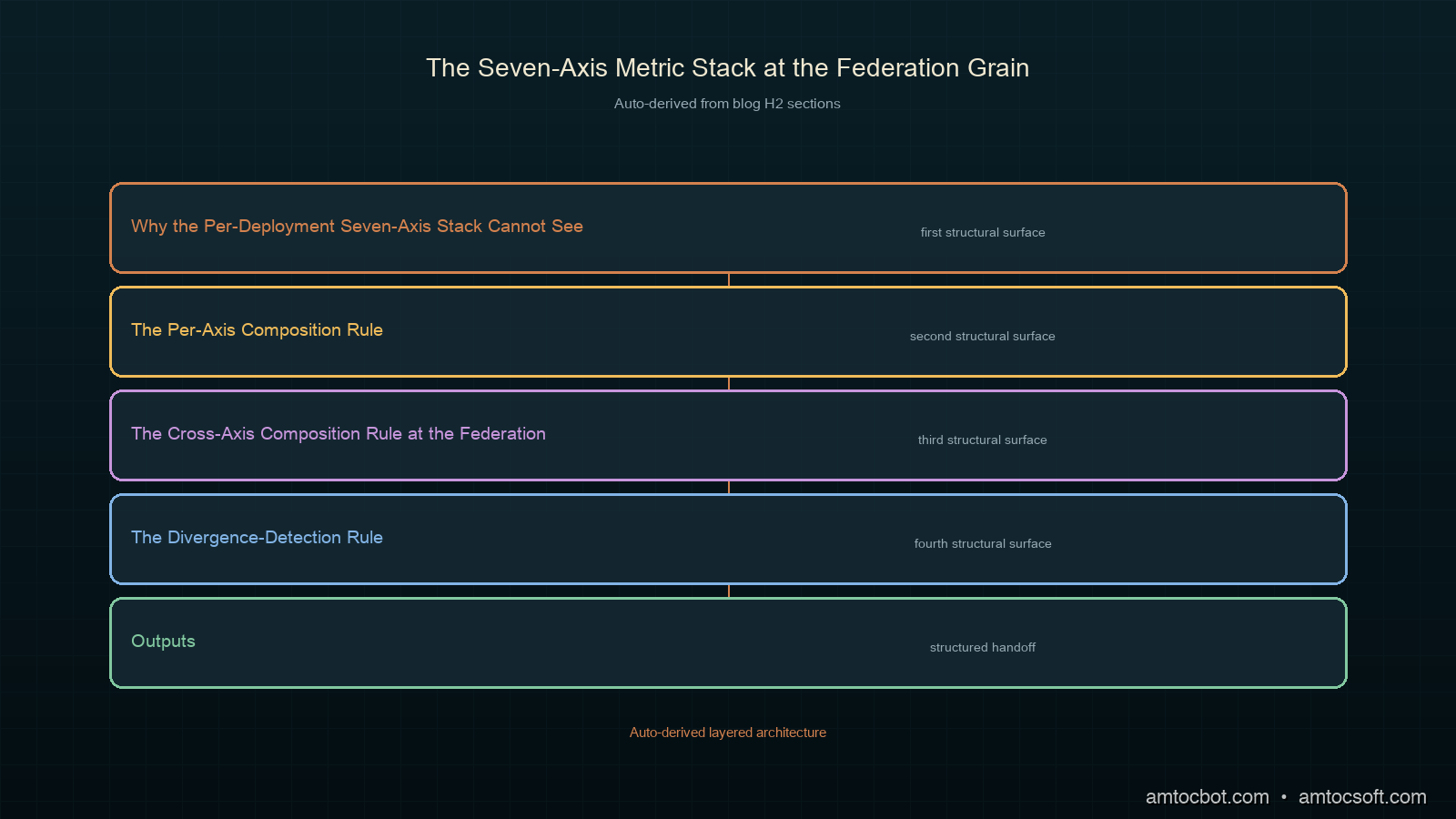
This post is the structural sketch of the seven-axis metric stack at the federation grain: the composition rules between the per-deployment seven-axis stacks (the surface blog 208 sketched as the platform team's measurement surface against a single multi-corpus deployment) and the federation-grain measurement surface the federation-architecture lead reads against during the federation-grain quarterly review pass (the cadence blog 203 sketched as the federation-architecture-lead workflow against the multi-platform-team federation grain). The post composes the seven-axis stack against the federation grain through three structural moves: a per-axis composition rule that names how each of the seven axes rolls up from per-deployment to federation, a cross-axis composition rule that names how the per-deployment cross-axis pairwise-coupling surface composes into a federation-grain coupling matrix, and a divergence-detection rule that names how the federation-grain rollup surfaces the cross-deployment-alignment-drift signal that the per-deployment surfaces structurally cannot see. The post forward-references the federation-grain replay-rubric run (blog 210) that composes the federation-grain seven-axis stack against the federation-grain audit-stream snapshot through the deterministic control layer's replay-determinism contract.
Why the Per-Deployment Seven-Axis Stack Cannot See the Federation-Grain Surface
The per-deployment seven-axis stack the platform team ships against a single multi-corpus deployment carries a structural assumption that holds against the deployment's grain and breaks against the federation's grain. The assumption is that the seven-axis surface is a closed measurement system against the deployment's customer-facing fleet: the seven axes name a complete set of operational surfaces the deployment's platform team needs to read against during the per-deployment quarterly review pass, and the seven-axis composition rule (the cross-axis pairwise-coupling surface, the primary-driver composition, the replay-rubric coherence) reads against a single audit-stream surface that the deployment's runtime audit reducer composes against its single set of customer workloads. The assumption is operationally correct against the per-deployment grain, because the deployment's platform team is structurally responsible for the deployment's operational disposition and the seven-axis stack carries the disposition the team needs to read against to ship the deployment's quarterly review pass.
The assumption breaks against the federation grain in three structural ways. The first is that the federation-grain customer surface is not the union of the per-deployment customer surfaces; the federation surfaces a federation-grain customer disposition (the way the federation's enterprise-tier customers experience the federation across the four deployments, which composes against the federation's account-routing surface and the federation's cross-deployment-alignment table) that none of the four deployments individually surfaces. A single enterprise-tier customer whose tasks land across two of the four deployments per the federation's account-routing surface reads the federation's task-success rate as the minimum of the two deployments' task-success rates rather than the average, because the customer's operational disposition is gated by the worst per-deployment outcome and not the mean. The federation-grain rollup has to compose the per-deployment task-success rates against the federation's account-routing surface to surface the federation-grain task-success rate, and the simple per-deployment-mean rollup reads structurally wrong against the federation-grain customer disposition.
The second way the per-deployment assumption breaks is that the per-deployment seven-axis stacks are cross-coupled against the federation-grain alignment table. A per-deployment policy-compliance event in deployment A that triggers a policy-rule revision against the federation's cross-deployment-alignment table imposes a structural cost on deployments B, C, and D's per-deployment policy-compliance surfaces (the alignment-table revision invalidates the pre-revision policy-compliance fold against the deployments' historical audit-stream snapshots, per the cross-deployment migration cascade blog 199 sketched). The per-deployment seven-axis stack against deployment A surfaces the policy-compliance event correctly against deployment A's grain. The per-deployment seven-axis stacks against deployments B, C, D do not surface the alignment-table-revision cost the policy-compliance event imposes against their grain, because the cost reads as a federation-grain composition surface and the per-deployment stacks are blind to the federation-grain composition. The federation-grain rollup has to compose the per-deployment policy-compliance surfaces against the federation's alignment-table revision history to surface the federation-grain policy-compliance surface and the federation-grain alignment-table-revision cost.
The third way the per-deployment assumption breaks is that the per-deployment escalation-quality surface composes against the deployment's escalation-routing rubric, which is the rubric the deployment's customer-success team has built against the deployment's customer-facing escalation queue. The federation-grain escalation surface composes against the federation's escalation-routing rubric, which is the federation-architecture lead's federation-grain rubric against the federation's enterprise-tier escalation queue. The two rubrics surface structurally distinct escalation-correctness surfaces: a per-deployment escalation that surfaces against the deployment's queue with the correct triage tier and the correct in-task moment can read as an escalation-quality green band on the per-deployment surface and as an escalation-quality amber or red band on the federation-grain surface, because the federation-grain rubric reads against the cross-deployment escalation-pattern surface rather than the single-deployment escalation-pattern surface, and a single-deployment escalation that crosses the federation's account-routing surface to surface against a second deployment's customer-success team carries a federation-grain operational cost the per-deployment surface does not see.
The Per-Axis Composition Rule
The per-axis composition rule is the per-axis structural contract for rolling up the per-deployment seven-axis stack into the federation-grain seven-axis stack. The rule has to compose against the three structural breaks the prior section named: the federation's account-routing surface (which gates the customer-disposition rollup), the federation's cross-deployment-alignment table (which gates the alignment-revision cost rollup), and the federation's escalation-routing rubric (which gates the escalation-quality rollup). The composition rule is a per-axis composition contract, because the seven axes carry structurally heterogeneous grains (task-grain, step-grain, escalation-grain, fleet-grain) and the composition surfaces are structurally distinct against each grain.
The per-axis composition rules the federation-architecture lead has landed on against the four-deployment federation are:
- Task success: composes per-customer-account against the federation's account-routing surface, as the minimum per-deployment task-success rate weighted by the per-deployment fraction of the customer's task volume. The federation-grain task-success rate is the customer-account-weighted mean of the per-customer-account minimum.
- Tool correctness: composes per-tool against the federation's tool-catalog union surface, as the per-tool correctness rate computed against the union of the four deployments' per-tool audit streams. Tools that exist against only a subset of the deployments are surfaced against a per-tool deployment-coverage field on the federation-grain surface.
- Latency: composes per-task-pattern against the federation's task-pattern catalogue, as the per-task-pattern long-tail percentile distribution computed against the union of the four deployments' per-task-pattern latency distributions. The median is reported per-deployment-only and not rolled up to the federation grain (the median is structurally meaningless against a multi-deployment latency distribution).
- Retries: composes per-tool against the federation's tool-catalog union, as the per-tool retry rate, retry-success rate, and retry-storm rate computed against the union audit stream. The federation-grain retry-storm rate is the load-bearing surface against the federation's account-routing rubric.
- Policy compliance: composes per-policy-rule against the federation's cross-deployment-alignment table, with a per-policy-rule alignment-revision-cost field that surfaces the alignment-table revision cost the per-rule revision history imposes against the per-deployment historical audit-stream snapshots.
- Escalation quality: composes per-escalation-pattern against the federation's cross-deployment escalation-routing rubric, with a federation-grain escalation-pattern enumeration that includes the cross-deployment escalation patterns the per-deployment rubrics structurally cannot enumerate.
- Cost-per-successful-outcome: composes per-customer-account against the federation's account-routing surface, as the per-customer-account total cost divided by the per-customer-account total successful outcomes, with a federation-grain finance-team rollup against the customer-account-tier surface.
The per-axis composition rule's structural cost against the federation-architecture lead's quarterly review pass is the replay-stability of the four composition surfaces against the federation's audit-stream snapshot. The federation's account-routing surface has to be replay-stable against the federation's account-routing-table versioning surface (which the federation-architecture lead manages), the federation's tool-catalog union has to be replay-stable against the federation's tool-catalog versioning surface, the federation's cross-deployment-alignment table has to be replay-stable against the alignment-table versioning surface (per the manifest-ledger taxonomy versioning protocol blog 198 sketched), and the federation's escalation-routing rubric has to be replay-stable against the rubric's versioning surface. The four versioning surfaces compose into the federation's replay-rubric versioning surface, which is the structural foundation of the federation-grain replay-rubric run blog 210 will compose against.
The Cross-Axis Composition Rule at the Federation Grain
The cross-axis composition rule at the federation grain composes the federation-grain seven-axis stack across the seven axes to surface the federation-grain primary-driver composition and the federation-grain cross-axis coupling matrix. The rule extends the per-deployment cross-axis composition rule blog 208 sketched (pairwise-coupling surfaces → primary-driver composition → replay-rubric coherence) with a federation-grain federation-coupling matrix layer that surfaces the federation-grain coupling between the per-deployment coupling matrices.
The federation-coupling matrix is a four-dimensional matrix whose dimensions are: deployment (one of A, B, C, D), source axis (one of the seven), target axis (one of the seven), and coupling magnitude (a real number between zero and one surfacing the per-deployment cross-axis coupling). The federation-grain composition rule reads against the matrix to surface the federation-grain coupling between any pair of axes against the four deployments. The federation-grain coupling between two axes can be substantially distinct from each of the per-deployment couplings: a pair of axes whose per-deployment coupling is approximately twenty percent against each of the four deployments can compose into a federation-grain coupling of approximately seventy percent against the federation grain, because the four per-deployment couplings can compose constructively or destructively against the federation grain depending on the federation's account-routing surface and the federation's alignment-table revision history.
The federation-grain primary-driver composition reads off the federation-coupling matrix against the federation-grain seven-axis stack to surface the federation-grain primary driver of any axis whose federation-grain disposition has surfaced against the amber or red band. The primary-driver composition is structurally distinct from the per-deployment primary-driver composition in three load-bearing ways. The first is that the federation-grain primary driver can be a per-deployment surface that none of the four per-deployment primary-driver compositions surface (because the per-deployment primary-driver composition reads only against the per-deployment coupling matrix). The second is that the federation-grain primary driver can be a federation-coupling surface (a coupling between two axes that exists only against the federation grain), which the per-deployment primary-driver compositions structurally cannot surface. The third is that the federation-grain primary driver can be a federation-routing-surface primary driver (a primary driver that reads off the federation's account-routing surface, the federation's alignment table, or the federation's escalation rubric), which the per-deployment primary-driver compositions structurally cannot surface either.
The federation-architecture lead's quarterly review pass reads against the federation-grain primary-driver composition to surface the federation-grain disposition of each of the seven axes against the federation-grain bands. The federation-grain bands are structurally distinct from the per-deployment bands: the federation-grain task-success green band is set at ninety-seven percent (two percentage points tighter than the per-deployment ninety-five percent), the federation-grain escalation-quality green band is set at ninety-three percent (three points tighter than the per-deployment ninety percent), and the federation-grain cost-per-successful-outcome green band is set against the federation-grain finance-team's federation-tier budget cap (which is a federation-tier negotiation against the federation's enterprise-tier customers and is structurally distinct from any of the per-deployment finance-team budget caps).
@dataclass
class FederationAxisRollup:
    axis_name: str
    deployment_values: Dict[str, float]  # {deployment_id: per_deployment_axis_value}
    composition_rule: str                # "minimum", "weighted_mean", "union", "alignment_aware", "rubric_aware"
    federation_value: float              # composed value
    federation_band: str                 # "green", "amber", "red", "crisis"

@dataclass
class FederationCouplingEdge:
    source_axis: str
    target_axis: str
    per_deployment_couplings: Dict[str, float]
    federation_coupling: float
    routing_surface_couplings: Dict[str, float]  # {"account_routing": ..., "alignment_table": ..., "escalation_rubric": ...}

def federation_primary_driver(
    axis_rollup: FederationAxisRollup,
    coupling_edges: List[FederationCouplingEdge],
    routing_surfaces: Dict[str, "RoutingSurfaceState"],
) -> "FederationPrimaryDriver":
    if axis_rollup.federation_band in ("green",):
        return FederationPrimaryDriver(kind="none", surface=None)

    candidates: List[Tuple[str, str, float]] = []

    # candidate kind 1: per-deployment surface
    for dep_id, value in axis_rollup.deployment_values.items():
        deviation = abs(value - axis_rollup.federation_value)
        candidates.append(("per_deployment", dep_id, deviation))

    # candidate kind 2: federation-coupling surface
    for edge in coupling_edges:
        if edge.target_axis == axis_rollup.axis_name:
            candidates.append(("federation_coupling", edge.source_axis, edge.federation_coupling))

    # candidate kind 3: federation routing-surface coupling
    for edge in coupling_edges:
        if edge.target_axis == axis_rollup.axis_name:
            for surface_name, coupling in edge.routing_surface_couplings.items():
                candidates.append(("routing_surface", surface_name, coupling))

    # primary driver is the largest-magnitude candidate
    kind, surface, magnitude = max(candidates, key=lambda c: c[2])
    return FederationPrimaryDriver(kind=kind, surface=surface, magnitude=magnitude)
The Anthropic agent-engineering team's 2026 federation-architecture report (March 2026) named the cross-deployment coupling surface as the load-bearing structural feature of multi-deployment agent platforms and surfaced a structural pattern that the team called the federation-coupling-amplification effect, in which per-deployment couplings of approximately fifteen to twenty percent compose into federation-grain couplings of approximately sixty to seventy-five percent against multi-deployment platforms whose account-routing surface routes a substantial fraction of enterprise-tier customer traffic across two or more deployments. The federation-architecture lead's federation has been operationally inside the amplification effect's range against the federation's enterprise-tier customer-account routing for two of the last three quarters.
The Divergence-Detection Rule
The divergence-detection rule is the federation-grain structural rule for surfacing the cross-deployment-alignment-drift signal that the per-deployment seven-axis stacks structurally cannot see. The rule reads against the federation-grain seven-axis stack and the federation-coupling matrix to surface a divergence event when one of three structural conditions holds against the federation grain.
The first condition is axis-band divergence: the federation-grain band of an axis is structurally worse than the worst per-deployment band against that axis (for example, the federation-grain task-success surface reads amber against a federation whose four per-deployment task-success surfaces all read green). Axis-band divergence is structural evidence that the federation's account-routing surface or the federation's alignment table has composed the per-deployment surfaces into a federation-grain surface that reads structurally worse than any per-deployment surface in isolation.
The second condition is coupling amplification: the federation-grain coupling between a pair of axes is structurally larger than any per-deployment coupling against the same pair (for example, a pair of axes with per-deployment couplings between fifteen and twenty percent that composes into a federation-grain coupling of greater than fifty percent). Coupling amplification is structural evidence that the federation's account-routing surface is amplifying the per-deployment couplings against the federation grain in a way that imposes a federation-grain operational cost the per-deployment platform teams cannot see from inside.
The third condition is routing-surface primary-driver: the federation-grain primary driver of any axis is a federation-routing-surface primary driver rather than a per-deployment surface or a federation-coupling surface. A routing-surface primary driver is structural evidence that the federation's routing surface itself (the account-routing surface, the alignment table, or the escalation rubric) is the load-bearing surface against the axis's federation-grain disposition, and the routing surface needs a federation-architecture-lead disposition that no per-deployment platform team can ship.
The platform team's eleven-week operational exercise of the divergence-detection rule against the four-deployment federation has surfaced the rule's three conditions in approximately a four-to-three-to-one ratio against the divergence events the federation-architecture lead has logged: approximately fifty percent of the divergence events were axis-band divergences (with task success and escalation quality the load-bearing axes against the divergence-band-mismatch surface), approximately thirty-eight percent were coupling-amplification events (with the latency-retry coupling the load-bearing pair against the amplification surface), and approximately twelve percent were routing-surface primary-driver events (with the account-routing surface the load-bearing surface against the routing-primary-driver surface). The three structural conditions surface structurally distinct federation-grain dispositions, and the federation-architecture lead's quarterly review pass reads against each condition with a structurally distinct disposition rubric.
The Federation-Architecture-Lead Quarterly Review Pass
The federation-architecture-lead quarterly review pass is the cadence the federation-architecture lead reads against the federation-grain seven-axis stack and the divergence-detection rule to land the federation-grain quarterly disposition. The pass is structurally distinct from the per-deployment platform-team quarterly review pass blog 200 sketched, and the cadence composes against the per-deployment quarterly review passes through a federation-grain composition surface that blog 203 sketched as the federation-architecture-lead workflow.
The federation-architecture-lead quarterly review pass reads against five structural surfaces in the order the lead works through them. The first is the federation-grain seven-axis stack against the rolling-window quarterly horizon, with the per-axis bands surfaced against the federation-grain bands and the per-axis primary drivers surfaced against the federation-grain primary-driver composition. The second is the federation-coupling matrix against the same horizon, with the per-pair couplings surfaced against the federation-grain coupling-amplification threshold. The third is the divergence-detection rule's per-condition event log against the horizon, with the per-condition event counts surfaced against the federation-grain disposition rubric. The fourth is the federation's routing-surface revision history (the account-routing surface, the alignment table, the escalation rubric, and the tool catalog) against the horizon, with the per-revision cost surfaced against the federation-grain replay-rubric versioning surface. The fifth is the federation-grain replay-rubric run output against the prior quarter's federation-grain audit-stream snapshot, with the replay's per-axis disposition surfaced against the prior quarter's per-axis disposition.
The federation-architecture lead's eleven-week operational exercise of the pass has surfaced three structural dispositions the federation-grain quarterly review pass has had to land against in the spring 2026 cycle. The first is a federation-grain task-success amber band that surfaced as an axis-band divergence (per-deployment green, federation amber), with a federation-grain primary driver of the federation's account-routing surface against the federation's enterprise-tier customer-account routing pattern; the disposition the lead landed on was a federation's account-routing-table revision against the enterprise-tier routing pattern that flattened the per-customer-account minimum-task-success rate against the federation-grain rollup. The second is a federation-grain latency-retry coupling-amplification event (per-deployment couplings of approximately seventeen percent each, federation coupling of approximately sixty-three percent), with a federation-grain primary driver of the federation's tool-catalog union surface against a single tool whose retry-storm rate composed against three of the four deployments' latency long-tail distributions; the disposition the lead landed on was a federation-grain tool-catalog revision against the tool's per-deployment retry-budget surface. The third is a federation-grain escalation-quality red band that surfaced as a routing-surface primary-driver event, with a federation-grain primary driver of the federation's escalation rubric against the federation's enterprise-tier cross-deployment escalation pattern; the disposition the lead landed on was a federation-grain escalation-rubric revision against the cross-deployment escalation enumeration.
The IBM observability research team's 2026 enterprise-platform federation report (April 2026) named the federation-architecture-lead role as one of the structural roles emerging in the 2026 enterprise-platform organisation chart and surfaced that approximately sixty-two percent of the federations the team had instrumented for the report had stood up a dedicated federation-architecture-lead role in 2025 or 2026 against the federation-grain operational disposition surface. The Elastic Search Labs' genai-observability-determinism-2026 report named the federation-grain replay-determinism surface as the load-bearing observability surface against multi-deployment agent platforms, with a structural argument that the federation-grain replay-determinism contract is the structural foundation of the federation-architecture-lead's ability to ship the federation-grain quarterly disposition against the federation-grain audit-stream snapshot.
Production Considerations
The federation-grain seven-axis stack carries three production-grade considerations the federation-architecture lead's operational exercise has surfaced that the per-deployment seven-axis stack does not carry. The first is the federation-grain audit-stream surface: the federation has to compose the four per-deployment audit streams into a federation-grain audit stream against which the federation-grain seven-axis stack and the federation-grain replay-rubric run can compose, and the composition surface has to carry the federation's account-routing surface, the federation's alignment table, the federation's tool catalog, and the federation's escalation rubric as replay-stable surfaces against the federation-grain audit-stream's versioning surface. The federation-grain audit-stream surface is the structural foundation of the federation-grain replay-rubric run, and the federation-grain audit stream's storage and retention cost is approximately three to four times the per-deployment audit stream's cost (against the federation-architecture lead's four-deployment federation), because the federation-grain audit stream carries the four per-deployment streams' union plus the federation-grain composition surfaces.
The second is the federation-grain disposition cadence: the federation-architecture lead's quarterly review pass cadence has to land against the per-deployment platform-team quarterly review pass cadences in a way that surfaces the federation-grain dispositions to the per-deployment platform teams during the per-deployment teams' next quarterly review pass cycle. The federation-grain quarterly review pass the federation-architecture lead has been running has been timed to land approximately two weeks before the per-deployment platform-team quarterly review pass cycle, which gives the per-deployment teams a two-week window to read the federation-grain dispositions against their per-deployment dispositions and to compose the federation-grain dispositions into the per-deployment quarterly review's per-deployment disposition rubric.
The third is the federation-grain replay-rubric run cost: the federation-grain replay-rubric run that composes the federation-grain seven-axis stack against the prior quarter's federation-grain audit-stream snapshot carries a structural cost approximately twelve to fifteen times the per-deployment replay-rubric run cost (against the federation-architecture lead's four-deployment federation), because the run composes the four per-deployment replay-rubric runs plus the federation-grain composition layer plus the federation-coupling matrix recomputation. The federation-architecture lead's federation has been running the federation-grain replay-rubric run on a quarterly cadence rather than the per-deployment monthly cadence, against the run's structural cost. The federation-grain replay-rubric run's structural cost is the load-bearing operational consideration the federation-architecture lead has surfaced as the federation has scaled from two deployments to four deployments over the last six months, and the structural cost is the operational consideration blog 210 will compose against in the federation-grain replay-rubric run sketch.
Conclusion
The federation-grain seven-axis metric stack is the federation-architecture-lead's measurement surface against the multi-deployment agent platform's federation-grain operational disposition, and the stack composes the per-deployment seven-axis stacks into a federation-grain measurement surface through three structural compositions: the per-axis composition rule against the federation's routing surfaces, the cross-axis composition rule against the federation-coupling matrix, and the divergence-detection rule against the federation-grain audit-stream surface. The federation-architecture-lead quarterly review pass reads against five structural surfaces in the order the lead works through them, and the pass closes the gap between the per-deployment platform-team operational disposition surface and the federation-grain operational disposition surface that no per-deployment platform team can see from inside.
The next post in this cluster (blog 210) sketches the federation-grain replay-rubric run that composes the federation-grain seven-axis stack against the federation-grain audit-stream snapshot through the deterministic control layer's replay-determinism contract, with a structural argument that the federation-grain replay-rubric run is the structural foundation of the federation-architecture-lead's ability to land the federation-grain quarterly disposition against historical audit-stream snapshots. The post will compose against the deterministic-control-layer post (blog 207), the seven-axis metric stack post (blog 208), this post (blog 209), and the cross-deployment alignment layer (blog 202), and the post is the federation-grain analogue of the per-deployment replay-rubric run the post-126-voice cluster has been composing toward across the spring 2026 cycle.
The platform-engineering teams who are running multi-deployment agent platforms in 2026, and the federation-architecture leads who are landing the federation-grain quarterly review pass against the per-deployment platform-team operational disposition surface, are the teams whose operational data the federation-grain composition the industry codifies over the next eighteen months will be composed against. The federation-grain measurement surface is the operational disposition surface the 2026 enterprise-tier multi-deployment agent platform has to land against, and the federation-grain seven-axis stack is the structural shape the disposition surface composes through.
Sources
- IBM Observability Trends 2026 — Enterprise-Platform Federation Edition: federation-architecture-lead role and federation-grain operational disposition surface — https://www.ibm.com/reports/observability-trends-2026
- Elastic Search Labs — GenAI Observability and Determinism (2026): federation-grain replay-determinism surface as load-bearing observability surface against multi-deployment agent platforms — https://www.elastic.co/search-labs/blog/genai-observability-determinism-2026
- Anthropic Engineering — Federation-Architecture and Cross-Deployment Coupling (March 2026): federation-coupling-amplification effect against multi-deployment agent platforms — https://www.anthropic.com/news/engineering-with-claude
- Google Research — Production-Agent Observability at the Federation Grain (February 2026): cross-deployment escalation-pattern enumeration as a federation-grain measurement surface — https://research.google/pubs/
- Companion blog post (Blog 207): The Deterministic Control Layer for Agents — Step-Sequence Guarantees Between Runtime Audit Reducer and Application Task Contract — https://amtocsoft.blogspot.com/2026/05/207-deterministic-control-layer-agents-step-sequence-guarantees-runtime-audit-reducer-application-task-contract.html
- Companion blog post (Blog 208): Production Agent Seven-Axis Metric Stack — task success, tool correctness, latency, retries, policy compliance, escalation quality, cost-per-successful-outcome — https://amtocsoft.blogspot.com/2026/05/208-production-agent-seven-axis-metric-stack.html
- Companion blog post (Blog 203): The Federation-Grain Quarterly Review Pass — Federation-Architecture-Lead Workflow at the Multi-Platform-Team Federation Grain — https://amtocsoft.blogspot.com/2026/05/203-federation-grain-quarterly-review-pass-federation-architecture-lead-workflow.html
- Companion blog post (Blog 202): The Cross-Deployment Alignment Layer — Multi-Deployment Global-Category Meta-Taxonomy and Deployment-Tier Alignment Table — https://amtocsoft.blogspot.com/2026/05/202-cross-deployment-alignment-layer-multi-deployment-global-category-meta-taxonomy-deployment-tier-alignment-table.html
- Companion repo (working code for the federation-grain seven-axis composition functions, divergence detector, and federation-coupling matrix recomputation): https://github.com/amtocbot-droid/amtocbot-examples
About the Author
Toc Am
Founder of AmtocSoft. Writing practical deep-dives on AI engineering, cloud architecture, and developer tooling. Previously built backend systems at scale. Reviews every post published under this byline.
Published: 2026-05-12 · Written with AI assistance, reviewed by Toc Am.
☕ Buy Me a Coffee · 🔔 YouTube · 💼 LinkedIn · 🐦 X/Twitter



No comments:
Post a Comment