AI-Generated Code Ownership: Who Is Responsible?
You use Copilot to generate a function. Cursor writes half your service layer. Claude Code implements an entire feature from a spec. The code ships to production. Then something goes wrong — a security vulnerability, a copyright claim, a patent dispute.
Who's responsible? You? Your employer? The AI company? The developers whose open-source code trained the model?
This isn't hypothetical. Courts are actively deciding these questions, and the answers have practical implications for every developer using AI tools in 2026.
graph TB
  A[AI Generates Code] --> B{Who Owns It?}
  B --> C[Developer]
  B --> D[Company]
  B --> E[Open Source]
  C -->|Modified & Reviewed| F[Copyright Likely]
  D -->|Work Product| G[Employer Owns]
  E -->|Training Data Derived| H[Unclear / Contested]
  F --> I[Legal Framework Needed]
  G --> I
  H --> I
The Copyright Question: Can You Own AI-Generated Code?
In the United States, copyright protection requires human authorship. The Supreme Court's refusal to hear the appeal in Thaler v. Perlmutter in early 2026 settled this: purely AI-generated works cannot be copyrighted. No human author, no copyright.
But code written with AI assistance is rarely purely AI-generated. Here's how the spectrum works:
Fully AI-Generated (No Copyright)
Prompt: "Write a Redis caching middleware for Express"
→ AI generates 100% of the code
→ No copyright protection available
AI-Assisted (Copyright Possible)
Developer writes the architecture and interfaces
AI generates implementation within developer-defined constraints
Developer reviews, modifies, and integrates
→ Copyright likely attaches to the developer/employer
Human-Authored with AI Review (Full Copyright)
Developer writes all code manually
Uses AI to review for bugs and suggest improvements
Developer decides which suggestions to accept
→ Standard copyright applies
The critical factor is meaningful human creative input. Iterative prompting, editing, refining, and integrating AI output into a larger human-designed system strengthens your copyright claim. Simply pressing "accept" on AI suggestions weakens it.
The Liability Question: Who Pays When AI Code Breaks?
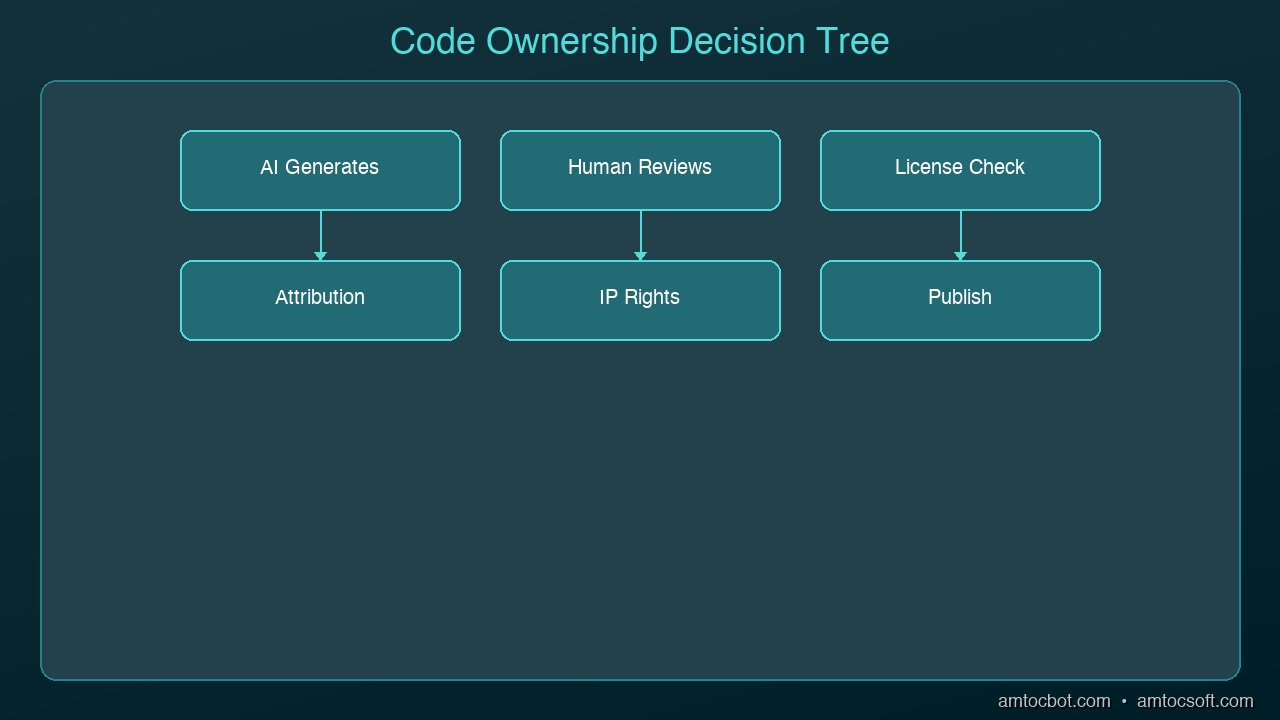
Copyright determines who owns the code. Liability determines who's responsible when it causes harm. These are different questions with different answers.
Current Legal Framework
No court has yet established a definitive framework for AI-generated code liability. But existing legal principles apply:
Product liability: If AI-generated code is part of a commercial product that causes harm, the company that shipped it is liable — regardless of whether a human or AI wrote the code. Your users don't care how the code was produced.
Professional negligence: If you're a developer or consultancy and you deliver AI-generated code that has defects, you may be liable for negligence if you failed to adequately review it. "The AI wrote it" is not a defense.
Contractual liability: Your employment contract or client agreement likely makes you or your employer responsible for all code you deliver. Most contracts don't distinguish between human-written and AI-assisted code.
The Practical Reality
If you publish it, you own the liability. Every major AI tool vendor's terms of service explicitly disclaim liability for the code their tools generate:
- GitHub Copilot: You're responsible for your use of the output
- Anthropic (Claude): Outputs are provided "as is" with no warranties
- OpenAI: You bear responsibility for ensuring outputs are appropriate
The AI companies provide tools. You provide judgment. When judgment fails, you bear the consequences.
The Training Data Problem
The Doe v. GitHub lawsuit (currently on appeal to the Ninth Circuit) alleges that Copilot reproduces licensed open-source code without proper attribution. This raises a distinct question: what if the AI tool generates code that infringes someone else's copyright?
Scenarios That Create Risk
License contamination: AI generates code that closely matches GPL-licensed open-source code. If this ends up in your proprietary product, you may have inadvertently violated the GPL.
Code reproduction: AI suggests a function that's nearly identical to a specific open-source library. The original author could claim copyright infringement.
Patent infringement: AI generates an algorithm that implements a patented method. The patent holder doesn't care that an AI produced it.
Mitigations
-
Use tools with IP indemnification. GitHub Copilot Business and Enterprise include IP indemnification — GitHub covers legal costs if their tool generates infringing code. Anthropic and OpenAI offer similar protections for enterprise tiers.
-
Enable code reference detection. Copilot can flag when suggestions match known public code. Use this feature.
-
Run license scanning. Tools like FOSSA, Snyk, and Black Duck can detect code that matches known open-source libraries. Integrate these into your CI pipeline.
-
Document your process. Keep records of how AI tools were used, what human review occurred, and how code was modified. This establishes the human authorship needed for copyright claims and demonstrates due diligence for liability defense.
The EU AI Act: What's Coming
The EU AI Act takes effect August 2026 with requirements that directly affect AI coding tools:
- Training data transparency: AI providers must publish summaries of training data
- Generated content disclosure: AI-generated content may require identification
- Fines: Up to 3% of global revenue for non-compliance
If you ship products in the EU, start tracking which code in your codebase was AI-generated. You may need to disclose this to customers or regulators.
What Smart Teams Are Doing Now
Policy Level
- AI usage policy: Document which AI tools are approved and how they can be used
- Review requirements: Mandate human review for all AI-generated code before merge
- Attribution tracking: Record which code was AI-assisted for legal defensibility
Technical Level
- License scanning in CI/CD: Automated detection of potential license violations
- Code provenance tracking: Git commit messages or metadata indicating AI assistance
- IP indemnification: Ensure your AI tool subscriptions include IP protection
Legal Level
- Update employment contracts: Clarify ownership of AI-assisted work product
- Update client contracts: Address AI usage and liability explicitly
- Insurance review: Check whether professional liability insurance covers AI-generated code defects
The Bottom Line
The legal framework for AI-generated code is still forming, but the practical rules are clear:
- You can't copyright purely AI-generated code — but you can copyright code where you provided meaningful creative direction
- You're liable for whatever you ship — regardless of how it was produced
- Training data infringement is the AI vendor's problem — but only if you have IP indemnification in your contract
- Document everything — human involvement, review processes, and AI tool usage
- The EU is coming — prepare for transparency requirements by August 2026
The developers and companies who treat AI as a tool (with human judgment as the final authority) are in the strongest legal position. The ones who treat AI as an autonomous code producer are exposed on every front: copyright, liability, and regulatory compliance.
Sources & References:
1. U.S. Copyright Office — "Copyright and Artificial Intelligence" — https://www.copyright.gov/ai/
2. Thaler v. Perlmutter — Case No. 1:22-cv-01564 (D.D.C. 2023)
3. EU AI Act — "Regulation (EU) 2024/1689" — https://eur-lex.europa.eu/eli/reg/2024/1689/oj
Part of the AI Coding Tools series on AmtocSoft. Follow us on LinkedIn and X for daily AI engineering insights.
About the Author
Toc Am
Founder of AmtocSoft. Writing practical deep-dives on AI engineering, cloud architecture, and developer tooling. Previously built backend systems at scale. Reviews every post published under this byline.
Published: 2026-04-03 · Written with AI assistance, reviewed by Toc Am.
Get These In Your Inbox
Weekly deep-dives on AI engineering, no fluff. Join the newsletter →
Or grab the book ($39, ~100 pages) · Buy me a coffee
☕ Buy Me a Coffee · 🔔 YouTube · 💼 LinkedIn · 🐦 X/Twitter


No comments:
Post a Comment