Edge AI: Running Language Models on Phones and IoT Devices
Your phone has more compute power than the servers that trained GPT-2. So why are we still sending every AI request to the cloud?
Edge AI is changing that. In 2026, language models run directly on phones, tablets, laptops, and even embedded devices -- no internet required. Here's how it works and why it matters.
Why Edge AI Matters
Privacy: Your data never leaves your device. Medical questions, financial queries, personal messages -- processed locally, seen by no one.
Latency: No network round-trip. Responses start in milliseconds, not seconds. Critical for real-time applications like voice assistants and AR.
Cost: No API fees. No cloud compute bills. Once the model is on the device, inference is free.
Availability: Works offline. In airplanes, remote areas, or when your cloud provider has an outage.
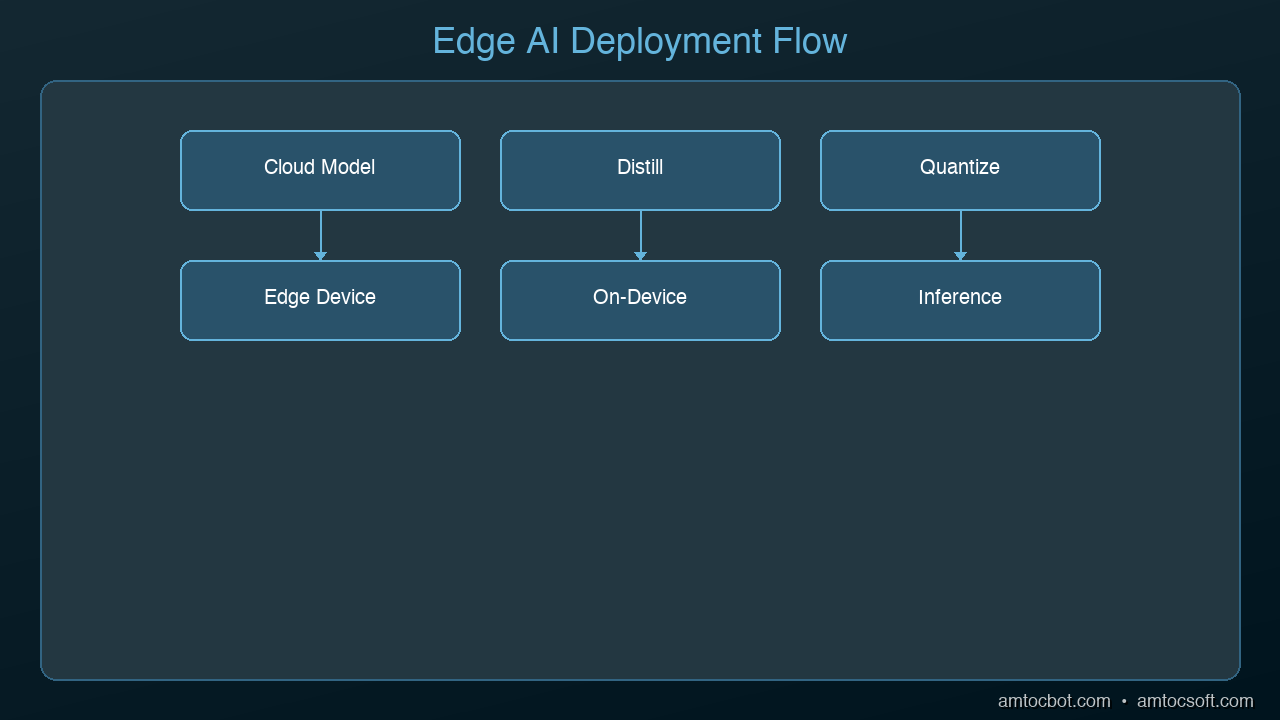
graph LR
  A["Cloud Model"] -->|"quantize & optimize"| B["Convert to Edge Format"]
  B -->|"CoreML / TFLite / ONNX"| C["Deploy to Device"]
  C --> D["On-Device Inference"]
  D --> E["No Internet Needed"]
What's Possible Today
Phones (2026)
Modern smartphones are surprisingly capable AI devices:
- iPhone 16 Pro: 16 GB unified memory, Apple Neural Engine (38 TOPS). Runs a 3B parameter model at ~15 tokens/second
- Samsung Galaxy S26: 12 GB RAM, Snapdragon 8 Gen 4 NPU. Runs Gemma 2B at ~20 tokens/second
- Google Pixel 10: 12 GB RAM, Tensor G5 with dedicated AI core. Runs Gemini Nano natively
These devices comfortably run 1-3B parameter models. With aggressive quantization (Q2-Q4), you can squeeze in a 7B model, though response times slow down.
Laptops (The Sweet Spot)
Apple Silicon Macs have become the default local AI development platform:
- MacBook Air M3 (24 GB): Runs 7B Q4 at 30+ tokens/sec, 13B Q4 at 15 tokens/sec
- MacBook Pro M4 Max (128 GB): Runs 70B Q4 at 20+ tokens/sec
- Framework Laptop (32 GB, Intel/AMD): Runs 7B Q4 at 15-20 tokens/sec via llama.cpp
The Apple MLX framework deserves special mention. It's designed specifically for Apple Silicon's unified memory architecture, delivering 20-40% better performance than generic implementations.
IoT and Embedded
The frontier of edge AI:
- Raspberry Pi 5 (8 GB): Runs TinyLlama 1.1B at ~3 tokens/sec. Slow, but it works
- NVIDIA Jetson Orin Nano: 8 GB GPU memory, runs 3B models at 10+ tokens/sec. Perfect for robotics
- Coral Edge TPU: Specialized for inference, runs small quantized models for classification and simple generation
The Edge AI Stack
Apple Ecosystem: MLX
MLX is Apple's machine learning framework optimized for Apple Silicon. Key advantages:
- Leverages unified memory (no CPU-to-GPU data copying)
- Lazy evaluation for memory efficiency
- NumPy-like API for Python developers
- Growing model ecosystem on Hugging Face
import mlx.core as mx
from mlx_lm import load, generate

model, tokenizer = load("mlx-community/Llama-3.2-3B-Instruct-4bit")
response = generate(model, tokenizer, prompt="Explain edge AI", max_tokens=200)
Cross-Platform: llama.cpp
llama.cpp runs everywhere -- literally. It's written in pure C/C++ with optional acceleration for:
- Apple Metal (Mac/iOS)
- CUDA (NVIDIA GPUs)
- Vulkan (AMD GPUs, Android)
- OpenCL (broader GPU support)
- CPU with SIMD optimizations (AVX2, NEON)
This makes it the go-to choice for cross-platform edge deployment.
Android: MediaPipe LLM
Google's MediaPipe now includes an LLM inference API for Android. It handles model loading, quantization, and hardware acceleration through a simple API:
val llmInference = LlmInference.createFromOptions(context, options)
val response = llmInference.generateResponse("What is edge AI?")
Optimization Techniques for Edge
Running models on constrained devices requires aggressive optimization:
1. Aggressive Quantization
Edge devices benefit most from Q2-Q4 quantization. The quality trade-off is worth it when the alternative is "doesn't fit in memory at all."
2. Knowledge Distillation
Train a small model (1-3B) to mimic a large model (70B). The small model captures 80-90% of the large model's capability at 1/20th the size. This is how Apple Intelligence and Google's on-device models are built.
3. Pruning
Remove unnecessary neurons and connections. Structured pruning can reduce model size by 30-50% with minimal quality loss. Unstructured pruning goes further but requires hardware support.
4. Model Architecture Optimization
Newer architectures designed for edge:
- Gemma 2B: Google's compact model designed for on-device use
- Phi-3 Mini: Microsoft's 3.8B model that punches above its weight
- TinyLlama: 1.1B model trained on 3 trillion tokens -- tiny but capable
5. KV-Cache Compression
On memory-constrained devices, the KV-cache (which grows with context length) is often the bottleneck. Techniques like sliding window attention and grouped-query attention reduce cache size by 4-8x.
Use Cases in Production
Smart Home Assistants: Process voice commands locally. No cloud dependency, instant responses, complete privacy.
Healthcare: Medical devices that analyze patient data on-device. HIPAA compliance is simpler when data never leaves the device.
Automotive: In-car AI for navigation, voice control, and driver assistance. Works in tunnels and dead zones.
Industrial IoT: Predictive maintenance on factory floors. Analyze sensor data locally, alert only when needed.
Education: Offline tutoring apps for students without reliable internet. Especially impactful in developing regions.
The Trade-offs
Edge AI isn't always the right choice:
| Factor | Edge | Cloud |
|---|---|---|
| Model Size | 1-7B | Unlimited |
| Response Quality | Good | Best |
| Latency | <100ms | 200ms-2s |
| Privacy | Complete | Depends on provider |
| Cost per Query | Free | $0.001-0.01 |
| Offline Support | Yes | No |
| Updates | Manual | Automatic |
The emerging pattern is hybrid: use edge AI for simple, latency-sensitive, or privacy-critical tasks, and fall back to cloud for complex reasoning that requires larger models.
Getting Started
The fastest path to edge AI:
- Mac users: Install Ollama, run
ollama run llama3.2:3b - Mobile developers: Try MediaPipe LLM (Android) or Core ML (iOS)
- IoT: Start with a Jetson Orin Nano and llama.cpp
- Web: Use WebLLM to run models directly in the browser via WebGPU
Edge AI isn't a future technology. It's a today technology that's getting better every month. The models are getting smaller, the hardware is getting faster, and the tools are getting simpler.
Next: Putting it all together -- a complete guide to choosing your AI deployment strategy from development to production.
Sources & References:
1. Apple — "Core ML Documentation" — https://developer.apple.com/documentation/coreml
2. Google — "MediaPipe Solutions" — https://ai.google.dev/edge/mediapipe/solutions/guide
3. ONNX Runtime — "Mobile and Edge Deployment" — https://onnxruntime.ai/
About the Author
Toc Am
Founder of AmtocSoft. Writing practical deep-dives on AI engineering, cloud architecture, and developer tooling. Previously built backend systems at scale. Reviews every post published under this byline.
Published: 2026-04-05 · Written with AI assistance, reviewed by Toc Am.
Get These In Your Inbox
Weekly deep-dives on AI engineering, no fluff. Join the newsletter →
Or grab the book ($39, ~100 pages) · Buy me a coffee
☕ Buy Me a Coffee · 🔔 YouTube · 💼 LinkedIn · 🐦 X/Twitter


No comments:
Post a Comment