Fine-Tuning vs RAG: When to Use Which
Level: Advanced | Topic: Fine-Tuning vs RAG | Read Time: 7 min
Two techniques dominate the conversation about customizing LLMs: fine-tuning and Retrieval-Augmented Generation (RAG). Both make models more useful for specific tasks. But they solve fundamentally different problems, and using the wrong one wastes time and money.
This guide provides a clear decision framework for choosing between them.
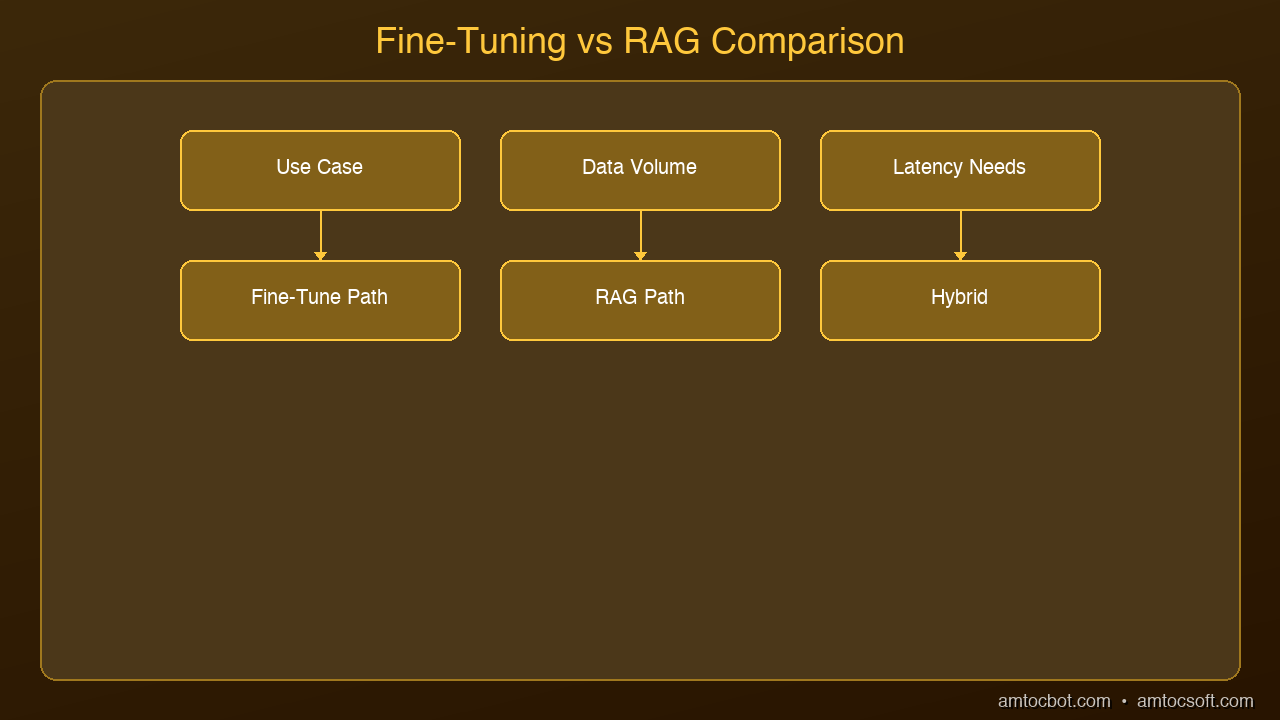
graph TB
  A[Need to Customize AI?] --> B{Is Data Static?}
  B -->|Yes| C[Fine-Tuning]
  B -->|No / Dynamic| D[RAG]
  A --> E{Need Both?}
  E -->|Yes| F[Hybrid\nFine-Tune + RAG]
What Each Technique Does
RAG adds external knowledge at inference time. Before the model generates a response, RAG searches a knowledge base, retrieves relevant documents, and includes them in the prompt. The model's weights remain unchanged.
Fine-tuning changes the model's behavior by updating its weights with new training data. The model permanently learns new patterns, styles, or domain knowledge.
The distinction matters: RAG teaches the model what to know. Fine-tuning teaches the model how to behave.
When to Use RAG
RAG is the right choice when:
- Knowledge changes frequently: Product catalogs, documentation, news, pricing — anything that updates regularly
- You need citations: RAG naturally provides source documents for every answer
- Your knowledge base is large: RAG can search millions of documents without increasing model size
- Accuracy is critical: Grounding responses in retrieved documents reduces hallucinations
- You need to get started quickly: RAG requires no training, just a vector database and embeddings
Common RAG use cases: customer support chatbots, document Q&A, knowledge base search, legal research, internal wikis.
When to Use Fine-Tuning
Fine-tuning is the right choice when:
- You need a specific output format: Always return JSON, always use a template, always follow a rubric
- You need a specific tone or style: Brand voice, medical writing style, legal prose
- You need improved reasoning in a domain: Medical diagnosis, code review, financial analysis
- Latency matters: Fine-tuned models respond in one pass; RAG adds retrieval latency
- You want a smaller, faster model: Fine-tune a 3B model to outperform a general 70B on your task
Common fine-tuning use cases: code generation for specific frameworks, clinical note summarization, sentiment analysis in a specific domain, structured data extraction.
The Decision Matrix
| Criterion | Choose RAG | Choose Fine-Tuning |
|---|---|---|
| Knowledge freshness | Dynamic, changes often | Static domain knowledge |
| Training data available | Not enough examples | 1,000+ quality examples |
| Output format needs | Standard text | Specific structure required |
| Deployment speed | Need it now | Can invest training time |
| Cost sensitivity | Low ongoing cost | Upfront training cost |
| Model behavior change | No | Yes |
The Best Answer: Use Both
The most effective production systems combine both techniques:
- Fine-tune the base model on your domain to improve its reasoning and output format
- Add RAG to give it access to current knowledge and specific documents
- Engineer prompts to guide the fine-tuned model's behavior at inference time
Example: A medical AI that is fine-tuned on clinical notes (behavior), uses RAG to retrieve patient records (knowledge), and has a system prompt defining the output template (format).
Cost Comparison
| Approach | Upfront Cost | Ongoing Cost | Maintenance |
|---|---|---|---|
| RAG only | Vector DB setup | Embedding + retrieval per query | Update documents |
| Fine-tuning only | GPU training time | Inference compute | Retrain periodically |
| Both | Higher initial | Moderate | Both maintenance streams |
For most teams, starting with RAG and adding fine-tuning when needed is the pragmatic path.
Sources & References:
1. Lewis et al. — "Retrieval-Augmented Generation" (2020) — https://arxiv.org/abs/2005.11401
2. Hu et al. — "LoRA: Low-Rank Adaptation" (2021) — https://arxiv.org/abs/2106.09685
3. LangChain — "RAG Documentation" — https://python.langchain.com/docs/concepts/rag/
Published by AmtocSoft | amtocsoft.blogspot.com
Level: Advanced | Topic: Fine-Tuning vs RAG
About the Author
Toc Am
Founder of AmtocSoft. Writing practical deep-dives on AI engineering, cloud architecture, and developer tooling. Previously built backend systems at scale. Reviews every post published under this byline.
Published: 2026-04-11 · Written with AI assistance, reviewed by Toc Am.
Get These In Your Inbox
Weekly deep-dives on AI engineering, no fluff. Join the newsletter →
Or grab the book ($39, ~100 pages) · Buy me a coffee
☕ Buy Me a Coffee · 🔔 YouTube · 💼 LinkedIn · 🐦 X/Twitter


No comments:
Post a Comment