The Open-Source AI Revolution: DeepSeek, Mistral, and Granite
Level: Beginner | Topic: Open-Source AI | Read Time: 6 min
The AI landscape is shifting. For years, the most capable models were locked behind API paywalls from OpenAI, Google, and Anthropic. You paid per token, your data went to their servers, and you had no control over the model itself.
That era is ending. Open-source AI models are now matching and in some cases exceeding the performance of their closed-source counterparts. And they are completely free to download, run, and modify.
This article introduces the key players driving the open-source AI revolution and explains why it matters for developers, startups, and enterprises.
graph TB
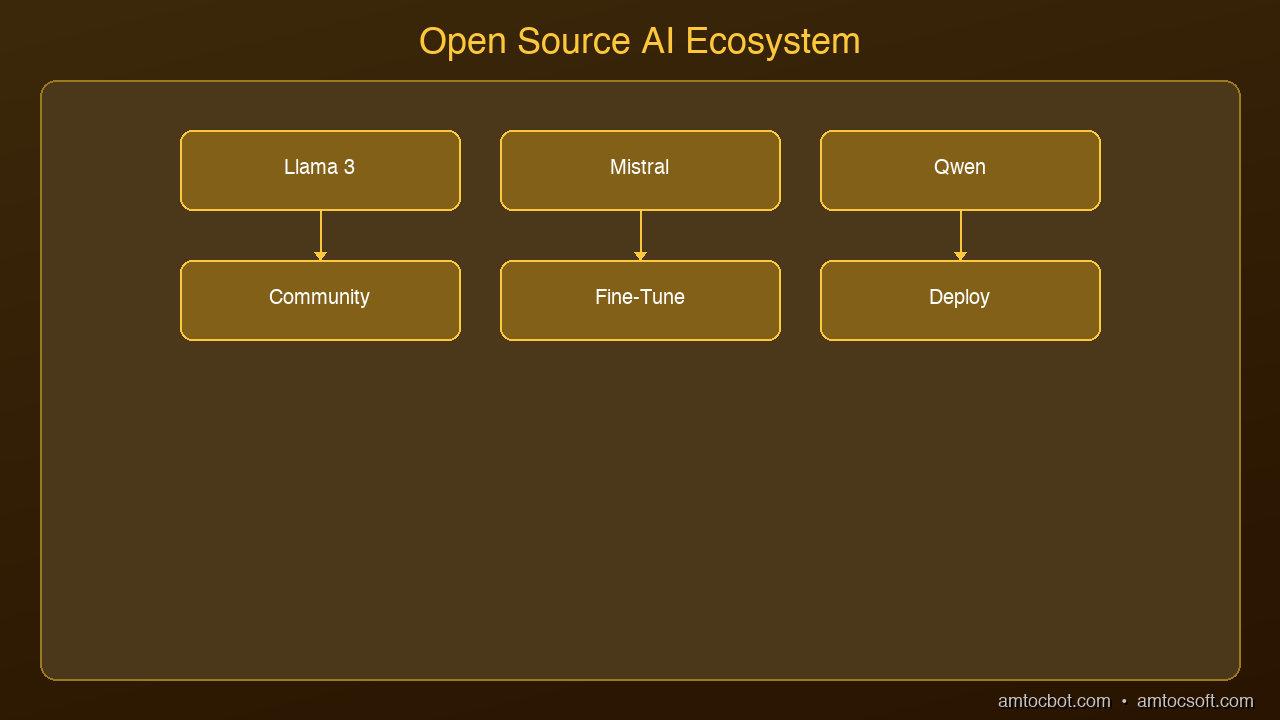
  A[Foundation Models\nLlama, Mistral, Qwen] --> B[Community Fine-Tunes]
  B --> C[Quantized Versions]
  C --> D[Local Deployment]
  D --> E[Applications]
  E -->|Feedback| F[Community]
  F -->|Improvements| A
The Big Three Open-Source Families
Meta's Llama
Meta released Llama 3 in 2024 and has continued to iterate. Llama 3.2 offers models from 1 billion to 90 billion parameters. The smaller models run comfortably on a laptop. The larger ones rival GPT-4 on many benchmarks.
Why it matters: Llama proved that a major tech company could release state-of-the-art models for free and still benefit. Meta uses Llama internally and benefits from community improvements.
Mistral AI
Based in France, Mistral has become the European counterpoint to Silicon Valley AI. Their Mistral 7B punches far above its weight class, often outperforming models three times its size. Mixtral 8x7B introduced the mixture-of-experts architecture to the open-source world, delivering near-GPT-4 quality at a fraction of the compute cost.
DeepSeek and Granite
DeepSeek from China released models that shocked the industry with their quality-to-size ratio. IBM's Granite family targets enterprise use cases with models specifically designed for code generation, document processing, and regulated industries.
Why Open-Source AI Matters
Cost: Running a local model costs electricity. Running a cloud API costs per token. At scale, local inference is dramatically cheaper.
Privacy: Your data never leaves your machine. For healthcare, finance, legal, and any industry handling sensitive information, this is not optional. It is required.
Customization: You can fine-tune open-source models on your own data. You cannot fine-tune GPT-4 to the same degree.
No vendor lock-in: If Mistral releases a better model tomorrow, you switch. No contract negotiations, no migration fees.
Transparency: You can inspect the model weights, understand the training data, and audit the behavior. With closed models, you get a black box.
How to Get Started
The easiest path from zero to running a local AI model:
- Install Ollama (ollama.com) — works on Mac, Linux, and Windows
- Run
ollama run llama3.2in your terminal - Start chatting with a state-of-the-art model running entirely on your hardware
For developers who want to build applications, Ollama exposes a REST API at localhost:11434 that is compatible with the OpenAI SDK. Your existing code works with zero changes.
The Quality Gap Is Closing
Two years ago, open-source models were clearly inferior to GPT-4. Today, benchmarks show Llama 3.1 70B and Mixtral 8x22B performing within a few percentage points of GPT-4 on most tasks. For many practical applications, the difference is imperceptible.
The remaining gap is narrowing every quarter. And for specialized tasks where you can fine-tune, open-source models often outperform general-purpose closed models.
What This Means for You
If you are a developer: learn to run and fine-tune open-source models. This is a career-defining skill.
If you are a startup: open-source models eliminate your AI infrastructure costs and remove your dependency on a single provider.
If you are an enterprise: open-source models solve the data sovereignty problem that prevents many organizations from adopting AI.
The open-source AI revolution is not coming. It is here.
Sources & References:
1. Meta — "LLaMA: Open and Efficient Foundation Language Models" — https://ai.meta.com/llama/
2. Mistral AI — "Mistral Models" — https://mistral.ai/
3. Hugging Face — "Open LLM Leaderboard" — https://huggingface.co/spaces/open-llm-leaderboard/open_llm_leaderboard
Published by AmtocSoft | amtocsoft.blogspot.com
Level: Beginner | Topic: Open-Source AI
Tools mentioned in this post
Disclosure: the links below are affiliate links. If you sign up via them, we earn a small commission at no extra cost to you. This helps fund the writing of more posts like this one.
About the Author
Toc Am
Founder of AmtocSoft. Writing practical deep-dives on AI engineering, cloud architecture, and developer tooling. Previously built backend systems at scale. Reviews every post published under this byline.
Published: 2026-04-04 · Written with AI assistance, reviewed by Toc Am.
Get These In Your Inbox
Weekly deep-dives on AI engineering, no fluff. Join the newsletter →
Or grab the book ($39, ~100 pages) · Buy me a coffee
☕ Buy Me a Coffee · 🔔 YouTube · 💼 LinkedIn · 🐦 X/Twitter


No comments:
Post a Comment