What is Fine-Tuning? Customizing AI Models for Your Data
Level: Beginner | Topic: Fine-Tuning | Read Time: 6 min
You have used ChatGPT or a local model like Llama and gotten decent results. But what if you need the model to speak in your company's voice, understand your industry's jargon, or follow your specific output format every time?
That is where fine-tuning comes in. It is the process of taking a pre-trained AI model and teaching it new behaviors using your own data.
graph LR
  A[Base Model] --> B[Training Dataset]
  B --> C[Fine-Tuning Process\nLoRA / Full]
  C --> D[Evaluation]
  D --> E[Merged Model]
  E --> F[Deployment]
The Cooking Analogy
Think of a pre-trained model like a culinary school graduate. They know how to cook. They understand flavors, techniques, and presentation. But they have never cooked your grandmother's recipes.
Fine-tuning is like giving that chef your family cookbook. They do not forget how to cook. They just learn your specific dishes on top of everything they already know. The result: a chef who combines world-class technique with your exact preferences.
How Fine-Tuning Works
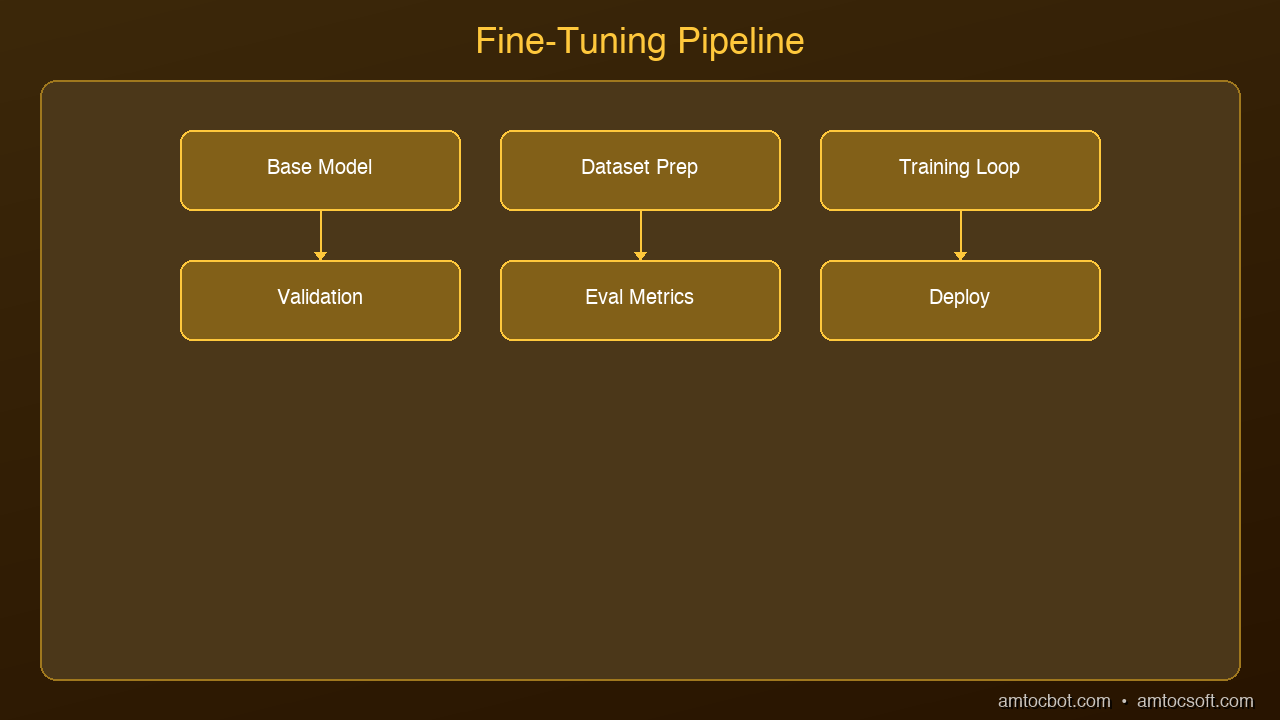
A pre-trained model like Llama 3.2 has already been trained on trillions of tokens from the internet. It understands language, reasoning, and a broad range of knowledge.
Fine-tuning adds a second, smaller training phase where you feed the model examples of the specific behavior you want:
- Collect training data: Pairs of inputs and desired outputs in your domain
- Format the data: Convert to the model's expected format (usually instruction-response pairs)
- Run training: Update the model weights using your examples
- Evaluate: Test the fine-tuned model against held-out examples
The model learns to pattern-match your specific use case while retaining its general knowledge.
What Fine-Tuning Can Do
- Adopt a specific tone: Make the model write in your brand voice
- Learn domain knowledge: Medical terminology, legal language, financial analysis
- Follow output formats: Always return JSON, always use bullet points, always cite sources
- Improve accuracy: On your specific task, fine-tuning often outperforms prompting
- Reduce hallucinations: In a narrow domain, a fine-tuned model hallucinates less than a general one
What Fine-Tuning Cannot Do
- It cannot teach the model entirely new factual knowledge (use RAG for that)
- It cannot make a small model perform like a large one
- It does not work well with tiny datasets (you need at least hundreds of examples)
- It requires compute resources (though modern techniques like LoRA make this affordable)
Fine-Tuning vs Prompt Engineering vs RAG
| Approach | Best For | Cost | Complexity |
|---|---|---|---|
| Prompt Engineering | Quick customization, one-off tasks | Free | Low |
| RAG | Adding current knowledge, document Q&A | Low-Medium | Medium |
| Fine-Tuning | Changing model behavior, domain specialization | Medium | Medium-High |
The three approaches are complementary. Many production systems use all three: a fine-tuned model with RAG for knowledge and carefully engineered prompts for each task.
Getting Started
If you are new to fine-tuning, here is the recommended path:
- Start with prompt engineering. Many problems can be solved with better prompts.
- If prompting is not enough, try RAG. Add your documents to a vector database and retrieve them at inference time.
- If you need the model to fundamentally change its behavior, fine-tune using LoRA (covered in our next article).
The barrier to fine-tuning has dropped dramatically. With tools like Unsloth, Axolotl, and Hugging Face TRL, you can fine-tune a 7B model on a single GPU in under an hour.
Sources & References:
1. Hugging Face — "Fine-Tuning a Pretrained Model" — https://huggingface.co/docs/transformers/training
2. Unsloth — "Fine-Tune LLMs 2x Faster" — https://unsloth.ai/
3. Axolotl — "Fine-Tuning Framework" — https://github.com/axolotl-ai-cloud/axolotl
Published by AmtocSoft | amtocsoft.blogspot.com
Level: Beginner | Topic: Fine-Tuning
About the Author
Toc Am
Founder of AmtocSoft. Writing practical deep-dives on AI engineering, cloud architecture, and developer tooling. Previously built backend systems at scale. Reviews every post published under this byline.
Published: 2026-04-09 · Written with AI assistance, reviewed by Toc Am.
Get These In Your Inbox
Weekly deep-dives on AI engineering, no fluff. Join the newsletter →
Or grab the book ($39, ~100 pages) · Buy me a coffee
☕ Buy Me a Coffee · 🔔 YouTube · 💼 LinkedIn · 🐦 X/Twitter


No comments:
Post a Comment