What Is MCP? The Protocol That Connects AI to Everything
Level: Beginner
Topic: AI / MCP / AI Agents
In the last post, we explained what AI agents are. Now meet the thing that makes them actually powerful: MCP — the Model Context Protocol.
The Problem Before MCP
Connecting an AI to any external tool used to be a custom job. Every integration needed its own code. If you wanted Claude to read your emails, search your docs, and update your CRM, that was three separate bespoke integrations — each one hand-coded, each one requiring ongoing maintenance.
It didn't scale. And it meant most AI tools stayed trapped in a chat window, disconnected from everything useful.
graph LR
  A["🤖 AI Application"] -->|sends request| B["📡 MCP Client"]
  B -->|JSON-RPC| C["🔄 MCP Protocol"]
  C -->|structured call| D["🖥️ MCP Server"]
  D -->|access| E["🔧 External Tools & APIs"]
  E -->|data/result| D
  D -->|response| C
  C -->|result| B
  B -->|context| A
What Is MCP?
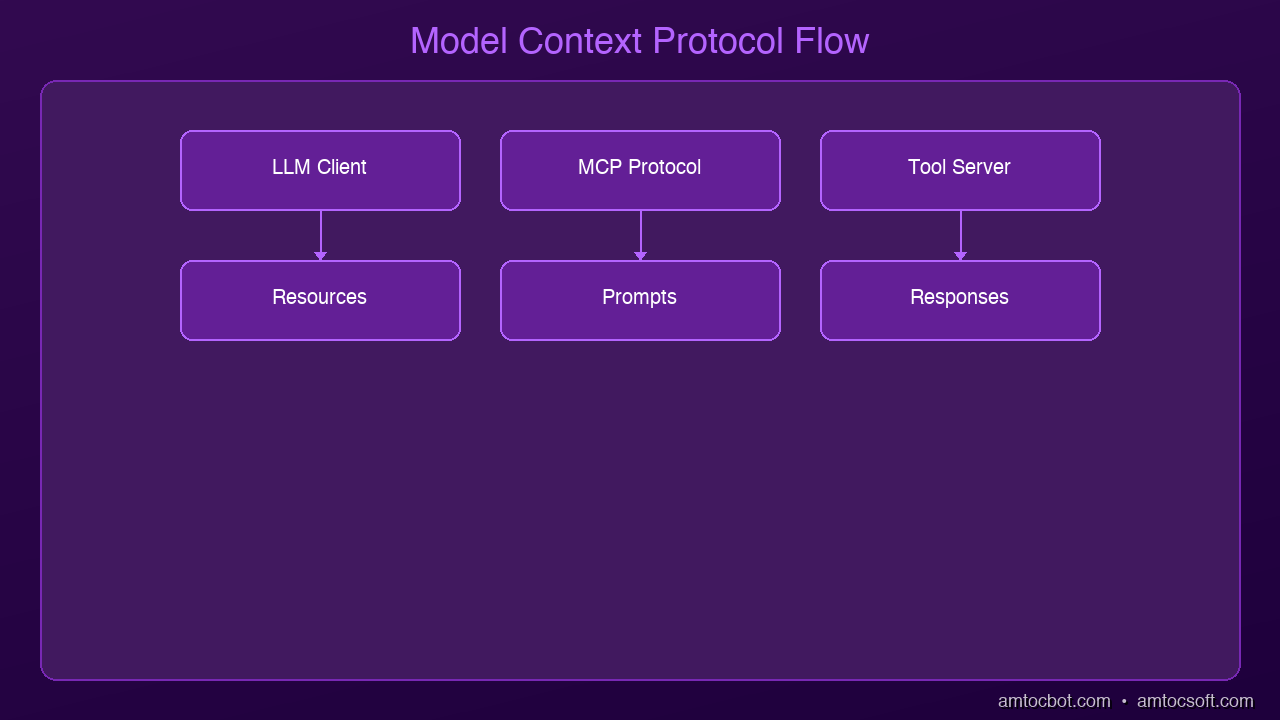
MCP stands for Model Context Protocol. Designed by Anthropic and released in late 2024, it's an open standard that defines how AI models communicate with external tools and data sources.
The best analogy: USB-C for AI.
Before USB-C, every device had a different connector — micro-USB, Lightning, proprietary ports. USB-C became the universal standard, and suddenly any cable worked with any device.
MCP does the same thing for AI:
One standard protocol. Any AI connects to any tool that supports it.
How MCP Works
MCP uses a simple client-server model:
- Client = the AI (Claude, GPT, Gemini, etc.)
- Server = the external tool (database, file system, browser, API)
The AI sends structured requests to MCP servers. Servers respond with data or confirm actions. Everything follows the same format — so a server built once works with every AI that speaks the protocol.
The three things MCP servers can expose:
| Type | What It Does | Example |
|---|---|---|
| Resources | Expose data the AI can read | Files, database rows, emails |
| Tools | Actions the AI can execute | Send email, create issue, query DB |
| Prompts | Reusable prompt templates | "Summarize this document" |
Real Examples of MCP in Action
The MCP ecosystem went from zero to hundreds of servers in under six months:
- File system server — Claude reads and writes files on your computer
- Database server — Claude queries Postgres, SQLite, or any SQL database
- GitHub server — Claude opens PRs, reviews code, creates issues
- Browser server — Claude controls a web browser (search, click, scrape)
- Slack server — Claude reads channels and sends messages
- Code execution — Claude runs Python, JS, or shell commands
Any developer can build a new MCP server in an afternoon. Once built, it's accessible to every MCP-compatible AI.
Why It Matters for Developers
Three reasons MCP is worth learning right now:
- If you build internal tools: Adding MCP support makes your tool AI-accessible instantly — no custom integration needed per AI provider.
- If you build AI agents: MCP eliminates bespoke integration code. Your agent can use any MCP server out of the box.
- Composability: An agent can connect to 10 different servers simultaneously — file system, database, email, calendar — all coordinated through the same protocol.
The Future of MCP
MCP is still early but the momentum is real:
- Every major AI lab is adopting it (Anthropic, OpenAI, Google)
- Enterprise software companies are adding MCP endpoints
- The open-source community is shipping hundreds of servers
If AI agents are the workforce, MCP is the infrastructure they run on. Understanding it now puts you ahead of the curve.
Key Takeaways
| Concept | What It Means |
|---|---|
| MCP | Open standard for AI ↔ tool communication |
| Client | The AI model |
| Server | The external tool or data source |
| Resources | Data the AI can read |
| Tools | Actions the AI can take |
| Why it matters | One protocol, any AI, any tool — no custom code |
Watch the Video
We made a 6-minute explainer covering everything above with visuals.
What's Next?
Next up: Prompt Engineering That Actually Works — the specific techniques that make AI outputs reliably useful, not just occasionally good.
Sources
- Anthropic — "Introducing the Model Context Protocol" (2024) — https://www.anthropic.com/news/model-context-protocol
- MCP — "Official Documentation" — https://modelcontextprotocol.io/
- MCP — "Python SDK" — https://github.com/modelcontextprotocol/python-sdk
This is post #6 in the AmtocSoft Tech Insights series. We cover AI, security, performance, and software engineering — at every level from beginner to expert.
About the Author
Toc Am
Founder of AmtocSoft. Writing practical deep-dives on AI engineering, cloud architecture, and developer tooling. Previously built backend systems at scale. Reviews every post published under this byline.
Published: 2026-04-01 · Written with AI assistance, reviewed by Toc Am.
Get These In Your Inbox
Weekly deep-dives on AI engineering, no fluff. Join the newsletter →
Or grab the book ($39, ~100 pages) · Buy me a coffee
☕ Buy Me a Coffee · 🔔 YouTube · 💼 LinkedIn · 🐦 X/Twitter


No comments:
Post a Comment