The first time the platform-team federation I work with tried to align the global category taxonomies across two sister deployments, the alignment exercise stalled at the third meeting because the two engineering managers in the room could not agree on whether their two customer_payment_dispute categories meant the same thing. One deployment's category covered chargebacks, refund disputes, and provisional credit reversals; the other deployment's category covered chargebacks only, with refund disputes split into a separate refund_dispute category and provisional credit reversals folded into payment_processing_anomaly. The two deployments had each evolved their global category taxonomies against their own four-corpus operational histories, with the engineering manager's quarterly review passes from blog 200 driving each deployment's per-corpus and cross-corpus alignment decisions. Neither deployment was wrong; they had each optimised against different per-corpus operational realities, and the two global category taxonomies had drifted apart at the same rate the two deployments had drifted apart operationally. The cross-deployment alignment layer this post walks through is the structural answer that emerged from the year of platform-team federation work that followed.
The cross-deployment alignment layer sits one composition step above the multi-corpus single-deployment shape that blog 199's cross-corpus alignment table from blog 199 covers. The cross-corpus alignment table binds a single deployment's per-corpus categories to a single deployment's global category taxonomy. The cross-deployment alignment layer binds multiple deployments' global category taxonomies to a federation-wide meta-taxonomy. The annual taxonomy-evolution rollup from blog 201 is the year-end synthesis that covers a single deployment's per-corpus and cross-corpus alignment evolution; the cross-deployment alignment layer is the structural surface that the annual rollup's planning input feeds into when the platform-team federation is running the rollup at the federation grain rather than the single-deployment grain. The post after this one will pivot to the federation-grain quarterly review pass, which is the human-in-the-loop layer that sits one composition step above the cross-deployment alignment layer the way the engineering manager's quarterly review pass sits one composition step above the cross-corpus alignment table.
This post covers four pieces of the cross-deployment alignment layer: the meta-taxonomy structure (the federation-wide set of meta-categories that span multiple deployments' global category taxonomies), the deployment-tier alignment table (the structural surface that binds per-deployment global categories to federation-wide meta-categories with the alignment confidence and rebinding cadence the federation tracks), the cross-deployment drift detection (the federation-grain analogue of the per-deployment cross-corpus drift detection from blog 199), and the federation review pass (the structural shape of the human-in-the-loop layer that finalises cross-deployment drift dispositions across the platform-team federation).
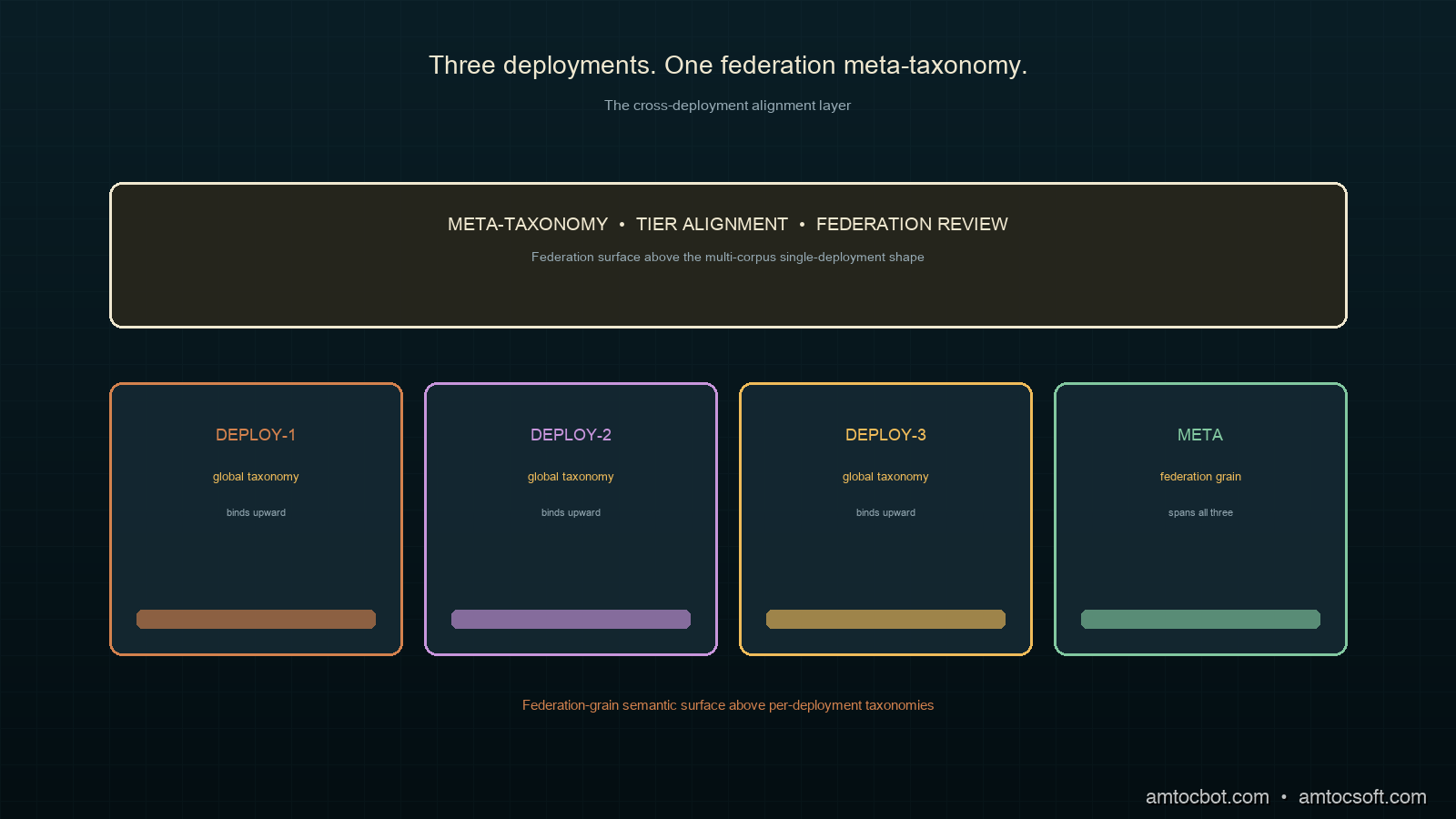
The Meta-Taxonomy Structure
The lesson the platform-team federation carried out of the stalled customer_payment_dispute discussion is that the federation does not need the two deployments to agree on a single global category. The two deployments' global categories are operationally meaningful at the per-deployment grain, and forcing the two deployments to merge their categories would impose a federation-wide constraint that neither deployment's per-corpus operational history would defend. What the federation needs is a structural surface that lets the two deployments' global categories coexist, with the federation able to reason about cross-deployment patterns at a coarser grain than the per-deployment global category taxonomy carries.
The meta-taxonomy is that coarser-grain surface. A meta-category is a federation-wide named bucket that one or more per-deployment global categories bind into, with the meta-category carrying the federation-grain operational meaning the per-deployment global categories have in common. The customer_payment_dispute example resolves into a meta-category named payment_dispute_class that deployment one's customer_payment_dispute category binds into directly, that deployment two's three categories (customer_payment_dispute, refund_dispute, payment_processing_anomaly) bind into as a structured triple, and that any future deployment's payment-dispute-shaped categories bind into without forcing the future deployment to mirror either existing deployment's category structure.
The meta-category is not a global category. The federation does not push a meta-category back down into a deployment's global category taxonomy as an authoritative parent. The meta-taxonomy is a federation-grain semantic surface that exists alongside the per-deployment global category taxonomies, with the binding direction running upward from the per-deployment global categories to the meta-categories rather than downward. The directionality is load-bearing because it preserves the per-deployment global category taxonomy's operational legitimacy at the per-deployment grain, and lets the meta-taxonomy carry the federation-grain operational meaning without imposing structural constraints on the deployment-grain layer.
The meta-taxonomy is authored by the platform-team federation's federation-architecture lead in collaboration with the platform-team leads from each deployment, on a federation-grain quarterly cadence that aligns with the per-deployment quarterly review-pass cadence from blog 200. The federation-architecture lead carries the federation-grain operational evidence into the meta-taxonomy authoring conversation; the per-deployment platform-team leads carry the deployment-grain operational evidence into the same conversation, with the meta-taxonomy emerging as the structural agreement on the federation-grain operational meaning that the per-deployment global category taxonomies have in common.
flowchart TB
  D1[Deployment one<br/>global taxonomy] --> M[Federation<br/>meta-taxonomy]
  D2[Deployment two<br/>global taxonomy] --> M
  D3[Deployment three<br/>global taxonomy] --> M
  M --> MC1[Meta-category<br/>payment_dispute_class]
  M --> MC2[Meta-category<br/>document_review_class]
  M --> MC3[Meta-category<br/>regulatory_query_class]
  D1 -.binds.-> MC1
  D2 -.binds triple.-> MC1
  D2 -.binds.-> MC2
  D3 -.binds.-> MC2
  D3 -.binds.-> MC3
  MC1 --> RP[Federation<br/>review pass]
  MC2 --> RP
  MC3 --> RP
The Deployment-Tier Alignment Table
The structural surface that binds per-deployment global categories to meta-categories is the deployment-tier alignment table. The table is the federation-grain analogue of the cross-corpus alignment table from blog 199. The cross-corpus alignment table binds per-corpus categories to per-deployment global categories at the single-deployment grain; the deployment-tier alignment table binds per-deployment global categories to federation-wide meta-categories at the federation grain.
The table's primary key is the alignment-row identifier, with the row carrying the deployment identifier, the per-deployment global category identifier, the meta-category identifier the global category binds into, the binding-shape tag (one-to-one for the simple case, one-of-many for the case where multiple per-deployment global categories bind to the same meta-category, many-to-one for the case where the same per-deployment global category binds to multiple meta-categories with the binding-shape carrying the operationally-meaningful split), the alignment-confidence score the federation review pass calibrated against the deployment-grain operational evidence, the rebinding-cadence flag (stable for rows that have not rebound across the most recent federation-grain review window, recently-rebound for rows the most recent federation review pass adjusted, watching for rows the federation-grain drift detection has flagged but the federation review pass has not yet finalised a disposition for), and the next-federation-review-pass-owner field that names the federation-architecture lead or the per-deployment platform-team lead who carries the row into the next federation review pass.
The deployment-tier alignment table's row count grows roughly linearly with the federation's deployment count multiplied by the per-deployment global category taxonomy's category count, which means the table's operational scale at the four-deployment, sixty-category-per-deployment shape the federation I work with operates at runs at roughly two hundred forty alignment rows. The four-deployment scale is small enough that the federation-architecture lead and the per-deployment platform-team leads can reason about the alignment rows directly in the federation review pass without delegating row-level reasoning to a structured drill-down. At the eight-deployment, eighty-category-per-deployment shape the federation has projected for two years out, the alignment-row count would be roughly six hundred forty rows, which is the scale at which the federation review pass would need a per-meta-category drill-down structure rather than a single flat row-walk.
CREATE TABLE deployment_tier_alignment (
  alignment_row_id UUID PRIMARY KEY,
  deployment_id TEXT NOT NULL,
  per_deployment_global_category_id UUID NOT NULL,
  meta_category_id UUID NOT NULL,
  binding_shape TEXT NOT NULL CHECK (
    binding_shape IN ('one_to_one', 'one_of_many', 'many_to_one')
  ),
  alignment_confidence NUMERIC NOT NULL CHECK (
    alignment_confidence >= 0 AND alignment_confidence <= 1
  ),
  rebinding_cadence_flag TEXT NOT NULL CHECK (
    rebinding_cadence_flag IN ('stable', 'recently_rebound', 'watching')
  ),
  last_federation_review_pass_id UUID NOT NULL,
  next_federation_review_pass_owner TEXT NOT NULL,
  binding_rationale TEXT NOT NULL
);

CREATE INDEX idx_alignment_watching
  ON deployment_tier_alignment (rebinding_cadence_flag, meta_category_id)
  WHERE rebinding_cadence_flag = 'watching';

CREATE INDEX idx_alignment_per_deployment
  ON deployment_tier_alignment (deployment_id, per_deployment_global_category_id);
The idx_alignment_watching partial index is the federation-review-pass query primitive. The federation review pass walks the watching-flagged rows first, with the meta-category grouping carried through the index for the per-meta-category disposition pass the federation-architecture lead runs against each watching cluster. The idx_alignment_per_deployment index supports the per-deployment platform-team lead's pre-review-pass reading, where the platform-team lead walks their deployment's alignment rows ahead of the federation review pass to surface deployment-grain context the federation-architecture lead needs for the disposition conversation.
The binding-rationale column is load-bearing for the federation review pass's re-readability across federation grain quarterly review-pass cycles. The rationale carries the federation-architecture lead's structured argument for why the per-deployment global category binds to the meta-category in the binding shape the row records, with the rationale referring back to the deployment-grain operational evidence the federation review pass weighed at the time of binding. The rationale is the federation-grain analogue of the engineering manager's per-row binding rationale from the cross-corpus alignment table in blog 199, scaled up one composition step.
Cross-Deployment Drift Detection
The federation-grain drift detection layer is the federation-grain analogue of the per-deployment cross-corpus drift detection from blog 199. The cross-corpus drift detection surfaces alignment-table candidate signals from the manifest-ledger archives and the trend-pass projections at the single-deployment grain. The cross-deployment drift detection surfaces alignment-table candidate signals from the federation-grain reading of the per-deployment cross-corpus alignment tables and the per-deployment trend-pass projections.
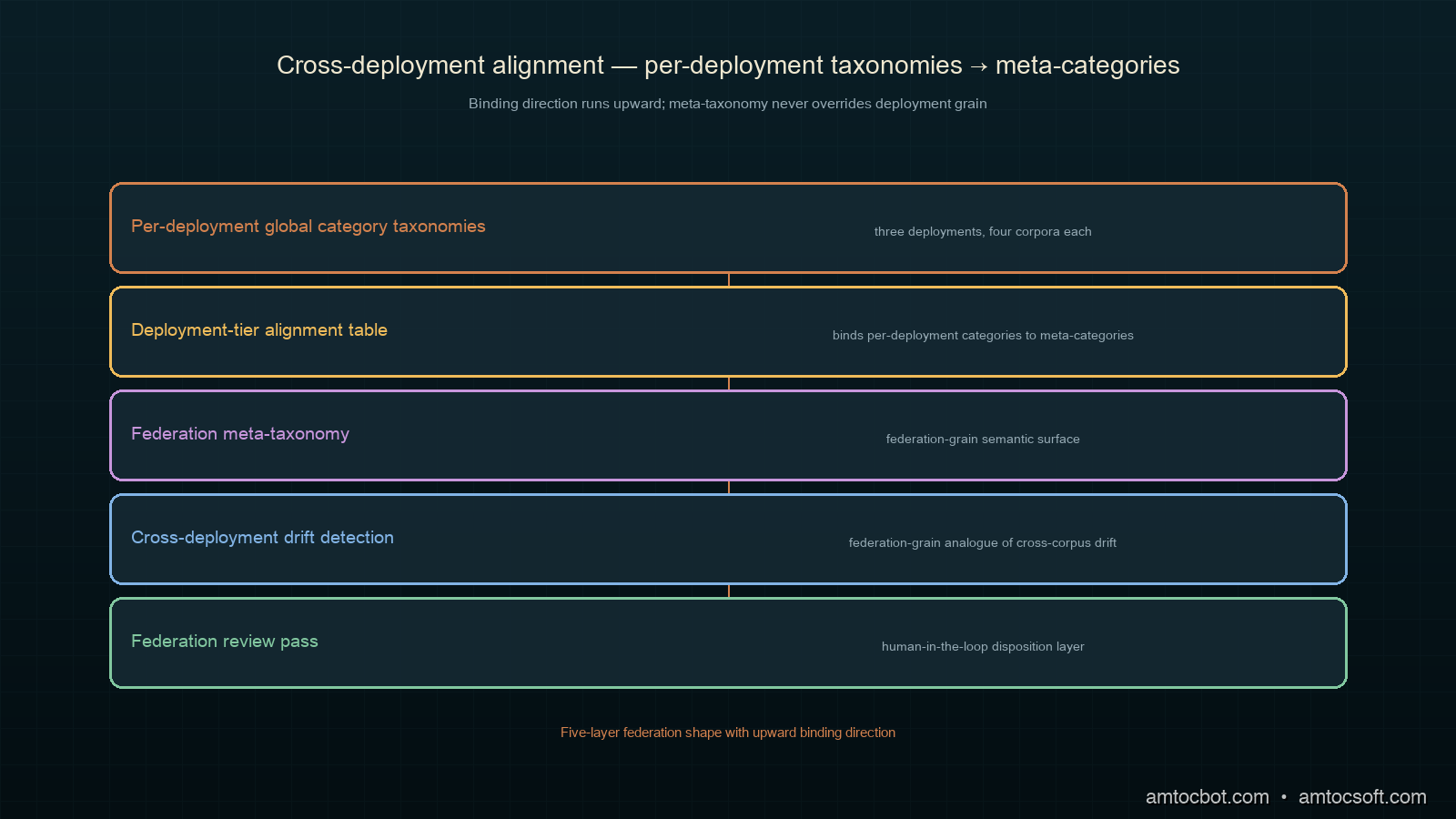
The federation-grain drift detection runs three rule types. The first rule type is meta-category split detection. The rule fires when one meta-category's per-deployment global categories show divergent semantic drift across deployments at a rate that exceeds the federation-grain rebinding-cadence threshold. The mechanism reads each per-deployment global category bound to the meta-category against the federation-grain trend-pass projections and the per-deployment cross-corpus alignment-row retraction patterns, with the divergence signal scoring the per-deployment global categories' federation-grain operational meaning drift. The signal surfaces meta-categories that are operationally splitting at the federation grain even though the per-deployment global categories continue to bind into the same meta-category at the deployment-tier alignment table.
The second rule type is meta-category merge detection. The rule fires when two meta-categories' per-deployment global categories show convergent operational meaning across deployments at a rate that exceeds the federation-grain merge-candidate threshold. The mechanism reads pairs of meta-categories' per-deployment global categories against the federation-grain trend-pass projections and the per-deployment cross-corpus alignment-row addition patterns, with the convergence signal scoring the meta-categories' federation-grain operational meaning overlap. The signal surfaces meta-categories whose per-deployment global categories are operationally merging at the federation grain, with the federation review pass deciding whether to merge the two meta-categories or preserve the meta-categories with the convergence as a federation-grain operational reality the meta-taxonomy carries forward.
The third rule type is deployment-specific category emergence. The rule fires when a deployment's new per-deployment global category does not bind to any existing meta-category at the federation-grain alignment-confidence threshold. The mechanism reads each newly-promoted per-deployment global category against the existing meta-categories' binding signatures, with the unbinding signal scoring the federation-grain operational novelty of the new per-deployment global category. The signal surfaces deployment-grain operational realities that the meta-taxonomy does not yet have a meta-category for, with the federation review pass deciding whether to add a new meta-category to the meta-taxonomy or rebind the new per-deployment global category to an existing meta-category as a binding-shape extension.
The three rule types together carry the federation-grain drift signal load. The four-deployment, sixty-category-per-deployment shape the federation operates at produces a federation-grain candidate-signal volume of roughly twenty-five to forty signals per federation review pass quarter, with the meta-category split detection rule carrying the largest share of signals (the meta-categories that span multiple deployments are the ones most exposed to deployment-grain operational drift), the meta-category merge detection rule carrying the smallest share (federation-grain merge candidates are rare because the meta-taxonomy is authored at the federation-grain operational meaning grain rather than at the per-deployment global category grain), and the deployment-specific category emergence rule carrying the middle share (the rule fires whenever a deployment promotes a new per-deployment global category, which happens at a roughly quarterly cadence per deployment).
flowchart TB
  PA[Per-deployment<br/>cross-corpus<br/>alignment tables] --> R1[Rule 1: Meta-category<br/>split detection]
  PA --> R2[Rule 2: Meta-category<br/>merge detection]
  PA --> R3[Rule 3: Deployment-specific<br/>category emergence]
  TP[Per-deployment<br/>trend-pass<br/>projections] --> R1
  TP --> R2
  TP --> R3
  R1 --> S1[Split-candidate<br/>signal stream]
  R2 --> S2[Merge-candidate<br/>signal stream]
  R3 --> S3[Emergence-candidate<br/>signal stream]
  S1 --> WQ[Watching queue<br/>on alignment table]
  S2 --> WQ
  S3 --> WQ
  WQ --> FRP[Federation<br/>review pass]
The Federation Review Pass
The federation review pass is the human-in-the-loop layer that finalises cross-deployment drift dispositions across the platform-team federation. The pass is the federation-grain analogue of the engineering manager's quarterly review pass from blog 200. The engineering manager's quarterly review pass finalises per-corpus migration dispositions and cross-corpus alignment-row dispositions at the single-deployment grain; the federation review pass finalises meta-taxonomy dispositions and deployment-tier alignment-row dispositions at the federation grain.
The federation review pass runs on a federation-grain quarterly cadence, with the federation-architecture lead chairing and the per-deployment platform-team leads attending as the per-deployment evidence carriers. The pass takes ninety to one hundred ten minutes at the four-deployment shape the federation operates at, which is roughly the same cadence the engineering manager's quarterly review pass runs at the single-deployment grain. The federation-grain pass is one composition step above the per-deployment pass, with the per-deployment platform-team leads carrying their respective per-deployment quarterly review pass dispositions into the federation pass as structured input.
| Federation-grain disposition | Frequency at four-deployment shape | Pass owner | Carry-forward target |
|---|---|---|---|
| Add new meta-category | Two to four per quarter | Federation-architecture lead | Next federation pass |
| Split existing meta-category | Zero to one per quarter | Federation-architecture lead | Next federation pass |
| Merge two meta-categories | Zero to one per six months | Federation-architecture lead | Next federation pass |
| Rebind alignment row | Five to nine per quarter | Per-deployment platform-team lead | Next per-deployment pass |
| Adjust binding-shape tag | Three to five per quarter | Per-deployment platform-team lead | Next per-deployment pass |
| Defer to next pass | Two to four per quarter | Federation-architecture lead | Next federation pass |
The disposition table reads the federation review pass's typical disposition load at the four-deployment shape. The largest single share is the alignment-row rebinding disposition, which is the per-deployment platform-team lead's structural commitment to adjust the deployment-tier alignment table against the federation review pass's federation-grain reading. The second-largest share is the binding-shape adjustment, which captures the federation-grain reading that a per-deployment global category's binding shape should change (often from one-to-one to one-of-many, or vice versa) against the federation-grain operational evidence. The new-meta-category disposition is the third-largest share, with the federation-architecture lead committing to add a new meta-category to the meta-taxonomy against the deployment-specific category emergence rule's signals.
The federation review pass produces three structured outputs the federation-grain operational layer consumes. The first output is the updated deployment-tier alignment table, with the federation-grain dispositions applied as alignment-row updates with the federation-review-pass-id stamped against each updated row. The second output is the updated meta-taxonomy, with the new meta-categories added, the merged meta-categories collapsed, and the split meta-categories partitioned, with each change carrying a federation-review-pass-id and a federation-architecture-lead-authored rationale. The third output is the federation-grain quarterly summary, which is the single-paragraph narrative the federation-architecture lead authors against the pass's dispositions and carries forward to the federation's annual rollup at the year-end synthesis pass.
flowchart LR
  A[Per-deployment<br/>quarterly review pass<br/>dispositions x N] --> B[Federation<br/>review pass]
  C[Cross-deployment<br/>drift signals] --> B
  D[Deployment-tier<br/>alignment-row<br/>watching queue] --> B
  B --> E[Updated<br/>meta-taxonomy]
  B --> F[Updated<br/>deployment-tier<br/>alignment table]
  B --> G[Federation-grain<br/>quarterly summary]
  E --> H[Next per-deployment<br/>quarterly review passes]
  F --> H
  G --> I[Federation<br/>annual rollup]
Comparison: Federation-Grain Versus Single-Deployment Disposition Pattern
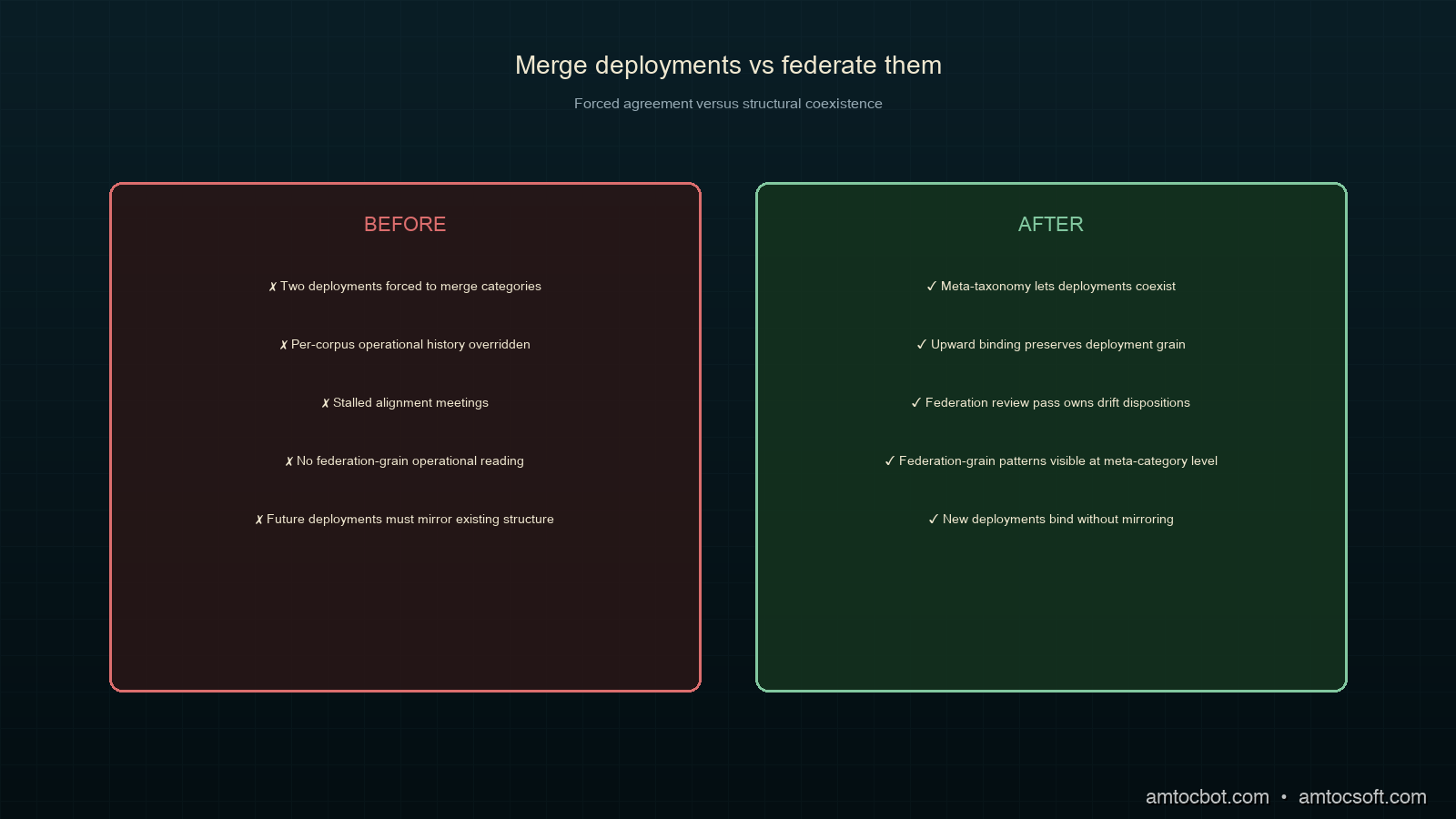
The structural correspondence between the single-deployment quarterly review pass from blog 200 and the federation-grain quarterly review pass is the post's central comparison point. The two passes operate at different grains but share the same structural shape: a human-in-the-loop layer that consumes structured drift signals, applies dispositions against an alignment table and a taxonomy surface, and produces structured outputs the next-grain-up planning conversation consumes. The structural correspondence is load-bearing because it lets the platform-team federation reuse the operational discipline the single-deployment quarterly review pass has built up at each deployment, scaled up one composition step to the federation grain.
The disposition frequencies differ in informative ways. The single-deployment quarterly review pass typically finalises eight to fifteen per-corpus migration dispositions per quarter and four to seven cross-corpus alignment rebindings per quarter, against a four-corpus deployment with sixty global categories. The federation-grain quarterly review pass finalises five to nine deployment-tier alignment rebindings per quarter and two to four meta-taxonomy adjustments per quarter, against a four-deployment federation with two hundred forty alignment rows and roughly thirty meta-categories. The federation-grain pass's lower per-row disposition rate reflects the meta-taxonomy's coarser grain: a meta-category captures the operational meaning of multiple per-deployment global categories, which means the meta-taxonomy's surface area is smaller than the sum of the per-deployment global category taxonomies and the disposition rate scales with the meta-taxonomy's surface area rather than with the deployment count.
The pass-owner structure also differs. The single-deployment quarterly review pass is owned end-to-end by the engineering manager, who carries both the per-corpus operational evidence and the cross-corpus alignment evidence into the disposition conversation. The federation-grain pass is co-owned by the federation-architecture lead and the per-deployment platform-team leads, with the federation-architecture lead carrying the meta-taxonomy authoring authority and the per-deployment platform-team leads carrying the per-deployment operational evidence. The co-ownership pattern keeps the federation-grain pass legible at the deployment grain, because each per-deployment platform-team lead reads the federation pass as their deployment's structural commitment to the federation-grain operational reality rather than as a federation-architecture-lead-only authored pass.
Production Considerations
Three production considerations are worth calling out for any platform-team federation that is shipping the cross-deployment alignment layer against multiple deployments running the multi-corpus single-deployment shape from blog 199.
The first is federation-grain authoring capacity. The federation review pass's authoring capacity is bounded by the federation-architecture lead's calendar at the federation grain and by each per-deployment platform-team lead's calendar at the deployment grain. The pattern that has worked at the four-deployment federation is to schedule the federation review pass two weeks after the per-deployment quarterly review passes have closed, which gives the per-deployment platform-team leads time to carry the per-deployment dispositions into the federation pass as structured input. At the eight-deployment scale, the federation-architecture lead would need a federation-architecture co-lead role to share the meta-taxonomy authoring load, with the two co-leads partitioning the meta-categories by federation-grain operational theme rather than by deployment.
The second is meta-taxonomy cadence and stability. The meta-taxonomy is authored at a federation-grain quarterly cadence, with the meta-taxonomy's stability carried forward as a federation-grain operational invariant. The stability has been load-bearing for the per-deployment platform-team leads' planning, because each per-deployment quarterly review pass reads against the meta-taxonomy as a stable federation-grain reference. A meta-taxonomy that re-shapes itself every quarter would push instability down into the per-deployment platform-team leads' planning conversations, which the federation review pass would then have to re-stabilise at each subsequent pass. The stability discipline the federation-architecture lead has carried at the four-deployment shape has kept the meta-taxonomy's quarter-over-quarter delta to roughly two to four meta-category changes per quarter, which the per-deployment platform-team leads have absorbed without significant deployment-grain disruption.
The third is cross-deployment drift signal volume control. The federation-grain drift detection layer's signal volume is bounded by the federation review pass's disposition capacity, which means the drift detection rules' threshold calibration is a load-bearing federation-grain operational discipline. The pattern that has worked is to recalibrate the three drift-detection rule types' thresholds at the federation review pass following each deployment's quarterly review pass, with the federation-architecture lead reviewing the signal volume against the federation review pass's disposition capacity and adjusting the thresholds to keep the signal-to-disposition ratio close to one-to-one. The recalibration cadence has kept the federation review pass's disposition load close to the ninety-to-hundred-ten-minute pass-length budget, with the federation-grain operational discipline preserved across the year.
Conclusion
The cross-deployment alignment layer is the structural surface that lets the platform-team federation reason about cross-deployment patterns at a coarser grain than the per-deployment global category taxonomy carries. The meta-taxonomy gives the federation a federation-grain semantic surface that lets the per-deployment global categories coexist without forcing the deployments to merge their per-deployment categories into a single federation-wide taxonomy. The deployment-tier alignment table binds per-deployment global categories to meta-categories with the alignment confidence and the rebinding cadence the federation tracks, and surfaces the watching queue the federation review pass walks. The cross-deployment drift detection layer surfaces meta-category split, merge, and deployment-specific emergence signals the federation review pass disposes against. The federation review pass is the human-in-the-loop layer that finalises meta-taxonomy and deployment-tier alignment dispositions at the federation grain, in structural correspondence to the engineering manager's quarterly review pass at the single-deployment grain.
The post after this one will pivot to the federation-grain quarterly review pass at the multi-platform-team federation grain, which is the next composition step above the platform-team federation pass this post sketched. The next post will cover how multiple platform-team federations (each running their own multi-deployment cross-deployment alignment layer) coordinate at the multi-platform-team federation grain, with the federation-of-federations meta-taxonomy and the multi-platform-team review pass that finalises cross-platform-team-federation drift dispositions.
Sources
- Manifest Ledger Archival Schema (blog 195): https://amtocsoft.blogspot.com/2026/05/manifest-ledger-archival-schema.html
- Manifest Ledger Taxonomy Versioning Protocol (blog 198): https://amtocsoft.blogspot.com/2026/05/manifest-ledger-taxonomy-versioning.html
- Cross-Corpus Taxonomy Alignment (blog 199): https://amtocsoft.blogspot.com/2026/05/cross-corpus-taxonomy-alignment.html
- Taxonomy-Aware Quarterly Review Pass (blog 200): https://amtocsoft.blogspot.com/2026/05/the-taxonomy-aware-quarterly-review.html
- Annual Taxonomy-Evolution Rollup (blog 201): https://amtocsoft.blogspot.com/2026/05/the-annual-taxonomy-evolution-rollup.html
- Companion repo (
adlc-eval-contracts/cross-deployment-alignment/): https://github.com/amtocbot-droid/amtocbot-examples
About the Author
Toc Am
Founder of AmtocSoft. Writing practical deep-dives on AI engineering, cloud architecture, and developer tooling. Previously built backend systems at scale. Reviews every post published under this byline.
Published: 2026-05-10 · Written with AI assistance, reviewed by Toc Am.
☕ Buy Me a Coffee · 🔔 YouTube · 💼 LinkedIn · 🐦 X/Twitter



No comments:
Post a Comment