The first federation-grain quarterly review pass I sat in on ran four hours longer than the federation-architecture lead had budgeted, because the federation review pass had inherited a watching queue of seventeen deployment_tier_alignment rows from the prior week's cross-deployment drift detection run and the federation-architecture lead had not yet built the per-meta-category drill-down structure the four-deployment shape needed. The federation-architecture lead walked the seventeen watching-flagged rows in deployment-tier alignment-table primary-key order, which meant the federation review pass alternated between three different meta-categories every few rows, with the per-deployment platform-team leads in the room context-switching between meta-categories faster than the discussion could converge on any single meta-category's federation-grain disposition. The federation review pass eventually finalised the dispositions, but the four-hour overrun was the structural signal that the federation-grain review pass needed a workflow protocol distinct from the engineering-manager's per-deployment quarterly review pass from blog 200. The protocol this post walks through is the structural answer that emerged from the year of federation-architecture-lead work that followed.
The federation-grain quarterly review pass sits one composition step above the cross-deployment alignment layer that blog 202 covers. Blog 202's deployment-tier alignment table is the structural surface that binds per-deployment global categories to federation-wide meta-categories, with the cross-deployment drift detection layer surfacing alignment-table candidate signals at the federation grain. The federation review pass is the human-in-the-loop layer that finalises the dispositions on those candidate signals: which meta-categories the federation will split, which meta-categories the federation will merge, which deployment-specific category emergences will promote to new meta-categories, and which watching-flagged rows the federation will fold back into stable cadence without structural change. The post after this one will pivot to the federation annual rollup, which is the year-end synthesis that composes four federation-grain quarterly review passes into the federation's annual taxonomy-evolution narrative.
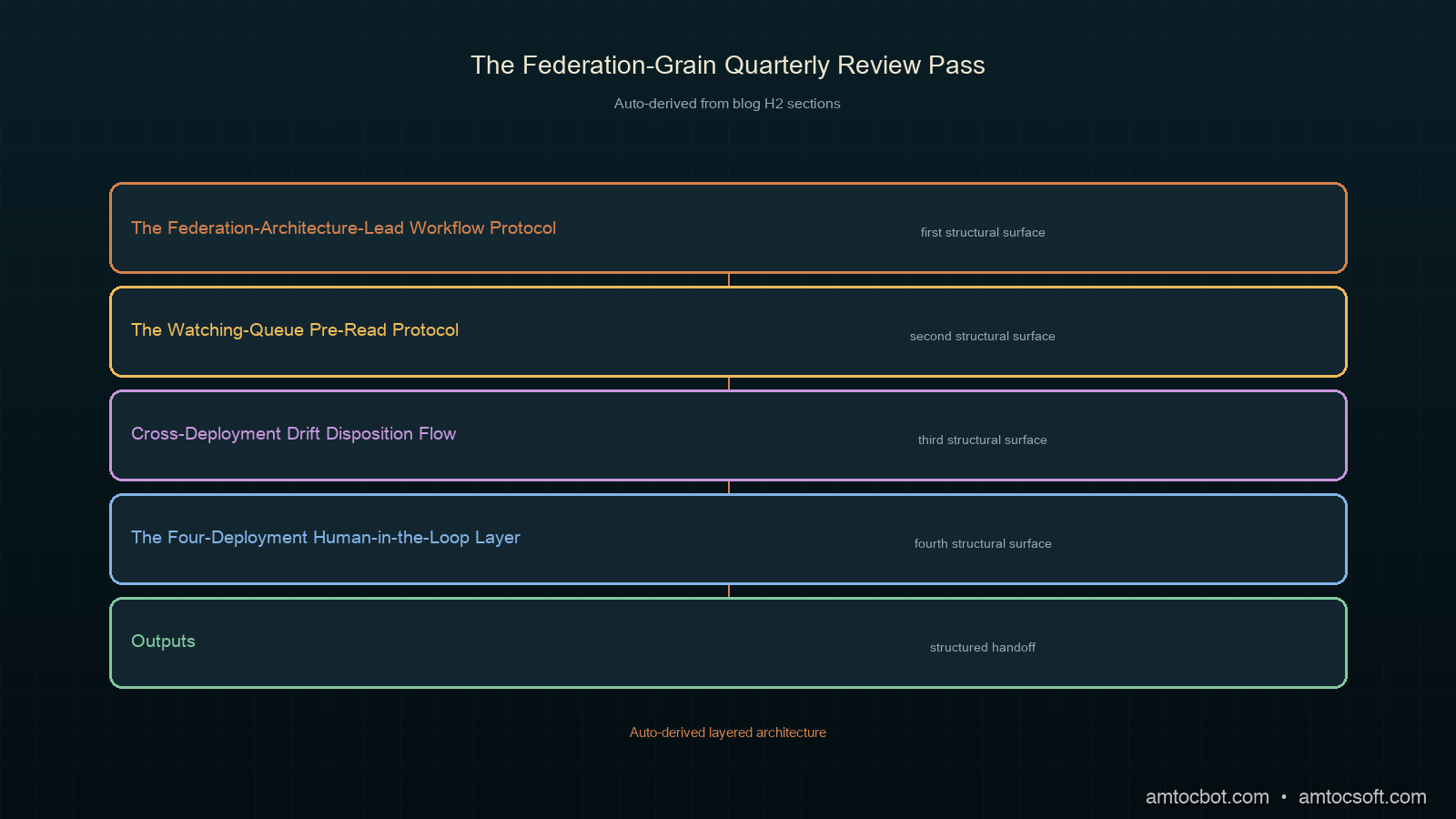
This post covers four pieces of the federation-grain quarterly review pass: the federation-architecture-lead workflow protocol (the per-meta-category drill-down structure that replaces the alignment-table primary-key walk), the watching-queue pre-read protocol (the per-deployment platform-team lead's pre-review-pass reading that surfaces deployment-grain context the federation review pass needs), the cross-deployment drift disposition flow (the structural shape of the disposition outputs and their downstream consumers), and the four-deployment human-in-the-loop layer (the operational details of how the federation-architecture lead and the four per-deployment platform-team leads compose into a single coherent review pass that the federation can run on a quarterly cadence without the four-hour overrun the first pass produced).
The Federation-Architecture-Lead Workflow Protocol
The lesson the federation-architecture lead carried out of the four-hour overrun on the first federation review pass is that the alignment-table primary-key walk is the wrong scan order for the federation-grain review pass. The cross-corpus alignment table's per-deployment walk from blog 200 is the right scan order for the engineering-manager's quarterly review pass at the single-deployment grain, because the engineering manager's context is the single-deployment operational reality and the per-deployment walk preserves the engineering manager's deployment-grain context across the review pass. The federation review pass has a different context: the federation-architecture lead's context is the federation-grain operational reality, and the federation-architecture lead's reasoning grain is the meta-category, not the alignment row.
The federation-architecture-lead workflow protocol that emerged from the year of federation review-pass work is the per-meta-category drill-down structure. The federation review pass walks the watching-queue alignment rows grouped by meta-category, with the federation-architecture lead running a per-meta-category disposition pass that surfaces all alignment-row signals against a single meta-category before the review pass moves to the next meta-category. The protocol preserves the federation-architecture lead's meta-category-grain context across the disposition pass, and lets the per-deployment platform-team leads in the room context-switch between meta-categories only when the federation-architecture lead moves the pass to the next meta-category rather than every few rows.
The drill-down structure is enabled by the idx_alignment_watching partial index from blog 202, which orders the watching-flagged rows by meta-category as its second index column. The federation review pass's primary query reads the watching-flagged rows ordered by meta-category, with each meta-category's per-deployment-global-category bindings surfaced together for the federation-architecture lead's disposition pass against that meta-category. The query is the federation-review-pass query primitive: the index supports the meta-category-grain scan order that the federation-architecture lead's workflow protocol requires.
The federation-architecture lead's per-meta-category disposition pass runs in four steps. First, the federation-architecture lead reads the meta-category's binding signature (the set of per-deployment global categories bound to the meta-category, with each binding's binding-shape tag from blog 202 and alignment-confidence score) and the meta-category's watching-flagged alignment rows. Second, the federation-architecture lead reads the cross-deployment drift detection output for the meta-category (which of the three drift-detection rule types from blog 202 fired, with what signal strength, against which alignment rows). Third, the federation-architecture lead consults the per-deployment platform-team leads for the deployments whose alignment rows are watching-flagged, surfacing the deployment-grain operational context the platform-team leads carry into the review pass. Fourth, the federation-architecture lead finalises the disposition for each watching-flagged alignment row in the meta-category, with the disposition-output rows fed into the disposition-flow layer for downstream consumption.
flowchart TB
  W[Watching-queue<br/>alignment rows] --> G[Grouped by<br/>meta-category]
  G --> M1[Meta-category one<br/>drill-down pass]
  G --> M2[Meta-category two<br/>drill-down pass]
  G --> M3[Meta-category three<br/>drill-down pass]
  M1 --> S1[Read binding signature<br/>and drift signals]
  M1 --> S2[Consult platform-team leads<br/>for deployment-grain context]
  M1 --> S3[Finalise per-row<br/>dispositions]
  M2 --> S1
  M2 --> S2
  M2 --> S3
  M3 --> S1
  M3 --> S2
  M3 --> S3
  S3 --> D[Disposition-flow<br/>layer]
The Watching-Queue Pre-Read Protocol
The federation review pass's four-hour overrun on the first pass surfaced a second structural problem alongside the wrong scan order: the per-deployment platform-team leads in the room had not pre-read the watching-queue alignment rows for their deployments, which meant the federation-architecture lead's consultation step in the per-meta-category disposition pass spent significant time surfacing deployment-grain context that the platform-team leads could have surfaced ahead of the review pass. The watching-queue pre-read protocol is the structural answer: the per-deployment platform-team leads pre-read their deployment's watching-flagged alignment rows ahead of the federation review pass, with each platform-team lead producing a pre-read briefing that the federation-architecture lead consumes as part of the review-pass preparation.
The pre-read protocol runs against the idx_alignment_per_deployment index from blog 202, which orders the alignment rows by deployment and per-deployment global category. Each platform-team lead's pre-read query reads the watching-flagged alignment rows for their deployment, ordered by per-deployment global category, with each row's meta-category binding and binding-shape tag surfaced for the platform-team lead's deployment-grain reading. The query is the platform-team-lead pre-read query primitive: the index supports the per-deployment scan order that the platform-team lead's workflow protocol requires.
The per-deployment platform-team lead's pre-read briefing carries three pieces of deployment-grain context for each watching-flagged alignment row. First, the deployment-grain operational evidence that explains why the per-deployment global category bound to the meta-category in its current binding-shape (the operational rationale carried in the alignment row's binding_rationale column from blog 202, augmented with any deployment-grain operational evidence that has accumulated since the binding decision). Second, the deployment-grain operational evidence that explains the cross-deployment drift signal the drift detection layer fired on the row (the deployment-grain context that surfaces whether the drift signal reflects a real deployment-grain operational change or a noise pattern that the federation review pass should fold back into stable cadence). Third, the deployment-grain operational projection that explains where the platform-team lead expects the per-deployment global category to drift over the next federation-grain quarterly window (the platform-team lead's read on whether the watching-flagged status will persist into the next federation review-pass cycle or whether the drift signal will resolve into a stable binding within the quarter).
The pre-read briefing is delivered to the federation-architecture lead at least three business days before the federation review pass, with the briefing's format standardised across the four deployments to enable the federation-architecture lead to compose the briefings into the per-meta-category drill-down structure ahead of the review pass. The three-day pre-read window is the operational compromise that emerged after the federation tried both shorter windows (one business day, which left the federation-architecture lead with insufficient time to compose the briefings) and longer windows (one full week, which produced stale briefings that did not reflect the most recent drift-detection signals from the rolling cross-deployment drift detection layer).
Cross-Deployment Drift Disposition Flow
The disposition-flow layer is the structural surface that carries the federation review pass's per-row dispositions to the downstream consumers that act on the dispositions. The federation review pass produces four disposition types for each watching-flagged alignment row, and the disposition-flow layer routes each disposition to the consumers that operate against it.
The first disposition type is meta-category split. The federation review pass selects this disposition when the cross-deployment drift detection's meta-category split signal reflects a real federation-grain operational shift that the federation will absorb by splitting the meta-category into two or more meta-categories. The disposition output carries the original meta-category identifier, the new meta-category identifiers, the per-deployment global-category rebinding decisions (which of the original meta-category's bound per-deployment global categories rebind to which of the new meta-categories), and the federation-grain rationale that defends the split decision. The downstream consumer is the meta-taxonomy authoring layer from blog 202, which absorbs the new meta-category identifiers into the meta-taxonomy and updates the deployment-tier alignment table's binding rows accordingly.
The second disposition type is meta-category merge. The federation review pass selects this disposition when the cross-deployment drift detection's meta-category merge signal reflects a real federation-grain operational convergence that the federation will absorb by merging two or more meta-categories into a single meta-category. The disposition output carries the merging meta-category identifiers, the merged meta-category identifier (which may be one of the original identifiers or a new identifier the federation review pass authors), the per-deployment global-category rebinding decisions (each per-deployment global category previously bound to one of the merging meta-categories rebinds to the merged meta-category), and the federation-grain rationale that defends the merge decision. The downstream consumer is the meta-taxonomy authoring layer from blog 202, which absorbs the merged meta-category into the meta-taxonomy and updates the deployment-tier alignment table accordingly.
The third disposition type is deployment-specific category promotion. The federation review pass selects this disposition when the cross-deployment drift detection's deployment-specific category emergence signal reflects a real deployment-grain operational novelty that the federation will absorb by promoting the new per-deployment global category to a new meta-category, with the meta-taxonomy gaining a new meta-category that initially binds only the promoting deployment's global category. The disposition output carries the promoting deployment identifier, the per-deployment global category identifier, the new meta-category identifier, the binding-shape tag (always one-to-one at promotion time), and the federation-grain rationale that defends the promotion decision. The downstream consumer is the meta-taxonomy authoring layer, which absorbs the new meta-category, and the other three per-deployment platform-team leads, who at the next federation review pass will read the new meta-category against their deployment's global category taxonomy to surface any candidate bindings from their deployment.
The fourth disposition type is watching-to-stable fold-back. The federation review pass selects this disposition when the cross-deployment drift detection signal reflects either a noise pattern that does not warrant a structural change, or a real drift pattern that the federation review pass has decided to absorb without structural change because the deployment-grain operational evidence does not yet defend a split, merge, or promotion. The disposition output carries the alignment-row identifier, the rebinding-cadence-flag transition (watching to stable), and the federation-grain rationale that explains the fold-back decision. The downstream consumer is the deployment-tier alignment table, which updates the row's rebinding-cadence flag and resets the row's federation-grain monitoring window.
| Disposition type | Frequency per quarter (federation of 4 deployments) | Disposition-flow consumer | Carry-forward target |
|---|---|---|---|
| Meta-category split | 0-2 | Meta-taxonomy authoring + alignment-table update | Next federation review pass + federation annual rollup |
| Meta-category merge | 0-1 | Meta-taxonomy authoring + alignment-table update | Next federation review pass + federation annual rollup |
| Deployment-specific category promotion | 1-4 | Meta-taxonomy authoring + other platform-team leads | Next federation review pass + federation annual rollup |
| Watching-to-stable fold-back | 6-12 | Alignment-table update | Next federation review pass (only if drift re-fires) |
The disposition-flow layer's audit trail is load-bearing for the federation's re-readability across federation-grain quarterly review-pass cycles. Each disposition-output row carries a disposition-row identifier, the federation-review-pass identifier that produced the disposition, the federation-architecture-lead signoff (the lead's identifier and the disposition-time timestamp), and the disposition-rationale text. The audit trail is the federation-grain analogue of the engineering-manager's disposition log from blog 200's quarterly review pass, scaled up one composition step.
flowchart LR
  RP[Federation<br/>review pass] --> D1[Meta-category<br/>split]
  RP --> D2[Meta-category<br/>merge]
  RP --> D3[Deployment-specific<br/>category promotion]
  RP --> D4[Watching-to-stable<br/>fold-back]
  D1 --> MA[Meta-taxonomy<br/>authoring]
  D2 --> MA
  D3 --> MA
  D4 --> AT[Deployment-tier<br/>alignment table]
  D1 --> AT
  D2 --> AT
  D3 --> AT
  MA --> AR[Federation<br/>annual rollup]
  AT --> AR
The Four-Deployment Human-in-the-Loop Layer
The federation-grain quarterly review pass is run by five humans in the room: the federation-architecture lead and the four per-deployment platform-team leads. The four-deployment shape is the scale the federation I work with operates at, and the five-human composition is the operational shape that emerged from the year of federation review-pass work. At the eight-deployment shape the federation has projected for two years out, the five-human composition would scale to nine humans, which is the largest synchronous-review composition the federation I work with thinks the federation-grain quarterly review pass can sustain without breaking into per-meta-category sub-passes.
The federation-architecture lead's role at the federation review pass is to compose the per-meta-category drill-down structure ahead of the review pass, to chair the per-meta-category disposition passes during the review pass, and to author the disposition-output rows after each disposition pass converges. The federation-architecture lead carries the federation-grain operational evidence into the review pass: the federation-grain trend-pass projection from the cross-deployment trend layer, the cross-deployment drift-detection signal strength readings, and the federation-grain operational metric stack that informs the federation-architecture lead's read on whether a drift signal reflects a real federation-grain shift or a deployment-grain noise pattern.
The per-deployment platform-team lead's role at the federation review pass is to surface the deployment-grain operational evidence the federation-architecture lead needs for the disposition decisions on the platform-team lead's deployment's alignment rows. The platform-team lead has pre-read their deployment's watching-flagged alignment rows ahead of the review pass and has produced the pre-read briefing the federation-architecture lead composed into the per-meta-category drill-down structure. During the review pass, the platform-team lead responds to the federation-architecture lead's questions during the consultation step of each per-meta-category disposition pass, surfacing the deployment-grain operational context that the disposition decision turns on.
The review pass's operational shape runs on a half-day cadence on a federation-grain quarterly schedule. The morning session covers the per-meta-category drill-down for the high-signal meta-categories (the meta-categories with the largest watching-queue row counts or the strongest drift-detection signal strengths), and the afternoon session covers the per-meta-category drill-down for the lower-signal meta-categories and the watching-to-stable fold-back dispositions. The half-day cadence is the operational compromise that emerged after the federation tried both shorter cadences (the original full-day cadence that produced the four-hour overrun on the first pass, before the per-meta-category drill-down structure replaced the alignment-table primary-key walk) and a two-day cadence (which the federation tried for one quarter when the watching queue exceeded forty rows; the two-day cadence produced platform-team-lead fatigue and the federation reverted to the half-day cadence with the federation-architecture lead's pre-composition step accepting more of the structural load).
flowchart TB
  PR[Pre-read briefings<br/>3 days before pass] --> FAL[Federation-architecture<br/>lead composes<br/>per-meta-category structure]
  FAL --> RP[Federation review pass<br/>half-day cadence]
  RP --> AM[Morning session:<br/>high-signal meta-categories]
  RP --> PM[Afternoon session:<br/>low-signal meta-categories<br/>+ watching-to-stable fold-backs]
  AM --> DO[Disposition outputs<br/>authored by FAL]
  PM --> DO
  DO --> NR[Next federation review pass<br/>+ federation annual rollup]
Production Considerations
The federation review pass's operational scale is bounded by the watching-queue row count and the meta-category count. At the four-deployment, sixty-category-per-deployment shape the federation I work with operates at, the watching-queue row count runs at roughly fifteen to twenty-five rows per federation-grain quarterly window, distributed across roughly eight to twelve meta-categories. The per-meta-category drill-down structure scales as the meta-category count rather than the watching-row count, which is the structural reason the half-day cadence holds at the federation's current shape. At the eight-deployment shape, the meta-category count would scale to roughly fifteen to twenty-five meta-categories, which is the scale at which the federation review pass would either need to break into per-meta-category sub-passes (each sub-pass covering a subset of meta-categories, with the federation-architecture lead chairing all sub-passes serially) or extend to a full-day cadence with the platform-team-lead fatigue risk the federation has previously encountered.
The federation review pass's pre-read window scales with the watching-queue row count. At the current shape, the three-business-day pre-read window holds. At the eight-deployment shape with a projected forty-row watching queue per quarter, the platform-team leads would each need to pre-read roughly ten rows on average, which the platform-team leads have signalled they can sustain at the three-day window. At a sixteen-deployment shape (which the federation has not yet projected for), the per-deployment row count would exceed the platform-team-lead's sustainable pre-read load and the federation would either need to break the federation review pass into per-deployment sub-passes (each platform-team lead participating in only the sub-passes covering their deployment's rows) or accept stale briefings with the federation-architecture lead absorbing more of the disposition load.
The federation review pass's audit-trail re-readability is bounded by the disposition-rationale text quality. The federation I work with has converged on a disposition-rationale template that surfaces the federation-grain evidence, the deployment-grain evidence, the federation-architecture lead's read on the disposition, and the per-deployment platform-team-lead consensus or dissent on the disposition. The template's structured fields keep the audit trail re-readable across federation-grain quarterly windows without requiring the federation-architecture lead to re-derive the disposition reasoning at each re-read pass. The template is the federation-grain analogue of the engineering-manager's per-row disposition-rationale template from blog 200, scaled up one composition step.
The federation review pass's failure modes are well-bounded at the current shape. The most common failure mode is the federation-architecture lead's pre-composition step running late, which delays the half-day cadence by one or two weeks until the federation-architecture lead has composed the per-meta-category drill-down structure. The second-most-common failure mode is the platform-team-lead pre-read briefing arriving incomplete, which the federation-architecture lead absorbs by deferring the platform-team-lead's deployment's watching rows to a subsequent federation review pass cycle. The least common failure mode is the federation review pass producing a disposition that the platform-team-lead with the affected deployment dissents from, which the federation handles by carrying the disposition into the federation annual rollup's narrative layer with the dissent recorded in the disposition-rationale text.
Conclusion
The federation-grain quarterly review pass is the human-in-the-loop layer that finalises the cross-deployment alignment layer's drift dispositions across the platform-team federation. The federation-architecture-lead workflow protocol replaces the alignment-table primary-key walk with the per-meta-category drill-down structure, the watching-queue pre-read protocol surfaces deployment-grain context ahead of the review pass, the cross-deployment drift disposition flow routes the four disposition types to the downstream consumers, and the four-deployment human-in-the-loop layer composes the federation-architecture lead and the four per-deployment platform-team leads into a half-day cadence that the federation can run on a quarterly schedule. The federation review pass is the federation-grain analogue of the engineering-manager's quarterly review pass from blog 200, scaled up one composition step.
The next post in the cluster will pivot to the federation annual rollup, which is the year-end synthesis that composes four federation-grain quarterly review passes into the federation's annual taxonomy-evolution narrative. The federation annual rollup is the federation-grain analogue of the annual taxonomy-evolution rollup from blog 201, with the four federation-grain quarterly review passes feeding the annual rollup the same way the four per-deployment quarterly review passes feed the per-deployment annual rollup. The federation annual rollup closes the federation-grain layer that the cross-deployment alignment layer (blog 202) and the federation-grain quarterly review pass (this post) opened, with the platform-team federation's annual narrative composing the federation-grain operational evolution that the platform-team federation will carry into the next federation-grain operational year.
The federation-grain quarterly review pass is the layer where the federation's structural decisions get made. The cross-deployment alignment layer surfaces the candidate signals, the cross-deployment drift detection scores the signals, and the federation review pass is the human-in-the-loop layer where the federation-architecture lead and the per-deployment platform-team leads decide what the federation does about the signals. The federation review pass's quality determines the meta-taxonomy's quality, which determines the federation's ability to reason coherently across multiple multi-corpus deployments over multi-year operational windows. The four-deployment shape this post describes is the shape I have direct operational experience with; the eight-deployment shape this post projects for is the shape the federation is preparing for; the sixteen-deployment shape this post acknowledges as a future scaling cliff is the shape the federation has not yet operationally encountered. The structural patterns this post catalogues are the patterns that scale from the four-deployment shape through the eight-deployment shape, and the structural patterns that the federation will rebuild against the sixteen-deployment shape when the federation operationally reaches it.
Sources
- Cross-Deployment Alignment Layer (blog 202): The multi-deployment global-category meta-taxonomy, deployment-tier alignment table, and cross-deployment drift detection layer that the federation review pass operates against — https://amtocsoft.blogspot.com/2026/05/202-cross-deployment-alignment-layer.html
- Engineering-Manager Quarterly Review Pass (blog 200): The single-deployment review-pass cadence the federation review pass is the federation-grain analogue of — https://amtocsoft.blogspot.com/2026/05/200-taxonomy-aware-quarterly-review-pass.html
- Annual Taxonomy-Evolution Rollup (blog 201): The single-deployment annual rollup the federation annual rollup (blog 205, forthcoming) is the federation-grain analogue of — https://amtocsoft.blogspot.com/2026/05/201-annual-taxonomy-evolution-rollup.html
- Companion code (amtocbot-examples repo):
adlc-eval-contracts/federation-review-pass/carries the disposition-output schema, the disposition-rationale template, the federation-architecture-lead pre-composition script that reads theidx_alignment_watchingindex into the per-meta-category drill-down structure, and the platform-team-lead pre-read query that reads theidx_alignment_per_deploymentindex into the pre-read briefing format — https://github.com/amtocbot-droid/amtocbot-examples
About the Author
Toc Am
Founder of AmtocSoft. Writing practical deep-dives on AI engineering, cloud architecture, and developer tooling. Previously built backend systems at scale. Reviews every post published under this byline.
Published: 2026-05-11 · Written with AI assistance, reviewed by Toc Am.
☕ Buy Me a Coffee · 🔔 YouTube · 💼 LinkedIn · 🐦 X/Twitter



No comments:
Post a Comment