The first time the multi-platform-team federation I have been watching tried to coordinate a federation-of-federations meta-taxonomy across two sister platform-team federations, the coordination stalled at the second cross-federation meeting because the two federation-architecture leads in the room could not agree on whether their two federations' payment_dispute_class meta-categories meant the same thing at the multi-federation grain. One federation's meta-category covered the payment-dispute structural shape its four deployments shared (chargebacks, refund disputes, provisional credit reversals, the structured triple deployment two's three categories bound into); the other federation's meta-category covered a narrower payment-dispute structural shape its three deployments shared (chargebacks and refund disputes only, with provisional credit reversals folded into a separate payment_processing_anomaly meta-category at the federation's own grain). The two federations had each evolved their meta-taxonomies against their own multi-deployment cross-deployment alignment-layer histories from blog 202, with each federation's quarterly federation review pass driving the meta-taxonomy's quarter-over-quarter shape. Neither federation was wrong at its own grain; the two federation-grain meta-taxonomies had drifted apart at the same rate the two platform-team federations had drifted apart structurally. The multi-platform-team federation grain this post walks through is the next composition step up: the structural surface the multi-platform-team federation uses to reason about cross-federation patterns at a grain coarser than the per-federation meta-taxonomy carries.
The multi-platform-team federation grain sits one composition step above the platform-team federation grain that blog 202's cross-deployment alignment layer covers. The cross-deployment alignment layer binds multiple deployments' global category taxonomies to a federation-wide meta-taxonomy at the single-federation grain. The multi-platform-team federation grain binds multiple federations' meta-taxonomies to a federation-of-federations meta-meta-taxonomy at the multi-federation grain. The annual taxonomy-evolution rollup from blog 201 is the year-end synthesis at the single-deployment grain; the federation annual rollup from the post after blog 202 (forward-referenced by blog 202's conclusion) is the year-end synthesis at the single-federation grain; the multi-platform-team annual rollup is the year-end synthesis at the multi-federation grain that this post sketches the quarterly review-pass shape for.
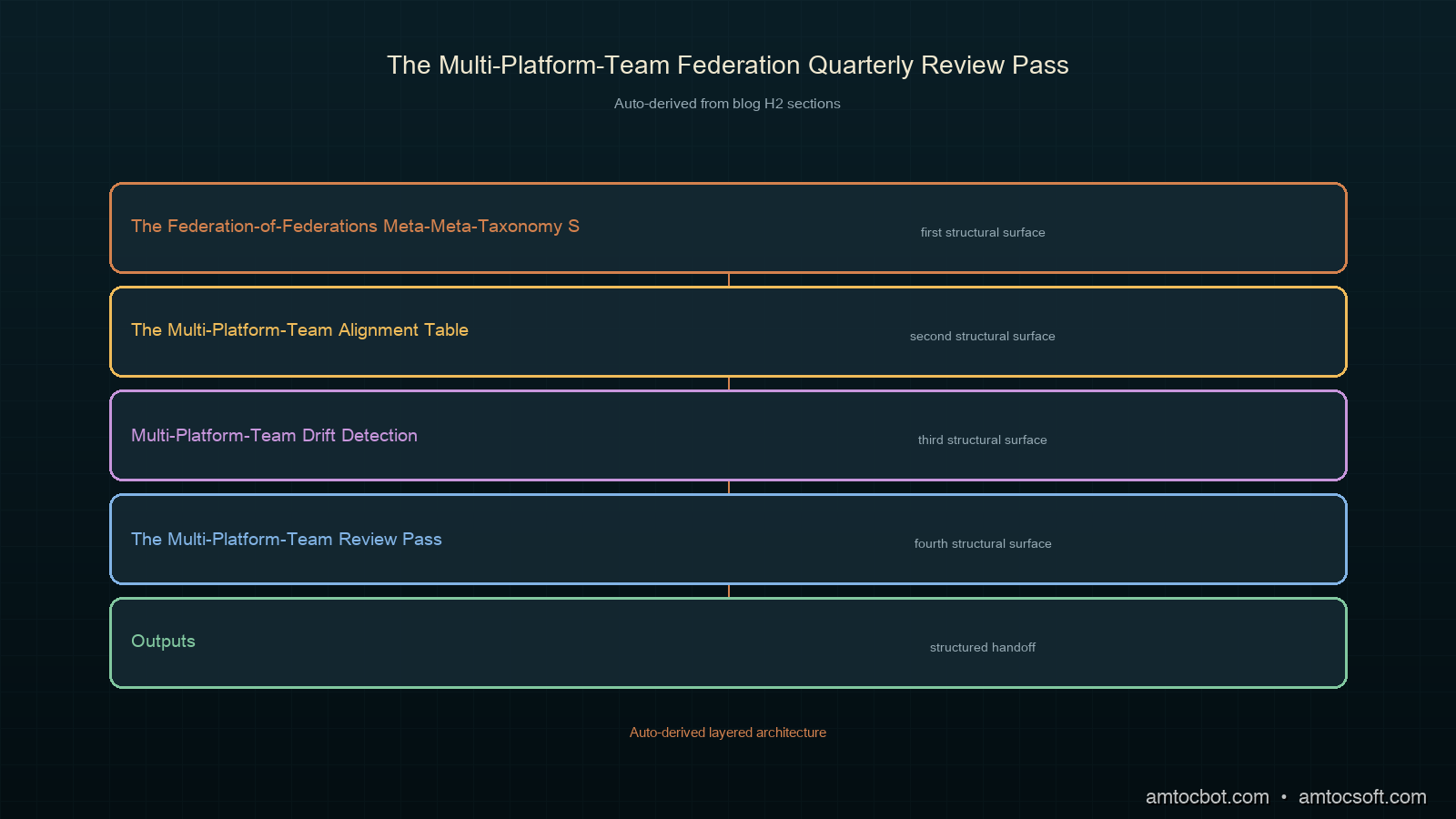
This post covers four pieces of the multi-platform-team federation quarterly review pass: the federation-of-federations meta-meta-taxonomy structure (the multi-federation-grain set of meta-meta-categories that span multiple platform-team federations' meta-taxonomies, with the same upward-binding directionality blog 202's meta-taxonomy carried), the multi-platform-team alignment table (the structural surface that binds per-federation meta-categories to multi-federation-grain meta-meta-categories), the multi-platform-team drift detection (the multi-federation-grain analogue of the cross-deployment drift detection from blog 202), and the multi-platform-team review pass (the human-in-the-loop layer that finalises multi-federation-grain drift dispositions across the platform-team federations participating in the multi-platform-team federation).
The Federation-of-Federations Meta-Meta-Taxonomy Structure
The lesson the multi-platform-team federation carried out of the stalled payment_dispute_class discussion is structurally identical to the lesson the platform-team federation carried out of its own stalled customer_payment_dispute discussion from blog 202. The multi-platform-team federation does not need the two platform-team federations to agree on a single federation-grain meta-category. The two federations' meta-categories are operationally meaningful at the per-federation grain, and forcing the two federations to merge their meta-categories would impose a multi-federation-wide constraint that neither federation's multi-deployment operational history would defend.
The federation-of-federations meta-meta-taxonomy is the structural surface that lets the per-federation meta-categories coexist at the multi-federation grain. A meta-meta-category is a multi-federation-grain named bucket that one or more per-federation meta-categories bind into, with the meta-meta-category carrying the multi-federation-grain operational meaning the per-federation meta-categories have in common. The payment_dispute_class example resolves into a meta-meta-category named payment_dispute_meta_class that federation one's meta-category binds into directly, that federation two's two meta-categories (payment_dispute_class, payment_processing_anomaly) bind into as a structured pair, and that any future federation's payment-dispute-shaped meta-categories bind into without forcing the future federation to mirror either existing federation's meta-taxonomy structure.
The directionality discipline the platform-team federation's meta-taxonomy carried (upward from per-deployment global categories to federation-grain meta-categories, never downward) carries through to the multi-platform-team federation's meta-meta-taxonomy. The multi-platform-team federation does not push a meta-meta-category back down into a federation's meta-taxonomy as an authoritative parent. The meta-meta-taxonomy is a multi-federation-grain semantic surface that exists alongside the per-federation meta-taxonomies, with the binding direction running upward from the per-federation meta-categories to the meta-meta-categories. The directionality discipline is load-bearing at every grain in the contract-corpus / trend-layer / federation stack: it preserves each grain's operational legitimacy at its own grain, and lets each next-grain-up surface carry its own grain's operational meaning without imposing structural constraints downward.
The meta-meta-taxonomy is authored by the multi-platform-team federation's multi-federation-architecture lead in collaboration with the federation-architecture leads from each platform-team federation, on a multi-federation-grain quarterly cadence that aligns with the per-federation quarterly review-pass cadence from blog 202. The multi-federation-architecture lead carries the multi-federation-grain operational evidence into the meta-meta-taxonomy authoring conversation; the per-federation federation-architecture leads carry the federation-grain operational evidence into the same conversation, with the meta-meta-taxonomy emerging as the structural agreement on the multi-federation-grain operational meaning that the per-federation meta-taxonomies have in common.
flowchart TB
  F1[Federation one<br/>meta-taxonomy] --> MM[Multi-federation<br/>meta-meta-taxonomy]
  F2[Federation two<br/>meta-taxonomy] --> MM
  F3[Federation three<br/>meta-taxonomy] --> MM
  MM --> MMC1[Meta-meta-category<br/>payment_dispute_meta_class]
  MM --> MMC2[Meta-meta-category<br/>document_review_meta_class]
  MM --> MMC3[Meta-meta-category<br/>regulatory_query_meta_class]
  F1 -.binds.-> MMC1
  F2 -.binds pair.-> MMC1
  F2 -.binds.-> MMC2
  F3 -.binds.-> MMC2
  F3 -.binds.-> MMC3
  MMC1 --> MPR[Multi-platform-team<br/>review pass]
  MMC2 --> MPR
  MMC3 --> MPR
The Multi-Platform-Team Alignment Table
The structural surface that binds per-federation meta-categories to meta-meta-categories is the multi-platform-team alignment table. The table is the multi-federation-grain analogue of the deployment-tier alignment table from blog 202. The deployment-tier alignment table binds per-deployment global categories to per-federation meta-categories at the single-federation grain; the multi-platform-team alignment table binds per-federation meta-categories to multi-federation-grain meta-meta-categories at the multi-federation grain.
The table's primary key is the multi-federation-alignment-row identifier, with the row carrying the federation identifier, the per-federation meta-category identifier, the meta-meta-category identifier the federation meta-category binds into, the binding-shape tag (one-to-one for the simple case, one-of-many for the case where multiple per-federation meta-categories bind to the same meta-meta-category, many-to-one for the case where the same per-federation meta-category binds to multiple meta-meta-categories with the binding-shape carrying the operationally-meaningful split at the multi-federation grain), the alignment-confidence score the multi-platform-team review pass calibrated against the federation-grain operational evidence, the rebinding-cadence flag (stable, recently-rebound, watching, with the same three-state semantics blog 202's deployment-tier alignment table carried), and the next-multi-platform-team-review-pass-owner field that names the multi-federation-architecture lead or the per-federation federation-architecture lead who carries the row into the next multi-platform-team review pass.
The multi-platform-team alignment table's row count grows roughly linearly with the multi-platform-team federation's federation count multiplied by the per-federation meta-taxonomy's meta-category count. At the three-federation, thirty-meta-category-per-federation shape the multi-platform-team federation I have been watching operates at, the table runs at roughly ninety alignment rows. The three-federation scale is small enough that the multi-federation-architecture lead and the per-federation federation-architecture leads can reason about the alignment rows directly in the multi-platform-team review pass without delegating row-level reasoning to a structured drill-down, the same way blog 202's four-deployment federation could reason about the deployment-tier alignment table's two-hundred-forty rows directly. At the six-federation, fifty-meta-category-per-federation shape the multi-platform-team federation has projected for two years out, the multi-platform-team alignment table's row count would scale to roughly three hundred rows, which is the scale at which the multi-platform-team review pass would need a per-meta-meta-category drill-down structure rather than a single flat row-walk.
CREATE TABLE multi_platform_team_alignment (
  multi_federation_alignment_row_id UUID PRIMARY KEY,
  federation_id TEXT NOT NULL,
  per_federation_meta_category_id UUID NOT NULL,
  meta_meta_category_id UUID NOT NULL,
  binding_shape TEXT NOT NULL CHECK (
    binding_shape IN ('one_to_one', 'one_of_many', 'many_to_one')
  ),
  alignment_confidence NUMERIC NOT NULL CHECK (
    alignment_confidence >= 0 AND alignment_confidence <= 1
  ),
  rebinding_cadence_flag TEXT NOT NULL CHECK (
    rebinding_cadence_flag IN ('stable', 'recently_rebound', 'watching')
  ),
  last_multi_platform_team_review_pass_id UUID NOT NULL,
  next_multi_platform_team_review_pass_owner TEXT NOT NULL,
  binding_rationale TEXT NOT NULL
);

CREATE INDEX idx_mpt_alignment_watching
  ON multi_platform_team_alignment (rebinding_cadence_flag, meta_meta_category_id)
  WHERE rebinding_cadence_flag = 'watching';

CREATE INDEX idx_mpt_alignment_per_federation
  ON multi_platform_team_alignment (federation_id, per_federation_meta_category_id);
The idx_mpt_alignment_watching partial index is the multi-platform-team review pass's query primitive at the multi-federation grain. The pass walks the watching-flagged rows first, with the meta-meta-category grouping carried through the index for the per-meta-meta-category disposition pass the multi-federation-architecture lead runs against each watching cluster. The idx_mpt_alignment_per_federation index supports the per-federation federation-architecture lead's pre-pass reading, where the federation-architecture lead walks their federation's multi-platform-team alignment rows ahead of the multi-platform-team review pass to surface federation-grain context the multi-federation-architecture lead needs for the multi-federation-grain disposition conversation.
The binding-rationale column is load-bearing for the multi-platform-team review pass's re-readability across multi-federation-grain quarterly review-pass cycles, the same way blog 202's binding-rationale column was load-bearing for the federation review pass and blog 199's binding-rationale column was load-bearing for the engineering manager's quarterly review pass. The rationale carries the multi-federation-architecture lead's structured argument for why the per-federation meta-category binds to the meta-meta-category in the binding shape the row records, with the rationale referring back to the federation-grain operational evidence the multi-platform-team review pass weighed at the time of binding.
Multi-Platform-Team Drift Detection
The multi-federation-grain drift detection layer is the multi-federation-grain analogue of the cross-deployment drift detection from blog 202. The cross-deployment drift detection surfaces alignment-table candidate signals from the federation-grain reading of the per-deployment cross-corpus alignment tables and the per-deployment trend-pass projections at the single-federation grain. The multi-platform-team drift detection surfaces alignment-table candidate signals from the multi-federation-grain reading of the per-federation deployment-tier alignment tables and the per-federation quarterly summaries.
The multi-federation-grain drift detection runs three rule types, structurally parallel to the cross-deployment drift detection's three rule types from blog 202 scaled up one composition step.
The first rule type is meta-meta-category split detection. The rule fires when one meta-meta-category's per-federation meta-categories show divergent operational meaning across federations at a rate that exceeds the multi-federation-grain rebinding-cadence threshold. The mechanism reads each per-federation meta-category bound to the meta-meta-category against the multi-federation-grain reading of the per-federation quarterly summaries and the per-federation deployment-tier alignment-row retraction patterns, with the divergence signal scoring the per-federation meta-categories' multi-federation-grain operational meaning drift. The signal surfaces meta-meta-categories that are operationally splitting at the multi-federation grain even though the per-federation meta-categories continue to bind into the same meta-meta-category at the multi-platform-team alignment table.
The second rule type is meta-meta-category merge detection. The rule fires when two meta-meta-categories' per-federation meta-categories show convergent operational meaning across federations at a rate that exceeds the multi-federation-grain merge-candidate threshold. The mechanism reads pairs of meta-meta-categories' per-federation meta-categories against the multi-federation-grain reading of the per-federation quarterly summaries and the per-federation deployment-tier alignment-row addition patterns, with the convergence signal scoring the meta-meta-categories' multi-federation-grain operational meaning overlap. The signal surfaces meta-meta-categories whose per-federation meta-categories are operationally merging at the multi-federation grain, with the multi-platform-team review pass deciding whether to merge the two meta-meta-categories or preserve them with the convergence as a multi-federation-grain operational reality the meta-meta-taxonomy carries forward.
The third rule type is federation-specific meta-category emergence. The rule fires when a federation's new per-federation meta-category does not bind to any existing meta-meta-category at the multi-federation-grain alignment-confidence threshold. The mechanism reads each newly-promoted per-federation meta-category against the existing meta-meta-categories' binding signatures, with the unbinding signal scoring the multi-federation-grain operational novelty of the new per-federation meta-category. The signal surfaces federation-grain operational realities that the meta-meta-taxonomy does not yet have a meta-meta-category for, with the multi-platform-team review pass deciding whether to add a new meta-meta-category to the meta-meta-taxonomy or rebind the new per-federation meta-category to an existing meta-meta-category as a binding-shape extension.
The three rule types together carry the multi-federation-grain drift signal load. The three-federation, thirty-meta-category-per-federation shape the multi-platform-team federation operates at produces a multi-federation-grain candidate-signal volume of roughly twelve to twenty signals per multi-platform-team review pass quarter, lower than the federation-grain pass's twenty-five-to-forty signal volume because the meta-meta-taxonomy is authored at a coarser grain than the meta-taxonomy and the per-federation meta-categories drift at a slower rate than the per-deployment global categories drift. The meta-meta-category split detection rule carries the largest share of signals (the meta-meta-categories that span multiple federations are the ones most exposed to federation-grain operational drift), the meta-meta-category merge detection rule carries the smallest share (multi-federation-grain merge candidates are rarer at the multi-federation grain than at the federation grain because the meta-meta-taxonomy's surface area is smaller), and the federation-specific meta-category emergence rule carries the middle share (the rule fires whenever a federation promotes a new meta-category, which happens at a roughly semi-annual cadence per federation).
flowchart TB
  PA[Per-federation<br/>deployment-tier<br/>alignment tables] --> R1[Rule 1: Meta-meta-category<br/>split detection]
  PA --> R2[Rule 2: Meta-meta-category<br/>merge detection]
  PA --> R3[Rule 3: Federation-specific<br/>meta-category emergence]
  QS[Per-federation<br/>quarterly summaries] --> R1
  QS --> R2
  QS --> R3
  R1 --> S1[Split-candidate<br/>signal stream]
  R2 --> S2[Merge-candidate<br/>signal stream]
  R3 --> S3[Emergence-candidate<br/>signal stream]
  S1 --> WQ[Watching queue<br/>on alignment table]
  S2 --> WQ
  S3 --> WQ
  WQ --> MPR[Multi-platform-team<br/>review pass]
The Multi-Platform-Team Review Pass
The multi-platform-team review pass is the human-in-the-loop layer that finalises multi-federation-grain drift dispositions across the platform-team federations participating in the multi-platform-team federation. The pass is the multi-federation-grain analogue of the federation review pass from blog 202. The federation review pass finalises meta-taxonomy dispositions and deployment-tier alignment-row dispositions at the single-federation grain; the multi-platform-team review pass finalises meta-meta-taxonomy dispositions and multi-platform-team alignment-row dispositions at the multi-federation grain.
The multi-platform-team review pass runs on a multi-federation-grain quarterly cadence, with the multi-federation-architecture lead chairing and the per-federation federation-architecture leads attending as the per-federation evidence carriers. The pass takes one hundred to one hundred twenty minutes at the three-federation shape the multi-platform-team federation operates at, slightly longer than the ninety-to-one-hundred-ten-minute federation review pass at the four-deployment federation grain, because the meta-meta-taxonomy authoring carries more structural reasoning per disposition than the meta-taxonomy authoring at the single-federation grain. The pass is one composition step above the federation review pass, with the per-federation federation-architecture leads carrying their respective per-federation quarterly review-pass dispositions and quarterly summaries into the multi-platform-team pass as structured input.
| Multi-federation-grain disposition | Frequency at three-federation shape | Pass owner | Carry-forward target |
|---|---|---|---|
| Add new meta-meta-category | One to two per quarter | Multi-federation-architecture lead | Next multi-platform-team pass |
| Split existing meta-meta-category | Zero to one per six months | Multi-federation-architecture lead | Next multi-platform-team pass |
| Merge two meta-meta-categories | Zero to one per year | Multi-federation-architecture lead | Next multi-platform-team pass |
| Rebind multi-platform-team alignment row | Three to five per quarter | Per-federation federation-architecture lead | Next federation pass |
| Adjust binding-shape tag | Two to three per quarter | Per-federation federation-architecture lead | Next federation pass |
| Defer to next pass | One to two per quarter | Multi-federation-architecture lead | Next multi-platform-team pass |
The disposition table reads the multi-platform-team review pass's typical disposition load at the three-federation shape. The largest single share is the multi-platform-team alignment-row rebinding disposition, which is the per-federation federation-architecture lead's structural commitment to adjust the multi-platform-team alignment table against the multi-platform-team review pass's multi-federation-grain reading. The second-largest share is the binding-shape adjustment, which captures the multi-federation-grain reading that a per-federation meta-category's binding shape should change against the multi-federation-grain operational evidence. The new-meta-meta-category disposition is the third-largest share, with the multi-federation-architecture lead committing to add a new meta-meta-category to the meta-meta-taxonomy against the federation-specific meta-category emergence rule's signals.
The multi-platform-team review pass produces three structured outputs the multi-federation-grain operational layer consumes, structurally parallel to the federation review pass's three outputs from blog 202. The first output is the updated multi-platform-team alignment table, with the multi-federation-grain dispositions applied as alignment-row updates with the multi-platform-team-review-pass-id stamped against each updated row. The second output is the updated meta-meta-taxonomy, with the new meta-meta-categories added, the merged meta-meta-categories collapsed, and the split meta-meta-categories partitioned, with each change carrying a multi-platform-team-review-pass-id and a multi-federation-architecture-lead-authored rationale. The third output is the multi-federation-grain quarterly summary, which is the single-paragraph narrative the multi-federation-architecture lead authors against the pass's dispositions and carries forward to the multi-platform-team federation's annual rollup at the year-end synthesis pass.
flowchart LR
  A[Per-federation<br/>quarterly review pass<br/>dispositions x N] --> B[Multi-platform-team<br/>review pass]
  C[Multi-federation-grain<br/>drift signals] --> B
  D[Multi-platform-team<br/>alignment-row<br/>watching queue] --> B
  B --> E[Updated<br/>meta-meta-taxonomy]
  B --> F[Updated<br/>multi-platform-team<br/>alignment table]
  B --> G[Multi-federation-grain<br/>quarterly summary]
  E --> H[Next per-federation<br/>quarterly review passes]
  F --> H
  G --> I[Multi-platform-team<br/>annual rollup]
Comparison: Multi-Federation-Grain Versus Single-Federation Disposition Pattern
The structural correspondence between the single-federation quarterly review pass from blog 202 and the multi-federation-grain quarterly review pass is the post's central comparison point. The two passes operate at different grains but share the same structural shape: a human-in-the-loop layer that consumes structured drift signals, applies dispositions against an alignment table and a taxonomy surface, and produces structured outputs the next-grain-up planning conversation consumes. The structural correspondence is load-bearing because it lets the multi-platform-team federation reuse the operational discipline the single-federation quarterly review pass has built up at each federation, scaled up one composition step to the multi-federation grain.
The disposition frequencies differ in informative ways that reflect the grain-depth lift. The single-federation quarterly review pass typically finalises five to nine deployment-tier alignment rebindings per quarter and two to four meta-taxonomy adjustments per quarter, against a four-deployment federation with two hundred forty alignment rows and roughly thirty meta-categories. The multi-federation-grain quarterly review pass finalises three to five multi-platform-team alignment rebindings per quarter and one to two meta-meta-taxonomy adjustments per quarter, against a three-federation multi-platform-team federation with ninety alignment rows and roughly fifteen meta-meta-categories. The multi-federation-grain pass's lower per-row disposition rate reflects the meta-meta-taxonomy's coarser grain: a meta-meta-category captures the operational meaning of multiple per-federation meta-categories, which means the meta-meta-taxonomy's surface area is smaller than the sum of the per-federation meta-taxonomies and the disposition rate scales with the meta-meta-taxonomy's surface area rather than with the federation count.
The pass-owner structure also differs in informative ways. The single-federation quarterly review pass is co-owned by the federation-architecture lead and the per-deployment platform-team leads. The multi-federation-grain pass is co-owned by the multi-federation-architecture lead and the per-federation federation-architecture leads, with the multi-federation-architecture lead carrying the meta-meta-taxonomy authoring authority and the per-federation federation-architecture leads carrying the per-federation operational evidence. The co-ownership pattern at each grain preserves the legibility of the next-grain-up pass at the next-grain-down layer, which is the structural property the whole contract-corpus / trend-layer / federation stack relies on.
Production Considerations
Three production considerations are worth calling out for any multi-platform-team federation that is shipping the multi-federation-grain quarterly review pass against multiple platform-team federations running the multi-deployment cross-deployment alignment layer from blog 202.
The first is multi-federation-grain authoring capacity. The multi-platform-team review pass's authoring capacity is bounded by the multi-federation-architecture lead's calendar at the multi-federation grain and by each per-federation federation-architecture lead's calendar at the federation grain. The pattern that has worked at the three-federation shape is to schedule the multi-platform-team review pass three weeks after the per-federation quarterly review passes have closed, which gives the per-federation federation-architecture leads time to carry the per-federation dispositions and quarterly summaries into the multi-platform-team pass as structured input. At the six-federation scale, the multi-federation-architecture lead would need a multi-federation-architecture co-lead role to share the meta-meta-taxonomy authoring load, with the two co-leads partitioning the meta-meta-categories by multi-federation-grain operational theme rather than by federation.
The second is meta-meta-taxonomy cadence and stability. The meta-meta-taxonomy is authored at a multi-federation-grain quarterly cadence, with the meta-meta-taxonomy's stability carried forward as a multi-federation-grain operational invariant. The stability discipline that worked at the federation grain in blog 202 carries through to the multi-federation grain, with the meta-meta-taxonomy's quarter-over-quarter delta running at roughly one-to-two meta-meta-category changes per quarter at the three-federation shape, lower than the federation-grain meta-taxonomy's two-to-four meta-category changes per quarter because the meta-meta-taxonomy's surface area is smaller and the multi-federation-grain operational drift runs at a slower rate than the federation-grain operational drift.
The third is multi-federation-grain drift signal volume control. The multi-federation-grain drift detection layer's signal volume is bounded by the multi-platform-team review pass's disposition capacity, the same way the federation-grain drift detection layer's signal volume is bounded by the federation review pass's disposition capacity in blog 202. The pattern that has worked is to recalibrate the three drift-detection rule types' thresholds at the multi-platform-team review pass following each federation's quarterly review pass, with the multi-federation-architecture lead reviewing the signal volume against the multi-platform-team review pass's disposition capacity and adjusting the thresholds to keep the signal-to-disposition ratio close to one-to-one. The recalibration cadence has kept the multi-platform-team review pass's disposition load close to the one-hundred-to-one-hundred-twenty-minute pass-length budget across the year.
Conclusion
The multi-platform-team federation quarterly review pass is the structural surface that lets the multi-platform-team federation reason about cross-federation patterns at a grain coarser than the per-federation meta-taxonomy carries. The federation-of-federations meta-meta-taxonomy gives the multi-platform-team federation a multi-federation-grain semantic surface that lets the per-federation meta-categories coexist without forcing the platform-team federations to merge their per-federation meta-taxonomies into a single multi-federation-wide meta-taxonomy. The multi-platform-team alignment table binds per-federation meta-categories to meta-meta-categories with the alignment confidence and the rebinding cadence the multi-platform-team federation tracks, and surfaces the watching queue the multi-platform-team review pass walks. The multi-platform-team drift detection layer surfaces meta-meta-category split, merge, and federation-specific meta-category emergence signals the multi-platform-team review pass disposes against. The multi-platform-team review pass is the human-in-the-loop layer that finalises meta-meta-taxonomy and multi-platform-team alignment dispositions at the multi-federation grain, in structural correspondence to the federation review pass at the single-federation grain.
The post after this one will pivot to the multi-platform-team annual rollup, which is the year-end synthesis at the multi-federation grain that consumes the four quarterly multi-platform-team review-pass quarterly summaries this post sketched. The next post will cover how the multi-platform-team annual rollup composes against the per-federation annual rollups (each of which composes against the per-deployment annual taxonomy-evolution rollups from blog 201) into a single multi-federation-grain year-end synthesis the multi-platform-team federation carries forward into the next year's quarterly review-pass cadence.
Sources
- Cross-Corpus Taxonomy Alignment (blog 199): https://amtocsoft.blogspot.com/2026/05/cross-corpus-taxonomy-alignment.html
- Taxonomy-Aware Quarterly Review Pass (blog 200): https://amtocsoft.blogspot.com/2026/05/the-taxonomy-aware-quarterly-review.html
- Annual Taxonomy-Evolution Rollup (blog 201): https://amtocsoft.blogspot.com/2026/05/the-annual-taxonomy-evolution-rollup.html
- Cross-Deployment Alignment Layer (blog 202): https://amtocsoft.blogspot.com/2026/05/the-cross-deployment-alignment-layer.html
- Companion repo (
adlc-eval-contracts/multi-platform-team-federation/): https://github.com/amtocbot-droid/amtocbot-examples
About the Author
Toc Am
Founder of AmtocSoft. Writing practical deep-dives on AI engineering, cloud architecture, and developer tooling. Previously built backend systems at scale. Reviews every post published under this byline.
Published: 2026-05-10 · Written with AI assistance, reviewed by Toc Am.
☕ Buy Me a Coffee · 🔔 YouTube · 💼 LinkedIn · 🐦 X/Twitter



No comments:
Post a Comment