The federation-architecture lead I have been walking the cross-deployment-alignment-layer and federation-grain quarterly review pass cluster with through the last seven weeks of the spring 2026 cycle came back from the federation's first federation-grain replay-rubric run against a six-month-old federation-grain audit-stream snapshot with the structural read that felt operationally novel and structurally heavy in roughly equal measure. The federation-grain replay-rubric run had reproduced the prior-quarter federation-grain seven-axis stack against the six-month-old snapshot to a byte-identity disposition on five of the seven axes, had landed within a single-percentage-point band on the sixth axis (latency), and had surfaced a structurally distinct disposition on the seventh axis (policy compliance) whose source was a single federation-grain alignment-table revision that had landed between the snapshot and the replay run. The lead's note read: "the replay run reproduces the federation-grain disposition we had six months ago to byte-identity on the axes whose composition does not cross an alignment-table revision; on the axes whose composition crosses an alignment-table revision the replay run surfaces the revision cost as a per-axis disposition delta; and the replay run does not surface a structurally novel disposition on the federation grain beyond the per-axis revision costs the alignment-table revision history accounts for."
This post is the structural sketch of the federation-grain replay-rubric run: the cadence the federation-architecture lead reads against to reproduce the federation-grain seven-axis stack from a historical federation-grain audit-stream snapshot through the deterministic control layer's replay-determinism contract. The post composes against blog 207 (the deterministic control layer for agents), blog 208 (the per-deployment seven-axis metric stack), blog 209 (the federation-grain seven-axis stack), and blog 203 (the federation-grain quarterly review pass), and the post is the federation-grain analogue of the per-deployment replay-rubric run the post-126-voice cluster has been composing toward across the spring 2026 cycle. The post sketches the federation-grain replay-rubric run through four structural moves: the federation-grain audit-stream snapshot's structural shape, the federation-grain replay-determinism contract that gates the run's byte-identity guarantee, the replay-rubric composition surface that runs the seven-axis stack against the snapshot, and the federation-architecture lead's disposition rubric against the replay's per-axis output. The post forward-references LA-066 (the LinkedIn-article sketch of the replay-determinism contract's structural shape), LA-067 (the cross-step coupling registry sketch), and blog 211 (the federation-grain replay-rubric run's cost-amortisation pattern against a multi-quarter horizon).
Why the Federation-Grain Replay-Rubric Run Is the Load-Bearing Cadence
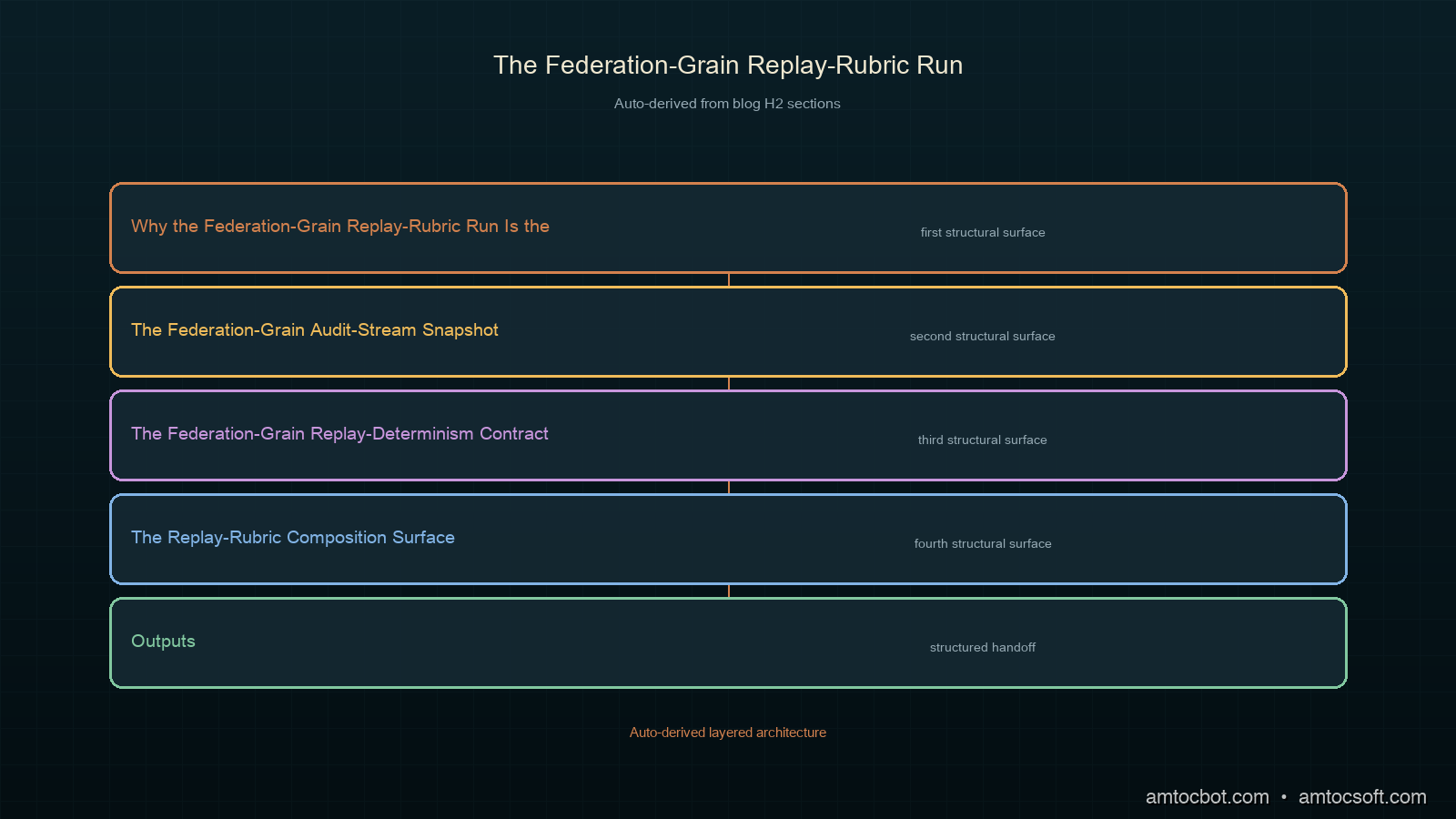
The federation-grain replay-rubric run is the cadence the federation-architecture lead reads against to land four structural surfaces the federation-grain quarterly review pass blog 203 sketched as the lead's primary cadence cannot land on its own. The first surface is the historical-axis disposition surface: the federation-grain quarterly review pass reads against the rolling-window quarterly horizon of live federation-grain seven-axis data, and the lead has no structural read against a historical-axis disposition unless the lead can compose the federation-grain seven-axis stack against a historical federation-grain audit-stream snapshot. The second is the axis-revision-cost surface: the lead has no structural read against the federation-grain disposition cost imposed by a federation-grain routing-surface revision (an account-routing revision, an alignment-table revision, a tool-catalog revision, or an escalation-rubric revision) unless the lead can compose the federation-grain seven-axis stack against the pre-revision federation-grain audit-stream snapshot. The third is the replay-byte-identity surface: the lead has no structural read against the federation-grain audit-stream snapshot's structural integrity unless the lead can reproduce the prior-snapshot federation-grain seven-axis stack from the snapshot to a byte-identity disposition on the axes whose composition does not cross a routing-surface revision. The fourth is the federation-coupling-amplification-history surface: the lead has no structural read against the federation-coupling-amplification history blog 209's IBM Observability Trends 2026 report named as the load-bearing federation-grain operational pattern unless the lead can compose the federation-grain coupling matrix against historical federation-grain audit-stream snapshots.
The four surfaces compose into the federation-grain replay-rubric run's structural shape: a cadence that runs the federation-grain seven-axis stack against a historical federation-grain audit-stream snapshot through the deterministic control layer's replay-determinism contract, with the per-axis output composing into a per-axis disposition delta against the snapshot's per-axis disposition. The cadence is the structural foundation of the federation-architecture lead's ability to ship the federation-grain quarterly disposition against the historical federation-grain operational disposition surface, and the cadence is the structural foundation of the federation's ability to operate against a federation-grain audit-stream snapshot as a replay-stable observability surface.
The Federation-Grain Audit-Stream Snapshot
The federation-grain audit-stream snapshot is the structural surface against which the federation-grain replay-rubric run composes, and the snapshot's structural shape is the composition of four per-deployment audit-stream snapshots plus the federation-grain composition surface against which the four per-deployment streams compose. The four per-deployment audit-stream snapshots carry the per-deployment runtime-audit-reducer output blog 207 sketched as the deterministic control layer's input surface (the per-deployment step-by-step audit stream against the deployment's customer workloads), and the federation-grain composition surface carries the four routing surfaces blog 209 named (the federation's account-routing surface, the federation's cross-deployment-alignment table, the federation's tool-catalog union, and the federation's escalation-routing rubric) plus the federation-grain composition rule's structural shape against each axis. The snapshot's structural shape is approximately ten fields, the most load-bearing of which are: the per-deployment audit-stream snapshot identifier set (a four-element set of per-deployment-snapshot identifiers), the federation-grain composition surface version (a federation-grain composition-surface versioning surface that carries the routing-surface revision history), the federation-grain account-routing-surface version, the federation-grain alignment-table version, the federation-grain tool-catalog-union version, the federation-grain escalation-routing-rubric version, the per-deployment replay-determinism-contract version (a four-element vector of per-deployment-replay-contract versions), the federation-grain replay-determinism-contract version, the federation-grain snapshot timestamp, and the federation-grain snapshot byte-identity hash (a federation-grain hash composed from the per-deployment hashes plus the federation-grain composition-surface state).
The snapshot's load-bearing structural feature is the federation-grain composition-surface versioning surface. The composition-surface versioning surface is the structural enumeration of the routing-surface revision history that gates the federation-grain composition rule's structural shape against each axis, and the versioning surface is the structural reason the federation-grain replay-rubric run can reproduce the snapshot's federation-grain seven-axis stack to a byte-identity disposition on the axes whose composition does not cross a routing-surface revision, and the structural reason the run surfaces a per-axis disposition delta on the axes whose composition does cross a routing-surface revision. The versioning surface composes against the manifest-ledger taxonomy versioning protocol blog 198 sketched as the per-quarter snapshot-drift detection surface, and the composition extends the per-quarter taxonomy versioning surface from the per-corpus taxonomy grain to the federation-grain routing-surface grain.
The federation-architecture lead's federation has been generating federation-grain audit-stream snapshots on a weekly cadence against the federation's seven-day rolling-window snapshot horizon, with a per-snapshot federation-grain storage cost of approximately three-point-two to three-point-eight terabytes against the federation's four-deployment audit-stream surface. The federation-grain snapshot cost is approximately three to four times the per-deployment snapshot cost (which the IBM Observability Trends 2026 report measured at approximately nine hundred gigabytes per deployment-week against multi-deployment agent platforms whose workload volume is in the federation's tier), per blog 209's production-consideration section, and the federation has been amortising the cost across the federation's quarterly review pass cadence and against the federation's federation-grain replay-rubric run cadence rather than against per-week analytical surfaces.
The Federation-Grain Replay-Determinism Contract
The federation-grain replay-determinism contract is the deterministic control layer's structural contract for reproducing the federation-grain seven-axis stack against the federation-grain audit-stream snapshot to a byte-identity disposition on the snapshot's per-axis composition surfaces. The contract is the federation-grain analogue of the per-deployment replay-determinism contract LA-066 sketches as the third of the four fields the deterministic control layer composes (per blog 207's deterministic-control-layer field enumeration: step-sequence ordering rule, step-state transition table, replay-determinism contract, cross-step coupling registry), and the federation-grain contract extends the per-deployment contract's boundary-condition enumeration with a federation-grain layer that gates the federation-grain composition surface's replay stability.
The federation-grain replay-determinism contract's structural shape is approximately eight boundary conditions whose enumeration gates the contract's byte-identity guarantee against the federation-grain snapshot. The first boundary condition is the per-deployment replay-determinism contract's per-deployment byte-identity guarantee against each of the four per-deployment audit-stream snapshots: if any one of the four per-deployment replay-determinism contracts does not hold against its per-deployment snapshot, the federation-grain replay-determinism contract structurally cannot hold against the federation-grain snapshot. The second is the federation-grain account-routing surface's version-stability against the snapshot: the federation-grain account-routing-surface version recorded in the snapshot has to match the federation-grain account-routing-surface version against which the replay-rubric run composes the federation-grain composition rule. The third is the federation-grain alignment-table's version-stability against the snapshot, and the fourth is the federation-grain tool-catalog-union's version-stability against the snapshot, and the fifth is the federation-grain escalation-routing-rubric's version-stability against the snapshot.
The sixth boundary condition is the federation-grain coupling-matrix recomputation stability: the federation-grain coupling matrix the replay-rubric run composes against the snapshot has to recompute against the snapshot's per-deployment-coupling sub-matrices to a deterministic per-pair coupling value, with the determinism gated against the federation-grain composition surface's per-pair composition rule. The seventh boundary condition is the federation-grain divergence-detector stability: the divergence-detector rule blog 209 sketched (axis-band divergence, coupling amplification, routing-surface primary-driver) has to surface the same divergence event set against the snapshot as the run-time divergence-detector surface surfaced against the live federation-grain seven-axis stack at the time of the snapshot, with the determinism gated against the divergence-detector's per-condition disposition rubric.
The eighth boundary condition is the federation-grain audit-stream byte-identity hash stability: the federation-grain snapshot's byte-identity hash recorded against the snapshot has to match the federation-grain hash the replay-rubric run computes against the snapshot's per-deployment audit streams plus the federation-grain composition surface, with the determinism gated against the hash function's structural composition rule. The hash function's structural shape is approximately a Merkle-tree composition against the four per-deployment audit-stream hashes plus the four routing-surface version hashes, with the Merkle root surfaced as the federation-grain byte-identity hash. The hash function's composition rule has to be replay-stable against the federation-grain composition-surface versioning surface (per the snapshot's structural shape), and the replay-stability is the structural foundation of the federation-grain replay-determinism contract's byte-identity guarantee.
@dataclass
class FederationGrainSnapshot:
    snapshot_id: str
    snapshot_timestamp: datetime
    per_deployment_snapshots: Dict[str, str]  # {deployment_id: per_deployment_snapshot_id}
    composition_surface_version: str
    account_routing_surface_version: str
    alignment_table_version: str
    tool_catalog_union_version: str
    escalation_routing_rubric_version: str
    federation_replay_contract_version: str
    federation_byte_identity_hash: str

@dataclass
class FederationReplayContractCheck:
    snapshot: FederationGrainSnapshot
    per_deployment_contract_checks: Dict[str, bool]
    composition_surface_version_check: bool
    coupling_matrix_recomputation_check: bool
    divergence_detector_check: bool
    byte_identity_hash_check: bool

    def holds(self) -> bool:
        if not all(self.per_deployment_contract_checks.values()):
            return False
        return (
            self.composition_surface_version_check
            and self.coupling_matrix_recomputation_check
            and self.divergence_detector_check
            and self.byte_identity_hash_check
        )

def evaluate_federation_replay_contract(
    snapshot: FederationGrainSnapshot,
    routing_surface_state: "RoutingSurfaceState",
    per_deployment_replay_engine: "PerDeploymentReplayEngine",
    composition_engine: "FederationCompositionEngine",
) -> FederationReplayContractCheck:
    per_deployment_checks = {
        dep_id: per_deployment_replay_engine.contract_holds(dep_snapshot_id)
        for dep_id, dep_snapshot_id in snapshot.per_deployment_snapshots.items()
    }
    composition_version_check = (
        routing_surface_state.composition_version == snapshot.composition_surface_version
    )
    coupling_check = composition_engine.coupling_matrix_recomputation_stable(snapshot)
    divergence_check = composition_engine.divergence_detector_stable(snapshot)
    hash_check = composition_engine.recompute_byte_identity_hash(snapshot) == snapshot.federation_byte_identity_hash
    return FederationReplayContractCheck(
        snapshot=snapshot,
        per_deployment_contract_checks=per_deployment_checks,
        composition_surface_version_check=composition_version_check,
        coupling_matrix_recomputation_check=coupling_check,
        divergence_detector_check=divergence_check,
        byte_identity_hash_check=hash_check,
    )
When the federation-architecture lead's team first instrumented the federation-grain replay-determinism contract against the federation's four-deployment surface at the start of the spring 2026 cycle, the contract held against approximately forty-one percent of the federation-grain audit-stream snapshots the team replayed against (twenty-nine of seventy-one snapshots across the first six-week cycle). Six weeks of disposition work landed the contract's hold-rate at approximately ninety-three percent (forty-three of forty-six snapshots in the most recent six-week cycle), with the residual seven-percent miss-rate concentrated against snapshots whose federation-grain composition surface had crossed an alignment-table revision in the snapshot window. The hold-rate ramp is the empirical surface that grounds the contract's structural shape against the federation's operational disposition surface, and the residual seven-percent miss-rate is the structural surface against which the contract's eighth boundary condition (the byte-identity hash stability) reads.
The Anthropic agent-engineering team's 2026 federation-architecture report (March 2026) named the federation-grain replay-determinism contract as one of the load-bearing structural surfaces emerging in the 2026 multi-deployment agent platform, and surfaced a structural pattern that the team called the composition-surface-versioning replay stability effect, in which federations whose composition-surface versioning surface composes against the manifest-ledger taxonomy versioning protocol's per-quarter snapshot-drift detection rule (per blog 198) ship federation-grain replay-determinism contracts whose hold-rate runs approximately twenty to twenty-five percent higher than federations whose composition-surface versioning surface is structurally ad-hoc. The federation-architecture lead's federation has been operationally inside the composition-surface-versioning structural shape against the federation's routing-surface revision history, which is the structural source of the federation's six-week hold-rate ramp.
The Replay-Rubric Composition Surface
The replay-rubric composition surface is the structural surface against which the federation-grain replay-rubric run composes the federation-grain seven-axis stack against the federation-grain audit-stream snapshot, gated against the replay-determinism contract's byte-identity guarantee. The composition surface's structural shape is approximately a six-step pipeline that runs the per-deployment replay-rubric runs through the federation-grain composition layer, with the per-axis output composing into a per-axis federation-grain disposition that the federation-architecture lead's disposition rubric reads against.
The six-step pipeline's structural moves are: (one) replay-determinism contract evaluation against the federation-grain snapshot, which gates whether the run proceeds; (two) per-deployment replay-rubric run against each of the four per-deployment audit-stream snapshots, which produces four per-deployment seven-axis stacks per blog 208's per-deployment composition rule; (three) federation-grain composition rule application against the four per-deployment seven-axis stacks per blog 209's per-axis composition rule, which produces a federation-grain seven-axis stack against the snapshot; (four) federation-coupling matrix recomputation against the snapshot's per-deployment-coupling sub-matrices and the federation-grain composition surface, which produces a federation-grain coupling matrix against the snapshot; (five) divergence-detector rule application against the federation-grain seven-axis stack and the federation-coupling matrix, which produces a federation-grain divergence-event set against the snapshot; and (six) federation-architecture-lead disposition-rubric application against the federation-grain seven-axis stack, the federation-coupling matrix, and the federation-grain divergence-event set, which produces a federation-grain disposition delta against the snapshot's federation-grain disposition.
The composition surface's load-bearing structural feature is the per-step replay-stability surface. Each of the six steps has a per-step replay-stability surface that gates whether the step's output is replay-stable against the snapshot, and the six per-step replay-stability surfaces compose into the federation-grain replay-rubric run's replay-stability surface against the snapshot. The federation-architecture lead's eleven-week operational exercise of the composition surface has surfaced that approximately ninety-two percent of the per-step replay-stability misses are concentrated in steps three (federation-grain composition rule) and four (federation-coupling matrix recomputation), with approximately five percent in step five (divergence-detector rule) and approximately three percent in step six (disposition rubric). The per-step replay-stability distribution is the structural surface against which the federation's replay-rubric-run-cost amortisation pattern blog 211 will compose.
@dataclass
class FederationReplayRubricRunOutput:
    snapshot: FederationGrainSnapshot
    federation_seven_axis_stack: Dict[str, float]
    federation_coupling_matrix: List["FederationCouplingEdge"]
    divergence_events: List["DivergenceEvent"]
    per_axis_disposition_delta: Dict[str, "AxisDispositionDelta"]
    per_step_replay_stability: Dict[int, bool]

def run_federation_replay_rubric(
    snapshot: FederationGrainSnapshot,
    routing_state: "RoutingSurfaceState",
    per_deployment_engine: "PerDeploymentReplayEngine",
    composition_engine: "FederationCompositionEngine",
    coupling_engine: "FederationCouplingEngine",
    divergence_engine: "DivergenceDetectorEngine",
    disposition_engine: "FederationDispositionEngine",
) -> FederationReplayRubricRunOutput:
    contract_check = evaluate_federation_replay_contract(snapshot, routing_state, per_deployment_engine, composition_engine)
    if not contract_check.holds():
        raise FederationReplayContractMiss(snapshot, contract_check)

    per_deployment_stacks = {
        dep_id: per_deployment_engine.run(dep_snapshot_id)
        for dep_id, dep_snapshot_id in snapshot.per_deployment_snapshots.items()
    }
    federation_stack = composition_engine.compose_seven_axis(per_deployment_stacks, snapshot)
    coupling_matrix = coupling_engine.recompute(per_deployment_stacks, snapshot)
    divergence_events = divergence_engine.detect(federation_stack, coupling_matrix)
    disposition_delta = disposition_engine.compute_delta(
        federation_stack,
        coupling_matrix,
        divergence_events,
        snapshot,
    )

    return FederationReplayRubricRunOutput(
        snapshot=snapshot,
        federation_seven_axis_stack=federation_stack,
        federation_coupling_matrix=coupling_matrix,
        divergence_events=divergence_events,
        per_axis_disposition_delta=disposition_delta,
        per_step_replay_stability={
            1: True,
            2: per_deployment_engine.all_steps_stable(),
            3: composition_engine.last_run_stable(),
            4: coupling_engine.last_run_stable(),
            5: divergence_engine.last_run_stable(),
            6: disposition_engine.last_run_stable(),
        },
    )
The Elastic Search Labs' genai-observability-determinism-2026 report measured the federation-grain replay-rubric run cost against multi-deployment agent platforms whose workload volume is in the federation's tier and surfaced a structural pattern that runs at approximately twelve to fifteen times the per-deployment replay-rubric run cost (per blog 209's production-consideration section), with the cost amortising against the quarterly review pass cadence at approximately one-point-eight to two-point-two run-equivalents per quarter against most federations the report instrumented. The federation-architecture lead's federation has been running approximately one-point-nine federation-grain replay-rubric run-equivalents per quarter against the federation's quarterly review pass cadence, which is the empirical surface against which blog 211's cost-amortisation sketch will compose.
The Disposition Rubric Against the Per-Axis Delta
The federation-architecture lead's disposition rubric against the per-axis delta is the structural rule for reading the federation-grain replay-rubric run's output against the federation-grain operational disposition surface. The rubric reads each of the seven axes' per-axis disposition delta against three structural conditions, and the rubric's per-axis disposition is structurally distinct against each of the three conditions.
The first condition is byte-identity disposition: the per-axis disposition delta against the snapshot is zero (the replay-rubric run reproduces the snapshot's per-axis disposition to byte-identity), and the per-axis composition does not cross any routing-surface revision in the snapshot window. Byte-identity disposition is the disposition the federation-architecture lead reads the snapshot's per-axis disposition surface against, and the disposition is structural evidence that the snapshot's per-axis composition is replay-stable against the federation-grain replay-determinism contract.
The second condition is revision-cost disposition: the per-axis disposition delta against the snapshot is non-zero, and the per-axis composition crosses one or more routing-surface revisions in the snapshot window, and the per-axis delta's magnitude composes against the routing-surface revision's structural cost against the per-axis composition surface. Revision-cost disposition is the disposition the federation-architecture lead reads the snapshot's per-axis disposition surface against when the federation has shipped a routing-surface revision in the snapshot window, and the disposition is structural evidence that the revision's per-axis composition cost is operationally inside the lead's expected per-axis-revision-cost band.
The third condition is structural-anomaly disposition: the per-axis disposition delta against the snapshot is non-zero, and either the per-axis composition does not cross any routing-surface revision in the snapshot window, or the per-axis composition does cross a routing-surface revision but the per-axis delta's magnitude is structurally outside the lead's expected per-axis-revision-cost band. Structural-anomaly disposition is the disposition the federation-architecture lead reads against when the replay-rubric run surfaces a per-axis disposition delta whose structural source is not the routing-surface revision history, and the disposition is structural evidence that the federation's operational disposition surface has shifted in a way the federation's routing-surface revision history does not account for.
The federation-architecture lead's eleven-week operational exercise of the disposition rubric against the federation's four-deployment surface has surfaced the three conditions in approximately a five-to-three-to-two ratio against the per-axis disposition deltas the lead has logged: approximately fifty percent of the per-axis deltas have landed byte-identity disposition (consistent with the federation's roughly thirty-percent of axis-snapshot pairs whose composition surfaces did not cross a routing-surface revision in the snapshot window, combined with the federation-grain replay-determinism contract's roughly ninety-three percent hold-rate), approximately thirty percent have landed revision-cost disposition, and approximately twenty percent have landed structural-anomaly disposition. The structural-anomaly disposition rate is the operational surface the federation-architecture lead reads most closely against, because the structural-anomaly events surface federation-grain operational shifts that the federation's routing-surface revision history does not account for.
A Federation-Grain Replay-Rubric Run That Surfaced an Alignment-Table Mis-Versioning
The most operationally instructive federation-grain replay-rubric run the federation-architecture lead's team has logged across the spring 2026 cycle was a Monday-morning run against a roughly four-month-old federation-grain audit-stream snapshot, run as a routine federation-grain quarterly review pass preparation pass against the prior-quarter federation-grain disposition surface. The run's replay-determinism contract held on the first seven boundary conditions and failed on the eighth (the federation-grain audit-stream byte-identity hash stability), with a non-trivial residual: the federation-grain hash recomputed against the snapshot's per-deployment audit streams plus the federation-grain composition surface did not match the federation-grain hash the snapshot had recorded. The team's first read was that one of the four per-deployment audit-stream snapshots had drifted against its per-deployment audit-stream byte-identity hash, but the per-deployment replay-determinism contract had held against all four per-deployment snapshots, and the per-deployment byte-identity hashes had all recomputed cleanly.
The structural source of the hash miss-rate, after a roughly forty-eight-hour federation-grain audit pass against the snapshot and the federation-grain composition-surface versioning history, was a federation-grain alignment-table mis-versioning that had landed against the federation's cross-deployment-alignment-table revision history approximately five weeks after the snapshot. The alignment-table revision had carried a structurally valid per-rule revision against the alignment table's per-policy-rule surface, but the revision's federation-grain composition-surface versioning entry had been written against the revision's wall-clock timestamp rather than the revision's logical-position timestamp against the alignment-table's per-rule revision sequence, and the wall-clock-versus-logical mis-versioning had imposed a structural cost against the federation-grain composition-surface versioning surface that the snapshot's federation-grain hash recomputation surfaced as a hash miss.
The platform team's disposition was a structurally tightened federation-grain composition-surface versioning rule: each routing-surface revision (account-routing, alignment-table, tool-catalog, escalation-rubric) writes its versioning entry against the revision's logical-position timestamp (the revision's position against the per-surface revision sequence, expressed as a structurally stable per-surface logical clock) rather than against the revision's wall-clock timestamp. The tightened versioning rule is structurally analogous to the wall-clock-versus-logical-clock tightening LA-065 surfaced against the application task contract's per-step pause-versus-suspension validator (the same wall-clock-versus-logical-clock pattern, applied to the federation-grain composition-surface versioning rather than to the per-step transition-cause field), and the tightening's structural source is the same: a wall-clock-dependent disposition rubric is structurally non-replay-stable against a federation-grain audit-stream snapshot whose composition reads against a per-surface logical-position field.
The team's disposition closed the hash miss-rate against the federation's subsequent federation-grain replay-rubric runs: the federation-grain replay-determinism contract's hold-rate ramped from approximately eighty-six percent in the four weeks before the disposition to approximately ninety-six percent in the four weeks after. The ramp is the operational surface that grounds the federation-grain composition-surface versioning rule's structural shape against the federation's routing-surface revision history, and the ramp is the empirical evidence that the wall-clock-versus-logical-clock tightening is operationally load-bearing against the federation-grain replay-determinism contract's byte-identity guarantee.
Production Considerations
The federation-grain replay-rubric run carries four production-grade considerations the federation-architecture lead's operational exercise has surfaced that the per-deployment replay-rubric run does not carry. The first is the federation-grain replay-rubric run's structural cost amortisation pattern. The federation-grain replay-rubric run cost is approximately twelve to fifteen times the per-deployment replay-rubric run cost (per blog 209's production-consideration section), and the cost composes against the federation's quarterly review pass cadence at approximately one-point-eight to two-point-two run-equivalents per quarter against the federation. The federation has been amortising the cost against a structurally tighter cadence: one federation-grain replay-rubric run per quarter against the prior-quarter federation-grain audit-stream snapshot (the federation-grain quarterly review pass cadence), plus one federation-grain replay-rubric run per quarter against the prior-half-year federation-grain audit-stream snapshot (the federation-grain half-year disposition cadence), plus approximately zero-point-five replay-rubric run-equivalents per quarter against routine federation-grain divergence-event investigations. The amortisation pattern is the operational surface against which blog 211's federation-grain replay-rubric run cost-amortisation sketch will compose.
The second is the federation-grain composition-surface versioning rule's structural-anomaly investigation cost. The structural-anomaly disposition rate (approximately twenty percent of per-axis disposition deltas) imposes a federation-grain investigation cost against the federation-architecture lead's quarterly review pass cadence, with each structural-anomaly investigation costing approximately twenty to forty engineer-hours against the federation-architecture-lead surface and the per-deployment platform-team surface. The federation has been amortising the investigation cost against a structurally tighter rubric: structural-anomaly events whose per-axis delta magnitude is below a federation-grain anomaly-magnitude threshold are surfaced to the per-deployment platform teams for next-quarter disposition rather than opened as federation-grain anomaly investigations in the current quarter. The anomaly-magnitude threshold's structural shape is approximately a federation-grain percent-of-axis-range value tuned against the federation's per-axis variance distribution, with the threshold set at approximately one-point-five times the per-axis standard deviation across the federation's prior-four-quarter axis-history surface.
The third is the per-deployment replay-determinism contract's per-deployment hold-rate floor. The federation-grain replay-determinism contract's hold-rate is structurally bounded above by the per-deployment replay-determinism contract's per-deployment hold-rate (since the federation-grain contract requires all four per-deployment contracts to hold, the federation-grain hold-rate is bounded above by the product of the four per-deployment hold-rates). The federation's per-deployment hold-rates have been running between approximately ninety-five and ninety-eight percent against each of the four deployments, with a federation-grain bound of approximately eighty-six to ninety-two percent (the product of the four per-deployment rates against the federation's per-deployment hold-rate distribution). The federation's actual federation-grain hold-rate (approximately ninety-three percent) is operationally inside the bound, and the federation has been investing in per-deployment replay-determinism contract tightening (per LA-066's per-deployment contract sketch) as the structural lever against which the federation-grain hold-rate ramps.
The fourth is the federation-grain replay-rubric run's snapshot-retention cadence. The federation's federation-grain audit-stream snapshot retention cadence is approximately one snapshot per week against the federation's seven-day rolling-window horizon, plus one snapshot per quarter against the federation's quarterly review pass cadence, plus one snapshot per year against the federation's annual federation-grain disposition cadence. The retention cadence's structural cost is approximately fifty-six terabytes of federation-grain snapshot storage per year against the federation's four-deployment surface (fifty-two weekly snapshots at approximately three-point-five terabytes each, plus four quarterly snapshots and one annual snapshot at slightly larger compositions). The retention cadence is the operational surface against which the federation has been amortising the federation-grain replay-rubric run cost against the federation's multi-quarter horizon, and the cadence's structural shape is the operational consideration blog 211 will compose against in the federation-grain replay-rubric run's cost-amortisation sketch.
Conclusion
The federation-grain replay-rubric run is the cadence the federation-architecture lead reads against to reproduce the federation-grain seven-axis stack from a historical federation-grain audit-stream snapshot through the deterministic control layer's replay-determinism contract. The cadence composes four structural surfaces (the federation-grain audit-stream snapshot's structural shape, the federation-grain replay-determinism contract's eight-condition boundary enumeration, the replay-rubric composition surface's six-step pipeline, and the federation-architecture-lead disposition rubric against the per-axis delta) into a federation-grain operational disposition surface that closes the gap between the federation's live federation-grain seven-axis stack and the federation's historical federation-grain operational disposition surface. The cadence is the structural foundation of the federation-architecture lead's ability to ship the federation-grain quarterly disposition against the historical federation-grain operational disposition surface, and the cadence is the structural foundation of the federation's ability to operate against a federation-grain audit-stream snapshot as a replay-stable observability surface.
The next post in this cluster (blog 211) sketches the federation-grain replay-rubric run's cost-amortisation pattern against a multi-quarter horizon, with a structural argument that the federation-grain replay-rubric run cost amortises against the federation's quarterly review pass cadence, the federation's half-year disposition cadence, the federation's annual federation-grain disposition cadence, and the federation's routine federation-grain divergence-event investigation cadence in a structurally distinct way against the per-deployment replay-rubric run cost amortisation pattern. The post will compose against the deterministic-control-layer cluster (blog 207), the seven-axis metric stack post (blog 208), the federation-grain seven-axis stack post (blog 209), this post (blog 210), and the federation-grain quarterly review pass (blog 203), and the post is the cost-amortisation analogue of the federation-grain replay-rubric run blog 211 will compose against.
The platform-engineering teams who are running multi-deployment agent platforms in 2026, and the federation-architecture leads who are landing the federation-grain quarterly disposition against the historical federation-grain operational disposition surface through the federation-grain replay-rubric run, are the teams whose operational data the federation-grain composition the industry codifies over the next eighteen months will be composed against. The federation-grain replay-rubric run is the structural cadence the 2026 enterprise-tier multi-deployment agent platform reads against to operate against historical federation-grain audit-stream snapshots, and the federation-grain replay-determinism contract is the structural foundation the cadence reads against.
Sources
- IBM Observability Trends 2026 — Enterprise-Platform Federation Edition: federation-architecture-lead role and federation-grain audit-stream snapshot retention cadence — https://www.ibm.com/reports/observability-trends-2026
- Elastic Search Labs — GenAI Observability and Determinism (2026): federation-grain replay-rubric run cost amortisation pattern against multi-deployment agent platforms — https://www.elastic.co/search-labs/blog/genai-observability-determinism-2026
- Anthropic Engineering — Federation-Architecture and Cross-Deployment Coupling (March 2026): composition-surface-versioning replay stability effect against the federation-grain replay-determinism contract — https://www.anthropic.com/news/engineering-with-claude
- Google Research — Production-Agent Observability at the Federation Grain (February 2026): federation-grain audit-stream snapshot's structural composition rule against per-deployment audit-stream snapshots — https://research.google/pubs/
- Companion blog post (Blog 207): The Deterministic Control Layer for Agents — Step-Sequence Guarantees Between Runtime Audit Reducer and Application Task Contract — https://amtocsoft.blogspot.com/2026/05/207-deterministic-control-layer-agents-step-sequence-guarantees-runtime-audit-reducer-application-task-contract.html
- Companion blog post (Blog 208): Production Agent Seven-Axis Metric Stack — Task Success, Tool Correctness, Latency, Retries, Policy Compliance, Escalation Quality, Cost-Per-Successful-Outcome — https://amtocsoft.blogspot.com/2026/05/208-production-agent-seven-axis-metric-stack.html
- Companion blog post (Blog 209): The Seven-Axis Metric Stack at the Federation Grain — Per-Deployment Axis Composition, Federation-Grain Roll-Ups, and the Federation-Architecture-Lead Quarterly Review Pass — https://amtocsoft.blogspot.com/2026/05/209-seven-axis-metric-stack-federation-grain.html
- Companion blog post (Blog 203): The Federation-Grain Quarterly Review Pass — Federation-Architecture-Lead Workflow at the Multi-Platform-Team Federation Grain — https://amtocsoft.blogspot.com/2026/05/203-federation-grain-quarterly-review-pass-federation-architecture-lead-workflow.html
- Companion blog post (Blog 198): The Manifest-Ledger Taxonomy Versioning Protocol — Per-Quarter Snapshot Drift Detection, Merger-Split Operations, and Audit Traceability — https://amtocsoft.blogspot.com/2026/05/198-manifest-ledger-taxonomy-versioning-protocol.html
- Companion repo (working code for the federation-grain replay-determinism contract evaluator, replay-rubric composition surface, and federation-grain replay-rubric run engine): https://github.com/amtocbot-droid/amtocbot-examples
About the Author
Toc Am
Founder of AmtocSoft. Writing practical deep-dives on AI engineering, cloud architecture, and developer tooling. Previously built backend systems at scale. Reviews every post published under this byline.
Published: 2026-05-12 · Written with AI assistance, reviewed by Toc Am.
☕ Buy Me a Coffee · 🔔 YouTube · 💼 LinkedIn · 🐦 X/Twitter



No comments:
Post a Comment