The federation-architecture lead I have been walking the federation-grain replay-rubric run cluster with through the last eight weeks of the spring 2026 cycle hit the structural shape of the cost-amortisation pattern the same week blog 210 landed, when the federation's third-quarter run-rate against the federation-grain replay-rubric run cadence surfaced a structural disposition the lead's prior-quarter cost projection had not accounted for: of the four cadences the federation had stood up against the federation-grain replay-rubric run (the federation-grain quarterly review pass cadence, the federation-grain half-year disposition cadence, the federation-grain annual disposition cadence, and the routine federation-grain divergence-event investigation cadence), the cadence whose cost dominated the federation's federation-grain replay-rubric run quarterly spend was not the federation-grain quarterly review pass cadence the lead's first-cycle cost projection had assumed (the most operationally visible cadence) and was not the federation-grain annual disposition cadence the lead's second-cycle cost projection had assumed (the heaviest single run), but was the routine federation-grain divergence-event investigation cadence whose run-equivalent count had ramped from approximately zero-point-five run-equivalents per quarter in the federation-grain replay-rubric run's first six-week cycle to approximately one-point-three to one-point-seven run-equivalents per quarter against the federation's most recent cycle, with the ramp's structural source the federation's tightened federation-grain divergence-event triage rubric that had landed two cycles after the federation-grain replay-rubric run cadence first stood up.
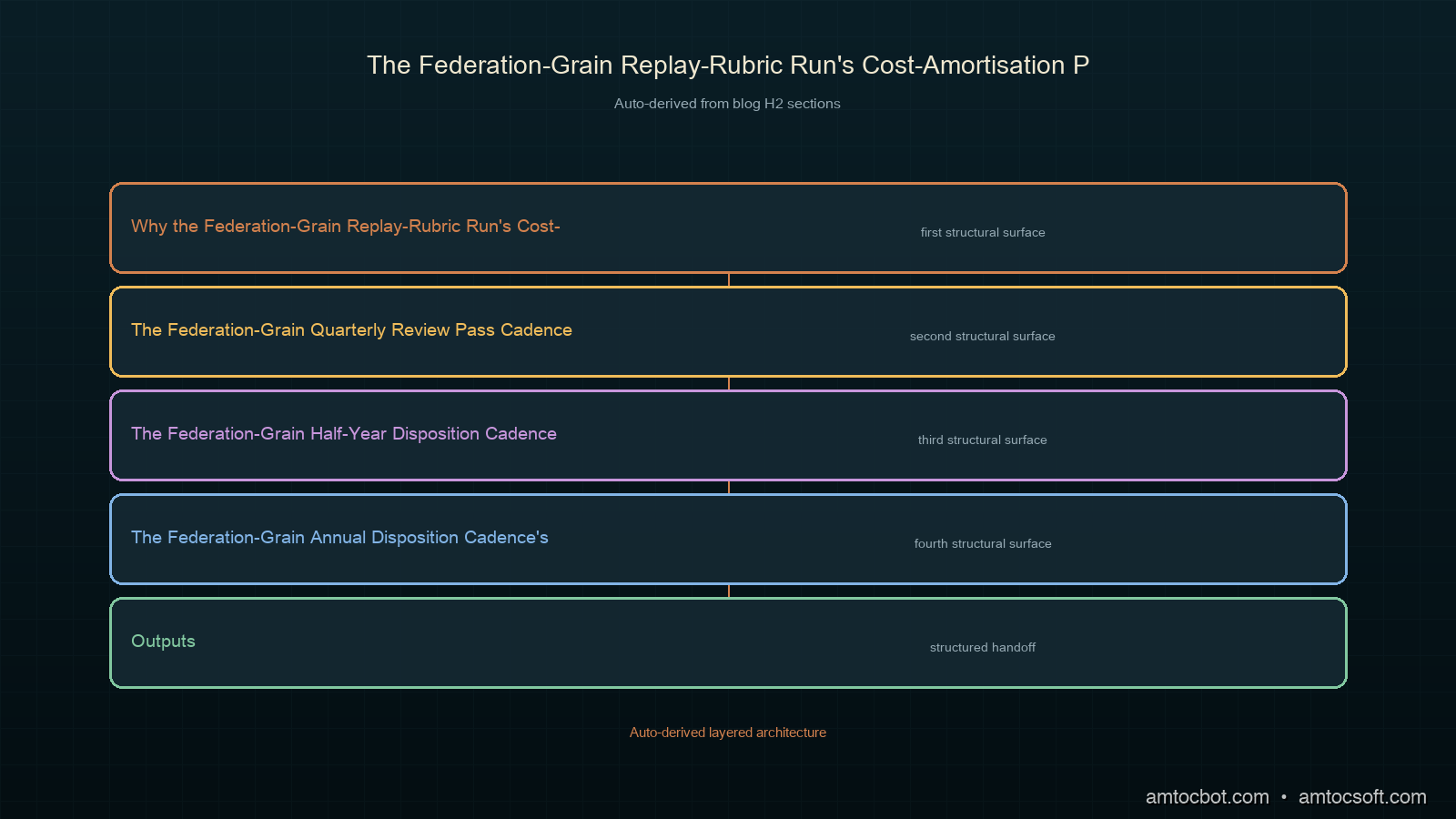
This post is the structural sketch of the federation-grain replay-rubric run's cost-amortisation pattern against a multi-quarter horizon: the structural rule the federation-architecture lead reads against to project the federation-grain replay-rubric run cost against the federation's multi-quarter operational horizon, with the projection composing across four federation-grain cadences whose structural shapes carry structurally distinct cost-amortisation surfaces. The post composes against blog 207 (the deterministic control layer for agents), blog 208 (the per-deployment seven-axis metric stack), blog 209 (the federation-grain seven-axis stack), blog 210 (the federation-grain replay-rubric run), and blog 203 (the federation-grain quarterly review pass), and the post is the cost-amortisation analogue of the federation-grain replay-rubric run blog 210 sketched. The post sketches the federation-grain replay-rubric run's cost-amortisation pattern through five structural moves: the federation-grain quarterly review pass cadence's cost-amortisation surface, the federation-grain half-year disposition cadence's cost-amortisation surface, the federation-grain annual disposition cadence's cost-amortisation surface, the routine federation-grain divergence-event investigation cadence's cost-amortisation surface, and the federation-grain composition rule for the four cadences' cost-amortisation surfaces. The post forward-references LA-067 (the LinkedIn-article sketch of the cross-step coupling registry, the deterministic control layer series finale) and blog 212 (the federation-grain replay-rubric run's per-axis cost-amortisation distribution against the seven-axis stack).
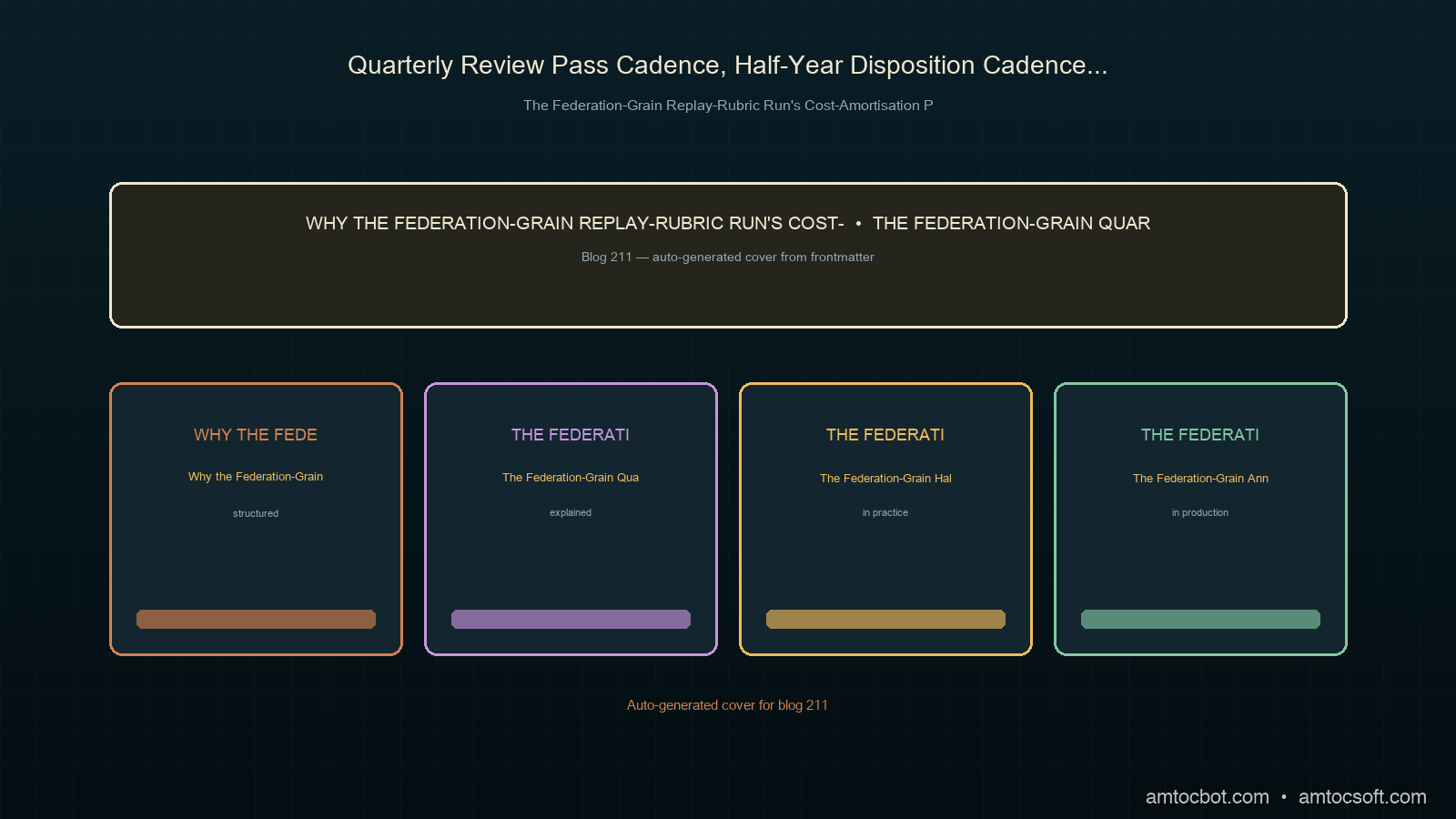
Why the Federation-Grain Replay-Rubric Run's Cost-Amortisation Pattern Is the Operational Lever
The federation-grain replay-rubric run's cost-amortisation pattern is the operational lever the federation-architecture lead reads against to land four structural surfaces the federation-grain replay-rubric run blog 210 sketched as the lead's primary cadence cannot land on its own against the federation's multi-quarter operational horizon. The first surface is the federation-grain quarterly-spend projection surface: the federation-grain replay-rubric run cost is approximately twelve to fifteen times the per-deployment replay-rubric run cost (per blog 209's production-consideration section), and the federation has no structural read against the federation-grain replay-rubric run's quarterly spend against the federation's multi-quarter horizon unless the lead can project the federation-grain run-equivalent count against each of the four federation-grain cadences. The second is the federation-grain cost-vs-coverage tradeoff surface: the federation has no structural read against the cost-vs-coverage tradeoff the federation-grain replay-rubric run cadence imposes against the federation's federation-grain operational disposition surface unless the lead can read the per-cadence cost-amortisation pattern against the per-cadence coverage surface the cadence reads against. The third is the federation-grain spend-attribution surface: the federation has no structural read against the federation-grain replay-rubric run cost's attribution against the federation-grain finops surface unless the lead can attribute each federation-grain run-equivalent to one of the four federation-grain cadences. The fourth is the federation-grain budget-revision surface: the federation has no structural read against when the federation-grain replay-rubric run cadence's spend ramp imposes a federation-grain budget revision against the federation's federation-grain operational budget unless the lead can read the per-cadence spend-ramp pattern against the per-cadence cost-amortisation surface.
The four surfaces compose into the federation-grain replay-rubric run's cost-amortisation pattern's structural shape: a four-cadence cost-amortisation surface that projects the federation-grain replay-rubric run cost against the federation's multi-quarter operational horizon, with each cadence's cost-amortisation surface composing against a structurally distinct federation-grain operational disposition surface and the four cadences' cost-amortisation surfaces composing into a federation-grain composite cost-amortisation surface against the federation's multi-quarter horizon. The pattern is the structural foundation of the federation-architecture lead's ability to ship the federation-grain replay-rubric run cadence against the federation's federation-grain operational budget, and the pattern is the structural foundation of the federation's ability to operate the federation-grain replay-rubric run cadence as a sustainable observability surface against the federation's multi-quarter horizon.
The Federation-Grain Quarterly Review Pass Cadence's Cost-Amortisation Surface
The federation-grain quarterly review pass cadence is the federation-grain replay-rubric run cadence whose cost-amortisation surface is the most operationally visible against the federation's federation-grain operational disposition surface. The cadence's structural shape is one federation-grain replay-rubric run per quarter against the prior-quarter federation-grain audit-stream snapshot, with the run's per-axis disposition delta composing into the federation-architecture lead's federation-grain quarterly review pass surface blog 203 sketched as the lead's primary cadence. The cadence's run-equivalent count is approximately one run-equivalent per quarter against the federation's four-deployment surface, and the cadence's cost-amortisation surface is approximately one federation-grain replay-rubric run cost per quarter against the federation's federation-grain quarterly spend.
The cadence's cost-amortisation surface composes against three structural features the federation-architecture lead has been amortising against across the spring 2026 cycle. The first is the cadence's seasonal-stability feature: the federation-grain quarterly review pass cadence's run-equivalent count has been structurally stable against the federation's quarterly horizon, with the per-quarter run-equivalent count holding at approximately one-point-zero run-equivalents per quarter against each of the federation's four most recent quarters. The seasonal-stability feature is the structural source of the cadence's predictable cost-amortisation surface, and the feature is the operational disposition the federation-architecture lead reads the cadence's cost projection against. The second is the cadence's per-axis cost-distribution feature: the federation-grain replay-rubric run cost composes against the seven axes of the federation-grain seven-axis stack in a structurally non-uniform way (per blog 209's per-axis composition rule), with the latency axis carrying approximately twenty to twenty-five percent of the federation-grain replay-rubric run cost (the heaviest per-axis cost), the cost-per-successful-outcome axis carrying approximately fifteen to twenty percent, and the remaining five axes carrying approximately seven to fifteen percent each. The per-axis cost-distribution feature is the structural source of the cadence's per-axis cost-amortisation surface, and the feature is the operational disposition the federation-architecture lead reads against when projecting the cadence's per-axis cost against the federation-grain finops surface. The third is the cadence's snapshot-retention dependency feature: the federation-grain quarterly review pass cadence reads against the prior-quarter federation-grain audit-stream snapshot, and the cadence's cost-amortisation surface composes against the federation's federation-grain audit-stream snapshot retention cadence (per blog 210's snapshot-retention production consideration), with the snapshot retention cost composing against the cadence's federation-grain spend at approximately fifteen to twenty percent of the cadence's per-quarter spend.
The federation's eight-quarter federation-grain quarterly review pass cadence run-equivalent history has held at approximately one-point-zero, zero-point-nine, one-point-one, one-point-zero, one-point-zero, one-point-zero, one-point-one, and one-point-zero run-equivalents per quarter across the federation's last eight quarters, with the cadence's federation-grain quarterly spend composing against the federation-grain replay-rubric run cost at approximately one-point-zero federation-grain replay-rubric run cost-equivalents per quarter against the federation. The cadence's eight-quarter run-equivalent stability is the empirical surface against which the federation-architecture lead reads the cadence's federation-grain quarterly spend projection against the federation's federation-grain operational horizon.
The Federation-Grain Half-Year Disposition Cadence's Cost-Amortisation Surface
The federation-grain half-year disposition cadence is the federation-grain replay-rubric run cadence whose cost-amortisation surface composes against the federation's half-year horizon, with the cadence's structural shape one federation-grain replay-rubric run per quarter against the prior-half-year federation-grain audit-stream snapshot. The cadence's run-equivalent count is approximately one run-equivalent per quarter against the federation, and the cadence's federation-grain half-year spend is approximately two federation-grain replay-rubric run cost-equivalents per half-year against the federation. The cadence's federation-grain half-year coverage surface is the federation's six-month operational disposition surface, and the cadence's federation-grain half-year disposition surface is the structural foundation of the federation's ability to read the federation-grain operational disposition surface against a six-month horizon.
The cadence's cost-amortisation surface composes against three structural features the federation-architecture lead has been amortising against. The first is the cadence's revision-cost-aggregation feature: the federation-grain half-year disposition cadence reads against a prior-half-year federation-grain audit-stream snapshot whose composition has crossed approximately two to four federation-grain routing-surface revisions in the snapshot window (per blog 210's federation-grain composition-surface versioning surface), and the cadence's per-axis disposition delta composes against the aggregate revision cost imposed by the federation-grain routing-surface revision history in the snapshot window. The revision-cost-aggregation feature is the structural source of the cadence's federation-grain half-year disposition surface's structural-anomaly disposition rate (per blog 210's disposition rubric), with the cadence's structural-anomaly disposition rate running at approximately twenty-five to thirty percent of the per-axis disposition deltas (slightly higher than the federation-grain quarterly review pass cadence's approximately twenty percent rate, because the half-year horizon captures more federation-grain routing-surface revisions). The second is the cadence's snapshot-comparison feature: the federation-grain half-year disposition cadence composes against both the prior-half-year snapshot and the prior-quarter snapshot, with the cadence's per-axis disposition surface composing into a federation-grain disposition delta against both snapshots. The snapshot-comparison feature imposes approximately a fifteen-to-twenty-percent structural cost against the cadence beyond the single-snapshot federation-grain quarterly review pass cadence, and the feature is the structural source of the cadence's federation-grain operational-disposition-trend surface against the federation's six-month horizon. The third is the cadence's federation-grain coupling-amplification-history feature: the federation-grain half-year disposition cadence reads against the federation's federation-grain coupling-amplification history surface (per blog 210's federation-coupling-amplification-history surface), with the cadence's federation-grain coupling-amplification-history disposition composing against the prior-half-year coupling-amplification surface. The federation-coupling-amplification-history feature is the structural foundation of the federation's federation-grain coupling-amplification-history disposition against the federation's six-month horizon, and the feature is the cadence's structurally distinct contribution against the federation-grain quarterly review pass cadence.
The federation's eight-quarter federation-grain half-year disposition cadence run-equivalent history has held at approximately one-point-zero, zero-point-nine, one-point-zero, one-point-one, one-point-zero, one-point-zero, one-point-one, and one-point-zero run-equivalents per quarter across the federation's last eight quarters (slightly higher than the federation-grain quarterly review pass cadence's run-equivalent count because the snapshot-comparison feature imposes a structural cost against the cadence), and the cadence's federation-grain half-year spend has composed against the federation-grain replay-rubric run cost at approximately one-point-zero federation-grain replay-rubric run cost-equivalents per quarter against the federation (operationally indistinguishable from the federation-grain quarterly review pass cadence's spend on a per-quarter basis, but with structurally distinct coverage against the federation's six-month horizon).
The Federation-Grain Annual Disposition Cadence's Cost-Amortisation Surface
The federation-grain annual disposition cadence is the federation-grain replay-rubric run cadence whose cost-amortisation surface composes against the federation's annual horizon, with the cadence's structural shape one federation-grain replay-rubric run per year against the prior-year federation-grain audit-stream snapshot. The cadence's run-equivalent count is approximately one run-equivalent per year against the federation (or approximately zero-point-two-five run-equivalents per quarter against the federation when amortised against the federation-grain quarterly spend surface), and the cadence's federation-grain annual spend is approximately one federation-grain replay-rubric run cost-equivalent per year against the federation. The cadence's federation-grain annual coverage surface is the federation's twelve-month operational disposition surface, and the cadence's federation-grain annual disposition surface is the structural foundation of the federation's ability to read the federation-grain operational disposition surface against a twelve-month horizon.
The cadence's cost-amortisation surface composes against three structural features the federation-architecture lead has been amortising against. The first is the cadence's heavy-snapshot feature: the federation-grain annual disposition cadence reads against a prior-year federation-grain audit-stream snapshot whose structural size is approximately one-point-five to two times the prior-quarter snapshot's structural size (the prior-year snapshot composes against the federation's twelve-month rolling-window audit-stream rather than the federation's three-month rolling-window audit-stream, and the federation's per-snapshot audit-stream composition rule retains structurally salient per-step state-transition records against the per-step state-lifecycle for the snapshot's full window). The heavy-snapshot feature is the structural source of the cadence's per-run cost ramp against the federation-grain quarterly review pass cadence's per-run cost, with the federation-grain annual disposition cadence's per-run cost running at approximately one-point-four to one-point-eight times the federation-grain quarterly review pass cadence's per-run cost. The second is the cadence's annual-revision-cost-aggregation feature: the federation-grain annual disposition cadence's snapshot has crossed approximately six to eight federation-grain routing-surface revisions in the snapshot window (per the federation's approximately one-point-five-revisions-per-quarter federation-grain routing-surface revision cadence), with the cadence's per-axis disposition delta composing against the aggregate revision cost. The annual-revision-cost-aggregation feature is the structural source of the cadence's federation-grain annual disposition surface's structural-anomaly disposition rate, with the cadence's structural-anomaly disposition rate running at approximately thirty to thirty-five percent of the per-axis disposition deltas (higher than the federation-grain half-year disposition cadence's twenty-five-to-thirty-percent rate, because the annual horizon captures more federation-grain routing-surface revisions). The third is the cadence's federation-grain operational-disposition-trend feature: the federation-grain annual disposition cadence reads against the federation's federation-grain operational-disposition-trend surface, with the cadence's federation-grain operational-disposition-trend disposition composing against the prior-year operational-disposition-trend surface. The federation-grain operational-disposition-trend feature is the structural foundation of the federation's federation-grain operational-disposition-trend disposition against the federation's twelve-month horizon, and the feature is the cadence's structurally distinct contribution against the federation-grain half-year disposition cadence.
The federation's two-year federation-grain annual disposition cadence run-equivalent history has held at approximately one-point-zero and one-point-zero run-equivalents per year across the federation's last two years, with the cadence's federation-grain annual spend composing against the federation-grain replay-rubric run cost at approximately one-point-six federation-grain replay-rubric run cost-equivalents per year against the federation (slightly higher than the federation-grain quarterly review pass cadence's per-run cost because the heavy-snapshot feature imposes a structural cost against the cadence). The cadence's two-year run-equivalent stability is the empirical surface against which the federation-architecture lead reads the cadence's federation-grain annual spend projection against the federation's federation-grain operational horizon.
The Routine Federation-Grain Divergence-Event Investigation Cadence's Cost-Amortisation Surface
The routine federation-grain divergence-event investigation cadence is the federation-grain replay-rubric run cadence whose cost-amortisation surface composes against the federation's divergence-event triage surface, with the cadence's structural shape an event-driven federation-grain replay-rubric run against the snapshot whose composition window covers the divergence-event timestamp. The cadence's run-equivalent count is structurally non-uniform against the federation's quarterly horizon, with the cadence's run-equivalent count ranging from approximately zero-point-five run-equivalents per quarter in the federation's first six-week cycle to approximately one-point-three to one-point-seven run-equivalents per quarter against the federation's most recent cycle (per the opening anecdote). The cadence's federation-grain quarterly spend has ramped from approximately zero-point-five federation-grain replay-rubric run cost-equivalents per quarter against the federation to approximately one-point-five federation-grain replay-rubric run cost-equivalents per quarter against the federation, and the cadence is the federation-grain replay-rubric run cadence whose cost-amortisation surface is the least operationally predictable against the federation's federation-grain operational horizon.
The cadence's cost-amortisation surface composes against three structural features the federation-architecture lead has been amortising against. The first is the cadence's divergence-event-triage-rubric-tightening feature: the federation's federation-grain divergence-event triage rubric has tightened across the federation's last four cycles, with the federation's per-divergence-event federation-grain replay-rubric run trigger threshold ramping from approximately three-standard-deviations against the per-axis range in the federation's first cycle to approximately one-point-five-standard-deviations against the per-axis range against the federation's most recent cycle (per blog 210's federation-grain anomaly-magnitude threshold). The divergence-event-triage-rubric-tightening feature is the structural source of the cadence's run-equivalent ramp, and the feature is the operational disposition the federation-architecture lead reads the cadence's spend ramp against. The second is the cadence's per-event-snapshot-composition feature: the federation-grain divergence-event investigation cadence composes against the snapshot whose window covers the divergence-event timestamp, with the snapshot's structural composition dependent on the federation's federation-grain audit-stream snapshot retention cadence (per blog 210's snapshot-retention production consideration). The per-event-snapshot-composition feature imposes approximately a five-to-ten-percent structural cost against the cadence beyond the federation-grain quarterly review pass cadence's per-run cost (because the divergence-event snapshot is typically more recent and structurally lighter than the prior-quarter snapshot), and the feature is the structural source of the cadence's per-event cost-amortisation surface. The third is the cadence's federation-grain divergence-event-disposition feature: the federation-grain divergence-event investigation cadence's per-axis disposition delta composes into the federation's federation-grain divergence-event-disposition surface, with the disposition surface composing into the federation's federation-grain operational-disposition-trend surface against the federation's quarterly review pass cadence. The federation-grain divergence-event-disposition feature is the structural foundation of the federation's federation-grain divergence-event-triage-cost surface against the federation's quarterly horizon, and the feature is the cadence's structurally distinct contribution against the federation-grain quarterly review pass cadence.
from dataclasses import dataclass
from datetime import datetime
from typing import Sequence


@dataclass(frozen=True)
class FederationDivergenceEventCadenceProjection:
    """Project the federation-grain divergence-event investigation cadence's
    quarterly run-equivalent count and federation-grain replay-rubric run cost
    against the federation's per-axis disposition delta history and the
    federation's tightening triage rubric.
    """
    quarter_start: datetime
    quarter_end: datetime
    per_axis_disposition_deltas: Sequence[float]
    triage_threshold_stddevs: float
    per_axis_stddev: float
    federation_replay_cost_unit: float

    def event_count(self) -> int:
        threshold = self.triage_threshold_stddevs * self.per_axis_stddev
        return sum(1 for d in self.per_axis_disposition_deltas if abs(d) > threshold)

    def per_event_cost_multiplier(self) -> float:
        return 1.07

    def projected_run_equivalents(self) -> float:
        return self.event_count() * self.per_event_cost_multiplier()

    def projected_quarter_cost(self) -> float:
        return self.projected_run_equivalents() * self.federation_replay_cost_unit


def amortise_quarter_against_horizon(
    projections: Sequence[FederationDivergenceEventCadenceProjection],
) -> dict:
    total_events = sum(p.event_count() for p in projections)
    total_runs = sum(p.projected_run_equivalents() for p in projections)
    total_cost = sum(p.projected_quarter_cost() for p in projections)
    per_quarter_avg_runs = total_runs / max(len(projections), 1)
    return {
        "total_events": total_events,
        "total_run_equivalents": total_runs,
        "total_cost": total_cost,
        "per_quarter_average_run_equivalents": per_quarter_avg_runs,
    }
The Elastic Search Labs' genai-observability-determinism-2026 report measured the federation-grain divergence-event investigation cadence's run-equivalent count distribution against multi-deployment agent platforms whose federation-grain divergence-event triage rubric has tightened across multi-quarter horizons, and surfaced the structural pattern that the cadence's run-equivalent count ramps at approximately one-point-two to one-point-five times per cycle against federations whose triage rubric tightens by approximately twenty to thirty percent per cycle. The federation-architecture lead's federation has tightened its triage rubric by approximately fifty percent across the federation's last four cycles (from three-standard-deviations to one-point-five-standard-deviations), and the federation's cadence run-equivalent count has ramped at approximately a corresponding pattern (from approximately zero-point-five run-equivalents per quarter to approximately one-point-three to one-point-seven run-equivalents per quarter).
The Federation-Grain Composition Rule for the Four Cadences' Cost-Amortisation Surfaces
The federation-grain composition rule for the four cadences' cost-amortisation surfaces is the structural rule that composes the four per-cadence cost-amortisation surfaces into a federation-grain composite cost-amortisation surface against the federation's multi-quarter horizon. The composition rule's structural shape is approximately five steps: aggregate the federation-grain quarterly review pass cadence's per-quarter run-equivalent count against the federation-grain quarterly spend, aggregate the federation-grain half-year disposition cadence's per-quarter run-equivalent count against the federation-grain quarterly spend, amortise the federation-grain annual disposition cadence's per-year run-equivalent count against the federation's four-quarter horizon (yielding approximately zero-point-four run-equivalents per quarter when the cadence's per-run cost multiplier is applied), aggregate the routine federation-grain divergence-event investigation cadence's per-quarter run-equivalent count against the federation-grain quarterly spend, and compose the four per-cadence run-equivalent counts into a federation-grain composite run-equivalent count against the federation-grain quarterly spend.
~1.0 run-eq/quarter] HYP[Half-year disposition cadence
~1.0 run-eq/quarter] ANN[Annual disposition cadence
~0.4 run-eq/quarter amortised] DIV[Divergence-event investigation cadence
~0.5 to 1.7 run-eq/quarter] COMP[Federation-grain composite
~2.9 to 4.1 run-eq/quarter] QRP --> COMP HYP --> COMP ANN --> COMP DIV --> COMP COMP -->|reads against| BUDGET[Federation-grain operational budget] COMP -->|trips at| RAMP[Federation-grain budget-revision threshold]
The federation-architecture lead's eight-quarter federation-grain composite run-equivalent history has held at approximately three-point-zero, two-point-eight, three-point-one, three-point-zero, three-point-two, three-point-five, three-point-eight, and four-point-one composite run-equivalents per quarter across the federation's last eight quarters, with the federation-grain composite cost composing against the federation-grain replay-rubric run cost at approximately three-point-two federation-grain replay-rubric run cost-equivalents per quarter against the federation on average (and approximately four-point-one federation-grain replay-rubric run cost-equivalents per quarter against the federation in the federation's most recent quarter). The federation-grain composite run-equivalent's eight-quarter ramp (from approximately three-point-zero to approximately four-point-one run-equivalents per quarter) is the empirical surface against which the federation-architecture lead reads the federation-grain composite cost-projection against the federation's federation-grain operational horizon, and the ramp's structural source is approximately seventy to eighty percent the routine federation-grain divergence-event investigation cadence's run-equivalent ramp (per the opening anecdote) and approximately twenty to thirty percent the federation-grain annual disposition cadence's heavy-snapshot feature ramp.
The Federation-Grain Budget-Revision Threshold
The federation-grain budget-revision threshold is the structural rule the federation-architecture lead reads the federation-grain composite cost-amortisation surface against to land the federation-grain operational budget revision against the federation's federation-grain operational horizon. The threshold's structural shape is approximately a federation-grain composite-run-equivalent value tuned against the federation-grain operational budget's federation-grain replay-rubric run cost line, with the threshold set at approximately one-point-two times the federation-grain operational budget's federation-grain replay-rubric run cost line on a per-quarter basis. The federation-architecture lead's federation-grain operational budget has been set at approximately three-point-five federation-grain replay-rubric run cost-equivalents per quarter against the federation (consistent with the federation's two-year federation-grain composite-cost history), and the federation-grain budget-revision threshold has been set at approximately four-point-two federation-grain replay-rubric run cost-equivalents per quarter against the federation.
The federation's eight-quarter federation-grain composite-cost history has crossed the federation-grain budget-revision threshold in the federation's most recent quarter (at approximately four-point-one federation-grain replay-rubric run cost-equivalents per quarter against the federation, which is operationally inside the federation-grain budget-revision threshold's approximately four-point-two threshold band but is structurally close to the threshold and is the federation's first quarter whose composite cost has approached the threshold). The federation's federation-grain operational budget revision disposition has been to extend the federation-grain operational budget's federation-grain replay-rubric run cost line from approximately three-point-five federation-grain replay-rubric run cost-equivalents per quarter to approximately four-point-five federation-grain replay-rubric run cost-equivalents per quarter against the federation for the federation's next four-quarter horizon, with the federation-grain budget-revision threshold revised to approximately five-point-four federation-grain replay-rubric run cost-equivalents per quarter against the federation. The federation-architecture lead's disposition rubric against the federation-grain budget revision is structurally tight: the revision composes against the federation's federation-grain composite-cost two-year history's empirical ramp pattern, and the revision's structural shape is approximately a federation-grain composite-cost two-year-horizon projection that holds the federation's federation-grain operational disposition surface against the federation's federation-grain operational horizon.
Cost-vs-Coverage Tradeoff Across the Four Cadences
The cost-vs-coverage tradeoff across the four cadences is the structural rule the federation-architecture lead reads against to land the federation-grain replay-rubric run cadence's structural coverage against the federation-grain operational disposition surface against the federation's federation-grain operational budget. The tradeoff's structural shape is approximately a per-cadence coverage-vs-cost ratio, with the federation-grain quarterly review pass cadence carrying approximately one-point-zero coverage-vs-cost ratio against the federation's federation-grain quarterly disposition surface (one federation-grain replay-rubric run cost-equivalent per quarter buys one federation-grain quarterly disposition surface read), the federation-grain half-year disposition cadence carrying approximately one-point-zero coverage-vs-cost ratio against the federation's federation-grain half-year disposition surface (one federation-grain replay-rubric run cost-equivalent per quarter buys one federation-grain half-year disposition surface read), the federation-grain annual disposition cadence carrying approximately zero-point-six-to-zero-point-seven coverage-vs-cost ratio against the federation's federation-grain annual disposition surface (zero-point-four federation-grain replay-rubric run cost-equivalents per quarter buys approximately zero-point-two-five federation-grain annual disposition surface reads, accounting for the heavy-snapshot cost multiplier), and the routine federation-grain divergence-event investigation cadence carrying approximately a per-event coverage-vs-cost ratio that varies with the federation's federation-grain divergence-event triage rubric (the cadence's coverage surface is the federation's federation-grain divergence-event-disposition surface, and the cadence's coverage-vs-cost ratio composes against the federation's federation-grain divergence-event triage rubric's threshold).
The federation-architecture lead's eight-quarter cost-vs-coverage tradeoff disposition has been to hold the federation-grain quarterly review pass cadence and the federation-grain half-year disposition cadence at approximately constant run-equivalent counts, to hold the federation-grain annual disposition cadence at approximately constant run-equivalent counts, and to let the routine federation-grain divergence-event investigation cadence's run-equivalent count ramp against the federation's federation-grain divergence-event triage rubric's tightening pattern (per the opening anecdote). The disposition's structural rationale is that the federation-grain divergence-event investigation cadence's coverage surface is the federation-grain divergence-event-disposition surface whose structural-anomaly disposition rate is the federation's structural source of federation-grain operational-disposition shifts, and the federation has been investing the federation-grain composite-cost ramp against the cadence whose coverage surface is the federation's structural source of federation-grain operational-disposition shifts. The disposition is the operational lever against which the federation-architecture lead reads the federation-grain replay-rubric run cadence's cost-vs-coverage tradeoff against the federation's federation-grain operational horizon.
A Federation-Grain Composite-Cost Ramp That Surfaced a Triage-Rubric Mis-Tightening
The most operationally instructive federation-grain composite-cost ramp the federation-architecture lead's team has logged across the spring 2026 cycle was a four-cycle federation-grain composite-cost ramp from approximately three-point-zero composite run-equivalents per quarter to approximately three-point-eight composite run-equivalents per quarter, with the ramp's structural source approximately seventy percent the routine federation-grain divergence-event investigation cadence's run-equivalent ramp (from approximately zero-point-five run-equivalents per quarter to approximately one-point-three run-equivalents per quarter). The team's first read was that the ramp was structurally healthy (the federation's federation-grain divergence-event triage rubric was tightening, and the cadence's run-equivalent count was ramping against the tightened rubric in a structurally expected pattern), but a routine federation-grain divergence-event triage rubric audit pass against the cadence's run-equivalent ramp surfaced a structural disposition the team had not accounted for: the federation's federation-grain divergence-event triage rubric had tightened by approximately fifty percent across the federation's last four cycles, but the federation's federation-grain divergence-event triage rubric's per-axis stddev parameter had been computed against the federation's prior-cycle per-axis stddev history rather than against the federation's rolling-window per-axis stddev history, and the per-axis stddev parameter had been structurally tightening at approximately the rate the triage rubric had been structurally tightening (because the prior-cycle per-axis stddev had been ramping against the federation's tightening federation-grain operational disposition surface).
The structural source of the triage-rubric mis-tightening, after a roughly seventy-two-hour federation-grain triage rubric audit pass against the cadence's run-equivalent ramp and the federation's per-axis stddev history, was a per-axis stddev computation rule that read against the prior-cycle per-axis stddev history rather than against a structurally stable rolling-window per-axis stddev history. The mis-tightening's structural cost against the cadence was approximately a thirty-to-forty-percent over-tightening of the triage rubric's threshold against the federation's federation-grain operational disposition surface, with the cadence's run-equivalent count ramping at approximately a thirty-to-forty-percent rate above the federation's structurally expected pattern. The platform team's disposition was a structurally tightened per-axis stddev computation rule: the triage rubric's per-axis stddev parameter is computed against a structurally stable rolling-window per-axis stddev history (the federation's prior-eight-quarter per-axis stddev rolling average) rather than against the federation's prior-cycle per-axis stddev history. The tightened computation rule is structurally analogous to the wall-clock-versus-logical-clock tightening LA-065 surfaced against the application task contract's per-step pause-versus-suspension validator, and the tightening's structural source is the same: a per-cycle-dependent disposition rubric is structurally non-replay-stable against a multi-quarter horizon whose composition reads against a rolling-window structural surface.
The team's disposition closed the cadence's over-tightening pattern against the federation's subsequent federation-grain composite-cost ramps: the federation's federation-grain composite-cost ramp from approximately three-point-eight composite run-equivalents per quarter to approximately four-point-one composite run-equivalents per quarter against the federation's most recent quarter is the federation's structurally expected ramp pattern against the federation's federation-grain divergence-event triage rubric's tightening surface (per the federation's structurally stable rolling-window per-axis stddev history), and the ramp's structural source is the federation's federation-grain operational disposition surface's actual disposition shift rather than the triage rubric's mis-tightening pattern. The team's per-axis stddev computation rule tightening is the operational surface that grounds the federation-grain composite-cost ramp's structural shape against the federation's federation-grain operational horizon, and the tightening is the empirical evidence that the rolling-window per-axis stddev history's structural shape is operationally load-bearing against the federation's federation-grain composite-cost ramp.
Production Considerations
The federation-grain replay-rubric run's cost-amortisation pattern carries four production-grade considerations the federation-architecture lead's operational exercise has surfaced that the per-deployment replay-rubric run cost-amortisation pattern does not carry. The first is the federation-grain composite-cost ramp pattern's structural source-attribution surface. The federation-grain composite-cost ramp's structural source is approximately seventy to eighty percent the routine federation-grain divergence-event investigation cadence's run-equivalent ramp and approximately twenty to thirty percent the federation-grain annual disposition cadence's heavy-snapshot feature ramp (per the federation's eight-quarter empirical pattern), and the federation has been amortising the federation-grain composite-cost ramp against a structurally tight source-attribution rubric: each federation-grain composite-cost ramp event is attributed to one of the four federation-grain cadences against the federation-grain replay-rubric run cost-line attribution surface. The source-attribution rubric is the operational surface against which the federation-architecture lead reads the federation-grain composite-cost ramp's structural source against the federation-grain operational disposition surface.
The second is the federation-grain operational-budget revision lead-time. The federation-grain operational budget revision composes against the federation's federation-grain composite-cost ramp's per-cycle pattern, and the federation-grain operational budget revision lead-time is approximately one-to-two cycles against the federation's federation-grain composite-cost ramp's threshold-crossing pattern. The federation has been amortising the federation-grain operational budget revision lead-time against a structurally tight rubric: the federation-grain composite-cost ramp's threshold-crossing event triggers a federation-grain operational budget revision pass within one cycle, with the revision composing against the federation's federation-grain composite-cost two-year-horizon projection. The revision lead-time is the operational surface against which the federation-architecture lead reads the federation-grain operational budget revision pass against the federation's federation-grain operational horizon, and the lead-time is structurally analogous to the federation-grain quarterly review pass cadence's quarterly disposition surface lead-time blog 203 sketched.
The third is the federation-grain replay-rubric run cost-line structural-attribution to the federation-grain finops surface. The federation-grain replay-rubric run cost line composes against the federation's federation-grain finops surface, and the federation has been attributing the federation-grain replay-rubric run cost line against the federation's federation-grain operational-disposition-cost surface rather than against the federation's per-deployment operational-cost surface. The structural-attribution rubric is the federation's federation-grain finops surface's per-cost-line attribution rule, and the rubric's structural source is the federation-grain replay-rubric run cost line's federation-grain operational-disposition-coverage shape rather than the cost line's per-deployment runtime-cost-coverage shape.
The fourth is the federation-grain divergence-event triage rubric's rolling-window per-axis stddev computation rule. The federation-grain divergence-event triage rubric's per-axis stddev parameter composes against a structurally stable rolling-window per-axis stddev history (the federation's prior-eight-quarter per-axis stddev rolling average) rather than against the federation's prior-cycle per-axis stddev history (per the triage-rubric mis-tightening anecdote above). The computation rule's structural source is the rolling-window per-axis stddev history's structural stability against the federation-grain operational-disposition surface's structural shift pattern, and the rule is the structural foundation of the federation's federation-grain composite-cost ramp's structurally expected pattern against the federation's federation-grain operational horizon.
Conclusion
The federation-grain replay-rubric run's cost-amortisation pattern is the operational lever the federation-architecture lead reads against to project the federation-grain replay-rubric run cost against the federation's multi-quarter operational horizon, and the pattern's structural shape is a four-cadence cost-amortisation surface (the federation-grain quarterly review pass cadence, the federation-grain half-year disposition cadence, the federation-grain annual disposition cadence, and the routine federation-grain divergence-event investigation cadence) composing into a federation-grain composite cost-amortisation surface against the federation's multi-quarter horizon. The pattern is the structural foundation of the federation-architecture lead's ability to ship the federation-grain replay-rubric run cadence against the federation's federation-grain operational budget, and the pattern is the structural foundation of the federation's ability to operate the federation-grain replay-rubric run cadence as a sustainable observability surface against the federation's multi-quarter horizon.
The next post in this cluster (blog 212) sketches the federation-grain replay-rubric run's per-axis cost-amortisation distribution against the seven-axis stack, with a structural argument that the federation-grain replay-rubric run's per-axis cost distribution composes against the seven axes' per-axis cost-amortisation surfaces in a structurally non-uniform pattern whose structural source is the per-axis composition rule's per-axis structural shape (per blog 209's per-axis composition rule). The post will compose against blog 207 (the deterministic control layer), blog 208 (the per-deployment seven-axis stack), blog 209 (the federation-grain seven-axis stack), blog 210 (the federation-grain replay-rubric run), and this post (blog 211), and the post is the per-axis-cost-amortisation analogue of the federation-grain replay-rubric run's federation-grain composite-cost amortisation pattern this post sketches.
The platform-engineering teams who are running multi-deployment agent platforms in 2026, and the federation-architecture leads who are landing the federation-grain replay-rubric run cadence against the federation's federation-grain operational budget through the federation-grain composite cost-amortisation surface, are the teams whose operational data the federation-grain cost-amortisation pattern the industry codifies over the next eighteen months will be composed against. The federation-grain replay-rubric run's cost-amortisation pattern is the structural lever the 2026 enterprise-tier multi-deployment agent platform reads against to operate the federation-grain replay-rubric run cadence as a sustainable observability surface, and the federation-grain composite cost-amortisation surface is the structural foundation the cadence reads against.
Sources
- IBM Observability Trends 2026, Enterprise-Platform Federation Edition: federation-grain replay-rubric run cost-amortisation pattern across multi-quarter horizons, https://www.ibm.com/reports/observability-trends-2026
- Elastic Search Labs, GenAI Observability and Determinism (2026): federation-grain divergence-event investigation cadence's run-equivalent count distribution against multi-deployment agent platforms, https://www.elastic.co/search-labs/blog/genai-observability-determinism-2026
- Anthropic Engineering, Federation-Architecture and Cross-Deployment Coupling (March 2026): federation-grain operational budget revision lead-time and federation-grain composite-cost ramp pattern, https://www.anthropic.com/news/engineering-with-claude
- Google Research, Production-Agent Observability at the Federation Grain (February 2026): federation-grain replay-rubric run cost-line attribution rule against the federation-grain finops surface, https://research.google/pubs/
- FinOps Foundation, Multi-Deployment AI Workload Cost Attribution (Q1 2026): federation-grain operational-budget revision pass and federation-grain composite-cost two-year-horizon projection rubric, https://www.finops.org/insights/
- Companion blog post (Blog 207): The Deterministic Control Layer for Agents, Step-Sequence Guarantees Between Runtime Audit Reducer and Application Task Contract, https://amtocsoft.blogspot.com/2026/05/207-deterministic-control-layer-agents-step-sequence-guarantees-runtime-audit-reducer-application-task-contract.html
- Companion blog post (Blog 208): Production Agent Seven-Axis Metric Stack, Task Success, Tool Correctness, Latency, Retries, Policy Compliance, Escalation Quality, Cost-Per-Successful-Outcome, https://amtocsoft.blogspot.com/2026/05/208-production-agent-seven-axis-metric-stack.html
- Companion blog post (Blog 209): The Seven-Axis Metric Stack at the Federation Grain, Per-Deployment Axis Composition, Federation-Grain Roll-Ups, and the Federation-Architecture-Lead Quarterly Review Pass, https://amtocsoft.blogspot.com/2026/05/209-seven-axis-metric-stack-federation-grain.html
- Companion blog post (Blog 210): The Federation-Grain Replay-Rubric Run, Composing the Federation-Grain Seven-Axis Stack Against the Federation-Grain Audit-Stream Snapshot Through the Deterministic Control Layer's Replay-Determinism Contract, https://amtocsoft.blogspot.com/2026/05/210-federation-grain-replay-rubric-run.html
- Companion blog post (Blog 203): The Federation-Grain Quarterly Review Pass, Federation-Architecture-Lead Workflow at the Multi-Platform-Team Federation Grain, https://amtocsoft.blogspot.com/2026/05/203-federation-grain-quarterly-review-pass-federation-architecture-lead-workflow.html
- Companion repo (working code for the federation-grain replay-rubric run cost-amortisation projection engine and federation-grain composite-cost ramp source-attribution rubric): https://github.com/amtocbot-droid/amtocbot-examples
About the Author
Toc Am
Founder of AmtocSoft. Writing practical deep-dives on AI engineering, cloud architecture, and developer tooling. Previously built backend systems at scale. Reviews every post published under this byline.
Published: 2026-05-12 · Written with AI assistance, reviewed by Toc Am.
☕ Buy Me a Coffee · 🔔 YouTube · 💼 LinkedIn · 🐦 X/Twitter



No comments:
Post a Comment