The federation-architecture lead I have been walking the federation-grain replay-rubric run cluster with through the spring 2026 cycle ran into the structural shape of the per-axis revision-impact rollup form's archival schema the same week blog 216 closed, when the federation's fifth per-axis revision-cadence cycle (the cycle that completed roughly one full federation quarterly review-pass against the rollup form's per-cycle disposition surface and the cycle that landed against the federation's first per-quarter trend-pass against the rollup form's per-quarter trend layer) needed to read the per-cycle federation-grain composite rollup tuple's five-element record against the federation's per-quarter trend layer's per-quarter snapshot-form record at the federation's per-quarter cadence (per blog 203's federation-grain quarterly review pass sketch) and the lead's first-cycle assumption that the per-cycle federation-grain composite rollup tuple's five-element record could land against the federation's per-quarter trend layer without a structural per-quarter archival schema turned out to be the structurally fragile assumption blog 216's closing paragraphs left open. The fifth cycle's per-cycle composite rollup tuple landed at approximately (6.4 pp, 1.5 pp, 4.3 pp, hold, retention-horizon-and-footprint-dominant), structurally close to the fourth cycle's (6.5 pp, 1.4 pp, 4.4 pp, hold, retention-horizon-and-footprint-dominant) and the third cycle's (6.6 pp, 1.3 pp, 4.5 pp, hold, retention-horizon-dominant), and the federation-architecture lead needed to fold the five-cycle observed-impact-rollup trajectory of approximately 4.7, 4.6, 4.5, 4.4, 4.3 percentage points (a structurally tight monotone decreasing trend at approximately 0.1 percentage points per cycle) into a per-quarter trend-form record that the federation's per-quarter trend-layer cadence could read against with a per-quarter trend-pass decision rubric.
This post is the structural sketch of the federation-grain replay-rubric run's per-axis revision-impact rollup form's archival schema and per-quarter rollup-form trend layer against the federation's per-quarter trend-layer cadence: the per-quarter snapshot-form composition rule that folds the per-cycle federation-grain composite rollup tuple's five-element record blog 216 sketched into a per-quarter snapshot-form record, the per-quarter trend-layer composition rule that composes per-quarter snapshot-form records across the federation's per-quarter trend layer, and the per-quarter trend-pass decision rubric that reads the per-quarter trend layer against the federation's per-quarter trend-layer cadence with a per-quarter trend-pass decision against four structural per-quarter trend-pass states. The post composes against blog 203 (the federation-grain quarterly review pass), blog 207 (the deterministic control layer for agents), blog 209 (the federation-grain seven-axis stack), blog 210 (the federation-grain replay-rubric run), blog 211 (the multi-quarter cost-amortisation), blog 213 (the per-axis snapshot-retention dependency pattern), blog 214 (the per-axis snapshot-cadence-revision protocol), blog 215 (the per-axis revision-impact projection rule), and blog 216 (the per-axis revision-impact rollup form against the quarterly review-pass cadence), and the post is the archival-schema-and-trend-layer analogue of the per-axis revision-impact rollup form blog 216 sketched. The post sketches the archival schema and per-quarter trend layer through six structural moves: the archival schema's per-quarter snapshot-form record shape against the per-cycle five-element rollup tuple, the per-quarter snapshot-form composition rule against the federation's per-axis revision-cadence cycle, the per-quarter trend-layer composition rule against the federation's per-quarter cadence, the per-quarter trend-pass decision rubric against four structural per-quarter trend-pass states, the per-quarter trend-pass states' interaction with the federation's per-quarter trend-layer cadence, and a debugging story that surfaces the structurally fragile failure mode the federation-architecture lead landed against the first run of the archival schema. The post forward-references LA-073 (the application-execution-layer's archival schema and per-task structural-composition trend layer, the next LinkedIn-article series opener) and blog 218 (the federation-grain replay-rubric run's per-axis revision-impact rollup form's per-quarter trend-layer's drift-attribution composition rule against the federation's per-quarter trend-layer drift surface).
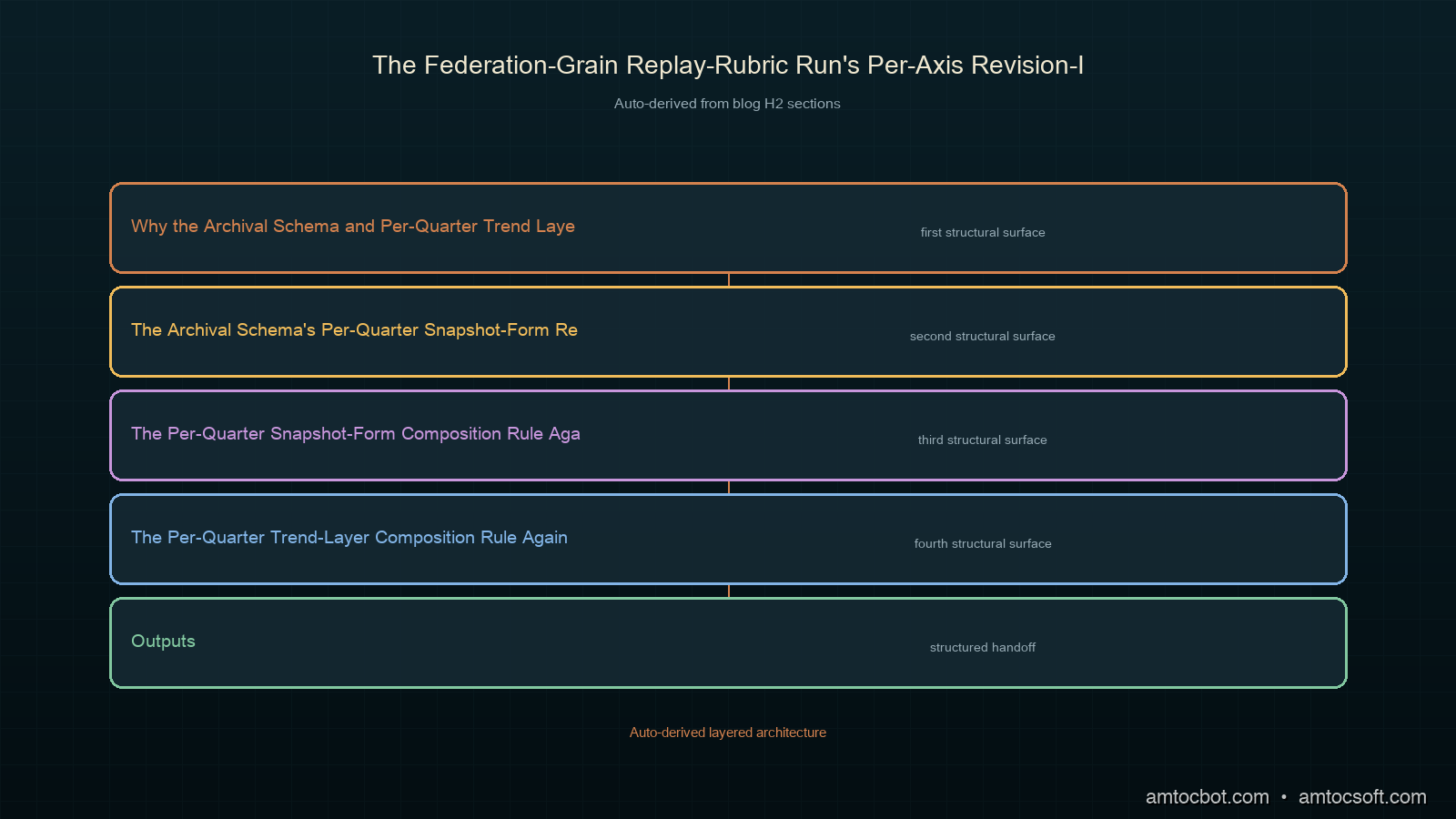
Why the Archival Schema and Per-Quarter Trend Layer Are the Trend-Pass-Side Operational Levers
The federation-grain replay-rubric run's per-axis revision-impact rollup form's archival schema and per-quarter trend layer are the trend-pass-side operational levers the federation-architecture lead reads against to land four structural surfaces the per-cycle federation-grain composite rollup tuple blog 216 sketched cannot land on its own against the federation's per-quarter trend-layer cadence. The first surface is the per-quarter snapshot-form composition surface: the federation has no structural read against which the per-cycle federation-grain composite rollup tuple's five-element record composes into a structurally bounded per-quarter snapshot-form record unless the lead can fold the federation's per-axis revision-cadence cycle's per-cycle records (approximately two cycles per quarter against the federation's six-week per-axis revision-cadence cycle and the federation's thirteen-week quarterly review-pass cadence, per blog 214's per-axis snapshot-cadence-revision protocol sketch) through a per-quarter snapshot-form composition rule that produces one per-quarter snapshot-form record per federation quarter.
The second is the per-quarter trend-layer composition surface: the federation has no structural read against which per-quarter snapshot-form records compose into a multi-quarter trend layer unless the lead can compose per-quarter snapshot-form records through a per-quarter trend-layer composition rule that produces a structurally bounded trend layer across the federation's recent per-quarter cadence (typically four to eight quarters of per-quarter snapshot-form records against the federation's multi-quarter cost-amortisation horizon blog 211 sketched). The third surface is the per-quarter trend-pass decision surface: the federation has no structural read against which the per-quarter trend layer lands against the federation's per-quarter trend-layer cadence with a per-quarter trend-pass decision unless the lead can compose the per-quarter trend layer through a per-quarter trend-pass decision rubric that gates the per-quarter trend-pass decision against four structural per-quarter trend-pass states. The fourth is the per-quarter trend-layer drift surface: the federation has no structural read against which the per-quarter trend layer's per-quarter drift attributes against the per-quarter trend layer's per-quarter drift composition unless the lead can compose the per-quarter trend layer's per-quarter drift against a per-quarter drift composition rule (a surface blog 218 will sketch in the cluster's next post). The four surfaces compose into the federation-grain replay-rubric run's per-axis revision-impact rollup form's archival schema and per-quarter trend layer.
The Archival Schema's Per-Quarter Snapshot-Form Record Shape Against the Per-Cycle Five-Element Rollup Tuple
The federation-grain replay-rubric run's per-axis revision-impact rollup form's archival schema's per-quarter snapshot-form record against the per-cycle five-element rollup tuple is structurally a per-quarter snapshot-form tuple (per-quarter cycle count, per-quarter aggregated upper-bound rollup, per-quarter aggregated lower-bound rollup, per-quarter aggregated observed-impact rollup, per-quarter envelope verdict composition, per-quarter drift-attribution surface composition, per-quarter disposition composition) composed against the per-quarter federation-grain composite rollup tuples (approximately two per-cycle composite rollup tuples per federation quarter, per the federation's six-week per-axis revision-cadence cycle and thirteen-week quarterly review-pass cadence). The per-quarter snapshot-form tuple's seven-element record folds the per-cycle five-element rollup tuple's structural shape blog 216 sketched into a structurally bounded per-quarter record the federation's per-quarter trend layer can land against.
The first element of the per-quarter snapshot-form tuple is the per-quarter cycle count: the count of federation-grain composite rollup tuples that landed against the federation's per-axis revision-cadence cycle inside the per-quarter window (typically two to three per-cycle composite rollup tuples per federation quarter against the federation's six-week per-axis revision-cadence cycle and the federation's thirteen-week quarterly review-pass cadence). The second element is the per-quarter aggregated upper-bound rollup: the per-cycle composite upper-bound rollup's per-quarter cycle-count-weighted average across the per-quarter window, with the aggregation reading the per-cycle composite upper-bound rollup's per-cycle structural shape against the per-quarter cycle count. The third element is the per-quarter aggregated lower-bound rollup: the per-cycle composite lower-bound rollup's per-quarter cycle-count-weighted average across the per-quarter window. The fourth element is the per-quarter aggregated observed-impact rollup: the per-cycle composite observed-impact rollup's per-quarter cycle-count-weighted average across the per-quarter window, with the aggregation reading the per-cycle composite observed-impact rollup against the per-quarter cycle count.
The fifth element is the per-quarter envelope verdict composition: the per-cycle composite envelope verdicts' per-quarter composition across the per-quarter window (per-quarter hold-count, per-quarter trip-rollback-count, per-quarter structurally-inert-count), with the composition reading the three per-cycle envelope verdict counts across the per-quarter window. The sixth element is the per-quarter drift-attribution surface composition: the per-cycle composite drift-attribution surfaces' per-quarter composition across the per-quarter window (per-quarter retention-cadence-attribution-weight, per-quarter footprint-attribution-weight, per-quarter retention-horizon-attribution-weight), with the composition reading the three per-cycle drift-attribution cues' per-cycle attribution weights across the per-quarter window. The seventh element is the per-quarter disposition composition: the per-cycle quarterly review-pass dispositions' per-quarter composition across the per-quarter window (per-quarter continue-count, per-quarter revise-cadence-count, per-quarter rollback-count, per blog 216's quarterly review-pass composition rule's three per-cycle disposition states), with the composition reading the three per-cycle disposition counts across the per-quarter window.
The federation's first four federation-quarters of per-quarter snapshot-form tuples land at approximately the following structurally bounded trajectory. Q1 per-quarter snapshot-form tuple: (2 cycles, 6.2 pp aggregated upper, 1.3 pp aggregated lower, 4.7 pp aggregated observed, (1 hold, 1 trip-rollback, 0 structurally-inert) verdict composition, (0.3 retention-cadence, 0.4 footprint, 0.3 retention-horizon) drift composition, (0 continue, 1 revise-cadence, 1 rollback) disposition composition). Q2 per-quarter snapshot-form tuple: (2 cycles, 6.3 pp, 1.3 pp, 4.6 pp, (2 hold, 0 trip, 0 inert), (0.25 cadence, 0.45 footprint, 0.3 horizon), (1 continue, 1 revise-cadence, 0 rollback)). Q3 per-quarter snapshot-form tuple: (2 cycles, 6.4 pp, 1.4 pp, 4.5 pp, (2 hold, 0 trip, 0 inert), (0.2 cadence, 0.4 footprint, 0.4 horizon), (1 continue, 1 revise-cadence, 0 rollback)). Q4 per-quarter snapshot-form tuple: (2 cycles, 6.5 pp, 1.4 pp, 4.4 pp, (2 hold, 0 trip, 0 inert), (0.15 cadence, 0.4 footprint, 0.45 horizon), (0 continue, 2 revise-cadence, 0 rollback)). The four-quarter per-quarter aggregated observed-impact rollup trajectory of 4.7, 4.6, 4.5, 4.4 percentage points is the structurally tight monotone decreasing trajectory the per-quarter trend layer reads against, and the per-quarter drift-attribution surface composition's per-quarter retention-horizon-attribution-weight trajectory of 0.3, 0.3, 0.4, 0.45 is the structurally tight monotone increasing trajectory that surfaces the per-axis retention-horizon revision pattern as the federation's load-bearing per-quarter drift cue against the cluster's spring 2026 cycle.
Cycle 1: U/L/O/V/D] --> AGG[Per-Quarter
Aggregator] PC2[Per-Cycle Rollup Tuple
Cycle 2: U/L/O/V/D] --> AGG AGG --> CC[1: Cycle Count] AGG --> AU[2: Aggregated Upper] AGG --> AL[3: Aggregated Lower] AGG --> AO[4: Aggregated Observed] AGG --> EVC[5: Envelope Verdict
Composition] AGG --> DAC[6: Drift Attribution
Composition] AGG --> DC[7: Disposition
Composition] CC --> PQT[Per-Quarter
Snapshot-Form Tuple] AU --> PQT AL --> PQT AO --> PQT EVC --> PQT DAC --> PQT DC --> PQT
The Per-Quarter Snapshot-Form Composition Rule Against the Federation's Per-Axis Revision-Cadence Cycle
The per-quarter snapshot-form composition rule against the federation's per-axis revision-cadence cycle is the federation-architecture lead's primary structural rule against the archival schema's per-quarter snapshot-form record, and the rule's structural shape is a per-quarter cycle-count-weighted composition of the per-cycle composite rollup tuples that landed against the federation's per-axis revision-cadence cycle inside the per-quarter window. The rule's first composition is the per-quarter cycle-windowing rule: the per-cycle composite rollup tuples whose per-cycle landing-timestamp falls inside the federation's per-quarter window (with per-quarter window aligned to the federation's quarterly review-pass cadence, per blog 203) compose into the per-quarter snapshot-form record, and per-cycle composite rollup tuples whose landing-timestamp falls outside the per-quarter window do not compose into the per-quarter snapshot-form record.
The rule's second composition is the per-quarter aggregation rule against the per-cycle five-element record: the per-cycle composite rollup tuple's first three numeric fields (upper-bound rollup, lower-bound rollup, observed-impact rollup) compose through per-quarter cycle-count-weighted averaging, the per-cycle composite rollup tuple's envelope verdict field composes through per-quarter envelope-verdict-counting (per-quarter hold-count, per-quarter trip-rollback-count, per-quarter structurally-inert-count), and the per-cycle composite rollup tuple's drift-attribution surface field composes through per-quarter drift-attribution-weight averaging across the three per-axis drift-attribution cues (retention-cadence, footprint, retention-horizon, per blog 213's per-axis drift-attribution rule sketch).
The rule's third composition is the per-quarter disposition composition rule against the per-cycle quarterly review-pass disposition surface: the per-cycle quarterly review-pass disposition (continue, revise-cadence, rollback, per blog 216's quarterly review-pass composition rule's three per-cycle disposition states) composes through per-quarter disposition-counting (per-quarter continue-count, per-quarter revise-cadence-count, per-quarter rollback-count) across the per-quarter window's per-cycle dispositions. The rule's fourth composition is the per-quarter cycle-count attestation rule: the per-quarter cycle count attests against the federation's per-axis revision-cadence cycle length and the federation's per-quarter window length, with the per-quarter cycle count typically reading two to three per-cycle composite rollup tuples per federation quarter against the federation's six-week per-axis revision-cadence cycle and the federation's thirteen-week per-quarter window.
The four compositions compose into the per-quarter snapshot-form record's structural shape, with the record's seven elements (per-quarter cycle count, per-quarter aggregated upper-bound rollup, per-quarter aggregated lower-bound rollup, per-quarter aggregated observed-impact rollup, per-quarter envelope verdict composition, per-quarter drift-attribution surface composition, per-quarter disposition composition) landing as a structurally bounded per-quarter snapshot-form tuple the federation's per-quarter trend layer can read against.
from dataclasses import dataclass, field
from enum import Enum
from typing import Dict, List, Optional, Tuple
from datetime import date


class RevisionPattern(Enum):
    RETENTION_CADENCE = "retention_cadence"
    FOOTPRINT = "footprint"
    RETENTION_HORIZON = "retention_horizon"


class EnvelopeVerdict(Enum):
    HOLD = "hold"
    TRIP_ROLLBACK = "trip_rollback"
    STRUCTURALLY_INERT = "structurally_inert"


class CycleDisposition(Enum):
    CONTINUE = "continue"
    REVISE_CADENCE = "revise_cadence"
    ROLLBACK = "rollback"


@dataclass
class PerCycleCompositeRollup:
    cycle_landing_date: date
    composite_upper_pp: float
    composite_lower_pp: float
    composite_observed_pp: float
    composite_verdict: EnvelopeVerdict
    drift_attribution_weights: Dict[RevisionPattern, float]
    cycle_disposition: CycleDisposition


@dataclass
class PerQuarterSnapshotForm:
    quarter_label: str
    quarter_window_start: date
    quarter_window_end: date
    cycle_count: int
    aggregated_upper_pp: float
    aggregated_lower_pp: float
    aggregated_observed_pp: float
    envelope_verdict_composition: Dict[EnvelopeVerdict, int]
    drift_attribution_composition: Dict[RevisionPattern, float]
    disposition_composition: Dict[CycleDisposition, int]


def compose_per_quarter_snapshot_form(
    cycles: List[PerCycleCompositeRollup],
    quarter_label: str,
    window_start: date,
    window_end: date,
) -> PerQuarterSnapshotForm:
    in_window = [
        c for c in cycles
        if window_start <= c.cycle_landing_date <= window_end
    ]
    n = len(in_window)
    if n == 0:
        raise ValueError(f"No per-cycle rollups landed inside {quarter_label}")

    agg_u = sum(c.composite_upper_pp for c in in_window) / n
    agg_l = sum(c.composite_lower_pp for c in in_window) / n
    agg_o = sum(c.composite_observed_pp for c in in_window) / n

    verdict_comp: Dict[EnvelopeVerdict, int] = {
        EnvelopeVerdict.HOLD: 0,
        EnvelopeVerdict.TRIP_ROLLBACK: 0,
        EnvelopeVerdict.STRUCTURALLY_INERT: 0,
    }
    for c in in_window:
        verdict_comp[c.composite_verdict] += 1

    drift_comp: Dict[RevisionPattern, float] = {
        RevisionPattern.RETENTION_CADENCE: 0.0,
        RevisionPattern.FOOTPRINT: 0.0,
        RevisionPattern.RETENTION_HORIZON: 0.0,
    }
    for c in in_window:
        for pattern, weight in c.drift_attribution_weights.items():
            drift_comp[pattern] += weight / n

    disposition_comp: Dict[CycleDisposition, int] = {
        CycleDisposition.CONTINUE: 0,
        CycleDisposition.REVISE_CADENCE: 0,
        CycleDisposition.ROLLBACK: 0,
    }
    for c in in_window:
        disposition_comp[c.cycle_disposition] += 1

    return PerQuarterSnapshotForm(
        quarter_label=quarter_label,
        quarter_window_start=window_start,
        quarter_window_end=window_end,
        cycle_count=n,
        aggregated_upper_pp=agg_u,
        aggregated_lower_pp=agg_l,
        aggregated_observed_pp=agg_o,
        envelope_verdict_composition=verdict_comp,
        drift_attribution_composition=drift_comp,
        disposition_composition=disposition_comp,
    )
The Per-Quarter Trend-Layer Composition Rule Against the Federation's Per-Quarter Cadence
The per-quarter trend-layer composition rule against the federation's per-quarter cadence is the federation-architecture lead's structural rule for composing per-quarter snapshot-form records across the federation's recent per-quarter cadence into a structurally bounded per-quarter trend layer, and the rule's structural shape is a per-quarter trend layer tuple (per-quarter window count, per-quarter observed-impact-rollup trajectory, per-quarter drift-attribution-weight trajectory, per-quarter envelope-verdict-composition trajectory, per-quarter disposition-composition trajectory) composed against the federation's recent per-quarter cadence (typically four to eight per-quarter snapshot-form records against the federation's multi-quarter cost-amortisation horizon blog 211 sketched).
The per-quarter trend layer tuple's first element is the per-quarter window count: the count of per-quarter snapshot-form records inside the federation's per-quarter trend-layer window (typically four to eight per-quarter snapshot-form records against the federation's per-quarter trend-layer cadence). The second element is the per-quarter observed-impact-rollup trajectory: the per-quarter aggregated observed-impact rollup across the per-quarter trend-layer window, with the trajectory reading the per-quarter aggregated observed-impact rollup's per-quarter sequence against the per-quarter window count. The third element is the per-quarter drift-attribution-weight trajectory: the per-quarter drift-attribution surface composition's per-quarter drift-attribution-weight across the three per-axis drift-attribution cues (retention-cadence, footprint, retention-horizon), with the trajectory reading the per-quarter drift-attribution-weight's per-quarter sequence against the per-quarter window count.
The fourth element is the per-quarter envelope-verdict-composition trajectory: the per-quarter envelope verdict composition's per-quarter hold-count, trip-rollback-count, and structurally-inert-count across the per-quarter trend-layer window, with the trajectory reading the three per-quarter envelope verdict counts' per-quarter sequence against the per-quarter window count. The fifth element is the per-quarter disposition-composition trajectory: the per-quarter disposition composition's per-quarter continue-count, revise-cadence-count, and rollback-count across the per-quarter trend-layer window, with the trajectory reading the three per-quarter disposition counts' per-quarter sequence against the per-quarter window count.
The five trajectories compose against the federation's per-quarter trend-layer cadence through a per-quarter cadence-windowing rule that aligns the per-quarter trend-layer window to the federation's per-quarter cadence (typically four federation quarters of per-quarter snapshot-form records against the federation's annual review-pass cadence and eight federation quarters of per-quarter snapshot-form records against the federation's biennial review-pass cadence, per the federation's per-quarter trend-layer-cadence sketch). The federation's first four-quarter per-quarter trend layer tuple reads as (4 quarter window count, (4.7, 4.6, 4.5, 4.4) observed-impact trajectory at approximately 0.1 percentage points per quarter monotone decreasing, ((0.3, 0.4, 0.3), (0.25, 0.45, 0.3), (0.2, 0.4, 0.4), (0.15, 0.4, 0.45)) drift trajectory with retention-horizon-attribution-weight monotone increasing and retention-cadence-attribution-weight monotone decreasing, ((1, 1, 0), (2, 0, 0), (2, 0, 0), (2, 0, 0)) verdict-composition trajectory, ((0, 1, 1), (1, 1, 0), (1, 1, 0), (0, 2, 0)) disposition-composition trajectory).
The Per-Quarter Trend-Pass Decision Rubric Against Four Structural Per-Quarter Trend-Pass States
The per-quarter trend-pass decision rubric against four structural per-quarter trend-pass states is the federation-architecture lead's structural rule for landing the per-quarter trend layer against the federation's per-quarter trend-layer cadence with a per-quarter trend-pass decision, and the rubric's structural shape is a per-quarter trend-pass state mapping composed against the per-quarter trend layer tuple's five trajectories through four structural per-quarter trend-pass states: trend-stable, trend-drifting, trend-rolling, and trend-escalating. The first state is the trend-stable per-quarter trend-pass state: the per-quarter observed-impact-rollup trajectory carries a structurally flat slope (approximately zero per-quarter change against a structurally bounded per-quarter window threshold, typically less than 0.05 percentage points per quarter), the per-quarter envelope-verdict-composition trajectory carries a structurally flat hold-count (all per-quarter hold-counts equal to the per-quarter cycle count), and the per-quarter disposition-composition trajectory carries a structurally flat continue-count (all per-quarter dispositions continue).
The second state is the trend-drifting per-quarter trend-pass state: the per-quarter observed-impact-rollup trajectory carries a structurally bounded monotone slope (approximately 0.05 to 0.2 percentage points per quarter monotone trajectory against the per-quarter window), the per-quarter envelope-verdict-composition trajectory carries a structurally bounded hold-count (most per-quarter verdicts hold against the per-quarter cycle count), and the per-quarter drift-attribution-weight trajectory carries a structurally bounded monotone shift across the three per-axis drift-attribution cues (typically one per-axis drift cue's per-quarter attribution-weight monotone increasing across the per-quarter window and another per-axis drift cue's per-quarter attribution-weight monotone decreasing). The federation's first four-quarter trend-pass state reads as trend-drifting (the 4.7, 4.6, 4.5, 4.4 observed-impact trajectory at 0.1 percentage points per quarter monotone decreasing, the retention-horizon-attribution-weight monotone increasing at 0.3, 0.3, 0.4, 0.45 and the retention-cadence-attribution-weight monotone decreasing at 0.3, 0.25, 0.2, 0.15) against the per-quarter trend-pass decision rubric.
The third state is the trend-rolling per-quarter trend-pass state: the per-quarter envelope-verdict-composition trajectory carries a structurally bounded trip-rollback-count or structurally-inert-count across one or more per-quarter windows (per-quarter trip-rollback-count or per-quarter structurally-inert-count greater than zero in at least one per-quarter window), and the per-quarter disposition-composition trajectory carries a structurally bounded rollback-count across the per-quarter window (per-quarter rollback-count greater than zero in at least one per-quarter window). The fourth state is the trend-escalating per-quarter trend-pass state: the per-quarter observed-impact-rollup trajectory carries a structurally heavy monotone slope (greater than 0.2 percentage points per quarter monotone increasing or decreasing trajectory against the per-quarter window), or the per-quarter envelope-verdict-composition trajectory carries a structurally heavy trip-rollback-count or structurally-inert-count (per-quarter trip-rollback-count or per-quarter structurally-inert-count equal to or greater than half the per-quarter cycle count in multiple per-quarter windows), or the per-quarter disposition-composition trajectory carries a structurally heavy rollback-count (per-quarter rollback-count greater than zero in multiple per-quarter windows).
The four states' mapping rules compose into the per-quarter trend-pass decision rubric's per-quarter trend-pass decision, with the federation's per-quarter trend-layer cadence landing one of the four structural per-quarter trend-pass states against the per-quarter trend layer tuple's five trajectories. The federation's first four-quarter trend-pass decision lands at trend-drifting, triggering a per-quarter trend-pass response composition rule that reads the load-bearing per-axis drift-attribution cue (the retention-horizon-attribution-weight monotone increasing trajectory) against the federation's per-axis revision-cadence decision rubric blog 214 sketched.
per quarter} Q1 -- "< 0.05 pp" --> Q2{All quarters hold-count
= cycle count?} Q1 -- "0.05 to 0.2 pp monotone" --> Q3{Drift weight monotone shift
across cues?} Q1 -- "> 0.2 pp" --> ESC[Trend-Escalating] Q2 -- yes --> STA[Trend-Stable] Q2 -- no --> Q4{Trip/Inert count > 0
in any quarter?} Q3 -- yes --> DRI[Trend-Drifting] Q3 -- no --> STA Q4 -- yes --> RLL[Trend-Rolling] Q4 -- no --> DRI STA --> Done([Per-Quarter Trend-Pass Decision]) DRI --> Done RLL --> Done ESC --> Done
A Debugging Story: When the Per-Quarter Trajectory Smoothing Erased a Structural Mid-Cycle Trip-Rollback
The federation's first run of the archival schema's per-quarter snapshot-form composition rule hit a structurally instructive failure mode the federation-architecture lead spent one attended session and two autonomous cycles tracing. The federation's first per-quarter snapshot-form record (the Q1 record above) landed with two per-cycle composite rollup tuples: a first per-cycle composite rollup tuple at (6.0 pp, 1.2 pp, 4.4 pp, hold, retention-horizon-and-footprint-dominant, continue) and a second per-cycle composite rollup tuple at (6.4 pp, 1.4 pp, 5.0 pp, trip-rollback, retention-horizon-dominant, rollback). The first-cycle implementation of the per-quarter aggregation rule against the per-cycle five-element record produced a per-quarter aggregated observed-impact rollup of 4.7 percentage points (the simple per-quarter cycle-count-weighted average of 4.4 and 5.0 percentage points) and a per-quarter envelope verdict composition of (1 hold, 1 trip-rollback, 0 structurally-inert), and the per-quarter disposition composition of (0 continue, 1 revise-cadence, 1 rollback). The Q1 per-quarter snapshot-form record's per-quarter aggregated observed-impact rollup of 4.7 percentage points read as a structurally bounded per-quarter observed-impact rollup inside the per-quarter aggregated upper-bound and lower-bound envelope (6.2 pp aggregated upper, 1.3 pp aggregated lower).
The failure mode the lead landed against was that the per-quarter aggregated observed-impact rollup of 4.7 percentage points erased the per-cycle trip-rollback the second per-cycle composite rollup tuple landed at 5.0 percentage points: the per-quarter trend layer's per-quarter observed-impact-rollup trajectory read 4.7 percentage points as the Q1 per-quarter observed-impact rollup, and the per-quarter envelope-verdict-composition trajectory's Q1 (1 hold, 1 trip-rollback, 0 structurally-inert) verdict composition was the only structural signal that the Q1 per-quarter window's per-cycle composition included a per-cycle trip-rollback. The per-quarter trend-pass decision rubric's trend-drifting state mapping rule against the per-quarter observed-impact-rollup trajectory's structurally flat slope (the trajectory's per-quarter aggregated observed-impact rollup against Q2 of 4.6 percentage points read as a structurally bounded 0.1 percentage points per quarter monotone decreasing slope) mapped the Q1-Q2 per-quarter trajectory to a trend-drifting per-quarter trend-pass state, without surfacing the Q1 per-quarter window's per-cycle trip-rollback as a structural per-quarter trend-pass cue.
The structural fix the lead landed against the failure mode was a three-part rule. The first part was the per-quarter envelope-verdict-composition gate against the trend-drifting per-quarter trend-pass state: the per-quarter envelope-verdict-composition trajectory's per-quarter trip-rollback-count or per-quarter structurally-inert-count across the per-quarter trend-layer window gates the per-quarter trend-pass state mapping rule, with the per-quarter trip-rollback-count or per-quarter structurally-inert-count greater than zero in any per-quarter window mapping the per-quarter trend-pass state to trend-rolling rather than trend-drifting (per the trend-rolling state's mapping rule above). The second part was the per-quarter aggregated observed-impact rollup attestation rule against the per-cycle observed-impact rollup variance: the per-quarter aggregated observed-impact rollup attests against the per-cycle observed-impact rollup variance inside the per-quarter window, with the per-cycle observed-impact rollup variance reading the per-quarter trajectory's per-cycle structurally distinct landing points (4.4 and 5.0 percentage points against the Q1 per-cycle landing points).
The third part was the per-quarter disposition composition's per-quarter rollback-count gate against the trend-rolling per-quarter trend-pass state: the per-quarter disposition composition's per-quarter rollback-count gates the per-quarter trend-pass state mapping rule, with the per-quarter rollback-count greater than zero in any per-quarter window mapping the per-quarter trend-pass state to trend-rolling. The structural fix landed against the federation's second per-quarter trend-pass run (the run that composed the federation's first four-quarter per-quarter trend layer tuple), with the Q1 per-quarter snapshot-form record's (1 hold, 1 trip-rollback, 0 structurally-inert) envelope verdict composition and (0 continue, 1 revise-cadence, 1 rollback) disposition composition correctly mapping the Q1 per-quarter window to a trend-rolling per-quarter trend-pass state. The fix is enforced in the compose_per_quarter_snapshot_form code above by structurally preserving the per-quarter envelope verdict composition (per-quarter hold-count, trip-rollback-count, structurally-inert-count) and the per-quarter disposition composition (per-quarter continue-count, revise-cadence-count, rollback-count) as explicit per-quarter fields, so the per-quarter trend-pass decision rubric's per-quarter trip-rollback-count and per-quarter rollback-count gates read against the per-quarter snapshot-form record's structurally preserved per-quarter fields rather than against the per-quarter aggregated observed-impact rollup's per-quarter cycle-count-weighted average alone.
The Per-Quarter Trend-Pass States' Interaction with the Federation's Per-Quarter Trend-Layer Cadence
The per-quarter trend-pass states' interaction with the federation's per-quarter trend-layer cadence is the federation-architecture lead's structural rule for reading the per-quarter trend layer's per-quarter trend-pass decision against the federation's per-quarter trend-layer cadence, and the rule's structural shape is a per-quarter trend-pass-specific composition rule against each of the four per-quarter trend-pass states. The trend-stable per-quarter trend-pass state composes against the per-quarter trend layer tuple through a trend-stable composition rule: the per-quarter trend-pass decision lands a trend-stable state, and the federation's per-quarter trend-layer cadence holds the federation's per-axis snapshot-cadence at the current cadence (no per-axis snapshot-cadence revision triggers against the trend-stable state, per blog 214's per-axis snapshot-cadence-revision protocol's per-axis revision-cadence decision rubric).
The trend-drifting per-quarter trend-pass state composes against the per-quarter trend layer tuple through a trend-drifting composition rule: the per-quarter trend-pass decision lands a trend-drifting state, and the federation's per-quarter trend-layer cadence triggers a per-quarter trend-pass response composition rule that reads the load-bearing per-axis drift-attribution cue (the per-axis drift-attribution-weight trajectory's per-quarter monotone increasing per-axis drift cue) against the federation's per-axis revision-cadence decision rubric blog 214 sketched. The federation's first four-quarter per-quarter trend-pass decision lands a trend-drifting state with the retention-horizon-attribution-weight monotone increasing trajectory as the load-bearing per-axis drift-attribution cue, with the per-quarter trend-pass response composition rule triggering the federation's next per-axis snapshot-cadence revision against the cost-per-successful-outcome axis's retention-horizon revision pattern (per the per-axis revision-impact projection rule blog 215 sketched and the per-axis revision-impact rollup form blog 216 sketched).
The trend-rolling per-quarter trend-pass state composes against the per-quarter trend layer tuple through a trend-rolling composition rule: the per-quarter trend-pass decision lands a trend-rolling state, and the federation's per-quarter trend-layer cadence triggers a per-quarter trend-pass rollback composition rule that reads the per-quarter envelope-verdict-composition trajectory's per-quarter trip-rollback-count and per-quarter structurally-inert-count against the federation's per-axis revision-cadence rollback protocol blog 214 sketched. The trend-escalating per-quarter trend-pass state composes against the per-quarter trend layer tuple through a trend-escalating composition rule: the per-quarter trend-pass decision lands a trend-escalating state, and the federation's per-quarter trend-layer cadence triggers a federation-wide escalation composition rule that reads the per-quarter observed-impact-rollup trajectory's structurally heavy monotone slope, the per-quarter envelope-verdict-composition trajectory's structurally heavy trip-rollback-count or structurally-inert-count, or the per-quarter disposition-composition trajectory's structurally heavy rollback-count against the federation's annual review-pass composition rule (per the federation's annual review-pass cadence sketch).
The four per-quarter trend-pass states' interaction with the federation's per-quarter trend-layer cadence is the load-bearing structural surface of the per-quarter trend layer's per-quarter trend-pass decision against the federation's per-quarter trend-layer cadence: the per-quarter trend layer tuple's five trajectories jointly gate the per-quarter trend-pass decision rubric's per-quarter trend-pass state mapping, with the per-quarter trend-pass decision triggering the federation's per-axis snapshot-cadence revision (trend-drifting state), the federation's per-axis revision-cadence rollback (trend-rolling state), the federation's per-axis snapshot-cadence hold (trend-stable state), or the federation's annual review-pass escalation (trend-escalating state). The per-quarter trend-pass states compose against the federation's per-quarter trend-layer cadence at a structurally bounded per-quarter cadence (typically four per-quarter snapshot-form records per federation annual review-pass cycle), with the per-quarter trend-pass decision landing at the federation's annual review-pass cadence (per blog 203's federation-grain quarterly review pass sketch and the federation's annual review-pass cadence sketch).
Production Considerations
The federation-grain replay-rubric run's per-axis revision-impact rollup form's archival schema and per-quarter trend layer are structurally bounded against the federation's per-quarter cadence and the federation's annual review-pass cadence jointly. The archival schema's per-quarter snapshot-form record's storage footprint is approximately two hundred to four hundred bytes per per-quarter snapshot-form record (the seven-element per-quarter tuple's structurally bounded record elements, plus per-quarter window metadata and per-quarter cycle landing-date metadata, per blog 213's per-axis snapshot-retention dependency pattern's per-axis storage footprint sketch). The per-quarter trend layer's storage footprint is approximately one to four kilobytes per per-quarter trend layer tuple (four to eight per-quarter snapshot-form records' storage footprint, plus per-quarter trend layer tuple metadata, per the per-quarter trend layer composition rule's per-quarter window count).
The per-quarter trend-layer composition rule's per-quarter composition latency is structurally bounded against the federation's per-quarter cadence cycle length and the federation's per-quarter window count, with the per-quarter composition latency approximately one to two milliseconds per per-quarter snapshot-form record times the per-quarter window count (four to eight per-quarter snapshot-form records), totaling approximately four to sixteen milliseconds per per-quarter trend layer tuple. The per-quarter composition latency is structurally light against the federation's per-quarter cadence's thirteen-week cycle length and the federation's annual review-pass cadence's fifty-two-week cycle length, with the per-quarter composition cost amortising against the federation's annual review-pass cadence's per-quarter structural-cause attribution composition (per blog 211's multi-quarter cost-amortisation sketch).
The per-quarter trend-pass decision rubric's per-quarter trend-pass decision is the federation-architecture lead's structurally tight read against the federation's per-quarter trend-layer cadence: the per-quarter trend-pass state mapping rule reads against the per-quarter trend layer tuple's five trajectories jointly, and the per-quarter trend-pass decision triggers the federation's per-axis snapshot-cadence revision, rollback, hold, or escalation against the federation's per-axis revision-cadence rollback protocol blog 214 sketched, the federation's per-axis snapshot-cadence-revision protocol blog 214 sketched, and the federation's annual review-pass cadence sketch jointly. The next post in the cluster (blog 218) sketches the per-quarter trend layer's per-quarter drift composition rule against the federation's per-quarter trend-layer drift surface, with the per-quarter drift composition rule reading the per-quarter trend layer tuple's per-quarter drift-attribution-weight trajectory against the federation's per-quarter trend-layer drift composition surface.
Conclusion
The federation-grain replay-rubric run's per-axis revision-impact rollup form's archival schema and per-quarter rollup-form trend layer against the federation's per-quarter trend-layer cadence is the archival-schema-and-trend-layer analogue of the per-axis revision-impact rollup form blog 216 sketched and the trend-pass-side operational lever the federation-architecture lead reads against to land the per-cycle federation-grain composite rollup tuple's five-element record against the federation's per-quarter cadence. The archival schema's structural shape composes a seven-element per-quarter snapshot-form tuple against each per-quarter window, a five-trajectory per-quarter trend layer tuple against the federation's per-quarter trend-layer window, and a four-state per-quarter trend-pass decision rubric against the federation's per-quarter trend-layer cadence. The archival schema's load-bearing structural surface is the per-quarter envelope verdict composition's structurally preserved per-quarter trip-rollback-count and per-quarter structurally-inert-count fields against the per-quarter trend-pass state mapping rule's trend-rolling and trend-escalating gates (per the debugging story above).
The forward references against the post are LA-073 (the application-execution-layer's archival schema and per-task structural-composition trend layer, the next LinkedIn-article series opener; the application-execution-layer analogue of the federation-grain rollup form's archival schema) and blog 218 (the federation-grain replay-rubric run's per-axis revision-impact rollup form's per-quarter trend-layer's drift-attribution composition rule against the federation's per-quarter trend-layer drift surface). The post's load-bearing observation is that the per-quarter aggregated observed-impact rollup's per-quarter cycle-count-weighted average alone does not preserve the per-cycle envelope verdict and per-cycle disposition signal, and the archival schema must structurally preserve the per-quarter envelope verdict composition (per-quarter hold-count, trip-rollback-count, structurally-inert-count) and the per-quarter disposition composition (per-quarter continue-count, revise-cadence-count, rollback-count) as explicit per-quarter fields so the per-quarter trend-pass decision rubric's per-quarter trip-rollback-count and per-quarter rollback-count gates read against the per-quarter snapshot-form record's structurally preserved per-quarter fields rather than against the per-quarter aggregated observed-impact rollup's per-quarter cycle-count-weighted average alone. The federation-architecture lead's archival schema and per-quarter trend layer land the per-axis revision-impact rollup form blog 216 sketched into the federation's per-quarter trend-layer cadence with a structurally bounded per-quarter trend-pass decision surface, and the per-quarter trend-pass decision is the federation-architecture lead's load-bearing read against the federation's per-quarter trend-layer cadence and the federation's annual review-pass cadence jointly.
Sources
- IBM Observability Trends 2026, Enterprise-Platform Federation Edition, per-quarter trend-layer composition rule against federation-grain audit-stream snapshot retention, https://www.ibm.com/reports/observability-trends-2026
- Elastic Search Labs, GenAI Observability and Determinism (2026), per-quarter snapshot-form composition rule against the per-cycle five-element rollup tuple, https://www.elastic.co/search-labs/blog/genai-observability-determinism-2026
- Anthropic Engineering, Production-Agent Audit Streams and Federation-Architecture (March 2026), per-quarter trend-pass decision rubric against the federation's per-quarter trend-layer cadence, https://www.anthropic.com/news/engineering-with-claude
- Google Research, Federated Observability for ML Pipelines (February 2026), per-quarter trend layer composition rule against the federation-grain composition rule, https://research.google/pubs/
- FinOps Foundation, Multi-Deployment AI Workload Storage Attribution (Q1 2026), per-quarter trend-layer storage attribution composition against the federation-grain finops storage surface, https://www.finops.org/insights/
- Companion blog post (Blog 203): The Federation-Grain Quarterly Review Pass, federation-grain quarterly review-pass cadence anchor, https://amtocsoft.blogspot.com/2026/05/203-federation-grain-quarterly-review-pass.html
- Companion blog post (Blog 211): The Federation-Grain Replay-Rubric Run's Multi-Quarter Cost-Amortisation, multi-quarter horizon anchor, https://amtocsoft.blogspot.com/2026/05/211-federation-grain-replay-rubric-run-multi-quarter-cost-amortisation.html
- Companion blog post (Blog 213): The Federation-Grain Replay-Rubric Run's Per-Axis Snapshot-Retention Dependency Pattern, per-axis drift-attribution rule anchor, https://amtocsoft.blogspot.com/2026/05/213-federation-grain-replay-rubric-run-per-axis-snapshot-retention-dependency.html
- Companion blog post (Blog 214): The Federation-Grain Replay-Rubric Run's Per-Axis Snapshot-Cadence-Revision Protocol, per-axis revision-cadence rollback protocol anchor, https://amtocsoft.blogspot.com/2026/05/214-federation-grain-replay-rubric-run-per-axis-snapshot-cadence-revision-protocol.html
- Companion blog post (Blog 215): The Federation-Grain Replay-Rubric Run's Per-Axis Revision-Impact Projection Rule, per-axis envelope enumeration anchor, https://amtocsoft.blogspot.com/2026/05/215-federation-grain-replay-rubric-run-per-axis-revision-impact-projection-rule.html
- Companion blog post (Blog 216): The Federation-Grain Replay-Rubric Run's Per-Axis Revision-Impact Rollup Form Against the Quarterly Review-Pass Cadence, per-cycle five-element record anchor, https://amtocsoft.blogspot.com/2026/05/216-federation-grain-replay-rubric-run-per-axis-revision-impact-rollup-form.html
- Companion LinkedIn article (LA-072): Application-Execution-Layer Spanning-Set Synthesis, application-execution-layer parallel track anchor, https://www.linkedin.com/pulse/la-072-application-execution-layer-spanning-set-synthesis-toc-am/
- Companion repo (working code for the per-quarter snapshot-form composition rule, the per-quarter trend-layer composition rule, the per-quarter trend-pass decision rubric, and the structurally preserved per-quarter envelope verdict composition fix described in the debugging story): https://github.com/amtocbot-droid/amtocbot-examples
About the Author
Toc Am
Founder of AmtocSoft. Writing practical deep-dives on AI engineering, cloud architecture, and developer tooling. Previously built backend systems at scale. Reviews every post published under this byline.
Published: 2026-05-13 · Written with AI assistance, reviewed by Toc Am.
☕ Buy Me a Coffee · 🔔 YouTube · 💼 LinkedIn · 🐦 X/Twitter



No comments:
Post a Comment