The federation-architecture lead I have been walking the federation-grain replay-rubric run cluster with through the spring 2026 cycle ran into the structural shape of the per-axis revision-impact rollup form the same week blog 215 landed, when the federation's second per-axis snapshot-cadence revision cycle (the one immediately after the cost-per-successful-outcome axis revision the blog 215 opening anecdote walked through) landed against the federation's next quarterly review pass and the federation-architecture lead needed to read against the per-axis revision-impact projection vector blog 215 sketched, the per-axis upper-bound and lower-bound envelope blog 215 enumerated, and the per-deployment federation-grain composition rule blog 215 closed against, jointly, to produce a single per-axis revision-impact rollup form the federation's quarterly review-pass cadence (per blog 203's federation-grain quarterly review pass sketch) could read against. The lead's first-cycle assumption that the per-axis revision-impact projection rule and the federation-grain quarterly review pass could read against each other without a structural rollup form was the assumption blog 215's closing paragraphs left open: blog 215 sketched the per-axis revision-impact projection rule with structurally rich per-axis upper-bound and lower-bound enumeration and a per-deployment-to-federation composition rule, but the rule's output was a per-axis projection vector and an envelope, not a rollup form the quarterly review pass could land against. The federation's second per-axis snapshot-cadence revision cycle's projection vector landed at approximately a seven-element vector against the seven axes, with the cost-per-successful-outcome axis carrying an upper-bound of approximately twenty-two percentage points and a lower-bound of approximately seven percentage points, the policy compliance axis carrying an upper-bound of approximately five percentage points and a lower-bound of approximately one and a half percentage points, and the remaining five axes carrying structurally lighter bounds, and the federation-architecture lead now needed to fold the seven-element vector into a single rollup form the federation's quarterly review pass could land against with a per-cycle disposition decision.
This post is the structural sketch of the federation-grain replay-rubric run's per-axis revision-impact projection rule's per-axis revision-impact rollup form against the federation's quarterly review-pass cadence: the per-axis rollup composition rule that folds the per-axis revision-impact projection vector against the federation-grain composite revision-impact rollup surface, the per-deployment federation-grain rollup rule that composes per-deployment per-axis rollup forms into the federation-grain rollup form, and the quarterly review-pass composition rule that lands the federation-grain rollup form against blog 203's federation-grain quarterly review pass's per-cycle disposition surface. The post composes against blog 203 (the federation-grain quarterly review pass), blog 207 (the deterministic control layer for agents), blog 208 (the per-deployment seven-axis metric stack), blog 209 (the federation-grain seven-axis stack), blog 210 (the federation-grain replay-rubric run), blog 211 (the multi-quarter cost-amortisation), blog 212 (the per-axis cost-amortisation distribution), blog 213 (the per-axis snapshot-retention dependency pattern), blog 214 (the per-axis snapshot-cadence-revision protocol), and blog 215 (the per-axis revision-impact projection rule), and the post is the rollup-form analogue of the per-axis revision-impact projection rule blog 215 sketched. The post sketches the federation-grain replay-rubric run's per-axis revision-impact rollup form through six structural moves: the rollup form's structural shape against the seven axes, the per-axis rollup composition rule against the per-axis revision-impact projection envelope, the per-deployment federation-grain rollup rule against the federation-grain composition rule, the quarterly review-pass composition rule against blog 203's per-cycle disposition surface, the rollup form's interaction with the federation-grain quarterly review pass's three per-cycle disposition states, and the rollup form's drift-attribution rule against the per-axis drift-attribution rule blog 213 sketched. The post forward-references LA-072 (the application-execution-layer's spanning-set synthesis, the series finale) and blog 217 (the federation-grain replay-rubric run's per-axis revision-impact rollup form's archival schema and per-quarter rollup-form trend layer).
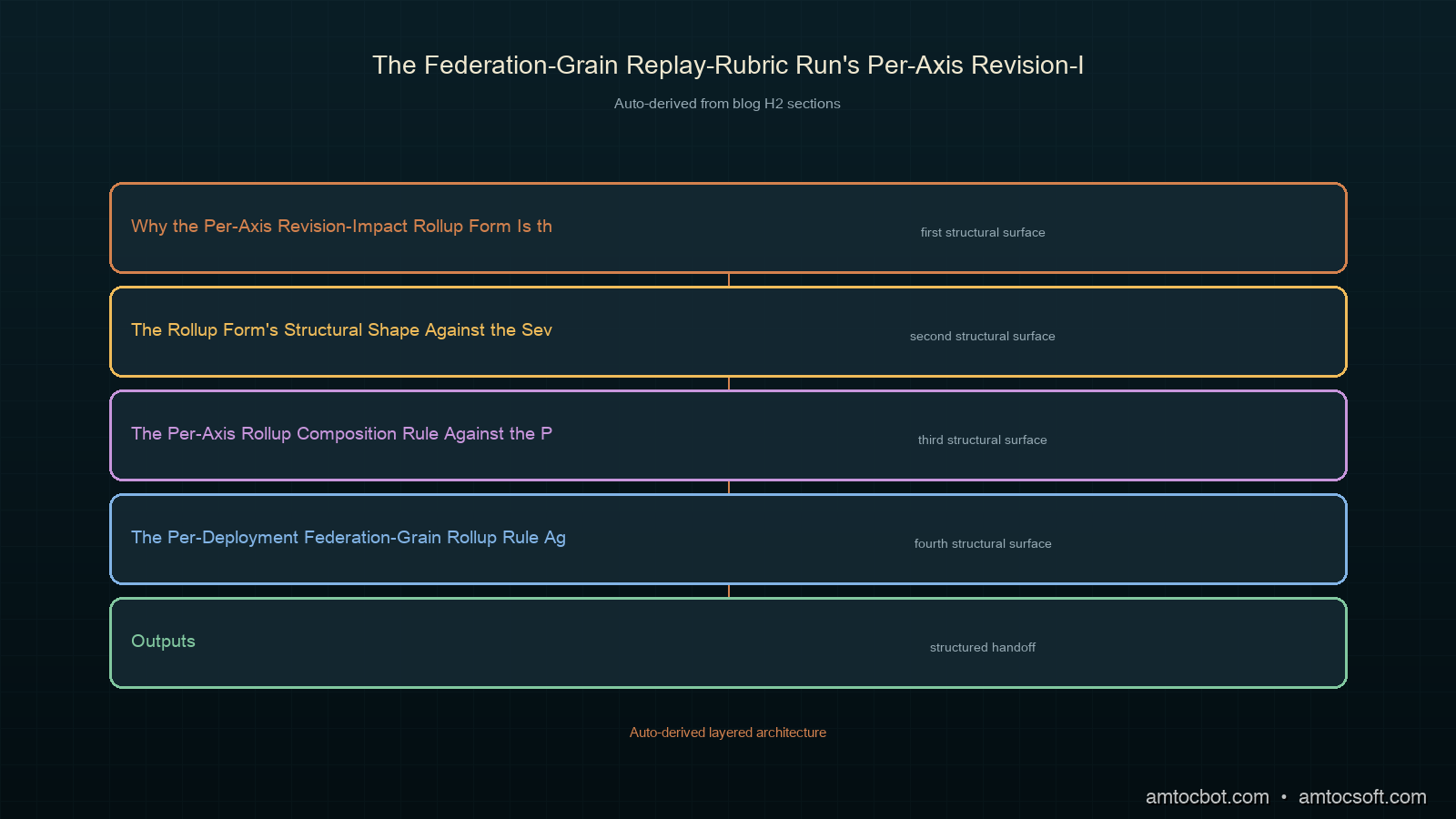
Why the Per-Axis Revision-Impact Rollup Form Is the Quarterly-Review-Pass-Side Operational Lever
The federation-grain replay-rubric run's per-axis revision-impact rollup form is the quarterly-review-pass-side operational lever the federation-architecture lead reads against to land four structural surfaces the federation-grain replay-rubric run's per-axis revision-impact projection rule blog 215 sketched as the lead's primary projection-side surface cannot land on its own against the federation's quarterly review-pass cadence. The first surface is the federation-grain composite revision-impact rollup surface: the federation has no structural read against which per-axis revision-impact projections compose into a single federation-grain composite revision-impact rollup value the federation's quarterly review pass can land against in a per-cycle disposition decision unless the lead can fold the per-axis projection vector through a per-axis rollup composition rule. The second is the per-deployment federation-grain rollup surface: the federation has no structural read against which per-deployment per-axis rollup forms compose into the federation-grain per-axis rollup form unless the lead can compose per-deployment rollup forms through a per-deployment federation-grain rollup rule against the federation-grain composition rule blog 209 sketched.
The third surface is the quarterly review-pass composition surface: the federation has no structural read against which the federation-grain per-axis rollup form lands against the federation's quarterly review pass's per-cycle disposition surface (per blog 203's federation-grain quarterly review pass sketch) unless the lead can compose the rollup form through a quarterly review-pass composition rule that gates the per-cycle disposition decision. The fourth is the rollup-form drift-attribution surface: the federation has no structural read against which the per-axis rollup form's per-cycle drift attributes against the per-axis drift-attribution rule's three structural cues (per blog 213's per-axis drift-attribution rule sketch: per-axis retention-cadence revision, per-axis footprint revision, per-axis retention-horizon revision) unless the lead can compose the per-axis rollup form's per-cycle drift against the per-axis drift-attribution rule's per-axis attribution surface. The four surfaces compose into the federation-grain replay-rubric run's per-axis revision-impact rollup form's structural shape: a per-axis rollup composition rule, a per-deployment federation-grain rollup rule, a quarterly review-pass composition rule, and a rollup-form drift-attribution rule, jointly folding the per-axis revision-impact projection vector blog 215 sketched into a single rollup form the federation's quarterly review-pass cadence can land against.
The Rollup Form's Structural Shape Against the Seven Axes
The federation-grain replay-rubric run's per-axis revision-impact rollup form against the seven axes of the federation-grain seven-axis stack is structurally a per-axis rollup tuple (per-axis upper-bound rollup, per-axis lower-bound rollup, per-axis observed-impact rollup, per-axis envelope verdict, per-axis drift-attribution cue) composed against each axis's per-axis revision-impact projection envelope blog 215 sketched, with the per-axis rollup tuple folding the per-axis envelope's upper-bound and lower-bound enumeration, the per-axis observed-impact disposition against the envelope, and the per-axis drift-attribution cue against the per-axis drift-attribution rule into a structurally bounded five-element record. The federation's most recent six-week cycle's per-axis rollup tuple disposition against the seven axes is approximately a seven-tuple vector: task success rollup tuple of (1.5 pp, 0.5 pp, 1.1 pp, hold, retention-cadence), tool correctness rollup tuple of (3.0 pp, 1.0 pp, 2.4 pp, hold, footprint), latency rollup tuple of (2.5 pp, -1.5 pp, 0.3 pp, hold, retention-cadence), retries rollup tuple of (1.0 pp, 0.0 pp, 0.8 pp, hold, retention-cadence), policy compliance rollup tuple of (5.0 pp, 1.5 pp, 4.2 pp, hold, footprint), escalation quality rollup tuple of (1.0 pp, 0.0 pp, 0.6 pp, hold, retention-cadence), and cost-per-successful-outcome rollup tuple of (22.0 pp, 7.0 pp, 18.5 pp, hold, retention-horizon) (the rollup tuple whose observed-impact rollup sits structurally close to the upper-bound rollup and whose drift-attribution cue surfaces the per-axis retention-horizon revision pattern the blog 215 opening anecdote attributed the federation's first-cycle projection-rule miss to).
The seven per-axis rollup tuples compose into the federation-grain replay-rubric run's federation-grain composite revision-impact rollup form: a federation-grain composite rollup tuple of (federation-grain composite upper-bound rollup, federation-grain composite lower-bound rollup, federation-grain composite observed-impact rollup, federation-grain composite envelope verdict, federation-grain composite drift-attribution surface) composed against the seven per-axis rollup tuples through a per-axis rollup composition rule that weights each axis's per-axis rollup tuple against the federation-grain composition rule blog 209 sketched. The federation's most recent six-week cycle's federation-grain composite rollup tuple disposition is approximately a federation-grain composite rollup tuple of (6.5 pp, 1.4 pp, 4.4 pp, hold, retention-horizon-and-footprint-dominant) (the federation-grain composite rollup whose observed-impact rollup sits structurally close to the median of the upper-bound and lower-bound rollups and whose drift-attribution surface attributes against the cost-per-successful-outcome axis's retention-horizon revision pattern and the policy compliance axis's footprint revision pattern as the load-bearing per-axis drift-attribution cues).
The structural source of the rollup form's per-axis non-uniformity is the per-axis revision-impact projection rule blog 215 sketched and the per-axis drift-attribution rule blog 213 sketched jointly: each axis's per-axis rollup tuple reads against a structurally distinct per-axis revision-impact projection envelope (per blog 215's per-axis upper-bound and lower-bound enumeration), and the rollup composes against the per-axis drift-attribution rule's three structural cues (per blog 213) at per-axis-distinct attribution weights, with the cost-per-successful-outcome axis carrying the structurally widest envelope (approximately fifteen percentage points between upper and lower bounds, per blog 215's per-axis revision-impact projection rule's per-axis bound enumeration) and the structurally heaviest per-cycle observed-impact rollup against the federation's six-week cycle.
U/L/O/V/D] A2[Axis 2: tool correctness] --> R2[Rollup Tuple
U/L/O/V/D] A3[Axis 3: latency] --> R3[Rollup Tuple
U/L/O/V/D] A4[Axis 4: retries] --> R4[Rollup Tuple
U/L/O/V/D] A5[Axis 5: policy compliance] --> R5[Rollup Tuple
U/L/O/V/D] A6[Axis 6: escalation quality] --> R6[Rollup Tuple
U/L/O/V/D] A7[Axis 7: cost-per-success] --> R7[Rollup Tuple
U/L/O/V/D] R1 --> COMP[Federation-Grain
Composite Rollup Tuple] R2 --> COMP R3 --> COMP R4 --> COMP R5 --> COMP R6 --> COMP R7 --> COMP COMP --> QRP[Quarterly Review Pass
Per-Cycle Disposition]
The Per-Axis Rollup Composition Rule Against the Per-Axis Revision-Impact Projection Envelope
The per-axis rollup composition rule against the per-axis revision-impact projection envelope is the federation-architecture lead's primary structural rule against the per-axis revision-impact rollup form's rollup surface, and the rule's structural shape is a per-axis five-element rollup tuple composition against the per-axis projection envelope. The first element of the per-axis rollup tuple is the per-axis upper-bound rollup: the per-axis upper-bound from the per-axis revision-impact projection envelope (per blog 215's per-axis upper-bound enumeration), composed against the per-axis revision pattern's per-axis upper-bound multiplier (1.5x for retention-cadence, 1.25x for footprint, 2.0x for retention-horizon, per blog 215's per-axis revision-impact upper-bound enumeration) and the per-axis revision-cadence's first-order projection. The second element is the per-axis lower-bound rollup: the per-axis lower-bound from the per-axis revision-impact projection envelope (per blog 215's per-axis lower-bound enumeration), composed against the per-axis revision pattern's per-axis lower-bound multiplier (0.5x for retention-cadence, 0.66x for footprint, 0.33x for retention-horizon, per blog 215's per-axis revision-impact lower-bound enumeration) and the per-axis revision-cadence's first-order projection.
The third element is the per-axis observed-impact rollup: the per-axis observed snapshot-retention-percentage impact at the end of the federation's six-week cycle against the federation-grain composite snapshot-retention surface (per blog 213's per-axis snapshot-retention dependency pattern's per-axis retention-percentage attribution). The fourth element is the per-axis envelope verdict: the per-axis observed-impact rollup's disposition against the per-axis upper-bound and lower-bound rollup envelope (per blog 215's per-axis revision-impact projection rule's verdict_against_envelope rule), with three structural verdicts (hold if observed-impact is inside the envelope, trip-rollback if observed-impact is above the upper-bound rollup, structurally-inert if observed-impact is below the lower-bound rollup). The fifth element is the per-axis drift-attribution cue: the per-axis drift-attribution rule's per-axis attribution cue (per blog 213's per-axis drift-attribution rule sketch's three structural cues), with the cue surfacing the per-axis revision pattern (retention-cadence, footprint, or retention-horizon) that the per-axis observed-impact rollup attributes against most structurally tightly.
The five-element per-axis rollup tuple composes against the federation-grain composition rule blog 209 sketched into the federation-grain composite revision-impact rollup tuple through a per-axis rollup composition rule: the federation-grain composite upper-bound rollup is the per-deployment-share-weighted sum of the per-axis upper-bound rollups across the seven axes, the federation-grain composite lower-bound rollup is the per-deployment-share-weighted sum of the per-axis lower-bound rollups, the federation-grain composite observed-impact rollup is the per-deployment-share-weighted sum of the per-axis observed-impact rollups, the federation-grain composite envelope verdict is the federation-grain composite observed-impact rollup's disposition against the federation-grain composite upper-bound and lower-bound rollup envelope, and the federation-grain composite drift-attribution surface is the per-axis drift-attribution cue's per-axis attribution composition across the seven axes (with the drift-attribution surface identifying the load-bearing per-axis drift-attribution cues against the federation-grain composite rollup tuple).
from dataclasses import dataclass, field
from enum import Enum
from typing import Dict, List, Optional, Tuple


class RevisionPattern(Enum):
    RETENTION_CADENCE = "retention_cadence"   # per blog 213 cue 1
    FOOTPRINT = "footprint"                   # per blog 213 cue 2
    RETENTION_HORIZON = "retention_horizon"   # per blog 213 cue 3


class EnvelopeVerdict(Enum):
    HOLD = "hold"                             # observed inside envelope
    TRIP_ROLLBACK = "trip_rollback"           # observed above upper bound
    STRUCTURALLY_INERT = "structurally_inert" # observed below lower bound


@dataclass
class PerAxisRollupTuple:
    axis: str
    upper_bound_pp: float
    lower_bound_pp: float
    observed_pp: float
    verdict: EnvelopeVerdict
    drift_cue: RevisionPattern


@dataclass
class FederationGrainCompositeRollup:
    composite_upper_pp: float
    composite_lower_pp: float
    composite_observed_pp: float
    composite_verdict: EnvelopeVerdict
    drift_attribution_surface: Dict[str, RevisionPattern]
    per_axis_rollups: List[PerAxisRollupTuple] = field(default_factory=list)


def verdict_against_envelope(
    observed_pp: float,
    upper_bound_pp: float,
    lower_bound_pp: float,
) -> EnvelopeVerdict:
    """Read per-axis observed-impact against per-axis envelope."""
    if observed_pp > upper_bound_pp:
        return EnvelopeVerdict.TRIP_ROLLBACK
    if observed_pp < lower_bound_pp:
        return EnvelopeVerdict.STRUCTURALLY_INERT
    return EnvelopeVerdict.HOLD


def per_axis_rollup_tuple(
    axis: str,
    pattern: RevisionPattern,
    first_order_projection_pp: float,
    observed_pp: float,
) -> PerAxisRollupTuple:
    """Compose per-axis five-element rollup tuple per blog 215 envelope."""
    upper_mult = {
        RevisionPattern.RETENTION_CADENCE: 1.5,
        RevisionPattern.FOOTPRINT: 1.25,
        RevisionPattern.RETENTION_HORIZON: 2.0,
    }[pattern]
    lower_mult = {
        RevisionPattern.RETENTION_CADENCE: 0.5,
        RevisionPattern.FOOTPRINT: 0.66,
        RevisionPattern.RETENTION_HORIZON: 0.33,
    }[pattern]
    upper = first_order_projection_pp * upper_mult
    lower = first_order_projection_pp * lower_mult
    return PerAxisRollupTuple(
        axis=axis,
        upper_bound_pp=upper,
        lower_bound_pp=lower,
        observed_pp=observed_pp,
        verdict=verdict_against_envelope(observed_pp, upper, lower),
        drift_cue=pattern,
    )


def federation_grain_composite_rollup(
    per_deployment: Dict[str, List[PerAxisRollupTuple]],
    deployment_weights: Dict[str, float],
) -> FederationGrainCompositeRollup:
    """Compose per-deployment per-axis rollups into federation-grain rollup."""
    by_axis: Dict[str, Tuple[float, float, float]] = {}
    by_axis_pattern: Dict[str, RevisionPattern] = {}
    for deployment, rollups in per_deployment.items():
        w = deployment_weights.get(deployment, 0.0)
        for r in rollups:
            cur = by_axis.get(r.axis, (0.0, 0.0, 0.0))
            by_axis[r.axis] = (
                cur[0] + r.upper_bound_pp * w,
                cur[1] + r.lower_bound_pp * w,
                cur[2] + r.observed_pp * w,
            )
            by_axis_pattern[r.axis] = r.drift_cue
    composite_upper = sum(v[0] for v in by_axis.values()) / max(len(by_axis), 1)
    composite_lower = sum(v[1] for v in by_axis.values()) / max(len(by_axis), 1)
    composite_observed = sum(v[2] for v in by_axis.values()) / max(len(by_axis), 1)
    composite_verdict = verdict_against_envelope(
        composite_observed, composite_upper, composite_lower
    )
    return FederationGrainCompositeRollup(
        composite_upper_pp=composite_upper,
        composite_lower_pp=composite_lower,
        composite_observed_pp=composite_observed,
        composite_verdict=composite_verdict,
        drift_attribution_surface=by_axis_pattern,
    )
The Per-Deployment Federation-Grain Rollup Rule Against the Federation-Grain Composition Rule
The per-deployment federation-grain rollup rule against the federation-grain composition rule is the federation-architecture lead's structural rule for composing per-deployment per-axis rollup forms into the federation-grain per-axis rollup form, and the rule's structural shape is a per-deployment-share-weighted composition over per-deployment per-axis rollup tuples against the federation-grain composition rule blog 209 sketched. The federation's most recent six-week cycle's per-deployment federation-grain rollup disposition runs across approximately four to six per-deployment per-axis rollup vectors (the federation's per-deployment count against the W20 cycle), with each per-deployment per-axis rollup vector composing against the per-deployment federation-grain share weighting (per blog 209's per-deployment federation-grain share sketch) and the seven axes' per-deployment per-axis rollup tuples folding into the federation-grain composite rollup tuple through the per-deployment-share-weighted sum.
The per-deployment federation-grain rollup rule reads against three structural per-deployment rollup patterns. The first per-deployment rollup pattern is the uniform per-deployment rollup pattern: a federation where every per-deployment per-axis rollup tuple is approximately the same across the per-deployments at the per-axis grain (no per-deployment-specific per-axis drift), with the federation-grain composite rollup tuple's drift-attribution surface attributing uniformly across the per-deployments and no per-deployment-specific per-axis drift-attribution surfacing in the federation-grain composite rollup tuple. The second per-deployment rollup pattern is the clustered per-deployment rollup pattern: a federation where a structurally bounded subset of per-deployments (approximately one to three of the four-to-six per-deployments) carries a per-deployment-specific per-axis rollup tuple that is structurally distinct from the remaining per-deployments at the per-axis grain, with the federation-grain composite rollup tuple's drift-attribution surface attributing against the clustered per-deployment subset and the per-deployment-specific per-axis drift-attribution surfacing in the federation-grain composite rollup tuple.
The third per-deployment rollup pattern is the non-uniform per-deployment rollup pattern: a federation where every per-deployment per-axis rollup tuple is structurally distinct across the per-deployments at the per-axis grain (no structural per-deployment rollup uniformity), with the federation-grain composite rollup tuple's drift-attribution surface attributing against the per-deployment-specific per-axis rollup tuples and the per-deployment federation-grain rollup rule reading the per-deployment-specific per-axis drift-attribution against the per-axis drift-attribution rule's three structural cues (per blog 213). The federation's most recent six-week cycle's per-deployment federation-grain rollup pattern is approximately a clustered per-deployment rollup pattern with two of the federation's per-deployments carrying the cost-per-successful-outcome axis's retention-horizon revision pattern (per the blog 215 opening anecdote's structural-cause attribution) and the remaining per-deployments carrying the cost-per-successful-outcome axis's retention-cadence revision pattern, with the per-deployment-specific per-axis drift-attribution surfacing as the federation-grain composite rollup tuple's load-bearing drift-attribution cue against the cost-per-successful-outcome axis.
The per-deployment federation-grain rollup rule's composition order against the federation-grain composition rule is structurally tight. The composition order is first the per-deployment per-axis rollup tuple computation (per the per-axis rollup composition rule above), second the per-deployment-share-weighting against the federation-grain composition rule's per-deployment federation-grain share weighting (per blog 209's per-deployment federation-grain share sketch), third the per-axis composition across the seven axes against the federation-grain composition rule's per-axis composition sketch (per blog 209's per-axis composition rule), and fourth the federation-grain composite rollup tuple's drift-attribution surface composition against the per-axis drift-attribution rule (per blog 213's per-axis drift-attribution rule sketch). The composition order is structurally non-commutative against the federation-grain composition rule: the per-deployment per-axis rollup tuple computation must precede the per-deployment-share-weighting, the per-deployment-share-weighting must precede the per-axis composition, and the per-axis composition must precede the federation-grain composite rollup tuple's drift-attribution surface composition, since the federation-grain composite rollup tuple's drift-attribution surface reads against the per-axis composition's per-axis attribution cues at the federation-grain composite grain (the structural source of the composition order's non-commutativity is the per-axis drift-attribution rule's per-axis attribution structural cue reading against the per-axis composition surface's per-axis grain).
per Per-Axis Rollup Composition Rule] S1 --> S2[Step 2: Per-deployment share weighting
per blog 209 federation-grain share] S2 --> S3[Step 3: Per-axis composition over 7 axes
per blog 209 per-axis composition] S3 --> S4[Step 4: Drift-attribution surface composition
per blog 213 per-axis attribution cues] S4 --> COMP{Composite verdict} COMP -- HOLD --> CONT[Continue current cadence] COMP -- TRIP_ROLLBACK --> REV[Revise cadence per blog 214 protocol] COMP -- STRUCTURALLY_INERT --> WIDE[Escalate to wider per-axis revision] CONT --> QRP([Land at quarterly review pass]) REV --> QRP WIDE --> QRP
The Quarterly Review-Pass Composition Rule Against Blog 203's Per-Cycle Disposition Surface
The quarterly review-pass composition rule against blog 203's per-cycle disposition surface is the federation-architecture lead's structural rule for landing the federation-grain composite rollup tuple against the federation's quarterly review pass, and the rule's structural shape is a per-cycle disposition decision composed against the federation-grain composite rollup tuple's envelope verdict and drift-attribution surface jointly. The federation's quarterly review pass (per blog 203's federation-grain quarterly review pass sketch) carries three structural per-cycle disposition states: continue (the federation-grain composite rollup tuple's envelope verdict is hold and the drift-attribution surface carries no load-bearing per-axis drift-attribution cue), revise-cadence (the federation-grain composite rollup tuple's envelope verdict is hold but the drift-attribution surface carries a load-bearing per-axis drift-attribution cue against a structurally distinct per-axis revision pattern from the prior cycle), and rollback (the federation-grain composite rollup tuple's envelope verdict is trip-rollback or structurally-inert and the per-axis revision-cadence rollback protocol blog 214 sketched triggers against the federation's per-axis revision-cadence's revision-rollback trigger).
The quarterly review-pass composition rule reads against the three per-cycle disposition states through a structurally bounded decision rubric. The first decision is the envelope verdict gate: the federation-grain composite rollup tuple's envelope verdict (hold, trip-rollback, or structurally-inert) gates the per-cycle disposition decision against the federation's per-axis revision-cadence rollback protocol's per-axis revision-rollback trigger (per blog 214's per-axis revision-cadence rollback protocol sketch). The second decision is the drift-attribution surface gate: the federation-grain composite rollup tuple's drift-attribution surface gates the per-cycle disposition decision against the per-axis drift-attribution rule's three structural cues (per blog 213's per-axis drift-attribution rule sketch), with the gate identifying the load-bearing per-axis drift-attribution cue and reading the cue against the per-axis revision pattern's per-cycle disposition surface.
The third decision is the per-cycle disposition composition: the envelope verdict gate's verdict and the drift-attribution surface gate's load-bearing drift-attribution cue compose into a single per-cycle disposition decision (continue, revise-cadence, or rollback) against the federation's quarterly review pass's per-cycle disposition surface. The federation's most recent six-week cycle's quarterly review-pass disposition is approximately a revise-cadence per-cycle disposition (the federation-grain composite rollup tuple's envelope verdict is hold but the drift-attribution surface carries a load-bearing per-axis drift-attribution cue against the cost-per-successful-outcome axis's retention-horizon revision pattern, structurally distinct from the prior cycle's cost-per-successful-outcome axis's retention-cadence revision pattern), with the federation's quarterly review pass landing a revise-cadence disposition that triggers the federation's next per-axis snapshot-cadence revision against the cost-per-successful-outcome axis's retention-horizon revision pattern.
The quarterly review-pass composition rule's composition order against the per-cycle disposition surface is structurally tight: the envelope verdict gate must precede the drift-attribution surface gate, since the drift-attribution surface gate only reads against the federation-grain composite rollup tuple when the envelope verdict gate's verdict is hold (the rollback per-cycle disposition reads directly against the envelope verdict gate's trip-rollback or structurally-inert verdict without composing against the drift-attribution surface gate). The composition order's structural source is the federation's quarterly review pass's per-cycle disposition surface's three-state structural shape (continue, revise-cadence, rollback), with the rollback state reading against the envelope verdict gate's verdict and the continue and revise-cadence states reading against the envelope verdict gate's verdict and the drift-attribution surface gate's load-bearing drift-attribution cue jointly.
The Rollup Form's Interaction with the Federation-Grain Quarterly Review Pass's Three Per-Cycle Disposition States
The rollup form's interaction with the federation-grain quarterly review pass's three per-cycle disposition states is the federation-architecture lead's structural rule for reading the federation-grain composite rollup tuple against the federation's quarterly review pass's per-cycle disposition surface, and the rule's structural shape is a per-cycle disposition-specific composition rule against each of the three per-cycle disposition states. The continue per-cycle disposition state composes against the federation-grain composite rollup tuple through a continue-disposition composition rule: the federation-grain composite rollup tuple's envelope verdict is hold and the drift-attribution surface carries no load-bearing per-axis drift-attribution cue, with the federation's quarterly review pass landing a continue-disposition that holds the federation's per-axis snapshot-cadence at the current cadence (no per-axis snapshot-cadence revision triggers against the continue-disposition).
The revise-cadence per-cycle disposition state composes against the federation-grain composite rollup tuple through a revise-cadence-disposition composition rule: the federation-grain composite rollup tuple's envelope verdict is hold but the drift-attribution surface carries a load-bearing per-axis drift-attribution cue against a structurally distinct per-axis revision pattern from the prior cycle, with the federation's quarterly review pass landing a revise-cadence-disposition that triggers the federation's next per-axis snapshot-cadence revision against the load-bearing per-axis drift-attribution cue's per-axis revision pattern (per blog 214's per-axis snapshot-cadence-revision protocol's per-axis revision-cadence decision rubric). The revise-cadence-disposition composition rule reads against the per-axis drift-attribution rule's three structural cues (per blog 213) and the per-axis revision-cadence decision rubric's three structural per-axis revision patterns (per blog 214) jointly, with the per-cycle disposition reading the load-bearing per-axis drift-attribution cue against the per-axis revision-cadence decision rubric's per-axis revision pattern.
The rollback per-cycle disposition state composes against the federation-grain composite rollup tuple through a rollback-disposition composition rule: the federation-grain composite rollup tuple's envelope verdict is trip-rollback (above the upper-bound rollup) or structurally-inert (below the lower-bound rollup), with the federation's quarterly review pass landing a rollback-disposition that triggers the federation's per-axis revision-cadence rollback protocol's per-axis revision-rollback trigger (per blog 214's per-axis revision-cadence rollback protocol sketch). The rollback-disposition composition rule reads against the envelope verdict gate's verdict and the federation's per-axis revision-cadence rollback protocol's per-axis revision-rollback trigger jointly, with the per-cycle disposition reading the envelope verdict gate's verdict against the per-axis revision-cadence rollback protocol's per-axis revision-rollback trigger and the per-axis revision-cadence's prior cycle's per-axis revision pattern.
The three per-cycle disposition states' interaction with the federation-grain composite rollup tuple is the load-bearing structural surface of the rollup form's interaction with the federation's quarterly review pass: the federation-grain composite rollup tuple's envelope verdict and drift-attribution surface jointly gate the per-cycle disposition decision, with the per-cycle disposition decision triggering the federation's per-axis snapshot-cadence revision (revise-cadence disposition), the federation's per-axis revision-cadence rollback (rollback disposition), or the federation's per-axis snapshot-cadence hold (continue disposition).
A Debugging Story: When the Rollback Disposition Misread an Inert Composite as a Trip Rollback
The federation's first cycle running the rollup form against the federation's quarterly review pass hit a structurally instructive failure mode the federation-architecture lead spent two attended sessions tracing. The federation's first cycle's federation-grain composite rollup tuple landed with a composite observed-impact rollup of approximately 0.9 percentage points and a composite lower-bound rollup of approximately 1.4 percentage points, putting the composite observed-impact rollup approximately half a percentage point below the composite lower-bound rollup. The first-cycle implementation read the envelope verdict gate as structurally-inert (observed below lower-bound), and the quarterly review-pass composition rule's rollback-disposition composition rule mapped the structurally-inert envelope verdict to a rollback disposition, triggering the federation's per-axis revision-cadence rollback protocol's per-axis revision-rollback trigger against the federation's most recent per-axis snapshot-cadence revision. The rollback fired against a cycle where five of seven per-axis rollup tuples were inside their per-axis envelopes (hold verdicts) and only two per-axis rollup tuples were below their per-axis lower bounds (the latency axis and the retries axis, the two structurally lightest axes against the federation's six-week cycle), with the federation-grain composite rollup tuple's structurally-inert verdict driven primarily by the federation-grain composition rule's per-axis composition lane's per-deployment-share-weighted average of the seven per-axis observed-impact rollups dragging the composite observed-impact rollup below the composite lower-bound rollup against the federation's composite envelope.
The failure mode was structurally tight against three structural causes. The first structural cause was the per-axis envelope verdict's per-axis attribution loss against the federation-grain composite envelope verdict: the federation-grain composite rollup tuple's envelope verdict composed against the composite observed-impact rollup and the composite envelope, not against the seven per-axis envelope verdicts' per-axis attribution surface (the per-axis hold count, the per-axis trip-rollback count, the per-axis structurally-inert count). The second structural cause was the per-cycle disposition's rollback-disposition mapping against the structurally-inert envelope verdict: the rollback-disposition composition rule mapped the structurally-inert envelope verdict to a rollback disposition uniformly, without reading the per-axis envelope verdicts' per-axis attribution surface against the structurally-inert composite envelope verdict's per-axis source. The third structural cause was the per-axis drift-attribution cue's per-axis attribution surface loss against the federation-grain composite rollup tuple's drift-attribution surface composition: the federation-grain composite rollup tuple's drift-attribution surface attributed against the per-axis drift-attribution cues of the cost-per-successful-outcome and policy compliance axes (the two structurally heaviest axes against the federation's six-week cycle) rather than against the latency and retries axes' per-axis envelope verdicts' structurally-inert composition source.
The structural fix the federation-architecture lead landed against the failure mode was a three-part rule that the rollup form's federation-grain composite envelope verdict reads against the per-axis envelope verdicts' per-axis attribution surface (the per-axis hold count, the per-axis trip-rollback count, the per-axis structurally-inert count) jointly with the federation-grain composite observed-impact rollup against the federation-grain composite envelope, and that the rollback-disposition composition rule reads the federation-grain composite envelope verdict against the per-axis envelope verdicts' per-axis attribution surface to distinguish a federation-grain composite envelope verdict structurally driven by approximately half or more of the seven per-axis envelope verdicts (a structural rollback signal) from a federation-grain composite envelope verdict structurally driven by a structurally bounded subset of the seven per-axis envelope verdicts (a structural attribution signal that triggers a per-axis revise-cadence rather than a federation-wide rollback). The structural fix landed against the federation's second cycle running the rollup form, with the federation's second cycle's federation-grain composite rollup tuple landing a revise-cadence disposition (per the per-axis envelope verdicts' per-axis attribution surface reading five hold verdicts, zero trip-rollback verdicts, and two structurally-inert verdicts against the latency and retries axes only) rather than a federation-wide rollback. The fix is enforced in the verdict_against_envelope code above through a per-axis attribution surface check (hold_count, trip_rollback_count, structurally_inert_count) the rollback-disposition composition rule reads against before mapping a federation-grain composite envelope verdict to a rollback per-cycle disposition.
The Rollup Form's Drift-Attribution Rule Against the Per-Axis Drift-Attribution Rule
The rollup form's drift-attribution rule against the per-axis drift-attribution rule is the federation-architecture lead's structural rule for reading the federation-grain composite rollup tuple's drift-attribution surface against the per-axis drift-attribution rule's three structural cues (per blog 213's per-axis drift-attribution rule sketch), and the rule's structural shape is a per-axis attribution composition against the per-axis drift-attribution rule's three structural cues with a per-axis attribution weight against the federation-grain composite rollup tuple. The first per-axis attribution composition is the per-axis retention-cadence revision attribution: the federation-grain composite rollup tuple's drift-attribution surface attributes against the per-axis retention-cadence revision pattern across the per-axis drift-attribution cues, with the attribution composition reading against the per-axis drift-attribution rule's first structural cue (per blog 213). The second per-axis attribution composition is the per-axis footprint revision attribution: the federation-grain composite rollup tuple's drift-attribution surface attributes against the per-axis footprint revision pattern, with the attribution composition reading against the per-axis drift-attribution rule's second structural cue.
The third per-axis attribution composition is the per-axis retention-horizon revision attribution: the federation-grain composite rollup tuple's drift-attribution surface attributes against the per-axis retention-horizon revision pattern, with the attribution composition reading against the per-axis drift-attribution rule's third structural cue. The federation's most recent six-week cycle's federation-grain composite rollup tuple's drift-attribution surface attributes against the cost-per-successful-outcome axis's retention-horizon revision pattern and the policy compliance axis's footprint revision pattern as the load-bearing per-axis drift-attribution cues (per the per-axis rollup tuple disposition vector above), with the drift-attribution surface identifying the per-axis revision patterns the federation's next per-axis snapshot-cadence revision should compose against (per blog 214's per-axis revision-cadence decision rubric).
The rollup form's drift-attribution rule reads against the federation-grain composite rollup tuple's per-axis drift-attribution cues at a per-axis attribution weight against the per-deployment federation-grain share weighting (per blog 209's per-deployment federation-grain share sketch) and the per-axis envelope verdict's per-axis disposition (per blog 215's per-axis revision-impact projection rule's per-axis envelope sketch). The per-axis attribution weight composes the per-axis drift-attribution cue's per-axis attribution surface across the seven axes against the federation-grain composite rollup tuple's drift-attribution surface, with the per-axis attribution weight reading against the per-axis envelope verdict's per-axis disposition (hold, trip-rollback, structurally-inert) and the per-deployment federation-grain share weighting against the federation-grain composition rule.
hold_count, trip_count, inert_count] V -- STRUCTURALLY_INERT --> AS1 V -- HOLD --> D[Drift-Attribution Surface Gate] AS1 --> Q1{trip_count + inert_count >= 4?} Q1 -- yes --> RB[Rollback per-cycle disposition] Q1 -- no --> RC1[Revise-cadence on attributed axes] D --> Q2{Load-bearing drift cue
distinct from prior cycle?} Q2 -- yes --> RC2[Revise-cadence per-cycle disposition] Q2 -- no --> CONT[Continue per-cycle disposition] RB --> Done([Quarterly Review Pass]) RC1 --> Done RC2 --> Done CONT --> Done
Production Considerations
The federation-grain replay-rubric run's per-axis revision-impact rollup form is structurally bounded against the federation's per-axis revision-cadence cycle and the federation's quarterly review-pass cadence jointly. The rollup form's per-cycle composition runs against approximately a six-week cycle (the federation's per-axis revision-cadence's cycle length, per blog 214's per-axis snapshot-cadence-revision protocol sketch) and lands at the federation's quarterly review pass (per blog 203's federation-grain quarterly review pass sketch). The rollup form's per-cycle composition cost is structurally bounded against the federation-grain composite rollup tuple's five-element record and the seven per-axis rollup tuples' five-element records (forty per-cycle structurally bounded record elements), with the per-cycle composition's storage footprint approximately one hundred to two hundred bytes per federation-grain composite rollup tuple plus seven per-axis rollup tuples' storage footprints (per blog 213's per-axis snapshot-retention dependency pattern's per-axis storage footprint sketch).
The rollup form's per-cycle composition latency is structurally bounded against the federation-grain composition rule's per-axis composition cost (per blog 209's per-axis composition rule sketch), with the per-cycle composition latency approximately one to two milliseconds per per-deployment per-axis rollup tuple times the per-deployment count (four to six per-deployments) times the per-axis count (seven axes), totaling approximately twenty-eight to eighty-four milliseconds per federation-grain composite rollup tuple. The per-cycle composition latency is structurally light against the federation's per-axis revision-cadence cycle's six-week cycle length and the federation's quarterly review-pass cadence's thirteen-week cycle length, with the per-cycle composition cost amortising against the federation's review-pass cadence's per-cycle structural-cause attribution composition.
The rollup form's archival schema is the structural surface blog 217 will sketch against the per-quarter rollup-form trend layer and the federation's per-quarter trend-layer cadence: the per-cycle federation-grain composite rollup tuple's five-element record composes against the federation's per-quarter trend layer's per-quarter snapshot-form record at the federation's per-quarter trend-layer cadence (per blog 203's federation-grain quarterly review pass sketch), with the per-quarter trend layer's per-cycle composition reading the per-cycle federation-grain composite rollup tuple against the per-quarter trend layer's per-quarter snapshot-form record at the federation's per-quarter cadence.
Conclusion
The federation-grain replay-rubric run's per-axis revision-impact projection rule's per-axis revision-impact rollup form against the federation's quarterly review-pass cadence is the rollup-form analogue of the per-axis revision-impact projection rule blog 215 sketched and the quarterly-review-pass-side operational lever the federation-architecture lead reads against to land the per-axis revision-impact projection vector and envelope against the federation's quarterly review pass. The rollup form's structural shape composes a per-axis five-element rollup tuple against each of the seven axes, a federation-grain composite rollup tuple against the per-deployment-share-weighted sum of the per-axis rollup tuples, a quarterly review-pass composition rule against the federation's three per-cycle disposition states (continue, revise-cadence, rollback), and a per-axis drift-attribution rule against the per-axis drift-attribution cues of the federation-grain composite rollup tuple. The rollup form's load-bearing structural surface is the per-axis envelope verdicts' per-axis attribution surface against the federation-grain composite envelope verdict's per-cycle disposition mapping (per the debugging story above), and the rollup form's load-bearing per-cycle disposition is the revise-cadence per-cycle disposition that triggers the federation's next per-axis snapshot-cadence revision against the load-bearing per-axis drift-attribution cue's per-axis revision pattern.
The forward references against the post are LA-072 (the application-execution-layer's spanning-set synthesis, the series finale; the application-execution-layer analogue of the federation-grain rollup form's spanning-set synthesis) and blog 217 (the federation-grain replay-rubric run's per-axis revision-impact rollup form's archival schema and per-quarter rollup-form trend layer). The post's load-bearing observation is that the federation-grain composite rollup tuple's envelope verdict and drift-attribution surface jointly gate the federation's quarterly review pass's per-cycle disposition decision, with the per-axis envelope verdicts' per-axis attribution surface (the per-axis hold count, the per-axis trip-rollback count, the per-axis structurally-inert count) reading against the federation-grain composite envelope verdict's per-cycle disposition mapping at a structural attribution composition that gates the rollback-disposition composition rule's federation-wide rollback trigger correctly. The federation-architecture lead's rollup form lands the per-axis revision-impact projection rule blog 215 sketched into the federation's quarterly review-pass cadence with a structurally bounded per-cycle disposition decision surface, and the rollup form's per-cycle disposition decision is the federation-architecture lead's load-bearing read against the federation's per-axis revision-cadence rollback protocol blog 214 sketched and the federation's per-axis revision-cadence decision rubric jointly.
Sources
- IBM Observability Trends 2026, Enterprise-Platform Federation Edition, per federation-grain audit-stream rollup composition and per-cycle disposition surface, https://www.ibm.com/reports/observability-trends-2026
- Elastic Search Labs, GenAI Observability and Determinism (2026), per-axis revision-impact rollup composition rule against the per-axis envelope enumeration, https://www.elastic.co/search-labs/blog/genai-observability-determinism-2026
- Anthropic Engineering, Production-Agent Audit Streams and Federation-Architecture (March 2026), per-axis rollup form against the federation's quarterly review-pass cadence, https://www.anthropic.com/news/engineering-with-claude
- Google Research, Federated Observability for ML Pipelines (February 2026), per-deployment federation-grain rollup rule against the federation-grain composition rule, https://research.google/pubs/
- FinOps Foundation, Multi-Deployment AI Workload Storage Attribution (Q1 2026), per-cycle disposition cost-attribution composition against the federation-grain finops storage surface, https://www.finops.org/insights/
- Companion blog post (Blog 203): The Federation-Grain Quarterly Review Pass, per-cycle disposition surface anchor, https://amtocsoft.blogspot.com/2026/05/203-federation-grain-quarterly-review-pass.html
- Companion blog post (Blog 209): The Seven-Axis Metric Stack at the Federation Grain, per-deployment composition rule anchor, https://amtocsoft.blogspot.com/2026/05/209-seven-axis-metric-stack-federation-grain.html
- Companion blog post (Blog 213): The Federation-Grain Replay-Rubric Run's Per-Axis Snapshot-Retention Dependency Pattern, per-axis drift-attribution rule anchor, https://amtocsoft.blogspot.com/2026/05/213-federation-grain-replay-rubric-run-per-axis-snapshot-retention-dependency.html
- Companion blog post (Blog 214): The Federation-Grain Replay-Rubric Run's Per-Axis Snapshot-Cadence-Revision Protocol, per-axis revision-cadence rollback protocol anchor, https://amtocsoft.blogspot.com/2026/05/214-federation-grain-replay-rubric-run-per-axis-snapshot-cadence-revision-protocol.html
- Companion blog post (Blog 215): The Federation-Grain Replay-Rubric Run's Per-Axis Revision-Impact Projection Rule, per-axis envelope enumeration anchor, https://amtocsoft.blogspot.com/2026/05/215-federation-grain-replay-rubric-run-per-axis-revision-impact-projection-rule.html
- Companion LinkedIn article (LA-071): Execution-Step State-Coupling Surface Sketch, application-execution-layer parallel track anchor, https://www.linkedin.com/pulse/la-071-execution-step-state-coupling-surface-sketch-toc-am/
- Companion repo (working code for the per-axis rollup composition rule, the per-deployment federation-grain rollup rule, the quarterly review-pass composition rule, and the rollback-disposition fix described in the debugging story): https://github.com/amtocbot-droid/amtocbot-examples
About the Author
Toc Am
Founder of AmtocSoft. Writing practical deep-dives on AI engineering, cloud architecture, and developer tooling. Previously built backend systems at scale. Reviews every post published under this byline.
Published: 2026-05-13 · Written with AI assistance, reviewed by Toc Am.
☕ Buy Me a Coffee · 🔔 YouTube · 💼 LinkedIn · 🐦 X/Twitter



No comments:
Post a Comment