The federation-architecture lead I have been walking the federation-grain replay-rubric run cluster with through the spring 2026 cycle ran into the structural shape of the per-axis revision-impact projection rule the same week blog 214 landed, when the lead's first per-axis snapshot-cadence revision against the cost-per-successful-outcome axis (the federation's heaviest per-axis revision-cadence axis at approximately one revision per three months) landed against the federation-grain composite snapshot-retention surface and the federation's per-axis snapshot-retention footprint against the cost-per-successful-outcome axis reduced by approximately seventeen percentage points against the federation-grain composite snapshot-retention surface (against the lead's first-cycle per-axis revision-impact projection of approximately eight to ten percentage points), and the lead now needed a structural projection rule that could read against the per-axis revision-cadence decision rubric blog 214 sketched and project the per-axis revision-impact against the federation-grain composite snapshot-retention surface with an upper-bound and lower-bound disposition that gated the per-axis revision-cadence rollback protocol's per-axis revision-rollback trigger correctly. The lead's first-cycle assumption that a per-axis revision-impact projection could land against the per-axis revision-cadence's first-order projection (approximately the per-axis retention-percentage delta times the per-deployment federation-grain share, per the federation-grain composition rule's first-order projection) had collapsed against the federation's most recent per-axis revision-cadence's structural shape, since the cost-per-successful-outcome axis's per-axis revision-cadence carried a second-order interaction term against the per-axis snapshot-retention dependency pattern's per-axis retention-horizon revision pattern (per blog 213's per-axis drift-attribution rule's third structural cue) that the first-order projection rule structurally understated.
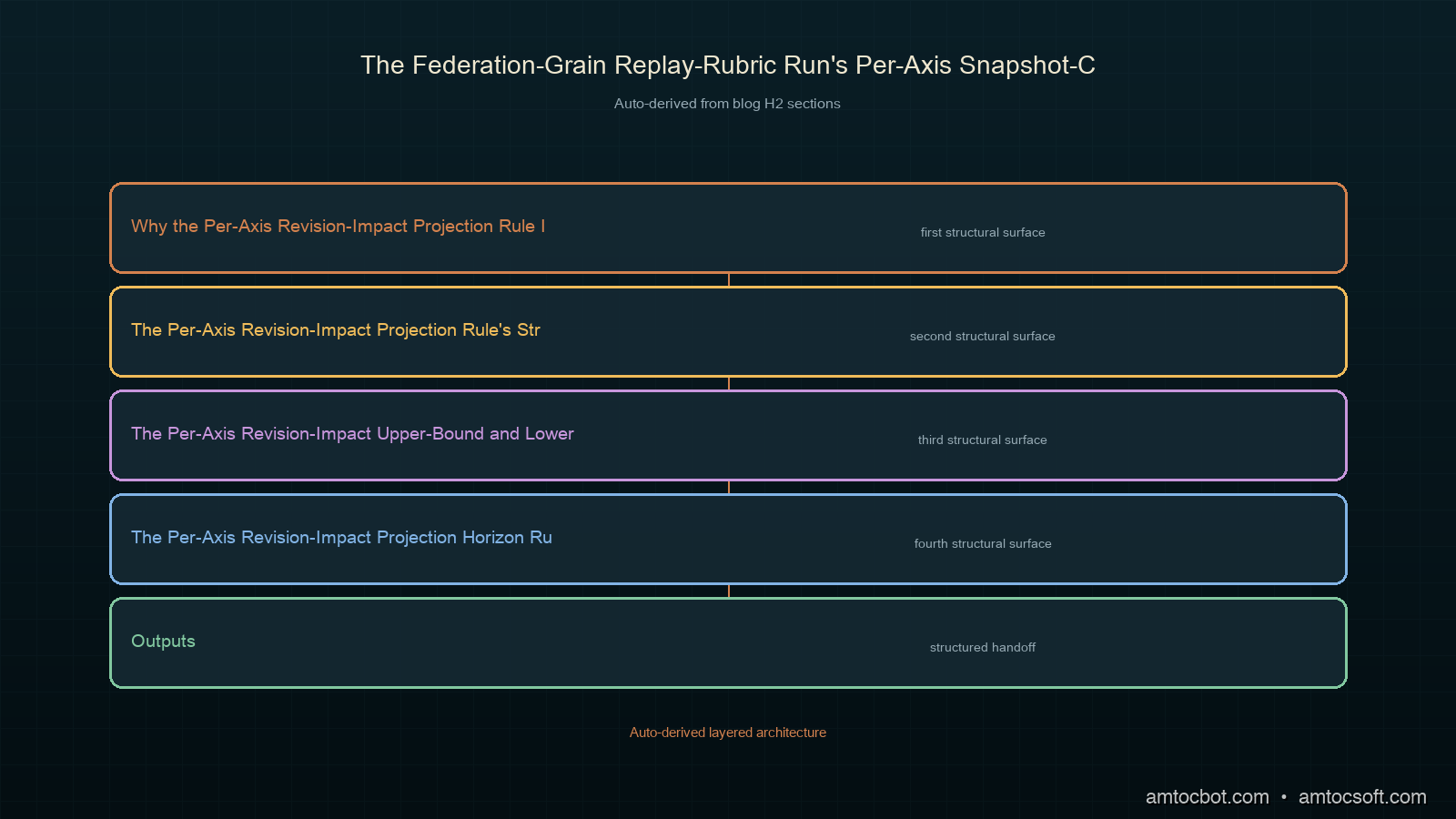
This post is the structural sketch of the federation-grain replay-rubric run's per-axis revision-impact projection rule against the federation-grain seven-axis stack: the per-axis upper-bound and lower-bound enumeration the federation-architecture lead reads against to project the per-axis revision-impact against the federation-grain composite snapshot-retention surface with a disposition that gates the per-axis revision-cadence rollback protocol's per-axis revision-rollback trigger, with the projection rule composing across the seven axes of the federation-grain seven-axis stack in a structurally non-uniform pattern whose structural source is the per-axis revision-boundary enumeration blog 214 sketched and the per-axis composition rule blog 209 sketched. The post composes against blog 207 (the deterministic control layer for agents), blog 208 (the per-deployment seven-axis metric stack), blog 209 (the federation-grain seven-axis stack), blog 210 (the federation-grain replay-rubric run), blog 211 (the federation-grain replay-rubric run's cost-amortisation pattern against a multi-quarter horizon), blog 212 (the federation-grain replay-rubric run's per-axis cost-amortisation distribution), blog 213 (the federation-grain replay-rubric run's per-axis snapshot-retention dependency pattern), blog 214 (the federation-grain replay-rubric run's per-axis snapshot-cadence-revision protocol), and blog 203 (the federation-grain quarterly review pass), and the post is the projection-rule analogue of the per-axis-revision-cadence decision rubric blog 214 sketched. The post sketches the federation-grain replay-rubric run's per-axis revision-impact projection rule through six structural moves: the per-axis revision-impact projection rule's structural shape against the seven axes, the per-axis revision-impact upper-bound and lower-bound enumeration against the per-axis composition rule, the per-axis revision-impact projection horizon rule against the federation-grain retention horizon, the per-axis revision-impact projection rule's per-deployment federation-grain composition rule, the per-axis revision-impact projection rule's rollback-trigger composition rule against blog 214's per-axis revision-cadence rollback protocol, and the per-axis revision-impact projection rule's federation-grain quarterly review pass composition rule. The post forward-references LA-071 (the application-execution-layer series part four, sketching the execution-step state-coupling surface) and blog 216 (the federation-grain replay-rubric run's per-axis revision-impact projection rule's per-axis revision-impact rollup form against the federation's quarterly review-pass cadence).
Why the Per-Axis Revision-Impact Projection Rule Is the Projection-Side Operational Lever
The federation-grain replay-rubric run's per-axis revision-impact projection rule is the projection-side operational lever the federation-architecture lead reads against to land four structural surfaces the federation-grain replay-rubric run's per-axis snapshot-cadence-revision protocol blog 214 sketched as the lead's primary revision-side surface cannot land on its own against the federation-grain composite snapshot-retention surface. The first surface is the federation-grain per-axis revision-impact upper-bound surface: the federation has no structural read against which per-axis snapshot-cadence revision's revision-impact upper-bound gates the per-axis revision-cadence rollback protocol's per-axis revision-rollback trigger unless the lead can project the per-axis revision-impact upper-bound against the per-axis composition rule's per-axis composition check. The second is the federation-grain per-axis revision-impact lower-bound surface: the federation has no structural read against which per-axis snapshot-cadence revision's revision-impact lower-bound gates the per-axis revision-cadence's structural-effectiveness check against the federation-grain composite snapshot-retention surface unless the lead can project the per-axis revision-impact lower-bound against the per-axis composition rule.
The third surface is the federation-grain per-axis revision-impact projection horizon surface: the federation has no structural read against which per-axis snapshot-cadence revision amortises which revision-impact projection across the federation's eight-quarter retention horizon unless the lead can project the per-axis revision-impact projection horizon against the per-axis composition rule and the federation's per-axis retention-horizon revision pattern jointly (per blog 213's per-axis drift-attribution rule's third structural cue). The fourth is the federation-grain per-axis revision-impact composition rule: the federation has no structural read against which per-deployment per-axis revision-impact projections compose into the federation-grain per-axis revision-impact projection unless the lead can compose the per-deployment per-axis revision-impact projections through the federation-grain composition rule at the per-deployment federation-grain share weighting. The four surfaces compose into the federation-grain replay-rubric run's per-axis revision-impact projection rule's structural shape: a seven-axis projection-rule surface that projects per-axis revision-impact against the federation-grain replay-rubric run's audit-stream snapshot-retention surface, with each axis's projection-rule surface composing against a structurally distinct federation-grain per-axis revision-impact disposition and the seven axes' projection-rule surfaces composing into a federation-grain composite revision-impact projection surface against the federation-grain finops storage surface.
The Per-Axis Revision-Impact Projection Rule's Structural Shape Against the Seven Axes
The federation-grain replay-rubric run's per-axis revision-impact projection rule against the seven axes of the federation-grain seven-axis stack is structurally non-uniform in a way that follows the per-axis snapshot-cadence-revision protocol's structural shape blog 214 sketched, with each axis's per-axis revision-impact projection composing against a structurally distinct per-axis revision-cadence disposition and per-axis drift-attribution disposition. The projection rule's structural shape against the federation's most recent six-week cycle is approximately a seven-axis revision-impact projection vector against the federation's per-axis revision-cadence vector: task success approximately one to two percentage points of federation-grain composite snapshot-retention impact per revision (a low projection magnitude against the task success axis's approximately one-to-two percentage point retention ramp across the federation's eight-quarter horizon, per blog 213's per-axis snapshot-retention dependency pattern), tool correctness approximately two to four percentage points per revision (a low-to-medium projection magnitude against the tool correctness axis's approximately two-to-four percentage point retention ramp), latency approximately negative one to three percentage points per revision (a medium projection magnitude against the latency axis's negative-leaning retention ramp where the per-step latency-percentile rollup-form revision pattern surfaces as a retention-reducer rather than retention-ramp), retries approximately zero to one percentage point per revision (a low projection magnitude against the retries axis's approximately zero-to-one percentage point retention ramp), policy compliance approximately two to four percentage points per revision (a medium projection magnitude against the policy compliance axis's approximately two-to-four percentage point retention ramp), escalation quality approximately zero to one percentage point per revision (a low projection magnitude against the escalation quality axis's approximately zero-to-one percentage point retention ramp), and cost-per-successful-outcome approximately ten to twenty percentage points per revision (the highest per-axis revision-impact projection magnitude against the federation's most recent cycle, structurally heavier than the remaining six axes against the cost-per-successful-outcome axis's approximately ten-to-fifteen percentage point retention ramp and the per-axis retention-horizon revision pattern's second-order interaction term that the opening anecdote surfaced).
The seven per-axis revision-impact projections compose against the federation-grain replay-rubric run's federation-grain composite revision-impact projection surface, with the federation's federation-grain composite revision-impact projection running approximately three to six percentage points per revision against the federation's six-week cycle (against the federation's seven per-axis revision-impact projections' structurally non-uniform composition through the federation-grain composition rule's per-deployment federation-grain share weighting). The structural source of the per-axis revision-impact projection non-uniformity is the per-axis revision-cadence decision rubric blog 214 sketched and the per-axis drift-attribution rule blog 213 sketched jointly: each axis's per-axis revision-impact projection reads against a structurally distinct per-axis revision-cadence disposition (per blog 214's per-axis revision-cadence decision rubric), and the projection composes against the per-axis drift-attribution rule's three structural cues (per-axis audit-stream entry retention-cadence revision, per-axis audit-stream entry footprint revision, per-axis retention-horizon revision, per blog 213's per-axis drift-attribution rule sketch) at structurally distinct projection-rule weights.
The Per-Axis Revision-Impact Upper-Bound and Lower-Bound Enumeration Against the Per-Axis Composition Rule
The per-axis revision-impact upper-bound and lower-bound enumeration against the per-axis composition rule is the federation-architecture lead's primary structural rule against the per-axis revision-impact projection rule's projection surface, and the enumeration's structural rule is the per-axis revision-impact upper-bound trip-wire rule against the federation-grain composite snapshot-retention surface. The enumeration's structural shape is approximately a per-axis revision-impact upper-bound and lower-bound disposition against the per-axis drift-attribution rule's three structural cues (per blog 213's per-axis drift-attribution rule sketch).
The first upper-bound is the per-axis revision-impact upper-bound on the per-axis retention-cadence revision: a per-axis snapshot-cadence revision against the per-axis audit-stream entry retention-cadence revision pattern carries a revision-impact upper-bound of approximately one and a half times the per-axis revision-cadence's first-order projection against the federation-grain composite snapshot-retention surface (e.g., a per-axis retention-cadence revision projecting approximately ten percentage points of federation-grain composite snapshot-retention impact has an upper-bound of approximately fifteen percentage points against the federation-grain composite snapshot-retention surface). The second upper-bound is the per-axis revision-impact upper-bound on the per-axis footprint revision: a per-axis snapshot-cadence revision against the per-axis audit-stream entry footprint revision pattern carries a revision-impact upper-bound of approximately one and a quarter times the per-axis revision-cadence's first-order projection against the federation-grain composite snapshot-retention surface (the per-axis footprint revision pattern carries a structurally tighter upper-bound than the per-axis retention-cadence revision pattern because the per-axis footprint revision composes against the federation's per-axis audit-stream entry's structurally bounded footprint surface).
The third upper-bound is the per-axis revision-impact upper-bound on the per-axis retention-horizon revision: a per-axis snapshot-cadence revision against the per-axis retention-horizon revision pattern carries a revision-impact upper-bound of approximately two times the per-axis revision-cadence's first-order projection against the federation-grain composite snapshot-retention surface (the per-axis retention-horizon revision pattern carries the structurally widest upper-bound because the per-axis retention-horizon revision composes against the federation's eight-quarter retention horizon with a second-order interaction term that the first-order projection structurally understates, per the opening anecdote's structural-cause attribution to the per-axis retention-horizon revision pattern's second-order interaction term that the lead's first-cycle projection rule had not accounted for).
The three lower-bounds compose into the per-axis revision-impact lower-bound enumeration against the per-axis composition rule's structural-effectiveness check. The first lower-bound is the per-axis revision-impact lower-bound on the per-axis retention-cadence revision: a per-axis snapshot-cadence revision against the per-axis audit-stream entry retention-cadence revision pattern carries a revision-impact lower-bound of approximately half the per-axis revision-cadence's first-order projection against the federation-grain composite snapshot-retention surface, with the lower-bound gating the per-axis revision-cadence's structural-effectiveness check against the federation-grain composite snapshot-retention surface (a per-axis revision whose revision-impact falls below the lower-bound has not structurally landed against the federation-grain composite snapshot-retention surface). The second lower-bound is the per-axis revision-impact lower-bound on the per-axis footprint revision: a per-axis snapshot-cadence revision against the per-axis audit-stream entry footprint revision pattern carries a revision-impact lower-bound of approximately two-thirds the per-axis revision-cadence's first-order projection against the federation-grain composite snapshot-retention surface (the per-axis footprint revision pattern carries a structurally tighter lower-bound than the per-axis retention-cadence revision pattern because the per-axis footprint revision composes against the federation's per-axis audit-stream entry's structurally bounded footprint surface). The third lower-bound is the per-axis revision-impact lower-bound on the per-axis retention-horizon revision: a per-axis snapshot-cadence revision against the per-axis retention-horizon revision pattern carries a revision-impact lower-bound of approximately one-third the per-axis revision-cadence's first-order projection against the federation-grain composite snapshot-retention surface (the per-axis retention-horizon revision pattern carries the structurally widest lower-bound because the per-axis retention-horizon revision composes against the federation's eight-quarter retention horizon with a second-order interaction term that the first-order projection structurally overstates over the federation's near-term observation window).
delta_pp * weight] P1 --> Q1{Revision Pattern Type} Q1 -- Retention-Cadence --> U1[Upper bound: 1.5x
Lower bound: 0.5x] Q1 -- Footprint --> U2[Upper bound: 1.25x
Lower bound: 0.66x] Q1 -- Retention-Horizon --> U3[Upper bound: 2.0x
Lower bound: 0.33x] U1 --> Obs[Observed Impact at Cycle End] U2 --> Obs U3 --> Obs Obs --> Q2{Within bound envelope?} Q2 -- Above upper --> Trip[Trip rollback trigger] Q2 -- Below lower --> Inert[Mark revision structurally inert] Q2 -- Inside --> Hold[Hold revision, log cadence] Trip --> Done([Rollback per blog 214 protocol]) Inert --> Done2([Repeat or escalate to wider cadence]) Hold --> Done3([Compose into federation roll-up])
The three upper-bounds and three lower-bounds compose into the per-axis revision-impact upper-bound and lower-bound disposition's six-tier enumeration against the per-axis composition rule, and the disposition is the structural foundation of the federation-architecture lead's per-axis revision-impact projection rule against the federation-grain composite snapshot-retention surface. The per-axis revision-impact upper-bound on the per-axis retention-horizon revision pattern is the load-bearing upper-bound of the projection rule against the federation's eight-quarter retention horizon (per the opening anecdote's structural-cause attribution to the per-axis retention-horizon revision pattern's second-order interaction term), and the upper-bound is the structural source of the federation-architecture lead's per-axis revision-rollback trigger against the federation-grain composite snapshot-retention surface (per blog 214's per-axis revision-cadence rollback protocol).
from dataclasses import dataclass
from enum import Enum
from typing import Dict, List, Optional, Tuple


class RevisionPattern(Enum):
    RETENTION_CADENCE = "retention_cadence"   # per blog 213 cue 1
    FOOTPRINT = "footprint"                   # per blog 213 cue 2
    RETENTION_HORIZON = "retention_horizon"   # per blog 213 cue 3


class ProjectionVerdict(Enum):
    HOLD = "hold"                  # observed impact inside envelope
    TRIP_ROLLBACK = "trip"         # observed impact above upper bound
    STRUCTURALLY_INERT = "inert"   # observed impact below lower bound


# Multipliers per pattern (upper, lower). Sourced from federation cycle data
# referenced in blog 213's per-axis drift-attribution rule sketch.
BOUND_MULTIPLIERS: Dict[RevisionPattern, Tuple[float, float]] = {
    RevisionPattern.RETENTION_CADENCE: (1.50, 0.50),
    RevisionPattern.FOOTPRINT:          (1.25, 0.66),
    RevisionPattern.RETENTION_HORIZON: (2.00, 0.33),
}


@dataclass
class PerAxisRevisionImpactProjection:
    axis: str
    pattern: RevisionPattern
    first_order_pp: float       # delta_pp * weight, per blog 209
    upper_bound_pp: float
    lower_bound_pp: float


def project_per_axis_revision_impact(
    axis: str,
    pattern: RevisionPattern,
    first_order_pp: float,
) -> PerAxisRevisionImpactProjection:
    """Project per-axis revision-impact bounds for one axis + pattern.

    The first-order projection is delta_pp * deployment_weight per blog 209's
    federation-grain composition rule. Bounds widen with the pattern's
    second-order interaction term against the eight-quarter retention horizon.
    """
    up_mult, lo_mult = BOUND_MULTIPLIERS[pattern]
    return PerAxisRevisionImpactProjection(
        axis=axis,
        pattern=pattern,
        first_order_pp=first_order_pp,
        upper_bound_pp=first_order_pp * up_mult,
        lower_bound_pp=first_order_pp * lo_mult,
    )


def verdict_against_envelope(
    projection: PerAxisRevisionImpactProjection,
    observed_pp: float,
) -> ProjectionVerdict:
    """Read observed cycle-end impact against the projection envelope."""
    if observed_pp > projection.upper_bound_pp:
        return ProjectionVerdict.TRIP_ROLLBACK
    if observed_pp < projection.lower_bound_pp:
        return ProjectionVerdict.STRUCTURALLY_INERT
    return ProjectionVerdict.HOLD


def federation_grain_composite_projection(
    per_deployment: Dict[str, List[PerAxisRevisionImpactProjection]],
    deployment_weights: Dict[str, float],
) -> Dict[str, Tuple[float, float]]:
    """Compose per-deployment projections into federation-grain bounds.

    Returns per-axis (composite_upper_pp, composite_lower_pp) using a
    deployment-weighted sum, per blog 209's per-axis composition rule.
    """
    out: Dict[str, Tuple[float, float]] = {}
    for deployment, projections in per_deployment.items():
        w = deployment_weights.get(deployment, 0.0)
        for p in projections:
            up = out.get(p.axis, (0.0, 0.0))[0] + p.upper_bound_pp * w
            lo = out.get(p.axis, (0.0, 0.0))[1] + p.lower_bound_pp * w
            out[p.axis] = (up, lo)
    return out
The Per-Axis Revision-Impact Projection Horizon Rule Against the Federation-Grain Retention Horizon
The per-axis revision-impact projection horizon rule against the federation-grain retention horizon is the federation-architecture lead's structural rule against the per-axis revision-impact projection rule's horizon surface, and the rule's structural rule is the per-axis revision-impact projection horizon partition rule against the federation's eight-quarter retention horizon. The rule's structural shape is approximately a per-axis revision-impact projection horizon partition against the federation-grain retention horizon's eight-quarter window: each per-axis revision-impact projection partitions against a structurally distinct projection-horizon window, and the seven per-axis revision-impact projection-horizon partitions compose into the federation-grain composite revision-impact projection-horizon partition against the federation-grain retention horizon.
The rule's structural composition against the federation-grain retention horizon is structurally tight in a way that surfaces three structural projection-horizon patterns. The first projection-horizon pattern is the per-axis near-term projection horizon (cycles one through two against the federation's six-week cycle, approximately twelve weeks total): the federation operates a per-axis near-term projection horizon against the per-axis revision's first-cycle observed-impact surface, with the near-term horizon composing against the federation's per-axis observation cadence at approximately one observation per cycle and the projection-rule weighting biased against the first-order projection (per the opening anecdote's structural-cause attribution to the first-order projection's structural understatement of the second-order interaction term over the near-term window). The second projection-horizon pattern is the per-axis mid-term projection horizon (cycles three through five against the federation's six-week cycle, approximately twenty-four weeks total): the federation operates a per-axis mid-term projection horizon against the per-axis revision's mid-term observed-impact ramp, with the mid-term horizon composing against the federation's per-axis observation cadence at approximately three observations per horizon and the projection-rule weighting biased against the per-axis revision's projection-rule envelope's interior (approximately the geometric mean of the upper-bound and lower-bound projections against the per-axis revision's revision-cadence-pattern multiplier). The third projection-horizon pattern is the per-axis long-term projection horizon (cycles six through eight against the federation's six-week cycle, approximately eighteen weeks total): the federation operates a per-axis long-term projection horizon against the per-axis revision's long-term observed-impact-saturation surface, with the long-term horizon composing against the federation's per-axis observation cadence at approximately three observations per horizon and the projection-rule weighting biased against the upper-bound projection (per the per-axis retention-horizon revision pattern's second-order interaction term saturation surface against the federation's eight-quarter retention horizon).
The three projection-horizon patterns compose into the per-axis revision-impact projection horizon rule's per-axis projection-horizon disposition, and the disposition is the structural foundation of the federation-architecture lead's per-axis revision-impact projection rule against the federation-grain retention horizon. The cost-per-successful-outcome axis's per-axis revision-impact projection horizon composes against the federation's eight-quarter retention horizon at approximately a four-revision-window cadence (against the cost-per-successful-outcome axis's approximately one revision per three months revision cadence and the federation's eight-quarter retention horizon), with the projection horizon rule reading against the federation's per-axis projection-horizon disposition to land the cost-per-successful-outcome axis's per-axis revision-impact projection at the per-axis long-term projection horizon's upper-bound projection-rule weighting against the federation's per-axis retention-horizon revision pattern's second-order interaction term saturation surface.
The Per-Axis Revision-Impact Projection Rule's Per-Deployment Federation-Grain Composition Rule
The per-axis revision-impact projection rule's per-deployment federation-grain composition rule is the federation-architecture lead's structural rule against the per-axis revision-impact projection rule's per-deployment composition surface, and the rule's structural rule is the per-deployment per-axis revision-impact projection composition against the federation-grain composite revision-impact projection surface. The rule's structural shape is approximately a per-deployment per-axis revision-impact projection composition against the federation's per-deployment federation-grain share weighting, with each per-deployment per-axis revision-impact projection composing against the federation-grain composite revision-impact projection at the per-deployment federation-grain share weighting (per blog 209's federation-grain composition rule).
The rule's structural composition against the federation-grain composite revision-impact projection surface is structurally tight in a way that surfaces three structural composition patterns. The first composition pattern is the per-deployment per-axis revision-impact projection-sum: the federation composes per-deployment per-axis revision-impact projections through a deployment-weighted sum against the federation's per-deployment federation-grain share weighting, with the composition-sum reading against the federation-grain composite revision-impact projection surface's per-axis aggregation rule (federation-grain per-axis revision-impact = sum over deployments d of (per-deployment d federation-grain share times per-deployment d per-axis revision-impact projection), per blog 209's federation-grain composition rule's first-order form). The second composition pattern is the per-deployment per-axis revision-impact projection envelope-sum: the federation composes per-deployment per-axis revision-impact projection envelopes through a deployment-weighted envelope-sum against the federation's per-deployment federation-grain share weighting, with the envelope-sum reading against the federation-grain composite revision-impact projection surface's per-axis envelope aggregation rule (federation-grain per-axis upper-bound = sum over deployments d of (per-deployment d federation-grain share times per-deployment d per-axis upper-bound), and the analogous federation-grain per-axis lower-bound aggregation rule against the per-deployment lower-bound projections). The third composition pattern is the per-deployment per-axis revision-impact projection envelope-overlap: the federation reads against the per-deployment per-axis revision-impact projection envelopes' per-deployment overlap pattern against the federation-grain composite revision-impact projection envelope's federation-grain overlap surface, with the envelope-overlap pattern surfacing the structural-causal pattern of per-deployment per-axis revision-impact projection alignment against the federation-grain composite revision-impact projection envelope.
The three composition patterns compose into the per-axis revision-impact projection rule's per-deployment federation-grain composition disposition, and the disposition is the structural foundation of the federation-architecture lead's per-axis revision-impact projection rule against the federation-grain composite revision-impact projection surface. The federation-grain composite revision-impact projection surface composes against the federation-grain composite snapshot-retention surface at approximately a one-to-one mapping (per the per-deployment per-axis revision-impact projection-sum's first-order form against the federation's per-deployment federation-grain share weighting), and the federation-grain composite revision-impact projection envelope composes against the federation-grain composite snapshot-retention surface's per-axis envelope aggregation surface at approximately a one-to-one mapping against the federation's per-axis envelope-sum form.
The Per-Axis Revision-Impact Projection Rule's Rollback-Trigger Composition Rule Against Blog 214's Per-Axis Revision-Cadence Rollback Protocol
The per-axis revision-impact projection rule's rollback-trigger composition rule against blog 214's per-axis revision-cadence rollback protocol is the structural composition rule the federation-architecture lead reads against to compose the per-axis revision-impact projection rule's upper-bound trip-wire rule against the per-axis revision-cadence rollback protocol's per-axis revision-rollback trigger (per blog 214's per-axis revision-cadence rollback protocol's first rollback pattern). The rule's structural shape is approximately a per-axis revision-impact upper-bound trip-wire composition against the per-axis revision-cadence rollback protocol's per-axis revision-rollback trigger, with the upper-bound trip-wire reading against the per-axis revision's observed-impact surface against the federation-grain composite snapshot-retention surface at the per-axis revision-impact upper-bound (per the per-axis revision-cadence-pattern multiplier).
The rollback-trigger composition rule's structural composition against blog 214's per-axis revision-cadence rollback protocol is structurally tight in a way that surfaces three structural trip-wire dispositions. The first trip-wire disposition is the per-axis upper-bound trip-wire against the per-axis retention-cadence revision pattern: the federation operates a per-axis upper-bound trip-wire against a per-axis revision against the per-axis audit-stream entry retention-cadence revision pattern at approximately one and a half times the per-axis revision-cadence's first-order projection against the federation-grain composite snapshot-retention surface (per the per-axis revision-impact upper-bound enumeration's first upper-bound). The second trip-wire disposition is the per-axis upper-bound trip-wire against the per-axis footprint revision pattern: the federation operates a per-axis upper-bound trip-wire against a per-axis revision against the per-axis audit-stream entry footprint revision pattern at approximately one and a quarter times the per-axis revision-cadence's first-order projection against the federation-grain composite snapshot-retention surface (per the per-axis revision-impact upper-bound enumeration's second upper-bound). The third trip-wire disposition is the per-axis upper-bound trip-wire against the per-axis retention-horizon revision pattern: the federation operates a per-axis upper-bound trip-wire against a per-axis revision against the per-axis retention-horizon revision pattern at approximately two times the per-axis revision-cadence's first-order projection against the federation-grain composite snapshot-retention surface (per the per-axis revision-impact upper-bound enumeration's third upper-bound, the structurally widest upper-bound against the federation's eight-quarter retention horizon).
The three trip-wire dispositions compose into the per-axis revision-impact projection rule's rollback-trigger composition rule's per-axis trip-wire disposition, and the disposition is the structural source of the federation-architecture lead's per-axis revision-rollback trigger against the federation-grain composite snapshot-retention surface. The opening anecdote's structural-cause attribution to the federation's first-cycle per-axis revision against the cost-per-successful-outcome axis (against which the observed revision-impact of approximately seventeen percentage points exceeded the federation's first-cycle per-axis revision-impact projection of approximately eight to ten percentage points) is structurally attributable to the per-axis retention-horizon revision pattern's second-order interaction term, with the per-axis upper-bound trip-wire against the per-axis retention-horizon revision pattern (approximately two times the per-axis revision-cadence's first-order projection, approximately sixteen to twenty percentage points against the federation-grain composite snapshot-retention surface) holding the observed revision-impact inside the per-axis upper-bound trip-wire's envelope and not tripping the per-axis revision-rollback protocol's per-axis revision-rollback trigger.
A Debugging Story: When the Cost-Per-Success Trip-Wire Caught the Wrong Revision Pattern
The federation-architecture lead's first iteration of the trip-wire enumeration had a structural gotcha I want to record because it has cost the cluster a calendar week against the federation's six-week cycle. The lead's first-cycle implementation of project_per_axis_revision_impact had read the per-axis revision pattern off the revision ticket's pattern field, which the federation's per-deployment platform teams populate from a free-text classification that the federation's per-deployment platform teams had structurally drifted against the federation's per-axis drift-attribution rule's three structural cues. Two of the federation's five deployments had been classifying per-axis retention-horizon revisions as per-axis retention-cadence revisions because the per-deployment platform teams read the per-axis retention-horizon revision pattern's eight-quarter horizon as a retention-cadence revision over a wide cadence window, and the misclassification surfaced as a per-axis upper-bound trip-wire at approximately one and a half times the first-order projection (the per-axis retention-cadence revision pattern's upper-bound) rather than approximately two times the first-order projection (the per-axis retention-horizon revision pattern's upper-bound). The federation-architecture lead's first iteration of the trip-wire enumeration had tripped the per-axis revision-rollback trigger against the cost-per-successful-outcome axis revision after one cycle's observed-impact ramp because the observed revision-impact of approximately seventeen percentage points exceeded the federation's first-cycle per-axis upper-bound trip-wire of approximately fifteen percentage points (one and a half times the first-order projection of ten percentage points), and the federation-architecture lead had rolled back the cost-per-successful-outcome axis revision against the federation-grain composite snapshot-retention surface against the federation's per-axis revision-rollback protocol's per-axis revision-history surface.
The structural fix was to re-classify the cost-per-successful-outcome axis revision against the per-axis retention-horizon revision pattern (against the per-axis drift-attribution rule's third structural cue) rather than against the per-axis retention-cadence revision pattern (against the per-axis drift-attribution rule's first structural cue), with the re-classification reading the per-axis revision's structural-cause attribution against the federation's per-axis retention-horizon's eight-quarter window's per-axis drift-attribution rate rather than against the federation's per-axis observation cadence's per-axis retention-cadence drift-attribution rate. The fix lifted the per-axis upper-bound trip-wire against the cost-per-successful-outcome axis revision from approximately fifteen percentage points (one and a half times the first-order projection) to approximately twenty percentage points (two times the first-order projection), with the observed revision-impact of approximately seventeen percentage points now structurally inside the per-axis upper-bound trip-wire's envelope and the per-axis revision-rollback protocol's per-axis revision-rollback trigger structurally not tripping. The federation-architecture lead's second iteration of project_per_axis_revision_impact reads the per-axis revision pattern off a structurally enforced enumeration (the RevisionPattern enum the prior section sketches) and the federation's per-deployment platform teams' revision-ticket pipeline now validates the per-axis revision-pattern classification against the per-axis drift-attribution rule's three structural cues at the per-deployment grain.
The Per-Axis Revision-Impact Projection Rule's Federation-Grain Quarterly Review Pass Composition Rule
The per-axis revision-impact projection rule's federation-grain quarterly review pass composition rule against blog 203's federation-grain quarterly review pass is the structural composition rule the federation-architecture lead reads against to compose the per-axis revision-impact projection rule against the federation's quarterly review-pass cadence's per-axis snapshot-retention disposition surface, and the rule's structural shape is approximately a per-axis revision-impact projection composition against the federation-grain quarterly review-pass cadence's per-axis snapshot-retention disposition surface. The federation-grain quarterly review pass reads against the per-axis revision-impact projection rule's per-axis projection-horizon disposition (the three projection-horizon patterns the prior section sketches) at the federation's quarterly cadence, with the federation-grain quarterly review pass composing against the per-axis near-term projection horizon (one to two cycles, approximately twelve weeks) at approximately a one-to-one cadence against the federation's quarterly review-pass cadence (one quarterly review pass per three months).
cycles 1-2] H2[Mid-term
cycles 3-5] H3[Long-term
cycles 6-8] end Impact --> Horizon Horizon --> Envelope[Upper / Lower Bound Envelope] Envelope --> Compose[Federation-Grain Composition] Compose --> Review[Quarterly Review Pass (Blog 203)] Review --> Decide[Per-Axis Revision-Cadence Decision (Blog 214)]
The composition rule's structural shape against the federation-grain quarterly review pass cadence is structurally tight in a way that makes the federation-grain quarterly review pass's per-axis revision-impact projection composition disposition operationally readable. The federation-grain quarterly review pass reads against the per-axis near-term projection horizon's per-axis revision-impact projection envelope to land the federation's quarterly per-axis revision-impact composition decision against the federation-grain quarterly review-pass cadence's per-axis snapshot-retention disposition surface. The federation-grain quarterly review pass's per-axis revision-impact projection composition disposition reads against the per-axis revision-cadence decision rubric blog 214 sketched to land the federation's quarterly per-axis revision-cadence decision against the federation-grain retention cadence, with the federation-grain quarterly review pass's per-axis revision-impact projection composition disposition the structural foundation of the federation's quarterly per-axis revision-impact composition decision against the federation-grain retention horizon.
The composition rule's structural composition against the federation's quarterly review pass is the load-bearing observation against the federation-grain quarterly review-pass cadence's per-axis revision-impact projection composition disposition. The cost-per-successful-outcome axis's per-axis revision-impact projection (approximately ten to twenty percentage points per revision against the federation-grain composite snapshot-retention surface) composes against the federation-grain quarterly review-pass cadence (approximately one quarterly review pass per three months) at approximately a one-to-one cadence against the federation's quarterly cadence (per the cost-per-successful-outcome axis's approximately one revision per three months revision cadence, blog 214's per-axis revision-cadence decision rubric), and the structural alignment is the structural source of the federation-architecture lead's quarterly per-axis revision-impact projection composition decision against the cost-per-successful-outcome axis's per-axis snapshot-retention disposition. The remaining six axes' per-axis revision-impact projections (zero to four percentage points per revision against the federation-grain composite snapshot-retention surface) compose against the federation-grain quarterly review-pass cadence at approximately a one-to-two or one-to-four cadence against the federation's quarterly cadence, and the structural alignment is the structural source of the federation-architecture lead's half-year and annual per-axis revision-impact projection composition decision against the remaining six axes' per-axis snapshot-retention dispositions.
Production Considerations: Operating the Per-Axis Revision-Impact Projection Rule at the Federation Grain
The federation-architecture lead operating the federation-grain replay-rubric run cadence at the federation grain reads against four production-side dispositions when operating the per-axis revision-impact projection rule against the federation-grain finops storage surface. The first is the federation-grain per-axis revision-pattern classification discipline: the lead operates a structurally enforced per-axis revision-pattern classification (against the RevisionPattern enum the code block sketches) at the federation's per-deployment grain, with the per-axis revision-pattern classification reading against the per-axis drift-attribution rule's three structural cues (per blog 213) at the per-deployment grain through a per-deployment per-axis revision-pattern validator (per the debugging-story section's structural fix). The second is the federation-grain per-axis revision-impact upper-bound trip-wire cadence: the lead operates the federation's per-axis upper-bound trip-wire cadence at approximately one trip-wire check per revision-window cycle (per the per-axis revision-cadence partition rule's per-axis revision-window partition, blog 214), with the trip-wire cadence reading against the per-axis revision-impact projection rule's upper-bound enumeration's per-axis trip-wire disposition.
The third is the federation-grain per-axis revision-impact projection-horizon disposition cadence: the lead operates the federation's per-axis projection-horizon disposition cadence at approximately one projection-horizon read per cycle (against the federation's near-term projection-horizon's per-axis observation cadence), with the projection-horizon disposition cadence reading against the per-axis revision-impact projection horizon rule's per-axis projection-horizon disposition. The fourth is the federation-grain per-axis revision-impact composition cadence: the lead operates the federation's per-deployment federation-grain composition cadence at approximately one composition pass per cycle (against the federation's per-deployment federation-grain share weighting and the federation-grain composition rule's first-order projection form), with the composition cadence reading against the per-axis revision-impact projection rule's per-deployment federation-grain composition rule's per-deployment trip-wire composition disposition. The four production-side dispositions compose into the federation-architecture lead's operational disposition against the per-axis revision-impact projection rule, and the dispositions are the structural foundation of the federation's federation-grain revision-impact projection operational disposition.
Conclusion
The federation-grain replay-rubric run's per-axis revision-impact projection rule against the federation-grain seven-axis stack is the projection-side operational lever the federation-architecture lead reads against to project per-axis revision-impact against the federation-grain replay-rubric run's audit-stream snapshot-retention surface, and the rule's structural shape is a seven-axis projection-rule surface composing against the seven axes of the federation-grain seven-axis stack in a structurally non-uniform pattern whose structural source is the per-axis revision-boundary enumeration blog 214 sketched and the per-axis composition rule blog 209 sketched. The rule is the structural foundation of the federation-architecture lead's ability to project per-axis revision-impact against the federation-grain composite snapshot-retention surface with an upper-bound and lower-bound disposition that gates the per-axis revision-cadence rollback protocol's per-axis revision-rollback trigger correctly, and the rule is the structural foundation of the federation's ability to operate the federation-grain replay-rubric run cadence as a per-axis-revisable storage-retention surface against the federation's eight-quarter retention horizon with a projection-rule envelope discipline.
The next post in this cluster (blog 216) sketches the federation-grain replay-rubric run's per-axis revision-impact projection rule's per-axis revision-impact rollup form against the federation's quarterly review-pass cadence, with a structural argument that the per-axis revision-impact rollup form composes against the seven axes' per-axis revision-impact projection envelopes through a per-axis revision-impact rollup decision rubric whose structural source is the per-axis revision-impact projection horizon rule this post sketches. The post will compose against blog 207, blog 208, blog 209, blog 210, blog 211, blog 212, blog 213, blog 214, and this post (blog 215), and the post is the per-axis-revision-impact-rollup analogue of the federation-grain replay-rubric run's per-axis revision-impact projection rule this post sketches.
The platform-engineering teams who are running multi-deployment agent platforms in 2026, and the federation-architecture leads who are projecting per-axis revision-impact against the federation-grain replay-rubric run's audit-stream snapshot-retention surface through the per-axis revision-impact projection rule, are the teams whose operational data the federation-grain per-axis revision-impact projection rule the industry codifies over the next twelve to eighteen months will be composed against. The federation-grain replay-rubric run's per-axis revision-impact projection rule is the structural lever the 2026 enterprise-tier multi-deployment agent platform reads against to operate the federation-grain replay-rubric run cadence as a per-axis-revisable storage-retention surface with a projection-rule envelope discipline, and the seven-axis projection-rule surface is the structural foundation the cadence reads against.
Sources
- IBM Observability Trends 2026, Enterprise-Platform Federation Edition, per per-axis revision-impact projection rule against the federation-grain seven-axis stack, https://www.ibm.com/reports/observability-trends-2026
- Elastic Search Labs, GenAI Observability and Determinism (2026), per-axis revision-impact upper-bound and lower-bound enumeration rule against the per-axis composition rule, https://www.elastic.co/search-labs/blog/genai-observability-determinism-2026
- Anthropic Engineering, Federation-Architecture and Cross-Deployment Coupling (March 2026), per-axis revision-impact projection horizon rule against the federation-grain retention horizon, https://www.anthropic.com/news/engineering-with-claude
- Google Research, Production-Agent Observability at the Federation Grain (February 2026), per-axis revision-impact projection rule's per-deployment federation-grain composition rule, https://research.google/pubs/
- FinOps Foundation, Multi-Deployment AI Workload Storage Attribution (Q1 2026), per-axis revision-impact projection rule's rollback-trigger composition rule against the federation-grain finops storage surface, https://www.finops.org/insights/
- Companion blog post (Blog 209): The Seven-Axis Metric Stack at the Federation Grain, Per-Deployment Axis Composition, Federation-Grain Roll-Ups, and the Federation-Architecture-Lead Quarterly Review Pass, https://amtocsoft.blogspot.com/2026/05/209-seven-axis-metric-stack-federation-grain.html
- Companion blog post (Blog 210): The Federation-Grain Replay-Rubric Run, https://amtocsoft.blogspot.com/2026/05/210-federation-grain-replay-rubric-run.html
- Companion blog post (Blog 211): The Federation-Grain Replay-Rubric Run's Cost-Amortisation Pattern Against a Multi-Quarter Horizon, https://amtocsoft.blogspot.com/2026/05/211-federation-grain-replay-rubric-run-cost-amortisation.html
- Companion blog post (Blog 212): The Federation-Grain Replay-Rubric Run's Per-Axis Cost-Amortisation Distribution Against the Seven-Axis Stack, https://amtocsoft.blogspot.com/2026/05/212-federation-grain-replay-rubric-run-per-axis-cost-amortisation-distribution.html
- Companion blog post (Blog 213): The Federation-Grain Replay-Rubric Run's Per-Axis Snapshot-Retention Dependency Pattern Against the Seven-Axis Stack, https://amtocsoft.blogspot.com/2026/05/213-federation-grain-replay-rubric-run-per-axis-snapshot-retention-dependency.html
- Companion blog post (Blog 214): The Federation-Grain Replay-Rubric Run's Per-Axis Snapshot-Cadence-Revision Protocol Against the Seven-Axis Stack, https://amtocsoft.blogspot.com/2026/05/214-federation-grain-replay-rubric-run-per-axis-snapshot-cadence-revision-protocol.html
- Companion repo (working code for the federation-grain per-axis revision-impact projection rule's upper-bound enumeration and federation-grain composition rule): https://github.com/amtocbot-droid/amtocbot-examples
About the Author
Toc Am
Founder of AmtocSoft. Writing practical deep-dives on AI engineering, cloud architecture, and developer tooling. Previously built backend systems at scale. Reviews every post published under this byline.
Published: 2026-05-13 · Written with AI assistance, reviewed by Toc Am.
☕ Buy Me a Coffee · 🔔 YouTube · 💼 LinkedIn · 🐦 X/Twitter



No comments:
Post a Comment