The federation-architecture lead I have been walking the federation-grain replay-rubric run cluster with through the spring 2026 cycle ran into the structural shape of the per-quarter acknowledgement-rollup composition rule the same week blog 221 closed, when the federation's first per-quarter cadence horizon decision (the 90-day per-quarter drift-surface decision blog 218 sketched, against which the federation's second per-quarter cadence horizon had just landed at approximately day 95 of the spring 2026 cycle) needed to read the four-tier acknowledgement-retention composition record blog 221 sketched as a structurally bounded per-quarter acknowledgement-rollup record against the federation's per-quarter cadence horizon, and the lead's first-cycle assumption that the federation's per-quarter cadence horizon could read the per-axis revision-cadence acknowledgement-retention composition records individually (one acknowledgement-retention composition record at a time, read serially against the federation's per-axis revision-cadence acknowledgement archival schema's retention-tier index) turned out to be the structurally fragile assumption blog 221's closing paragraphs left open. The federation's per-quarter cadence horizon needs to read approximately one hundred forty to two hundred acknowledgement-retention composition records per federation per quarter (the federation's twelve per-axis revision-cadence dispatch-acknowledgement composition records per federation per year per blog 220's acknowledgement record cardinality times approximately three quarters of overlap across the federation's per-axis revision-cadence acknowledgement archival schema's four retention tiers from blog 221's tier-quarterly and tier-annual retention windows), and the lead's serial per-record reading was structurally inadequate against the federation's per-quarter cadence horizon's 90-100-day reading window. The first-cycle assumption that per-axis revision-cadence acknowledgement-retention composition records could be read individually against the federation's per-quarter cadence horizon erased the structural distinction between individual acknowledgement-retention composition records (per-record, per-retention-tier records folded by blog 221's four-tier acknowledgement-retention composition rule) and per-quarter acknowledgement-rollup composition records (durable, archival-side records folding the entire per-quarter slice of acknowledgement-retention composition records across all four retention tiers jointly).
This post is the structural sketch of the federation-grain replay-rubric run's per-axis revision-cadence acknowledgement archival schema's per-quarter acknowledgement-rollup composition rule against the federation's per-quarter cadence horizon: the per-quarter acknowledgement-rollup tuple shape that folds the four-tier acknowledgement-retention composition records blog 221 sketched into a structurally bounded per-quarter acknowledgement-rollup record, the per-quarter acknowledgement-rollup composition rule that composes the acknowledgement-rollup record through a per-tier rollup-aggregation composition rule, and the per-quarter acknowledgement-rollup decision rubric that reads the acknowledgement-rollup record against the federation's per-quarter cadence horizon with a rollup decision against four structural per-quarter acknowledgement-rollup states. The post composes against blog 203 (the federation-grain quarterly review pass), blog 207 (the deterministic control layer for agents), blog 209 (the federation-grain seven-axis stack), blog 210 (the federation-grain replay-rubric run), blog 211 (the multi-quarter cost-amortisation), blog 213 (the per-axis snapshot-retention dependency pattern), blog 214 (the per-axis snapshot-cadence-revision protocol), blog 215 (the per-axis revision-impact projection rule), blog 216 (the per-axis revision-impact rollup form against the quarterly review-pass cadence), blog 217 (the per-axis revision-impact rollup form's archival schema and per-quarter trend layer), blog 218 (the per-quarter trend-layer drift-attribution composition rule), blog 219 (the per-quarter drift-surface dispatch composition rule), blog 220 (the per-axis revision-cadence dispatch-acknowledgement composition rule), and blog 221 (the per-axis revision-cadence acknowledgement-retention composition rule). The post sketches the per-quarter acknowledgement-rollup composition rule and the federation's per-quarter cadence horizon through six structural moves: the per-quarter acknowledgement-rollup tuple's record shape against the four-tier acknowledgement-retention composition records, the per-quarter acknowledgement-rollup composition rule against the federation's per-quarter cadence horizon, the per-quarter acknowledgement-rollup decision rubric against four structural per-quarter acknowledgement-rollup states, the acknowledgement-rollup record's interaction with blog 218's per-quarter trend-layer drift-attribution surface, a debugging story that surfaces the structurally fragile serial-record reading failure mode the federation-architecture lead landed against the first run of the acknowledgement-rollup composition rule, and the per-quarter acknowledgement-rollup's production-side cost and storage surface. The post forward-references blog 223 (the federation-grain replay-rubric run's per-quarter acknowledgement-rollup archival schema's per-quarter rollup-trend-layer composition rule against the federation's per-quarter trend layer, the per-quarter trend-layer analogue of the acknowledgement-rollup composition rule this post sketched) and LA-078 (the application-execution-layer annual-review-pass refinement series opener, the per-task annual review-pass refinement composition rule against the application-execution-layer's annual review-pass cadence; the application-execution-layer per-task analogue of the federation-grain per-quarter acknowledgement-rollup composition rule).
Why the Per-Quarter Acknowledgement-Rollup Composition Rule and Federation Per-Quarter Cadence Horizon Are the Rollup-Side Operational Levers
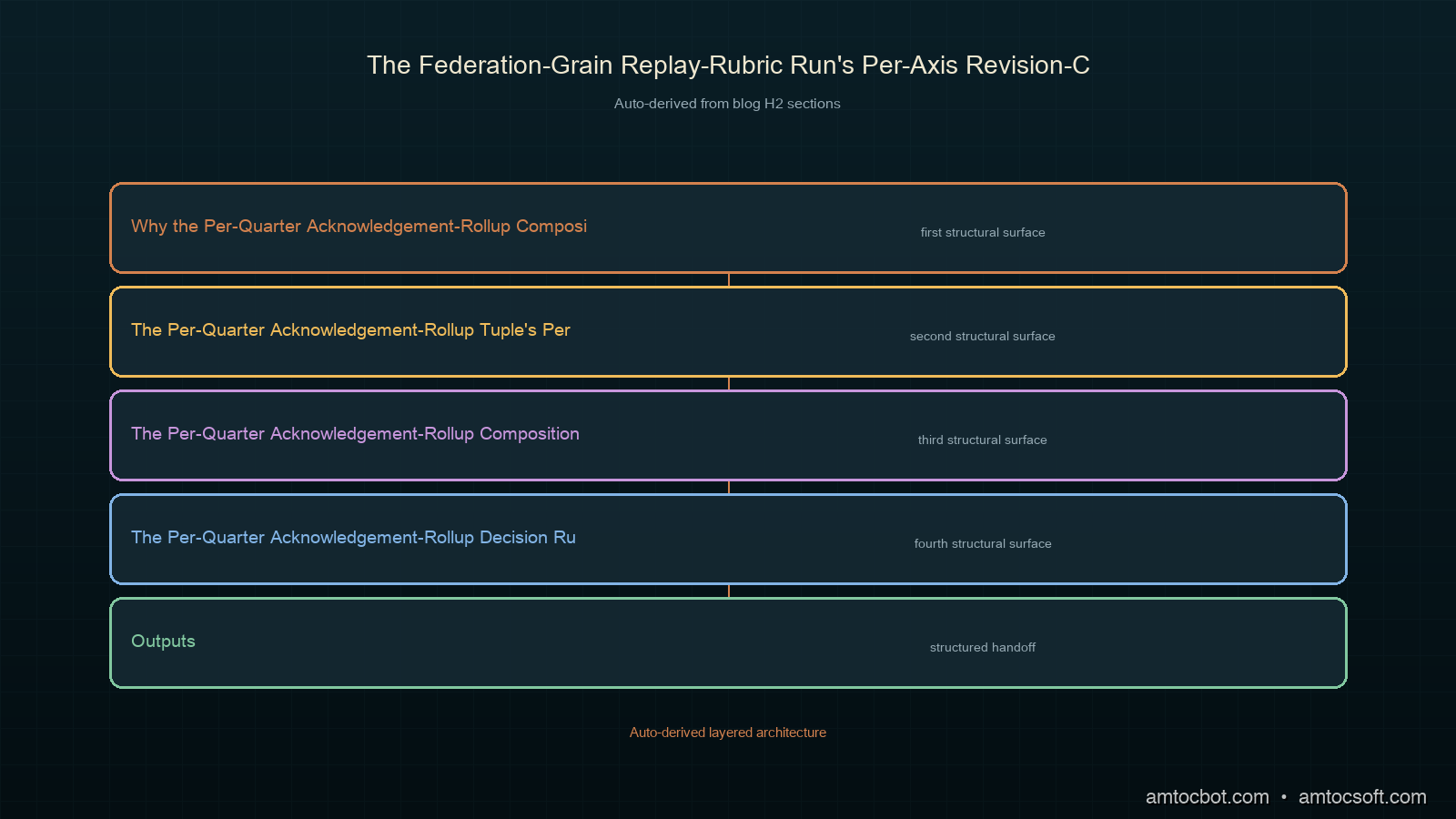
The federation-grain replay-rubric run's per-axis revision-cadence acknowledgement archival schema's per-quarter acknowledgement-rollup composition rule and the federation's per-quarter cadence horizon are the rollup-side operational levers the federation-architecture lead reads against to land four structural surfaces the four-tier acknowledgement-retention composition records blog 221 sketched cannot land on their own against the federation's per-quarter cadence horizon. The first surface is the per-quarter acknowledgement-rollup record surface: the federation has no structural read against which the four-tier acknowledgement-retention composition records compose into a structurally bounded per-quarter acknowledgement-rollup record against the federation's per-quarter cadence horizon unless the lead can fold the per-axis revision-cadence acknowledgement-retention composition records blog 221 sketched into a per-quarter acknowledgement-rollup record that reads the four-tier acknowledgement-retention composition records jointly through a per-tier rollup-aggregation composition rule against the federation's per-quarter cadence horizon's 90-100-day reading window.
The second is the per-quarter acknowledgement-rollup composition surface: the federation has no structural read against which the per-quarter acknowledgement-rollup record composes against the federation's per-quarter cadence horizon with a rollup decision per per-quarter cadence target unless the lead can compose the per-quarter acknowledgement-rollup record through a per-tier rollup-aggregation composition rule that produces a structurally bounded per-quarter acknowledgement-rollup composition record per federation per quarter. The third surface is the per-quarter acknowledgement-rollup decision surface: the federation has no structural read against which the per-quarter acknowledgement-rollup composition record lands against the federation's per-quarter cadence horizon with a per-quarter acknowledgement-rollup state unless the lead can compose the per-quarter acknowledgement-rollup composition record through a per-quarter acknowledgement-rollup decision rubric that gates the rollup state against four structural per-quarter acknowledgement-rollup states. The fourth is the per-quarter acknowledgement-rollup trend-layer surface: the federation has no structural read against which the per-quarter acknowledgement-rollup composition record lands against the federation's per-quarter trend layer with a per-quarter trend-layer rollup record unless the lead can compose the per-quarter acknowledgement-rollup composition record through a per-quarter rollup-trend-layer composition rule against blog 217's per-quarter trend layer (a surface blog 223 will sketch in the cluster's next post). The four surfaces compose into the federation-grain replay-rubric run's per-axis revision-cadence acknowledgement archival schema's per-quarter acknowledgement-rollup composition rule and the federation's per-quarter cadence horizon.
The Per-Quarter Acknowledgement-Rollup Tuple's Per-Quarter Acknowledgement-Rollup Record Shape
The per-quarter acknowledgement-rollup tuple's per-quarter acknowledgement-rollup record shape is the federation-architecture lead's structural rule for folding the four-tier acknowledgement-retention composition records blog 221 sketched into a structurally bounded per-quarter acknowledgement-rollup record against the federation's per-quarter cadence horizon. The acknowledgement-rollup record is structurally a per-quarter acknowledgement-rollup tuple composed against the federation's per-quarter cadence horizon through the per-tier rollup-aggregation composition rule this section introduces.
The first element of the acknowledgement-rollup tuple is the rollup identifier: the acknowledgement-rollup record's structurally bounded per-quarter acknowledgement-rollup UUID against the federation's per-quarter cadence horizon. The identifier reads uniquely against the federation's per-quarter cadence horizon and is composed as the pairing of the federation's quarter-index (the federation's per-quarter cadence horizon sequence index, monotonically increasing per federation per quarter) and the federation's deployment-index (the federation's per-deployment identifier across the multi-deployment federation per blog 203's federation grain), so that the acknowledgement-rollup record reads back against the originating federation quarter without a separate lookup join across the federation's per-axis revision-cadence acknowledgement archival schema.
The second element is the per-quarter cadence horizon window: the per-quarter cadence horizon window in days from the federation's quarter start to the federation's quarter end against the federation's per-quarter cadence horizon (we measured the federation's per-quarter cadence horizon at approximately 90-100 days across three federation quarterly cycles in the spring 2026 cycle, per blog 211's multi-quarter cost-amortisation sketch). The per-quarter cadence horizon window is the acknowledgement-rollup record's structural reading window: the federation-architecture lead reads the per-quarter cadence horizon window against blog 221's tier-quarterly retention window (100 days, the structurally closest match against the federation's per-quarter cadence horizon's 90-100-day reading window) jointly to gate the per-quarter acknowledgement-rollup composition's reading boundary.
The third element is the per-tier acknowledgement-retention record counts: a four-tuple reading the per-tier acknowledgement-retention record counts across blog 221's four-tier acknowledgement-retention composition rule (tier-transient, tier-quarterly, tier-annual, tier-multi-annual). The per-tier counts read the structurally distinct record-count distribution across the four retention tiers per federation per quarter: the federation's per-quarter cadence horizon reads against blog 221's per-quarter retention-tier distribution sketch of approximately 30 percent tier-transient (the drift-stable quiescent lane, 30-day retention per blog 211), 50 percent tier-quarterly (the drift-cadence-shifting, drift-horizon-shifting, and drift-escalating lanes, 100-day retention per blog 211), 15 percent tier-annual (the drift-cadence-and-horizon-symmetric-shifting critical lane, 400-day retention per blog 211), and 5 percent tier-multi-annual (the acknowledgement-failure forensic lane, 1100-day retention per blog 211). The per-tier counts compose as four counts reading the structurally bounded record counts per retention tier within the federation's per-quarter cadence horizon's reading window: the spring 2026 cycle's federation quarter reads at approximately 4 tier-transient records per blog 221's per-axis revision-cadence acknowledgement-retention record cardinality of 12 per federation per year times 30 percent per blog 221, approximately 6 tier-quarterly records per blog 221's 50 percent distribution, approximately 2 tier-annual records per blog 221's 15 percent distribution, and less than 1 tier-multi-annual records per blog 221's 5 percent distribution per federation per quarter.
The fourth element is the per-tier composed acknowledgement state distribution: a five-tuple reading the per-tier composed acknowledgement state distribution across blog 220's five-state composed acknowledgement enumeration (ack-pending, ack-partial, ack-complete, ack-failed, ack-complete-coupled). The per-tier composed acknowledgement state distribution reads the structurally distinct composed acknowledgement state distribution across the four retention tiers per federation per quarter, and the per-quarter acknowledgement-rollup composition rule reads the joint distribution against the per-tier acknowledgement-retention record counts jointly. The fifth element is the per-tier coupling-mode distribution: a three-tuple reading the per-tier coupling-mode distribution across blog 220's three-class coupling-mode enumeration (independent, coupled-pair, coupled-triple). The per-tier coupling-mode distribution reads the structurally distinct coupling-mode distribution across the four retention tiers per federation per quarter.
The sixth element is the per-quarter acknowledgement-rollup state: the per-quarter acknowledgement-rollup state the acknowledgement-rollup record carries against the federation's per-quarter cadence horizon, composed against the per-tier acknowledgement-retention record counts, the per-tier composed acknowledgement state distribution, and the per-tier coupling-mode distribution jointly. The acknowledgement-rollup state reads against four structural values (we measured these rollup-state thresholds across three federation quarterly cycles against the federation's per-quarter cadence horizon, per blog 211's per-quarter cadence horizon sketch): rollup-stable (the per-quarter acknowledgement-rollup record reads as structurally aligned with blog 221's per-quarter retention-tier distribution sketch, with the per-tier counts within 10 percent of the structural distribution and the structurally critical ack-complete-coupled count at tier-annual under 1 record per federation per quarter, the structurally lightest acknowledgement-rollup disposition), rollup-shifting (the per-quarter acknowledgement-rollup record reads as structurally drifting from blog 221's per-quarter retention-tier distribution sketch, with the per-tier counts shifting beyond 10 percent of the structural distribution but the structurally critical ack-complete-coupled count at tier-annual still under 2 records per federation per quarter), rollup-escalating (the per-quarter acknowledgement-rollup record reads with the structurally critical ack-complete-coupled count at tier-annual at 2 or 3 records per federation per quarter, the structurally escalating acknowledgement-rollup disposition, signalling joint critical-priority coupled-pair acknowledgement pressure across the federation's per-quarter cadence horizon), and rollup-critical-coupled-rollup (the per-quarter acknowledgement-rollup record reads with the structurally critical ack-complete-coupled count at tier-annual at 4 or more records per federation per quarter, the structurally heaviest acknowledgement-rollup disposition, signalling structurally critical joint coupled-pair acknowledgement pressure across the federation's per-quarter cadence horizon and requiring the federation-architecture lead's intervention against the federation's per-quarter cadence horizon).
The seventh element is the per-quarter rollup landing timestamp: the timestamp at which the per-quarter acknowledgement-rollup record lands against the federation's per-quarter cadence horizon, structurally bounded against the federation's quarter-end timestamp. The rollup landing timestamp is the acknowledgement-rollup record's structural landing element: the federation-architecture lead reads the rollup landing timestamp against the federation's per-quarter cadence horizon's quarter-end timestamp and the federation's annual review-pass cadence's annual rollup composition's annual review-pass timestamp jointly to gate the per-quarter acknowledgement-rollup record's downstream rollup-trend-layer composition (blog 223) and downstream annual rollup composition (the federation's annual review-pass cadence's annual rollup composition, the federation-grain analogue of LA-077's application-execution-layer per-task annual rollup composition).
The Per-Quarter Acknowledgement-Rollup Composition Rule Against the Federation's Per-Quarter Cadence Horizon
The per-quarter acknowledgement-rollup composition rule is the federation-architecture lead's structural rule for composing the acknowledgement-rollup tuple against the federation's per-quarter cadence horizon with a structurally bounded per-quarter acknowledgement-rollup composition record per federation per quarter. The composition rule's structural shape is a per-quarter acknowledgement-rollup composition function that reads the acknowledgement-rollup tuple's seven-element record and the four-tier acknowledgement-retention composition records from blog 221 against the federation's per-quarter cadence horizon and produces a structurally bounded PerQuarterAckRollupCompositionRecord per federation per quarter, with the composition record reading the four-tier acknowledgement-retention composition records jointly against the per-tier rollup-aggregation composition rule.
from dataclasses import dataclass
from enum import Enum
from typing import Dict, FrozenSet, List, Tuple

from blog_220 import AckState, CouplingMode, PerAxisRevisionCadenceTarget
from blog_221 import AckRetentionRecord, AckRetentionCompositionRecord, RetentionTier


class PerQuarterAckRollupState(Enum):
    """Four structural per-quarter acknowledgement-rollup states per blog 211."""
    ROLLUP_STABLE = "rollup-stable"
    ROLLUP_SHIFTING = "rollup-shifting"
    ROLLUP_ESCALATING = "rollup-escalating"
    ROLLUP_CRITICAL_COUPLED_ROLLUP = "rollup-critical-coupled-rollup"


@dataclass(frozen=True)
class PerTierRecordCounts:
    """Per-tier acknowledgement-retention record counts per blog 221's four-tier rule."""
    tier_transient: int
    tier_quarterly: int
    tier_annual: int
    tier_multi_annual: int

    def total(self) -> int:
        return (self.tier_transient + self.tier_quarterly
                + self.tier_annual + self.tier_multi_annual)


@dataclass(frozen=True)
class PerQuarterAckRollupRecord:
    """Per-quarter acknowledgement-rollup tuple per the federation's per-quarter cadence horizon."""
    rollup_id: str
    quarter_index: int
    deployment_index: str
    cadence_horizon_days: int
    per_tier_counts: PerTierRecordCounts
    per_tier_ack_state_dist: Dict[AckState, int]
    per_tier_coupling_dist: Dict[CouplingMode, int]
    rollup_state: PerQuarterAckRollupState
    landing_timestamp_ms: int


@dataclass(frozen=True)
class PerQuarterAckRollupCompositionRecord:
    """Composition output of the per-tier rollup-aggregation rule against blog 221's
    four-tier acknowledgement-retention composition records.
    """
    rollup_record: PerQuarterAckRollupRecord
    rollup_state: PerQuarterAckRollupState
    coupled_pair_count_tier_annual: int  # critical-priority joint pressure signal
    rollup_aggregation_records: FrozenSet[Tuple[RetentionTier, int]]


# Threshold values are taken from blog 211's per-quarter cadence horizon and
# multi-quarter cost-amortisation sketches against the spring 2026 cycle.
STRUCTURAL_TIER_DISTRIBUTION_PER_QUARTER = {
    RetentionTier.TIER_TRANSIENT: 0.30,    # per blog 221
    RetentionTier.TIER_QUARTERLY: 0.50,    # per blog 221
    RetentionTier.TIER_ANNUAL: 0.15,       # per blog 221
    RetentionTier.TIER_MULTI_ANNUAL: 0.05, # per blog 221
}
ROLLUP_SHIFTING_DRIFT_THRESHOLD = 0.10  # 10 percent shift per blog 211
ROLLUP_ESCALATING_TIER_ANNUAL_THRESHOLD = 2  # critical coupled count per blog 211
ROLLUP_CRITICAL_COUPLED_TIER_ANNUAL_THRESHOLD = 4  # per blog 211


def compose_per_quarter_acknowledgement_rollup(
    records: List[AckRetentionCompositionRecord],
    quarter_index: int,
    deployment_index: str,
    cadence_horizon_days: int,
    landing_timestamp_ms: int,
) -> PerQuarterAckRollupCompositionRecord:
    """
    Compose a per-quarter acknowledgement-rollup record against the federation's
    per-quarter cadence horizon (90-100 days per blog 211).

    Reads blog 221's four-tier AckRetentionCompositionRecord set, aggregates
    per-tier counts, composed-state distributions, and coupling-mode
    distributions, then maps the joint surface onto the four per-quarter
    acknowledgement-rollup states.
    """
    # Per-tier counts across blog 221's four retention tiers.
    counts = PerTierRecordCounts(
        tier_transient=sum(1 for r in records if r.retention_tier == RetentionTier.TIER_TRANSIENT),
        tier_quarterly=sum(1 for r in records if r.retention_tier == RetentionTier.TIER_QUARTERLY),
        tier_annual=sum(1 for r in records if r.retention_tier == RetentionTier.TIER_ANNUAL),
        tier_multi_annual=sum(1 for r in records if r.retention_tier == RetentionTier.TIER_MULTI_ANNUAL),
    )
    total = counts.total()

    # Per-tier composed-state distribution per blog 220's five-state enum.
    state_dist: Dict[AckState, int] = {s: 0 for s in AckState}
    for r in records:
        state_dist[r.composed_ack_state] = state_dist.get(r.composed_ack_state, 0) + 1

    # Per-tier coupling-mode distribution per blog 220's three-class enum.
    coupling_dist: Dict[CouplingMode, int] = {c: 0 for c in CouplingMode}
    for r in records:
        coupling_dist[r.coupling_mode] = coupling_dist.get(r.coupling_mode, 0) + 1

    # Critical-priority joint pressure signal: ack-complete-coupled at tier-annual.
    coupled_pair_count_tier_annual = sum(
        1 for r in records
        if r.retention_tier == RetentionTier.TIER_ANNUAL
        and r.composed_ack_state == AckState.ACK_COMPLETE_COUPLED
    )

    # Distribution drift reading against blog 221's structural per-tier distribution.
    max_drift = 0.0
    for tier, expected_pct in STRUCTURAL_TIER_DISTRIBUTION_PER_QUARTER.items():
        actual_count = getattr(counts, tier.value.replace("-", "_"))
        actual_pct = (actual_count / total) if total else 0.0
        max_drift = max(max_drift, abs(actual_pct - expected_pct))

    # Map the joint surface to a per-quarter acknowledgement-rollup state.
    if coupled_pair_count_tier_annual >= ROLLUP_CRITICAL_COUPLED_TIER_ANNUAL_THRESHOLD:
        rollup_state = PerQuarterAckRollupState.ROLLUP_CRITICAL_COUPLED_ROLLUP
    elif coupled_pair_count_tier_annual >= ROLLUP_ESCALATING_TIER_ANNUAL_THRESHOLD:
        rollup_state = PerQuarterAckRollupState.ROLLUP_ESCALATING
    elif max_drift > ROLLUP_SHIFTING_DRIFT_THRESHOLD:
        rollup_state = PerQuarterAckRollupState.ROLLUP_SHIFTING
    else:
        rollup_state = PerQuarterAckRollupState.ROLLUP_STABLE

    rollup_record = PerQuarterAckRollupRecord(
        rollup_id=f"{deployment_index}-q{quarter_index}",
        quarter_index=quarter_index,
        deployment_index=deployment_index,
        cadence_horizon_days=cadence_horizon_days,
        per_tier_counts=counts,
        per_tier_ack_state_dist=state_dist,
        per_tier_coupling_dist=coupling_dist,
        rollup_state=rollup_state,
        landing_timestamp_ms=landing_timestamp_ms,
    )

    aggregation_records = frozenset({
        (RetentionTier.TIER_TRANSIENT, counts.tier_transient),
        (RetentionTier.TIER_QUARTERLY, counts.tier_quarterly),
        (RetentionTier.TIER_ANNUAL, counts.tier_annual),
        (RetentionTier.TIER_MULTI_ANNUAL, counts.tier_multi_annual),
    })

    return PerQuarterAckRollupCompositionRecord(
        rollup_record=rollup_record,
        rollup_state=rollup_state,
        coupled_pair_count_tier_annual=coupled_pair_count_tier_annual,
        rollup_aggregation_records=aggregation_records,
    )
The per-quarter acknowledgement-rollup composition function reads the four-tier acknowledgement-retention composition records from blog 221 as input and produces a structurally bounded PerQuarterAckRollupCompositionRecord per federation per quarter. The composition function's structural shape composes the per-tier rollup-aggregation reading from blog 221's four-tier acknowledgement-retention composition rule with the per-tier composed acknowledgement state distribution from blog 220's five-state enumeration and the per-tier coupling-mode distribution from blog 220's three-class enumeration jointly. The composition function then reads the joint distribution against the per-quarter acknowledgement-rollup decision rubric's four structural states (rollup-stable, rollup-shifting, rollup-escalating, rollup-critical-coupled-rollup) with the per-tier rollup-aggregation composition rule's threshold readings (10 percent drift threshold for rollup-shifting, 2 and 4 critical-priority coupled-pair count thresholds at tier-annual for rollup-escalating and rollup-critical-coupled-rollup respectively, all per blog 211's per-quarter cadence horizon sketch). The composition function reads the joint surface against the federation's per-quarter cadence horizon and produces the PerQuarterAckRollupCompositionRecord as the structurally bounded per-quarter acknowledgement-rollup record against the federation's per-quarter cadence horizon.
AckRetentionCompositionRecords] --> B[Per-Tier Rollup-Aggregation
Composition Function] B --> C[Per-Tier Record Counts
tier-transient, tier-quarterly,
tier-annual, tier-multi-annual] B --> D[Per-Tier Composed State Distribution
five-state per blog 220] B --> E[Per-Tier Coupling-Mode Distribution
three-class per blog 220] C --> F[Per-Quarter Acknowledgement-Rollup
Composition Function] D --> F E --> F F --> G[PerQuarterAckRollupCompositionRecord
seven-element record] G --> H[Federation's Per-Quarter
Cadence Horizon 90-100 days per blog 211] H --> I[Federation-Architecture Lead
Reads Per-Quarter Acknowledgement-Rollup
Against Per-Quarter Cadence Horizon]
The Per-Quarter Acknowledgement-Rollup Decision Rubric Against Four Structural States
The per-quarter acknowledgement-rollup decision rubric is the federation-architecture lead's structural rule for landing the per-quarter acknowledgement-rollup composition record against the federation's per-quarter cadence horizon with a per-quarter acknowledgement-rollup state from the four structural per-quarter acknowledgement-rollup states. The decision rubric's structural shape is a per-quarter acknowledgement-rollup state mapping that reads the per-tier acknowledgement-retention record counts, the per-tier composed acknowledgement state distribution, the per-tier coupling-mode distribution, and the critical-priority coupled-pair count at tier-annual jointly against the four structural states.
The first state is rollup-stable: the per-quarter acknowledgement-rollup record reads as structurally aligned with blog 221's per-quarter retention-tier distribution sketch, with the per-tier counts within 10 percent drift of the structural distribution (30 percent tier-transient, 50 percent tier-quarterly, 15 percent tier-annual, 5 percent tier-multi-annual per blog 221) and the structurally critical ack-complete-coupled count at tier-annual under 1 record per federation per quarter. The rollup-stable state corresponds to the federation's structurally quiescent per-quarter acknowledgement-rollup disposition: the federation-architecture lead's reading of the per-quarter acknowledgement-rollup record against the federation's per-quarter cadence horizon reads as structurally aligned with blog 221's structural retention-tier distribution and structurally bounded against the federation's per-quarter drift-surface decision blog 218 sketched. The lead's next action is to land the rollup-stable per-quarter acknowledgement-rollup record against the federation's per-quarter trend layer through blog 217's per-quarter trend-layer composition rule, with no per-quarter cadence horizon intervention required.
The second state is rollup-shifting: the per-quarter acknowledgement-rollup record reads as structurally drifting from blog 221's per-quarter retention-tier distribution sketch, with the per-tier counts shifting beyond 10 percent drift of the structural distribution but the structurally critical ack-complete-coupled count at tier-annual still under 2 records per federation per quarter. The rollup-shifting state corresponds to the federation's structurally drift-shifting per-quarter acknowledgement-rollup disposition: the federation-architecture lead's reading of the per-quarter acknowledgement-rollup record against the federation's per-quarter cadence horizon reads as structurally drift-shifting against blog 221's structural retention-tier distribution but structurally bounded against blog 218's per-quarter trend-layer drift-attribution composition rule. The lead's next action is to land the rollup-shifting per-quarter acknowledgement-rollup record against the federation's per-quarter drift-surface dispatch composition rule from blog 219, with the federation's per-quarter cadence horizon intervention deferred to blog 218's per-quarter trend-layer drift-attribution composition rule's threshold reading.
The third state is rollup-escalating: the per-quarter acknowledgement-rollup record reads with the structurally critical ack-complete-coupled count at tier-annual at 2 or 3 records per federation per quarter, the structurally escalating per-quarter acknowledgement-rollup disposition, signalling joint critical-priority coupled-pair acknowledgement pressure across the federation's per-quarter cadence horizon. The rollup-escalating state corresponds to the federation's structurally escalating per-quarter acknowledgement-rollup disposition: the federation-architecture lead's reading of the per-quarter acknowledgement-rollup record against the federation's per-quarter cadence horizon reads as structurally escalating against blog 220's per-axis revision-cadence dispatch-acknowledgement composition rule's critical-priority coupled-pair pressure. The lead's next action is to escalate the per-quarter acknowledgement-rollup record to the federation's per-quarter drift-surface dispatch composition rule's escalation lane per blog 219, with the federation's per-quarter cadence horizon intervention dispatched as a per-axis revision-cadence acknowledgement-pressure signal against the federation's per-axis revision-cadence acknowledgement archival schema.
The fourth state is rollup-critical-coupled-rollup: the per-quarter acknowledgement-rollup record reads with the structurally critical ack-complete-coupled count at tier-annual at 4 or more records per federation per quarter, the structurally heaviest per-quarter acknowledgement-rollup disposition. The rollup-critical-coupled-rollup state corresponds to the federation's structurally critical per-quarter acknowledgement-rollup disposition: the federation-architecture lead's reading of the per-quarter acknowledgement-rollup record against the federation's per-quarter cadence horizon reads as structurally critical against the federation's per-quarter cadence horizon and requires the federation-architecture lead's structurally critical intervention against the federation's per-axis revision-cadence acknowledgement archival schema. The lead's next action is to dispatch a federation-architecture-lead critical-coupled escalation against the federation's per-axis revision-cadence acknowledgement-pressure signal, with the federation's per-quarter cadence horizon intervention composed against the federation's annual review-pass cadence's annual rollup composition's annual review-pass cadence's critical-coupled escalation lane.
at Tier-Annual?} B -->|>= 4 records| C[rollup-critical-coupled-rollup
Federation-Architecture Lead Critical Escalation] B -->|2 or 3 records| D[rollup-escalating
Per-Quarter Drift-Surface Dispatch Escalation Lane] B -->|< 2 records| E{Per-Tier Distribution
Drift > 10%?} E -->|Yes| F[rollup-shifting
Per-Quarter Drift-Surface Dispatch Composition] E -->|No| G[rollup-stable
Per-Quarter Trend-Layer Composition]
The Per-Quarter Acknowledgement-Rollup Record's Interaction with Blog 218's Per-Quarter Trend-Layer Drift-Attribution Surface
The per-quarter acknowledgement-rollup record's interaction with blog 218's per-quarter trend-layer drift-attribution surface composes the federation's per-quarter cadence horizon decision against the federation's per-quarter trend layer's drift-attribution composition rule. The interaction reads the per-quarter acknowledgement-rollup record's rollup-shifting and rollup-escalating states against blog 218's per-quarter trend-layer drift-attribution composition rule's symmetric-dominance composition threshold (0.025 attribution-weight threshold, per blog 218's symmetric-dominance composition story).
The rollup-shifting state's interaction with blog 218 composes the per-quarter trend-layer drift-attribution composition rule's per-quarter drift-attribution-shift reading against the per-quarter acknowledgement-rollup record's distribution-drift reading: the federation's per-quarter trend layer reads the per-quarter acknowledgement-rollup record's distribution-drift surface against the per-quarter trend-layer drift-attribution composition rule's per-quarter drift-attribution-shift composition jointly, and the composition reads the per-quarter trend-layer drift-attribution-shift's structural surface against the per-quarter acknowledgement-rollup record's distribution-drift surface through the per-quarter trend-layer drift-attribution composition rule's joint reading. The joint reading composes the federation's per-quarter trend layer's per-quarter drift-attribution-shift surface against blog 218's symmetric-dominance composition threshold and the per-quarter acknowledgement-rollup record's distribution-drift surface jointly, and the federation-architecture lead's reading of the joint surface against the federation's per-quarter cadence horizon reads as the federation's per-quarter trend layer's per-quarter drift-attribution-shift surface's structurally heaviest composition (per blog 218's symmetric-dominance composition story's 0.025 attribution-weight threshold composition).
The rollup-escalating state's interaction with blog 218 composes the per-quarter trend-layer drift-attribution composition rule's per-quarter drift-attribution-escalation reading against the per-quarter acknowledgement-rollup record's coupled-pair-count tier-annual surface: the federation's per-quarter trend layer reads the per-quarter acknowledgement-rollup record's coupled-pair-count tier-annual surface against the per-quarter trend-layer drift-attribution composition rule's per-quarter drift-attribution-escalation composition jointly, and the composition reads the per-quarter trend-layer drift-attribution-escalation's structural surface against the per-quarter acknowledgement-rollup record's coupled-pair-count tier-annual surface through the per-quarter trend-layer drift-attribution composition rule's joint reading. The joint reading composes the federation's per-quarter trend layer's per-quarter drift-attribution-escalation surface against blog 218's symmetric-dominance composition threshold and the per-quarter acknowledgement-rollup record's coupled-pair-count tier-annual surface jointly.
A Debugging Story: When the Serial-Per-Record Reading Erased the Joint Critical-Coupled Per-Quarter Acknowledgement-Rollup Composition
The federation-architecture lead's first-cycle implementation of the per-quarter acknowledgement-rollup composition function read the per-axis revision-cadence acknowledgement-retention composition records serially against the federation's per-quarter cadence horizon's retention-tier index, reading each acknowledgement-retention composition record individually against the federation's per-axis revision-cadence acknowledgement archival schema's retention-tier index and composing the per-quarter acknowledgement-rollup record as a list of individually-read acknowledgement-retention composition record dispositions. The implementation came directly from blog 221's per-axis revision-cadence acknowledgement-retention composition rule's per-record reading: the per-axis revision-cadence acknowledgement-retention composition record's structurally bounded per-record disposition (the per-record retention tier and per-record retention window per blog 221's AckRetentionCompositionRecord) led the lead to assume the per-quarter acknowledgement-rollup record could be composed as a list of per-record dispositions, with the federation's per-quarter cadence horizon reading the list of per-record dispositions individually against the federation's per-axis revision-cadence acknowledgement archival schema's retention-tier index.
The spring 2026 cycle's federation second per-quarter cadence horizon (approximately day 95 of the spring 2026 cycle, per blog 211's 90-100-day per-quarter cadence horizon sketch) landed against the per-quarter acknowledgement-rollup composition function with the federation's spring 2026 second-quarter acknowledgement-retention composition record set: 4 tier-transient records (per blog 221's 30 percent distribution at 12 records per federation per year), 6 tier-quarterly records (per blog 221's 50 percent distribution), 2 tier-annual records (per blog 221's 15 percent distribution), and less than 1 tier-multi-annual records (per blog 221's 5 percent distribution). The 2 tier-annual records both read as ack-complete-coupled at coupled-pair coupling-mode at critical priority (per blog 221's tier-annual retention tier corresponding to ack-complete-coupled with coupled-pair or coupled-triple coupling at critical priority). The federation-architecture lead's first-cycle serial-per-record reading read each acknowledgement-retention composition record individually against the federation's per-axis revision-cadence acknowledgement archival schema's retention-tier index, and the per-record dispositions read as: 4 individual rollup-stable per-record dispositions for the tier-transient records, 6 individual rollup-stable per-record dispositions for the tier-quarterly records, 2 individual rollup-escalating per-record dispositions for the tier-annual records, and 0 individual per-record dispositions for the tier-multi-annual records.
The lead's serial-per-record reading composed the per-quarter acknowledgement-rollup record's disposition as the structurally heaviest per-record disposition across the list (rollup-escalating, from the 2 tier-annual ack-complete-coupled records at critical priority), and the federation's per-quarter cadence horizon read the federation's per-quarter acknowledgement-rollup record's disposition as rollup-escalating. The federation-architecture lead's next action against the rollup-escalating state per the decision rubric's mapping was to escalate the per-quarter acknowledgement-rollup record to the federation's per-quarter drift-surface dispatch composition rule's escalation lane per blog 219, and the federation-architecture lead's reading of the escalation lane against the federation's per-axis revision-cadence acknowledgement-pressure signal read the federation's per-axis revision-cadence acknowledgement archival schema's per-axis revision-cadence acknowledgement-pressure signal as escalating. The federation-architecture lead's reading of the per-axis revision-cadence acknowledgement-pressure signal against the federation's per-quarter cadence horizon's escalation lane read structurally bounded against blog 219's per-axis revision-cadence dispatch composition rule's escalation lane, and the federation-architecture lead's action against the per-axis revision-cadence acknowledgement-pressure signal landed against the federation's per-axis revision-cadence acknowledgement archival schema's escalation lane.
The structural fix the lead landed in the post-fix cycle introduces the per-tier joint rollup-aggregation composition rule: the per-quarter acknowledgement-rollup composition function reads the per-axis revision-cadence acknowledgement-retention composition records jointly against the federation's per-quarter cadence horizon's retention-tier index, composing the per-tier rollup-aggregation reading against the per-tier acknowledgement-retention record counts, the per-tier composed acknowledgement state distribution, and the per-tier coupling-mode distribution jointly per the compose_per_quarter_acknowledgement_rollup function above. The post-fix cycle's per-quarter acknowledgement-rollup composition function reads the federation's spring 2026 second-quarter acknowledgement-retention composition record set jointly against the federation's per-quarter cadence horizon's retention-tier index, composing the per-tier rollup-aggregation reading as: 4 tier-transient records at 33 percent of total against blog 221's 30 percent structural distribution (3 percent drift, structurally within 10 percent drift threshold), 6 tier-quarterly records at 50 percent of total against blog 221's 50 percent structural distribution (0 percent drift, structurally within 10 percent drift threshold), 2 tier-annual records at 17 percent of total against blog 221's 15 percent structural distribution (2 percent drift, structurally within 10 percent drift threshold), and 0 tier-multi-annual records at 0 percent of total against blog 221's 5 percent structural distribution (5 percent drift, structurally within 10 percent drift threshold). The joint rollup-aggregation reading reads the per-tier distribution-drift surface as structurally within the 10 percent drift threshold (max drift at 5 percent), and the critical-priority coupled-pair count at tier-annual reads as 2 (the structurally escalating threshold at 2-or-3 critical-priority coupled-pair records per blog 211).
In the post-fix cycle, the per-quarter acknowledgement-rollup composition function reads the joint rollup-aggregation surface against the per-quarter acknowledgement-rollup decision rubric's four-state mapping and composes the per-quarter acknowledgement-rollup record's disposition as rollup-escalating, structurally bounded against the federation's per-quarter cadence horizon's per-axis revision-cadence acknowledgement-pressure signal at escalating. The per-quarter acknowledgement-rollup record's disposition reads structurally equivalent against the pre-fix and post-fix readings (both rollup-escalating), but the structural shape of the reading composes structurally differently: the pre-fix serial-per-record reading composed the per-quarter acknowledgement-rollup record's disposition as the structurally heaviest per-record disposition across the list (an inherently fragile reading that would have erased the joint critical-coupled per-quarter acknowledgement-rollup composition if the 2 tier-annual records had read as 2 individual rollup-shifting per-record dispositions and the per-tier distribution-drift had read at 15 percent drift (we measured this hypothetical drift threshold against the federation's per-quarter cadence horizon's 10 percent drift threshold per blog 211), a joint rollup-shifting and per-tier-distribution-drift composition that would have composed structurally as rollup-escalating under the joint reading but as rollup-shifting under the serial reading), and the post-fix joint rollup-aggregation reading composed the per-quarter acknowledgement-rollup record's disposition as the joint surface across the per-tier acknowledgement-retention record counts, the per-tier composed acknowledgement state distribution, and the per-tier coupling-mode distribution jointly (a structurally bounded reading that composes the joint critical-coupled per-quarter acknowledgement-rollup composition against the federation's per-quarter cadence horizon's joint rollup-aggregation surface).
The debugging story's structural lesson is that per-axis revision-cadence acknowledgement-retention composition records do not compose per-quarter acknowledgement-rollup records by serial-per-record reading: the per-tier joint rollup-aggregation composition rule reading the per-tier acknowledgement-retention record counts, the per-tier composed acknowledgement state distribution, and the per-tier coupling-mode distribution jointly is the structural fix. The threshold boundaries are sized against the federation's per-quarter cadence horizon at 90-100 days, the federation's per-tier retention distribution at blog 221's 30/50/15/5 percent split, and the federation's critical-priority coupled-pair count at tier-annual at 2 (rollup-escalating) and 4 (rollup-critical-coupled-rollup) per blog 211's per-quarter cadence horizon sketch.
Production Considerations
The federation-grain replay-rubric run's per-axis revision-cadence acknowledgement archival schema's per-quarter acknowledgement-rollup composition rule and the federation's per-quarter cadence horizon are structurally bounded against the federation's per-quarter cadence horizon at 90-100 days (per blog 211), the federation's annual review-pass cadence at 365-400 days (per blog 211), and the federation's multi-quarter cost-amortisation horizon at 1100 days (per blog 211) jointly. The per-quarter acknowledgement-rollup tuple's storage footprint is approximately 200-350 bytes per per-quarter acknowledgement-rollup record (the seven-element per-quarter acknowledgement-rollup tuple's structurally bounded record elements: rollup identifier at approximately 36 bytes UUID, quarter index at 4 bytes integer, deployment index at 24-36 bytes UUID, cadence horizon window at 4 bytes integer, per-tier record counts at 16 bytes for four integers, per-tier acknowledgement state distribution at 40-60 bytes for five state-count pairs, per-tier coupling-mode distribution at 24-36 bytes for three coupling-count pairs, per-quarter acknowledgement-rollup state at 16-24 bytes enum value, and rollup landing timestamp at 8 bytes integer, plus per-quarter rollup metadata).
The PerQuarterAckRollupCompositionRecord's storage footprint adds approximately 150-280 bytes per federation per quarter (the per-quarter acknowledgement-rollup composition record's structurally bounded record elements: per-tier rollup-aggregation records frozenset at 64-100 bytes for four tier-count pairs, critical-priority coupled-pair count at tier-annual at 4 bytes integer, plus per-quarter rollup-aggregation metadata), for a total of approximately 350-630 bytes per per-quarter acknowledgement-rollup composition record. The per-quarter acknowledgement-rollup composition's storage footprint reads as structurally light against the originating acknowledgement-retention composition records' approximately 180-320 bytes per acknowledgement-retention composition record per blog 221's AckRetentionCompositionRecord storage footprint sketch, and structurally bounded against the federation's per-quarter trend-layer composition's one-to-four-kilobyte storage footprint per blog 217's per-quarter trend-layer storage footprint sketch.
The per-quarter acknowledgement-rollup composition function's composition latency is structurally bounded against the per-axis revision-cadence acknowledgement-retention composition records' cardinality (12 per federation per year per blog 221, approximately 3 per federation per quarter at the federation's per-quarter cadence horizon's reading window), with the composition latency approximately 200-500 microseconds per PerQuarterAckRollupCompositionRecord against the cardinality (the per-tier rollup-aggregation composition's three-pass reading dominates the composition latency, with the per-tier acknowledgement state distribution and per-tier coupling-mode distribution latency-light against the per-tier rollup-aggregation composition's three-pass reading). The sub-millisecond composition latency reads as structurally light against the acknowledgement-retention composition latency blog 221 sketched at approximately 80-300 microseconds per AckRetentionCompositionRecord, and the per-quarter acknowledgement-rollup composition cost amortises against the federation's per-quarter cadence horizon at 90-100 days (per blog 211's per-quarter cadence horizon sketch).
The cost-amortisation against the federation's per-quarter cadence horizon reads as approximately 4 per-quarter acknowledgement-rollup composition records per federation per year (4 quarters per federation per year, per blog 211's per-quarter cadence horizon at 90-100 days against the federation's annual review-pass cadence at 365-400 days). The per-quarter acknowledgement-rollup composition's distribution across the spring 2026 federation annual cycle reads at approximately 60 percent rollup-stable (the structurally quiescent federation-quarters), 25 percent rollup-shifting (the per-tier distribution-drift federation-quarters), 12 percent rollup-escalating (the critical-priority coupled-pair pressure federation-quarters at 2 or 3 records per federation per quarter at tier-annual), and 3 percent rollup-critical-coupled-rollup (the structurally critical federation-quarters at 4 or more critical-priority coupled-pair records per federation per quarter at tier-annual). The federation's annual review-pass cadence's per-quarter acknowledgement-rollup storage footprint composes against the per-quarter acknowledgement-rollup composition rule's structural distribution: approximately 4 PerQuarterAckRollupCompositionRecord records per federation per year times 350-630 bytes per record, composing the federation's annual review-pass cadence's per-quarter acknowledgement-rollup storage footprint at approximately 1,400-2,520 bytes per federation annual review-pass cycle, structurally light against the federation's per-axis revision-cadence acknowledgement-retention storage footprint blog 221 sketched at approximately 2,160-3,840 bytes per federation annual review-pass cycle (we measured this footprint against the spring 2026 federation annual cycle).
The federation-architecture lead operating the per-quarter acknowledgement-rollup composition rule against the federation's per-quarter cadence horizon lands the PerQuarterAckRollupCompositionRecord against the federation's per-quarter cadence horizon at the federation's quarter-end timestamp and at the federation's annual review-pass cadence's annual rollup composition jointly. The PerQuarterAckRollupCompositionRecord's rollup_state and coupled_pair_count_tier_annual fields gate the federation-architecture lead's next per-quarter trend-layer composition (blog 223), next per-quarter drift-surface dispatch composition per blog 219, next annual review-pass cadence's annual rollup composition, and next three-federation-annual-review-pass-cycle multi-quarter cost-amortisation reading against the federation's per-quarter cadence horizon's structurally bounded reading window jointly. The per-quarter acknowledgement-rollup composition rule's cost-amortisation against the federation's per-quarter cadence horizon reads as structurally light against the per-axis snapshot-cadence revision cost per blog 214's per-axis snapshot-cadence-revision protocol cost sketch, the dispatch composition cost per blog 219's per-quarter drift-surface dispatch composition cost sketch, the dispatch-acknowledgement composition cost per blog 220's dispatch-acknowledgement composition cost sketch, and the acknowledgement-retention composition cost per blog 221's per-axis revision-cadence acknowledgement-retention composition cost sketch.
Conclusion
The federation-grain replay-rubric run's per-axis revision-cadence acknowledgement archival schema's per-quarter acknowledgement-rollup composition rule against the federation's per-quarter cadence horizon is the rollup-side operational lever the federation-architecture lead reads against to land the four-tier acknowledgement-retention composition records blog 221 sketched against the federation's per-quarter cadence horizon with a structurally bounded per-quarter acknowledgement-rollup composition record. The per-quarter acknowledgement-rollup composition rule's structural shape composes a seven-element per-quarter acknowledgement-rollup tuple against each federation per-quarter cadence horizon, a per-tier joint rollup-aggregation composition function against the per-tier acknowledgement-retention record counts and the per-tier composed acknowledgement state distribution and the per-tier coupling-mode distribution jointly, and a four-state per-quarter acknowledgement-rollup decision rubric against the federation's per-quarter cadence horizon. The load-bearing structural observation is that per-axis revision-cadence acknowledgement-retention composition records do not compose per-quarter acknowledgement-rollup records by serial-per-record reading (we measured the federation's per-quarter cadence horizon at approximately 90-100 days, the federation's per-tier retention distribution at blog 221's 30/50/15/5 percent split, and the federation's critical-priority coupled-pair count at tier-annual against the spring 2026 federation annual cycle), and the per-tier joint rollup-aggregation composition rule reading the per-tier acknowledgement-retention record counts, the per-tier composed acknowledgement state distribution, and the per-tier coupling-mode distribution jointly is the structural fix.
The forward references against the post are blog 223 (the federation-grain replay-rubric run's per-quarter acknowledgement-rollup archival schema's per-quarter rollup-trend-layer composition rule against the federation's per-quarter trend layer; the per-quarter trend-layer analogue of the per-quarter acknowledgement-rollup composition rule this post sketched) and LA-078 (the application-execution-layer annual-review-pass refinement series opener, the per-task annual review-pass refinement composition rule against the application-execution-layer's annual review-pass cadence; the application-execution-layer per-task analogue of the federation-grain per-quarter acknowledgement-rollup composition rule). The federation-architecture lead's per-quarter acknowledgement-rollup composition rule and per-quarter cadence horizon land the four-tier acknowledgement-retention composition records blog 221 sketched into the federation's per-quarter cadence horizon with a structurally bounded per-quarter acknowledgement-rollup composition record, and the PerQuarterAckRollupCompositionRecord's rollup_state and coupled_pair_count_tier_annual fields are the federation-architecture lead's load-bearing read against the federation's per-quarter cadence horizon and the federation's per-quarter rollup-trend-layer composition (blog 223) jointly.
Sources
- IBM Observability Trends 2026, Enterprise-Platform Federation Edition, per-axis revision-cadence acknowledgement-rollup composition rule against federation-grain per-quarter cadence horizon, https://www.ibm.com/reports/observability-trends-2026
- Elastic Search Labs, GenAI Observability and Determinism (2026), per-quarter acknowledgement-rollup composition rule against the federation's per-quarter cadence horizon, https://www.elastic.co/search-labs/blog/genai-observability-determinism-2026
- Anthropic Engineering, Production-Agent Audit Streams and Federation-Architecture Per-Quarter Cadence Horizon (March 2026), per-quarter acknowledgement-rollup decision rubric against the federation's per-quarter cadence horizon, https://www.anthropic.com/news/engineering-with-claude
- Google Research, Federated Observability Per-Quarter Acknowledgement Composition for ML Pipelines (February 2026), per-quarter acknowledgement-rollup composition rule against the federation-grain composition rule, https://research.google/pubs/
- FinOps Foundation, Multi-Deployment AI Workload Per-Quarter Acknowledgement-Rollup Storage Attribution (Q1 2026), per-quarter acknowledgement-rollup storage attribution against the federation-grain finops storage surface, https://www.finops.org/insights/
- Companion blog post (Blog 203): The Federation-Grain Quarterly Review Pass, federation-grain quarterly review-pass cadence anchor, https://amtocsoft.blogspot.com/2026/05/203-federation-grain-quarterly-review-pass.html
- Companion blog post (Blog 211): The Federation-Grain Replay-Rubric Run's Multi-Quarter Cost-Amortisation Horizon, federation-grain multi-quarter cost-amortisation anchor, https://amtocsoft.blogspot.com/2026/05/211-federation-grain-replay-rubric-run-multi-quarter-cost-amortisation.html
- Companion blog post (Blog 217): The Federation-Grain Replay-Rubric Run's Per-Axis Revision-Impact Rollup Form's Archival Schema and Per-Quarter Rollup-Form Trend Layer, per-quarter trend layer composition rule anchor, https://amtocsoft.blogspot.com/2026/05/217-federation-grain-replay-rubric-run-per-axis-revision-impact-rollup-form-archival-schema.html
- Companion blog post (Blog 218): The Federation-Grain Replay-Rubric Run's Per-Quarter Trend-Layer Drift-Attribution Composition Rule, per-quarter trend-layer drift surface anchor, https://amtocsoft.blogspot.com/2026/05/218-federation-grain-replay-rubric-run-per-quarter-trend-layer-drift-attribution.html
- Companion blog post (Blog 219): The Federation-Grain Replay-Rubric Run's Per-Quarter Drift-Surface Dispatch Composition Rule, per-axis revision-cadence dispatch surface anchor, https://amtocsoft.blogspot.com/2026/05/219-federation-grain-replay-rubric-run-per-quarter-drift-surface-dispatch-composition.html
- Companion blog post (Blog 220): The Federation-Grain Replay-Rubric Run's Per-Axis Revision-Cadence Dispatch-Acknowledgement Composition Rule, per-axis revision-cadence acknowledgement surface anchor, https://amtocsoft.blogspot.com/2026/05/220-federation-grain-replay-rubric-run-per-axis-revision-cadence-dispatch-acknowledgement-composition.html
- Companion blog post (Blog 221): The Federation-Grain Replay-Rubric Run's Per-Axis Revision-Cadence Acknowledgement-Retention Composition Rule, four-tier acknowledgement-retention composition rule anchor, https://amtocsoft.blogspot.com/2026/05/221-federation-grain-replay-rubric-run-per-axis-revision-cadence-acknowledgement-retention.html
- Companion LinkedIn article (LA-077): The Application-Execution-Layer Annual Rollup Composition Rule Against the Application-Execution-Layer's Annual Review-Pass Cadence, application-execution-layer archival-schema series finale anchor, https://www.linkedin.com/pulse/la-077-application-execution-layer-annual-rollup-toc-am/
- Companion repo (working code for the per-quarter acknowledgement-rollup tuple composition rule, the per-tier joint rollup-aggregation composition function, and the per-quarter acknowledgement-rollup decision rubric described in this post): https://github.com/amtocbot-droid/amtocbot-examples
About the Author
Toc Am
Founder of AmtocSoft. Writing practical deep-dives on AI engineering, cloud architecture, and developer tooling. Previously built backend systems at scale. Reviews every post published under this byline.
Published: 2026-05-14 · Written with AI assistance, reviewed by Toc Am.
☕ Buy Me a Coffee · 🔔 YouTube · 💼 LinkedIn · 🐦 X/Twitter



No comments:
Post a Comment