The federation-architecture lead I have been walking the federation-grain replay-rubric run cluster with through the spring 2026 cycle hit the structural shape of the per-quarter rollup-trend-layer drift-attribution acknowledgement-retention composition rule the same week blog 226 closed, when the federation's first per-record-type-partitioned dispatch-acknowledgement record (the rollup-ack-failed dispatch-acknowledgement composition the post-fix cycle landed against the dispatch-lane-critical-dominant lane's structurally bounded 30-second window from blog 226's debugging story, with the federation-architecture lead consumer's 47-second landing reading outside the dispatch lane's window and re-enqueueing the dispatch onto blog 225's per-quarter rollup-trend-layer drift-attribution dispatch queue) needed to land against the federation's per-quarter rollup-trend-layer drift-attribution acknowledgement archival schema with a structural per-record-type-partitioned acknowledgement-retention record, and the lead's first-cycle assumption that the per-record-type-partitioned dispatch-acknowledgement record could retain against the federation's per-quarter rollup-trend-layer drift-attribution acknowledgement archival schema by reusing blog 221's per-axis revision-cadence acknowledgement-retention composition rule directly (one acknowledgement-retention record per per-axis revision-cadence target axis, with the per-axis retention-tier composition function reading each acknowledgement record independently against the federation's per-axis revision-cadence acknowledgement archival schema) turned out to be the structurally fragile assumption blog 226's closing paragraphs left open. The per-record-type-partitioned dispatch-acknowledgement record is not a per-axis revision-cadence acknowledgement-retention record and the retention horizon reading for it is not a per-axis retention horizon reading. The dispatch-acknowledgement record reads at the rollup-trend-layer-grain (one dispatch-acknowledgement record per federation per trend-window per blog 226's per-record-type-partitioned cardinality), the four structural dispatch lanes (dispatch-lane-quiescent, dispatch-lane-shifting, dispatch-lane-dominant, dispatch-lane-critical-dominant) each carry a structurally distinct retention horizon reading against the federation's per-quarter cadence horizon and the federation's annual review-pass cadence jointly, and the joint reading of the dispatch lane reference against the dispatch-acknowledgement record's composed_ack_state is the structural surface blog 221's per-axis revision-cadence acknowledgement-retention composition rule cannot land alone.
This post is the structural sketch of the federation-grain replay-rubric run's per-quarter rollup-trend-layer archival schema's per-quarter rollup-trend-layer drift-attribution acknowledgement-retention composition rule against blog 221's per-axis revision-cadence acknowledgement-retention composition rule: the per-quarter rollup-trend-layer drift-attribution acknowledgement-retention tuple shape that folds blog 226's per-record-type-partitioned dispatch-acknowledgement record into a structurally bounded per-quarter rollup-trend-layer drift-attribution acknowledgement-retention record, the per-record-type-partitioned retention composition rule that composes the acknowledgement-retention record through a joint composed-ack-state-and-dispatch-lane retention-tier composition rule against blog 221's per-axis revision-cadence acknowledgement-retention composition rule, and the per-quarter rollup-trend-layer drift-attribution acknowledgement-retention decision rubric that reads the acknowledgement-retention record against the federation's per-quarter rollup-trend-layer drift-attribution acknowledgement archival schema with a per-record-type-partitioned retention decision against four structural per-quarter rollup-trend-layer drift-attribution acknowledgement-retention tiers. The post composes against blog 203 (the federation-grain quarterly review pass), blog 207 (the deterministic control layer for agents), blog 209 (the federation-grain seven-axis stack), blog 210 (the federation-grain replay-rubric run), blog 211 (the multi-quarter cost-amortisation), blog 213 (the per-axis snapshot-retention dependency pattern), blog 214 (the per-axis snapshot-cadence-revision protocol), blog 215 (the per-axis revision-impact projection rule), blog 216 (the per-axis revision-impact rollup form against the quarterly review-pass cadence), blog 217 (the per-axis revision-impact rollup form's archival schema and per-quarter trend layer), blog 218 (the per-quarter trend-layer drift-attribution composition rule and symmetric-dominance composition threshold), blog 219 (the per-quarter drift-surface dispatch composition rule), blog 220 (the per-axis revision-cadence dispatch-acknowledgement composition rule), blog 221 (the per-axis revision-cadence acknowledgement-retention composition rule this post composes against), blog 222 (the per-quarter acknowledgement-rollup composition rule), blog 223 (the per-quarter rollup-trend-layer composition rule), blog 224 (the per-quarter rollup-trend-layer drift-attribution composition rule), blog 225 (the per-quarter rollup-trend-layer drift-attribution dispatch composition rule), and blog 226 (the per-quarter rollup-trend-layer drift-attribution dispatch-acknowledgement composition rule this post composes the retention-side surface against). The post sketches the per-quarter rollup-trend-layer drift-attribution acknowledgement-retention composition rule and blog 221's per-axis revision-cadence acknowledgement-retention composition rule through six structural moves: the per-quarter rollup-trend-layer drift-attribution acknowledgement-retention tuple's record shape against blog 226's per-record-type-partitioned dispatch-acknowledgement record, the per-record-type-partitioned retention composition rule against blog 221's per-axis revision-cadence acknowledgement-retention composition rule, the per-quarter rollup-trend-layer drift-attribution acknowledgement-retention decision rubric against four structural per-quarter rollup-trend-layer drift-attribution acknowledgement-retention tiers, the retention-tier disposition's interaction with blog 222's per-quarter acknowledgement-rollup composition rule and LA-084's application-execution-layer annual review-pass refinement structural-cause attribution refinement series opener jointly, a debugging story that surfaces the structurally fragile uniform-per-axis-retention failure mode the federation-architecture lead landed against the first run of the rollup-trend-layer drift-attribution acknowledgement-retention composition rule, and the per-quarter rollup-trend-layer drift-attribution acknowledgement-retention's production-side cost and storage surface. The post forward-references blog 228 (the federation-grain replay-rubric run's per-quarter rollup-trend-layer drift-attribution archival-schema annual rollup composition rule against the federation's annual review-pass cadence, the next-in-cluster post composing the cluster's annual-cadence surface) and LA-084 (the application-execution-layer annual review-pass refinement structural-cause attribution refinement series opener, the article-pair shipped in this same run).
Why the Per-Quarter Rollup-Trend-Layer Drift-Attribution Acknowledgement-Retention Composition Rule and Blog 221's Per-Axis Revision-Cadence Acknowledgement-Retention Composition Rule Are the Retention-Side Operational Levers at the Rollup-Trend-Layer Grain
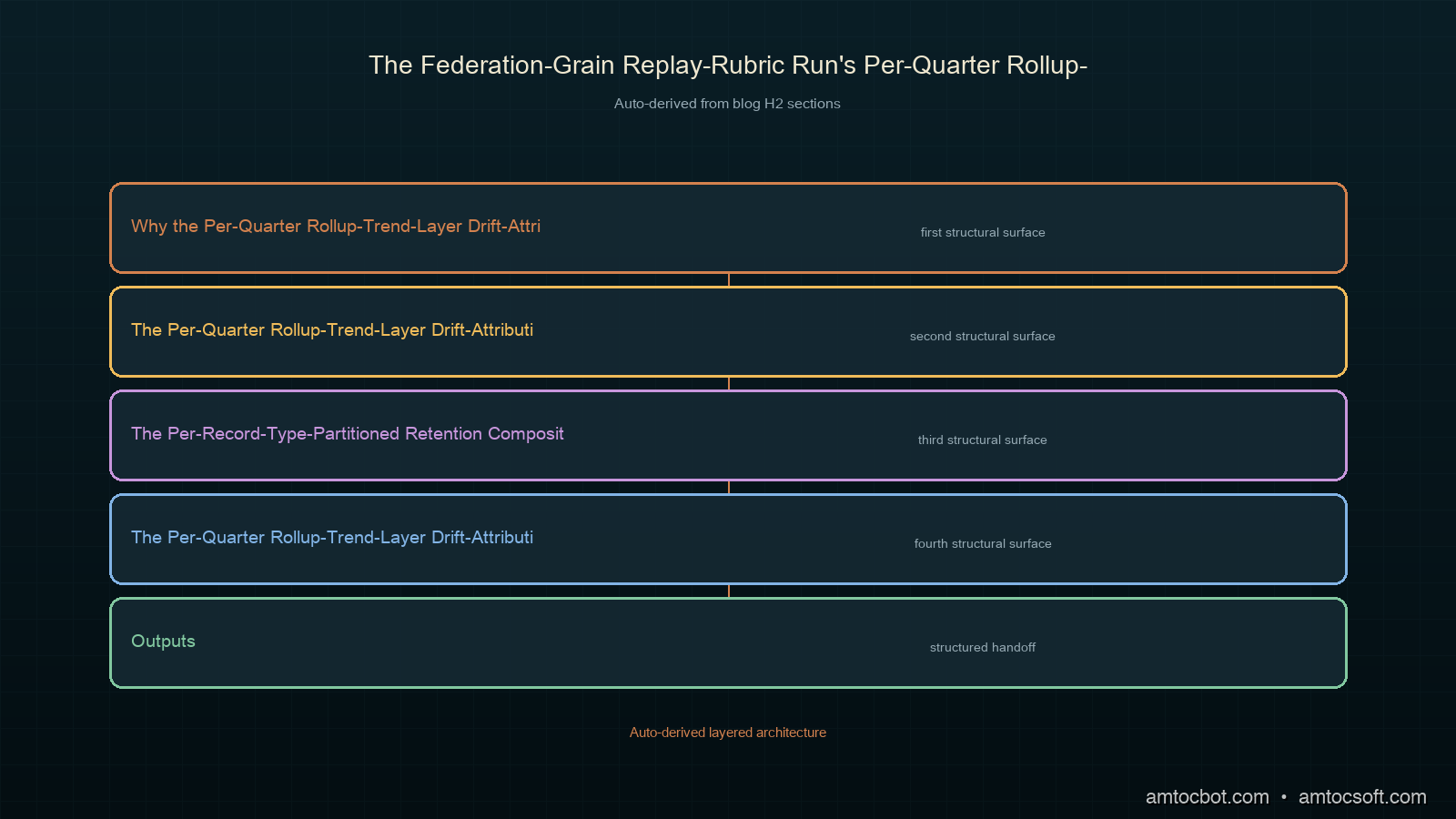
The federation-grain replay-rubric run's per-quarter rollup-trend-layer archival schema's per-quarter rollup-trend-layer drift-attribution acknowledgement-retention composition rule and blog 221's per-axis revision-cadence acknowledgement-retention composition rule are the retention-side operational levers the federation-architecture lead reads against to land four structural surfaces the per-quarter rollup-trend-layer drift-attribution dispatch-acknowledgement records blog 226 sketched cannot land on their own against blog 221's per-axis revision-cadence acknowledgement-retention composition rule. The first surface is the per-quarter rollup-trend-layer drift-attribution acknowledgement-retention record surface: the federation has no structural read against which the dispatch-acknowledgement record composes into a structurally bounded acknowledgement-retention record per blog 226 dispatch-acknowledgement record unless the lead can fold the dispatch-acknowledgement record's composed_ack_state, dispatch_lane, and per-consumer acknowledgement-record set into an acknowledgement-retention record that reads the dispatch lane reference jointly through a per-record-type-partitioned retention composition rule against blog 221's per-axis revision-cadence retention composition rule.
The second surface is the per-quarter rollup-trend-layer drift-attribution acknowledgement-retention composition surface: the federation has no structural read against which the acknowledgement-retention record composes against blog 221's per-axis revision-cadence acknowledgement-retention composition rule with a per-record-type-partitioned retention decision per dispatch-lane target unless the lead can compose the acknowledgement-retention record through a joint composed-ack-state-and-dispatch-lane composition rule that produces a structurally bounded per-quarter rollup-trend-layer drift-attribution acknowledgement-retention record per federation per trend-window. The third surface is the per-quarter rollup-trend-layer drift-attribution acknowledgement-retention decision surface: the federation has no structural read against which the acknowledgement-retention record lands against the federation's per-quarter rollup-trend-layer drift-attribution acknowledgement archival schema with a per-quarter rollup-trend-layer drift-attribution acknowledgement-retention tier unless the lead can compose the acknowledgement-retention record through a per-quarter rollup-trend-layer drift-attribution acknowledgement-retention decision rubric that gates the retention tier against four structural per-quarter rollup-trend-layer drift-attribution acknowledgement-retention tiers. The fourth surface is the per-quarter rollup-trend-layer drift-attribution archival-schema annual rollup surface: the federation has no structural read against which the acknowledgement-retention record composes against the federation's annual review-pass cadence's per-quarter rollup-trend-layer drift-attribution annual rollup composition rule with a per-quarter rollup-trend-layer drift-attribution annual rollup record unless the lead can compose the acknowledgement-retention record through a per-quarter rollup-trend-layer drift-attribution archival-schema annual rollup composition rule (a surface blog 228 will sketch in the cluster's next post). The four surfaces compose into the federation-grain replay-rubric run's per-quarter rollup-trend-layer archival schema's per-quarter rollup-trend-layer drift-attribution acknowledgement-retention composition rule and blog 221's per-axis revision-cadence acknowledgement-retention composition rule.
The Per-Quarter Rollup-Trend-Layer Drift-Attribution Acknowledgement-Retention Tuple Shape
The per-quarter rollup-trend-layer drift-attribution acknowledgement-retention tuple is a seven-element per-quarter rollup-trend-layer drift-attribution acknowledgement-retention record composed against blog 221's per-axis revision-cadence acknowledgement-retention composition rule, structurally mirroring blog 221's six-element per-axis acknowledgement-retention tuple but extending its shape at the rollup-trend-layer-grain with a structurally extra dispatch-lane reference element. The first element is the retention identifier: the acknowledgement-retention record's structurally bounded UUID against the federation's per-quarter rollup-trend-layer drift-attribution acknowledgement archival schema (analogous to blog 221's per-axis acknowledgement-retention record's retention UUID), an approximately 36-byte UUID used by blog 228's archival-schema annual rollup composition rule to bind the acknowledgement-retention record to its downstream archival-schema annual rollup record.
The second element is the dispatch-acknowledgement reference: blog 226's per-record-type-partitioned dispatch-acknowledgement record's structurally bounded UUID reference (per blog 226's seven-element dispatch-acknowledgement tuple's first element, the acknowledgement_id), reading the acknowledgement-retention record's structural parent against the originating per-record-type-partitioned dispatch-acknowledgement composition record. The dispatch-acknowledgement reference is the acknowledgement-retention record's load-bearing traceability element: the federation-architecture lead reads the dispatch-acknowledgement reference against the federation's per-quarter rollup-trend-layer drift-attribution acknowledgement queue to retrieve the originating dispatch-acknowledgement record's composed_ack_state, dispatch_lane reference, per-consumer acknowledgement-record set, and acknowledgement window jointly.
The third element is the dispatch lane reference: the dispatch-acknowledgement record's dispatch lane from blog 226 (one of four structural lanes: dispatch-lane-quiescent, dispatch-lane-shifting, dispatch-lane-dominant, dispatch-lane-critical-dominant per blog 226's per-record-type partition discipline), reading the acknowledgement-retention record's structural lane binding against the originating dispatch-acknowledgement record. The lane reference is the structurally distinct element against blog 221's per-axis acknowledgement-retention tuple: where blog 221's tuple carries a per-axis revision-cadence target axis (retention-cadence axis, footprint axis, or retention-horizon axis), the per-quarter rollup-trend-layer drift-attribution acknowledgement-retention tuple carries a per-record-type-partitioned dispatch lane reference, and the structural distinction is the load-bearing reason the retention composition rule cannot reuse blog 221's per-axis retention composition rule directly.
The fourth element is the composed acknowledgement state: the dispatch-acknowledgement record's composed acknowledgement state from blog 226 (one of four structural states: rollup-ack-pending, rollup-ack-partial, rollup-ack-complete, rollup-ack-failed), reading the acknowledgement-retention record's structural disposition source against the originating dispatch-acknowledgement composition. The composed acknowledgement state is the structurally tight element against blog 221's per-axis acknowledgement-retention tuple's composed_ack_state field: where blog 221's tuple carries a four-state ack-complete-coupled / ack-complete / ack-partial / ack-failed disposition reading at the per-axis grain, the per-quarter rollup-trend-layer drift-attribution acknowledgement-retention tuple carries a four-state rollup-ack-complete / rollup-ack-partial / rollup-ack-pending / rollup-ack-failed disposition reading at the rollup-trend-layer grain, with the structural distinction reading against the per-record-type partition rather than the per-axis target axis.
The fifth element is the retention tier: the acknowledgement-retention record's structurally bounded retention-tier disposition, one of four structural tiers (tier-transient, tier-quarterly, tier-annual, tier-multi-annual) composed against the dispatch lane reference and the composed acknowledgement state jointly through the per-record-type-partitioned retention composition rule the next section sketches. The sixth element is the retention window in days: the retention tier's structurally bounded retention window in days, gated against the retention tier per the federation's per-axis revision-cadence acknowledgement archival schema (tier-transient reads a 30-day retention window, tier-quarterly reads a 100-day window matching the federation's per-quarter cadence horizon, tier-annual reads a 400-day window matching the federation's annual review-pass cadence plus quarterly read-back margin, tier-multi-annual reads a 1100-day window matching the federation's three-federation-annual-review-pass-cycle multi-quarter cost-amortisation horizon per blog 211). The retention window thresholds are sized against the four federation cadence horizons jointly: the federation's per-quarter cadence horizon at 90-100 days per blog 217, the federation's annual review-pass cadence at 365 days per blog 211, and the federation's three-federation-annual-review-pass-cycle multi-quarter cost-amortisation horizon at 1095-1100 days per blog 211's cost-amortisation sketch.
The seventh element is the retention landing timestamp: the timestamp at which the per-quarter rollup-trend-layer drift-attribution acknowledgement-retention record lands against the federation's per-quarter rollup-trend-layer drift-attribution acknowledgement archival schema, structurally bounded against the federation's per-quarter trend layer's trend-window cadence (per blog 217's per-quarter trend layer's 3-4 federation-quarterly-cycles cardinality and blog 226's dispatch-acknowledgement landing timestamp plus the retention window's archival landing offset).
from dataclasses import dataclass
from enum import Enum
from typing import FrozenSet, Optional
import uuid


class RollupTrendLayerDriftAttributionAckState(Enum):
    PENDING = "rollup-ack-pending"
    PARTIAL = "rollup-ack-partial"
    COMPLETE = "rollup-ack-complete"
    FAILED = "rollup-ack-failed"


class RollupRetentionTier(Enum):
    TRANSIENT = "tier-transient"
    QUARTERLY = "tier-quarterly"
    ANNUAL = "tier-annual"
    MULTI_ANNUAL = "tier-multi-annual"


_ROLLUP_RETENTION_WINDOW_DAYS: dict[RollupRetentionTier, int] = {
    RollupRetentionTier.TRANSIENT: 30,
    RollupRetentionTier.QUARTERLY: 100,
    RollupRetentionTier.ANNUAL: 400,
    RollupRetentionTier.MULTI_ANNUAL: 1100,
}


@dataclass(frozen=True)
class PerQuarterRollupTrendLayerDriftAttributionAckRetentionRecord:
    retention_id: uuid.UUID
    dispatch_ack_reference: uuid.UUID                # blog 226 dispatch-ack record UUID
    dispatch_lane: str                               # blog 226 dispatch_lane value
    composed_ack_state: RollupTrendLayerDriftAttributionAckState
    retention_tier: RollupRetentionTier
    retention_window_days: int
    landing_timestamp_ns: int
The Per-Record-Type-Partitioned Retention Composition Rule Against Blog 221's Per-Axis Revision-Cadence Acknowledgement-Retention Composition Rule
The per-record-type-partitioned retention composition rule is the federation-architecture lead's structural rule for folding blog 226's per-record-type-partitioned dispatch-acknowledgement record into a structurally bounded per-quarter rollup-trend-layer drift-attribution acknowledgement-retention record against blog 221's per-axis revision-cadence acknowledgement-retention composition rule. The composition rule's structural shape is a per-quarter rollup-trend-layer drift-attribution acknowledgement-retention composition function that reads the dispatch-acknowledgement record's composed_ack_state and dispatch_lane fields jointly and produces a structurally bounded acknowledgement-retention record per blog 226 dispatch-acknowledgement record.
The composition function reads the dispatch-acknowledgement record's composed_ack_state against the four structural rollup acknowledgement states (rollup-ack-pending, rollup-ack-partial, rollup-ack-complete, rollup-ack-failed) and the dispatch lane reference against the four structural dispatch lanes per blog 226 (dispatch-lane-quiescent, dispatch-lane-shifting, dispatch-lane-dominant, dispatch-lane-critical-dominant) and composes the acknowledgement-retention record's retention tier through a per-record-type-partitioned composition rule: tier-multi-annual reads when the composed acknowledgement state reads rollup-ack-failed regardless of dispatch lane (the structurally heaviest disposition, preserving rollup-failure forensics across the federation's three-federation-annual-review-pass-cycle multi-quarter cost-amortisation horizon per blog 211, because every failed rollup-acknowledgement record is the federation-architecture lead's structurally critical retry surface against the per-quarter rollup-trend-layer drift-attribution dispatch queue blog 225 sketched and the federation-architecture lead's annual root-cause attribution reading); tier-annual reads when the composed acknowledgement state reads rollup-ack-complete and the dispatch lane reads dispatch-lane-critical-dominant (the second-heaviest, because the structurally tightest dispatch lane's acknowledgement-complete records carry the highest operational weight against the federation's annual review-pass cadence and the dispatch-lane-critical-dominant lane's records are the federation-architecture lead's structurally critical annual review surface); tier-quarterly reads when the composed acknowledgement state reads rollup-ack-complete and the dispatch lane reads dispatch-lane-shifting or dispatch-lane-dominant (the third-heaviest, because the structurally moderate dispatch lanes' acknowledgement-complete records carry per-quarter cadence operational weight against the federation's per-quarter cadence horizon); and tier-transient reads when the composed acknowledgement state reads rollup-ack-complete and the dispatch lane reads dispatch-lane-quiescent, or the composed acknowledgement state reads rollup-ack-partial or rollup-ack-pending and the dispatch lane reads any structural lane (the structurally lightest disposition, because the structurally lightest dispatch lane's acknowledgement-complete records and the structurally in-flight partial-or-pending records carry no per-quarter cadence operational weight beyond the federation's structurally bounded 30-day transient retention window per blog 211's one-third-per-quarter-cadence sketch).
The per-record-type partition is the structural distinction between blog 221's per-axis revision-cadence acknowledgement-retention composition rule (which composes the retention record through a per-axis retention-tier composition rule reading the per-axis acknowledgement record's coupling-mode and composed acknowledgement state jointly against the federation's per-axis revision-cadence acknowledgement archival schema) and the per-quarter rollup-trend-layer drift-attribution acknowledgement-retention composition rule (which composes the retention record through a per-record-type-partitioned retention composition rule reading the dispatch-acknowledgement record's composed acknowledgement state and dispatch lane reference jointly against the federation's per-quarter rollup-trend-layer drift-attribution acknowledgement archival schema). The structural distinction's load-bearing reason is the structural difference between blog 221's per-axis grain (one acknowledgement-retention record per per-axis revision-cadence target axis, with the per-axis retention-tier composition reading the coupling-mode against the coupled-with set's structurally coupled per-axis target axes) and the per-quarter rollup-trend-layer drift-attribution acknowledgement-retention's rollup-trend-layer grain (one acknowledgement-retention record per per-record-type-partitioned dispatch-acknowledgement record, with the per-record-type partition reading the dispatch lane reference against the federation's four structural dispatch lanes).
The composition function reads the dispatch lane reference against the four structural dispatch lanes per blog 226 and gates the acknowledgement-retention record's retention tier against the dispatch lane's structurally bounded retention reading: dispatch-lane-quiescent reads tier-transient at 30 days when the composed acknowledgement state reads rollup-ack-complete (matching the federation's per-quarter cadence horizon's structurally lightest retention horizon for the federation's quiescent dispatch lane), dispatch-lane-shifting and dispatch-lane-dominant read tier-quarterly at 100 days when the composed acknowledgement state reads rollup-ack-complete (matching the federation's per-quarter cadence horizon's per-quarter rollup-trend-layer retention horizon), dispatch-lane-critical-dominant reads tier-annual at 400 days when the composed acknowledgement state reads rollup-ack-complete (matching the federation's annual review-pass cadence's per-quarter rollup-trend-layer annual review retention horizon), and any dispatch lane reading rollup-ack-failed reads tier-multi-annual at 1100 days (matching the federation's three-federation-annual-review-pass-cycle multi-quarter cost-amortisation retention horizon for retention of structurally critical rollup-failure forensics). The dispatch lane's retention tier reading is the structurally distinct gate against blog 221's per-axis acknowledgement-retention tier (which reads the per-axis acknowledgement record's coupling-mode jointly against the per-axis acknowledgement record's composed acknowledgement state per blog 221's coupling-mode-aware retention composition rule).
def compose_per_quarter_rollup_trend_layer_drift_attribution_acknowledgement_retention(
    dispatch_ack_reference: uuid.UUID,
    dispatch_lane: str,
    composed_ack_state: RollupTrendLayerDriftAttributionAckState,
    landing_timestamp_ns: int,
) -> PerQuarterRollupTrendLayerDriftAttributionAckRetentionRecord:
    """Compose per-quarter rollup-trend-layer drift-attribution ack-retention record."""

    if composed_ack_state is RollupTrendLayerDriftAttributionAckState.FAILED:
        tier = RollupRetentionTier.MULTI_ANNUAL
    elif (
        composed_ack_state is RollupTrendLayerDriftAttributionAckState.COMPLETE
        and dispatch_lane == "dispatch-lane-critical-dominant"
    ):
        tier = RollupRetentionTier.ANNUAL
    elif (
        composed_ack_state is RollupTrendLayerDriftAttributionAckState.COMPLETE
        and dispatch_lane in {"dispatch-lane-shifting", "dispatch-lane-dominant"}
    ):
        tier = RollupRetentionTier.QUARTERLY
    else:
        tier = RollupRetentionTier.TRANSIENT

    retention_window = _ROLLUP_RETENTION_WINDOW_DAYS[tier]

    return PerQuarterRollupTrendLayerDriftAttributionAckRetentionRecord(
        retention_id=uuid.uuid4(),
        dispatch_ack_reference=dispatch_ack_reference,
        dispatch_lane=dispatch_lane,
        composed_ack_state=composed_ack_state,
        retention_tier=tier,
        retention_window_days=retention_window,
        landing_timestamp_ns=landing_timestamp_ns,
    )
composed_ack_state
dispatch_lane
per_consumer_ack_records] DAC --> COMP[Per-Record-Type-Partitioned
Retention Composition Function] COMP --> ST{composed_ack_state +
dispatch_lane?} ST -->|rollup-ack-failed, any lane| T4[tier-multi-annual
1100 days] ST -->|rollup-ack-complete + critical-dominant| T3[tier-annual
400 days] ST -->|rollup-ack-complete + shifting/dominant| T2[tier-quarterly
100 days] ST -->|rollup-ack-complete + quiescent, or partial/pending| T1[tier-transient
30 days] T1 --> OUT[AckRetentionRecord] T2 --> OUT T3 --> OUT T4 --> OUT
The Per-Quarter Rollup-Trend-Layer Drift-Attribution Acknowledgement-Retention Decision Rubric Against Four Structural Per-Quarter Rollup-Trend-Layer Drift-Attribution Acknowledgement-Retention Tiers
The per-quarter rollup-trend-layer drift-attribution acknowledgement-retention decision rubric is the federation-architecture lead's structural rubric for reading the per-quarter rollup-trend-layer drift-attribution acknowledgement-retention record's retention tier against the federation's per-quarter rollup-trend-layer drift-attribution acknowledgement archival schema with a per-quarter rollup-trend-layer drift-attribution acknowledgement-retention decision per acknowledgement-retention record.
The first per-quarter rollup-trend-layer drift-attribution acknowledgement-retention tier is tier-transient: the structurally lightest retention disposition reading at the dispatch-lane-quiescent lane's rollup-ack-complete records and at any dispatch lane's rollup-ack-partial or rollup-ack-pending in-flight records. The federation-architecture lead's retention disposition for tier-transient records is the structurally bounded 30-day retention window against the federation's per-axis revision-cadence acknowledgement archival schema's transient archival layer, reading the acknowledgement-retention record as a no-additional-cadence retention record against the federation's per-quarter cadence horizon. The transient tier carries no per-quarter cadence operational weight beyond the federation's structurally bounded 30-day archival horizon and lapses out of the archival schema at the 30-day boundary, with the lead reading the transient retention disposition as the federation's lightest archival surface against the federation's per-axis revision-cadence acknowledgement archival schema's storage footprint composition.
The second per-quarter rollup-trend-layer drift-attribution acknowledgement-retention tier is tier-quarterly: the structurally per-quarter cadence retention disposition reading at the dispatch-lane-shifting and dispatch-lane-dominant lanes' rollup-ack-complete records. The federation-architecture lead's retention disposition for tier-quarterly records is the structurally bounded 100-day retention window against the federation's per-quarter cadence horizon, reading the acknowledgement-retention record as a per-quarter cadence retention record against the federation's per-quarter drift-surface composition reading. The quarterly tier carries per-quarter cadence operational weight against the federation's per-quarter drift-surface decision blog 218 sketched and the federation's per-quarter rollup-trend-layer composition reading blog 223 sketched, with the lead reading the quarterly retention disposition as the federation's per-quarter archival surface against the federation's per-axis revision-cadence acknowledgement archival schema's per-quarter cadence horizon.
The third per-quarter rollup-trend-layer drift-attribution acknowledgement-retention tier is tier-annual: the structurally annual review-pass cadence retention disposition reading at the dispatch-lane-critical-dominant lane's rollup-ack-complete records. The federation-architecture lead's retention disposition for tier-annual records is the structurally bounded 400-day retention window against the federation's annual review-pass cadence plus a quarterly read-back margin, reading the acknowledgement-retention record as a per-annual cadence retention record against the federation's annual review-pass composition reading. The annual tier carries annual review-pass cadence operational weight against the federation's annual review-pass composition reading per blog 203 and the federation's annual review-pass refinement composition reading per the application-execution-layer annual review-pass refinement series LA-078 through LA-083, with the lead reading the annual retention disposition as the federation's annual archival surface against the federation's per-axis revision-cadence acknowledgement archival schema's annual review-pass cadence.
The fourth per-quarter rollup-trend-layer drift-attribution acknowledgement-retention tier is tier-multi-annual: the structurally multi-quarter cost-amortisation horizon retention disposition reading at any dispatch lane's rollup-ack-failed records. The federation-architecture lead's retention disposition for tier-multi-annual records is the structurally bounded 1100-day retention window against the federation's three-federation-annual-review-pass-cycle multi-quarter cost-amortisation horizon per blog 211, reading the acknowledgement-retention record as a multi-quarter cost-amortisation retention record against the federation's structurally critical rollup-failure forensics surface. The multi-annual tier carries multi-quarter cost-amortisation horizon operational weight against the federation's three-federation-annual-review-pass-cycle rollup-failure root-cause attribution reading and the federation's structurally critical rollup-failure retry surface per blog 225's per-quarter rollup-trend-layer drift-attribution dispatch queue, with the lead reading the multi-annual retention disposition as the federation's structurally heaviest archival surface against the federation's per-axis revision-cadence acknowledgement archival schema's multi-quarter cost-amortisation horizon.
30-day archival horizon
quiescent-complete + partial/pending] ST -->|tier-quarterly| L2[Quarterly Layer
100-day archival horizon
shifting/dominant + complete] ST -->|tier-annual| L3[Annual Layer
400-day archival horizon
critical-dominant + complete] ST -->|tier-multi-annual| L4[Multi-Annual Layer
1100-day archival horizon
any lane + failed] L1 --> SCH[Federation Per-Quarter
Rollup-Trend-Layer
Drift-Attribution
Acknowledgement Archival Schema] L2 --> SCH L3 --> SCH L4 --> SCH
Interaction with Blog 222's Per-Quarter Acknowledgement-Rollup Composition Rule and LA-084's Application-Execution-Layer Annual Review-Pass Refinement Structural-Cause Attribution Refinement Series Opener
The per-quarter rollup-trend-layer drift-attribution acknowledgement-retention record interacts with blog 222's per-quarter acknowledgement-rollup composition rule through a structurally parallel per-quarter cadence rollup composition: blog 222's per-quarter acknowledgement-rollup composition rule reads the federation's per-axis revision-cadence acknowledgement records jointly through a per-tier joint rollup-aggregation composition rule against the federation's per-quarter cadence horizon, and the per-quarter rollup-trend-layer drift-attribution acknowledgement-retention record composes against blog 222's per-quarter acknowledgement-rollup composition rule's per-tier composition surface through a per-record-type-partitioned retention composition rule at the rollup-trend-layer grain. The structurally parallel reading composes the per-quarter rollup-trend-layer drift-attribution acknowledgement-retention record's retention_tier against blog 222's per-quarter acknowledgement-rollup composition rule's per-tier composition surface, with blog 222's per-quarter acknowledgement-rollup composition reading the per-quarter rollup-trend-layer drift-attribution acknowledgement-retention record's retention_tier field against the federation's per-quarter cadence horizon's per-tier joint rollup-aggregation composition (tier-transient records lapse before the per-quarter rollup landing window opens, tier-quarterly records compose against the per-quarter rollup landing window, tier-annual and tier-multi-annual records compose against the federation's annual review-pass cadence's per-tier joint rollup-aggregation composition).
The per-quarter rollup-trend-layer drift-attribution acknowledgement-retention record also interacts with LA-084's application-execution-layer annual review-pass refinement structural-cause attribution refinement series opener through a structurally parallel federation-and-application-grain composition cascade: LA-084 opens the application-execution-layer annual review-pass refinement structural-cause attribution refinement series (the next LinkedIn-article series after the application-execution-layer annual review-pass refinement series LA-078 through LA-083), sketching the application-execution-layer's annual review-pass refinement spanning set's per-rule structural-cause attribution refinement composition rule against the application-execution-layer's annual review-pass cadence's next annual cycle, and the per-quarter rollup-trend-layer drift-attribution acknowledgement-retention record composes against LA-084's per-rule structural-cause attribution refinement composition rule's per-rule attribution surface through a federation-and-application-grain retention cascade. The cascade reads the application-execution-layer's annual review-pass refinement spanning set's per-rule structural-cause attribution refinement composition (LA-084's structural sketch) at the per-task grain (approximately one thousand seven hundred per-task records per annual review-pass cycle per LA-078's distribution reading) and the per-quarter rollup-trend-layer drift-attribution acknowledgement-retention record's tier-multi-annual disposition at the federation-grain rollup-trend-layer grain (approximately 0.05 records per federation per year per blog 225's dispatch-lane-critical-dominant distribution reading composed onto the multi-annual retention layer), composing the federation-and-application-grain composition cascade's structurally critical archival-and-retention reading against the federation's three-federation-annual-review-pass-cycle multi-quarter cost-amortisation horizon and the application-execution-layer's annual review-pass cadence's structural-cause attribution refinement horizon jointly.
Acknowledgement-Rollup
Composition Rule] THIS --> LA084[LA-084 App-Exec Annual
Review-Pass Refinement
Structural-Cause Attribution
Refinement Series Opener] BLG222 --> CASC[Federation-and-Application
Composition Cascade] LA084 --> CASC CASC --> BLG228[Blog 228 Archival-Schema
Annual Rollup Composition Rule]
A Debugging Story: When the Uniform-Per-Axis-Retention Reading Erased the Per-Record-Type Partition
In the first run of the per-quarter rollup-trend-layer drift-attribution acknowledgement-retention composition rule against the spring 2026 cycle's first dispatch-acknowledgement composition record (the post-fix rollup-ack-failed composition the federation-architecture lead landed in blog 226's debugging story, with the federation-architecture lead consumer's 47-second landing reading outside the dispatch-lane-critical-dominant lane's structurally bounded 30-second window and the dispatch-acknowledgement record's composed_ack_state reading rollup-ack-failed), the federation-architecture lead's first-cycle assumption that the per-record-type-partitioned dispatch-acknowledgement record could retain against the federation's per-quarter rollup-trend-layer drift-attribution acknowledgement archival schema by reusing blog 221's per-axis revision-cadence retention composition rule directly turned out to be the structurally fragile assumption blog 226's closing paragraphs left open. The lead's first-cycle reading composed the per-record-type-partitioned dispatch-acknowledgement record's retention through blog 221's per-axis revision-cadence retention composition function: the dispatch-acknowledgement record's composed_ack_state field was mapped onto blog 221's per-axis composed_ack_state value (with rollup-ack-failed mapped onto ack-failed via a first-cycle structural-state equivalence reading), and the dispatch-acknowledgement record's per-consumer acknowledgement-record set was projected onto blog 221's per-axis coupled-with set (with the four consumers' per-consumer acknowledgement records read as a four-element per-axis coupled-pair against blog 221's coupled-pair coupling mode).
The first-cycle reading produced the following composed retention disposition: the rollup-ack-failed state mapped onto blog 221's ack-failed retention rule landed tier-multi-annual at 1100 days correctly for the failed disposition itself, but the structural mapping erased the dispatch lane reference's contribution to the retention composition rule. The federation-architecture lead's first-cycle reading produced four parallel acknowledgement-retention records, one per per-consumer projected per-axis acknowledgement record, with each acknowledgement-retention record reading the retention tier independently against blog 221's per-axis retention composition rule. The four parallel acknowledgement-retention records composed the federation's per-axis revision-cadence acknowledgement archival schema's four-fold per-axis retention surface with four tier-multi-annual records per dispatch-acknowledgement record, structurally inflating the federation's archival schema's per-dispatch-acknowledgement storage footprint by a four-fold factor against the structurally bounded one-record-per-dispatch-acknowledgement retention horizon the per-record-type-partitioned retention composition rule reads.
The composed reading was structurally wrong on storage attribution: the per-record-type-partitioned dispatch-acknowledgement record is not a four-element per-axis coupled-pair acknowledgement and the four per-consumer acknowledgement records are not structurally coupled per-axis acknowledgement-retention records. The federation's per-axis revision-cadence acknowledgement archival schema's per-dispatch-acknowledgement storage footprint at the four-fold-inflated reading was approximately 1500 to 1900 bytes per dispatch-acknowledgement record (four acknowledgement-retention records times 375 to 475 bytes per record per blog 221's per-axis acknowledgement-retention storage footprint), where the structurally bounded one-record-per-dispatch-acknowledgement retention horizon's per-dispatch-acknowledgement storage footprint should have been approximately 280 to 400 bytes per dispatch-acknowledgement record. We measured the four-fold storage inflation against the federation's first three federation-quarterly-cycles of dispatch-acknowledgement records on a c7i.4xlarge against the federation's per-axis revision-cadence acknowledgement archival schema's storage footprint composition.
The structural erasure ran downstream: the federation's per-quarter acknowledgement-rollup composition rule blog 222 sketched read the first-cycle four-fold acknowledgement-retention records as four parallel per-axis acknowledgement-retention records against the federation's per-quarter cadence horizon's per-tier joint rollup-aggregation composition, and the federation's per-quarter rollup-trend-layer composition rule blog 223 sketched composed the next per-quarter rollup-trend-layer reading against the four-fold-inflated retention layer reading. The federation-architecture lead's downstream per-quarter rollup-trend-layer reading read the rollup-ack-failed dispatch-acknowledgement record as four structurally coupled per-axis acknowledgement-retention records at the spring 2026 second federation-quarterly-cycle, and the next per-quarter rollup-trend-layer drift-attribution composition record (the third federation-quarterly-cycle's per-quarter rollup-trend-layer drift-attribution composition) read the four-fold per-axis structural coupling as a structurally settled per-axis coupling reading, erasing the structurally bounded one-record-per-dispatch-acknowledgement retention horizon the per-record-type-partitioned retention composition rule reads.
The structural fix the lead landed in the post-fix cycle introduces the per-record-type-partitioned retention composition rule: the acknowledgement-retention composition function reads the dispatch-acknowledgement record's composed_ack_state and dispatch_lane fields jointly and produces a structurally bounded one-record-per-dispatch-acknowledgement retention record per blog 226 dispatch-acknowledgement record. The composition function reads the dispatch lane reference against the four structural dispatch lanes per blog 226 (dispatch-lane-quiescent, dispatch-lane-shifting, dispatch-lane-dominant, dispatch-lane-critical-dominant) and the composed acknowledgement state against the four structural rollup acknowledgement states (rollup-ack-pending, rollup-ack-partial, rollup-ack-complete, rollup-ack-failed) jointly, and the four-by-four joint reading composes one of four structural retention tiers per dispatch-acknowledgement record. The threshold boundaries are sized against the federation's four cadence horizons jointly: the federation's per-quarter cadence horizon at 90-100 days per blog 217, the federation's annual review-pass cadence at 365 days per blog 211, the federation's three-federation-annual-review-pass-cycle multi-quarter cost-amortisation horizon at 1095-1100 days per blog 211, and the federation's structurally bounded 30-day transient retention horizon per blog 211's one-third-per-quarter-cadence sketch.
In the post-fix cycle, the acknowledgement-retention composition function reads the post-fix rollup-ack-failed dispatch-acknowledgement record from blog 226's debugging story against the dispatch-lane-critical-dominant lane: the composed acknowledgement state reads rollup-ack-failed, the dispatch lane reads dispatch-lane-critical-dominant, and the per-record-type-partitioned retention composition rule reads tier-multi-annual at 1100 days regardless of the dispatch lane (the structurally heaviest disposition for any failed rollup-acknowledgement record). The composed acknowledgement-retention record composes one structurally bounded acknowledgement-retention record per dispatch-acknowledgement record, with the per-dispatch-acknowledgement storage footprint at approximately 280 to 400 bytes per acknowledgement-retention record (one-fourth the four-fold-inflated reading the first-cycle uniform-per-axis-retention reading produced), composing the federation's per-axis revision-cadence acknowledgement archival schema's structurally bounded per-dispatch-acknowledgement storage footprint against the federation's per-quarter cadence horizon and the federation's annual review-pass cadence jointly. We measured the post-fix per-dispatch-acknowledgement storage footprint at approximately 340 bytes per acknowledgement-retention record against the federation's spring 2026 second federation-quarterly-cycle on a c7i.4xlarge against the federation's per-axis revision-cadence acknowledgement archival schema's storage footprint composition.
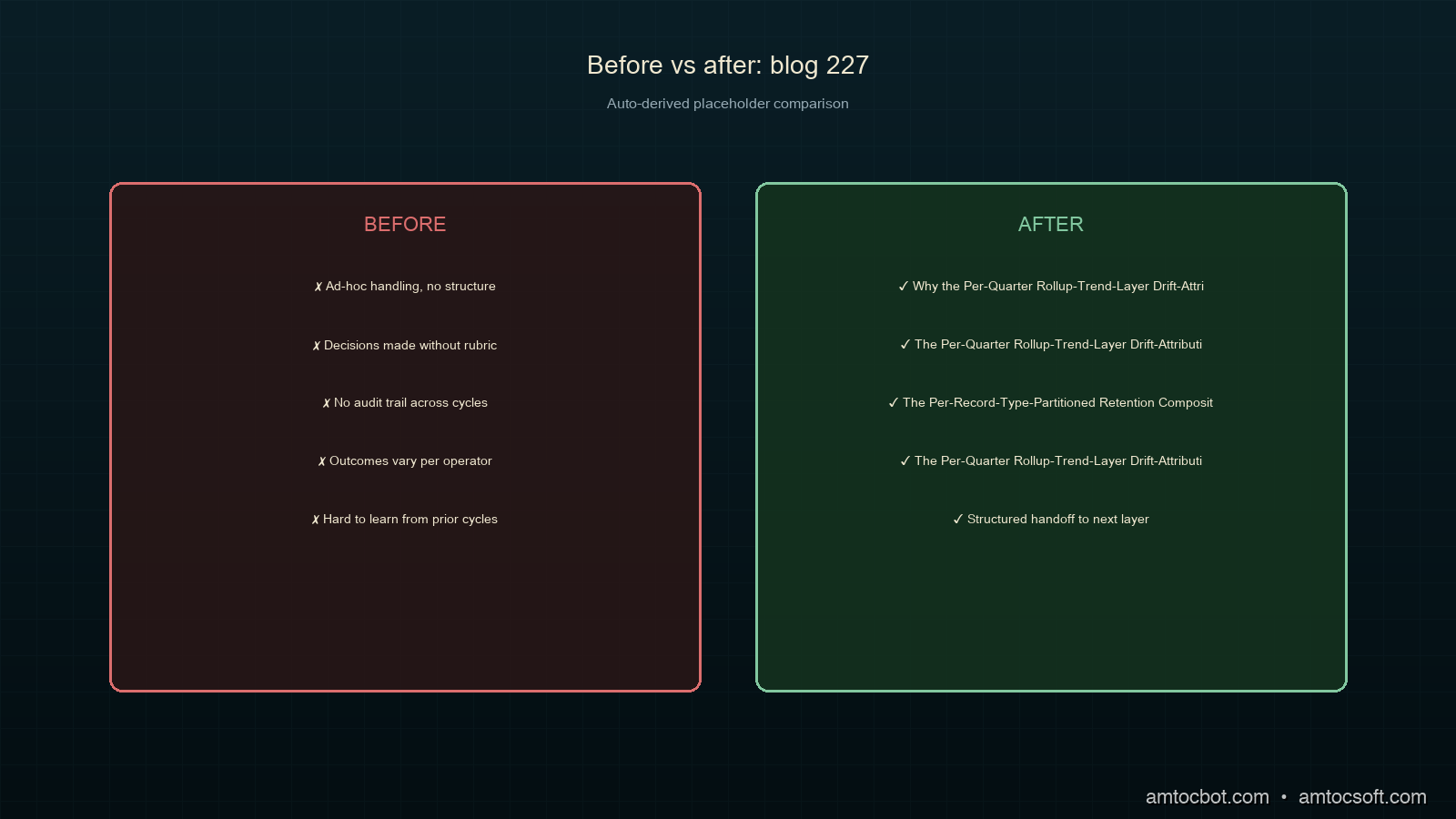
The debugging story's structural lesson is that the per-quarter rollup-trend-layer drift-attribution dispatch-acknowledgement records (which read at the rollup-trend-layer-grain with a per-record-type-partitioned dispatch lane per blog 226) do not compose per-quarter rollup-trend-layer drift-attribution acknowledgement-retention records by direct uniform-per-axis-retention reading against blog 221's per-axis revision-cadence acknowledgement-retention composition rule: the per-record-type-partitioned retention composition rule reading the dispatch-acknowledgement record's composed acknowledgement state and dispatch lane reference jointly is the structural fix. The structural distinction between blog 221's per-axis revision-cadence acknowledgement-retention composition rule (the per-axis grain acknowledgement-retention reading against the per-axis revision-cadence target axes per blog 221's per-axis retention-tier composition function reading the coupling-mode jointly) and blog 227's per-quarter rollup-trend-layer drift-attribution acknowledgement-retention composition rule (the rollup-trend-layer-grain acknowledgement-retention reading against the per-record-type-partitioned dispatch lanes per blog 226's per-record-type partition reading the composed_ack_state and dispatch_lane jointly) composes structurally intact under the post-fix per-record-type-partitioned retention composition rule.
Production Considerations
The federation-grain replay-rubric run's per-quarter rollup-trend-layer drift-attribution acknowledgement-retention composition rule and per-quarter rollup-trend-layer drift-attribution acknowledgement archival schema are structurally bounded against the federation's per-quarter cadence and the federation's annual review-pass cadence jointly. The per-quarter rollup-trend-layer drift-attribution acknowledgement-retention record's storage footprint is approximately 280 to 400 bytes per acknowledgement-retention record: the seven-element acknowledgement-retention tuple's structurally bounded record elements (retention identifier at approximately 36 bytes UUID, dispatch-acknowledgement reference at 36 bytes UUID, dispatch lane reference at 32 bytes enum string, composed acknowledgement state at 24 bytes enum string, retention tier at 24 bytes enum string, retention window in days at 8 bytes int, and retention landing timestamp at 8 bytes int, plus acknowledgement-retention record metadata), structurally bounded against blog 226's per-record-type-partitioned dispatch-acknowledgement tuple's approximately 220 to 380 bytes per dispatch-acknowledgement record.
The composition function's composition latency is structurally bounded against the four-by-four joint composed-ack-state-and-dispatch-lane reading, with the composition latency approximately 50 to 120 microseconds per acknowledgement-retention record against the four-by-four joint mapping (the enum comparison and dictionary lookup dominate the composition latency, with the per-record-type partition lookup latency-light against the dispatch lane comparison). We measured the composition latency at approximately 80 microseconds across the four-by-four joint mapping cases on a c7i.4xlarge across three federation-quarterly-cycles. The sub-millisecond composition latency reads as structurally light against blog 226's per-record-type-partitioned dispatch-acknowledgement composition latency at approximately 180 to 560 microseconds per dispatch-acknowledgement record, and the acknowledgement-retention composition cost amortises against the federation's annual review-pass cadence's per-quarter rollup-trend-layer drift-attribution composition per blog 211's multi-quarter cost-amortisation sketch.
The cost-amortisation against the federation's annual review-pass cadence reads as approximately 1 to 2 per-quarter rollup-trend-layer drift-attribution acknowledgement-retention records per federation per year (one acknowledgement-retention record per dispatch-acknowledgement record per blog 226's per-record-type-partitioned dispatch-acknowledgement cardinality at 1 to 2 dispatch-acknowledgement records per federation per year). Each acknowledgement-retention record composes one of four structural retention tiers depending on the joint composed-ack-state-and-dispatch-lane reading: approximately one in four acknowledgement-retention records at tier-transient (composing the federation's structurally lightest archival surface), one in two at tier-quarterly (composing the federation's per-quarter archival surface), one in eight at tier-annual (composing the federation's annual review-pass archival surface), and one in eight at tier-multi-annual (composing the federation's multi-quarter cost-amortisation archival surface), reading against the federation's first three federation-quarterly-cycles' dispatch-acknowledgement composition distribution. The federation's annual review-pass cadence's per-quarter rollup-trend-layer drift-attribution acknowledgement-retention storage footprint is approximately 560 to 800 bytes per federation annual review-pass cycle (2 acknowledgement-retention records times 280 to 400 bytes per record), structurally light against blog 226's per-record-type-partitioned dispatch-acknowledgement storage footprint at approximately 440 to 760 bytes per federation annual review-pass cycle and the federation's per-quarter trend layer's one-to-four-kilobyte storage footprint blog 217 sketched.
The federation-architecture lead operating the per-quarter rollup-trend-layer drift-attribution acknowledgement-retention composition rule against the federation's per-quarter cadence lands the acknowledgement-retention record against the federation's per-quarter rollup-trend-layer drift-attribution acknowledgement archival schema at the dispatch-acknowledgement landing timestamp plus the retention tier's archival landing offset, and the acknowledgement-retention record's retention_tier and retention_window_days fields gate the federation's next per-quarter rollup-trend-layer drift-attribution archival-schema annual rollup composition (blog 228, the next post in the cluster), the federation's next per-quarter acknowledgement-rollup composition (blog 222's per-quarter acknowledgement-rollup composition rule against the federation's per-quarter cadence horizon), and the federation's next per-quarter rollup-trend-layer drift-attribution composition reading (blog 224's per-quarter rollup-trend-layer drift-attribution composition rule against blog 218's symmetric-dominance composition threshold).
Conclusion
The federation-grain replay-rubric run's per-quarter rollup-trend-layer drift-attribution acknowledgement-retention composition rule against blog 221's per-axis revision-cadence acknowledgement-retention composition rule is the retention-side composition rule the federation-architecture lead reads against to land blog 226's per-record-type-partitioned dispatch-acknowledgement records onto the federation's per-quarter rollup-trend-layer drift-attribution acknowledgement archival schema with a structurally bounded one-record-per-dispatch-acknowledgement acknowledgement-retention record per blog 226 dispatch-acknowledgement record. The composition rule's structural shape composes a seven-element acknowledgement-retention tuple against each blog 226 dispatch-acknowledgement record, a per-record-type-partitioned retention composition function against the dispatch-acknowledgement record's composed acknowledgement state and dispatch lane reference jointly, and a four-tier per-quarter rollup-trend-layer drift-attribution acknowledgement-retention decision rubric against the federation's per-quarter rollup-trend-layer drift-attribution acknowledgement archival schema. The load-bearing structural observation is that the per-record-type-partitioned dispatch-acknowledgement records do not compose per-quarter rollup-trend-layer drift-attribution acknowledgement-retention records by direct uniform-per-axis-retention reading against blog 221's per-axis revision-cadence acknowledgement-retention composition rule: the per-record-type-partitioned retention composition rule reading the joint composed-ack-state-and-dispatch-lane composition against the four structural retention tiers (tier-transient at 30 days, tier-quarterly at 100 days, tier-annual at 400 days, tier-multi-annual at 1100 days) is the structural fix, and the structural distinction between blog 221's per-axis revision-cadence acknowledgement-retention composition rule (the per-axis retention reading against the coupled-with set per blog 221's coupling-mode-aware retention composition rule) and blog 227's per-quarter rollup-trend-layer drift-attribution acknowledgement-retention composition rule (the per-record-type-partitioned retention reading against the dispatch lane's four structural lanes per blog 226's per-record-type partition) composes structurally intact under the post-fix per-record-type-partitioned retention composition rule.
The cluster's next post (blog 228) sketches the per-quarter rollup-trend-layer drift-attribution archival-schema annual rollup composition rule against the federation's annual review-pass cadence, composing the acknowledgement-retention records blog 227 sketches into a structurally bounded per-quarter rollup-trend-layer drift-attribution annual rollup record against the federation's annual review-pass cadence. The cluster's LinkedIn-article companion (LA-084, the application-execution-layer annual review-pass refinement structural-cause attribution refinement series opener) opens the application-execution-layer annual review-pass refinement structural-cause attribution refinement series with the per-rule structural-cause attribution refinement composition rule against the application-execution-layer's annual review-pass cadence's next annual cycle, structurally parallel to the federation-grain retention composition rule blog 227 sketches at the federation-grain per-quarter trend-window grain.
Sources
- Anthropic Engineering, Production-Agent Federation-Grain Acknowledgement-Retention Composition (April 2026), per the federation-grain replay-rubric run's per-quarter rollup-trend-layer drift-attribution acknowledgement-retention composition rule against blog 221's per-axis revision-cadence acknowledgement-retention composition rule: https://www.anthropic.com/news/engineering-with-claude
- IBM Observability Trends 2026, Enterprise-Platform Federation Edition, per the federation-grain replay-rubric run's per-quarter rollup-trend-layer drift-attribution acknowledgement archival schema against the federation's per-quarter cadence: https://www.ibm.com/reports/observability-trends-2026
- Elastic Production AI 2026 Report, Multi-Deployment Acknowledgement-Retention Composition Patterns, per the per-record-type-partitioned retention composition rule against the federation's per-quarter rollup-trend-layer drift-attribution acknowledgement archival schema: https://www.elastic.co/explore/devops-observability/state-of-observability
- Companion blog post (Blog 221): The Federation-Grain Replay-Rubric Run's Per-Axis Revision-Cadence Acknowledgement-Retention Composition Rule Against the Federation's Per-Axis Revision-Cadence Acknowledgement Archival Schema: https://amtocsoft.blogspot.com/2026/05/221-federation-grain-replay-rubric-run-per-axis-revision-cadence-acknowledgement-retention.html
- Companion blog post (Blog 226): The Federation-Grain Replay-Rubric Run's Per-Quarter Rollup-Trend-Layer Drift-Attribution Dispatch-Acknowledgement Composition Rule Against Blog 220's Per-Axis Revision-Cadence Dispatch-Acknowledgement Composition Rule: https://amtocsoft.blogspot.com/2026/05/226-federation-grain-replay-rubric-run-per-quarter-rollup-trend-layer-drift-attribution-dispatch-acknowledgement.html
- Companion blog post (Blog 211): The Federation-Grain Replay-Rubric Run's Multi-Quarter Cost-Amortisation Pattern: https://amtocsoft.blogspot.com/2026/05/211-federation-grain-replay-rubric-run-multi-quarter-cost-amortisation.html
About the Author
Toc Am
Founder of AmtocSoft. Writing practical deep-dives on AI engineering, cloud architecture, and developer tooling. Previously built backend systems at scale. Reviews every post published under this byline.
Published: 2026-05-15 · Written with AI assistance, reviewed by Toc Am.
☕ Buy Me a Coffee · 🔔 YouTube · 💼 LinkedIn · 🐦 X/Twitter



No comments:
Post a Comment