Intent-Driven Development: The End of Manual Coding?
For decades, software development has been about how. How do I implement this feature? How do I structure this query? How do I handle this edge case? Every line of code is a how-level decision.
Intent-Driven Development flips this entirely. You describe what the software should do — the intent — and AI handles the how. It's not autocomplete. It's not a chatbot suggesting snippets. It's a fundamental shift in what it means to be a developer.
With 92% of US developers now using AI coding tools daily and agentic systems like Claude Code handling entire multi-file workflows autonomously, we're past the experimentation phase. The question isn't whether IDD will happen. It's whether you're ready for it.
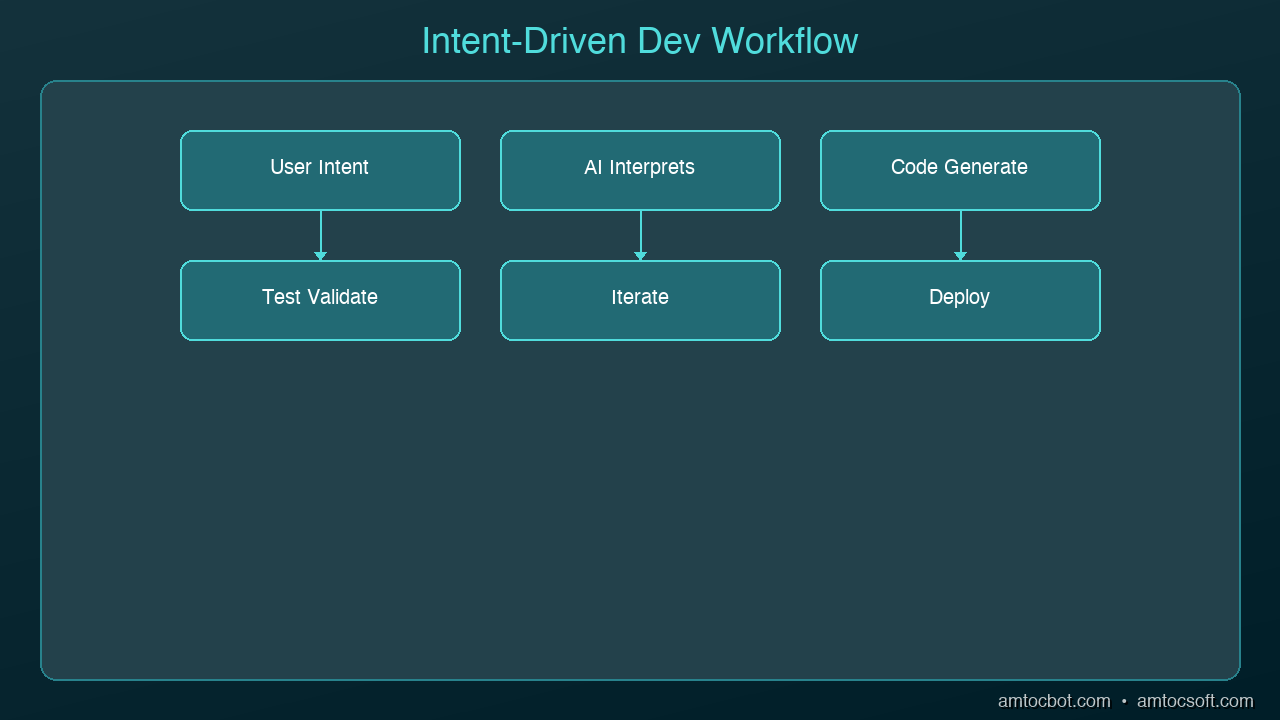
graph LR
  A[Express Intent in Natural Language] --> B[AI Interprets]
  B --> C[Generates Code]
  C --> D[Developer Reviews]
  D --> E{Tests Pass?}
  E -->|Yes| F[Ship]
  E -->|No| G[Refine Intent]
  G --> A
What Intent-Driven Development Actually Means
Traditional development follows an implementation-first model:
Requirement → Design → Write Code → Test → Debug → Ship
IDD inverts the ratio. Instead of spending 80% of your time writing implementation and 20% verifying it, you spend 80% defining constraints and verification criteria, then let AI generate the implementation:
Intent → Constraints → Verification Criteria → AI Generates → You Verify → Ship
Here's what that looks like in practice:
Traditional Approach
You write every line:
async function transferFunds(fromId: string, toId: string, amount: number) {
  const from = await accountRepo.findById(fromId);
  if (!from) throw new AccountNotFoundError(fromId);
  const to = await accountRepo.findById(toId);
  if (!to) throw new AccountNotFoundError(toId);
  if (from.balance < amount) throw new InsufficientFundsError(from.balance, amount);

  await db.transaction(async (tx) => {
    await tx.accounts.update({ id: fromId, balance: from.balance - amount });
    await tx.accounts.update({ id: toId, balance: to.balance + amount });
    await tx.auditLog.create({
      type: 'TRANSFER',
      fromAccount: fromId,
      toAccount: toId,
      amount,
      timestamp: new Date()
    });
  });
}
IDD Approach
You describe the intent and constraints:
## Intent
Transfer funds between two accounts atomically.

## Constraints
- Both accounts must exist (throw AccountNotFoundError)
- Source account must have sufficient balance (throw InsufficientFundsError)
- Must be atomic -- either both updates succeed or neither does
- Must create an audit log entry within the same transaction
- Must follow our repository pattern (see accountRepo in src/repos/)

## Verification
- Test: transfer succeeds with sufficient funds
- Test: transfer fails and rolls back on insufficient funds
- Test: audit log entry is created with correct details
- Test: concurrent transfers don't cause race conditions
The AI generates the implementation, the tests, and often catches edge cases you didn't think of. Your job shifts from writing code to specifying what correct code looks like.
The Three Levels of IDD
Not all intent-driven development is equal. The industry is progressing through three distinct levels:
Level 1: Prompt-Driven (Where Most Teams Are)
You tell the AI what to build in natural language. The AI generates code. You review and iterate.
Tools: Copilot Chat, Cursor Composer, Claude Code
Developer role: Prompt writer + code reviewer
Level 2: Spec-Driven (Where Leading Teams Are Moving)
You write formal specifications — structured documents that describe behavior, constraints, and acceptance criteria. AI generates implementation that satisfies the spec.
Tools: Claude Code with CLAUDE.md, Cursor with .cursorrules, custom spec frameworks
Developer role: Specification author + architect
Level 3: Autonomous Agents (The Frontier)
AI agents receive high-level goals, decompose them into tasks, implement across multiple files, run tests, and iterate until the spec passes — with minimal human intervention.
Tools: Claude Code in agentic mode, Copilot Workspace, Devin
Developer role: System architect + quality gate
Most teams are at Level 1. The competitive advantage in 2026 belongs to teams moving to Level 2.
What Changes for Developers
IDD doesn't eliminate developers. It changes what developers do.
Skills That Matter More
- System architecture: Understanding how components fit together becomes critical when you're not writing every line
- Specification writing: The precision of your intent description directly determines output quality
- Verification design: Writing comprehensive test criteria is now 50% of your job
- Domain knowledge: AI can't know your business rules — you're the expert on what "correct" means
- Code review: Reading and evaluating AI-generated code is a different skill than writing it
Skills That Matter Less
- Syntax memorization: The AI knows the syntax better than you
- Boilerplate generation: Nobody needs to manually write CRUD endpoints anymore
- Pattern implementation: Standard patterns (auth, caching, pagination) are solved problems for AI
- Language-specific tricks: Clever one-liners and language idioms are less valuable when AI handles implementation
The New Developer Profile
The teams being built for 2026 optimize for:
- 60% product judgment — knowing what to build
- 30% engineering architecture — knowing how systems compose
- 10% implementation precision — handling the edge cases AI misses
The Risks Nobody Talks About
IDD isn't a free lunch. Here's what can go wrong:
Specification drift. If your specs are vague, AI fills in the gaps with assumptions. Those assumptions compound across a codebase until your system behaves in ways nobody intended.
Testing false confidence. AI-generated tests pass AI-generated code. But do they test the right things? If both the implementation and the tests share the same blind spot, you'll never know until production.
Architecture erosion. When AI generates code file by file, it doesn't always respect your architectural boundaries. Without human oversight, you end up with a codebase that works but is unmaintainable.
Knowledge atrophy. If you never write implementation code, you lose the deep understanding needed to debug production incidents. The developer who has only ever described intents may struggle when the system breaks in ways the AI can't diagnose.
How to Start Practicing IDD
You don't need to go all-in. Start with these concrete steps:
Step 1: Write Specs Before Code
For your next feature, write a structured specification before touching any implementation. Include:
- What the feature does (intent)
- What constraints apply (business rules, performance, security)
- How to verify it works (test scenarios)
Step 2: Use AI to Implement the Spec
Give the spec to your AI coding tool. Let it generate the implementation. Resist the urge to write the code yourself.
Step 3: Review Ruthlessly
Evaluate the AI output against your spec. Does it satisfy every constraint? Does it handle every test scenario? Would you approve this PR from a human teammate?
Step 4: Iterate on the Spec, Not the Code
When the output is wrong, don't fix the code — fix the spec. Add the missing constraint or clarification, then regenerate. This trains you to write better specs.
Step 5: Build Your Spec Library
Over time, create reusable spec templates for common patterns in your codebase. These become your team's shared understanding of "how we build things."
The Bottom Line
Intent-Driven Development isn't the end of coding. It's the end of coding as the primary activity. Developers who embrace IDD will operate at a higher level of abstraction — spending their time on what to build and why, while AI handles the how.
The transition isn't instant, and it's not without risk. But the direction is clear. The developers who thrive in 2026 and beyond won't be the fastest typists. They'll be the clearest thinkers.
Sources & References:
1. Stack Overflow — "2024 Developer Survey" — https://survey.stackoverflow.co/2024/
2. GitHub — "Copilot Research" (2022) — https://github.blog/news-insights/research/research-quantifying-github-copilots-impact-on-developer-productivity-and-happiness/
3. Anthropic — "Claude Code" — https://docs.anthropic.com/en/docs/claude-code
Part of the AI Coding Tools series on AmtocSoft. Follow us on LinkedIn and X for daily AI engineering insights.
About the Author
Toc Am
Founder of AmtocSoft. Writing practical deep-dives on AI engineering, cloud architecture, and developer tooling. Previously built backend systems at scale. Reviews every post published under this byline.
Published: 2026-04-02 · Written with AI assistance, reviewed by Toc Am.
Get These In Your Inbox
Weekly deep-dives on AI engineering, no fluff. Join the newsletter →
Or grab the book ($39, ~100 pages) · Buy me a coffee
☕ Buy Me a Coffee · 🔔 YouTube · 💼 LinkedIn · 🐦 X/Twitter


No comments:
Post a Comment