Multi-Agent Systems: When One AI Isn't Enough
A single AI agent is powerful. But some problems are too big, too complex, or too parallel for one agent to handle alone. That's where multi-agent systems come in.
In this post, we'll cover what multi-agent systems are, why they exist, how they're architected, and when you actually need one versus when you're over-engineering.
The Limits of a Single Agent
A single Claude agent operating in a loop is surprisingly capable. It can read files, query databases, browse the web, write code, and synthesize information — all in a single session.
But it runs into walls:
- Context window limits — a 200K token window sounds huge until you're processing hundreds of documents
- Speed — a single agent works sequentially; one tool call, then the next
- Specialization — a generalist agent makes mediocre decisions across wildly different domains
- Reliability — one failure in a long chain can derail the entire task
Multi-agent systems are the architectural answer to these constraints.
graph TB
  O["Orchestrator"] -->|delegate| A["Agent A: Planning"]
  O -->|delegate| B["Agent B: Research"]
  O -->|delegate| C["Agent C: Execution"]
  A -->|results| M["Merge Results"]
  B -->|results| M
  C -->|results| M
  M -->|synthesize| F["Final Output"]
What Is a Multi-Agent System?
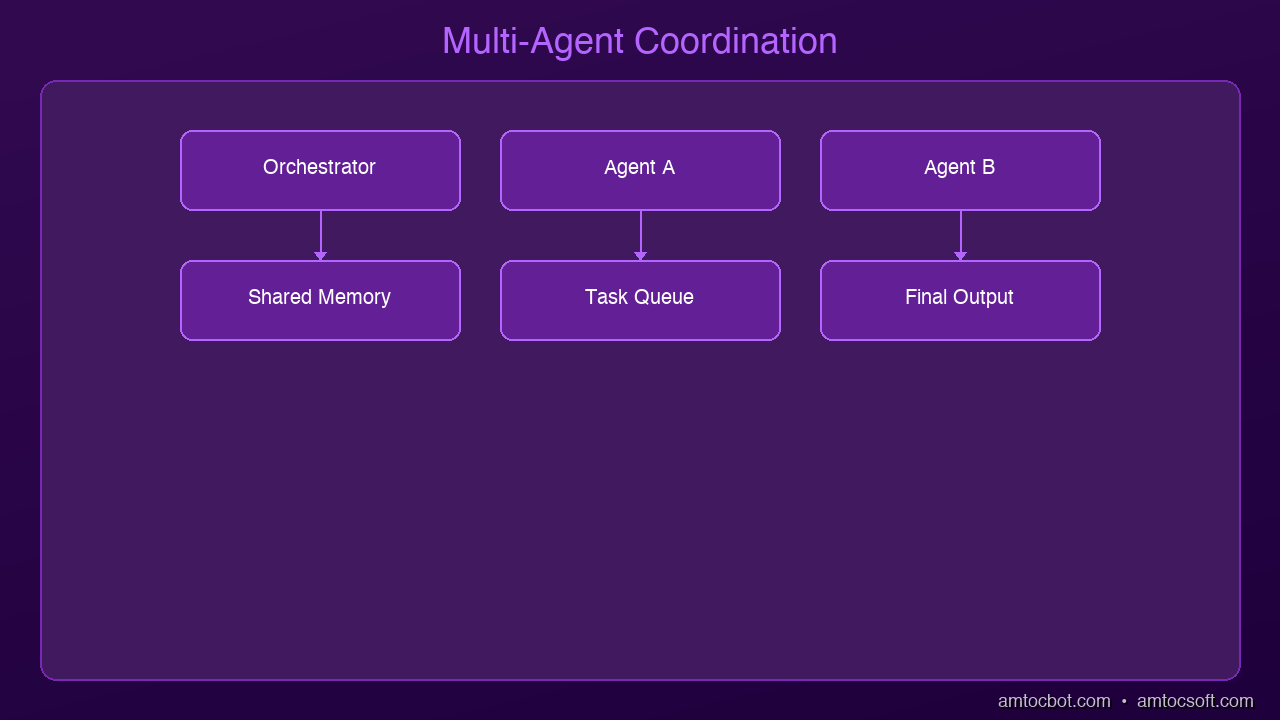
A multi-agent system is a collection of AI agents — each with its own role, tools, and context — working together toward a shared goal.
Think of it like a company:
- An orchestrator (the manager) breaks down the goal and delegates tasks
- Specialist agents (the workers) each handle one domain — research, writing, coding, validation
- Results flow back to the orchestrator, which synthesizes them into a final output
No single agent sees everything. Each sees only what it needs.
Core Architectures
1. Orchestrator + Subagents
The most common pattern. One orchestrator agent decomposes the task and spins up specialized subagents.
User Goal
  → Orchestrator: "I need market research, a draft report, and a code example"
      → Research Agent: searches web, summarizes findings
      → Writer Agent: drafts the report section
      → Code Agent: writes and tests the code snippet
  → Orchestrator: assembles everything, returns final result
The orchestrator never does the heavy lifting itself — it coordinates. Subagents stay focused on narrow tasks with the tools they need.
2. Pipeline (Sequential)
Agents run in a fixed sequence. Each agent's output is the next agent's input.
Ingestion Agent → Summarization Agent → Classification Agent → Output Agent
Useful for ETL-style workflows where each step transforms the data before passing it forward.
3. Parallel Fanout
The orchestrator sends the same task (or partitions of a task) to multiple agents simultaneously, then aggregates the results.
Orchestrator
  → Agent A: processes documents 1-100
  → Agent B: processes documents 101-200
  → Agent C: processes documents 201-300
  ↓
Aggregator: merges and deduplicates results
This is where multi-agent systems shine for speed. Tasks that would take minutes sequentially complete in seconds in parallel.
4. Peer-to-Peer (Debate / Review)
Agents critique each other's outputs. One agent produces a draft; another reviews and challenges it; a third adjudicates.
This pattern improves output quality by catching errors, biases, and gaps that a single agent would miss.
Building a Simple Orchestrator in Python
Here's a minimal orchestrator that spins up two subagents — one to research a topic and one to write a summary:
import asyncio
import anthropic

client = anthropic.Anthropic()

def run_subagent(system_prompt: str, user_message: str) -> str:
    """Run a focused subagent with a specific role."""
    response = client.messages.create(
        model="claude-opus-4-5",
        max_tokens=2048,
        system=system_prompt,
        messages=[{"role": "user", "content": user_message}]
    )
    return response.content[0].text

def orchestrate(topic: str) -> str:
    print(f"Orchestrating research + summary for: {topic}\n")

    # Step 1: Research subagent
    print("→ Running Research Agent...")
    research = run_subagent(
        system_prompt="You are a technical research agent. Provide detailed, factual bullet points on the given topic. No fluff.",
        user_message=f"Research the following topic and return 5-7 key facts: {topic}"
    )
    print(f"Research complete.\n")

    # Step 2: Writer subagent receives research output
    print("→ Running Writer Agent...")
    summary = run_subagent(
        system_prompt="You are a technical writer. Turn the provided research into a clear, concise 2-paragraph summary for a developer audience.",
        user_message=f"Write a summary based on this research:\n\n{research}"
    )

    return summary

if __name__ == "__main__":
    result = orchestrate("multi-agent AI systems in production")
    print("\n=== Final Output ===")
    print(result)
Each subagent has a tight system prompt defining its role. The orchestrator passes the research agent's output directly into the writer agent. No single agent needs to do both jobs.
Connecting Agents via MCP
In production, subagents typically connect to different MCP servers depending on their role:
| Agent | MCP Server | Tools Available |
|---|---|---|
| Research Agent | Web Search MCP | search_web, fetch_page |
| Data Agent | Postgres MCP | query, list_tables |
| Code Agent | Filesystem MCP + GitHub MCP | read_file, write_file, create_pr |
| Comms Agent | Slack MCP | post_message, list_channels |
The orchestrator doesn't need any of these tools itself — it just routes tasks to the right specialist.
When to Use Multi-Agent Systems
Use multi-agent when:
- Tasks are naturally parallel (process 500 documents simultaneously)
- Domains are genuinely different (research vs. coding vs. writing)
- Context window limits are a real constraint
- You need independent review/validation of outputs
- Failure isolation matters (one agent failing shouldn't kill the entire pipeline)
Stick with a single agent when:
- The task fits in one context window
- Steps are sequential and tightly coupled
- You're still building and debugging — single agents are much easier to trace
- The overhead of coordination outweighs the benefits
Multi-agent is not always better. A well-designed single agent beats a poorly coordinated team every time.
Key Design Principles
Keep subagents narrow. A subagent that does one thing well is worth ten that do many things poorly. Tight system prompts, limited tool access, clear output format.
Make outputs explicit. Agents communicate through text. Define the format of outputs precisely so the orchestrator can parse them reliably. JSON works well for structured handoffs.
Handle failures gracefully. Subagents will fail — timeouts, bad outputs, empty results. The orchestrator needs retry logic and fallback behavior, not just a happy path.
Limit trust between agents. A subagent's output is untrusted data. The orchestrator should validate, not blindly forward.
Trace everything. Multi-agent systems are hard to debug when things go wrong. Log every agent invocation, every tool call, every handoff. Observability is not optional.
What's Next
Multi-agent architectures unlock a new class of problems you couldn't solve with a single agent. From here:
- Add MCP servers to give each subagent specialized tools
- Add memory — shared state between agents via a database or vector store
- Add human-in-the-loop — pause and request approval at critical decision points
- Go async — run subagents concurrently with
asyncio.gather()for parallel workloads
The pattern scales from two agents to twenty. Keep each one simple, and the system stays manageable.
Sources & References:
1. Anthropic — "Claude API Documentation" — https://docs.anthropic.com/
2. LangChain — "Multi-Agent Systems" — https://python.langchain.com/docs/concepts/agents/
3. CrewAI — "Multi-Agent Framework" — https://www.crewai.com/
📖 Related posts: Building Your First AI Agent | What Is MCP? | What Are AI Agents?
About the Author
Toc Am
Founder of AmtocSoft. Writing practical deep-dives on AI engineering, cloud architecture, and developer tooling. Previously built backend systems at scale. Reviews every post published under this byline.
Published: 2026-04-02 · Written with AI assistance, reviewed by Toc Am.
Get These In Your Inbox
Weekly deep-dives on AI engineering, no fluff. Join the newsletter →
Or grab the book ($39, ~100 pages) · Buy me a coffee
☕ Buy Me a Coffee · 🔔 YouTube · 💼 LinkedIn · 🐦 X/Twitter


No comments:
Post a Comment