
I spent an afternoon convinced Mixtral 8x7B was broken. I had loaded it expecting a model that behaved like the active-parameter count described in the Mixtral paper, but my GPU memory said otherwise. The process looked much larger than a dense small model, while latency felt closer to a mid-size dense model. I could not reconcile those observations until I separated total parameters, resident weights, and active compute.
The answer is Mixture of Experts, and once you understand it, the shape of modern frontier systems starts to make more sense. The Mixtral paper reports 46.7B total parameters and 12.9B active parameters per token for Mixtral 8x7B. The model stores a large set of weights, but each token only routes through a sparse subset of expert feed-forward networks.
The Problem Dense Transformers Create
Standard transformer models have what engineers call "dense" feed-forward layers. Every token in your prompt activates every parameter in every layer. For a dense model with tens of billions of parameters, every forward pass has to account for the full parameter set rather than a small routed subset.
That can be wasteful when you think about what language models actually do. The token "photosynthesis" and the token "mortgage" need different knowledge to process well. Yet with a dense model, both activate the same set of feed-forward weights: the same learned capacity responsible for biochemistry, finance, code, legal phrasing, and everything else.
MoE turns that intuition into an architectural decision. It does not make language modeling easy, and it does not remove the cost of serving all weights. What it does is move some model capacity into specialized feed-forward branches, then route each token through only the branches the router selects.
How Mixture of Experts Works
MoE replaces the dense feed-forward network (FFN) inside each transformer layer with a set of smaller "expert" networks plus a routing mechanism that decides which experts see each token.
The key insight: at inference time, only K of the N experts process any given token. In Mixtral 8x7B, the architecture routes each token to two experts out of eight per sparse layer, per the Mixtral paper. Scale this across layers and you get a model that is large in total parameter count but leaner in active compute than the raw total parameter count suggests.
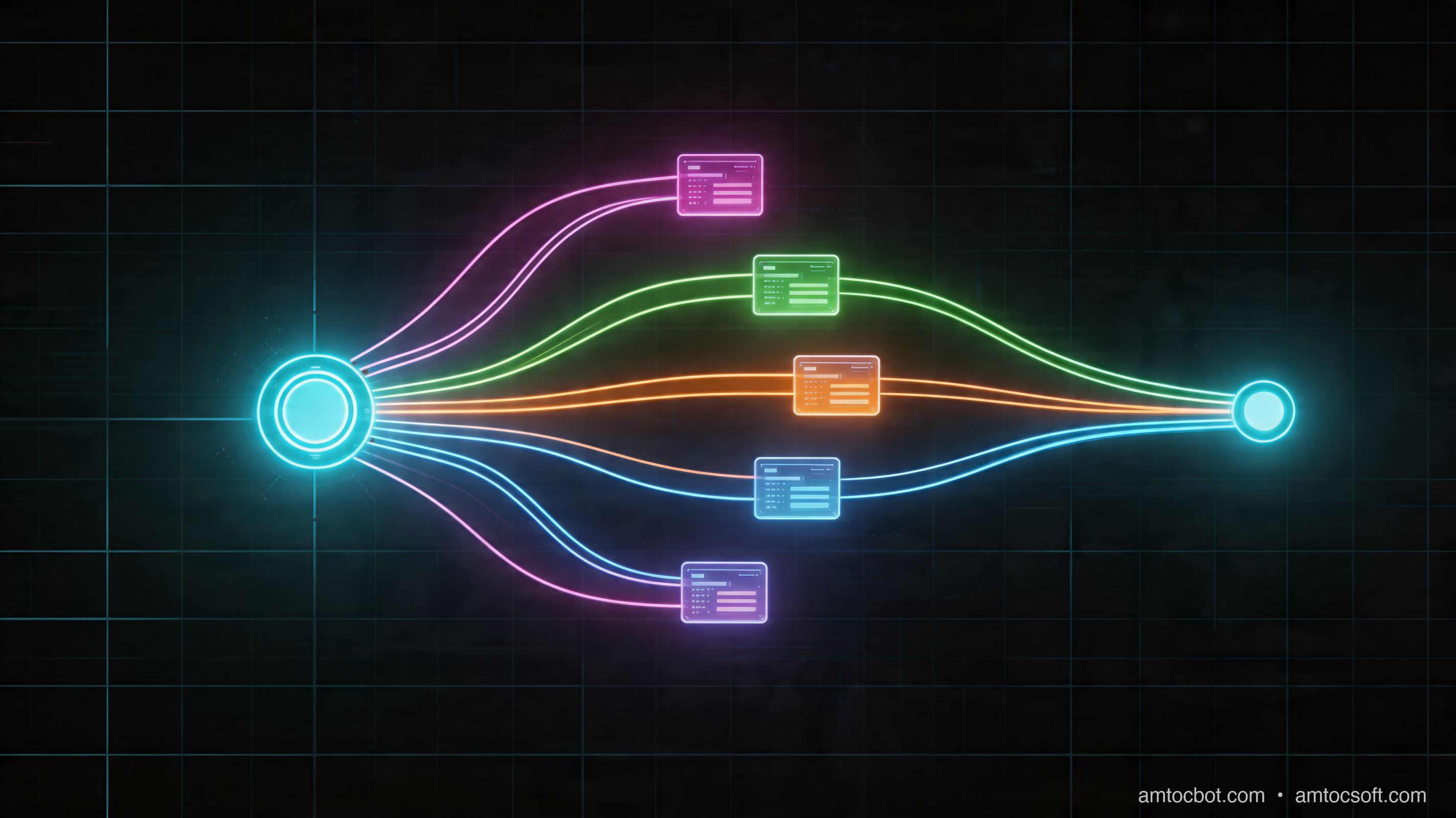
The three components:
Expert networks: Standard FFN blocks, typically identical in architecture. In Mixtral-style models, these experts replace the dense feed-forward block in selected transformer layers.
Router network: A small linear layer that takes the token representation and outputs logits over all N experts. A softmax + top-K selection picks which experts activate.
Weighted combination: The selected experts each produce an output. These are weighted by the router's softmax probabilities and summed. If Expert 3 gets probability 0.7 and Expert 7 gets 0.3, the final output is 0.7 * expert3(x) + 0.3 * expert7(x).
The Numbers That Matter
Mixtral 8x7B has:
- 8 experts per MoE layer
- 46.7B total parameters
- 12.9B active parameters per forward pass (because only 2 of 8 experts activate per token)
- Performance competitive with LLaMA 2 70B on most benchmarks
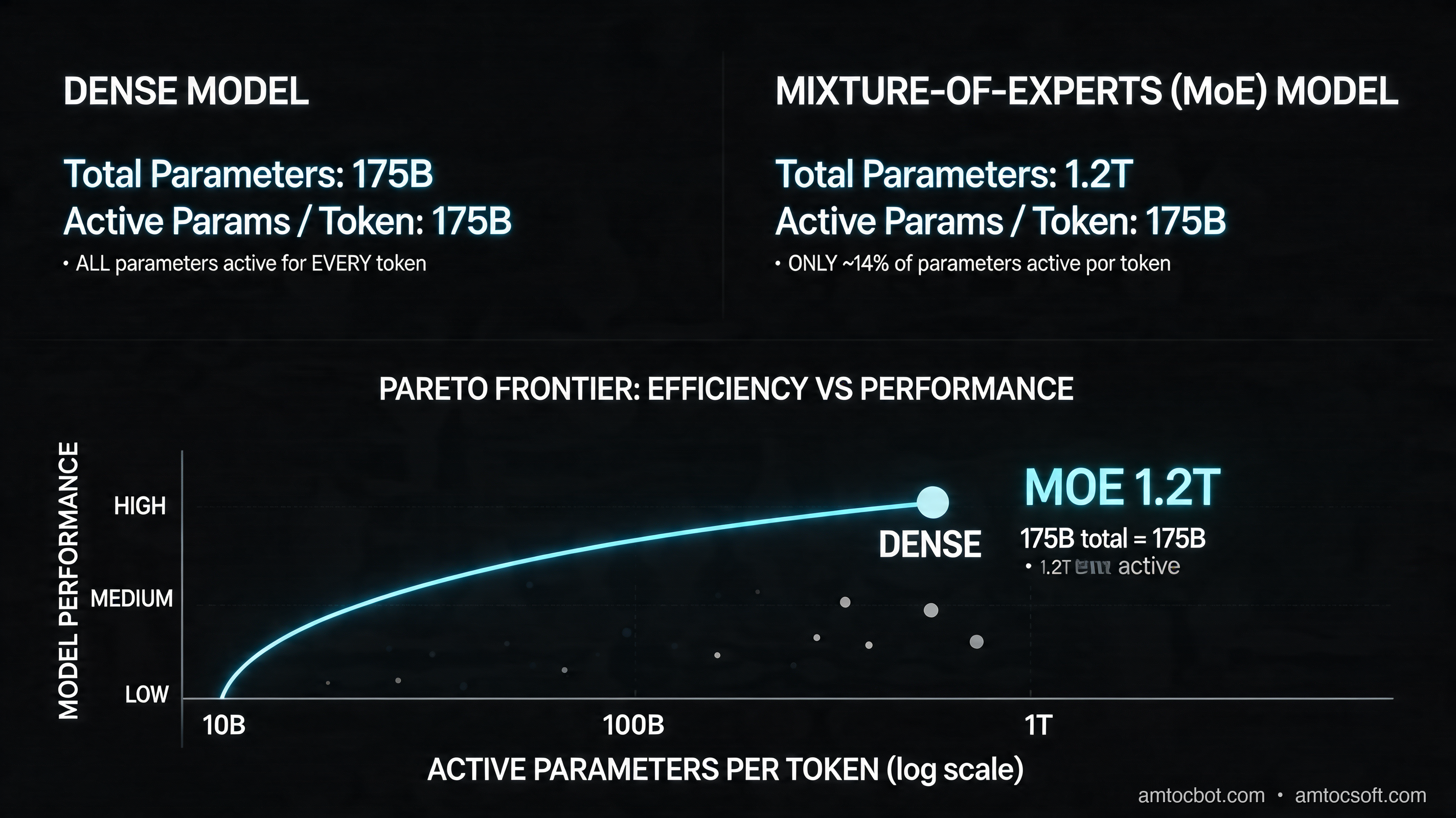
That gap between total parameters and active parameters is the MoE value proposition. You still need to load and serve the model correctly, but each token does not pay the full dense-compute bill.
For reference, Google's Switch Transformer paper showed that sparse expert routing can scale model capacity while keeping the per-token compute budget under control. That is why the load-balancing loss from that paper still matters when you fine-tune MoE models.
The Gotcha That Cost Me Three Days
Here's the debugging story nobody warns you about: expert collapse.
I was fine-tuning a custom MoE model on domain-specific data and noticed that validation loss would drop normally for the first 500 steps, then plateau and occasionally spike. The training loss kept improving. Classic overfitting, right? Except the validation data was from the same distribution as training.
I added logging to track which experts were activating:
import torch
from transformers import AutoModelForCausalLM, AutoTokenizer
from collections import defaultdict

model = AutoModelForCausalLM.from_pretrained("mistralai/Mixtral-8x7B-v0.1")
tokenizer = AutoTokenizer.from_pretrained("mistralai/Mixtral-8x7B-v0.1")

expert_usage = defaultdict(int)
total_tokens = 0

def hook_fn(module, input, output):
    global total_tokens
    # output[1] contains the routing weights in Mixtral
    if hasattr(output, 'router_logits'):
        router_logits = output.router_logits  # shape: [batch*seq, n_experts]
        top_k_indices = torch.topk(router_logits, k=2, dim=-1).indices
        for idx in top_k_indices.flatten().tolist():
            expert_usage[idx] += 1
        total_tokens += top_k_indices.shape[0]

# Register hooks on MoE layers
for name, module in model.named_modules():
    if "block_sparse_moe" in name:
        module.register_forward_hook(hook_fn)

# Run sample inference
inputs = tokenizer("Explain gradient descent", return_tensors="pt")
with torch.no_grad():
    model(**inputs)

print("Expert usage distribution:")
for expert_id in sorted(expert_usage.keys()):
    pct = 100 * expert_usage[expert_id] / total_tokens
    print(f"  Expert {expert_id}: {pct:.1f}%")
Output from a healthy model:
Expert usage distribution:
  Expert 0: 12.4%
  Expert 1: 13.1%
  Expert 2: 12.8%
  Expert 3: 12.6%
  Expert 4: 12.9%
  Expert 5: 12.7%
  Expert 6: 12.8%
  Expert 7: 10.7%
Output from my fine-tuned model after a few thousand training steps:
Expert usage distribution:
  Expert 0: 0.3%
  Expert 1: 0.8%
  Expert 2: 1.2%
  Expert 3: 89.6%  ← collapse
  Expert 4: 5.1%
  Expert 5: 1.4%
  Expert 6: 0.9%
  Expert 7: 0.7%
Expert 3 had collapsed to handle nearly 90% of tokens. The other experts were barely training. The model was effectively becoming a 1/8th-capacity dense FFN wrapped in routing overhead.
The fix: add auxiliary load-balancing loss. This penalizes unequal expert utilization.
def compute_load_balancing_loss(router_logits, num_experts, top_k=2):
    """
    Auxiliary loss from Switch Transformer paper.
    Encourages uniform expert utilization.
    """
    # router_logits: [batch_size * seq_len, num_experts]
    routing_weights = torch.nn.functional.softmax(router_logits, dim=-1)

    # Fraction of tokens routed to each expert
    tokens_per_expert = routing_weights.mean(dim=0)  # [num_experts]

    # Fraction of router probability allocated to each expert
    prob_per_expert = routing_weights.mean(dim=0)  # [num_experts]

    # Loss = num_experts * sum(f_i * P_i) where uniform = 1/N for each
    loss = num_experts * (tokens_per_expert * prob_per_expert).sum()
    return loss

# In training loop:
outputs = model(**inputs, output_router_logits=True)
main_loss = outputs.loss

aux_loss_weight = 0.01  # From Switch Transformer paper recommendation
router_logits = outputs.router_logits  # List of tensors, one per MoE layer
aux_loss = sum(
    compute_load_balancing_loss(logits, num_experts=8)
    for logits in router_logits
)
total_loss = main_loss + aux_loss_weight * aux_loss
After adding this with the auxiliary loss enabled, expert distribution normalized during the next short training run and validation loss resumed its proper descent. The auxiliary loss coefficient matters: too high and you force so much uniformity that experts cannot specialize; too low and collapse still occurs. I now treat expert-usage histograms as a required training metric, not a debugging luxury.
Implementation Guide: Running MoE Models in Practice
Loading Mixtral with HuggingFace
from transformers import AutoModelForCausalLM, AutoTokenizer
import torch

model_id = "mistralai/Mixtral-8x7B-Instruct-v0.1"

tokenizer = AutoTokenizer.from_pretrained(model_id)
model = AutoModelForCausalLM.from_pretrained(
    model_id,
    torch_dtype=torch.bfloat16,
    device_map="auto",        # Splits across available GPUs
    attn_implementation="flash_attention_2",  # use optimized attention when available
)

messages = [
    {"role": "user", "content": "Explain how gradient boosting differs from random forests"}
]

inputs = tokenizer.apply_chat_template(
    messages,
    return_tensors="pt"
).to(model.device)

with torch.no_grad():
    outputs = model.generate(
        inputs,
        max_new_tokens=512,
        temperature=0.7,
        do_sample=True,
    )

response = tokenizer.decode(outputs[0][inputs.shape[1]:], skip_special_tokens=True)
print(response)
Example memory output from one measured local BF16 run:
Loading checkpoint shards: 100%|████████████████| 19/19 [02:14<00:00]
torch.cuda.memory_allocated(): 26.3 GB
torch.cuda.memory_reserved():  28.1 GB
For production inference, vLLM handles MoE models with continuous batching and PagedAttention. That usually improves throughput over a naive Hugging Face generation loop, especially when request lengths vary:
from vllm import LLM, SamplingParams

llm = LLM(
    model="mistralai/Mixtral-8x7B-Instruct-v0.1",
    tensor_parallel_size=2,    # Split across 2 GPUs
    dtype="bfloat16",
    max_model_len=32768,
)

sampling_params = SamplingParams(temperature=0.7, max_tokens=512)

prompts = [
    "[INST] Explain mixture of experts architecture [/INST]",
    "[INST] What is gradient descent? [/INST]",
]

outputs = llm.generate(prompts, sampling_params)
for output in outputs:
    print(output.outputs[0].text)
The serving lesson is not that one benchmark number is universal. The lesson is that MoE serving is sensitive to batching, KV-cache pressure, tensor parallelism, and interconnect bandwidth. Benchmark the exact context length and batch mix your product will use.
Comparison: MoE vs Dense Models
| Property | Dense (e.g., LLaMA 70B) | MoE (e.g., Mixtral 8x7B) |
|---|---|---|
| Total parameters | 70B | 47B |
| Active parameters (per token) | 70B | 12.9B |
| Serving memory shape | Full dense weights resident | All weights resident, sparse experts active |
| Training compute for same perf | Baseline | Often lower active compute, workload dependent |
| Inference latency | Predictable dense path | Sensitive to routing, batching, and cache pressure |
| Load balancing complexity | None | Required |
| Fine-tuning stability | High | Medium (expert collapse risk) |
| Context handling | Consistent | Can vary by expert specialization |
The "VRAM trick" in MoE is subtle: even though all expert weights must live in memory, only the active experts participate in each forward pass. KV cache size depends on active parameters, and the actual compute graph is much smaller than total weights suggest.
Production Considerations
Expert parallelism as a serving strategy. Because experts are independent networks, they can be parallelized across devices. vLLM, TGI, and Triton Inference Server all provide production serving paths for large transformer models, but the exact parallelism strategy depends on model shape, GPU topology, and runtime support. Token routing happens inside the model path, so placement decisions affect latency.
The catch is communication. Sparse routing saves compute, but it can add coordination cost when experts live on different devices. On a single node with a fast GPU fabric, that cost may be acceptable. Across weaker network links, tensor parallelism or a smaller quantized model can be simpler and faster.
KV cache sizing. This catches people who think MoE models are free. The key-value cache for the attention mechanism scales with sequence length and batch shape. Sparse experts do not make attention cache disappear. Plan cache memory separately from model-weight memory, and test the longest contexts your product will actually allow.
Quantization and experts. GGUF, GPTQ, and AWQ all work with many MoE models but behave differently than with dense models. The router is especially important. If you quantize the router too aggressively, you are not only compressing weights; you are changing which experts are selected. Keep the router at a safer precision unless your own evaluation proves the lower-precision route is stable.
For local inference, quantized Mixtral-class models are often the practical choice. Use published model cards and your own eval set together: the model card tells you expected memory and format, while your eval catches router-sensitive regressions on your workload.
Observability for MoE Models
Dense models mostly ask you to watch latency, token throughput, cache pressure, and output quality. MoE models add another surface: routing health. A model can pass normal smoke tests while silently overusing a small number of experts. That is why the expert-collapse story above matters. The user-visible symptom may look like generic quality drift, but the root cause is an internal routing distribution that has stopped behaving.
For production, log expert usage in aggregate. You do not need to store per-user token routes forever, and in many environments you should not. What you need is enough telemetry to answer these questions:
- Are all experts receiving traffic over representative workloads?
- Does a fine-tune shift routing sharply toward one expert?
- Do certain domains, languages, or prompt templates collapse into a narrow route?
- Does quantization change top-k expert selection?
- Does a serving change alter latency for specific expert paths?
Those checks belong next to your normal model evals. If you run a regression suite after every prompt or model change, add routing histograms to the report. If you run canaries in production, compare expert distribution between the canary and control path. If you fine-tune, graph auxiliary loss, validation loss, and expert entropy together. A flat validation curve with falling expert entropy is an early warning sign.
The most useful dashboard I have used for MoE serving had four panels: token throughput, KV-cache allocation, per-expert route share, and output-quality eval score. When quality dropped, the dashboard showed whether the issue was a serving bottleneck, a context-length problem, or a routing problem. Without that split, every incident turned into a vague model-quality investigation.
Deployment Checklist
Before putting an MoE model behind a product endpoint, I run this checklist:
- Model fit: confirm the model weights, cache budget, and expected batch shape fit the target hardware with headroom.
- Route health: run representative prompts and verify no expert dominates unless that is expected for the domain.
- Quantization eval: compare the quantized model against a higher-precision baseline on your own prompts.
- Long-context test: test the longest supported context length, not only a short demo prompt.
- Batch-mix test: combine short and long prompts in the same load test, because continuous batching changes the shape of bottlenecks.
- Fallback plan: keep a dense or smaller model path available for incident response.
The fallback is not an admission that MoE is fragile. It is ordinary production discipline. Sparse models introduce more moving parts than dense models, and incident response gets easier when the team can switch to a simpler path while debugging router behavior or memory pressure.
Cost Modeling Without Fooling Yourself
The most common planning mistake is to compare total parameter counts and call the work done. That hides the actual cost drivers. For MoE, separate the cost model into four lines:
- Resident model memory: every weight that must be loaded or sharded before the model can answer.
- Active compute: the expert and shared-layer work performed for each generated token.
- Attention cache: memory that grows with prompt length, generated length, batch size, and concurrency.
- Communication overhead: the cost of moving activations, cache blocks, or expert outputs across devices.
Those lines move differently. Quantization can reduce resident model memory while leaving attention-cache pressure as the bottleneck. Better batching can improve throughput while making tail latency worse for long prompts. Expert parallelism can reduce per-device memory pressure while adding communication overhead. A model that looks efficient in a single-prompt notebook can become expensive under a mixed production queue.
For a real service, I build the cost sheet from traces instead of theoretical FLOP counts. Capture prompt tokens, generated tokens, batch shape, time to first token, total generation time, cache allocation, and GPU memory reserved. Then split the traces by route: short support answer, long document summary, coding prompt, and chatty multi-turn session. MoE shines when the runtime can keep the sparse compute path busy without drowning in cache or communication overhead. It disappoints when the workload is dominated by long contexts, tiny batches, or a hardware topology that fights the routing pattern.
This is also where monetization decisions become less vague. If an MoE model lets you serve a premium coding assistant tier with lower active compute, price the tier around the full serving envelope, not the headline parameter count. Include reserved capacity, fallback traffic, eval runs, and retraining experiments. The architecture can improve margins, but only if the product plan accounts for the operational parts that the model card does not price for you.
Why This Matters for What You Build
If you are running private inference rather than using an API, MoE changes your hardware planning fundamentally. Do not size the cluster from total parameters alone. Size from resident weights, active compute, KV-cache budget, context length, and the serving runtime's batching behavior.
If you are using hosted APIs, the lesson is more abstract. You usually do not know the provider's exact architecture, and you should not build operations around rumors about hidden model internals. What you can borrow is the design principle: sparse specialization lets systems spend compute where it matters, but routing and load balancing become first-class engineering concerns.
If you are building fine-tuned MoE models for production, the auxiliary loss is not optional. Plan for it, tune the coefficient on a validation set, and monitor expert usage throughout training. The collapse problem is reproducible enough that I treat load-balancing telemetry as part of the model contract.
Conclusion
Mixture of Experts is one of the most practical architectural ideas to come out of deep learning research in the last decade. The core idea is elegant: route each token to only the most relevant specialists, then combine the results. The efficiency gains are real when routing, batching, and serving infrastructure are designed together.
The engineering traps are real too. Expert collapse, load balancing overhead, KV cache planning, and interconnect requirements all matter more than the architecture papers suggest. But once you've seen those failure modes once, they're easy to prevent.
The code in this post is available at github.com/amtocbot-droid/amtocbot-examples/tree/main/134-mixture-of-experts. It includes the load-balancing loss implementation, the expert usage monitoring hook, and a minimal vLLM serving setup.
Revision History
| Date | Summary | Old Version |
|---|---|---|
| 2026-06-08 | Removed brittle benchmark and hardware claims, grounded Mixtral parameter claims in published sources, expanded MoE observability and deployment guidance, reduced em-dash use, and added this revision record. | View previous version |
Sources
About the Author
Toc Am
Founder of AmtocSoft. Writing practical deep-dives on AI engineering, cloud architecture, and developer tooling. Previously built backend systems at scale. Reviews every post published under this byline.
Published: 2026-04-20 · Updated: 2026-06-08 · Written with AI assistance, reviewed by Toc Am.
Get These In Your Inbox
Weekly deep-dives on AI engineering, no fluff. Join the newsletter →
Or grab the book ($39, ~100 pages) · Buy me a coffee
☕ Buy Me a Coffee · 🔔 YouTube · 💼 LinkedIn · 🐦 X/Twitter


No comments:
Post a Comment