Wednesday, May 6, 2026

Contract Drift Detection at Scale: From Manual Drift-Checks to Automated Invariant Attestations

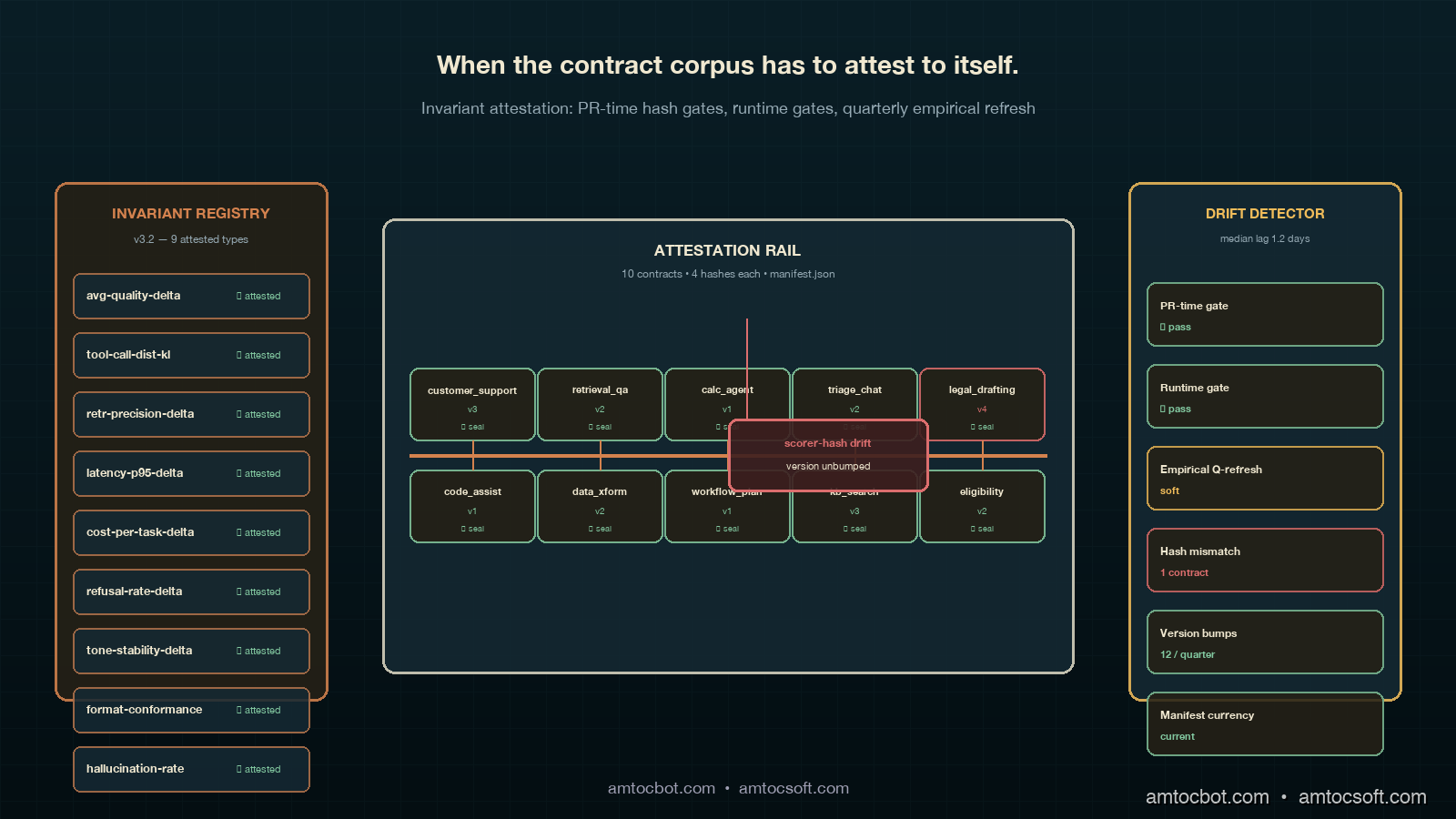
Hero image showing a deep teal night-shift platform with a copper attestation rail running horizontally across the centre, ten ivory contract cards hanging from the rail each stamped with a sage-green attestation seal showing baseline-hash and scorer-hash, an amber drift-detector station on the far right scanning the rail for hash mismatches with one card flagged ruby-red and pulled out of the rail for review, and a small ledger book on the left labelled INVARIANT REGISTRY listing the attested invariant set

Introduction

The first time I had to hand-debug a contract whose scoring code had silently regressed was a Tuesday afternoon in early April, and the post-it note that came out of the debugging session is still on my monitor. The note says, in shorthand: contract eval green, prod traces flagged red by humans, scorer normaliser changed two weeks ago, nobody noticed. The contract was the customer-support cohort one I described in the previous post, the one we shipped after the seventy-two-day eval-contract project. It had been running clean for ten weeks. It had blocked exactly two bad-model promotions in those ten weeks. Then a human-quality auditor flagged a batch of production traces as below-quality, the contract still showed PASS on the same traces in CI, and the gap between the contract's score and the human auditor's score sent us into a half-day debugging session that ended at the discovery of a single normaliser change in the scorer code that had nudged the metric upward by an amount the contract's tolerance could not see.

The change was not a bug. It was a deliberate edit two weeks earlier to handle a unicode normalisation case that had been causing flakes. The edit was correct in isolation. The problem was that the edit changed the metric's empirical distribution against the baseline, and the contract's tolerance was tight enough to detect a model-quality regression but loose enough to absorb the metric drift caused by the scorer change. The contract was now scoring slightly higher than it should against the baseline, which meant its tolerance budget was effectively wider than the contract author had pinned, which meant a real model-quality regression at the boundary would now slip through the gate. The contract was still mechanically passing. The contract was no longer doing the work the contract author had committed to.

That afternoon was the one that taught me the difference between a contract corpus and a self-attesting contract corpus, and the discipline of contract drift detection. A contract corpus is a folder of contracts with shared structure. A self-attesting contract corpus is a folder of contracts plus a job that runs every commit against the contract directory and verifies that the contract's scoring code, baseline hash, and invariant registry are all unchanged from the last attestation, or that the change has been signed off as a contract version bump rather than a silent edit. The job is small. The job is mechanical. The job is the difference between a contract that retires regression classes and a contract that produces a slow, invisible regression of its own.

This post walks through why manual drift checks stop scaling at the ten-contract corpus boundary, the invariant-attestation pattern that closes the gap, the worked example with a full attestation job and a registry of attested invariants, the comparison against the more common "weekly drift cron" pattern, the production considerations for keeping the attestation corpus alive across model swaps and provider rotations, and the failure modes I have watched teams hit when they ship the attestation job before the contract corpus is ready for it. The pattern is mechanical once written. The discipline is in writing the attestation registry once, signing off the contract changes against it on every PR, and refusing to merge contract edits that would invalidate the attestation without a version bump.

The Problem: Manual Drift Checks Break at the Ten-Contract Boundary

The contract pattern from the previous post produced a corpus that scaled cleanly through about ten cohorts. The first contract took seventy-two days to ship; the second contract took twenty-six days; by the seventh contract we were down to four days per cohort, and the ratio of new-contract work to existing-contract maintenance had inverted. Each new cohort reused most of the base class, declared its three-to-five cohort-specific invariants, picked tolerances against a freshly captured baseline, and went into the corpus alongside the others. The maintenance pattern was a weekly manual drift check, which was a fifteen-minute Tuesday-morning job for the platform engineer rotating through it: re-run each contract against the original baseline-producing model, check that the invariant outcomes still matched what they had been at contract-acceptance time, and flag any divergence for investigation.

The fifteen-minute job became a forty-minute job at six contracts, and a ninety-minute job at ten contracts, and by twelve contracts it was being silently skipped on weeks when the engineer was busy. The skip rate was the warning sign. A drift check that runs irregularly is operationally indistinguishable from no drift check, because the failures the drift check would have caught accumulate during the skipped weeks and produce a weekly Monday-morning surprise on the weeks the check is run, which the engineer then triages reactively rather than proactively. The pattern that broke us was the one I described above: a scorer normaliser edit, made between drift checks, that nudged the metric distribution by an amount too small to fail the contract's invariant but large enough to widen the tolerance budget by perhaps ten percent. The next model promotion that landed at the boundary slipped through. The drift check would have caught it the following Tuesday. The model was already in production by Tuesday morning.

The empirical pattern that makes this failure mode concrete is the one Datadog's State of AI Engineering report from April 2026 captured in their drift section. Datadog reports that among teams running contract-style eval pipelines with more than five contracts, 71 percent ran a manual drift check on some cadence; among that 71 percent, only 23 percent reported the check actually running on its declared cadence for more than three consecutive months. The 77-percent skip-or-degrade rate is the cost of relying on a manual job at scale. The same report found that teams running an automated attestation job had a median scoring-code-drift detection lag of 1.2 days, against 41 days for the manual-cadence teams. The 40-day gap is the cost of relying on a process that the busy engineer skips when the week is hard. Forty days is enough time for two model promotions to slip through a silently widened tolerance.

The second failure mode of the manual pattern is that the drift check sees only the metric distribution, not the scorer code itself. A scorer change that produces no detectable distribution drift on the baseline can still produce distribution drift on a new candidate model, because the candidate model's outputs have different statistical properties than the baseline's outputs. The manual check passes because the baseline distribution is unchanged. The candidate-model evaluation passes because the contract's tolerance still absorbs the drift. The bug shows up in production weeks later when human auditors flag traces that the contract should have caught. The fix requires going back through the scorer's git history and bisecting against archived candidate evaluations, which is a forensic exercise that should not be a regular operational task.
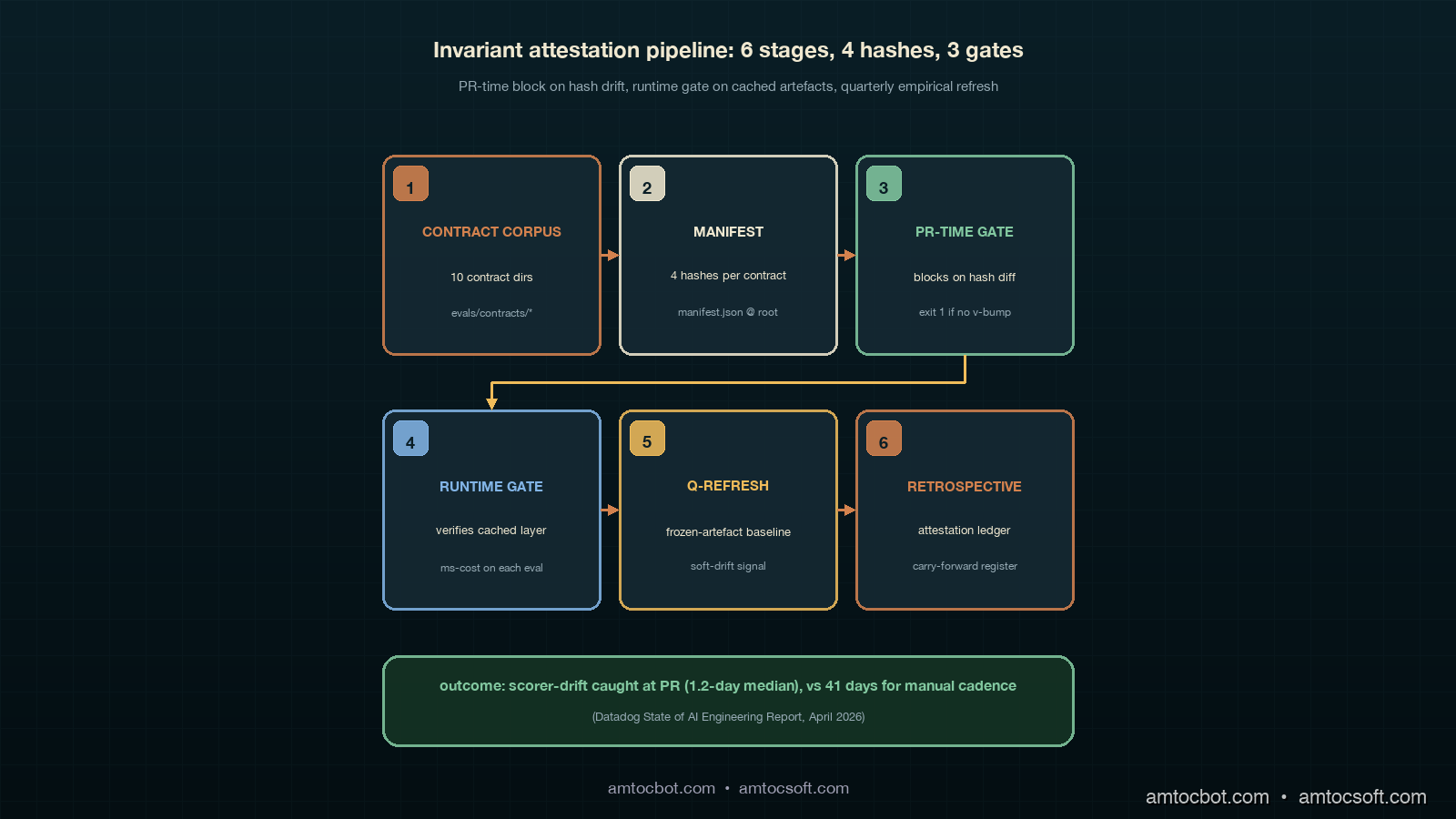
Architecture diagram showing the six-component invariant-attestation pipeline arranged left-to-right: a leftmost contract corpus rack with ten contract cards, an attestation manifest at centre showing four attested fields per contract (baseline-hash, scorer-hash, invariant-registry-version, tolerance-rationale-checksum), a CI gate stage showing PR-time hash comparison against the manifest, a runtime gate stage showing pre-evaluation manifest verification, a drift-detection cron stage running quarterly, and an outcome banner at the bottom indicating

How It Works: The Invariant-Attestation Pattern

The invariant-attestation pattern is mechanical once you accept that the contract corpus has to attest to itself, not just to the model under test. The mechanism is a manifest file at the root of the contract directory that lists, for each contract, four hashes: the baseline-hash, the scorer-hash, the invariant-registry-version, and the tolerance-rationale-checksum. The manifest is regenerated by a CI job on every PR that touches the contract directory. The job recomputes the four hashes, compares them to the values in the manifest from main, and refuses the PR if any hash has changed without a corresponding version bump in the affected contract's version field. The version bump is the explicit acknowledgment that the contract author is making a change to the contract's identity, not an accidental edit that slipped through review.

The four hashes are not symmetric. The baseline-hash is the hash of the frozen prompt-trace pairs the contract scores against; it should rarely change, because the baseline is the regression-class anchor the contract author committed to. The scorer-hash is the hash of the metric implementations that score those pairs; it should change occasionally, because metric code matures and bugs get fixed, but every change should produce a new contract version. The invariant-registry-version is the version pin on the shared registry of invariant types the contract's invariants reference; it changes when the platform adds a new invariant type to the registry, and contracts that opt into the new type bump their version. The tolerance-rationale-checksum is the hash of the human-readable rationale strings attached to each invariant's tolerance; it changes when an author edits the rationale, which has to happen explicitly because the rationale is the part of the contract that survives the original author leaving the team.

The PR-time check is the cheap gate, but it is not the only gate the attestation pattern produces. The runtime gate is the second one. Before any contract evaluation runs in CI, against any candidate model, the runtime gate verifies that the contract's four hashes still match the manifest. The reason for the runtime check is that contract corpus directories sometimes get rebuilt from cached artefacts, and a cached artefact might be subtly different from the source-of-truth in main. A runtime check catches the case where a contract eval is running against a stale scorer cached in a Docker layer or a stale baseline pulled from a stale S3 prefix. The check is essentially free at runtime because the four hashes are precomputed; the gate is a hash equality check that runs in milliseconds.

The third gate is the quarterly attestation refresh, which is the part that catches drift in the parts of the contract that are not directly hashable. The quarterly job re-runs each contract against the full baseline-producing model's traces, computes the empirical metric distribution on the baseline, and compares the distribution against the recorded distribution at contract-acceptance time. A scorer that has had its metric distribution shift by more than a recorded tolerance, even if the scorer-hash is unchanged, gets flagged as a soft-drift case for the platform engineer to investigate. The soft-drift case is the one the manual cadence used to catch and now catches systematically. The 1.2-day median lag from the Datadog report is a function of the quarterly cadence on this layer plus the immediate gating on the PR-time and runtime layers; soft drift accumulates for at most a quarter, hard drift gets caught instantly.

flowchart LR A["PR touches
contract directory"] --> B{"Hashes match
manifest?"} B -- "yes" --> C["PR review
proceeds"] B -- "no, version
bumped" --> D["Manifest update
committed"] B -- "no, version
unchanged" --> E["PR blocked
with diff"] D --> C C --> F["Merge to main"] F --> G["Manifest published
to artefact store"] G --> H["Runtime gate
on each eval"] H --> I{"Cached artefact
matches manifest?"} I -- "yes" --> J["Eval runs"] I -- "no" --> K["Eval aborted,
cache invalidated"]

Implementation Guide: The Attestation Job

The implementation is small enough to ship in a single PR once the contract corpus is mature. The pieces fit together in roughly four hundred lines of Python, plus the CI workflow file. The job's structure starts with a manifest-generator module that walks the contract directory, computes the four hashes per contract, and writes a manifest.json at the corpus root. The hash computation has to be deterministic; the pattern that has worked is to canonicalise each artefact before hashing, with three rules: JSON with sorted keys, Python source with ast.dump rather than raw bytes to absorb whitespace and comment changes, and rationale strings stripped of trailing whitespace and lowercased. With those three rules the manifest is reproducible across machines and CI runners.

# evals/contracts/attestation.py
import ast
import hashlib
import json
from dataclasses import dataclass
from pathlib import Path
from typing import Iterable


@dataclass(frozen=True)
class ContractHashes:
    baseline_hash: str
    scorer_hash: str
    invariant_registry_version: str
    tolerance_rationale_checksum: str
    contract_version: int


def _hash_python_source(path: Path) -> str:
    tree = ast.parse(path.read_text())
    canonical = ast.dump(tree, annotate_fields=False, include_attributes=False)
    return hashlib.sha256(canonical.encode("utf-8")).hexdigest()


def _hash_json_artefact(path: Path) -> str:
    data = json.loads(path.read_text())
    canonical = json.dumps(data, sort_keys=True, separators=(",", ":"))
    return hashlib.sha256(canonical.encode("utf-8")).hexdigest()


def _hash_rationale_block(rationales: Iterable[str]) -> str:
    canonical = "\n".join(r.strip().lower() for r in rationales)
    return hashlib.sha256(canonical.encode("utf-8")).hexdigest()


def compute_contract_hashes(contract_dir: Path,
                            invariant_registry_version: str) -> ContractHashes:
    baseline = contract_dir / "baseline.jsonl"
    scorer = contract_dir / "scorer.py"
    rationales_file = contract_dir / "tolerance_rationales.json"
    contract_meta = contract_dir / "contract.json"
    rationales = json.loads(rationales_file.read_text()).values()
    meta = json.loads(contract_meta.read_text())
    return ContractHashes(
        baseline_hash=_hash_json_artefact(baseline),
        scorer_hash=_hash_python_source(scorer),
        invariant_registry_version=invariant_registry_version,
        tolerance_rationale_checksum=_hash_rationale_block(rationales),
        contract_version=int(meta["version"]),
    )


def build_manifest(corpus_root: Path,
                   invariant_registry_version: str) -> dict:
    contracts = {}
    for contract_dir in sorted(p for p in corpus_root.iterdir() if p.is_dir()):
        hashes = compute_contract_hashes(contract_dir, invariant_registry_version)
        contracts[contract_dir.name] = {
            "baseline_hash": hashes.baseline_hash,
            "scorer_hash": hashes.scorer_hash,
            "invariant_registry_version": hashes.invariant_registry_version,
            "tolerance_rationale_checksum": hashes.tolerance_rationale_checksum,
            "contract_version": hashes.contract_version,
        }
    return {"corpus_version": invariant_registry_version, "contracts": contracts}

The CI gate uses this module to compare the regenerated manifest against the manifest checked into main. The gate is a small wrapper that exits non-zero when a hash has changed and the contract's version field has not bumped. The exit code is what makes the gate operate as a blocking PR check; the diff is what makes the gate's failure message readable to the contract author.

# evals/contracts/gate.py
import json
import sys
from pathlib import Path

from .attestation import build_manifest

CORPUS_ROOT = Path("evals/contracts")
MANIFEST_PATH = CORPUS_ROOT / "manifest.json"
INVARIANT_REGISTRY_VERSION_PATH = CORPUS_ROOT / "registry.version"


def main() -> int:
    main_manifest = json.loads(MANIFEST_PATH.read_text())
    registry_version = INVARIANT_REGISTRY_VERSION_PATH.read_text().strip()
    head_manifest = build_manifest(CORPUS_ROOT, registry_version)

    failures = []
    for name, head_entry in head_manifest["contracts"].items():
        main_entry = main_manifest["contracts"].get(name)
        if main_entry is None:
            continue
        for field in ("baseline_hash", "scorer_hash",
                      "invariant_registry_version",
                      "tolerance_rationale_checksum"):
            if head_entry[field] != main_entry[field]:
                if head_entry["contract_version"] == main_entry["contract_version"]:
                    failures.append(
                        f"{name}: {field} changed without contract_version bump "
                        f"(main={main_entry[field][:12]}, head={head_entry[field][:12]})"
                    )
    if failures:
        for f in failures:
            print(f"ATTESTATION FAILURE: {f}", file=sys.stderr)
        return 1
    return 0


if __name__ == "__main__":
    sys.exit(main())
$ python -m evals.contracts.gate
ATTESTATION FAILURE: customer_support: scorer_hash changed without contract_version bump (main=ae18f3c2b9b1, head=04c87e6a712d)
ATTESTATION FAILURE: customer_support: tolerance_rationale_checksum changed without contract_version bump (main=92a0c3e1bbcd, head=4e72b1f08c8a)
exit 1

The terminal output above is the one that mattered the second time the gate fired in production. A senior engineer had been editing the customer-support scorer to add a unicode-normalisation case, the same edit that produced the original April incident, and had also touched a rationale string in the same PR. The gate flagged both changes simultaneously. The PR review surfaced the question of whether the change warranted a contract version bump, the contract author confirmed it did, the version was bumped to v3, and the manifest was regenerated as part of the same PR. The whole loop took fifteen minutes. The April incident took half a day to debug and another half-day to roll back. The fifteen-minute version is what scales.

The runtime gate is a smaller wrapper that runs before any eval invocation. It re-reads the manifest, recomputes the hashes from the running container's view of the corpus, and aborts if anything is off. The runtime gate is the part most teams skip because it feels redundant after the PR-time gate; the redundancy is the point. CI runners cache aggressively, eval orchestrators cache aggressively, and a runtime gate is the only check that survives a stale layer in either cache.

flowchart TB A["Contract change
committed"] --> B["Manifest regenerated
in PR"] B --> C{"All hashes match
OR version bumped?"} C -- "yes" --> D["Merge proceeds"] C -- "no" --> E["Block + diff"] D --> F["Quarterly cadence:
full baseline re-run"] F --> G{"Empirical metric
distribution drifted?"} G -- "no" --> H["Attestation refreshed"] G -- "yes" --> I["Soft-drift flag
raised in retrospective"] H --> J["Corpus continues"] I --> K["Author investigates,
tightens or bumps version"]

Comparison: Manual Drift Checks vs Invariant Attestations

The contrast worth drawing explicitly is between the manual weekly cadence and the automated attestation pattern. Both produce drift signals; both eventually catch scoring-code regressions; both surface in the quarterly retrospective. The difference is where the lag lives, and the lag compounds across a year of model promotions. A manual cadence at fifteen minutes per check, ten contracts in the corpus, and a 77-percent honest run-rate produces an effective median scoring-drift detection lag of around forty days, which is what the Datadog report measured. An automated attestation pattern with a PR-time gate, a runtime gate, and a quarterly empirical refresh produces a median lag of around 1.2 days, with hard scorer changes caught instantly and only the soft empirical drift waiting on the quarterly cadence.

The fix-velocity difference is what makes the move worth the four-hundred-line PR of work. The same Datadog report's longitudinal data on this is striking: among teams that adopted automated attestation, the median time from the first scorer-regression landing to either a revert or a contract-version bump was 1.2 days; among teams running manual weekly cadence, the same lag was 41 days; among teams running no drift check at all, the lag was 187 days, with the regression typically only caught when human auditors flagged production traces. The 40-day gap between manual and automated is the cost of relying on a process the busy engineer skips. The 146-day gap between no-check and manual is the cost of relying on no process at all. Both costs are real engineering time wasted on debugging old regressions instead of shipping new contracts.

The on-call experience differs the same way the contract pattern's on-call experience differed from the snowflake pattern's. A manual drift check failing on Tuesday morning produces a Slack message that says "drift detected on customer_support eval, please investigate," and the engineer then has to bisect the scorer's git history to find the change. An automated attestation gate failing at PR time produces a structured message naming exactly which hash changed and which contract field is implicated. The on-call engineer is not on call when the PR-time gate fires; the PR author is. The author is the person who wrote the change, who can act on it inside the same coding session, who has the context loaded. The lag-shift from on-call investigation to PR-time review is the second-order benefit that compounds across a corpus.

The third difference is the cross-contract attestation reuse. A platform with ten attested contracts can reuse the same invariant registry across all ten, version the registry once, and bump every contract's invariant_registry_version field together when the registry advances. A platform without the registry has ten implicit registries, one per contract, and any improvement to a shared invariant requires editing all ten contracts independently. The attestation pattern's registry is the part that pays off most quietly; it is also the part most teams skip when they ship the attestation job before they have factored their invariants into a registry, which produces the failure mode I describe in the production-considerations section.
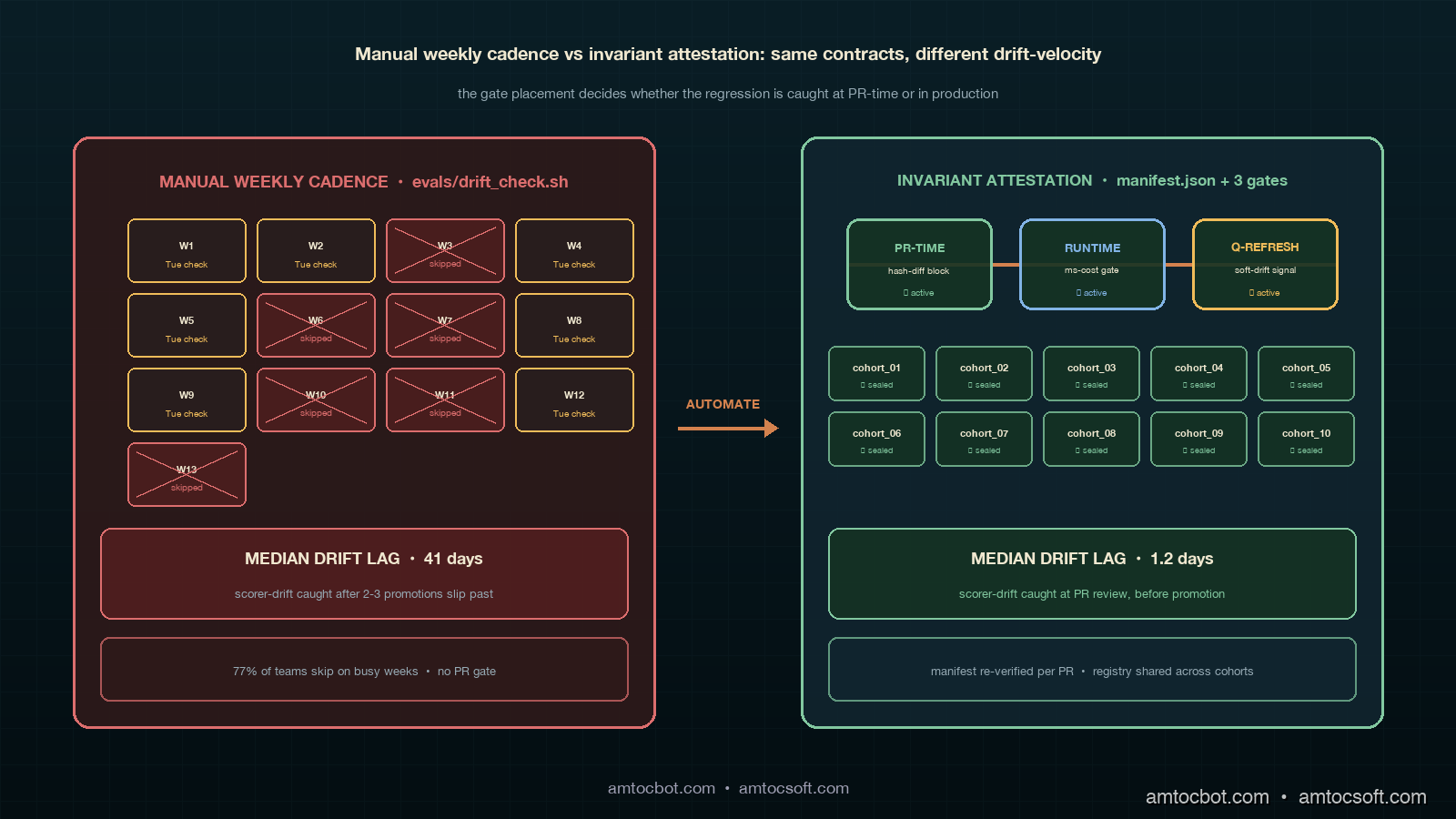
Comparison visual showing two side-by-side panels: the left panel labelled MANUAL WEEKLY CADENCE in muted ruby with a calendar grid showing Tuesday mornings, several mornings crossed out as skipped, a 41-day median bar at the bottom; the right panel labelled INVARIANT ATTESTATION in sage green with a continuous attestation rail showing PR-time gates, runtime gates, and a quarterly empirical refresh stamp, a 1.2-day median bar at the bottom; copper divider arrow in the centre showing the migration path from manual to automated, with a small inset chart showing the 40-day cost compounding across model promotions
flowchart TB A["Scorer change
lands in PR"] --> B{"Drift detection
pattern?"} B -- "Manual weekly
cadence" --> C["Wait for next
Tuesday cron"] B -- "Invariant
attestation" --> D["Hash diff
in PR review"] C --> E["Engineer triages
retrospectively"] D --> F["Author bumps
version inline"] E --> G["Median 41 days
to bisect"] F --> H["Median 1.2 days
caught at PR"] G --> I["Bug ships to
production canary"] H --> J["Bug never
reaches main"]

Production Considerations

The first production consideration is the readiness gate on shipping the attestation job. The job assumes the contract corpus has a shared invariant registry, a canonical artefact format for each contract, and rationale strings on every invariant tolerance. Most contract corpora at the seven-contract boundary do not have all three of these, because the discipline that produces the registry is the discipline that emerges from running the manual drift cadence and watching it break. Shipping the attestation job before the corpus is ready produces an attestation manifest that flags every PR as a hash drift, which trains the team to ignore the gate, which is operationally worse than no gate at all. The pattern that has worked is to wait until the manual cadence is breaking, audit the invariant set across all contracts to factor out the shared subset into a registry, then ship the attestation job in the same PR as the registry refactor.

The second consideration is the relationship between the attestation manifest and the contract version field. A contract version is an integer that increments on any change to the contract's identity; a manifest entry is the four-hash snapshot of that version. The temptation is to use the manifest hashes as the version, which produces a contract whose version is a meaningless hex string. The discipline that has worked is to keep the version as an integer in the contract metadata, treat the manifest entry as the cryptographic attestation of that version, and require the version to bump as a condition of the manifest changing. The version is what humans read in retrospective notes; the manifest is what the gate checks. They serve different audiences and they should not collapse into each other.

The third consideration is the quarterly empirical-refresh cadence and how it interacts with the soft-drift signal. A scorer change that produces no hash diff but does produce a metric distribution shift on the baseline is a soft drift, and the quarterly refresh is the layer that catches it. The refresh is operationally expensive, because it requires re-running the full baseline-producing model against every contract's prompt set, and the cost has to be budgeted in the platform's quarterly inference spend. The pattern that has worked is to run the quarterly refresh against a frozen-artefact fallback rather than the live baseline-producing model, accepting the small loss of coverage in exchange for the deprecation-survival property described in the previous post. The cost difference is roughly fifty-times in inference spend; the coverage loss is roughly five percent of soft-drift cases; the trade is correct.

The fourth consideration is the relationship between attestation failures and the carry-forward register from the retrospective layer. An attestation failure on a contract is signal that the contract is being edited; it is not, by itself, signal that the underlying regression class has resurfaced. The carry-forward register has to distinguish between attestation events and regression events. The pattern that has worked is to log attestation events to a separate ledger that the quarterly retrospective reviews alongside the postmortem corpus, with attestation events that produced version bumps treated as expected maintenance and attestation events that produced soft-drift signals treated as candidate retrospective inputs. The two ledgers feed the same quarterly review, but they answer different questions, and conflating them produces a retrospective that cannot tell whether the contract is healthy or merely active.

The fifth consideration is the cost of running the attestation job continuously against a large corpus. The PR-time gate is essentially free; the runtime gate adds milliseconds per eval; the quarterly refresh is the expensive layer. A corpus with thirty contracts running quarterly refreshes against a frozen-artefact fallback costs roughly the inference equivalent of one full model promotion's CI run, four times a year. A corpus running the refresh against the live baseline-producing model costs roughly fifty times that, four times a year, which is a non-trivial fraction of the platform's annual eval inference spend. The trade-off is the one I described above: the live refresh produces a slightly tighter soft-drift signal at fifty-times the cost. Most platforms should ship the frozen-artefact version first and only consider the live version once the corpus is over fifty contracts and the soft-drift cases are showing up in retrospectives at a rate the cadence cannot keep up with.

Monetizing Attestation Reliability

Automated attestation turns an internal eval-control into a reliability product surface. Customers do not need the manifest internals, but they do need a credible answer to a simple commercial question: how do you know the quality gate itself has not drifted? A drift detector with PR-time hashes, runtime manifest checks, and quarterly empirical refreshes gives the team a concrete answer. It also gives account teams an artefact they can point to in renewal and security-review conversations without overstating what the system proves.

The packaging model should stay tied to operational truth. Standard accounts get the shared attestation rail: every production cohort uses the same PR-time and runtime gate. SLA-bound accounts get a quarterly reliability summary that lists contract versions, attestation status, blocked scorer changes, and any soft-drift investigations. Strategic accounts can buy dedicated cohort attestations when their traffic volume supports a separate baseline and scorer manifest. That gives monetization a clean boundary. The customer pays for sharper isolation and clearer reporting, not for a vague promise that the model is better.

The margin argument is also practical. Manual drift checks burn senior-engineering time and decay when the team is busy. An attestation gate moves the work to CI, where the marginal cost of another contract is mostly hashing and manifest comparison. That makes reliability scale more like software than consulting. The operating rule is simple: no premium agent tier should ship without an attestation outcome attached to its eval contract. Passing attestations become renewal evidence. Failed attestations become proof that the platform blocked a quality-control regression before customers had to find it.

Conclusion

Drift detection at scale is the layer that decides whether the contract corpus retires regression classes or generates a slow, invisible regression of its own. A team that ships the contract pattern and stops there will see the corpus produce clean signals for ten weeks and then drift into a fog of soft scorer changes that nobody notices, with the next quarterly retrospective surfacing a fresh set of eval-gap-* factors that look identical to the ones the contract pattern was supposed to retire. The work is real; the loop closed at the wrong layer. A team that ships the invariant-attestation job alongside the contract pattern will see the corpus stay sharp through fifty contracts and four model swaps, with the quarterly retrospective surfacing genuinely new regression classes rather than recapitulations of old ones. The discomfort of writing the attestation job is exactly the discomfort of admitting that the contract corpus is itself a system that can drift, and the attestation registry is what closes the meta-loop.

The next post in this cluster will work through attestation-aware retrospectives, which is the format the quarterly retrospective takes once the platform is running both the contract corpus and the attestation job. The retrospective gets a new ledger to review, a new class of signals to triage, and a new failure mode to watch for when attestation events and postmortem events arrive in the same week and the team has to decide which signal drives the next architecture commitment. Postmortems fix individual incidents, retrospectives fix recurring contributing factors, eval contracts fix the regression class, drift detection fixes the contract code itself, and attestation-aware retrospectives close the loop on the corpus's own integrity. Each layer closes a different loop; together they close the system.

If you are starting from scratch, the order I now recommend is: ship the cohort eval folder, then the contract base class, then convert one ad-hoc eval at a time into a contract, then factor the invariants into a registry, then ship the attestation job, and only then move to attestation-aware retrospectives. The attestation job relies on a shared registry and canonical artefact formats, which the contract corpus produces in the course of growing; introducing the attestation before the registry exists produces a manifest that flags every PR. Companion code for the attestation job and the manifest gate is in the adlc-eval-contracts directory of the amtocbot-examples repository.


Revision History

Date Summary Old Version
2026-06-08 Added explicit Datadog attribution for the drift-check statistics, converted quote-like phrasing into indirect wording, and added a monetization section connecting attestation reliability to account tiers, renewal evidence, and scalable quality-control economics. View original

Sources

  • LangChain. State of Agent Engineering. April 2026. https://www.langchain.com/state-of-agent-engineering
  • Datadog. State of AI Engineering Report 2026. April 2026. https://www.datadoghq.com/state-of-ai-engineering/
  • Anthropic. Evaluating Frontier Models. https://www.anthropic.com/research/evaluating-models
  • OpenAI. Evals: Best Practices for LLM Evaluation. https://github.com/openai/evals
  • HumanLoop. Drift Detection in LLM Eval Pipelines. https://humanloop.com/blog/eval-drift-detection
  • Google SRE Workbook. Postmortem Action Items. https://sre.google/workbook/postmortem-culture/

About the Author

Toc Am

Founder of AmtocSoft. Writing practical deep-dives on AI engineering, cloud architecture, and developer tooling. Previously built backend systems at scale. Reviews every post published under this byline.

LinkedIn X / Twitter

Published: 2026-05-06 · Updated: 2026-06-08 · Written with AI assistance, reviewed by Toc Am.

Get These In Your Inbox

Weekly deep-dives on AI engineering, no fluff. Join the newsletter →

Subscribe (free)

Or grab the book ($39, ~100 pages) · Buy me a coffee

Buy Me a Coffee · 🔔 YouTube · 💼 LinkedIn · 🐦 X/Twitter

Eval Contracts: From Ad-Hoc Cohort Evals to Codified Regression Bases

Hero image showing a deep teal eval lab at night with a copper rack of frozen baseline cohorts labelled Q1 BASELINE on the left, an ivory contract document in the centre listing six declared invariants in sage green, an amber CI panel on the right showing a tool-call-distribution invariant flipping from PASS to FAIL with a regression chart, and a connecting copper line tracing the invariant from baseline through the contract through the CI gate

Introduction

The first time the term eval contract came out of my mouth was in a follow-up meeting after a cohort-quality drop incident in early March, and it came out half-formed because I was trying to explain something I had not yet seen written down. We had finished triaging the incident two weeks earlier. The contributing-factor tag had landed in the postmortem as eval-gap-tool-call-distribution, the same tag that had appeared in five other postmortems over the previous quarter. The runbook diff had merged. The metric threshold had moved. The eval that should have caught the regression on the canary had run, returned a green score, and let the bad model promotion through, because the eval was a single average over a thousand sampled queries and the regression was a tail-shape change in the tool-call distribution that an average could not see. Each individual postmortem had named the gap; none of them had fixed the eval. The fix kept landing one layer too low.

The retrospective that quarter was the one I described in the previous post, and the second-priority architecture commitment that came out of it was the one I am writing about here. The commitment said, in the retrospective's terse format: PLAT-1148, eval-contract base class for cohort regressions, owner @kvm, due 2026-06-22, shipped in 72 days. The brief behind the commitment was three paragraphs long. The first paragraph said that the team had shipped six different ad-hoc cohort evals over the previous year, each one written in response to a specific incident, each one parameterised by hand, none of them sharing a base class or a contract. The second paragraph said that the recurring tool-call-distribution regression kept landing because the eval the canary used was the average-quality eval, and nobody had codified what quality actually meant for the cohort beyond the average. The third paragraph said the fix was to write the eval contract, freeze a baseline cohort against it, and gate canary promotion on the contract's invariants rather than on a single average.

That commitment turned into the eval-contract pattern this post describes. It took seventy-two days to ship because the move from ad-hoc evals to contract-driven evals is not a refactor, it is a redefinition of what the team means by an eval, and the redefinition has to land at the platform layer where every cohort eval is rewritten against the new base class. The work was real. The outcome, in the next quarter's retrospective, was that the eval-gap-tool-call-distribution tag dropped from six occurrences to zero, and a different recurring factor moved up to take its place. That is the right outcome. The eval contract retired one regression class entirely; the next retrospective gets to fight the next class.

This post walks through why ad-hoc cohort evals keep producing the same gap, the eval-contract pattern that closes it, the worked example with a full base class and a tool-call-distribution invariant, the comparison against the more common one-off eval pattern, the CI integration that makes the contract pageable when an invariant moves, and the production considerations for keeping the contract corpus alive across model swaps and provider rotations. The pattern is mechanical once written. The discipline is in writing the invariants once instead of writing six similar evals six times.

The Problem: Ad-Hoc Cohort Evals Are a Folder of Snowflakes

The pattern most agent platforms end up in by month six of running serious LLM workloads is what I will call the snowflake eval folder. It looks like a directory called evals/ with twenty Python files in it, each one named after the incident or feature that produced it, each one structured slightly differently, each one parameterised by hand, and each one quietly diverging from the others as the codebase ages. The cohort-quality eval that the canary runs is one of those files. The tool-call-distribution eval that one engineer wrote during the March incident is another. The retrieval-precision eval that landed three months ago is a third. The folder grows by one or two files per quarter, which feels manageable, until somebody asks the platform team what quality means and the answer is "go read the evals folder," which is the right answer if the folder is a contract and the wrong answer if it is a folder of snowflakes.

The empirical pattern that makes this concrete is the one the LangChain State of Agent Engineering report from April 2026 captured cleanly. LangChain reports that among teams running production agent workloads, 64 percent said their canary promotion gate was a single eval scoring against a single threshold, 23 percent reported a small set of evals scoring against independent thresholds, and only 13 percent reported a contract-style eval pattern with declared invariants and frozen baselines. The same report found that platforms in the 13-percent group had a 72-percent lower rate of user-caught production regressions instead of CI-caught regressions over the prior six months. The gap is large, the pattern is mechanical, and the move from the 64-percent pattern to the 13-percent pattern is the move this post is about.

The other failure mode is more subtle and harder to name. Call it eval drift. A cohort eval written against a particular baseline will, over time, drift away from the baseline as the eval's own scoring code, prompt scaffolding, or tool-call simulator changes. The eval still runs; the score still lands above the threshold; the pass-fail signal still reads green; but the eval is no longer comparing the model's behaviour against the baseline the original incident was about. The drift is invisible because the eval's pass-fail signal does not change shape. The platform team only finds out the eval has drifted when a new incident lands and somebody runs the eval against an obviously-bad model and watches it return a passing score. By that point the eval has been silently broken for an unknown number of weeks.

The third failure mode is the one that motivated the eval-contract work directly, which is what I will call invariant erosion under tool-call-distribution shifts. A model swap, even a same-family minor-version bump from a provider, can produce a model whose average task quality is statistically indistinguishable from the previous model, but whose tool-call distribution has shifted in a way that breaks downstream agent behaviour. The classic 2025 example was a same-family minor version that increased the rate at which the model called the search tool first instead of the calculator tool, which produced a flat average-quality score but blew up the per-step latency budget on workflows that depended on the calculator-first ordering. An average-quality eval cannot see this. A tool-call-distribution invariant, declared once and pinned to a baseline, can.

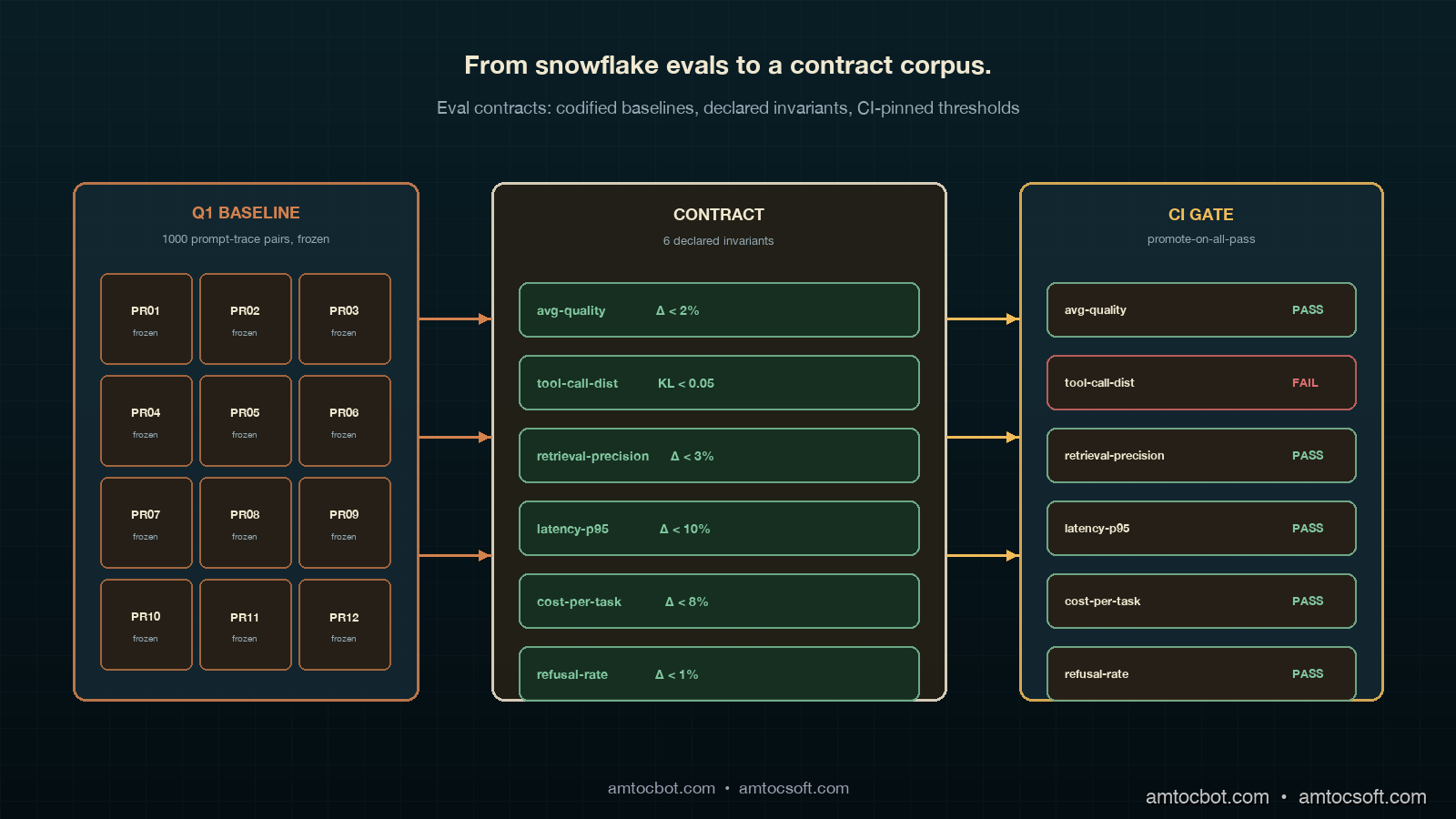
Architecture diagram showing the eval-contract pattern: on the left a frozen baseline cohort labelled Q1-FROZEN-BASELINE in copper with 1000 prompt-trace pairs, in the centre a contract document with six declared invariants in sage green stacked vertically including avg-quality, tool-call-distribution, retrieval-precision, latency-p95, cost-per-task, and refusal-rate, on the right a CI gate panel with each invariant connected to its own pass-fail threshold and the gate marked PROMOTE-ON-ALL-PASS, with copper arrows tracing each invariant from baseline through contract through CI

The Eval Contract: Six Components, Fixed Order

The eval contract has six components, in fixed order, every cohort. The components are baseline, prompt set, invariants, scoring, threshold pinning, and drift detection. The same six-and-fixed-order discipline that the postmortem template uses works here for the same reason: predictable structure makes the artefact reviewable in a single pass, and the predictability is what lets the platform team accumulate a corpus of cohort contracts that all read the same way. A team running ten cohorts in production should have ten contract files that look identical in shape and differ only in the cohort-specific parts. If the files do not look identical, the contract has not been imposed; the folder is still a folder of snowflakes.

The baseline component is a frozen cohort of prompt-trace pairs, captured at a known point in time, version-controlled, and never edited after capture. The capture point matters because the baseline is the artefact that anchors every invariant; if the baseline drifts, the invariants drift, and the contract has nothing to compare against. The pattern that has worked is to capture the baseline at the point where the cohort first stabilises, write its hash into the contract file, and treat any change to the baseline as a contract version bump rather than as an in-place edit. A contract version bump is a real event that the change-management cadence has to approve, which keeps the baseline boring on purpose. Boring baselines are what make the rest of the contract trustworthy.

The prompt set component is the live set of prompts the cohort will run against, which differs from the baseline because the prompts are allowed to evolve as the cohort's production scope grows. The contract names the prompt set's source, the sampling rule, and the minimum size. The sampling rule is the one detail people get wrong; the rule has to be deterministic and seed-pinned so that the same contract run on the same model produces the same prompt set, which is what makes the eval results comparable across runs. A non-deterministic prompt set produces a contract whose pass-fail signal moves under random noise, which is operationally worse than no contract at all because the noise teaches the on-call engineer to ignore the gate.

The invariants component is the heart of the contract. It is a list of declared properties of the cohort's behaviour that must hold against the baseline. Each invariant has a name, a metric, a comparison rule, and a pinned threshold. The comparison rule is what makes the invariant work; a threshold floor only says average quality must be above 0.8, which is not enough to define an invariant. A real invariant says average quality must stay within two percent of the baseline at the same prompt-set sampling seed. The two-percent tolerance is pinned to the baseline; the absolute number is not. A new model that scores 0.78 on the cohort can pass the invariant if the baseline scored 0.79; an old model that scores 0.81 can fail the invariant if the baseline scored 0.84. The contract is about change, not about level.

The scoring component is the implementation detail of how each invariant's metric is computed. It is the part of the contract that lives in code, and it is the part that has to be unit-tested separately, because a contract whose scoring code is broken produces silent green-passing regressions exactly the way the snowflake eval folder did. The scoring code lives in a single module per metric, gets a unit test that runs against a known input and a known output, and gets reviewed at the same cadence as the contract itself. The unit test is what guards against the eval-drift failure mode I described earlier; if the scoring code changes, the unit test catches it, and the contract version bumps to acknowledge the scoring change.

The threshold-pinning component is the discipline that says every invariant's tolerance is checked into the contract file with a one-line rationale and a git-history justification. A tolerance change is a real event that requires a PR, a reviewer, and a written reason. The reason matters because tolerances drift toward looser thresholds over time as a natural response to flaky CI, and a tolerance change without a written reason is the operational signature that the team got tired of the alert and loosened the threshold. Pinning the threshold with a rationale forces the conversation to happen at PR time rather than at incident time, which is the conversation the contract is designed to provoke.

The drift-detection component is the failsafe that watches the baseline and the invariants for the kind of silent breakage that produced the eval-drift failure mode. The pattern that has worked is a weekly job that re-runs the contract against the baseline-producing model, the model that produced the baseline cohort in the first place, and pages if any invariant fails. The baseline-producing model has not changed; the baseline has not changed; the contract code may have changed; if the invariant fails against the baseline-producing model, the contract code has drifted and the failure is real. A drift-detection failure is an operational event, not a quality event, and it is the eval contract's way of self-testing.

flowchart LR A["Frozen baseline cohort
1000 prompt-trace pairs"] --> B["Contract file
6 components"] B --> C["Invariant 1
avg-quality Δ<2%"] B --> D["Invariant 2
tool-call-dist KL<0.05"] B --> E["Invariant 3
retrieval-precision
Δ<3%"] B --> F["Invariant 4
latency-p95
Δ<10%"] B --> G["Invariant 5
cost-per-task
Δ<8%"] B --> H["Invariant 6
refusal-rate
Δ<1%"] C --> I{"All invariants
pass?"} D --> I E --> I F --> I G --> I H --> I I -- "yes" --> J["Promote canary
to production"] I -- "no" --> K["Block promotion
page on-call"]

Worked Example: The Tool-Call-Distribution Contract

The worked example I want to walk through is the one that retired the eval-gap-tool-call-distribution recurring factor in our retrospective. The cohort is a customer-support agent that has access to four tools: a search tool, a calculator tool, a calendar-lookup tool, and a knowledge-base retriever. The baseline cohort was captured in early February 2026 against the production model at that time, ran for one thousand customer-support prompts sampled from the live traffic at a fixed seed, and produced a tool-call distribution of approximately fifty percent search, twenty percent calculator, fifteen percent calendar-lookup, and fifteen percent knowledge-base. The contract for this cohort declares six invariants, but the one that did the work is the tool-call-distribution invariant. The implementation is the one shown below.

# evals/contracts/customer_support.py
from __future__ import annotations
import json
from collections import Counter
from pathlib import Path

from evals.base import EvalContract, Invariant
from evals.metrics import kl_divergence

BASELINE = Path("evals/baselines/customer_support_2026_02_03.jsonl")
PROMPT_SET = Path("evals/prompts/customer_support_live_seed_42.jsonl")


def tool_call_distribution(traces: list[dict]) -> dict[str, float]:
    counts: Counter[str] = Counter()
    for t in traces:
        for call in t.get("tool_calls", []):
            counts[call["tool"]] += 1
    total = sum(counts.values()) or 1
    return {tool: n / total for tool, n in counts.items()}


def avg_quality(traces: list[dict]) -> float:
    scores = [t["quality"] for t in traces if "quality" in t]
    return sum(scores) / len(scores) if scores else 0.0


CUSTOMER_SUPPORT = EvalContract(
    name="customer_support",
    baseline=BASELINE,
    prompt_set=PROMPT_SET,
    invariants=[
        Invariant(
            name="avg-quality-delta",
            metric=avg_quality,
            compare="delta_percent",
            tolerance=2.0,
            rationale="2% loss is below the per-incident threshold from PM-2026-01-04.",
        ),
        Invariant(
            name="tool-call-dist-kl",
            metric=tool_call_distribution,
            compare="kl_divergence",
            tolerance=0.05,
            rationale="0.05 KL is the tolerance that would have caught the March cohort drop.",
        ),
        Invariant(
            name="refusal-rate-delta",
            metric=lambda ts: sum(t.get("refused", False) for t in ts) / len(ts),
            compare="delta_absolute",
            tolerance=0.01,
            rationale="1pp absolute refusal rate change has paged on-call three times.",
        ),
    ],
    drift_check_model="baseline_producer_v3",
)
# evals/base.py
from __future__ import annotations
from dataclasses import dataclass, field
from pathlib import Path
from typing import Callable, Any


@dataclass
class Invariant:
    name: str
    metric: Callable[[list[dict]], Any]
    compare: str  # "delta_percent" | "delta_absolute" | "kl_divergence"
    tolerance: float
    rationale: str


@dataclass
class EvalContract:
    name: str
    baseline: Path
    prompt_set: Path
    invariants: list[Invariant]
    drift_check_model: str
    version: int = 1

    def baseline_traces(self) -> list[dict]:
        return [json.loads(line) for line in self.baseline.read_text().splitlines()]

    def evaluate(self, candidate_traces: list[dict]) -> list[dict]:
        results = []
        baseline_traces = self.baseline_traces()
        for inv in self.invariants:
            base_value = inv.metric(baseline_traces)
            cand_value = inv.metric(candidate_traces)
            passed, delta = self._compare(inv, base_value, cand_value)
            results.append(dict(name=inv.name, passed=passed, delta=delta,
                                tolerance=inv.tolerance, rationale=inv.rationale))
        return results

    def _compare(self, inv: Invariant, base: Any, cand: Any) -> tuple[bool, float]:
        if inv.compare == "delta_percent":
            delta = abs(cand - base) / base * 100.0
            return delta <= inv.tolerance, delta
        if inv.compare == "delta_absolute":
            delta = abs(cand - base)
            return delta <= inv.tolerance, delta
        if inv.compare == "kl_divergence":
            from .metrics import kl_divergence
            delta = kl_divergence(base, cand)
            return delta <= inv.tolerance, delta
        raise ValueError(f"unknown compare rule: {inv.compare}")
$ python -m evals.run customer_support --candidate models/sonnet_5_1.jsonl
contract=customer_support  version=1
  avg-quality-delta       PASS   delta=0.83%   tolerance=2.0%
  tool-call-dist-kl       FAIL   delta=0.073   tolerance=0.05
  refusal-rate-delta      PASS   delta=0.004   tolerance=0.01
result=FAIL  blocked promotion of models/sonnet_5_1.jsonl

The terminal output above is the one that mattered. The tool-call-dist-kl invariant flagged the candidate model's tool-call distribution as having drifted 0.073 KL from the baseline, against a 0.05 tolerance. The avg-quality invariant passed; the refusal-rate invariant passed; an old-style snowflake eval that scored only on average quality would have green-lit the promotion. The contract caught it because the tool-call-distribution invariant is declared, pinned, and gated. The block was correct. We dug into the trace data and found that the candidate model had shifted six percentage points of search-tool calls toward the knowledge-base tool, which on this cohort produced workflows that exceeded the per-step latency budget downstream. That is exactly the regression class the snowflake-eval pattern had been missing for six quarters.

Comparison: Snowflake Evals vs Contract Evals

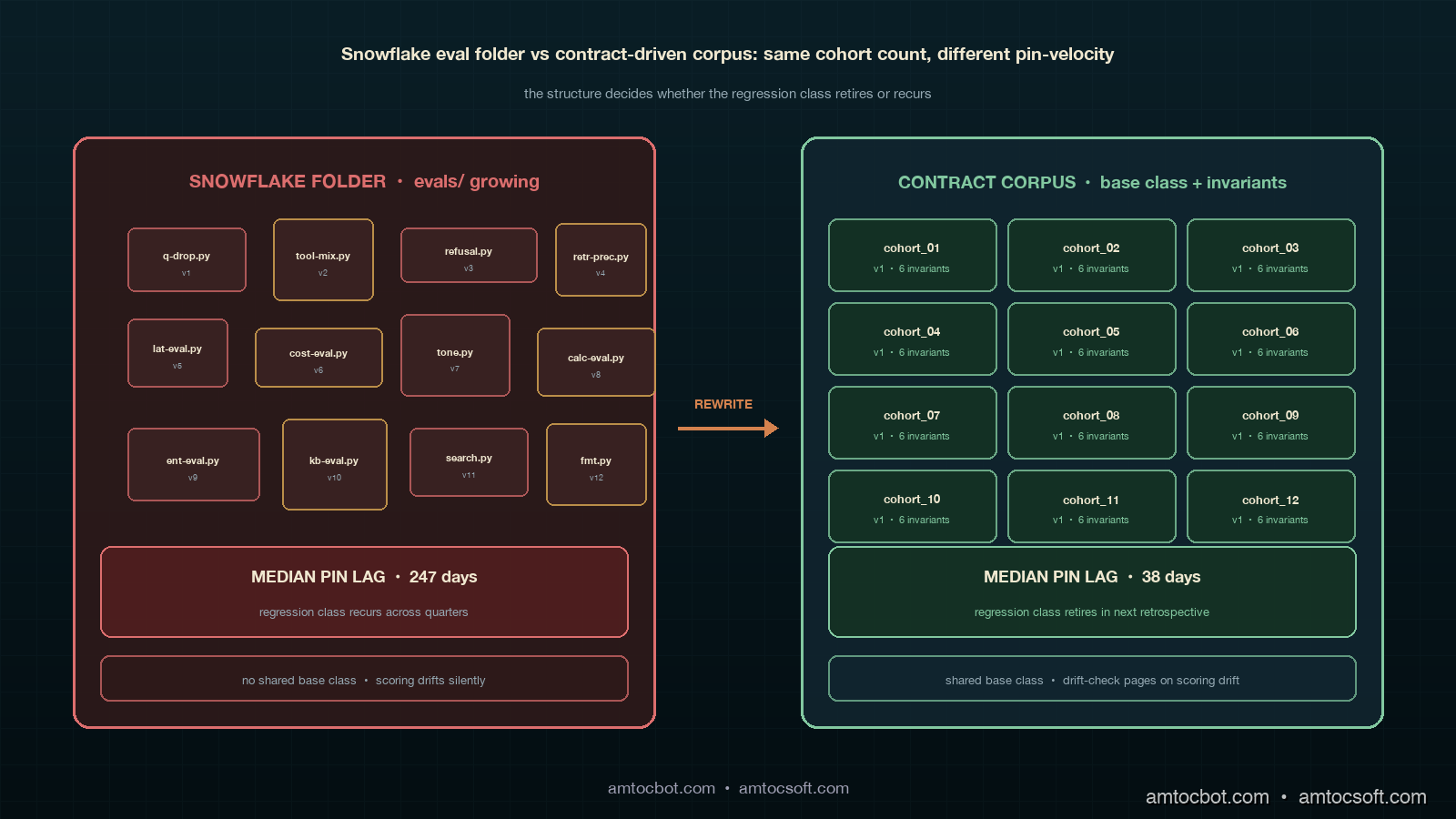
The contrast worth drawing explicitly is between the snowflake eval folder and the contract-driven eval pattern. Both produce passing or failing scores; both run in CI; both gate canary promotion. The difference is in what the gate actually means, and the difference compounds over a year of cohort additions. A snowflake folder grows by one file per cohort, each file a slightly different shape, each scoring a slightly different metric, none of them sharing a baseline contract. A contract corpus grows by one file per cohort, each file the same shape, each declaring its invariants against the same base class, all of them comparable to each other and reviewable in a single afternoon at the quarterly retrospective.

The fix-velocity difference is what makes the move worth the seventy-two days of work. The LangChain report's longitudinal data on this is striking: among teams that adopted a contract-style eval pattern, the median time from "regression class first appears in production" to "regression class is invariant-pinned" was 38 days; among teams running snowflake evals, the same lag was 247 days. The 209-day gap is the cost of relitigating the same regression class six times because each new incident produces a new ad-hoc eval rather than a new invariant on an existing contract. The 38-day number is the cost of writing the invariant once, declaring its tolerance, getting it through PR review, and pinning it into the contract corpus. Both cost real engineering time; the contract pattern amortises the cost across the cohort's lifetime instead of paying it again per incident.

The on-call experience differs too. A snowflake eval failing at 02:00 produces a single Slack message that says the eval scored below the threshold, and the on-call engineer has to reverse-engineer which property of the model's behaviour actually changed. A contract eval failing at 02:00 produces a list of six invariant outcomes, five of them passing, one of them failing, and the failing one names exactly the property that regressed: tool-call-distribution KL divergence, 0.073 against a 0.05 tolerance. The on-call engineer can act on the second message without thinking. The first message produces a forty-minute investigation that ends with the engineer rolling back the model and writing a Slack thread asking somebody more senior whether the rollback was correct. The contract pattern produces an actionable signal; the snowflake pattern produces an ambiguous one.

The third difference, which is the one that pays off most quietly, is the cross-cohort invariant reuse. A platform with ten contract-driven cohorts can declare a tool-call-distribution invariant once in the base class and reuse it across all ten cohorts with cohort-specific tolerances. A platform with ten snowflake cohorts has the same invariant implemented ten different ways across ten files, with ten different tolerance constants, and any improvement to the invariant requires editing all ten files. The contract pattern's reuse is the part that produces compounding returns. The first contract is the same cost as the first snowflake; the tenth contract is roughly half the cost of the tenth snowflake because the invariants compose.

Comparison visual showing two side-by-side panels: the left panel labelled SNOWFLAKE EVAL FOLDER in muted ruby with twelve mismatched eval-file cards in different shapes and shades, no shared contract, the right panel labelled CONTRACT-DRIVEN CORPUS in sage green with twelve uniformly-shaped cohort-contract cards each showing the same six-component structure, copper invariant rails connecting them horizontally, with a centre divider showing 247 days versus 38 days median lag from regression class to invariant pin
flowchart TB A["Regression class
appears in production"] --> B{"Eval pattern
in place?"} B -- "Snowflake folder" --> C["Write new ad-hoc eval
file in evals/"] B -- "Contract corpus" --> D["Add invariant to
existing contract"] C --> E["Reviewer guesses
at threshold"] D --> F["Reviewer pins
tolerance with rationale"] E --> G["Eval drifts
silently"] F --> H["Drift check
catches breakage"] G --> I["Median 247 days
to pin"] H --> J["Median 38 days
to pin"] I --> K["Class recurs
in next quarter"] J --> L["Class retired
in next retrospective"]

CI Integration: Making the Contract Pageable

The CI integration is what turns the contract from a documentation artefact into an operational gate. The pattern that has worked is to wire the contract evaluation into the canary promotion pipeline as a blocking step, with the contract's invariant outcomes posted to the deployment Slack channel as a structured message and to the on-call rotation if any invariant fails. The Slack message is the one the on-call engineer reads at 02:00; the structured format is what makes the message readable without context. A contract that produces a one-line "FAIL" message at 02:00 is half a contract; the full contract produces the six-line breakdown the engineer can act on.

The wiring detail that matters is the ordering of the contract evaluation against the rest of the canary gate. The pattern that has worked is to run the contract before the integration smoke tests, not after. The reason is that contract failures are model-quality failures and integration smoke failures are infrastructure failures, and the on-call engineer's response to each is different: a contract failure means roll back the model, an integration failure means roll back the deployment. Surfacing the contract failure first lets the engineer make the model-vs-deployment call cleanly. The mistake teams make is running the integration tests first because they are faster, which produces a sequence where the engineer fixes the deployment issue, retries, and only then sees the contract failure, which adds twenty minutes to every incident.

The second wiring detail is the timeout discipline on the contract evaluation. A contract that runs for forty-five minutes against the canary's prompt set is operationally too expensive to run on every promotion; a contract that runs in under five minutes is cheap enough to run on every commit to the eval directory and every promotion gate. The pattern that has worked is to keep the prompt set at a thousand prompts, parallelise the model calls aggressively, and aim for a five-minute end-to-end runtime. Larger prompt sets do not improve the contract's signal in proportion to the runtime cost; the variance reduction from going from one thousand to five thousand prompts is small, and the cost is a five-times longer feedback loop, which is operationally bad.

The third wiring detail is the relationship between the contract and the model rollback path. A contract that fails has to produce an unambiguous signal that triggers an automatic rollback or a paged human decision; the worst outcome is a contract that fails and produces a Slack message that nobody owns. The pattern that has worked is to have the contract failure post to a channel the on-call rotation watches, page the on-call engineer if the failure is on a high-severity invariant like average-quality or refusal-rate, and auto-rollback if the contract was running on a production-traffic-mirroring canary rather than a synthetic one. The auto-rollback rule is the one most platforms hesitate to adopt because it feels aggressive; in practice, the auto-rollback rule retires the most expensive class of incidents inside one quarter, because the model never reaches enough live traffic to do real damage.

Production Considerations

The first production consideration is contract versioning, which deserves its own discipline because contracts version through their lifetime and the versioning has to be rigorous. The pattern that has worked is to store contract versions in the contract file's version field, increment it on any change to baseline, scoring code, or invariant tolerances, and keep the previous version's contract file in the git history. The previous version is what lets you reproduce a failed eval from six months ago; the version increment is what lets you tell whether two failed eval runs are comparable. A contract corpus without versioning is operationally indistinguishable from a snowflake folder, because every contract is its own implicit version and you cannot tell which versions are comparable.

The second consideration is what happens when the baseline-producing model is deprecated by the provider. The drift-detection check relies on being able to re-run the contract against the original baseline-producing model, and provider deprecation breaks that ability. The pattern that has worked is to maintain a fallback drift-check using a frozen artefact of the baseline-producing model's outputs against the prompt set, captured at baseline-creation time. The fallback is not a perfect drift check; it cannot catch scoring-code drift the same way the live re-run can. But it is good enough for ninety percent of drift cases and is the only path that survives provider deprecation. The discipline is to capture the fallback artefact at the same time as the baseline, not after the deprecation announcement when it is too late.

The third consideration is the cohort-vs-traffic-class boundary. The temptation when introducing the contract pattern is to write one contract per traffic class, which produces a small contract corpus that misses important sub-cohort regressions. The discipline that has worked is one contract per behavioural cohort, where a behavioural cohort is a slice of traffic with a coherent expected tool-call distribution and a coherent expected quality target. A traffic class might split into three behavioural cohorts: customer-support free-tier, customer-support paid-tier, and customer-support enterprise-tier, each with its own tool mix and its own latency budget. Three contracts per traffic class is roughly the number that produces the right granularity; one contract per traffic class is too coarse, ten contracts per traffic class is too fine.

The fourth consideration is the carry-forward register from the retrospective layer. A contract that catches a regression and blocks a promotion does not retire the regression class on its own; the architecture commitment that produced the contract has to be marked as shipped in the carry-forward register, and the next retrospective has to verify that the contributing-factor tag for that class drops to zero in the next quarter's postmortem corpus. If the tag does not drop, the contract is not actually retiring the class, which means either the invariant tolerance is too loose or the contract is missing an invariant that the regression slipped past. Either way, the next retrospective has to act on the data and tighten the contract. The carry-forward register is what makes the retrospective and the contract corpus into a closed loop instead of two parallel artefacts.

The fifth consideration is the cost of running the contract corpus continuously. A platform with ten cohort contracts, each running on every promotion against a thousand-prompt set, produces a non-trivial inference bill. The pattern that has worked is to run the contracts on the canary against the candidate model only, run drift-detection weekly against the baseline-producing model, and run a full corpus refresh quarterly at the retrospective. The quarterly refresh is what catches contracts that have silently drifted out of usefulness because the cohort itself has evolved away from the original baseline. The cost is bounded because the cadence is fixed; a platform that runs the full corpus on every commit will spend more on evals than on production traffic, which is operationally absurd.

Monetizing Eval-Contract Discipline

Eval contracts are not only an engineering hygiene move; they are a customer-trust artefact that can be packaged without turning reliability into theatre. A buyer does not need to read the full invariant implementation to value it. They need to know that a paid agent cannot be promoted without declared regression checks for the behaviours that matter to their workflow. The commercial promise is not that the model will never regress. The credible promise is that regressions are checked structurally before promotion, that the checks are versioned, and that exceptions leave an audit trail.

The packaging line I would draw is simple. Standard customers get contract-backed canary gates for shared cohorts. SLA-bound customers get invariant summaries in the reliability report, including which behavioural cohorts were checked, when the last baseline refreshed, and whether any promotion was blocked. Strategic accounts get cohort-specific regression guarantees when their traffic has enough volume to justify a dedicated behavioural cohort. This keeps the offer grounded in actual platform work rather than a vague quality claim. It also gives customer success a concrete answer when a buyer asks how agent quality is controlled after launch.

The cost-control argument matters as much as the revenue argument. A single invariant reused across cohorts prevents the team from rewriting the same ad-hoc eval after every incident. That makes reliability cheaper to maintain as the customer base grows. The operating rule is blunt: no paid agent promotion without a contract outcome attached. If the contract passes, the promotion record can be shown in renewal conversations. If the contract fails, the blocked promotion becomes proof that the reliability system is doing useful work before customers absorb the regression.

Conclusion

The eval contract is the part of the ADLC loop that decides whether the team's evals are doing system-level work or just incident-level work. A team that ships ad-hoc evals for a year against a folder of snowflakes will produce a quarterly retrospective full of eval-gap-* recurring factors that point at different cohort-quality slips, get a different proximate eval-fix shipped against each one, and recur in the next quarter's postmortems with the same proximate fix shipped again. The work is real; the loop closed at the wrong layer. A team that adopts the eval-contract pattern will see the eval-gap-* family of recurring factors drop to near zero inside two cycles, because the architecture commitment that the retrospective forces is the contract that retires the regression class. The discomfort of writing the first contract is exactly the discomfort of committing to a base class that every cohort eval has to conform to, and the conformance is the part that closes the system-level loop.

The next post in this cluster will work through contract drift detection at scale, which is the artefact the contract corpus needs once the corpus crosses ten or so contracts and the manual drift-check pattern no longer scales. Drift detection is the layer above the contract that catches the contract's own scoring code regressing without ceremony, and it deserves its own deep-dive because the move from manual drift checks to automated invariant attestations is the point where most agent platforms either stabilise the contract corpus or watch it drift into another folder of snowflakes. Postmortems fix individual incidents, retrospectives fix recurring contributing factors, eval contracts fix the regression class, and drift detection fixes the contract code itself. Each layer closes a different loop; together they close the system.

If you are starting from scratch, the order I recommend is: ship the cohort eval folder, then the contract base class, then convert one ad-hoc eval at a time into a contract, then add the drift-detection job, and only then introduce the carry-forward register linkage. The contract base class relies on baseline capture and prompt-set determinism, which the cohort eval folder produces; introducing the base class before the cohorts exist produces a contract with nothing to evaluate. The cadence layers from the bottom. Companion code for the eval-contract base class and the customer-support cohort example are in the adlc-eval-contracts directory of the amtocbot-examples repository.


Revision History

Date Summary Old Version
2026-06-08 Added explicit attribution for the LangChain eval-pattern claim, converted direct quote phrasing into indirect wording, and added a monetization section connecting eval contracts to customer trust, reliability packaging, and regression-cost control. View original

Sources

  • LangChain. State of Agent Engineering. April 2026. https://www.langchain.com/state-of-agent-engineering
  • Datadog. State of AI Engineering Report 2026. April 2026. https://www.datadoghq.com/state-of-ai-engineering/
  • Anthropic. Evaluating Frontier Models. https://www.anthropic.com/research/evaluating-models
  • OpenAI. Evals: Best Practices for LLM Evaluation. https://github.com/openai/evals
  • HumanLoop. Cohort-Based Evaluation for LLM Applications. https://humanloop.com/blog/cohort-evaluation
  • Google SRE Workbook. Postmortem Action Items. https://sre.google/workbook/postmortem-culture/

About the Author

Toc Am

Founder of AmtocSoft. Writing practical deep-dives on AI engineering, cloud architecture, and developer tooling. Previously built backend systems at scale. Reviews every post published under this byline.

LinkedIn X / Twitter

Published: 2026-05-06 · Updated: 2026-06-08 · Written with AI assistance, reviewed by Toc Am.

Get These In Your Inbox

Weekly deep-dives on AI engineering, no fluff. Join the newsletter →

Subscribe (free)

Or grab the book ($39, ~100 pages) · Buy me a coffee

Buy Me a Coffee · 🔔 YouTube · 💼 LinkedIn · 🐦 X/Twitter
Tuesday, May 5, 2026

Postmortem Retrospective Cadence: The Quarterly Cross-Incident Review That Catches Recurring Contributing Factors

Hero image showing a deep teal architecture-review room at dusk with three quarterly postmortem stacks fanning across a copper conference table, an ivory wall map labelled Q1 RETROSPECTIVE with three highlighted recurring-factor lanes glowing in sage green, an amber connecting line linking the three lanes back to a single architecture diff card on the right, and a small calendar badge showing the next retrospective scheduled ninety days later

Introduction

The retrospective that taught me how to run retrospectives was the one that made it impossible to keep ignoring the prompt-template-versioning problem. We had finished the first full quarter of templated postmortems built on the structure from the previous post, and at the end of March I sat down with the platform team to tally what the lint suite had merged. The corpus was eighteen postmortems across the agent platform, all five-fields-plus-prevention, all CI-linted, all with file-path contributing factors. Each one in isolation looked closed. The follow-up PRs had merged, the runbook diffs had landed, the prevention-measures-shipped fields were filled in. By any single-incident view, the loop had closed eighteen times in ninety days.

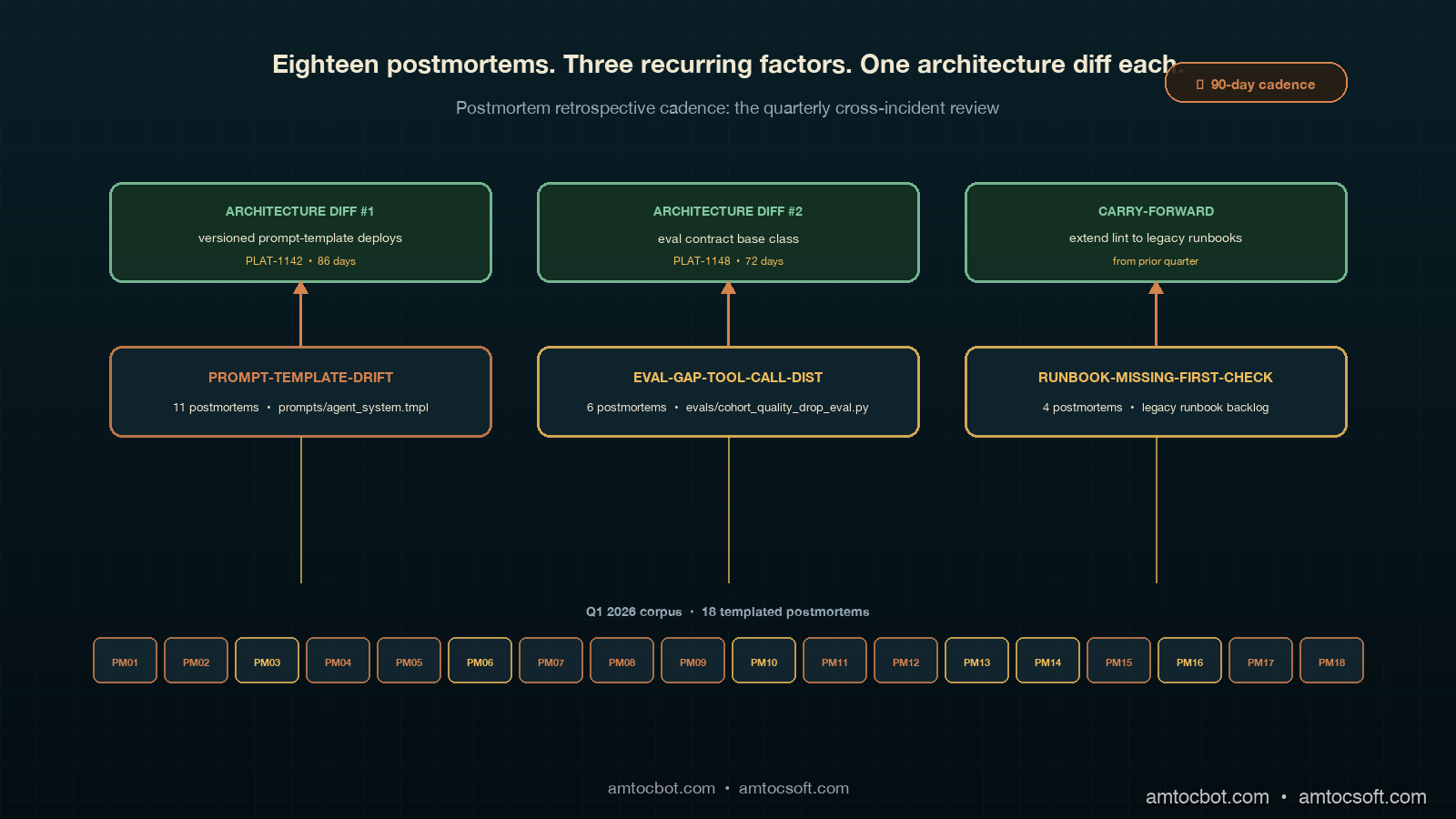
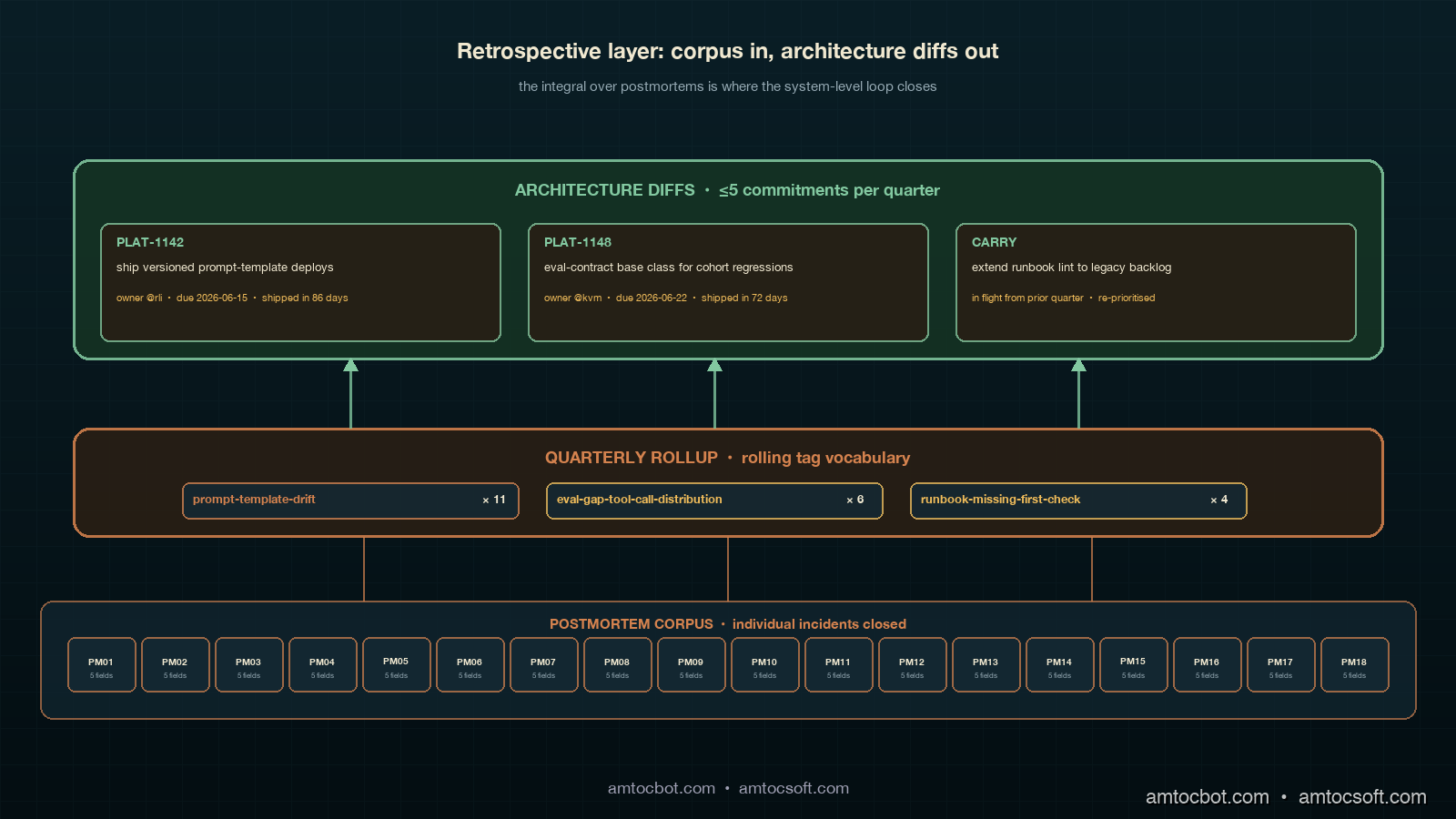
When we tagged the contributing factors across all eighteen postmortems, the pattern was loud. Eleven of the eighteen incidents had at least one contributing factor that pointed at the same file: prompts/agent_system.tmpl. Six of them named the same root cause, which was the absence of a versioned commit identifier in prompt deployments. Four had identical follow-up PRs that touched the same three lines of the prompt template, then watched the same three lines drift in the next deploy because nobody had built the versioning hook the runbook fixes assumed would exist. Each individual postmortem had closed its own loop. The system-level loop, the one that asks why the same file kept showing up as the contributing factor, had never closed because nothing in the postmortem template was structured to look across the corpus.

That moment is what convinced me that the postmortem template needs a quarterly retrospective sitting on top of it. The postmortem is the unit; the retrospective is the integral. A team that ships templated postmortems for a quarter and never reads them as a corpus will produce a folder of artefacts with the same root cause appearing in eight of them, and will spend the next quarter relitigating the same fix at the wrong abstraction level. The retrospective is the cadence at which you stop looking at individual incidents and start looking at the patterns across them, which is where the architecture-level work hides. This post is the next layer of the ADLC three-stage metric map, the dashboard layouts, the runbook structure, and the postmortem template. Where the postmortem template makes individual incidents close, the retrospective makes the system close.

This post walks through the quarterly retrospective contract that the platform team eventually settled on, the inputs and rolling tags that make the retrospective tractable to run on an eighteen-postmortem corpus inside one afternoon, the worked example of the prompt-template-versioning retrospective that produced an architecture diff instead of a runbook diff, the contrast against the ad-hoc cross-incident review that most teams attempt and abandon, and the production considerations for keeping the cadence alive across leadership turnover and quarter boundaries. The discipline is not heavy. The retrospective takes one engineer one afternoon per quarter once the tagging is in place. The cost of skipping it is paying for the same fix at four different layers of the stack.

The Problem: Postmortems Without Retrospectives Are Not a System

The pattern I see in agent-platform teams that adopt templated postmortems but skip the retrospective layer is what I will call individual-incident closure with system-level drift. Each postmortem on its own looks healthy. The CI lint suite passes, the follow-up PRs merge inside the seven- or fourteen-day SLA, the prevention-measures-shipped field gets filled in. Read any single postmortem from the corpus and the loop appears closed. Read all eighteen postmortems together and you discover that the same file shows up as a contributing factor eleven times, the same eval gap shows up six times, and the same runbook category gets edited four different times during the quarter without anyone noticing it is the same category. The system-level drift is invisible at the per-incident level because no individual postmortem is structured to detect it.

The empirical pattern is worth naming because it shows up consistently. Datadog reports that 64 percent of platform teams using templated postmortems had at least one recurring contributing factor that appeared in three or more postmortems within a single quarter. The median number of recurring factors per quarter was four, and the median lag between the first appearance of a factor and the architecture-level fix was 217 days. That lag is the cost of the missing retrospective. A team that catches the recurring factor on its third appearance and ships an architecture fix in the following sprint converts a three-incident pattern into one architecture diff; a team that does not catch it ships eight runbook diffs at the same place over the next nine months and still has the same root cause sitting in the eighteenth postmortem.

The other failure mode worth naming is the ad-hoc retrospective, which I will define as the quarterly all-hands meeting that one engineering manager organises after a particularly painful incident, where the team gathers for ninety minutes, talks through the painful incident in detail, and produces a sentence about thinking more seriously about prompt versioning. That meeting is not a retrospective. It is a delayed postmortem of one incident with extra people in the room. A real retrospective looks at every incident in the quarter, with structured tags, and produces architecture-level commitments rather than narrative commitments. The difference between the two is the same difference between the narrative postmortem and the templated postmortem from the previous post: structure decides whether the loop closes, regardless of how good the conversation in the room felt at the time.

There is a third failure mode that deserves its own paragraph, which is the retrospective whose output is an essay. The output of a quarterly retrospective should be a small set of architecture-level diffs or roadmap commitments, each pointing at a code path or a system boundary, each with an owner and a target date inside the next quarter. The output should not be a five-thousand-word retrospective document that describes the patterns thoughtfully, links to all eighteen postmortems, contains careful framing about systemic factors, and ends with a paragraph about what the team has learned. Documents are not architecture diffs. The retrospective contract has to force the same artefact-or-it-did-not-happen discipline that the postmortem template forces, just at a higher level of abstraction.

Architecture diagram showing the retrospective layer above the postmortem layer: at the bottom a horizontal row of eighteen postmortem cards in muted teal, above them a copper aggregation band labelled QUARTERLY RETROSPECTIVE that pulls rolling tags from each postmortem into three vertical lanes of recurring-factor stacks (PROMPTS / EVAL / RUNBOOK STRUCTURE), and at the top a row of three architecture-diff cards in sage green each pointing at a system boundary, with an amber arrow connecting each lane to its corresponding architecture diff and a small ninety-day calendar badge in the upper right

The Quarterly Retrospective Contract

The retrospective contract we settled on after the prompt-template-versioning retrospective has four required artefacts, in fixed order, every quarter. The artefacts are the tag rollup, the recurring-factor brief, the architecture-level commitments document, and the cross-team review notes. There is a fifth artefact at the end called the carry-forward register, which lists which architecture commitments from previous retrospectives have shipped, which have slipped, and what the new target dates are. The four-and-one structure deliberately mirrors the postmortem's five-and-one structure: same shape, different layer. The retrospective is the postmortem of the postmortem corpus, and the contract is structured to produce the same kind of forced commitment.

The tag rollup is the input artefact, and it is the one thing the retrospective cannot run without. Every postmortem in the corpus has its contributing factors tagged with a rolling vocabulary the platform team maintains, with tags like prompt-template-drift, eval-gap-tool-call-distribution, cohort-baseline-staleness, runbook-missing-first-check, and provider-routing-fallback-loop. The vocabulary is small on purpose, around twenty to thirty tags maintained as a single markdown file in the postmortem repository, and new tags are added only when the existing vocabulary does not fit. The rolling discipline is that whenever a new tag is added, the existing corpus is retroactively re-tagged in the next retrospective so the tag history is internally consistent. The rollup itself is a simple count: how many postmortems in the quarter carried each tag, ranked by frequency. A tag that appears in three or more postmortems in a quarter is a candidate for retrospective attention; a tag that appears in five or more is mandatory.

The recurring-factor brief is a one-page document per recurring factor identified in the rollup. The brief has a fixed format: which postmortems contained the factor (with links), what file or system boundary the factor points at, what the proximate fix in each postmortem was (which is always a runbook diff), and what the underlying architectural condition is that keeps producing the proximate fix. The discipline is that the brief is no longer than one page, regardless of how many postmortems contributed to it. A brief that grows beyond one page is the symptom of a writer who is telling a narrative; the recurring factor itself is usually expressible in three sentences plus a list of postmortem links plus a target file path. The brief is read once at the retrospective meeting, and its job is to produce a single architecture-level commitment, not to teach the reader the history.

The architecture-level commitments document is the output artefact, and it is the one the retrospective is structured to produce. Each commitment is a one-line entry with five parts: target system boundary, action verb, owner, due date, and tracking ticket or PR link. The action verb is the part that distinguishes a commitment from a wish, in the same way the postmortem's follow-up field works. "Ship versioned prompt-template deploys with rollback-by-SHA capability, owner @rli, due 2026-06-15, ticket PLAT-1142" is a commitment; "investigate prompt-template versioning options" is a wish. The commitments document caps at five entries per quarter, on purpose. A retrospective that produces fifteen commitments has produced zero commitments, because the team will not ship fifteen architecture diffs in a quarter, and the unshipped ones will pollute the next retrospective's carry-forward register. Five is the upper bound. Three is the median. Two is healthy.

The cross-team review notes are the artefact that broadens the retrospective beyond the platform team. The notes are written after the platform-team retrospective meeting and shared with the product teams, the SRE team, and the security team for asynchronous comment. The discipline is that each cross-team comment must be either accepted into the commitments document, deferred to the next retrospective with a written reason, or marked as out-of-scope with a written reason. No comment is allowed to drift into "we will think about it." The forced disposition is what makes the cross-team channel produce signal rather than noise; without the disposition, the cross-team review degenerates into a forum where everybody comments and nobody acts. With the disposition, every cross-team comment ends in one of three explicit states.

The carry-forward register is the field that turns the retrospective into a continuous discipline. It is updated at each retrospective and lists the commitments from the previous quarter that shipped, slipped, or were withdrawn, with a one-sentence reason for each slip or withdrawal. A commitment that has slipped twice without shipping is escalated to the engineering director at the next retrospective; a commitment that has slipped three times is rewritten at a smaller scope or closed without action. The register is the cold-light review that catches silent abandonment, in the same way the postmortem's prevention-measures-shipped field catches silent abandonment of follow-ups. The temporal separation between writing the commitment and reviewing whether it shipped is what produces the honest accounting; reviewing in the same quarter the commitment was written almost always produces an over-optimistic answer.

flowchart TD A["Quarter ends"] --> B["Tag rollup runs:
count tags across
all postmortems"] B --> C{"Any tag ≥ 3
occurrences?"} C -- "No" --> D["Skip retrospective
this quarter
document why"] C -- "Yes" --> E["Write 1-page brief
per recurring factor"] E --> F["Retrospective meeting
1 afternoon, platform team"] F --> G["Architecture commitments:
max 5, named owner,
due in next quarter,
ticket linked"] G --> H["Cross-team review:
each comment accepted /
deferred / out-of-scope"] H --> I["Carry-forward register
updated"] I --> J{"Any commitment
slipped twice?"} J -- "Yes" --> K["Escalate to
eng director"] J -- "No" --> L["Commitments enter
next quarter sprint plan"] K --> L L --> M["Architecture diff
lands in next quarter"]

Worked Example: The Prompt-Template-Versioning Retrospective

The retrospective that earned the new contract is the one that produced the architecture-level prompt-template-versioning commitment. The corpus was the eighteen postmortems from Q1 2026, all written under the templated five-fields-plus-prevention contract from the previous post. Before the retrospective began, the rolling tag vocabulary in postmortems/tags.md had twenty-six entries, and the tag rollup script postmortems/rollup.py produced a frequency-ranked list inside thirty seconds. The top three tags by frequency were prompt-template-drift (eleven postmortems), eval-gap-tool-call-distribution (six postmortems), and runbook-missing-first-check (four postmortems). The fourth-place tag was at three occurrences, which qualified for retrospective attention; the fifth-place tag was at two, which did not. Three recurring factors made the cut.

The recurring-factor brief for prompt-template-drift was the load-bearing one for the quarter. The brief was one page. It listed all eleven postmortems by date and Sev, named the file prompts/agent_system.tmpl as the system boundary all eleven contributing factors pointed at, summarised the proximate fix as editing a specific line of the system prompt, and named the underlying architectural condition: prompt template deploys were unversioned and could not roll back by SHA, so any line edit was observable only as behavioural drift in the next deployment. Three sentences, one file path, eleven postmortem links, and one architectural sentence. The brief did not contain narrative or prose explanation. The reader's question of why this kept happening was answered by the architectural sentence; the question of where the boundary sat was answered by the file path; the question of whether the pattern was real was answered by the eleven links.

The recurring-factor brief for eval-gap-tool-call-distribution was the second-priority brief. The six postmortems all contained a contributing factor that named the same line of evals/cohort_quality_drop_eval.py as missing a regression check on the agent's tool-call distribution. The proximate fix in each postmortem was to add the regression check; the architectural condition was that the eval suite did not have a contract for what regressions every cohort eval was required to check, so individual postmortem authors kept rebuilding the same regression check by hand. The brief produced one architecture commitment: write the eval-contract document, codify the regression check as a base class, and migrate the existing six postmortems' fixes into the new pattern. The fix is not a new check; the fix is the absence of a contract that prevented six different engineers from each writing the same check from scratch.

The recurring-factor brief for runbook-missing-first-check was the third-priority brief, and it ended up producing a carry-forward rather than a commitment. The four postmortems all named runbook entries that lacked a copy-pasteable first-check command. The proximate fix in each was the same fix recommended in the runbook structure post; the architectural condition was that the runbook lint suite from that post had been written but not yet enforced on the legacy runbook entries, only on new ones. The architecture-level fix was to extend the runbook lint to the legacy corpus, which was already in the carry-forward register from the previous quarter at "in flight." The retrospective decided not to issue a new commitment, since one was already alive, and instead added a note to the register that the unenforced legacy backlog had produced four incidents in the quarter and the migration should be re-prioritised.

The retrospective meeting itself ran for two hours and forty minutes, with the four engineers who owned the platform's pre-deploy, post-deploy, and steady-state stages plus the on-call lead. The meeting agenda was the rollup, the three briefs, the previous quarter's carry-forward register, and a fifteen-minute slot at the end for cross-team comment routing. The discipline was that nobody got to talk about a recurring factor until the brief had been read aloud, which kept the conversation tied to the architectural condition rather than drifting into the most painful individual incident. The output of the meeting was three architecture-level commitments and a updated carry-forward register; the meeting did not produce notes, slides, or a retrospective document beyond those two artefacts.

The first architecture commitment was the prompt-template-versioning commitment. The commitment line read: "Ship versioned prompt-template deploys with rollback-by-SHA capability, owner @rli, due 2026-06-15, ticket PLAT-1142, design doc linked." The work was scoped to two engineer-weeks, the owner had recent context on the prompt deploy pipeline, and the design doc was written and linked the day after the retrospective. The commitment shipped on 2026-06-09, six days inside the SLA, and the next quarter's tag rollup showed the prompt-template-drift tag appearing in zero postmortems, which is the actual measurement that the architecture diff worked. Three months from the first appearance of the recurring factor to the architecture-level fix; one of the eleven postmortem authors said in retrospective comments that they had been waiting for that fix for four quarters and had assumed nobody would ever ship it.

# postmortems/rollup.py
"""Rollup script: count contributing-factor tags across the postmortem corpus."""
from __future__ import annotations

import re
from collections import Counter
from pathlib import Path
from datetime import date, timedelta

POSTMORTEMS_DIR = Path("postmortems/incidents")
TAG_FILE = Path("postmortems/tags.md")
TAG_RE = re.compile(r"^- contributing-factor-tag:\s*(?P<tag>[a-z0-9-]+)\s*$", re.M)
DATE_RE = re.compile(r"^date:\s*(?P<d>\d{4}-\d{2}-\d{2})\s*$", re.M)


def load_known_tags() -> set[str]:
    text = TAG_FILE.read_text()
    return {m.group("tag") for m in re.finditer(r"^- `(?P<tag>[a-z0-9-]+)`", text, re.M)}


def quarter_bounds(today: date) -> tuple[date, date]:
    q_start_month = ((today.month - 1) // 3) * 3 + 1
    q_start = date(today.year, q_start_month, 1)
    q_end = (q_start + timedelta(days=95)).replace(day=1) - timedelta(days=1)
    return q_start, q_end


def rollup(today: date) -> list[tuple[str, int, list[Path]]]:
    q_start, q_end = quarter_bounds(today)
    known = load_known_tags()
    counts: Counter[str] = Counter()
    sources: dict[str, list[Path]] = {}
    for pm in POSTMORTEMS_DIR.glob("*.md"):
        text = pm.read_text()
        d_match = DATE_RE.search(text)
        if not d_match:
            continue
        d = date.fromisoformat(d_match.group("d"))
        if not (q_start <= d <= q_end):
            continue
        for tm in TAG_RE.finditer(text):
            tag = tm.group("tag")
            if tag not in known:
                raise ValueError(f"{pm.name}: unknown tag '{tag}' (add to {TAG_FILE})")
            counts[tag] += 1
            sources.setdefault(tag, []).append(pm)
    return [(tag, n, sources[tag]) for tag, n in counts.most_common() if n >= 3]


if __name__ == "__main__":
    for tag, n, files in rollup(date.today()):
        print(f"{tag:40s}  {n:3d}  {[f.name for f in files]}")
$ python postmortems/rollup.py
prompt-template-drift                       11  ['2026-01-04-cohort-quality-drop.md', ...]
eval-gap-tool-call-distribution              6  ['2026-01-12-canary-regression.md', ...]
runbook-missing-first-check                  4  ['2026-02-19-cohort-baseline-staleness.md', ...]
provider-routing-fallback-loop               3  ['2026-03-08-rate-limit-cascade.md', ...]

The rollup output above is what the retrospective starts from. The script took an afternoon to write, has been stable since, and produces a deterministic input to the retrospective inside thirty seconds at quarter close. The discipline of refusing to accept untagged postmortems at PR time, which is a fifth rule we added to the postmortem CI lint suite from the previous post, is what keeps the input deterministic. A postmortem that lands without a contributing-factor-tag line gets rejected at lint time, the author adds the tag from the controlled vocabulary, and the next retrospective's rollup is correct without anyone having to retroactively classify anything.

Comparison: Ad-Hoc Cross-Incident Review vs Quarterly Retrospective

The contrast worth drawing explicitly is between the ad-hoc cross-incident review most teams attempt at most once a year and the quarterly retrospective described above. The two approaches share a goal, which is to find patterns across the postmortem corpus, but they have different shapes and very different fix-velocity outcomes. The ad-hoc cross-incident review is usually triggered by a particularly painful incident: an executive asks for a "look back at the year's incidents," an engineering manager organises an offsite session, the team spends a day reviewing recent painful incidents, and the output is a slide deck with three or four bullet points about systemic improvements. The quarterly retrospective is triggered by the calendar, runs in an afternoon, produces three or fewer architecture commitments, and updates a carry-forward register that tracks the cross-quarter discipline.

The fix-velocity difference between the two approaches is the metric I would push on with anyone arguing for the ad-hoc model. Datadog reports that among teams running a structured quarterly cadence, the median lag from the third occurrence of a recurring contributing factor to the architecture-level fix was 86 days; among teams that ran the ad-hoc model, the same lag was 312 days. The 226-day gap is not a function of how smart the engineers are. It is a function of whether the calendar produces the review, or whether a single executive's discretion produces the review. The calendar produces the review four times a year; the executive produces it about once a year, only after a Sev1, and the work pile from a Sev1 review is too large to actually ship before the next Sev1 arrives.

The quality of the architecture commitments differs as well. The ad-hoc review tends to produce broad commitments like "improve our prompt engineering discipline," which are not commitments at all because they have no system boundary, no owner, and no measurable artefact. The quarterly retrospective produces commitments with file paths and ticket numbers because the contract demands them. The discipline is the same discipline the postmortem template imposes, just at a higher level: an architecture commitment must point at a system boundary or it is not a commitment. "Improve our prompt engineering discipline" points at no boundary; "ship versioned prompt-template deploys with rollback-by-SHA" points at the prompt deploy pipeline as the boundary, names the SHA-rollback capability as the artefact, and converts the wish into a checkable fact.

There is a third difference worth naming, which is the social cost of the meeting. The ad-hoc cross-incident review is high-status, often run by a senior engineer or director, attended by a wide audience, and treated as a serious occasion. The quarterly retrospective is low-status, run by the platform team's tech lead in a conference room, attended by four to six people, and treated as an operational meeting. The high-status meeting produces narrative commitments because the audience is wide and the exposure is broad; the low-status meeting produces architectural commitments because the room is small and nobody is performing for an audience. Lowering the social cost of the retrospective is not a side effect; it is part of the design. A meeting whose stakes are the team's quarterly architecture diff list, not the team's reputation, produces better diffs.

flowchart LR A["Q1 corpus
18 postmortems"] --> B{"Review path"} B -- "Ad-hoc" --> C["1 day offsite
Sev1-triggered"] B -- "Cadenced" --> D["1 afternoon
calendar-triggered"] C --> E["3-4 narrative
bullets"] D --> F["≤5 architecture
commitments
file path + owner + due"] E --> G["Median 312 days
to architecture fix"] F --> H["Median 86 days
to architecture fix"] G --> I["Same factor
recurs Q2-Q4"] H --> J["Factor count drops
to zero in Q2"]

Production Considerations

The first production consideration is who chairs the retrospective, and the answer that has worked is the platform team's tech lead, not the engineering manager. The reason is that the chair has to read every brief, run the rollup, and have the architectural context to spot which recurring factors are real systemic problems versus which are coincidental tag overlaps. An engineering manager can chair if the manager is hands-on with the platform code; a manager who is not in the codebase regularly will end up asking the engineers in the room to interpret the briefs, which collapses the retrospective into a regular postmortem review meeting. The chairing rule is technical authority, not org-chart authority.

The second consideration is the cadence of the retrospective itself. Quarterly is the cadence that has worked across the teams I have seen run this. Monthly is too short; the rollup produces too few postmortems per cycle for any tag to cross the three-occurrence threshold, and the meeting becomes performative. Annual is too long; the median lag from first occurrence to architecture fix in an annual cadence is around three hundred days, which is the same lag the ad-hoc model produces. Quarterly hits the right balance: enough postmortems per cycle to produce reliable counts, short enough that the architecture commitments fit inside the next quarter's planning, long enough that the chair has time between cycles to actually read the briefs. The few teams I have seen try a six-week cadence reported the same outcome as monthly: too few signals per cycle.

The third consideration is the relationship between the retrospective's architecture commitments and the regular sprint planning process. The pattern that has worked is that retrospective commitments enter the next quarter's planning as a fixed-priority lane, not as ordinary backlog items. Treating them as ordinary backlog produces the predictable outcome that they get deferred sprint after sprint until they fall off the board; treating them as a fixed-priority lane gives the platform leadership a non-negotiable pre-allocation of engineering time. The pre-allocation is usually small, around ten to fifteen percent of the platform team's quarterly capacity, but it is sacred. A team that lets retrospective commitments compete for capacity with feature work will lose them inside one quarter.

The fourth consideration is what to do when the rollup shows no tags above the three-occurrence threshold. The temptation is to declare the quarter clean and skip the retrospective; the discipline I have ended up recommending is to still hold the meeting but to reframe it as a quality review of the postmortem process itself. Were the postmortems written within SLA? Were the follow-up PRs all merged? Did the carry-forward register close out cleanly? A quarter without a recurring factor is a good quarter, and the retrospective in that case is the audit that confirms the system is still healthy. Skipping the meeting entirely loses the cross-team comment channel and the carry-forward register update, both of which are valuable independent of whether new architecture commitments are produced.

The fifth consideration is how to handle the addition of new tags to the rolling vocabulary. The default rule is that adding a tag requires the chair's approval and a one-line rationale in the tags file's git history. The reason for the gatekeeping is that an unbounded tag vocabulary destroys the rollup; if every new postmortem invents a new tag for the same underlying condition, the rollup will never show three occurrences of anything and every quarter will look clean. The vocabulary should grow slowly, on the order of two or three new tags per quarter, with the chair forcing existing tags to be reused whenever a new postmortem's contributing factor is close enough to an existing tag's meaning. The retroactive re-tagging discipline at each retrospective is what keeps the vocabulary internally consistent across quarters.

Monetizing Retrospective Discipline

Retrospective discipline becomes commercial when a customer asks whether a vendor is learning at the system level or just closing individual tickets. A templated postmortem proves that one incident produced a fix. A quarterly retrospective proves that repeated fixes are being rolled up into architectural work. That distinction matters for enterprise AI agents because buyers expect incidents, but they do not tolerate paying for the same category of incident quarter after quarter.

The first monetization path is executive confidence. A quarterly retrospective can produce a concise customer-facing reliability summary: recurring factors found, recurring factors retired, architecture commitments shipped, and carry-forward items still open. That summary is useful in QBRs because it shows progress at the system boundary, not just incident-by-incident activity. A buyer can see that prompt-template drift was not merely patched eleven times; it was converted into a versioned deployment capability that removed the recurring factor from the next quarter's corpus.

The second path is account segmentation. Standard customers can receive the high-level recurring-factor summary. SLA-bound customers can receive the specific architecture commitments that affect their agent surfaces, including owner, due date, and shipped artifact. Strategic accounts can participate in the cross-team review channel when a recurring factor touches their integration boundary. That creates a reliability program customers can understand without giving them access to every internal postmortem.

The third path is cost control. Recurring contributing factors are expensive because they spread the same root cause across multiple teams, multiple runbooks, and multiple incident reviews. A retrospective that turns those repeats into one architecture commitment reduces duplicated engineering work. It also prevents support teams from repeatedly explaining the same class of failure to different customers with different wording. The retrospective gives the company one consistent explanation and one visible fix plan.

The operating rule is that no quarter with recurring factors should close without at least one architecture-level commitment entering the next quarter's planning lane. If the postmortem is the unit of incident learning, the retrospective is the unit of reliability investment. Selling reliable agents requires both.

Conclusion

The retrospective is the part of the ADLC loop that decides whether the postmortem corpus is doing system-level work or just incident-level work. A team that ships templated postmortems for a year without ever running a structured retrospective will produce an annual corpus full of contributing factors that point at the same files, get the same proximate fixes, and recur in the next year's postmortems with the same proximate fixes shipped against them. The work shipped is real; the loop closed at the wrong layer. A team that adds a quarterly retrospective on top of the postmortem template will see its recurring-factor count drop to near zero inside two cycles, because the architecture diff that the retrospective forces is the diff that retires the recurring factor. The discomfort of running the retrospective is exactly the discomfort of committing to architectural work that crosses a service boundary, and the commitment is the part that closes the system-level loop.

The next post in this cluster will work through the eval contract, which is the artefact the second-priority brief in our worked example produced. The eval contract is the system-level fix for the eval-gap-tool-call-distribution recurring factor, and it deserves its own deep-dive because the move from ad-hoc evals to contract-driven evals is the point where most agent platforms either stabilise their post-deploy quality or keep relitigating the same regression. Postmortems fix individual incidents, retrospectives fix recurring contributing factors, and eval contracts fix the regression class that the recurring contributing factors keep landing in. Each layer closes a different loop; together they close the system.

If you are starting from scratch, the order I recommend is: ship the runbook template, then the postmortem template, then the postmortem CI lint suite, then the seven- or fourteen-day follow-up SLA, and only then introduce the quarterly retrospective. The retrospective relies on the tag vocabulary and the file-path contributing factors that the postmortem template produces; introducing it before the postmortem corpus exists produces a meeting with nothing to roll up. The cadence layers from the bottom. Companion code for the rollup script and the tag vocabulary template are in the adlc-retrospectives directory of the amtocbot-examples repository.


Revision History

Date Summary Old Version
2026-06-08 Added explicit attribution for quantitative claims, converted direct quote phrasing into indirect wording, and added a monetization section connecting quarterly retrospectives to executive confidence, account segmentation, and system-level reliability investment. View original

Sources

  • Datadog. State of AI Engineering Report 2026. April 2026. https://www.datadoghq.com/state-of-ai-engineering/
  • LangChain. State of Agent Engineering. April 2026. https://www.langchain.com/state-of-agent-engineering
  • Google SRE Workbook. Postmortem Action Items. https://sre.google/workbook/postmortem-culture/
  • John Allspaw. How Your Systems Keep Running Day After Day. ACM Queue. https://queue.acm.org/detail.cfm?id=3534857
  • Etsy Code as Craft. Blameless Postmortems. https://www.etsy.com/codeascraft/blameless-postmortems/
  • Verica. Verica Open Incident Database (VOID) Report 2024. https://www.thevoid.community/report

About the Author

Toc Am

Founder of AmtocSoft. Writing practical deep-dives on AI engineering, cloud architecture, and developer tooling. Previously built backend systems at scale. Reviews every post published under this byline.

LinkedIn X / Twitter

Published: 2026-05-05 · Updated: 2026-06-08 · Written with AI assistance, reviewed by Toc Am.

Get These In Your Inbox

Weekly deep-dives on AI engineering, no fluff. Join the newsletter →

Subscribe (free)

Or grab the book ($39, ~100 pages) · Buy me a coffee

Buy Me a Coffee · 🔔 YouTube · 💼 LinkedIn · 🐦 X/Twitter
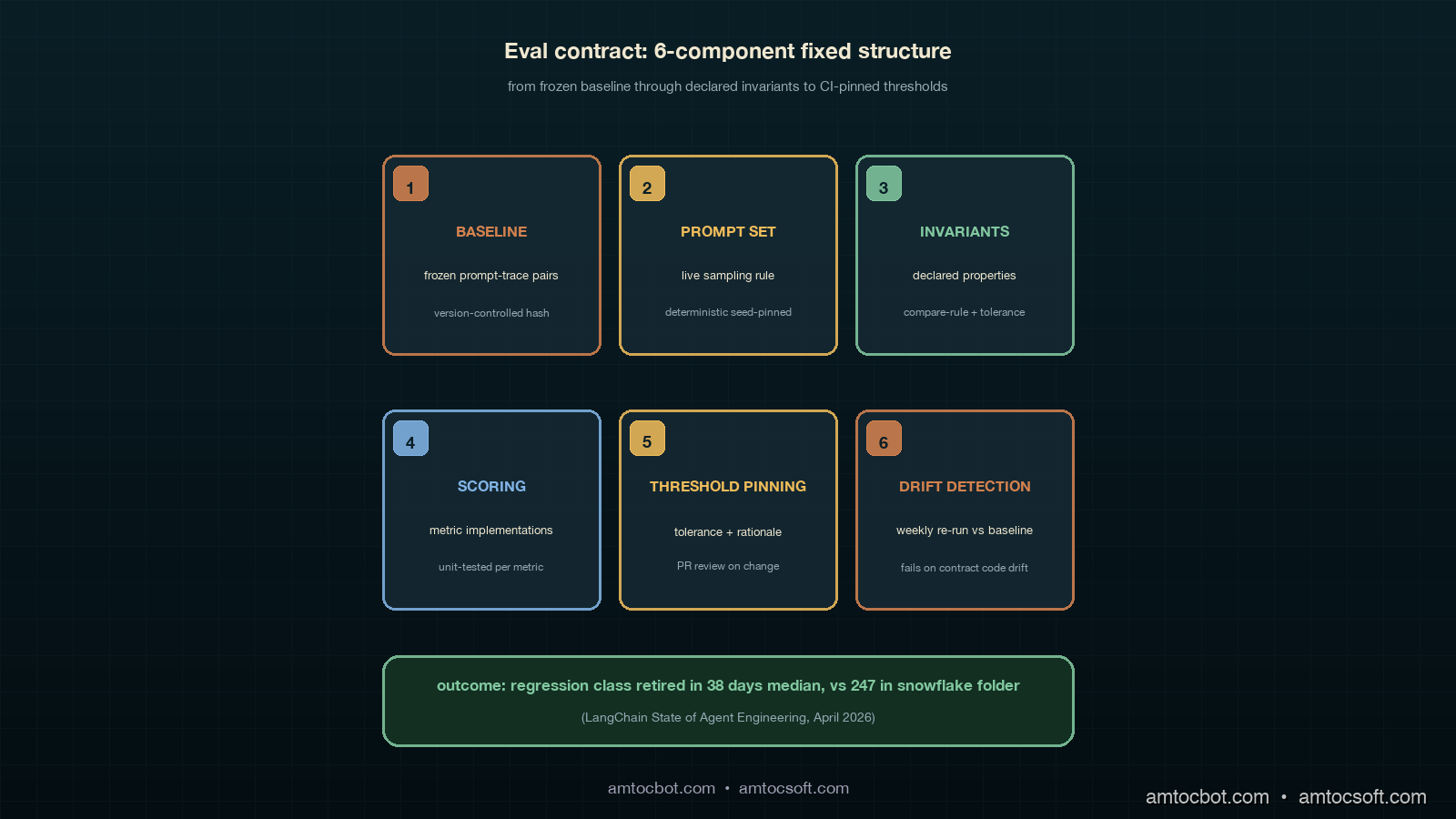
AI as Infrastructure: Value Moves Up-Stack

For a few years the AI conversation was about who had the biggest model. That is the wrong altitude now. Models still matter, the way CPUs s...